10 Major Trends Reshaping the Video Game Market
The global Video Game Market is entering a more connected and digital phase — mobile access widening, cloud reducing hardware dependence, subscriptions changing how libraries are consumed, and AI entering development workflows.
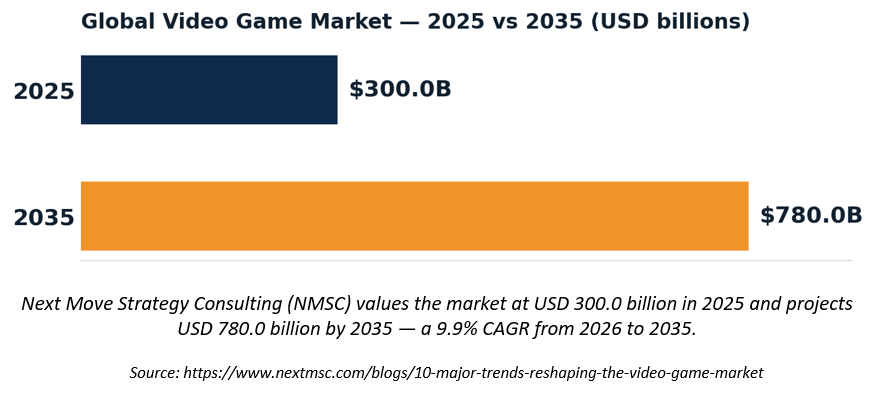
Note on sources: figures are drawn from Next Move Strategy Consulting's Video Games Market model (2025 base year, 2035 forecast) alongside separately sourced figures from the U.S. International Trade Administration (2023). The two use different market definitions and years and should not be treated as interchangeable.
Market Snapshot
|
$184B — global industry value, 2023 (U.S. ITA) |
95% — share of games purchased digitally, 2023 (ITA) |
|
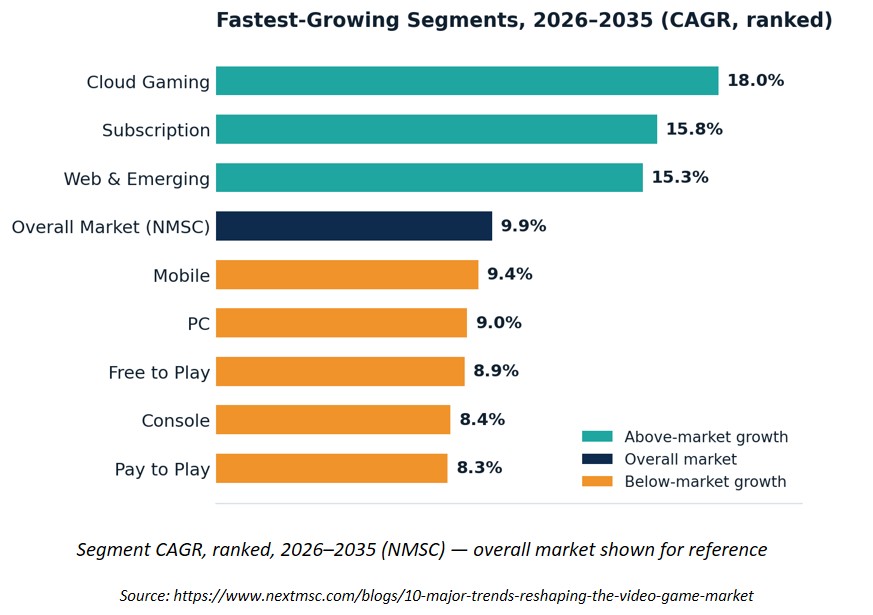
18.0% CAGR — cloud gaming, fastest-growing platform segment (NMSC) |
18.0% CAGR — Middle East & Africa, fastest-growing region (NMSC) |
Ten Trends Changing the Video Game Market
Technology, monetization, and regulation are moving together — reshaping how games are built, sold, and played.
01. Mobile gaming is widening access
$120.0B → $296.4B · 9.4% CAGR (2026–2035)
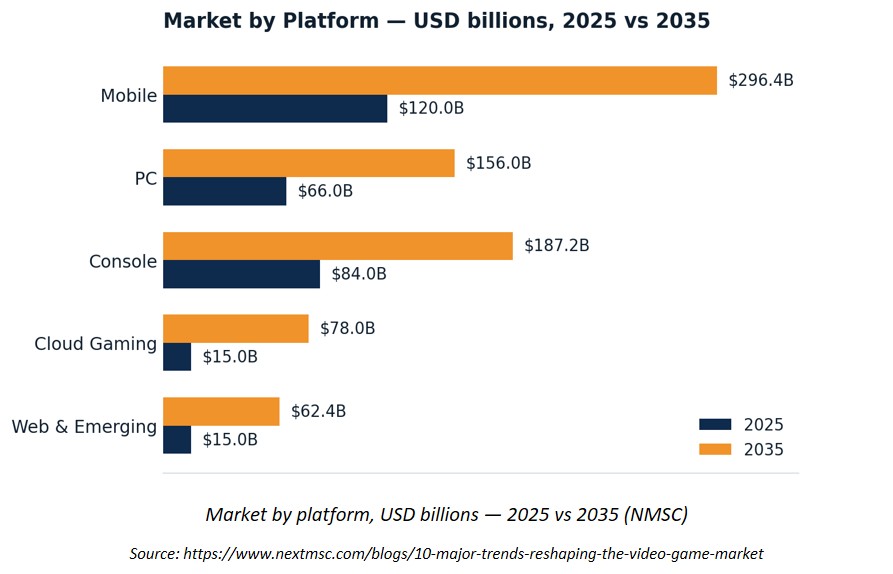
Mobile remains the largest platform segment in the NMSC analysis, generating approximately $120.0 billion in 2025 and projected to reach $296.4 billion by 2035.
Smartphones remove a major hardware barrier: users can download games without a dedicated console or high-end gaming PC. Free-to-play models strengthen adoption further, letting developers attract players through free downloads and monetize through in-game purchases, advertising, and recurring content.
Lower-cost smartphones and expanding digital connectivity are also extending access to regions that previously had fewer gaming options.
02. Cloud gaming is reducing hardware barriers
$15.0B → $78.0B · 18.0% CAGR (2026–2035)
Cloud gaming moves processing from a local device to remote servers, letting players access titles through connected devices instead of running them locally. NMSC projects the segment to grow from $15.0 billion in 2025 to $78.0 billion by 2035 — the fastest-growing platform segment in the report.
Services such as NVIDIA GeForce NOW and Xbox Cloud Gaming illustrate the model, with better broadband and expanding 5G supporting lower-latency play. Infrastructure remains a real constraint: players still need reliable connections, sufficient bandwidth, and access to supported services.
03. Subscription gaming is creating recurring revenue
$45.0B → $195.0B · 15.8% CAGR (2026–2035)
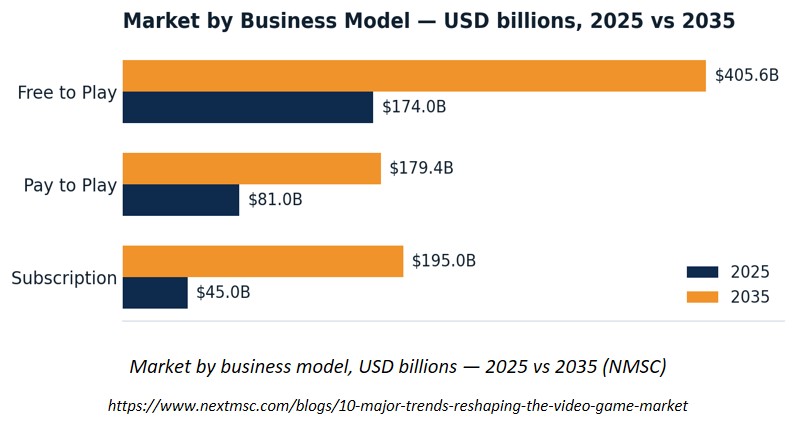
Subscription services change how players buy access to games: instead of purchasing every title separately, users pay recurring fees for larger libraries. NMSC estimates the segment at $45.0 billion in 2025, growing to $195.0 billion by 2035.
Xbox Game Pass and PlayStation Plus show how platform owners package games into recurring services. For players this lowers the upfront cost of trying multiple titles; for publishers it creates revenue that depends less on individual purchases. Subscription also pairs naturally with cloud gaming — both rely on digital delivery, recurring engagement, and broad libraries.
04. AI is changing game development workflows
Artificial intelligence is becoming part of several development processes, with studios applying AI and computer vision to animation, testing, asset workflows, and other production tasks.
Electronic Arts announced on August 7, 2026 that its markerless motion-capture technology uses AI and computer vision to capture movement for more authentic in-game animation — showing how AI can support specific production tasks rather than replace entire creative workflows.
Generative AI can also help teams create early concepts, test ideas, organize assets, and support repetitive work, which may be especially useful for live-service games needing frequent updates. Human direction still matters: gameplay balance, creative choices, testing, writing, and player feedback remain central.
05. Cross-platform gaming is becoming a player expectation
Players increasingly use more than one gaming device, and cross-platform features connect mobile, PC, console, and cloud experiences through shared accounts and online services.
Cross-platform design reduces friction when players switch devices — shared progression lets users carry achievements, purchases, or save data between supported platforms. NMSC identifies cross-platform save synchronization among the innovation strategies used by leading companies, and the trend expands publishers' reach when games are available across multiple platforms.
Platform owners still maintain different hardware and distribution ecosystems, so cross-platform support requires technical integration and careful decisions around monetization and ownership.
06. Free-to-play is reshaping monetization
$174.0B → $405.6B · 8.9% CAGR (2026–2035)
Free-to-play remains the dominant business model in the NMSC analysis, generating about $174.0 billion in 2025 and forecast to reach $405.6 billion by 2035.
The model lowers the initial cost for players; developers then generate revenue through optional purchases, battle passes, cosmetic items, advertising, and other digital content. Live-service games have strengthened the model by giving publishers more opportunities to release content after launch — but it also creates pressure to sustain engagement, since players may leave when content feels repetitive or monetization feels too aggressive.
07. Esports and streaming are expanding gaming communities
Gaming is increasingly consumed as entertainment beyond direct play. Esports competitions and game streaming let audiences watch professional players, creators, and competitive teams, while streaming also helps games attract new players who discover titles through gameplay videos, tutorials, reviews, and live broadcasts.
Esports adds a recurring engagement layer that keeps established games visible between major content releases. The commercial ecosystem spans advertising, sponsorships, subscriptions, events, merchandise, and creator partnerships — and strengthens the social side of gaming as players form communities around teams, creators, genres, and titles.
08. VR and AR are expanding immersive gaming
Virtual and augmented reality offer different ways to connect digital content with player environments. VR places players inside a simulated environment; AR overlays digital content onto the physical world.
Titles such as Beat Saber and Half-Life: Alyx illustrate how VR supports dedicated gameplay experiences, while Pokémon GO demonstrated how AR can connect gameplay with real-world movement and locations. Hardware cost remains an adoption barrier, but as hardware improves, developers keep experimenting with more immersive interfaces and social experiences.
09. New hardware is strengthening connected gaming ecosystems
3.5M+ Switch 2 units sold in first 4 days
Console and hardware upgrades continue to influence the broader gaming ecosystem — new devices can stimulate demand for games, accessories, digital stores, subscriptions, and upgraded software.
Nintendo launched Switch 2 on June 5, 2025 and reported more than 3.5 million units sold worldwide during its first four days. The system also introduced GameChat, combining voice and video communication with screen sharing — showing how new hardware increasingly functions as part of a connected ecosystem rather than an isolated device.
PC gaming follows its own upgrade cycle, with improvements in processors, graphics hardware, displays, and storage continuing to create new performance opportunities.
10. Digital distribution is becoming more open and regulated
95% of games purchased digitally (2023, ITA)
Digital distribution is central to the video game market — the U.S. International Trade Administration reported that 95% of video games were purchased digitally in 2023.
At the same time, regulators are changing how major digital storefronts operate. The European Commission states that the Digital Markets Act requires designated gatekeepers to allow app distribution through alternative app stores or the web under applicable conditions, and gives developers rights related to steering users toward alternative purchasing channels.
These changes can affect mobile game publishers, since storefront rules influence distribution, payments, and customer relationships — and the regulatory environment is still evolving.
Where the Growth Is Coming From
Two views of the same $300.0B → $780.0B forecast: by platform, and by business model. Both sum to the total NMSC market.
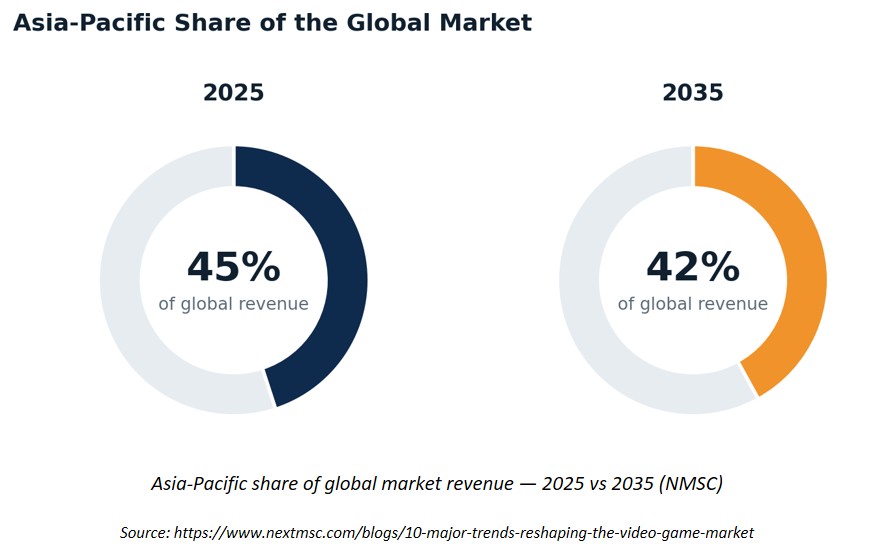
Asia-Pacific Leads; MEA Grows Fastest
|
$58.0B |
$9.5B |
18.0% CAGR |
|
China, 2025 — largest national contributor within Asia-Pacific |
India, 2025 — a mobile-first growth market |
Middle East & Africa, 2026–2035 — fastest-growing region in the NMSC report |
INDUSTRY IMPACT ANALYSIS
How the Value Chain Is Affected
These trends are affecting different parts of the gaming value chain in different ways.
DEVELOPERS
Higher production expectations
Managing rising expectations for graphics, content updates, online features, and cross-platform compatibility, with AI-assisted workflows supporting select production tasks.
PUBLISHERS
Expanding recurring revenue
Growing revenue through subscriptions, free-to-play models, DLC, and live-service strategies — models that reduce reliance on one-time sales but require continuous engagement.
PLATFORM PROVIDERS
Competing beyond hardware
Competing across hardware, digital storefronts, subscriptions, cloud services, and online communities — their role now extends well beyond selling devices.
PLAYERS
More ways to access games
Mobile, cloud, subscriptions, and cross-platform features reduce barriers, while growing digital ecosystems provide larger content libraries.
TECH SUPPL IERS
New infrastructure opportunities
Gaining opportunities in cloud infrastructure, AI tools, connectivity, cybersecurity, graphics, and development software.
Large-scale capital activity is also shaping the industry: Electronic Arts announced that its acquisition by PIF, Silver Lake, and Affinity Partners closed on August 4, 2026, with the company's shares ceasing to trade on Nasdaq.
WEIGHING THE TRADE-OFFS
Pros and Cons of Recent Market Developments
Recent developments are creating new commercial opportunities while adding operational challenges. The central task for companies is balance — adopting new technology without costs outrunning revenue.
|
Market development |
Potential advantages |
Potential challenges |
|
Cloud gaming |
Wider access without premium hardware |
Dependence on connectivity and latency |
|
Subscription gaming |
Recurring revenue and broader game access |
Higher content and retention pressure |
|
AI-assisted development |
Faster support for selected production tasks |
Quality, governance, and creative-control concerns |
|
Cross-platform gaming |
Larger player communities |
Greater technical complexity |
|
Free-to-play |
Lower entry barrier for players |
Monetization and player-trust concerns |
|
VR and AR |
More immersive experiences |
Hardware cost and adoption barriers |
|
Digital distribution |
Fast global delivery |
Storefront dependence and regulatory scrutiny |
|
Next-generation hardware |
Better performance and new experiences |
Upgrade costs for consumers |
REFERENCE DATA
Key Data and Statistics
The NMSC report's consistent view of the 2025 base market and 2035 forecast.
|
Market indicator |
2025 |
2035 |
CAGR |
|
Global Video Game Market |
$300.0B |
$780.0B |
9.9% |
|
Mobile |
$120.0B |
$296.4B |
9.4% |
|
PC |
$66.0B |
$156.0B |
9.0% |
|
Console |
$84.0B |
$187.2B |
8.4% |
|
Cloud Gaming |
$15.0B |
$78.0B |
18.0% |
|
Web and Emerging Platforms |
$15.0B |
$62.4B |
15.3% |
|
Free to Play |
$174.0B |
$405.6B |
8.9% |
|
Pay to Play |
$81.0B |
$179.4B |
8.3% |
|
Subscription |
$45.0B |
$195.0B |
15.8% |
Regional figures should be considered within the definitions and methodology of the NMSC report. Asia-Pacific: ~$135.0B (2025) → ~$327.6B (2035). China: ~$58.0B (2025). India: ~$9.5B (2025). Middle East & Africa: fastest-growing region at an 18.0% CAGR (2026–2035).
What Is the Future of the Video Game Market?
The market is moving toward broader digital access and more connected experiences. Mobile will remain a major share of the market because smartphones provide a relatively accessible entry point, while cloud gaming can extend that access by reducing reliance on high-end local hardware.
Subscription models and free-to-play systems will continue shaping revenue, as publishers focus on recurring engagement rather than relying entirely on individual purchases. AI will likely become more common across selected development workflows, and cross-platform systems can make games more portable across devices and ecosystems. Immersive technologies will keep developing, although hardware cost and adoption remain important constraints.
NMSC forecast: $780.0 billion global market by 2035
Next Steps for Stakeholders
DEVELOPERS
Evaluate cross-platform requirements early in the product lifecycle, and assess where AI tools can support production without weakening creative control or quality.
PUBLISHERS
Compare subscription, free-to-play, and premium models against player behavior and content requirements — recurring models need sustained engagement and reliable post-launch support.
PLATFORM PROVIDERS
Continue improving connectivity, cloud infrastructure, digital storefronts, and ecosystem integration.
TECH SUPPLIERS
Focus on tools that support cloud delivery, AI-assisted development, cybersecurity, graphics performance, and cross-platform deployment.
NEW ENTRANTS
Examine local regulation, payment systems, device availability, connectivity, and player preferences before expanding into new regions.
Frequently Asked Questions
What is the size of the Video Game Market?
NMSC estimates the global Video Game Market at $300.0 billion in 2025, projected to reach $780.0 billion by 2035.
What is the CAGR of the Video Game Market?
The NMSC report projects a 9.9% CAGR from 2026 to 2035.
Which platform leads the Video Game Market?
Mobile is the largest platform segment in the NMSC analysis, generating approximately $120.0 billion in 2025.
Which gaming segment is growing fastest?
Cloud gaming is the fastest-growing platform segment, with an 18.0% CAGR from 2026 to 2035.
Why is subscription gaming growing?
Subscriptions give players access to broader game libraries through recurring payments. NMSC projects this segment to grow from $45.0 billion in 2025 to $195.0 billion by 2035.
Why is mobile gaming important?
Mobile lowers the hardware barrier for many players since smartphones provide direct access to digital games, and benefits from broad app-store distribution and free-to-play monetization.
How is AI changing game development?
AI and computer vision are being applied to selected development tasks such as animation and content workflows — for example, Electronic Arts announced AI-assisted markerless motion capture technology in August 2026.
About the Author
 Debashree Dey
— Debashree Dey is Assistant Manager at Next Move Strategy Consulting, where she supports cross-vertical market content and communications across diverse industries for 6 years. Her professional background includes senior content writing, communications, and published manuscript authorship, with experience developing audience-focused business narratives and maintaining clear, consistent messaging. Her role supports research-led content development and editorial quality across NextMSC publications.
Debashree Dey
— Debashree Dey is Assistant Manager at Next Move Strategy Consulting, where she supports cross-vertical market content and communications across diverse industries for 6 years. Her professional background includes senior content writing, communications, and published manuscript authorship, with experience developing audience-focused business narratives and maintaining clear, consistent messaging. Her role supports research-led content development and editorial quality across NextMSC publications.
About the Reviewer
 Supradip Baul
— Supradip Baul is an accomplished business consultant and strategist with over a decade of rich experience in market intelligence, strategy, technology, and business transformation. His work has included rigorous qualitative and quantitative analysis across multiple industries, helping clients shape investment decisions and long-term roadmaps. Earlier in his career, he was associated with Gartner, where he contributed to industry-leading reports and market share analyses. He has worked with leading global companies and holds an MBA with a dual specialization in Marketing and Finance.
Supradip Baul
— Supradip Baul is an accomplished business consultant and strategist with over a decade of rich experience in market intelligence, strategy, technology, and business transformation. His work has included rigorous qualitative and quantitative analysis across multiple industries, helping clients shape investment decisions and long-term roadmaps. Earlier in his career, he was associated with Gartner, where he contributed to industry-leading reports and market share analyses. He has worked with leading global companies and holds an MBA with a dual specialization in Marketing and Finance.


















Add Comment