Ambient Radio Monitoring Sensors Market: Why Airwaves Need Eyes | NextMSC
Introduction
On May 27, 2026, SeRo Systems announced that EUROCONTROL had awarded it a contract for next-generation GRX radio frequency monitoring receivers, with the total shipment reaching 120 units once the final batch ships in June 2026. The receivers are optimised for L-band spectrum analysis in the 1030 and 1090 MHz bands that air traffic surveillance depends on, and SeRo reported that its EMIT platform for EUROCONTROL already processes up to 5 billion signals daily. When a continental air navigation body orders a fleet of passive receivers to listen to the airwaves rather than transmit on them, ambient radio monitoring stops being a laboratory discipline and becomes infrastructure procurement.
According to Next Move Strategy Consulting's Ambient Radio Monitoring Sensors Market report, the global ambient radio monitoring sensors market was valued at USD 12.50 billion in 2023 and is projected to reach USD 27.72 billion by 2030, growing at a CAGR of 12.1% from 2024 to 2030. NextMSC primary research and analysis defines the market around sensors that detect and measure radio waves from wireless communication, broadcasting and radar systems, segmented into portable and fixed sensors and sold into telecommunications, military and defense, aerospace, environment monitoring and consumer electronics applications.
For More Information: Download FREE Sample on Ambient Radio Monitoring Sensors Market Report
This analysis does not rest on the report alone. It follows six signals published between May and November 2026 by SeRo Systems, EUROCONTROL, the European Union Aviation Safety Agency (EASA), Ofcom, Sierra Leone's National Communications Authority (NatCA), the Federal Communications Commission (FCC), SpaceX and Ericsson, and asks what each means for the ambient radio monitoring sensors market.
Six Signals That Moved the Ambient Radio Monitoring Sensors Market in 2026
EUROCONTROL's 120-Receiver Order: Passive Listening Becomes Network Infrastructure
The SeRo Systems announcement of May 27, 2026 is specific about scale. According to SeRo Systems' press release distributed through PR Newswire, deliveries to EUROCONTROL were completed in January and April 2026, the final batch was scheduled for June, and the total shipment reaches 120 receivers. The contract followed a competitive tender and covers single-band and multi-band GRX receivers for monitoring the 1030 and 1090 MHz bands used by secondary surveillance radar and ADS-B.
SeRo's chief executive, Dr. Matthias Schäfer, tied the order to two pressures: continued frequency congestion and anomalies in surveillance system implementations, and the need to observe, analyse and respond to GPS jamming and spoofing. The company also stated that the contract extends a multi-year partnership with EUROCONTROL covering 1030 and 1090 MHz spectrum protection, including the EMIT platform and the ESIT project for transponder load prediction in European airspace planning.
The mechanism matters for the sensor market. A passive receiver network turns the airwaves into a continuous measurement layer: each added unit extends geographic coverage, and each added frequency band monitored brings a new class of anomaly into view. The order is therefore a volume purchase of fixed sensors, the product type that NextMSC's segmentation tracks alongside portable sensors.
EASA and EUROCONTROL Convene in Brussels: Interference Monitoring Becomes a Safety Process
On July 7 and 8, 2026, EASA and EUROCONTROL held a workshop in Brussels titled Satellite Navigation Under Threat: From Safety Risk to Coordinated Responses, with airline, regulator and European Commission speakers on the programme. The workshop slides published on the EUROCONTROL website outline recommended NOTAM wording for GNSS jamming and spoofing, a proposed new NOTAM code for spoofing, a forthcoming update to the GNSS Manual with guidance on monitoring and mitigation techniques, and a global ICAO event on GNSS resilience planned for the second quarter of 2027.
EASA's own community guidance, posted on July 28, 2026, states that reports of GNSS interference have increased significantly in recent years, that crews across Europe experience jamming and spoofing events of varying duration and intensity, and that high-quality occurrence reporting helps authorities identify trends. A crew report describes what one aircraft experienced, while a ground receiver measures the signal environment itself, the capability that monitoring guidance presupposes.
Ofcom Completes Its Radio Noise Campaign: Measuring the Ambient Floor Indoors
On November 2, 2026, Ofcom published the final report of its long-term radio noise monitoring campaign, which the UK regulator initiated in 2021 to improve understanding of the extent and impact of radio noise. The report states that the campaign substantially expands the limited empirical evidence on radio noise at frequencies above 400 MHz, particularly in indoor environments where electronic devices are dense.
Ofcom reports that the work produced a database supported by a catalogue recording noise source types, densities, activity patterns and proximity to the monitoring systems, and that a model for predicting indoor radio noise was validated against the measurement data. The stated purpose is to support more effective spectrum management decisions.
This is ambient radio monitoring in its literal sense, and the output is a dataset rather than an alarm. A regulator that holds a validated indoor noise model has a baseline against which later deployments, from Wi-Fi to private 5G, can be judged, and every baseline eventually needs sensors to check it.
Sierra Leone Commissions a Mobile Monitoring Vehicle: Emerging Regulators Buy Capability
On October 28, 2026, the National Communications Authority (NatCA) of Sierra Leone formally received spectrum monitoring and quality-of-service equipment at NatCA Tower in Freetown, according to handover coverage published by The Calabash Newspaper on October 30, 2026. The first component is a Mobile Spectrum Monitoring System that integrates TCI monitoring technology into a specially configured vehicle, enabling NatCA engineers to monitor spectrum in real time, analyse radio signals, locate interference sources and investigate suspected unauthorised frequency use.
The coverage links the capability to security operations announced on October 27, 2026 against a suspected international cybercrime network, with the minister stressing the value of systems that can detect suspicious spectrum activity. A national regulator in West Africa has now specified a vehicle-mounted system that pairs measurement with interference location, which is the portable-sensor use case in NextMSC's segmentation. For vendors, the signal is that spectrum monitoring demand extends well beyond the large aviation and defense customers that dominate headlines.
Direct-to-Device Spectrum Opens: The FCC and SpaceX Move on the Same Day
On October 8, 2026, the Federal Communications Commission issued a fact sheet for a Notice of Proposed Rulemaking titled Unleashing Licensed Spectrum for Direct-to-Device, proposing to modernize rules for satellite-to-phone services in licensed spectrum and referring to 13 spectrum bands for Supplemental Coverage from Space, counting the existing bands and the additional bands proposed. The same day, SpaceX announced an agreement to acquire 14 MHz of paired 800 MHz spectrum from Grain Management for Starlink Mobile, which Via Satellite reported is meant to give the service a coverage layer that works indoors.
Both events place new transmitters in bands that terrestrial networks already occupy, and the FCC item contemplates satellite service on a secondary basis in bands allocated to wireless radio services. NextMSC primary research and analysis reads this as a measurement problem: coexistence claims are settled by who is actually radiating in a band, where and at what level, and measuring that is what ambient radio monitoring sensors do.
Ericsson's June 2026 Mobility Report: A Denser, Uplink-Heavy Radio Environment
Ericsson's Mobility Report, released on June 16, 2026, reports that global 5G subscriptions passed 3 billion in the first quarter of 2026, reaching 3.1 billion after 162 million additions in the quarter, and forecasts 6.4 billion by the end of 2031. The report adds that 5G carried 48% of mobile data traffic at the end of 2025, up from 34% a year earlier, and that mobile network data traffic grew 22% between the first quarter of 2025 and the first quarter of 2026.
Two findings bear on monitoring. Ericsson's analysis of 55 service providers found uplink traffic growing faster than downlink at 43 of them, and its medium scenario for AI-related traffic puts uplink traffic three times higher in 2031 than in 2025. Uplink traffic originates at devices rather than at towers, so more radio activity occurs where operators have no measurement point. In SoftBank's slicing trial at the 2026 Formula 1 Japanese Grand Prix, per-minute observability was established because 15-minute KPI intervals could leave a service-level breach undetected until users felt it.
NMSC Strategic Perspective: Monitoring Is Shifting From Periodic Audit to Continuous Measurement
NextMSC primary research and analysis reads these developments as one structural shift. In each case the buyer's problem is not a lack of spectrum data but a lack of continuous, geographically distributed and independently produced measurements: EUROCONTROL needs coverage across Europe, Ofcom needed indoor noise measured over several years, NatCA needs interference located in the field, and operators need minute-level visibility in dense venues.
Our analysis separates the demand into three layers. The first is the fixed sensor layer, in which receiver networks are installed once and produce data for years; the SeRo order is the clearest 2026 example. The second is the portable layer, in which vehicle-mounted and handheld systems locate interference sources; the NatCA handover falls here. The third is the analytics layer, in which measurement becomes models and alerts; Ofcom's validated indoor noise model and SeRo's EMIT platform, which processes up to 5 billion signals daily, both belong to it.
NextMSC's report identifies high installation and maintenance costs, together with data privacy and security concerns, as the main restraints on the market. The 2026 evidence is consistent with buyers accepting those costs when the monitored asset is critical, such as air traffic surveillance or national spectrum enforcement. Regionally, the report identifies Asia-Pacific as the dominant region and North America as a steady-growth region supported by military and defense demand, and the 2026 events add a European regulatory pull and an African regulator-capability pull to that picture.
Section Summary:
Six 2026 signals show buyers moving from occasional spectrum audits toward continuous, networked measurement.
-
SeRo Systems' contract with EUROCONTROL brings the shipment to 120 receivers for the 1030 and 1090 MHz bands.
-
EASA and EUROCONTROL's July 2026 workshop put monitoring and mitigation guidance on the aviation agenda.
-
Ofcom's November 2026 final report delivers a validated indoor radio noise model and database.
-
NatCA's October 2026 handover and the FCC and SpaceX actions of October 8 widen the buyer base and the bands to be watched.
Industry Impact Analysis
Aviation and Aerospace: Interference Becomes a Reportable and Monitorable Risk
EASA's July 28, 2026 guidance treats GNSS interference as a recurring operational condition and asks for consistent occurrence reporting, while the EASA and EUROCONTROL workshop of July 7 and 8 discussed monitoring techniques for the forthcoming GNSS Manual update. SeRo Systems' contract shows where the money lands: receivers tuned to 1030 and 1090 MHz, the frequencies on which surveillance transponders operate. Because the buyer is a safety organisation, purchasing is mandate-driven and tied to milestones such as the ICAO event planned for the second quarter of 2027.
Telecommunications: Uneven 5G Density Shapes Ambient Radio Monitoring Sensors Market Demand
Ericsson's June 2026 report shows how unevenly the radio environment is developing. At the end of 2025, 5G represented 79% of mobile subscriptions in North America, 60% in North East Asia, 54% in Western Europe, 53% in the Gulf Cooperation Council countries and 35% in India, Nepal and Bhutan. Globally, 5G population coverage reached 60% at the end of 2025, and only about 35% of sites outside mainland China had been upgraded to 5G mid-band. A region at 79% penetration needs monitoring for dense, multi-layer networks, while a region at 35% needs it for rollout planning and interference control as 4G subscriptions migrate.
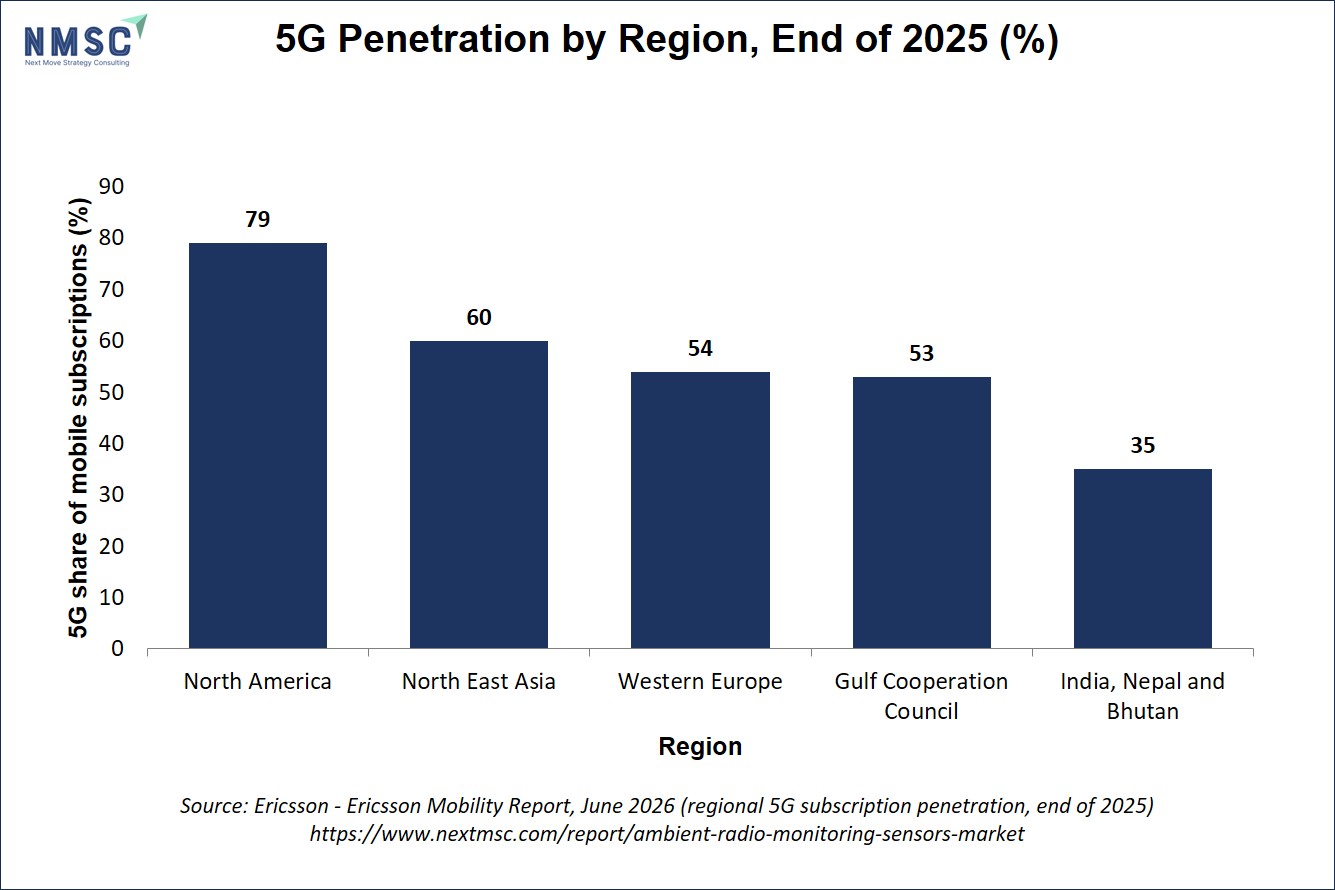
Ericsson's June 2026 Mobility Report records 5G penetration of 79% in North America, 60% in North East Asia, 54% in Western Europe, 53% in the Gulf Cooperation Council countries and 35% in India, Nepal and Bhutan at the end of 2025. Each value is the share of mobile subscriptions in the region that were 5G subscriptions. The chart reproduces the published values without adjustment.
Drones and Counter-UAS: The Detection Industry Is Itself a Transmitter
Ofcom's consultation titled Enabling drone innovation and security, published on July 16, 2026, seeks views on the future use and regulation of spectrum for drones. On November 16, 2026, LNB News reported that Ofcom had published a report on tests of whether drone detection radars operating in the 24 GHz band could cause harmful interference to speed enforcement cameras. Rohde & Schwarz, named in NextMSC's competitive landscape, announced its THORIS counter-drone solution on June 24, 2026. Every new detection technology needs radio frequency verification of its own emissions, which feeds the measurement loop rather than replacing it.
Section Summary:
Aviation regulation, uneven 5G density and drone spectrum policy each create a different monitoring requirement.
-
Aviation demand follows safety mandates and the GNSS resilience agenda.
-
5G penetration ranges from 35% to 79% across the regions Ericsson reports.
-
Ofcom's 24 GHz radar test shows detection equipment can itself raise interference questions.
Pros and Cons of Recent Market Developments
|
Pros |
Cons |
|
Large fixed-receiver orders, such as EUROCONTROL's 120 GRX units, give vendors repeatable volume. |
Public-sector tenders make revenue lumpy, because deliveries arrive in batches, as in SeRo's 2026 shipments. |
|
Regulators such as Ofcom now publish validated noise models and databases that give designers a shared baseline. |
Once a regulatory model is published, buyers may need fewer proprietary measurement campaigns. |
|
Vehicle-mounted systems, such as NatCA's, combine measurement with interference location. |
NextMSC's report identifies installation and maintenance costs as a restraint, and mobile systems add the cost of trained engineers. |
|
With 3.1 billion 5G subscriptions and 22% traffic growth, the radio environment keeps getting denser. |
5G penetration ranges from 35% to 79% by region, which complicates a single global product specification. |
|
The FCC's 13-band direct-to-device proposal and SpaceX's 800 MHz agreement raise coexistence questions that measurement can answer. |
The FCC item is a proposed rulemaking, so final rules and timing may differ from the proposal. |
Key Data & Statistics
The first table collects the quantitative anchors from Ericsson's June 2026 Mobility Report that describe the radio environment ambient sensors observe. The second table lists the dated 2026 events analysed in this blog.
Radio Environment Indicators, Ericsson Mobility Report
|
Indicator |
Value |
Basis |
|
Global 5G subscriptions, Q1 2026 |
3.1 billion |
Reported, Q1 2026 |
|
5G subscriptions added in Q1 2026 |
162 million |
Reported, Q1 2026 |
|
Global 5G subscriptions, end of 2031 |
6.4 billion |
Ericsson forecast |
|
Share of mobile data traffic on 5G, end of 2025 |
48% |
Reported, 2025 |
|
Growth in mobile network data traffic, Q1 2025 to Q1 2026 |
22% |
Reported |
|
Global 5G population coverage, end of 2025 |
60% |
Reported, 2025 |
The table shows a radio environment growing in subscriptions and traffic at once. Traffic growth of 22% in a year, with 5G carrying 48% of mobile data traffic at the end of 2025, means activity on newer, denser network layers is rising quickly.
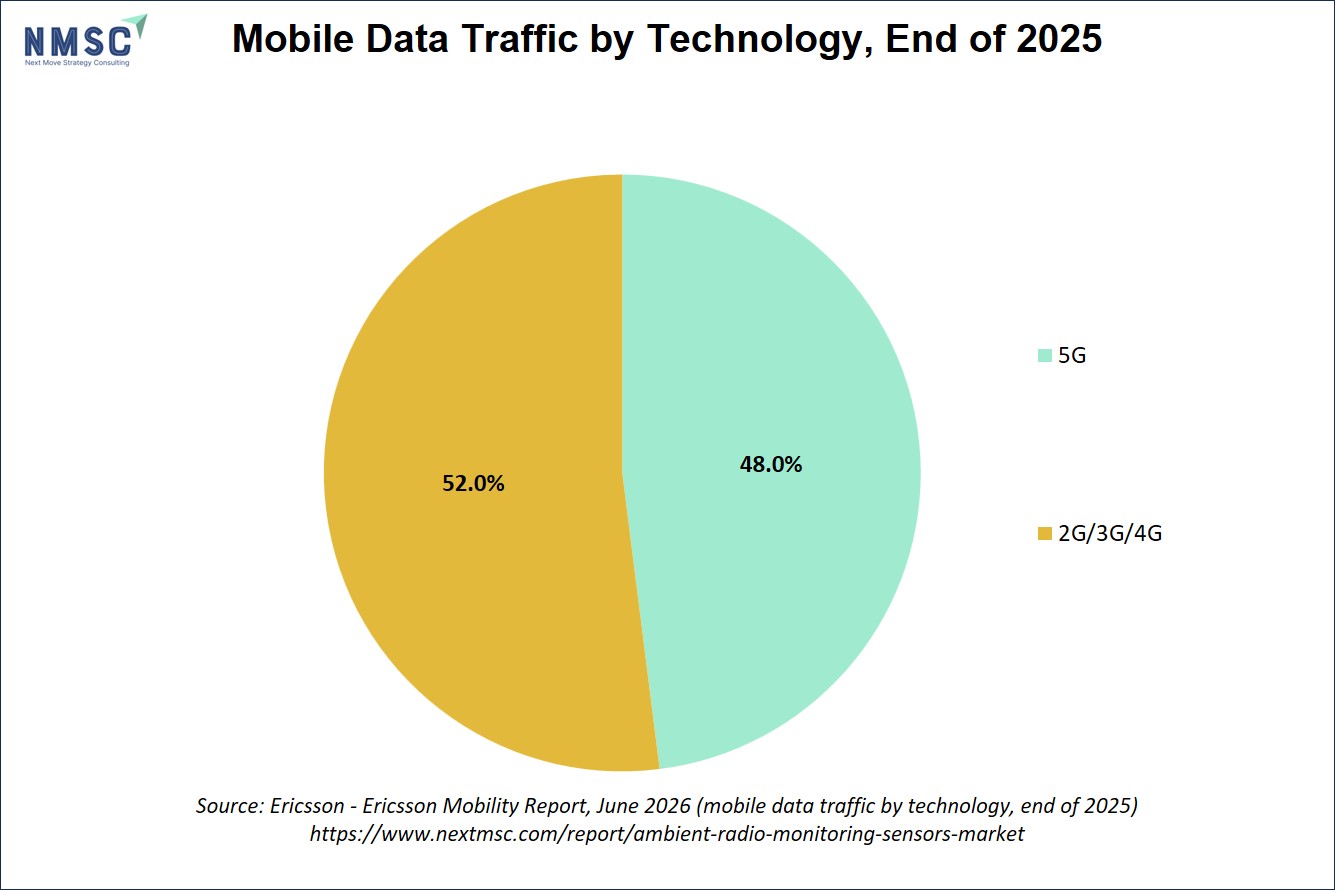
Ericsson's June 2026 Mobility Report states that the share of mobile data traffic carried over 5G rose from 34% to 48% during 2025. The remaining 52.0% was carried over 2G, 3G and 4G networks, calculated as 100% minus the reported 5G share from the same report. Ericsson reports Fixed Wireless Access traffic separately from mobile data traffic.
Dated 2026 Developments in Radio Monitoring
|
Date |
Organisation |
Development |
Relevance to Monitoring |
|
May 27, 2026 |
SeRo Systems and EUROCONTROL |
GRX receiver contract, 120 units |
Fixed receivers, 1030 and 1090 MHz |
|
July 7-8, 2026 |
EASA and EUROCONTROL |
Brussels workshop on GNSS interference |
Monitoring guidance |
|
July 28, 2026 |
EASA |
GNSS interference guidance |
Occurrence reporting |
|
October 8, 2026 |
FCC and SpaceX |
Direct-to-device proposal, 800 MHz agreement |
New transmitters in occupied bands |
|
October 28, 2026 |
NatCA, Sierra Leone |
Mobile monitoring system handover |
Field interference location |
|
November 2, 2026 |
Ofcom |
Final radio noise campaign report |
Validated indoor noise model |
Future Outlook & Forecast
Ambient Radio Monitoring Sensors Market Outlook: What the NextMSC Forecast Assumes
NextMSC primary research and analysis projects the ambient radio monitoring sensors market to rise from USD 12.50 billion in 2023 to USD 27.72 billion by 2030, an increase of USD 15.22 billion and a 2.2-fold expansion at a CAGR of 12.1% over the 2024 to 2030 forecast period. Our forecasting model combines top-down and bottom-up approaches with statistical techniques such as multilinear regression, ARIMA and Monte Carlo simulation.
Four developments will test that trajectory. First, the ICAO global event on GNSS resilience planned for the second quarter of 2027 will show whether monitoring guidance becomes binding. Second, the FCC's direct-to-device rulemaking will determine how many additional bands carry satellite transmissions alongside terrestrial networks. Third, Ofcom's drone spectrum consultation will shape how counter-drone sensing is licensed. Fourth, Ericsson's November Mobility Report, scheduled for November 30, 2026, will update subscription and traffic figures.
There is also a competitive risk to monitor. Ericsson's June 2026 report states that AI-native 6G is expected to bring full support for integrated sensing and communication, with the first commercial 6G services anticipated around 2030. If networks begin to sense their own radio environment, dedicated sensors will need to prove value through independence and measurement accuracy rather than coverage alone.
Section Summary:
The forecast depends on mandates, spectrum rulemaking and the pace at which networks absorb sensing functions.
-
NextMSC projects USD 27.72 billion by 2030 at a 12.1% CAGR from a USD 12.50 billion base in 2023.
-
The ICAO GNSS resilience event, FCC rulemaking and Ofcom's drone consultation are the next regulatory markers.
-
Integrated sensing in 6G, anticipated around 2030, is the main competitive variable.
Next Steps for Stakeholders
The 2026 evidence supports concrete actions for executives and investors in the ambient radio monitoring sensors market.
-
Sensor vendors: build the product plan around fixed receivers, portable locators and analytics, and prepare tender responses for batch delivery schedules like the EUROCONTROL pattern.
-
Network operators: review measurement granularity, since SoftBank's trial showed that 15-minute KPI intervals can miss short breaches that per-minute observability catches.
-
Regulators: treat published noise baselines, such as Ofcom's indoor model, as procurement inputs and specify interference-location capability in mobile systems, as NatCA has done.
-
Investors: track the dated catalysts, namely the ICAO event in the second quarter of 2027, the FCC's direct-to-device rulemaking and the November 30, 2026 Ericsson report, and test vendor claims against NextMSC's three-layer framework.
-
Aerospace and defense buyers: ask whether contracts cover both interference detection and the analytics needed to act on it, since data volume becomes the real workload.
Conclusion
The ambient radio monitoring sensors market is moving from instrument sales toward measurement infrastructure. EUROCONTROL's 120-receiver order, Ofcom's validated indoor noise model, NatCA's mobile monitoring vehicle and the FCC's direct-to-device proposal all show buyers asking for continuous, independent evidence of what is happening in the airwaves. NextMSC's projection of USD 27.72 billion by 2030 at a 12.1% CAGR is consistent with that direction, provided vendors can show accuracy, coverage and analytics value as 6G brings sensing into the network itself.
About the Author
 Priyanshu Das
— Priyanshu Das is SEO Executive at Next Move Strategy Consulting, where he has led on-page and off-page SEO, keyword research, and SEO audits for the firm's B2B market research publications for 2 years. His audit process combines technical crawl analysis, backlink profile review, and competitor keyword gap mapping — using tools including Screaming Frog and Google Search Console — to prioritize fixes by organic search-visibility impact, informed by his own prior in-house and agency SEO experience.
About the Reviewer
 Sanyukta Deb
— Sanyukta Deb is Digital Marketing Team Lead at Next Move Strategy Consulting, where she has led content strategy and technical SEO for the firm's B2B market research publications for over 2 years. Her editorial process translates NextMSC's primary and secondary research — spanning technology, industrial, and consumer sectors — into commercial narratives, backed by search-intent, keyword, and competitive analysis. She brings 5 years of overall experience in digital marketing and content strategy.

















Add Comment