B2B2C Insurance Market: How AI Is Reshaping Embedded Coverage | NextMSC

Introduction
The architecture of insurance distribution is undergoing a structural transformation. Rather than selling directly to consumers, insurers are increasingly routing their products through trusted intermediaries — banks, e-commerce platforms, automotive manufacturers, and fintech operators — who embed coverage seamlessly into the customer journey. This business-to-business-to-consumer (B2B2C) model is no longer a niche strategy; it has become the dominant growth vector for carriers seeking scale without proportional increases in customer acquisition cost.
According to Next Move Strategy Consulting's B2B2C Insurance Market report, the global B2B2C insurance market is projected to reach USD 11.22 billion by 2030, growing at a CAGR of 7.6% from 2024 to 2030. This trajectory reflects a market where the convergence of digital ecosystems, API-enabled distribution, and AI-powered underwriting is fundamentally redefining how insurance reaches the end consumer — not through agents or direct channels, but through the brands consumers already trust.
For More Information: Download FREE Sample on B2B2C Insurance Market Report
When Platforms Become the Policy Window: The Embedded Insurance Inflection Point
ING and Bolttech: A Blueprint for Bank-Led Embedded Distribution
In June 2026, ING — one of Europe's largest retail banking groups — selected bolttech as its strategic partner for insurance and protection solutions, embedding bolttech's API-driven insurance marketplace directly into ING's digital banking infrastructure across multiple markets. This partnership exemplifies the defining structural shift in B2B2C insurance: the bank ceases to be a passive referral channel and becomes an active distribution layer, with insurance products surfaced contextually at the moment of financial decision-making — a mortgage application, a device purchase, a travel booking.
The ING-bolttech arrangement is not an isolated event. It follows bolttech's receipt of a USD 147 million capital raise in 2025 and a strategic investment from Sumitomo Corporation in May 2025, both of which were directed at scaling the company's embedded insurance platform across 37 countries. The capital concentration around scalable orchestration platforms — rather than individual product insurers — signals that the market is rewarding infrastructure builders who can connect carriers to distribution partners at speed and at scale.
Allianz and Standard Chartered: Fifteen Years of Bancassurance Commitment Across Asia
Simultaneously, Allianz and Standard Chartered Bank formalized a 15-year bancassurance agreement for the distribution of Allianz's general insurance products across seven Asian markets, including Hong Kong and Singapore, with projected premium volumes of USD 200–300 million. Standard Chartered has redesigned its digital bancassurance model to bring the entire insurance journey — from quote to policy issuance — within the banking channel, eliminating the friction that historically caused consumers to abandon insurance purchases initiated outside their primary financial relationship.
This 15-year commitment is strategically significant: it locks in distribution economics for both parties across a region where, as the Allianz Global Insurance Report 2026 notes, Asia's life insurance premiums grew by 9.9% in 2025 — with China alone expanding by 11.4% — making it the global industry's principal growth engine.
AI as the Underwriting Engine Behind B2B2C Scale
The B2B2C model's commercial viability depends on the ability to underwrite and price policies in real time, at the point of sale, without human intervention. Artificial intelligence is the mechanism making this possible at scale. According to Gallagher Re's Q1 2026 Global InsurTech Report, global InsurTech funding reached USD 1.63 billion in Q1 2026, with AI-centered companies claiming a record 95% of that total — a concentration that reflects where the industry believes durable competitive advantage will be built. By Q2 2026, global InsurTech funding had surged further to USD 2.44 billion — the highest quarterly total since Q2 2022.
AIG's deployment of a generative AI-powered underwriting assistant — built in partnership with Anthropic and Palantir — demonstrates the operational impact: the system ingests and prioritizes every new excess and surplus submission, enabling review of additional policies without adding underwriting headcount. For B2B2C operators, where the intermediary partner may generate thousands of micro-insurance transactions daily, this kind of automated underwriting capacity is not a competitive advantage — it is a prerequisite for participation.
In Europe, Allianz and AXA are deploying agentic AI capabilities in claims processing, while Zurich Financial Services in Australia has partnered with the University of Technology Sydney to implement an AI tool that reduces life insurance application processing time for customers with mental health disclosures from 22 days to less than a day.
NMSC Strategic Perspective: The Ecosystem Orchestration Imperative
NextMSC primary research and analysis identifies ecosystem orchestration as the integration model with the highest long-term revenue potential within the B2B2C insurance landscape. Unlike light-touch referral arrangements — where the intermediary merely directs consumers to an insurer's own platform — ecosystem orchestration embeds the insurer's product logic, pricing engine, and policy issuance capability directly within the partner's digital infrastructure via APIs. The ING-bolttech and Allianz-Standard Chartered deals both exemplify this model.
The commercial logic is compelling: intermediaries operating at scale — a bank with 40 million retail customers, an e-commerce platform processing 10 million daily transactions — can deliver insurance penetration rates that no direct-to-consumer campaign could replicate at equivalent cost. NMSC's analysis indicates that the digital ecosystem distribution channel — encompassing e-commerce, fintech, service platforms, and OEM manufacturers — is the fastest-growing segment within the B2B2C insurance market, driven by the structural shift of consumer financial activity toward mobile-first, platform-native environments.
Section Summary: The B2B2C insurance market is being reshaped by three simultaneous forces: the formalization of long-term bancassurance partnerships (Allianz-Standard Chartered), the emergence of API-native embedded insurance platforms (bolttech-ING), and the industrialization of AI-driven underwriting that makes real-time policy issuance at the point of sale commercially viable.
Key Takeaways:
-
ING's selection of bolttech as its embedded insurance partner (June 2026) establishes a replicable model for bank-led B2B2C distribution across Europe.
-
Allianz and Standard Chartered's 15-year bancassurance deal across seven Asian markets reflects the long-term capital commitment now flowing into B2B2C distribution infrastructure.
-
AI-centered companies captured 95% of USD 1.63 billion in global InsurTech funding in Q1 2026, confirming that automated underwriting is the foundational technology layer for B2B2C scalability.
-
NMSC analysis identifies ecosystem orchestration — full API integration of insurer capabilities within partner platforms — as the highest-value integration model in the B2B2C spectrum.
Industry Impact Analysis
The Regulatory Recalibration: Consumer Duty, AI Governance, and the Embedded Product Scrutiny
The rapid expansion of B2B2C insurance distribution has drawn proportionate regulatory attention. In the United Kingdom, the Financial Conduct Authority's Consumer Duty — now firmly embedded in the FCA's 2025–2030 regulatory strategy — is reshaping how insurers design, communicate, and distribute products through intermediary channels. The FCA's 2026 regulatory priorities for the insurance sector are organized around four themes: improving consumer understanding of products, ensuring fair value, supporting consumer access, and strengthening claims handling. For B2B2C operators, the Consumer Duty creates a specific compliance obligation: the intermediary partner (B2) cannot be treated as a passive conduit — it bears responsibility for ensuring that the insurance product embedded in its platform delivers genuine value to the end consumer.
In the United States, the National Association of Insurance Commissioners (NAIC) is prioritizing new frameworks for artificial intelligence, data governance, and risk management in 2026, as standard-setting bodies work to close coverage gaps and establish real-time risk assessment models. The NAIC's focus on AI governance is directly relevant to B2B2C operators: when an AI model determines in real time whether a consumer purchasing a smartphone on an e-commerce platform qualifies for device protection insurance, the model's fairness, explainability, and accuracy become regulatory questions, not merely technical ones.
The Global Premium Expansion Context
The B2B2C market's 7.6% CAGR projection from NMSC primary research and analysis sits within a broader global insurance expansion. According to the OECD's Global Insurance Market Trends preliminary 2025 data (published June 2026), non-life insurance gross premiums written grew by 8.5% in nominal terms and 4.2% in real terms in 2025, while life insurance premiums grew by 11.5% nominally and 7.0% in real terms — the strongest life insurance growth performance in several years, driven by demand for unit-linked products amid the MSCI World Index's 21.1% gain in 2025.
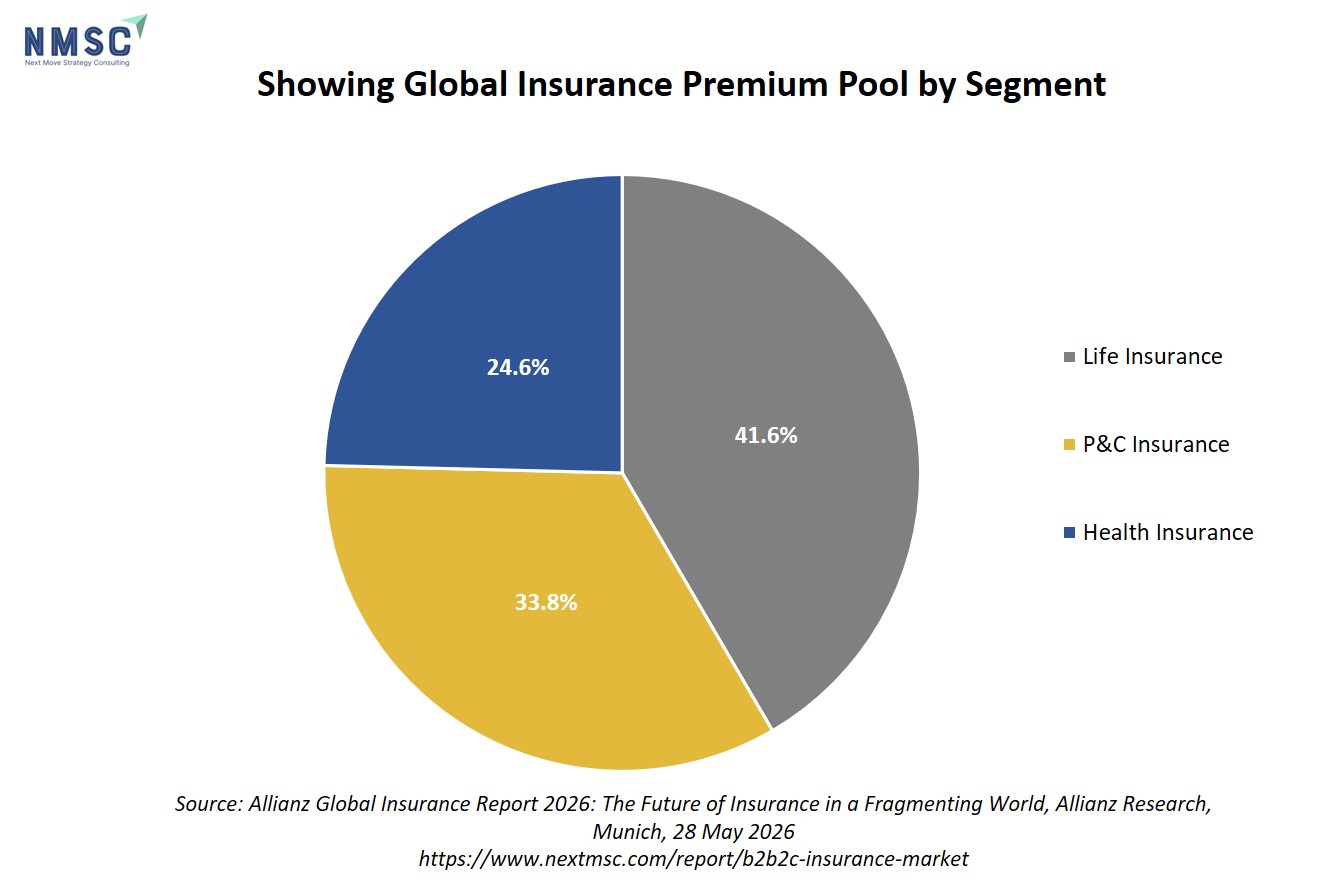
The Allianz Global Insurance Report 2026 places this in a ten-year context: the global insurance industry grew by 7.1% to EUR 6.9 trillion in 2025, adding EUR 456 billion to the global premium pool, and is projected to grow at an annual rate of 5.3% over the next decade — with health insurance, at 6.7% annual growth, representing the most dynamic segment. This macro expansion creates the addressable market into which B2B2C distribution channels are inserting themselves — particularly in health and non-life segments where the purchase decision is increasingly made at the point of a related transaction rather than through a standalone insurance-buying journey.
Europe's Institutional Weight and Asia's Growth Velocity
Europe's dominance in the B2B2C insurance market is underpinned by structural factors that extend beyond regulatory maturity. Insurance Europe reports that the European insurance industry is one of Europe's largest institutional investors, with close to €9.5 trillion invested in the economy. This capital base funds the product innovation, technology investment, and partnership infrastructure that makes sophisticated B2B2C distribution architectures commercially viable. Wakam's April 2024 FCA and PRA approval for its UK subsidiary — enabling white-label partnerships across Europe — is one example of how European embedded insurers are building the regulatory infrastructure to operate at continental scale.
Asia-Pacific, meanwhile, is the fastest-growing region in the B2B2C insurance market, according to NMSC primary research and analysis. The Allianz Global Insurance Report 2026 confirms that Asia has re-emerged as the global life insurance industry's principal growth engine, with life premiums rising 9.9% in 2025. In markets where health insurance penetration remains below 1% — as is the case in almost all Asian markets outside Japan and South Korea — the B2B2C model's ability to reach consumers through existing digital relationships (banking apps, e-commerce platforms, telecom operators) represents the most cost-effective path to closing the protection gap.
The Cybersecurity Constraint on Digital B2B2C Expansion
The same API connectivity and cloud infrastructure that enables B2B2C insurance distribution also expands the attack surface for cyber threats. The Deloitte 2026 Global Insurance Outlook notes that high-profile breaches and ransomware attacks continue to affect the insurance sector, with compromised customer information generating legal liability for carriers and intermediaries alike. For B2B2C operators, the risk is compounded: a data breach at the intermediary partner level can expose the insurer's policyholder data, creating regulatory and reputational consequences that the insurer cannot fully control. This dynamic is accelerating investment in cybersecurity governance frameworks specifically designed for multi-party insurance distribution architectures.
Section Summary: The B2B2C insurance market's expansion is occurring within a tightening regulatory environment — particularly in the UK and US — that is raising the compliance bar for embedded product distribution. Simultaneously, the global premium pool's continued growth and Asia's structural underinsurance create the demand conditions that justify the infrastructure investment B2B2C distribution requires.
Key Takeaways:
-
The FCA's Consumer Duty places explicit value-delivery obligations on B2B2C intermediaries, not just on the underlying insurer — a compliance shift that will require contractual restructuring across existing distribution partnerships.
-
NAIC's 2026 AI governance framework will establish the regulatory parameters within which automated B2B2C underwriting models must operate in the US market.
-
Global non-life premiums grew 8.5% nominally in 2025 (OECD), providing the macro tailwind into which B2B2C distribution channels are expanding.
-
Asia's sub-1% health insurance penetration in most markets represents the largest addressable opportunity for B2B2C distribution models that can reach consumers through existing digital relationships.
Global Insurance Premium Growth by Segment — 2025 Preliminary Data
|
Insurance Segment |
Nominal Premium Growth (2025) |
Real Premium Growth (2025) |
Key Driver |
|
Life Insurance |
+11.5% |
+7.0% |
Demand for unit-linked products; MSCI World Index +21.1% in 2025 |
|
Non-Life / P&C Insurance |
+8.5% |
+4.2% |
Continued inflationary adjustment of policy prices; dynamic automotive markets |
|
Health Insurance (Global) |
+12.3% |
— |
Ageing populations, rising medical costs, pressure on public healthcare systems |
|
Health Insurance (North America) |
+14.9% |
— |
Medical inflation acceleration; US accounts for >70% of global health premiums |
|
Life Insurance (Asia — China) |
+11.4% |
— |
Demographic ageing, high savings rates, limited public pension coverage |
Future Outlook & Forecast
The USD 11.22 Billion Destination and the Forces Shaping the Path
According to Next Move Strategy Consulting's B2B2C Insurance Market analysis, the market is projected to reach USD 11.22 billion by 2030 at a 7.6% CAGR. This trajectory is supported by three structural forces that NMSC primary research and analysis identifies as durable rather than cyclical.
-
First, the digitalization of financial services is permanently expanding the surface area for embedded insurance. As consumers conduct more of their financial lives within banking apps, e-commerce platforms, and super-apps, the number of contextually appropriate moments to offer insurance coverage multiplies. A consumer applying for a home loan within a banking app is a natural candidate for property insurance; a consumer purchasing a laptop on an e-commerce platform is a natural candidate for device protection. The B2B2C model is the only distribution architecture that can capture these moments at scale.
-
Second, the global protection gap is creating regulatory and commercial pressure to expand insurance access. The Deloitte 2026 Global Insurance Outlook identifies a USD 183 billion global protection gap — the difference between economic losses from catastrophic events and insured losses. B2B2C distribution, by embedding insurance into existing consumer relationships rather than requiring consumers to initiate a standalone insurance purchase, is the most scalable mechanism for closing this gap — particularly in emerging markets where insurance penetration remains structurally low.
-
Third, the economics of AI-driven underwriting are improving the unit economics of micro-insurance products. Deloitte research projects that fee-based revenue from AI-enabled insurance services will grow to USD 49.5 billion by 2030, and that AI-driven fraud analytics could save P&C insurers up to USD 160 billion by 2032. As the cost of underwriting a single policy falls, the minimum viable premium for an embedded insurance product decreases — opening product categories (gadget insurance, single-trip travel cover, gig-worker income protection) that were previously uneconomical to distribute through traditional channels.
The Allianz Global Insurance Report 2026 projects that the global insurance premium pool will grow by EUR 5.26 trillion over the next ten years, with more than half of the additional life insurance premium pool generated in Wider Asia. For B2B2C operators with established distribution infrastructure in Asian markets — as Allianz now has through its Standard Chartered partnership — this represents a structural tailwind that will compound over the forecast period.
The Blockchain and Open Insurance Horizon
Brazil's Open Insurance framework — which allows customers to share data across insurers, enabling personalized offerings and increased competition — is an early indicator of the regulatory direction in which multiple markets are moving. Open insurance frameworks, by standardizing the data-sharing protocols between insurers and intermediaries, reduce the technical friction of establishing new B2B2C partnerships — potentially accelerating the pace at which new distribution relationships can be formed and scaled.
Section Summary: The B2B2C insurance market's path to USD 11.22 billion by 2030 is supported by the permanent digitalization of financial services distribution, the commercial imperative to close a USD 183 billion global protection gap, and the improving unit economics of AI-driven underwriting that make micro-insurance products viable at scale.
Key Takeaways:
-
NMSC projects the global B2B2C insurance market will reach USD 11.22 billion by 2030 at a 7.6% CAGR, driven by digital ecosystem distribution and embedded insurance integration models.
-
The global insurance premium pool is projected to grow by EUR 5.26 trillion over the next decade, with Asia generating more than half of the additional life insurance premium volume (Allianz Global Insurance Report 2026).
-
AI-driven fraud analytics could save P&C insurers up to USD 160 billion by 2032 (Deloitte), improving the unit economics of embedded micro-insurance products.
-
Open insurance regulatory frameworks — pioneered in Brazil and being evaluated in multiple markets — will reduce the technical friction of establishing new B2B2C distribution partnerships.
Next Steps for Stakeholders
For Insurance Carriers (B1):
Prioritize API readiness over product breadth. The ING-bolttech and Allianz-Standard Chartered deals demonstrate that the carriers winning B2B2C distribution partnerships are those whose policy issuance, pricing, and claims systems can be integrated into a partner's digital infrastructure without requiring the partner to rebuild its own technology stack. Carriers that have not yet completed core system modernization should treat it as a prerequisite for B2B2C participation, not a parallel initiative.
For Intermediary Partners (B2 — Banks, Retailers, OEMs, Fintechs):
Conduct a rigorous value-delivery audit before embedding any insurance product. The FCA's Consumer Duty and equivalent regulatory frameworks in other jurisdictions place explicit responsibility on the intermediary for ensuring that embedded products deliver genuine value to end consumers. Intermediaries that treat insurance as a revenue add-on without assessing product-market fit will face regulatory scrutiny and reputational risk that outweighs the commission income.
For Institutional Investors:
The Gallagher Re Q2 2026 data — USD 2.44 billion in InsurTech funding, the highest quarterly total since Q2 2022 — confirms that capital is returning to the embedded insurance infrastructure layer. Investment theses should distinguish between AI-native underwriting platforms (capturing 95% of current funding) and distribution orchestration platforms (bolttech, Qover) — the latter category is currently underfunded relative to its strategic importance in the B2B2C value chain.
For C-Level Executives Across All Segments:
The 40% of employers willing to change group insurance carriers if their carrier cannot connect to their benefits technology platform (Life Insurance Marketing and Research Association survey, cited in Deloitte 2026 Global Insurance Outlook) is a leading indicator of what will happen across all B2B2C segments: intermediaries will route business to carriers whose technology integrates cleanly, regardless of product or price differentials. Technology integration capability is becoming a primary selection criterion, not a secondary one.
Conclusion
The B2B2C insurance market's progression from USD 6.72 billion in 2023 toward USD 11.22 billion by 2030 is not a function of organic premium inflation — it is a function of structural channel migration. Insurance is moving from a product consumers seek out to a protection layer that appears within the digital experiences they already inhabit. The ING-bolttech partnership, the Allianz-Standard Chartered bancassurance commitment, and the AI-driven underwriting investments by AIG, Allianz, and AXA are not isolated corporate decisions; they are coordinated signals that the industry's most sophisticated operators have concluded that B2B2C distribution is the primary growth architecture for the decade ahead.
For carriers, intermediaries, and investors, the strategic question is no longer whether to participate in B2B2C insurance distribution — it is whether their technology infrastructure, regulatory compliance posture, and partnership governance frameworks are mature enough to participate at the scale the market now demands. Those who have built the foundational capabilities will find the next five years highly rewarding. Those who have not will find themselves increasingly dependent on distribution partners who have already made their technology choices.
About the Author
 Sanyukta Deb
— Sanyukta Deb is Digital Marketing Team Lead at Next Move Strategy Consulting, where she has led content strategy and technical SEO for the firm's B2B market research publications for over 2 years. Her editorial process translates NextMSC's primary and secondary research — spanning technology, industrial, and consumer sectors — into commercial narratives, backed by search-intent, keyword, and competitive analysis. She brings 5 years of overall experience in digital marketing and content strategy.
Sanyukta Deb
— Sanyukta Deb is Digital Marketing Team Lead at Next Move Strategy Consulting, where she has led content strategy and technical SEO for the firm's B2B market research publications for over 2 years. Her editorial process translates NextMSC's primary and secondary research — spanning technology, industrial, and consumer sectors — into commercial narratives, backed by search-intent, keyword, and competitive analysis. She brings 5 years of overall experience in digital marketing and content strategy.
About the Reviewer
 Debashree Dey
— Debashree Dey is Assistant Manager at Next Move Strategy Consulting, where she supports cross-vertical market content and communications across diverse industries for 6 years. Her professional background includes senior content writing, communications, and published manuscript authorship, with experience developing audience-focused business narratives and maintaining clear, consistent messaging. Her role supports research-led content development and editorial quality across NextMSC publications.
Debashree Dey
— Debashree Dey is Assistant Manager at Next Move Strategy Consulting, where she supports cross-vertical market content and communications across diverse industries for 6 years. Her professional background includes senior content writing, communications, and published manuscript authorship, with experience developing audience-focused business narratives and maintaining clear, consistent messaging. Her role supports research-led content development and editorial quality across NextMSC publications.


















Add Comment