Botulinum Toxin Market: Key Trends, Bold Approvals & Forecasts for 2026
Introduction
Few medical innovations have demonstrated the commercial durability and clinical versatility of botulinum toxin. What began as a treatment for strabismus in the 1970s has evolved into one of the most widely administered injectable therapies in the world — spanning chronic migraine management, cervical dystonia, overactive bladder, spasticity, and an expanding portfolio of aesthetic indications. Today, the global Botulinum Toxin Market stands at a pivotal moment, shaped by record-breaking procedure volumes, landmark regulatory milestones, and an intensifying enforcement environment that is simultaneously protecting and redefining the competitive landscape.
According to Next Move Strategy Consulting (NMSC), the global botulinum toxin market is projected to reach USD 11.68 billion by 2030, advancing at a CAGR of 8.5% over the forecast period. For institutional investors, pharmaceutical executives, and healthcare system leaders, the forces driving this trajectory — from a fifth aesthetic indication for the world's most recognized neurotoxin to a sweeping FDA crackdown on counterfeit products — demand careful strategic attention.
For More Information: Download FREE Sample on Botulinum Toxin Market Report
Beyond Wrinkles: The New Commercial Frontiers of the Botulinum Toxin Market
AbbVie's Fifth Aesthetic Indication: A Landmark Regulatory Development
The most consequential development in the botulinum toxin market in recent months arrived on August 4, 2026, when Allergan Aesthetics, an AbbVie company (NYSE: ABBV), announced that the U.S. Food and Drug Administration had accepted for review its supplemental Biologics License Application (sBLA) for BOTOX® Cosmetic (onabotulinumtoxinA) for the temporary improvement in the appearance of marked to very marked masseter muscle prominence (MMP) associated with masseter muscle activity in adults.
If approved, BOTOX® Cosmetic would become the first and only neurotoxin indicated for masseter muscle prominence in the United States, and would expand its portfolio to a fifth aesthetic indication — a milestone that would further consolidate AbbVie's dominant position in the global aesthetic injectables market.
The sBLA submission is supported by two Phase 3 clinical studies (M21-416 and M21-417), both of which met their primary endpoints and demonstrated statistically significant improvements in the severity of masseter muscle prominence compared with placebo (p=0.0046 and p=0.0014, respectively). Patient satisfaction data was equally compelling: twice as many patients treated with BOTOX® Cosmetic reported being "Very Satisfied" or "Satisfied" compared with placebo, with no new safety signals identified.
The clinical and commercial significance of this development extends well beyond a single indication. MMP addresses a growing patient interest in non-surgical facial contouring — specifically, achieving improved jawline definition and a more slimming lower face profile without surgical intervention. As facial assessment in aesthetic medicine continues to evolve beyond individual treatment areas toward holistic lower-face management, this indication positions BOTOX® Cosmetic at the center of one of the fastest-growing segments in aesthetic medicine.
The Global Procedure Surge: ISAPS 2024 Data Confirms Record Demand
The regulatory momentum surrounding botulinum toxin is anchored in an undeniable commercial reality: global demand for aesthetic and therapeutic procedures is at an all-time high. According to the International Society of Aesthetic Plastic Surgery (ISAPS) 2024 Global Survey, released at the ISAPS Olympiad World Congress in Singapore in June 2025, nearly 38 million aesthetic procedures were performed globally in 2024 — comprising more than 17.4 million surgical and 20.5 million non-surgical procedures. This represents an overall increase of 42.5% from 2020, underscoring the structural, long-term nature of demand growth in this sector.
Botulinum toxin retained its position as the most common non-surgical procedure for both men and women and across all age groups, with 7.8 million procedures performed by plastic surgeons worldwide in 2024. Hyaluronic acid (filler) ranked second, with 6.3 million procedures — a 5.2% increase from the prior year.
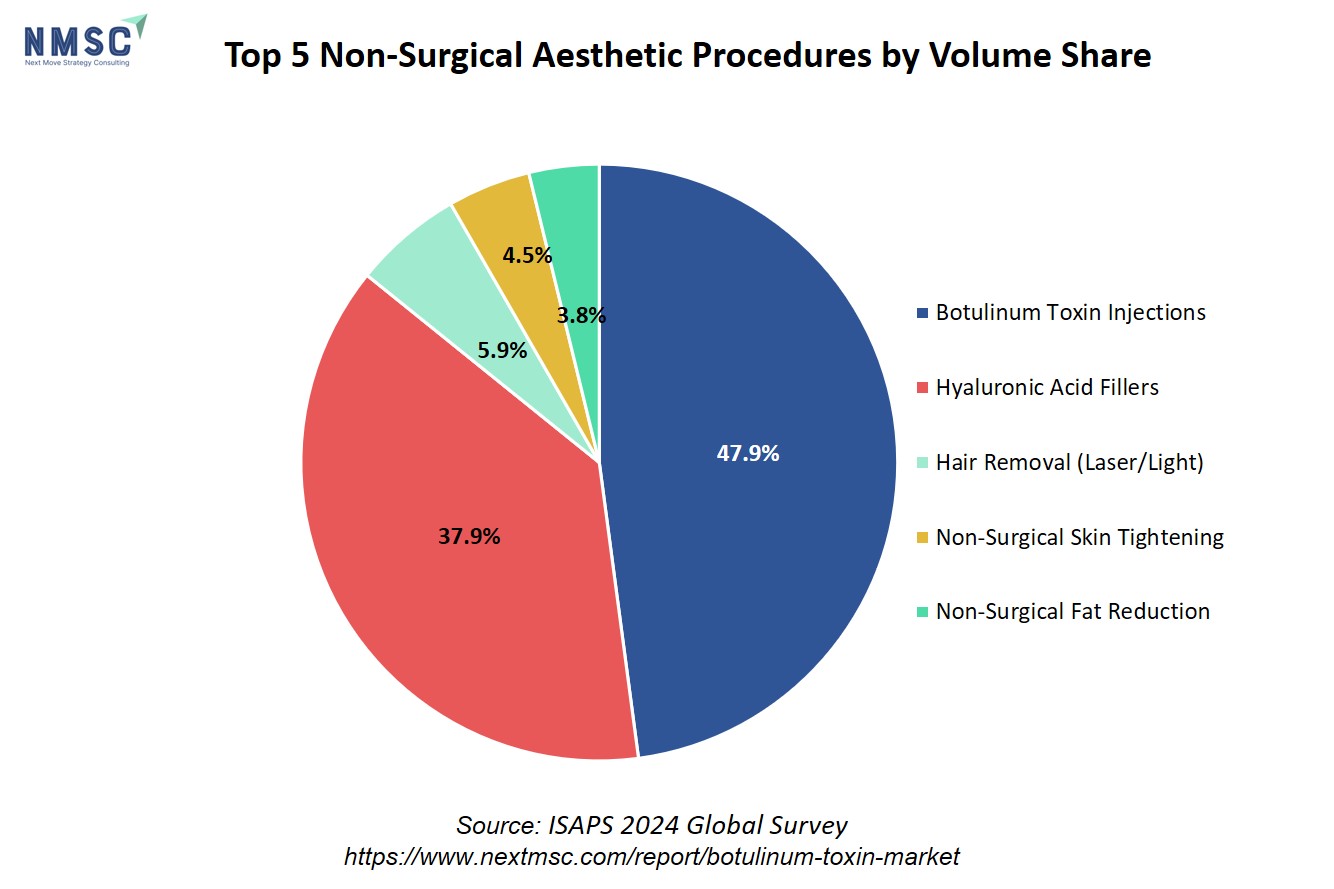
Geographically, the United States performed the most procedures globally, with over 6.1 million, followed by Brazil with 3.1 million and Japan in third place. Botulinum toxin injectables were most popular among patients aged 35–50, who accounted for 47.0% of total botulinum toxin procedures in 2024.
NMSC Strategic Perspective: A Market at a Dual Inflection Point
From Next Move Strategy Consulting's analytical standpoint, the botulinum toxin market is experiencing a dual inflection point: on one axis, the expansion of approved indications — both aesthetic and therapeutic — is broadening the addressable patient population and creating new revenue streams for established players. On the other axis, the proliferation of counterfeit and unapproved products is creating a regulatory and reputational risk environment that is simultaneously constraining market access for bad actors and reinforcing the premium positioning of FDA-approved, clinically validated products.
NMSC identifies three primary structural growth drivers: (1) the sustained consumer preference for minimally invasive, non-surgical aesthetic procedures over traditional surgical alternatives; (2) the accelerating pace of regulatory approvals for new botulinum toxin indications across both aesthetic and therapeutic applications; and (3) the demographic tailwind of an aging global population with rising disposable income and growing awareness of both cosmetic and therapeutic botulinum toxin applications. The convergence of these forces is expected to sustain the market's 8.5% CAGR through 2030.
Section Summary: The botulinum toxin market is being propelled by a landmark FDA sBLA acceptance for BOTOX® Cosmetic's fifth aesthetic indication, record global procedure volumes confirmed by ISAPS 2024 data, and a structural shift toward non-surgical facial contouring. These developments collectively signal a market that is expanding both in breadth of application and depth of patient demand.
Key Takeaways:
-
On August 4, 2026, the FDA accepted AbbVie's sBLA for BOTOX® Cosmetic for masseter muscle prominence — a potential fifth aesthetic indication supported by two Phase 3 studies with statistically significant results.
-
ISAPS 2024 data confirms 7.8 million botulinum toxin procedures performed by plastic surgeons globally — the most common non-surgical procedure worldwide for the third consecutive year.
-
Global aesthetic procedures reached nearly 38 million in 2024, a 42.5% increase from 2020, confirming the structural, long-term nature of demand growth.
-
The 35–50 age group accounts for 47.0% of all botulinum toxin procedures, representing the core commercial demographic for market participants.
Industry Impact Analysis
The FDA's Enforcement Action: Protecting Market Integrity
The commercial growth of the botulinum toxin market has attracted a parallel surge in counterfeit and unapproved products — a development that the FDA moved decisively to address. On November 5, 2025, the FDA issued 18 warning letters to owners of websites illegally marketing unapproved and misbranded botulinum toxin products. FDA Commissioner Marty Makary, M.D., M.P.H. stated: "Unapproved and misbranded Botox products carry serious health risks. Today we're taking action to protect American consumers and prevent online entities from selling these dangerous products."
The FDA noted that products purchased from unauthorized sources may be unapproved, misbranded, adulterated, counterfeit, contaminated, improperly stored and transported, ineffective, and/or unsafe — with adverse events including botulism symptoms that can lead to difficulty breathing and death.
For legitimate market participants, this enforcement action carries significant positive implications. It reinforces the value of regulatory compliance as a competitive differentiator, elevates patient safety awareness, and creates a more level playing field for FDA-approved products competing against illegally marketed alternatives. For institutional investors, it signals that the FDA is actively monitoring and enforcing the botulinum toxin market — a development that reduces systemic risk for compliant manufacturers.
Pharmacovigilance and Brand Concentration
A 2026 peer-reviewed study published in the Journal of Cosmetic Dermatology (PMC) conducted a global pharmacovigilance analysis of aesthetic botulinum toxin Type A using data from the FDA's FAERS database, EMA EudraVigilance, and Health Canada. Among FAERS reports with brand attribution, onabotulinumtoxinA (BOTOX®) accounted for 86.8% of all adverse event reports — a figure that reflects both its dominant market share and its widespread use as the reference product in the category.
This data underscores the importance of robust post-market surveillance infrastructure for all botulinum toxin manufacturers, and highlights the reputational and regulatory risks associated with adverse event reporting in a high-volume, high-visibility therapeutic category.
Therapeutic Expansion: DAXXIFY and the Long-Duration Opportunity
Beyond the aesthetic segment, the therapeutic applications of botulinum toxin continue to expand. Revance Therapeutics' DAXXIFY® (daxibotulinumtoxinA-lanm) — the only neurotoxin with a proprietary peptide formulation, made without human or animal-derived components — is FDA-approved for the treatment of cervical dystonia in adults, in addition to its aesthetic indication for glabellar lines. DAXXIFY's differentiated formulation, which offers longer-lasting effects compared to conventional botulinum toxin products, represents a meaningful clinical and commercial advance in the therapeutic segment of the botulinum toxin market.
Competitive Dynamics: Innovation as the Primary Differentiator
The competitive landscape of the botulinum toxin market is defined by a small number of highly differentiated, FDA-approved products competing across both aesthetic and therapeutic indications. Key players including AbbVie (Allergan Aesthetics), Galderma, Merz Pharma, Ipsen Pharma, Evolus Ltd., Revance Aesthetics, Hugel Aesthetics, Daewoong Pharmaceutical, Medytox, and Eisai Co., Ltd. are actively investing in new indications, formulation improvements, and geographic expansion to consolidate their market positions.
The shift toward longer-duration formulations, peptide-engineered neurotoxins, and indication-specific clinical programs is emerging as the primary axis of competitive differentiation — moving the market beyond price competition toward value-based positioning anchored in clinical outcomes and patient satisfaction data.
Section Summary: The botulinum toxin market's industry impact is being shaped by three concurrent forces: the FDA's active enforcement against counterfeit products, the expanding therapeutic pipeline anchored by long-duration formulations such as DAXXIFY, and a competitive landscape increasingly defined by clinical differentiation rather than price. These dynamics collectively favor established, FDA-approved manufacturers with robust clinical evidence portfolios.
Key Takeaways:
-
The FDA issued 18 warning letters in November 2025 to websites illegally marketing unapproved botulinum toxin products — a development that strengthens the competitive position of compliant manufacturers.
-
OnabotulinumtoxinA (BOTOX®) accounted for 86.8% of brand-attributed adverse event reports in the FDA FAERS database, reflecting its dominant market share.
-
DAXXIFY's proprietary peptide formulation and longer-lasting efficacy profile represent a meaningful clinical advance in the therapeutic botulinum toxin segment.
-
Innovation velocity — particularly in new indications and formulation technology — is the primary competitive differentiator in the botulinum toxin market.
Pros and Cons of Recent Market Developments
|
Recent Development |
Pros |
Cons |
|
FDA Acceptance of BOTOX® Cosmetic sBLA for Masseter Muscle Prominence (August 2026) |
First neurotoxin for MMP in the U.S. if approved; expands to 5th aesthetic indication; addresses growing demand for non-surgical facial contouring; strong Phase 3 data (p=0.0046 and p=0.0014) |
Approval not yet granted; pending FDA review timeline; competitive response from rival neurotoxin manufacturers expected |
|
FDA Issues 18 Warning Letters to Illegal Botox Websites (November 2025) |
Protects patient safety; levels the playing field for compliant manufacturers; reinforces brand value of FDA-approved products; deters counterfeit market growth |
Enforcement limited to identified websites; counterfeit market may migrate to new platforms; ongoing monitoring burden for regulators |
|
ISAPS 2024: 7.8 Million Botulinum Toxin Procedures Globally |
Confirms sustained demand growth; validates commercial investment in new indications; supports premium pricing for differentiated products |
Procedure volumes concentrated in U.S., Brazil, and Japan; growth in emerging markets remains infrastructure-dependent |
|
DAXXIFY® Approval for Cervical Dystonia (Revance) |
First peptide-engineered neurotoxin; longer-lasting effects; no human or animal-derived components; expands therapeutic market |
Limited to cervical dystonia and glabellar lines currently; higher cost may limit access in price-sensitive markets |
|
Global Aesthetic Procedures Up 42.5% Since 2020 (ISAPS 2024) |
Structural demand growth validates long-term market investment; expands addressable patient population; supports new entrant strategies |
Growth concentrated in non-surgical procedures; surgical segment showing mixed trends (breast procedures down 14.1%) |
|
Pharmacovigilance Data: 86.8% FAERS Reports Attributed to OnabotulinumtoxinA |
Highlights dominant market position of BOTOX®; reinforces importance of post-market surveillance |
High adverse event report volume may attract additional regulatory scrutiny; reputational risk for category leader |
Future Outlook & Forecast
The Botulinum Toxin Market Through 2030: NMSC Projections
According to Next Move Strategy Consulting's proprietary analysis, the global botulinum toxin market is forecast to grow from USD 6.6 billion in 2023 to USD 11.68 billion by 2030, at a CAGR of 8.5%. This trajectory is underpinned by three structural growth drivers: the sustained global preference for minimally invasive aesthetic procedures, the accelerating pace of new therapeutic indications, and the demographic reality of an aging global population with rising healthcare and aesthetic expenditure.
North America is expected to maintain its dominant market position throughout the forecast period, supported by the highest global procedure volumes, a robust regulatory approval pipeline, and significant investment in clinical research by key market participants. The United States alone accounted for over 6.1 million aesthetic procedures in 2024, representing the largest single-country market globally.
Asia-Pacific represents the most dynamic growth opportunity within the forecast horizon. According to the Economic and Social Commission for Asia and the Pacific, the number of older people in the region is projected to more than double, from 630 million in 2020 to approximately 1.3 billion by 2050 — a demographic shift with direct implications for both therapeutic and aesthetic botulinum toxin demand. Japan currently ranks third globally in total aesthetic procedures, while South Korea and China are emerging as significant growth markets driven by medical tourism and rising disposable income.
Emerging Trends Shaping the Long-Term Landscape
Several macro-level trends are expected to define the botulinum toxin market beyond 2026:
1.Indication Expansion as a Growth Engine: The potential approval of BOTOX® Cosmetic for masseter muscle prominence would establish a new commercial category in non-surgical facial contouring — a segment with significant untapped demand among patients seeking jawline definition without surgery.
2. Long-Duration Formulations: Peptide-engineered neurotoxins such as DAXXIFY, which offer longer-lasting effects than conventional botulinum toxin products, are expected to command premium pricing and drive market value growth beyond volume growth.
3. Preventive Aesthetics Among Younger Demographics: The growing adoption of botulinum toxin among patients aged 20–34 as a preventive measure against wrinkle formation represents a structural expansion of the addressable market beyond the traditional 35–50 core demographic.
4. Digital Health and Telehealth Integration: The rise of telehealth consultations for aesthetic medicine is expanding patient access to botulinum toxin treatments, particularly in markets with limited specialist density.
5. Regulatory Tightening as a Market Shaper: The FDA's November 2025 enforcement action against 18 illegal botulinum toxin websites signals an ongoing regulatory tightening that will continue to favor compliant, FDA-approved manufacturers and accelerate market consolidation around established brands.
Section Summary: The global botulinum toxin market is on a sustained growth trajectory, supported by NMSC's forecast of USD 11.68 billion by 2030 at an 8.5% CAGR. North America leads, while Asia-Pacific offers the highest growth potential. Indication expansion, long-duration formulations, and preventive aesthetics among younger demographics are the defining trends of the next decade.
Key Takeaways:
-
NMSC projects the global botulinum toxin market to reach USD 11.68 billion by 2030, growing at a CAGR of 8.5%.
-
Asia-Pacific's aging population — projected to reach 1.3 billion people aged 65+ by 2050 — represents the most significant long-term demand driver outside North America.
-
Long-duration, peptide-engineered neurotoxins are expected to drive market value growth beyond volume growth through premium pricing.
-
FDA regulatory enforcement is accelerating market consolidation around FDA-approved, clinically validated botulinum toxin products.
Next Steps for Stakeholders
For Pharmaceutical Executives and R&D Leaders:
-
Prioritize clinical programs targeting new aesthetic indications in the lower face — particularly non-surgical facial contouring — as patient demand for jawline and lower-face management continues to accelerate.
-
Invest in long-duration formulation technology as a primary axis of competitive differentiation, given the commercial success of peptide-engineered neurotoxins in both aesthetic and therapeutic segments.
-
Develop robust post-market surveillance and pharmacovigilance infrastructure to manage adverse event reporting in a high-volume, high-visibility category under increasing regulatory scrutiny.
For Healthcare System Administrators and Payers:
-
Develop evidence-based reimbursement frameworks for therapeutic botulinum toxin applications — particularly for chronic migraine, cervical dystonia, and spasticity — that reflect the clinical value of long-duration formulations in reducing treatment frequency and associated healthcare costs.
-
Invest in patient education programs that clearly distinguish FDA-approved botulinum toxin products from unapproved alternatives, particularly in the context of the FDA's November 2025 enforcement action.
-
Monitor the FDA's review timeline for BOTOX® Cosmetic's masseter muscle prominence indication, as approval would create new demand for specialist training and clinical protocols in aesthetic medicine settings.
For Institutional Investors and Private Equity:
-
The botulinum toxin market's 8.5% CAGR through 2030, combined with a robust pipeline of new indications and formulation innovations, presents a compelling risk-adjusted investment thesis in the aesthetic pharmaceutical and specialty therapeutics segments.
-
Focus due diligence on companies with diversified botulinum toxin portfolios spanning both aesthetic and therapeutic indications, as the market is bifurcating along these two application axes with distinct growth profiles.
-
Monitor Asia-Pacific market entry strategies, particularly in Japan, South Korea, and China, where aging demographics, rising disposable income, and growing medical tourism are creating significant commercial opportunities.
For Clinicians and Aesthetic Specialists:
-
Stay current with the evolving indication landscape for botulinum toxin products, particularly the pending FDA review of BOTOX® Cosmetic for masseter muscle prominence, which would require new clinical training and patient selection protocols.
-
Ensure all botulinum toxin products used in clinical practice are sourced exclusively from authorized distributors and carry FDA approval — a patient safety imperative reinforced by the FDA's November 2025 enforcement action.
-
Consider the clinical utility of long-duration formulations such as DAXXIFY for patients with cervical dystonia who require sustained symptom control between treatment cycles.
Conclusion
The global botulinum toxin market is at a defining juncture. The FDA's August 2026 acceptance of AbbVie's sBLA for BOTOX® Cosmetic's potential fifth aesthetic indication — masseter muscle prominence — represents the most significant near-term regulatory catalyst in the sector, with the potential to open a new commercial category in non-surgical facial contouring. Simultaneously, the ISAPS 2024 Global Survey's confirmation of 7.8 million botulinum toxin procedures performed by plastic surgeons worldwide — the most common non-surgical procedure globally for the third consecutive year — underscores the structural, demand-driven foundation upon which this market's growth is built.
According to Next Move Strategy Consulting, the market is projected to grow from USD 6.6 billion in 2023 to USD 11.68 billion by 2030 at a CAGR of 8.5% — a trajectory that reflects both the expanding breadth of botulinum toxin applications and the deepening commercial infrastructure supporting them. For investors, executives, and healthcare decision-makers, the strategic imperative is clear: the botulinum toxin market is not a mature, slow-growth sector. It is an innovation-driven, regulation-shaped growth market with significant upside potential for those who position themselves ahead of the next wave of approvals, formulation advances, and demographic tailwinds.
About the Author
 Sanyukta Deb
— Sanyukta Deb is Digital Marketing Team Lead at Next Move Strategy Consulting, where she has led content strategy and technical SEO for the firm's B2B market research publications for over 2 years. Her editorial process translates NextMSC's primary and secondary research — spanning technology, industrial, and consumer sectors — into commercial narratives, backed by search-intent, keyword, and competitive analysis. She brings 5 years of overall experience in digital marketing and content strategy.
Sanyukta Deb
— Sanyukta Deb is Digital Marketing Team Lead at Next Move Strategy Consulting, where she has led content strategy and technical SEO for the firm's B2B market research publications for over 2 years. Her editorial process translates NextMSC's primary and secondary research — spanning technology, industrial, and consumer sectors — into commercial narratives, backed by search-intent, keyword, and competitive analysis. She brings 5 years of overall experience in digital marketing and content strategy.
About the Reviewer
 Debashree Dey
— Debashree Dey is Assistant Manager at Next Move Strategy Consulting, where she supports cross-vertical market content and communications across diverse industries for 6 years. Her professional background includes senior content writing, communications, and published manuscript authorship, with experience developing audience-focused business narratives and maintaining clear, consistent messaging. Her role supports research-led content development and editorial quality across NextMSC publications.
Debashree Dey
— Debashree Dey is Assistant Manager at Next Move Strategy Consulting, where she supports cross-vertical market content and communications across diverse industries for 6 years. Her professional background includes senior content writing, communications, and published manuscript authorship, with experience developing audience-focused business narratives and maintaining clear, consistent messaging. Her role supports research-led content development and editorial quality across NextMSC publications.














Add Comment