IoT Platform Market 2026: Trends, Growth & Forecast
Introduction
The IoT platform market has moved decisively from an experimental technology bet to a board-level infrastructure priority. Enterprises across manufacturing, energy, healthcare, and logistics are no longer asking whether to connect their physical assets to the cloud; they are asking how quickly device management, connectivity orchestration, and application enablement layers can be scaled without compromising security or interoperability.
This shift has been reinforced by a landmark development in global connectivity: by the end of 2025, the mobile industry surpassed one billion active cellular low-power wide-area (NB-IoT and LTE-M) connections worldwide, a milestone that GSMA describes as a decade of coordinated industry alignment finally reaching global scale. For institutional investors, technology buyers, and C-level executives evaluating enterprise IoT platforms, this milestone signals that the underlying connectivity fabric supporting the IoT platform market has matured from proof-of-concept to production-grade global infrastructure.
MWC26 Barcelona and the Shift Toward Operational Maturity in IoT Platforms
The most consequential recent event shaping the IoT platform market was the IoT Summit at MWC Barcelona 2026, held in the first quarter of this year, where industry leaders from Deutsche Telekom, Giesecke+Devrient, Thales, Rivian, and Semtech converged on a single message: cellular IoT has proven it can scale, and the market's next challenge is proving that scale can operate reliably across borders, networks, and multi-year device lifecycles.
For More Information – Download FREE Sample on IoT Platform Market Report
Jens Olejak, Head of Satellite IoT at Deutsche Telekom, captured the tone of the summit by stating that "technology is no longer the bottleneck," and that consistency, clarity, and collaboration now define the frontier for enterprise IoT platform adoption. The summit also elevated the software-defined vehicle as a template for other industrial IoT applications, with Giesecke+Devrient's BeeGek Lim arguing that "devices must be born connected," reflecting a structural change in how enterprises now specify IoT platform requirements at the point of manufacture rather than as a retrofit. Discussions also centered on hybrid non-terrestrial network (NTN) and cellular connectivity, RedCap and eRedCap as a "missing middle" connectivity tier between low-power IoT and full 5G New Radio, and the eSIM provisioning standard SGP.32 as a foundation — though speakers cautioned that standards alone cannot resolve orchestration gaps between eSIM makers, device manufacturers, and IoT platform providers.
NMSC's Strategic Perspective on This Market Shift
At Next Move Strategy Consulting, we view the MWC26 Barcelona discourse as validation of a structural transition already visible in enterprise procurement patterns: IoT platform buyers are prioritizing lifecycle management, cross-network interoperability, and embedded security over raw connectivity price points. This has direct implications for platform vendors' product roadmaps. Vendors offering integrated device management, connectivity orchestration, and application enablement — rather than point solutions — are positioned to capture disproportionate enterprise wallet share as buyers consolidate vendor relationships to reduce integration risk. NMSC further observes that the "born connected" paradigm discussed at MWC26 will accelerate demand for IoT Application Enablement Platforms (AEP) that can be embedded at the manufacturing stage, a segment we expect to outperform standalone connectivity management within the broader IoT platform market through the remainder of the decade.
Section Summary: The IoT platform market's center of gravity has shifted from connectivity availability to operational reliability, security, and lifecycle management, as demonstrated at the 2026 MWC Barcelona IoT Summit following GSMA's confirmation of one billion global cellular LPWAN connections.
-
Cellular IoT has crossed the one-billion-connection threshold, cementing global-scale infrastructure readiness.
-
Industry focus is shifting from device connectivity to cross-network consistency, security, and long-term lifecycle management.
-
The automotive sector's "born connected" model is emerging as a template for industrial IoT platform deployment.
-
NMSC expects Application Enablement Platforms (AEP) to outperform standalone connectivity management as enterprises consolidate vendors.
Industry Impact Analysis
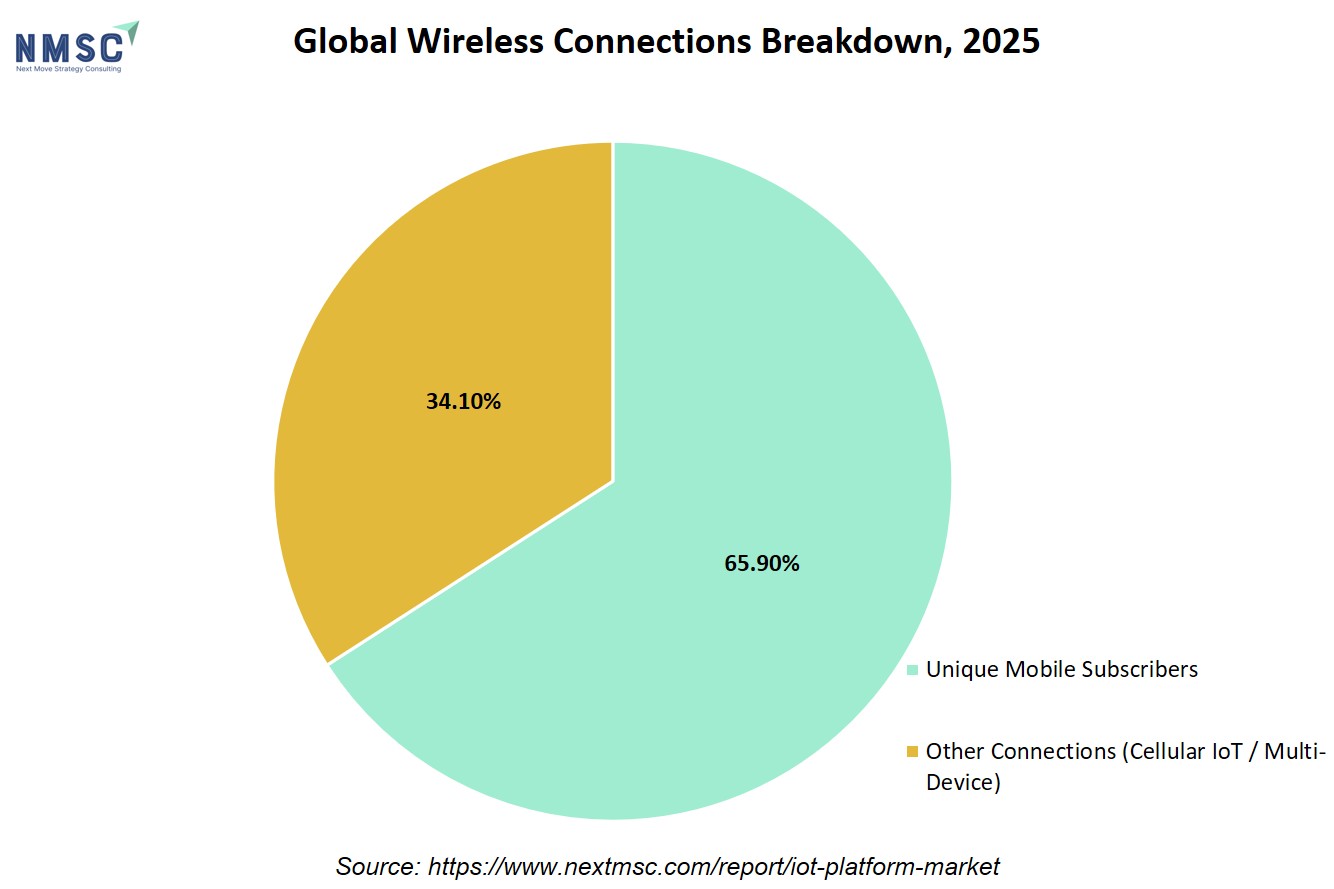
The maturing connectivity backbone is reshaping how enterprises approach digital transformation with IoT. According to GSMA Intelligence's Mobile Economy 2026 report, the mobile industry now supports 8.8 billion wireless connections globally, including 5.8 billion unique mobile subscribers — approximately 70% of the world's population — generating $7.6 trillion in economic value, equivalent to 6.4% of global GDP in 2025. The gap of roughly 3 billion connections between total wireless connections and unique subscribers reflects the rapid rise of non-human, machine-to-machine and cellular IoT connections layered onto core mobile infrastructure.
This infrastructure expansion, however, is not evenly distributed. ITU's Facts and Figures 2025 report finds that 5G network coverage now reaches 55% of the world's population, but that coverage is deeply uneven: 84% of people in high-income countries have access to 5G networks compared with just 4% in low-income countries, a divide that directly constrains where enterprise IoT platforms can be reliably deployed at scale. For multinational enterprises building connected device ecosystems, this disparity means IoT platform architecture must increasingly account for hybrid connectivity — blending cellular, LPWAN, and satellite NTN — rather than assuming uniform 5G availability across all operating geographies.
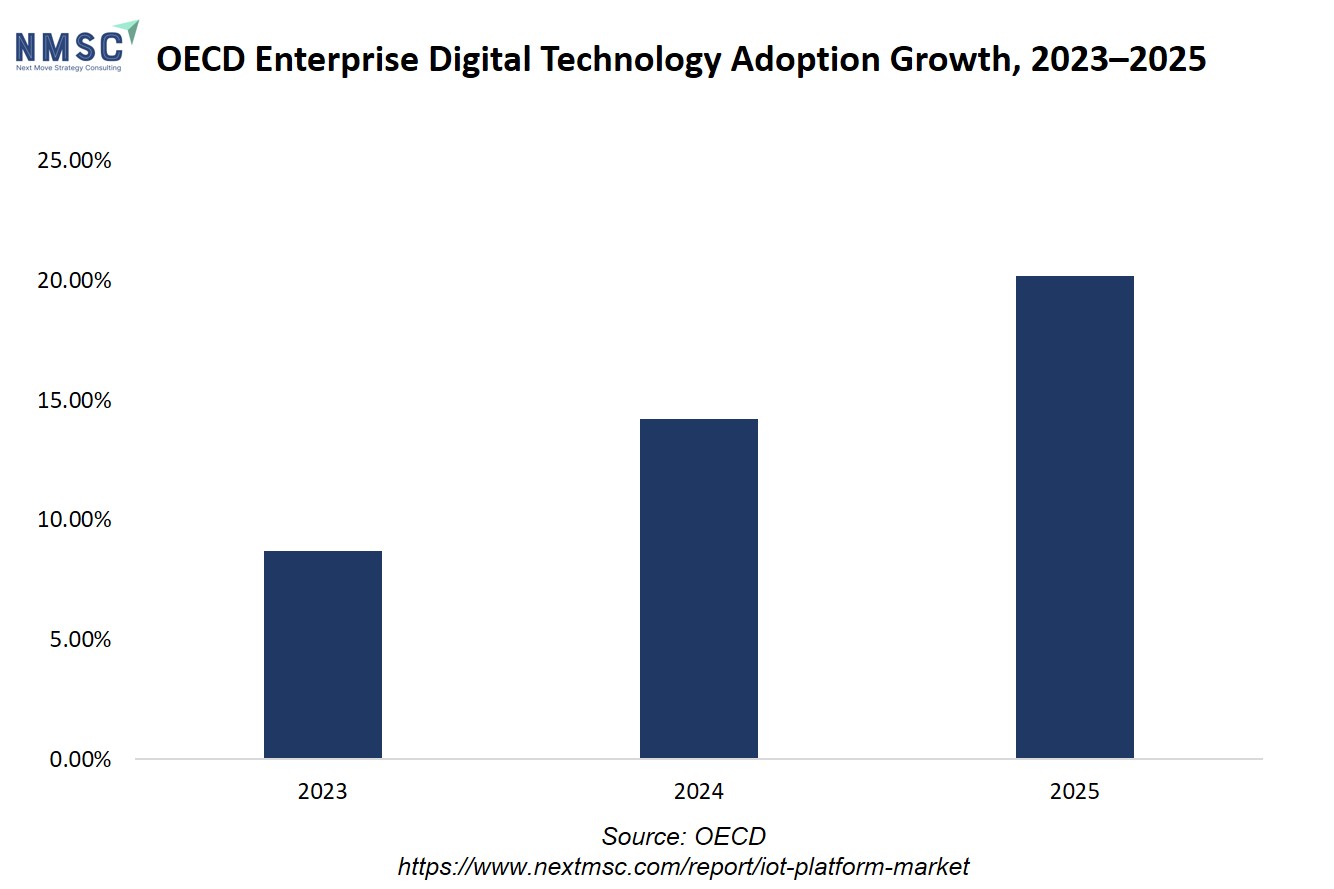
On the enterprise adoption side, the OECD reports that digital and AI-enabled technology adoption by firms across member countries has more than doubled in two years, rising from 8.7% in 2023 to 14.2% in 2024 and 20.2% in 2025, with adoption highly concentrated among large enterprises (52.0%) relative to small firms (17.4%). The ICT sector leads adoption at 57.3%, underscoring that industries closest to the technology stack — including IoT platform vendors and integrators themselves — are moving fastest, while manufacturing and industrial verticals still have significant adoption headroom that represents a growth opportunity for IIoT platform providers.
Section Summary: Global connectivity infrastructure and enterprise digital adoption are both scaling rapidly, but unevenly, creating both opportunity and complexity for IoT platform vendors and enterprise buyers.
-
The mobile ecosystem now carries 8.8 billion connections, with a growing share attributable to non-human, IoT-driven traffic.
-
5G coverage disparity (84% high-income vs. 4% low-income countries) forces enterprises to design hybrid connectivity strategies.
-
Enterprise digital technology adoption has more than doubled since 2023, led by large firms and the ICT sector.
-
Small and mid-sized enterprises remain under-penetrated, representing a substantial untapped segment for IoT platform providers.
Global Connectivity, 5G, IoT, and Enterprise AI Indicators
|
Metric |
Value |
|
Global cellular LPWAN (NB-IoT/LTE-M) connections |
1 billion+ |
|
Countries with commercial NB-IoT/LTE-M networks |
100+ countries |
|
Total global wireless connections (incl. cellular IoT) |
8.8 billion |
|
Unique mobile subscribers globally |
5.8 billion (~70% of world population) |
|
Global mobile economy contribution to GDP |
$7.6 trillion (6.4% of global GDP) |
|
5G network population coverage (global) |
55% |
|
5G coverage – high-income countries |
84% |
|
5G coverage – low-income countries |
4% |
|
Enterprise AI/digital technology adoption (OECD, 2025) |
20.2% (up from 8.7% in 2023) |
|
Large-firm digital technology adoption rate |
52.0% |
|
Small-firm digital technology adoption rate |
17.4% |
Future Outlook & Forecast
Against this backdrop of maturing global connectivity and accelerating enterprise digital readiness, the global IoT Platform Market is positioned for sustained expansion. According to Next Move Strategy Consulting's proprietary analysis, the IoT Platform Market was valued at USD 8.25 billion in 2022 and is projected to reach USD 23.66 billion by 2030, expanding at a compound annual growth rate (CAGR) of 14.1% between 2023 and 2030. This growth trajectory is underpinned by rising enterprise IoT adoption across healthcare, manufacturing, and automotive sectors, growing reliance on IoT data analytics and machine learning to process the expanding volume of connected-device data, and intensifying investment in IoT cloud infrastructure by hyperscale providers.
North America currently holds the dominant share of the IoT platform market, driven substantially by cloud-based IoT adoption in healthcare for secure management of electronic health records, while Asia-Pacific is expected to post steady growth on the back of large-scale BFSI and automotive sector adoption. The competitive landscape remains anchored by hyperscale and industrial technology leaders — including Microsoft Corporation, Amazon Web Services, Google LLC, Siemens AG, IBM Corporation, Cisco Systems, Oracle Corporation, PTC Inc., SAP SE, and Intel Corporation — each expanding platform capabilities across device management, connectivity management, application enablement, and IoT advanced analytics segments.
Looking ahead, NMSC expects the convergence of hybrid NTN-cellular connectivity, RedCap-enabled mid-tier IoT devices, and AI-augmented IoT data analytics to become the primary differentiators among enterprise IoT platform vendors through 2030. Investment in IoT platforms is also expected to increasingly favor providers capable of supporting the full device lifecycle — from manufacture-stage provisioning to end-of-life decommissioning — reflecting the "born connected" model highlighted at MWC26 Barcelona.
Section Summary: NMSC's proprietary forecast confirms a robust growth outlook for the IoT platform market through 2030, reinforced by external evidence of maturing global connectivity infrastructure and rising enterprise digital adoption.
-
The IoT Platform Market is forecast to grow from USD 8.25 billion (2022) to USD 23.66 billion (2030) at a 14.1% CAGR.
-
North America leads on cloud IoT adoption in healthcare; Asia-Pacific is the fastest-growing region on BFSI and automotive demand.
-
Hyperscale cloud providers and industrial technology leaders continue to dominate the competitive landscape.
-
Full device lifecycle management is emerging as the key differentiator among enterprise IoT platform vendors.
Next Steps for Stakeholders
C-level executives and institutional investors evaluating exposure to the IoT platform market should prioritize the following actions:
-
Audit connectivity strategy for hybrid readiness. Given the persistent 5G coverage gap between high- and low-income markets, enterprises operating globally should assess whether current IoT platform vendors support hybrid cellular, LPWAN, and satellite NTN connectivity before committing to multi-year deployments.
-
Prioritize vendors with full-lifecycle device management. As the "born connected" model gains traction, procurement teams should favor IoT Application Enablement Platform (AEP) vendors that support provisioning from the manufacturing stage through remote update and decommissioning.
-
Benchmark internal digital readiness against OECD adoption data. Enterprises trailing the 20.2% OECD firm-level digital technology adoption average should treat IoT platform investment as a competitiveness imperative rather than a discretionary IT upgrade.
-
Evaluate consolidation opportunities among platform vendors. Investors should monitor M&A activity among mid-tier IoT platform providers, as enterprise buyers increasingly consolidate around fewer, full-stack vendors to reduce integration and security risk.
Conclusion
The IoT platform market has entered a phase defined less by whether devices can connect, and more by whether that connectivity can be made consistent, secure, and commercially durable at global scale. The one-billion-connection milestone confirmed by GSMA, the connectivity quality disparities documented by ITU, and the accelerating enterprise digital adoption tracked by OECD collectively describe a market transitioning from early-stage deployment to industrial-grade maturity. With NMSC forecasting the global IoT Platform Market to nearly triple from USD 8.25 billion in 2022 to USD 23.66 billion by 2030 at a 14.1% CAGR, stakeholders that align platform investment with the operational maturity themes emerging from MWC26 Barcelona will be best positioned to capture value in this expanding market.
About the Author
 Sanyukta Deb
— Sanyukta Deb is Digital Marketing Team Lead at Next Move Strategy Consulting, where she has led content strategy and technical SEO for the firm's B2B market research publications for over 2 years. Her editorial process translates NextMSC's primary and secondary research — spanning technology, industrial, and consumer sectors — into commercial narratives, backed by search-intent, keyword, and competitive analysis. She brings 5 years of overall experience in digital marketing and content strategy.
Sanyukta Deb
— Sanyukta Deb is Digital Marketing Team Lead at Next Move Strategy Consulting, where she has led content strategy and technical SEO for the firm's B2B market research publications for over 2 years. Her editorial process translates NextMSC's primary and secondary research — spanning technology, industrial, and consumer sectors — into commercial narratives, backed by search-intent, keyword, and competitive analysis. She brings 5 years of overall experience in digital marketing and content strategy.
About the Reviewer
 Debashree Dey
— Debashree Dey is Assistant Manager at Next Move Strategy Consulting, where she supports cross-vertical market content and communications across diverse industries for 6 years. Her professional background includes senior content writing, communications, and published manuscript authorship, with experience developing audience-focused business narratives and maintaining clear, consistent messaging. Her role supports research-led content development and editorial quality across NextMSC publications.
Debashree Dey
— Debashree Dey is Assistant Manager at Next Move Strategy Consulting, where she supports cross-vertical market content and communications across diverse industries for 6 years. Her professional background includes senior content writing, communications, and published manuscript authorship, with experience developing audience-focused business narratives and maintaining clear, consistent messaging. Her role supports research-led content development and editorial quality across NextMSC publications.


















Add Comment