Is the Simulators Market Entering a New Era of Realism and Precision?
Why Should You Trust This Simulators Market Analysis?
This Simulators Market analysis is developed by Next Move Strategy Consulting, leveraging its expertise in tracking emerging technologies and industry-specific innovations. The insights are derived exclusively from verified 2025–2026 developments in automotive simulation and aviation training, ensuring a strong foundation in real-world applications. By combining factual reporting with structured analytical interpretation, we have provided a reliable perspective that supports informed decision-making for businesses, investors, and industry stakeholders.
The analysis focuses on how recent simulator advancements are influencing operational efficiency, safety standards, and innovation strategies across industries.
What Makes Modern Simulators More Realistic Than Ever?
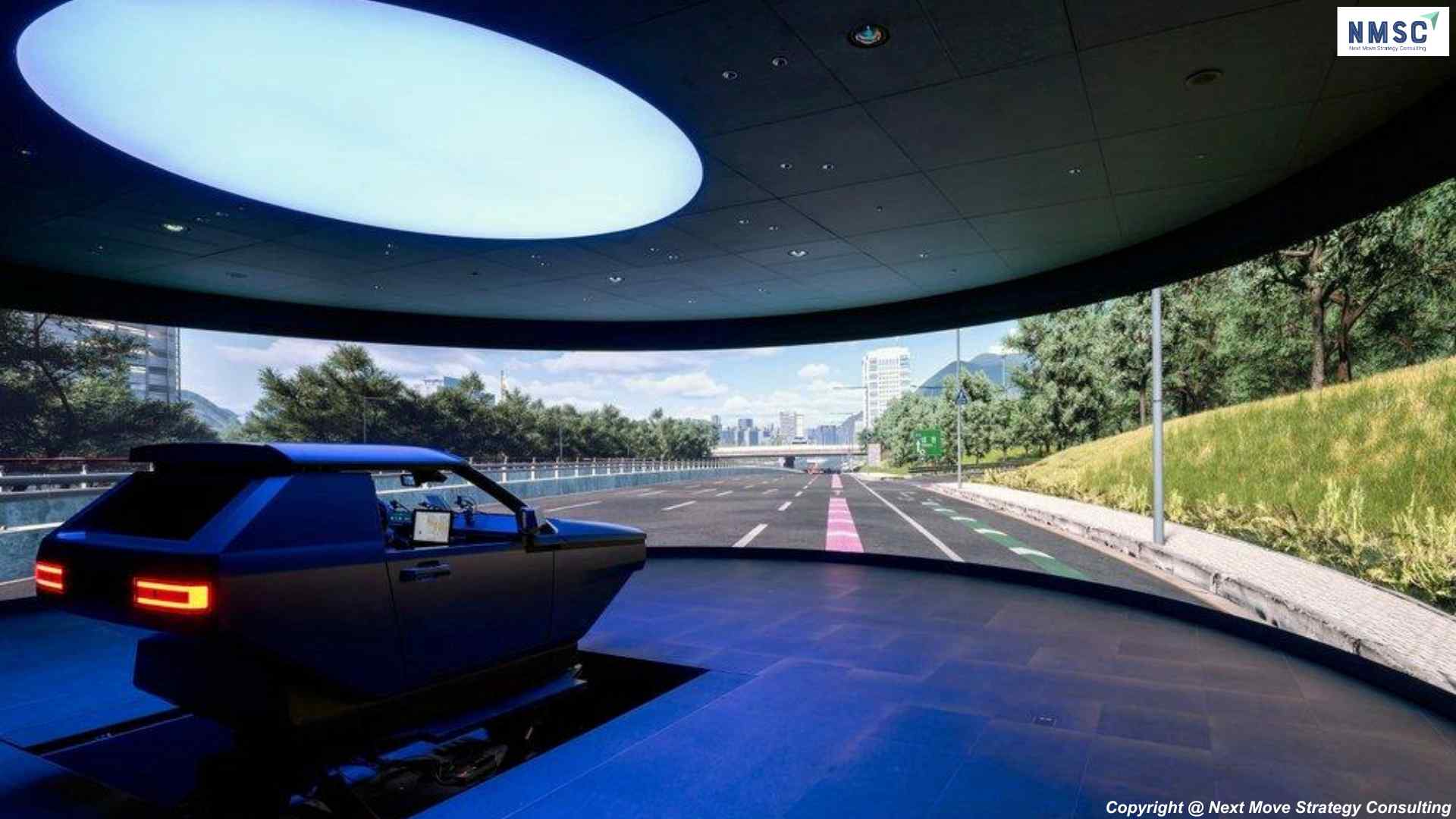
According to NMSC, realism is rapidly becoming the most critical differentiator in the simulators market. A recent development highlights how Ansible Motion has introduced advanced simulators capable of delivering high-fidelity motion feedback that closely replicates real-world driving dynamics. These systems simulate key parameters such as acceleration, braking, and road conditions with exceptional precision, allowing automotive manufacturers to conduct comprehensive testing within a controlled virtual environment. This reduces reliance on physical prototypes and enhances the efficiency of product development cycles.
Analytical Viewpoint
We have observed that such advancements are fundamentally transforming automotive research and development processes. Organizations are increasingly adopting motion simulators to accelerate innovation, optimize costs, and improve design accuracy. The ability to replicate real-world conditions digitally is enabling companies to make faster and more informed decisions, thereby strengthening their competitive positioning in the market.
How Are Aviation Simulators Strengthening Training and Safety?
Next Move Strategy Consulting also highlights that aviation simulators continue to play a critical role in enhancing training outcomes, particularly in high-risk operations. A recent deployment of an H145 helicopter simulator in Germany demonstrates how advanced simulation technologies are being used to improve pilot preparedness. The system offers a realistic cockpit environment along with accurate flight dynamics, enabling pilots to practice complex rescue missions in a safe and controlled setting. This approach allows for repeated scenario-based training, which is essential for improving response capabilities and operational readiness.
Analytical Viewpoint
From our analytical perspective, we have identified that this trend is a key driver for the simulators market, particularly within safety-critical industries. The increasing emphasis on regulatory compliance, combined with the need to minimize operational risks, is accelerating the adoption of aviation simulators. Organizations are recognizing the value of simulation-based training as a reliable and efficient method for preparing personnel for complex and unpredictable scenarios.
What Do These Developments Mean for the Simulators Market?
NMSC observes that the convergence of advancements in motion and aviation simulation is driving a structural transformation in the simulators market. Industries are increasingly leveraging simulation technologies to improve operational efficiency, reduce costs, and enhance safety outcomes. This shift reflects a broader trend toward digitalization, where virtual environments are being used to replicate real-world scenarios with high accuracy.
Key Market Trends
-
Realism-driven demand: Increasing need for accurate and immersive simulation environments
-
Operational efficiency: Reduced reliance on physical testing and training methods
-
Safety prioritization: Enhanced focus on risk-free training environments
-
Sector expansion: Growing adoption across automotive, aviation, and beyond
Strategic Market Table
|
Market Driver |
Verified Impact |
|
Motion simulation |
Accelerates automotive innovation |
|
Aviation simulators |
Enhances training and safety |
|
Realistic environments |
Improves decision-making accuracy |
|
Simulation-based testing |
Reduces operational costs |
How Is This Transforming Industry Decision-Making?
According to Next Move Strategy Consulting, the growing adoption of advanced simulators is significantly influencing how organizations approach decision-making. Simulation technologies provide controlled, repeatable, and data-driven environments that allow businesses to evaluate scenarios, test strategies, and refine operations without exposing themselves to real-world risks. This capability is particularly valuable in industries where safety, accuracy, and efficiency are critical to success.
Key Implications for Stakeholders
-
Businesses can optimize innovation and development cycles
-
Training institutions can enhance learning outcomes and effectiveness
-
Governments can strengthen safety and regulatory frameworks
Evidence-Based Insights
-
Simulation enables repeatable and controlled testing environments
-
It supports data-driven and informed decision-making
-
It reduces uncertainty and operational risks
Leading Companies of the Market
The simulators industry comprises several prominent players, including Boeing, CAE Inc., L3Harris Technologies Inc., FlightSafety International, Elbit Systems Ltd., FAAC Incorporated, Lockheed Martin Corporation, Thales Group, Raytheon Systems Limited, and Unitest Marine Simulators, among others. These companies are actively strengthening their market positions through strategic partnerships, geographic expansion, and continuous product innovation to maintain competitiveness in an evolving industry landscape.
For instance, in March 2024, CAE Inc. partnered with Akasa Air to establish a long-term agreement for Boeing 737MAX pilot training at CAE’s facilities in India. This collaboration enables Akasa Air to leverage CAE’s full-flight simulators, training infrastructure, and expert instructors to enhance pilot training standards. Additionally, in May 2022, Unitest Marine Simulators introduced the Virtual Engine Room 7 (VER7), an advanced emission module simulation software designed for maritime training. The platform allows trainees to simulate multiple engine faults, access various maintenance options, and utilize diagnostic tools for enhanced learning outcomes.
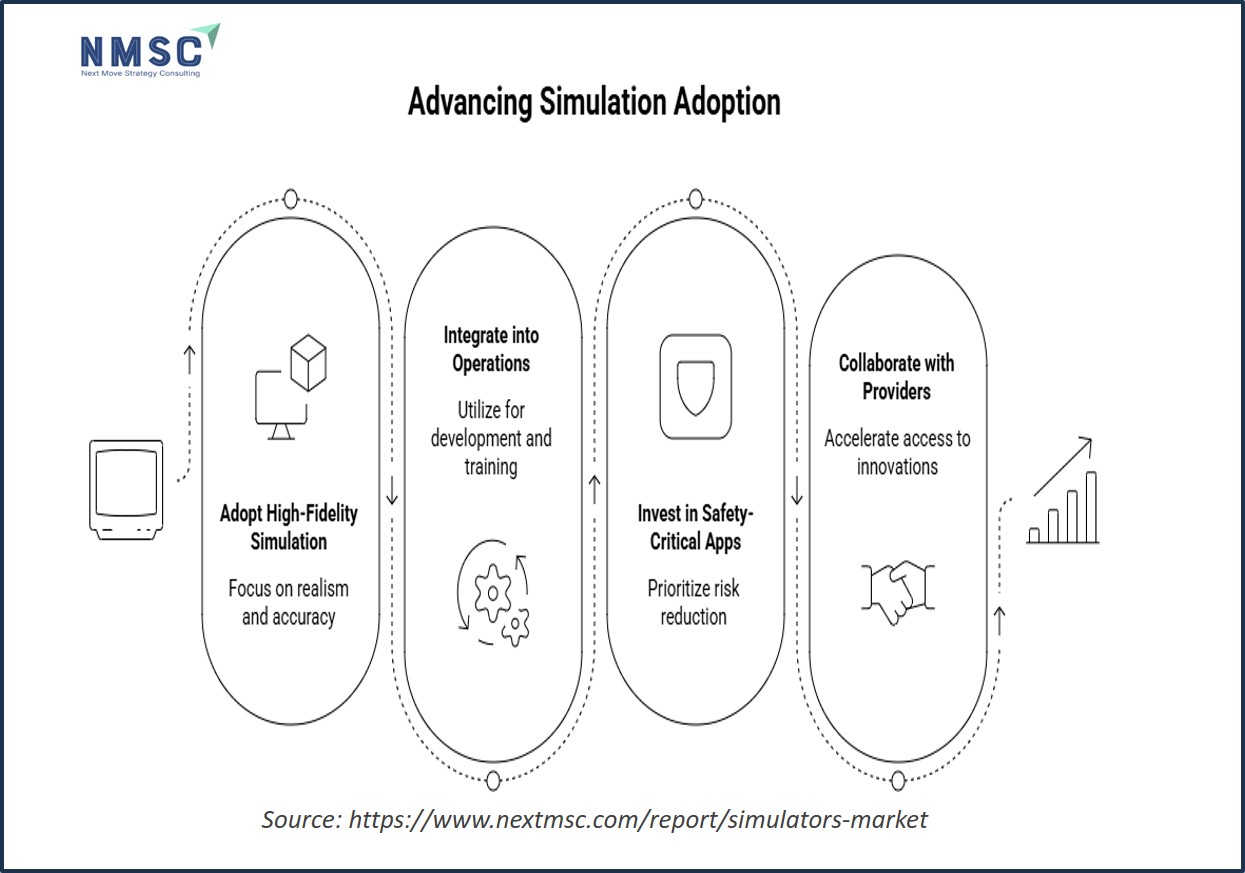
Next Steps: What Should Industry Players Do?
-
Adopt high-fidelity simulation systems: Focus on realism to enhance accuracy and competitiveness
-
Integrate simulators into core operations: Utilize simulation for both development and training
-
Invest in safety-critical applications: Prioritize industries where risk reduction is essential
-
Collaborate with technology providers: Accelerate access to advanced simulation innovations
-
Continuously monitor and optimize performance: Ensure alignment with evolving industry standards
About the Author
 Sanyukta Deb
— Sanyukta Deb is Digital Marketing Team Lead at Next Move Strategy Consulting, where she has led content strategy and technical SEO for the firm's B2B market research publications for over 2 years. Her editorial process translates NextMSC's primary and secondary research — spanning technology, industrial, and consumer sectors — into commercial narratives, backed by search-intent, keyword, and competitive analysis. She brings 5 years of overall experience in digital marketing and content strategy.
Sanyukta Deb
— Sanyukta Deb is Digital Marketing Team Lead at Next Move Strategy Consulting, where she has led content strategy and technical SEO for the firm's B2B market research publications for over 2 years. Her editorial process translates NextMSC's primary and secondary research — spanning technology, industrial, and consumer sectors — into commercial narratives, backed by search-intent, keyword, and competitive analysis. She brings 5 years of overall experience in digital marketing and content strategy.
About the Reviewer
 Debashree Dey
— Debashree Dey is Assistant Manager at Next Move Strategy Consulting, where she supports cross-vertical market content and communications across diverse industries for 6 years. Her professional background includes senior content writing, communications, and published manuscript authorship, with experience developing audience-focused business narratives and maintaining clear, consistent messaging. Her role supports research-led content development and editorial quality across NextMSC publications.
Debashree Dey
— Debashree Dey is Assistant Manager at Next Move Strategy Consulting, where she supports cross-vertical market content and communications across diverse industries for 6 years. Her professional background includes senior content writing, communications, and published manuscript authorship, with experience developing audience-focused business narratives and maintaining clear, consistent messaging. Her role supports research-led content development and editorial quality across NextMSC publications.


















Add Comment