Power Transmission Market Surges as Global Grid Investment Grows | NextMSC
Introduction
The global power grid is at an inflection point. Surging electricity demand from data centres, electric vehicles, industrial electrification, and the accelerating integration of utility-scale renewables has placed unprecedented pressure on transmission infrastructure — the steel towers, high-voltage conductors, and underground cables that form the physical backbone of every modern economy. According to Next Move Strategy Consulting's Power Transmission Lines and Towers Market report, the global power transmission lines and towers market was valued at USD 41.46 billion in 2023 and is projected to reach USD 58.11 billion by 2030, growing at a CAGR of 4.9% from 2024 to 2030. This trajectory is not driven by incremental demand — it is being shaped by a structural mismatch between the pace at which new generation capacity is being commissioned and the pace at which transmission infrastructure is being built to carry that power to consumers.
The International Energy Agency's Electricity 2026 report confirms that over 2,500 GW of renewable, large-load, and storage projects are currently stalled in grid connection queues worldwide — a backlog that cannot be cleared without a decisive acceleration in transmission investment. For C-level executives, infrastructure investors, and energy policymakers, the power transmission lines and towers market represents one of the most capital-intensive and strategically consequential infrastructure categories of this decade.
For More Information: Download FREE Sample on Power Transmission Lines and Towers Market Report
The Grid Bottleneck Crisis: Why Transmission Infrastructure Has Become the Defining Constraint of the Energy Transition
A Record-Breaking Contract Signals the Scale of What Is Required
In early 2026, Prysmian Group secured a contract worth over €2.3 billion (approximately £2 billion) with SP Energy Networks and National Grid Electricity Transmission for the Eastern Green Link 4 project — a 530-kilometre subsea HVDC cable connecting Scotland and England. This single contract, one of the largest offshore transmission awards in European history, illustrates the scale of capital now flowing into high-voltage transmission infrastructure. It is not an isolated event. Simultaneously, construction began in 2026 on the USD 11 billion Grain Belt Express — an 800-mile HVDC transmission line crossing Kansas, Missouri, Illinois, and Indiana — one of the largest transmission projects ever undertaken in the United States. In the same period, Minnesota Power broke ground on a USD 900 million HVDC modernisation project, further demonstrating that high-voltage direct current technology is now the preferred architecture for long-distance, high-capacity power transfer.
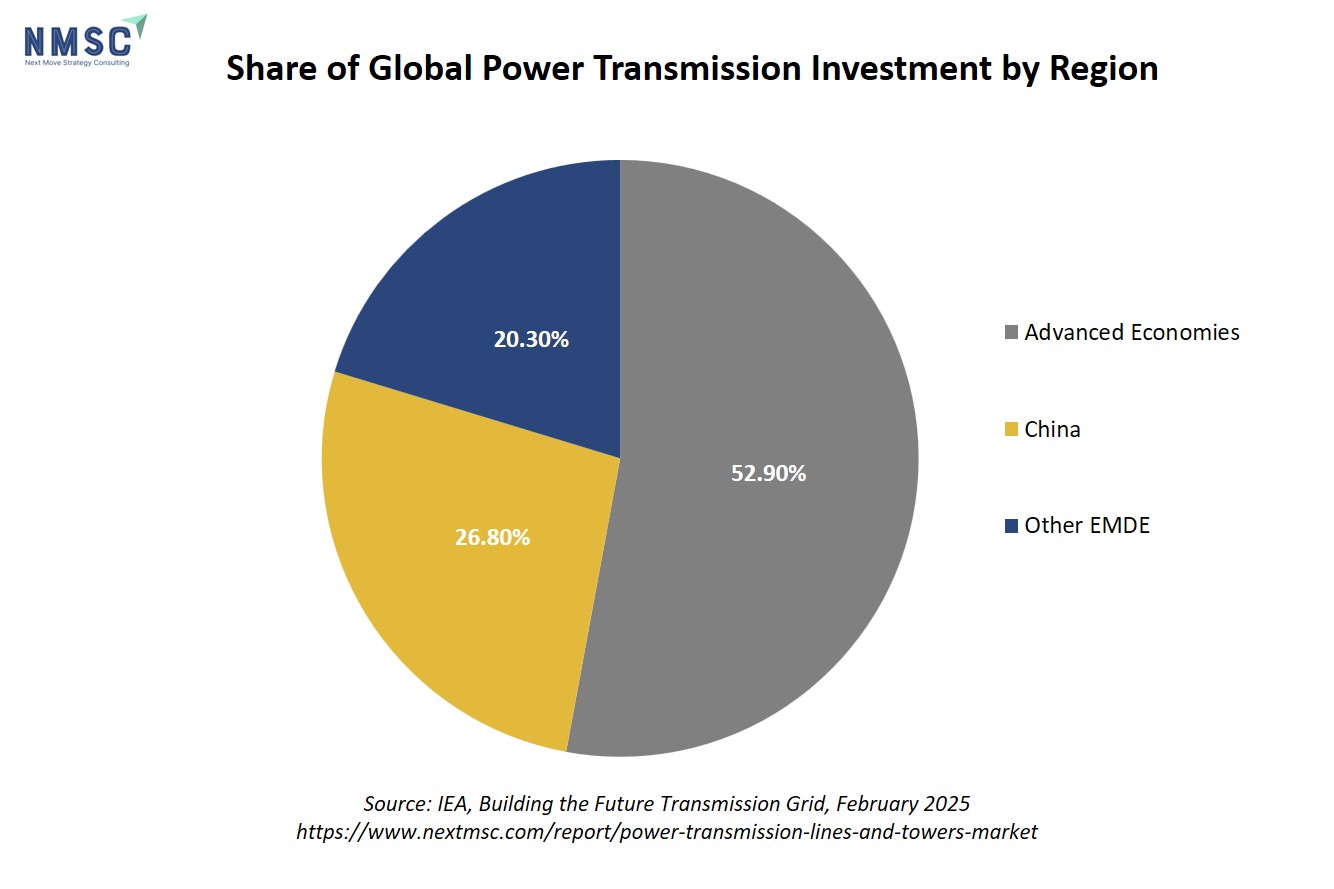
These project announcements are not coincidental. They reflect a coordinated global response to a structural supply-demand imbalance in transmission capacity that the IEA has described as a "gridlock" risk. According to the IEA's Building the Future Transmission Grid report (2025), global investment in power transmission grew by 10% in 2023 to reach USD 140 billion — yet this level of spending would need to exceed USD 200 billion per year by the mid-2030s under current policy settings, and USD 250–300 billion in scenarios aligned with national and global emissions goals.
The IEA's Electricity 2026 report further quantifies the urgency: annual grid investment needs to increase by approximately 50% by 2030 from today's USD 400 billion to meet electricity demand through the end of the decade. This is the macro-structural context within which the power transmission lines and towers market is expanding.
NMSC Strategic Perspective: What the 4.9% CAGR Conceals
NextMSC primary research and analysis indicates that the 4.9% CAGR for the power transmission lines and towers market through 2030 reflects a market that is simultaneously constrained by supply chain bottlenecks and propelled by policy-driven investment mandates. The headline growth rate understates the investment intensity of the sector: the market is not growing uniformly across all segments. HVDC transmission — which enables long-distance power transfer with lower line losses than conventional HVAC systems — is attracting a disproportionate share of new capital, as evidenced by the Grain Belt Express, Eastern Green Link 4, and India's 800 kV HVDC corridor connecting Gujarat and Maharashtra, scheduled for commissioning by end-2026.
The overhead transmission segment continues to dominate by volume, but the underground and submarine cable segments are growing at a faster rate, driven by offshore wind integration requirements and urban grid densification. The more-than-660 kV voltage segment is the fastest-growing voltage category, as governments in China, India, and the United States prioritise ultra-high-voltage corridors to move renewable power from generation-rich regions to high-demand urban centres. NextMSC's analysis identifies Asia-Pacific as the dominant regional market, with China and India together accounting for the majority of new transmission line additions globally.
Section Summary:
The power transmission lines and towers market is being reshaped by a convergence of record-scale project awards, HVDC technology adoption, and a structural global grid investment deficit that requires a near-doubling of annual spending by 2030.
-
Prysmian's €2.3B Eastern Green Link 4 contract and the USD 11B Grain Belt Express represent the new scale of transmission project commitments.
-
The IEA estimates that global transmission investment must exceed USD 200 billion per year by the mid-2030s — up from USD 140 billion in 2023.
-
HVDC technology is capturing an increasing share of new transmission investment due to its efficiency advantages over long distances.
-
NextMSC proprietary research identifies the more-than-660 kV voltage segment and the submarine cable segment as the fastest-growing categories within the market.
Industry Impact Analysis
Supply Chain Constraints Are Reshaping Project Economics and Timelines
The acceleration in transmission investment has collided with a supply chain that was not dimensioned for this level of demand. The IEA's survey of leading industry players, conducted for its Building the Future Transmission Grid report, found that it now takes two to three years to procure cables and up to four years to secure large power transformers — lead times that have almost doubled since 2021. Prices for cables have nearly doubled since 2019, and the price of power transformers rose by approximately 75% over the same period. For direct current cables — the preferred technology for long-distance HVDC transmission — waiting times extend beyond five years, creating a critical bottleneck for projects that are already in advanced planning stages.
This supply chain compression has direct consequences for the power transmission lines and towers market. Project developers are being forced to place orders for cables, transformers, and tower components years before construction begins, increasing working capital requirements and financial risk. The OECD's January 2026 working paper on transmission grid financing confirms that between 2018 and 2024, average prices for power transformers increased by 70% while average cable prices increased by close to 100%, compounding the challenge for utilities and independent transmission project developers seeking to maintain cost-competitive bids.
Permitting Delays: The Structural Bottleneck That Investment Alone Cannot Solve
Supply chain constraints are compounded by permitting timelines that are structurally misaligned with the pace of the energy transition. The IEA's Electricity 2026 report notes that planning, permitting, and completing new grid infrastructure can take anywhere from 5 to 15 years, whereas new renewable energy projects such as solar PV and wind can be delivered in 1 to 5 years, and data centres in 1 to 3 years. This mismatch means that even if capital is available and supply chains are resolved, the transmission infrastructure required to connect new generation capacity may not be ready when that capacity comes online.
The Niskanen Center's analysis of the U.S. transmission landscape confirms that 2025 did not close the transmission gap, and that 2026 will not either without structural policy change — specifically, reforms to interconnection queues, right-of-way acquisition processes, and federal permitting timelines.
Government Investment Commitments Are Providing a Demand Floor
Despite these constraints, government investment commitments are providing a structural demand floor for the power transmission lines and towers market. In the United States, the American Society of Civil Engineers projects that utilities will spend USD 32.1 billion on transmission in 2026 alone, representing a total of USD 121 billion in transmission construction investment over a multi-year period. The U.S. Department of Energy has separately announced a USD 1.5 billion investment in four transmission projects under the Transmission Facilitation Program, enabling nearly 1,000 miles of new transmission development and 7.1 GW of new capacity.
At the global level, J.P. Morgan's infrastructure analysis projects that global grid investment will reach USD 5.8 trillion between 2026 and 2035, with China, the EU, and the U.S. accounting for the majority of that spending. In Europe alone, cumulative grid investment is projected to reach approximately USD 1.1 trillion between 2026 and 2035. The Congressional Budget Office's August 2026 overview of electric transmission notes that industry projections suggest a nearly 50% increase in annual transmission investment by 2028.
Section Summary:
The industry is navigating a simultaneous acceleration in demand and a tightening of supply chain capacity, with permitting reform emerging as the critical policy lever that capital alone cannot substitute.
-
Cable procurement lead times have nearly doubled since 2021, with HVDC cable waiting times exceeding five years.
-
Power transformer prices rose approximately 75% and cable prices approximately 100% between 2018 and 2024.
-
U.S. utilities are projected to spend USD 32.1 billion on transmission in 2026, with global grid investment forecast at USD 5.8 trillion between 2026 and 2035.
-
Permitting timelines of 5 to 15 years for new transmission infrastructure remain the primary structural constraint on market growth.
Pros and Cons of Recent Market Developments
|
Recent Development |
Pros |
Cons |
|
HVDC mega-project awards (Grain Belt Express, Eastern Green Link 4) |
Establishes long-term revenue visibility for cable and tower manufacturers; accelerates HVDC technology standardisation |
Concentrates supply chain demand on a small number of specialised manufacturers, extending lead times for other projects |
|
U.S. DOE USD 1.5B Transmission Facilitation Program |
Provides concessional capital to de-risk projects in underserved corridors; enables 7.1 GW of new capacity |
Limited in scale relative to the USD 32.1B annual utility spend required; does not address permitting reform |
|
Rising cable and transformer prices (up ~75–100% since 2019) |
Improves revenue and margin outlook for established manufacturers with long-term supply agreements |
Increases project costs for developers and utilities, potentially delaying or cancelling marginal projects |
|
OECD Independent Transmission Project (ITP) model adoption in EMDEs |
Unlocks private capital for grid expansion in markets with constrained public budgets; introduces competitive pricing through reverse auctions |
Requires significant regulatory preparation; transaction costs are high for smaller-scale projects |
|
Grid-enhancing technologies (dynamic line rating, reconductoring) |
Can unlock 450–700 GW of additional hosting capacity from existing infrastructure at lower cost and shorter lead times than new builds |
Provides temporary relief rather than permanent capacity; does not replace the need for new transmission lines in high-growth corridors |
|
FRP composite adoption in transmission towers |
Reduces maintenance costs and extends asset life in corrosive or extreme-weather environments |
Higher upfront material costs compared to conventional steel lattice towers; limited manufacturing scale currently |
Key Data & Statistics
Global Transmission Investment Benchmarks — Key Institutional Data Points
|
Metric |
Value |
|
Global power transmission investment (2023) |
USD 140 billion |
|
Required annual transmission investment by mid-2030s (current policy) |
USD 200+ billion/year |
|
Required annual transmission investment (net-zero scenarios) |
USD 250–300 billion/year |
|
Global grid investment projected (2026–2035) |
USD 5.8 trillion |
|
Europe cumulative grid investment projected (2026–2035) |
~USD 1.1 trillion |
|
U.S. utility transmission spend projected (2026) |
USD 32.1 billion |
|
Renewable/storage projects stalled in grid queues globally |
2,500+ GW |
|
Global electricity demand growth rate (through 2027) |
~4% annually |
|
Power transformer price increase (2018–2024) |
~70–75% |
|
Cable price increase (2019–2024) |
~100% |
|
Cable procurement lead time (current) |
2–3 years |
|
Large power transformer procurement lead time (current) |
Up to 4 years |
|
HVDC cable waiting time (current) |
5+ years |
Future Outlook & Forecast
The Structural Investment Imperative Through 2030 and Beyond
NextMSC primary research and analysis projects the power transmission lines and towers market will reach USD 58.11 billion by 2030, reflecting a sustained 4.9% CAGR driven by three converging structural forces: the renewable energy integration imperative, the electrification of industrial and transport sectors, and the replacement of ageing grid infrastructure in advanced economies where more than 50% of grid assets have exceeded half of their average lifespan, according to the OECD's January 2026 transmission grid financing working paper.
The Asia-Pacific region will continue to dominate the market through 2030. India's government has committed to investing USD 29.6 billion to build new transmission lines and increase inter-regional transmission capacity from 112 GW to 150 GW by 2030, while the Central Electricity Authority's National Electricity Plan targets an additional 191,000 circuit kilometres of transmission lines by 2032. China remains the world's largest electricity consumer — accounting for 31% of global electricity consumption — and continues to invest in ultra-high-voltage transmission corridors that are the most technically demanding and capital-intensive segment of the market.
In North America, the combination of the Grain Belt Express, the DOE Transmission Facilitation Program, and state-level renewable portfolio standards is creating a multi-year pipeline of transmission projects that will sustain demand for towers, conductors, and high-voltage cable systems through the end of the decade. The CBO's August 2026 analysis projects a nearly 50% increase in annual transmission investment by 2028, a trajectory that aligns with NMSC's forecast for the market.
In Europe, the Eastern Green Link 4 contract is one of several HVDC interconnection projects that will define the continent's transmission investment landscape through 2030. The UK government has an ambition to deploy up to 50 GW of offshore wind capacity in the UK by 2030, including up to 5 GW of floating offshore wind, combined with the broader European grid modernisation agenda, will sustain demand for submarine cables, offshore transmission towers, and associated high-voltage infrastructure.
The introduction of fibre-reinforced polymer (FRP) composites in transmission tower construction represents a material technology shift with long-term market implications. FRP composites offer superior corrosion resistance, reduced maintenance requirements, and longer asset life compared to conventional steel lattice towers — characteristics that are particularly valuable in coastal, high-humidity, and extreme-weather environments. As manufacturing scale increases and unit costs decline, FRP adoption is expected to expand from niche applications to mainstream deployment in new transmission corridors, creating a new product category within the tower segment.
Section Summary:
The power transmission lines and towers market is positioned for sustained growth through 2030, underpinned by government investment mandates, renewable energy integration requirements, and the structural replacement cycle for ageing grid assets in advanced economies.
-
NextMSC projects the market will reach USD 58.11 billion by 2030 at a 4.9% CAGR, with Asia-Pacific maintaining regional dominance.
-
India's USD 29.6 billion transmission investment commitment and China's ultra-high-voltage corridor programme are the primary demand drivers in the Asia-Pacific region.
-
The CBO projects a nearly 50% increase in annual U.S. transmission investment by 2028, consistent with NMSC's global market trajectory.
-
FRP composite tower technology is emerging as a structural innovation that will expand the addressable market for premium tower products in corrosion-prone environments.
Next Steps for Stakeholders
For Infrastructure Investors and Private Equity:
The OECD's January 2026 analysis of transmission grid financing models identifies the Independent Transmission Project (ITP) structure — used successfully in Brazil, India, and the United Kingdom — as the most promising model for mobilising private capital in markets with constrained public budgets. Investors should evaluate ITP pipeline opportunities in emerging markets where grid investment deficits are largest and where competitive reverse auction processes are being established. Transmission assets in stable regulatory environments offer long-duration, inflation-linked revenue streams that are structurally attractive for pension funds, sovereign wealth funds, and infrastructure-focused asset managers.
For Transmission Equipment Manufacturers (Cable, Tower, Conductor):
The doubling of cable prices and near-doubling of transformer prices since 2019 reflects a seller's market that rewards manufacturers with established long-term supply agreements. Securing multi-year framework contracts with major transmission system operators — particularly in the EU, U.S., and India — is the primary strategic priority. Manufacturers should also evaluate capacity expansion investments in HVDC cable production, where waiting times exceeding five years represent both a constraint and a competitive moat for those who invest ahead of demand.
For Engineering, Procurement, and Construction (EPC) Contractors:
The permitting bottleneck identified by the IEA and the Niskanen Center means that EPC contractors with established right-of-way acquisition capabilities and regulatory expertise will command a premium in project selection. Contractors should build dedicated permitting and stakeholder engagement teams as a core competency, not a project-specific resource.
For C-Level Executives at Utilities and Transmission System Operators:
The IEA's recommendation to adopt proactive, anticipatory grid investment strategies — placing component orders years before construction begins — is now a financial necessity, not a best practice. Utilities that delay procurement decisions in the expectation of shorter lead times will face project delays and cost overruns. Long-term supply agreements for cables, transformers, and tower components should be treated as strategic balance sheet decisions, not procurement transactions.
For Policymakers and Regulators:
The OECD's toolkit for transmission grid financing provides a structured framework for selecting the appropriate financing model based on public sector investment capacity, market structure, and the scale of investment required. Streamlining permitting processes — the primary cause of transmission project delays in advanced economies — is the single highest-return policy intervention available to accelerate market growth.
Conclusion
The power transmission lines and towers market is not growing because of generic infrastructure spending cycles — it is growing because the physical infrastructure required to deliver the energy transition does not yet exist at the scale the transition demands. The IEA's finding that over 2,500 GW of generation and storage projects are stalled in grid queues worldwide is a direct measure of the market opportunity: every gigawatt of stranded renewable capacity represents transmission infrastructure that must be built. NextMSC's projection of a USD 58.11 billion market by 2030 reflects a sector where demand is structurally secured by government mandates, renewable energy targets, and the irreversible electrification of transport and industry. The constraints — supply chain lead times, permitting delays, and workforce shortages — are real, but they are constraints on the pace of growth, not on its direction. For investors, manufacturers, and policymakers who position themselves ahead of the investment wave, the power transmission lines and towers market represents one of the most durable infrastructure opportunities of this decade.
About the Author
 Sanyukta Deb
— Sanyukta Deb is Digital Marketing Team Lead at Next Move Strategy Consulting, where she has led content strategy and technical SEO for the firm's B2B market research publications for over 2 years. Her editorial process translates NextMSC's primary and secondary research — spanning technology, industrial, and consumer sectors — into commercial narratives, backed by search-intent, keyword, and competitive analysis. She brings 5 years of overall experience in digital marketing and content strategy.
Sanyukta Deb
— Sanyukta Deb is Digital Marketing Team Lead at Next Move Strategy Consulting, where she has led content strategy and technical SEO for the firm's B2B market research publications for over 2 years. Her editorial process translates NextMSC's primary and secondary research — spanning technology, industrial, and consumer sectors — into commercial narratives, backed by search-intent, keyword, and competitive analysis. She brings 5 years of overall experience in digital marketing and content strategy.
About the Reviewer
 Debashree Dey
— Debashree Dey is Assistant Manager at Next Move Strategy Consulting, where she supports cross-vertical market content and communications across diverse industries for 6 years. Her professional background includes senior content writing, communications, and published manuscript authorship, with experience developing audience-focused business narratives and maintaining clear, consistent messaging. Her role supports research-led content development and editorial quality across NextMSC publications.
Debashree Dey
— Debashree Dey is Assistant Manager at Next Move Strategy Consulting, where she supports cross-vertical market content and communications across diverse industries for 6 years. Her professional background includes senior content writing, communications, and published manuscript authorship, with experience developing audience-focused business narratives and maintaining clear, consistent messaging. Her role supports research-led content development and editorial quality across NextMSC publications.














Add Comment