What’s Impacting the Growth of Digital Marketplaces Today?
Digital marketplaces connect buyers and sellers on centralized platforms, handling everything from payment security to dispute resolution as they knit together commerce across borders. That basic function hasn't changed. What has changed, in the eighteen months since this piece last looked at the space, is who is doing the connecting and how. The technology story has moved on from AI and AR/VR as emerging capabilities to agentic AI as the new interface for shopping itself, while the competitive story has moved from platform differentiation to outright consolidation, cross-border logistics wars, and in at least one major market regulatory upheaval.
The scale of what's at stake keeps growing. The Digital Marketplace Market is projected to expand from roughly USD 748.6 billion in 2026 to USD 2,020.56 billion by 2035, advancing at a compound annual growth rate of 11.6%, according to Next Move Strategy Consulting's market analysis. That trajectory is being shaped less by any single technology than by how the twenty largest platform operators are placing their bets on AI, logistics, and geographic expansion right now.
How Is Agentic AI Reshaping Digital Marketplace Competition?
The defining shift of 2026 is the move from AI as a recommendation layer to AI as the transaction layer itself. Beyond AI capabilities, strong website design and user experience remain important to digital marketplaces, helping businesses create clearer product discovery, navigation, and purchasing journeys. Alibaba fully connected its Qwen AI assistant to the entire Taobao and Tmall catalog more than four billion products enabling shoppers to browse, compare, and complete purchases through natural-language conversation rather than keyword search, with the transaction itself settling through Alipay. Reuters reported that Qwen had already logged roughly 140 million first-time AI-driven shopping experiences during Alibaba's Chinese New Year campaign, before the full integration even launched. Alibaba's own account frames this as a response to share losses to PDD Holdings and to Douyin's in-app commerce, not simply an innovation showcase.
Western platforms are converging on the same idea from different starting points. eBay's "Magical Listing" tool has now generated more than 500 million AI-assisted listings and driven a reported 50% increase in new U.S. listing creation, according to the company's Q1 2026 earnings call, while a parallel agentic search pilot is testing conversational, multi-turn buyer search. Etsy has rolled out an AI Shop Assistant for sellers and notably made eligible listings discoverable and purchasable directly inside ChatGPT, Gemini, and Microsoft Copilot, effectively conceding that some shopping will start outside the marketplace app entirely. Sea Limited's Shopee reported that AI-powered search and recommendations lifted purchase conversion by 14% and cut customer-service costs by roughly 30% through AI chatbots, with management linking AI directly to a jump in Shopee's effective take rate from about 8.5% to roughly 11.2% year over year.
Section summary: AI in digital marketplaces has moved from a feature to the transaction interface itself, and platforms that treat it as core infrastructure are seeing measurable monetization gains, not just efficiency gains.
-
Alibaba's Qwen-Taobao integration opens 4B+ products to conversational, agent-completed shopping
-
eBay's Magical Listing and agentic search pilot are driving double-digit listing and engagement growth
-
Etsy is opting into third-party AI assistants (ChatGPT, Gemini, Copilot) as a discovery channel
-
Shopee's AI investment is translating directly into higher ad and commission take rates
What Cross-Border and Logistics Moves Are Reshaping the Competitive Map?
If AI is the interface war, logistics is the infrastructure war, and it's being fought hardest in Europe and Latin America. JD.com launched its Joybuy marketplace across the UK, Germany, France, the Netherlands, Belgium, and Luxembourg in March 2026, backed by more than 60 European warehouses, a proprietary last-mile network branded JoyExpress, and same-day delivery in major cities a direct challenge to Amazon built on owned logistics rather than the pure third-party-seller model that Temu and AliExpress have used to enter Europe. By June, Joybuy had begun opening the platform to curated third-party sellers from Europe and China, formally becoming a marketplace rather than a single-retailer storefront.
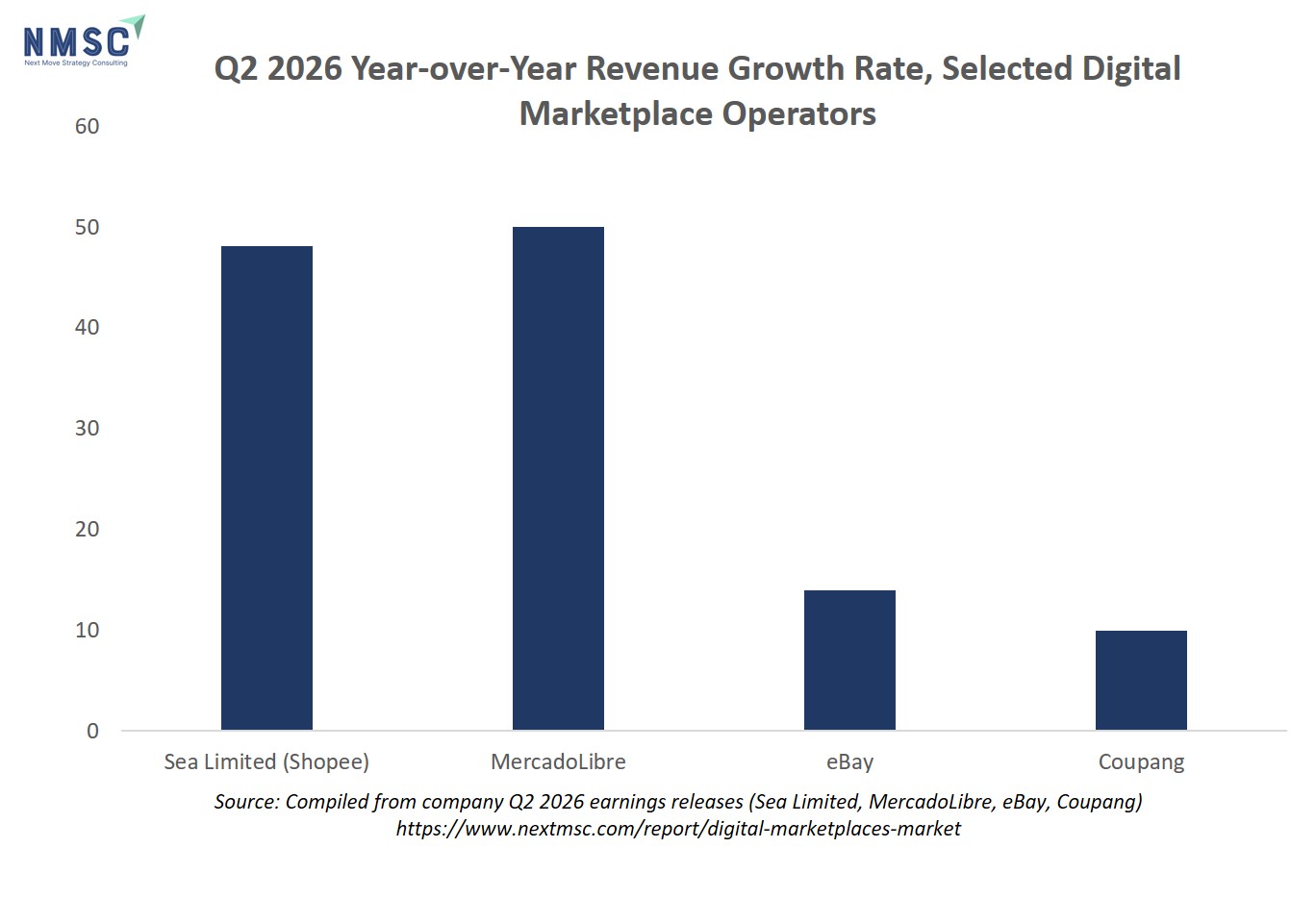
MercadoLibre answered with its own infrastructure bet, committing roughly USD 10.9 billion to Brazil in 2026 about 50% more than the prior year to fund 14 new fulfillment centers and roughly 10,000 new jobs, according to Reuters coverage of the announcement. That bet is already showing up in the numbers: MercadoLibre's Q2 2026 results reported GMV of $21.9 billion (up 44% year over year) and total payment volume of $101 billion (up 56%), per the company's own shareholder letter. Coupang, meanwhile, is investing through a very different set of circumstances: after a major 2025 data incident, the company reported that membership and demand had largely recovered by mid-2026, and it is now extending its "dawn delivery" model into Taiwan in roughly a quarter of the time the same build-out took in its home market of South Korea, per its Q1 2026 earnings call.
In India, Walmart-owned Flipkart is preparing for a domestic IPO after re-domiciling its holding company from Singapore back to India in March 2026, and is racing to close the gap in quick commerce Flipkart Minutes reportedly grew from roughly 390,000–400,000 daily orders in November 2025 to 1.1–1.2 million by mid-2026, with plans for 500 additional neighborhood warehouses, per Reuters. Amazon is meeting that competition head-on with seller economics: in March 2026 it expanded zero-referral-fee coverage on Amazon.in more than tenfold, from 1.2 crore to over 12.5 crore products priced under ₹1,000 across 1,800+ categories, while also cutting Easy Ship logistics fees, according to Amazon's own India press materials. PDD Holdings' Temu, by contrast, is navigating tightening conditions on two fronts: the U.S. closed the low-value "de minimis" import exemption that fueled its early growth, and the EU followed in July 2026 with a temporary €3 customs duty per tariff line on parcels valued under €150 arriving from outside the bloc a measure the European Commission says addresses roughly 4.6 billion such low-value parcels entering the EU each year. PDD's international business has stabilized rather than accelerated under this pressure, even as the company faces a fine in China and new regulatory probes in Europe and the U.S. over Temu's marketplace practices.
Section summary: Cross-border marketplace competition has shifted from "who has the most sellers" to "who controls the logistics," with asset-heavy entrants like JD.com and MercadoLibre betting on owned infrastructure against Temu's asset-light model, which is now under regulatory strain.
-
JD.com's Joybuy is the first logistics-backed Chinese entrant to challenge Amazon in Europe with owned delivery infrastructure
-
MercadoLibre's $10.9B Brazil build-out is already showing up in Q2 GMV (+44%) and payment volume (+56%)
-
Coupang is replicating its Korea logistics playbook in Taiwan at roughly 4x the original speed
-
Flipkart's quick-commerce scale-up is running in parallel with IPO preparation, while Amazon counters on Indian seller fees
-
Temu's early cost advantage has narrowed under U.S. tariff changes and the EU's new per-item customs duty effective July 2026
Where Is Consolidation and Regulatory Pressure Concentrated?
Consolidation is the third major thread. eBay is acquiring the Gen-Z-focused resale platform Depop from Etsy, which had owned it since 2019 in a deal expected to close by Q3 2026, adding it to eBay's prior acquisition of Nordic marketplace Tise as part of a deliberate rollup of younger-demographic recommerce. In European fashion, Zalando is realizing early synergies from its 2025 acquisition of About You Q2 2026 group GMV rose 20.7% to €4.9 billion and B2B revenue grew 27.6% but on a like-for-like basis stripping out the About You consolidation, GMV growth was closer to 4%, and the company cut its full-year guidance to the lower half of its 12–17% range, sending shares down as much as 17–18% in a single session in August. Allegro, meanwhile, is doing the opposite divesting its Slovenia and Croatia operations (the "Mall South" segment) to simplify its footprint and refocus capital on its core Polish and international marketplace business. In classifieds, Adevinta's private-equity owners, Permira and Blackstone, continue to advance plans for a roughly €10 billion Frankfurt IPO of the German auto-marketplace subsidiary Mobile.de, a process that has been running since late 2025 and remained active as of early September 2026.
Regulatory pressure is most acute in Russia, where Ozon and Wildberries have faced a difficult second half of 2026: seller commissions on Ozon reportedly rose from roughly 18.6% to 47.8% of base product price within a year, while Wildberries' rose from about 31.9% to 42.7%, according to Russian trade outlet CNews, and both platforms have contended with warehouse disruptions since mid-2026, prompting sellers to test alternative channels including M.Video and Yandex Market. New government-mandated seller and listing verification rules are set to take effect October 1, 2026. This is a useful reminder that "digital marketplace" regulation isn't only a European Digital Markets Act story commission structures and platform obligations are shifting unevenly worldwide.
Section summary: Consolidation is concentrating recommerce and classifieds assets among fewer, larger operators, while regulatory and operational disruption is compressing margins unevenly across regions sharply in Russia, more gradually in the EU and US.
-
eBay's Depop acquisition and Zalando's About You integration are reshaping the fashion-resale segment
-
Allegro is retrenching geographically while Adevinta pursues a major asset carve-out via IPO
-
Russian marketplace commissions have nearly doubled for some sellers amid warehouse disruptions and new compliance rules
What's the Outlook for the Digital Marketplace Market?
|
Selected 2026 Strategic Move |
Operator |
Scale / Metric |
|
European marketplace launch (Joybuy) |
JD.com |
6 countries, 60+ warehouses |
|
Brazil logistics investment |
MercadoLibre |
~$10.9B, 14 new fulfillment centers |
|
Satellite/connectivity acquisition |
Amazon |
~$11.6B (Globalstar) |
|
Resale-platform acquisition |
eBay (from Etsy) |
Depop, ~$1.2B |
|
Quick-commerce expansion |
Flipkart |
500 planned new warehouses |
|
Seller referral-fee elimination |
Amazon (India) |
12.5 crore products, 1,800+ categories |
|
Cross-border customs duty (regulatory, not a company move) |
EU / all non-EU sellers |
€3 per tariff line, parcels under €150 |
AI Adoption Metric, 2026
|
AI Adoption Metric, 2026 |
Operator |
|
~140M first-time AI-driven shopping sessions (Qwen app) |
Alibaba |
|
500M+ AI-generated listings; +50% new listing rate |
eBay |
|
Conversion +14%; service cost -30% via AI |
Sea Limited (Shopee) |
|
Take rate rose from ~8.5% to ~11.2% YoY |
Sea Limited (Shopee) |
Three forces will determine how this plays out over the next several quarters. First, the agentic-commerce race is now genuinely global and multi-platform rather than led by one company Alibaba, eBay, Etsy, and Shopee are each pursuing a different version of "AI completes the transaction," and buyer habits will likely settle around whichever version proves most trustworthy with money, not just most impressive as a demo. Second, logistics ownership is becoming a bigger differentiator than catalog breadth: JD.com, MercadoLibre, and Coupang are all spending heavily on owned delivery networks specifically to compete against lighter-asset rivals, a bet that only pays off if delivery speed continues to drive buyer loyalty as strongly as it has in South Korea and China. Third, regulatory exposure is no longer a background risk it is already showing up in PDD's slower Temu growth, in Ozon and Wildberries' seller economics, and in the compliance costs cited across nearly every operator's own disclosures.
Section summary: The digital marketplace market's next phase of growth looks less like uniform expansion and more like a sorting process between platforms that own their logistics and those that rent it, and between platforms whose AI investment shows up in monetization versus those still treating it as a feature checkbox.
-
Agentic commerce adoption is broad-based, not concentrated in one company
-
Owned logistics infrastructure is emerging as a primary competitive moat in cross-border expansion
-
Regulatory and compliance costs are now a measurable, disclosed drag on growth for several major operators
Conclusion
The digital marketplace market's growth story hasn't changed at the top line a market moving from roughly $748.6 billion to just over $2 trillion by 2035 is still a genuinely large opportunity. What has changed is where the competitive advantage actually sits. It's no longer enough for a platform to add AI features or open a storefront in a new country; the operators pulling ahead in 2026 Alibaba with agentic checkout, JD.com and MercadoLibre with owned logistics, Sea Limited with AI-driven monetization are the ones translating investment into measurable transaction-level outcomes. For businesses and investors tracking this space, the operators worth watching closest are the ones disclosing hard numbers behind their AI and logistics bets, not just the announcements.
For a deeper breakdown of market sizing, segment forecasts, and the competitive landscape across all major operators, see Next Move Strategy Consulting's full Digital Marketplace Market.
For More Information: Download FREE Sample on Digital Marketplace Market Report
About the Author
 Sanyukta Deb
— Sanyukta Deb is Digital Marketing Team Lead at Next Move Strategy Consulting, where she has led content strategy and technical SEO for the firm's B2B market research publications for over 2 years. Her editorial process translates NextMSC's primary and secondary research — spanning technology, industrial, and consumer sectors — into commercial narratives, backed by search-intent, keyword, and competitive analysis. She brings 5 years of overall experience in digital marketing and content strategy.
Sanyukta Deb
— Sanyukta Deb is Digital Marketing Team Lead at Next Move Strategy Consulting, where she has led content strategy and technical SEO for the firm's B2B market research publications for over 2 years. Her editorial process translates NextMSC's primary and secondary research — spanning technology, industrial, and consumer sectors — into commercial narratives, backed by search-intent, keyword, and competitive analysis. She brings 5 years of overall experience in digital marketing and content strategy.
About the Reviewer
 Debashree Dey
— Debashree Dey is Assistant Manager at Next Move Strategy Consulting, where she supports cross-vertical market content and communications across diverse industries for 6 years. Her professional background includes senior content writing, communications, and published manuscript authorship, with experience developing audience-focused business narratives and maintaining clear, consistent messaging. Her role supports research-led content development and editorial quality across NextMSC publications.
Debashree Dey
— Debashree Dey is Assistant Manager at Next Move Strategy Consulting, where she supports cross-vertical market content and communications across diverse industries for 6 years. Her professional background includes senior content writing, communications, and published manuscript authorship, with experience developing audience-focused business narratives and maintaining clear, consistent messaging. Her role supports research-led content development and editorial quality across NextMSC publications.


















Add Comment