Which Industries Drive US-Mexico Cross-Border Freight Demand?
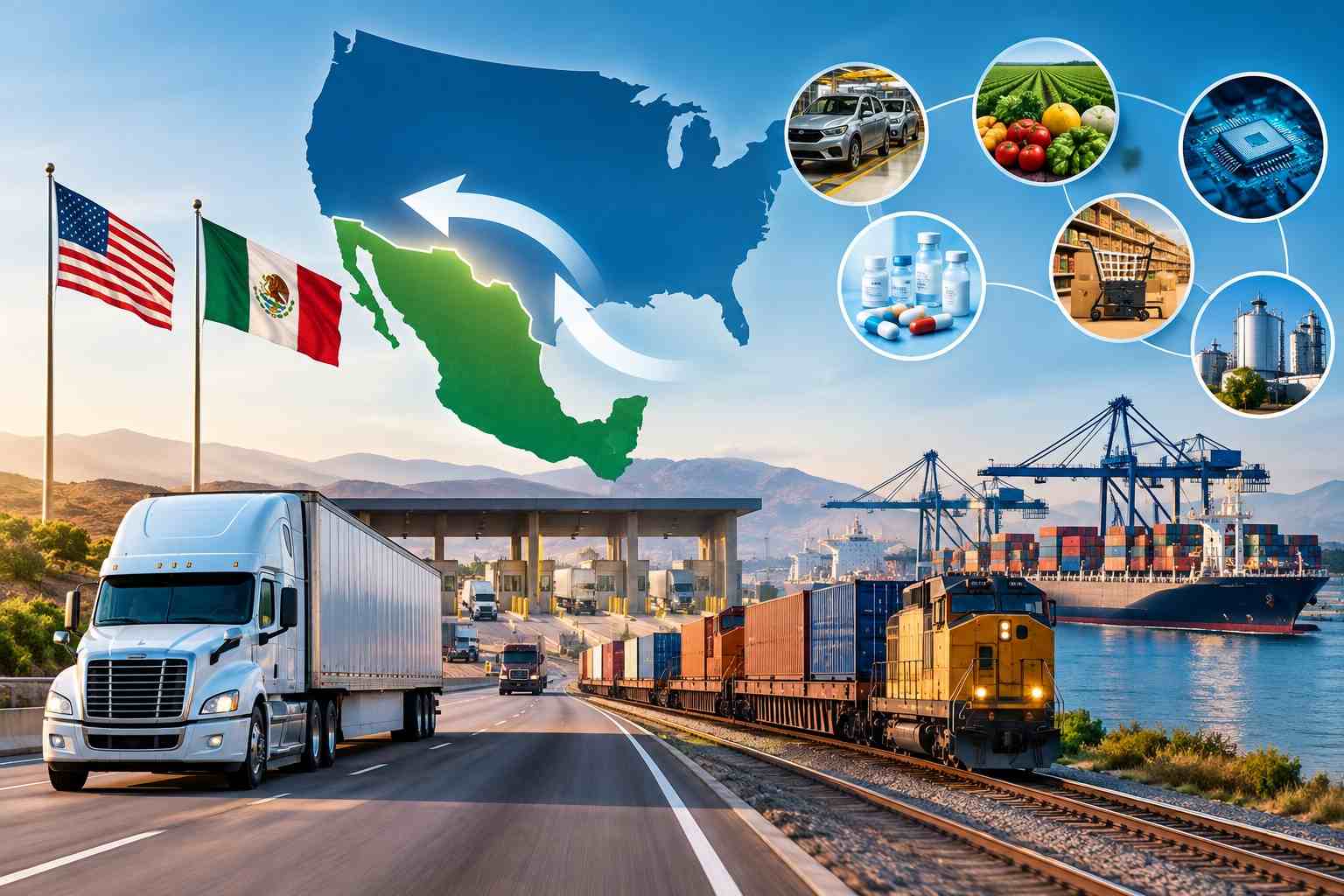
Before sunrise in Laredo, the trucks are already there, hundreds of them. Drivers wait in cabs, engines rumbling, paperwork in hand. By the time the sun climbs over the Rio Grande, the line stretches for miles. This is not a traffic jam; it is the circulatory system of North American commerce, and it never stops.
The freight moving between the United States and Mexico tells a story about two economies that have grown inseparable.
Auto parts, electronics, machinery, and farm products make up much of US to Mexico freight shipping, feeding assembly plants that often send finished goods right back north. Parts go south - vehicles come north, produce goes north - grain goes south. The cycle repeats every day, every week, every year.
But the composition of that freight is changing. Some sectors that once defined cross-border trade have plateaued. Others are surging. Understanding which industries drive demand today—and which will drive it tomorrow—requires looking beyond the truck traffic and into the factories, warehouses, and farms that depend on it.
Automotive: The Foundation That Stopped Growing
The automotive industry built cross-border freight, not trade agreements, not political speeches. Assembly lines.
For years, American components have been imported into Mexican factories to manufacture vehicles which are then transported back to America. The pickup truck you may buy in Houston could be made using steel from Indiana, electronic components from Michigan, seat covers from Ohio, and an engine from Tennessee. It is assembled by workers in Coahuila or Nuevo Leon, Mexico, and exported back to Texas.
This is not outsourcing in the traditional sense. It is integrated manufacturing. Every crossing adds value. Every handoff requires precision. A missing component can shut down a production line in minutes. That pressure keeps carriers busy and US to Mexico freight shipping moving. Automotive remains the largest single category of cross-border truck freight by value.
But here is what the numbers show: automotive freight has stopped growing. Production volumes have flattened. The action has shifted elsewhere.
Electronics: The New Engine of Growth
Walk through a warehouse located in El Paso or Otay Mesa, and you will know how these shipments are replacing automotive shipments. These shipments are more valuable than many homes. Carriers fight hard for such loads because of high rates. But one misplaced or dropped pallet, and the carrier earns nothing as the insurance claim takes away the entire earning from the shipment.
The industry mix behind cross-border trucking is shifting fast: as research from the Federal Reserve Bank of Dallas points out, Mexico was on track to overtake China as the largest source of U.S. advanced technology imports in 2025, while U.S. exports to Mexico have also climbed sharply, much of which feeds back into Mexican goods with substantial American content.
This is not a minor adjustment. It represents a fundamental realignment of North American supply chains. Companies that once sourced from Asia are looking closer to home. Mexico has become a preferred manufacturing partner for technology companies seeking to reduce lead times and avoid ocean freight bottlenecks. The result is more high-value freight moving by truck across the border, and more demand for carriers that can handle sensitive, expensive cargo.
Machinery: When Standard Trailers Will Not Do
American factories send equipment south; Mexican factories send equipment north: printing presses, harvesters, assembly robots, packaging lines. Some of these loads fit on standard trailers. Many do not, because they are too wide, tall, or heavy.
This is when the need for flatbeds and step-deck trailers arises. Permitting covers the rest. Planning such loads requires patience. Planning in haste only leads to problems. One mistake regarding bridge heights or road weight restrictions can set back a load by several days. Carriers specializing in such loads are aware of the laws governing such loads in U.S. These carriers also know the available routes for oversized loads and experienced customs brokers.
It is not glamorous work, but it keeps factories running. Without it, assembly lines in Monterrey and Detroit would grind to a halt.
Agriculture: Cold Air and Hard Deadlines
Produced in Mexico, goods are transported northwards every single week of the year. Avocados. Tomatoes. Peppers. Berries. All of it travels in refrigerated trailers where temperature never stops mattering. If they are delayed even for a couple of hours at the border crossing point, the entire cargo is rejected by the buyer.
Moving southward, corn and soy produced in America is used to feed cattle in Mexico. In this trade, the profits are good if the schedule is kept but it demands another form of discipline. There is no place for mistakes. The cold chain has to stay intact from the point of production to the point of distribution. Drivers have to know how to monitor refrigeration units.
Agricultural freight is unforgiving but it also is not going away. People need to eat.
What This Means for the Trucking Industry
Each industry has its own requirements. Cars need predictability. Electronics need speed and security. Machinery needs specialized trailers. Food needs cool air and tight windows. No single carrier can handle them all efficiently. International trucking favors the carriers that do research on the particular lanes and invest in their infrastructure for particular clients.
The days of being a generalist cross-border carrier are fading. Shippers want partners who understand their industry. They want carriers who know the customs brokers, the border crossing times, the seasonal fluctuations. They want someone who has moved their kind of freight before and knows what can go wrong.
This specialization is not a bad thing. It raises standards. It forces carriers to invest in training, equipment, and technology. It rewards those who take the time to understand their clients' businesses.
US to Mexico Freight Shipping: Looking Ahead
Trucks will always cross the border. The question is whose trucks. The carriers who thrive will be those who adapt to the changing mix of industries. They will invest in refrigerated equipment for produce. They will train drivers to handle high-value electronics. They will maintain flatbeds for machinery. They will build relationships with customs officials on both sides.
The border is not a barrier. It is a gateway. And the freight moving through it tells the story of two economies that need each other. That story is still being written. The next chapter will be about electronics, technology, and advanced manufacturing. The carriers who read that chapter early will be the ones still in business when the sun comes up over Laredo.
About the Author
 Sanyukta Deb
— Sanyukta Deb is Digital Marketing Team Lead at Next Move Strategy Consulting, where she has led content strategy and technical SEO for the firm's B2B market research publications for over 2 years. Her editorial process translates NextMSC's primary and secondary research — spanning technology, industrial, and consumer sectors — into commercial narratives, backed by search-intent, keyword, and competitive analysis. She brings 5 years of overall experience in digital marketing and content strategy.
Sanyukta Deb
— Sanyukta Deb is Digital Marketing Team Lead at Next Move Strategy Consulting, where she has led content strategy and technical SEO for the firm's B2B market research publications for over 2 years. Her editorial process translates NextMSC's primary and secondary research — spanning technology, industrial, and consumer sectors — into commercial narratives, backed by search-intent, keyword, and competitive analysis. She brings 5 years of overall experience in digital marketing and content strategy.
About the Reviewer
 Debashree Dey
— Debashree Dey is Assistant Manager at Next Move Strategy Consulting, where she supports cross-vertical market content and communications across diverse industries for 6 years. Her professional background includes senior content writing, communications, and published manuscript authorship, with experience developing audience-focused business narratives and maintaining clear, consistent messaging. Her role supports research-led content development and editorial quality across NextMSC publications.
Debashree Dey
— Debashree Dey is Assistant Manager at Next Move Strategy Consulting, where she supports cross-vertical market content and communications across diverse industries for 6 years. Her professional background includes senior content writing, communications, and published manuscript authorship, with experience developing audience-focused business narratives and maintaining clear, consistent messaging. Her role supports research-led content development and editorial quality across NextMSC publications.
















Add Comment