Why Every Startup Should Learn to Read a Profit and Loss Statement Before Raising Capital
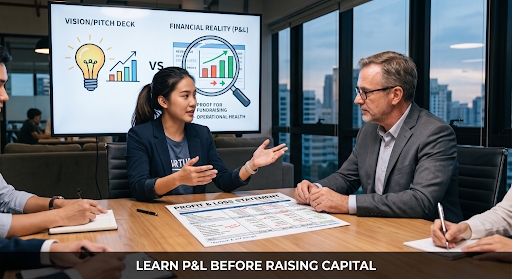
Pitching to investors usually feels like a high-stakes performance. You spend weeks perfecting slide decks, polishing vision statements, and refining pitch scripts late into the night. There's so much energy poured into describing market size, product features, and long-term potential.
Honestly, it’s easy to get caught up in the magic of your own vision while staring at the hum of your laptop screen at midnight.
Yet when meetings move past the initial introductions, the conversation shifts quickly. Investors want to see reality. They want to understand how money actually flows into the business, where it goes, and what remains after expenses.
This is where many early-stage founders run into friction. Pitch decks showcase optimism, but financial statements display truth.
I guess it comes down to a simple reality check. Among all financial documents, the profit and loss statement stands as the primary indicator of operational health. Learning to interpret this document before entering fundraising conversations isn't just an accounting exercise. It's a fundamental leadership capability.
Understanding the True Purpose of the P&L
A profit and loss statement, commonly called an income statement, summarizes revenues, costs, and expenses over a specific period. But what does it actually tell you about your business day to day? At its core, it answers a straightforward question: is the business generating more value than it consumes?
For early-stage startups, revenues might be modest or fluctuating. You know, that's completely normal.
What matters to seasoned investors is the underlying structure of your economics. A solid understanding of your income statement reveals whether your business model can scale or whether growth will simply amplify existing inefficiencies.
If you're new to analyzing financial records, consulting a comprehensive profit and loss statement guide can help you break down individual line items. And understanding how revenue translates into gross margin and operating income gives you immediate clarity on your operational levers.
Pitch Decks Tell Stories, Financials Provide Proof
Every compelling pitch tells a story about opportunity. You're solving a clear problem for a growing market. However, investors evaluate hundreds of pitches every year. So, how do you stand out when everyone has a great narrative?
Your financial statements serve as the proof for your story. And that's the point.
When you present revenue projections, investors look at your historical income statements to evaluate past performance. If you claim that customer acquisition costs will decrease as you scale, your historical sales and marketing spend must align with that narrative.
When founders can't explain the numbers on their financial statements, trust erodes quickly. I've seen that cold silence in a room when a simple question about gross margins goes unanswered. Investors begin to wonder whether the leadership team understands the operational reality of their own company. Conversely, a founder who speaks comfortably about gross margins, fixed expenses, and operating losses demonstrates competence and command over the business.
Identifying Operational Red Flags Early
Reading your financial statements before pitching enables you to identify and address weaknesses on your own terms. Isn't it far better to discover a margin issue during an internal review over coffee than to have a potential investor point it out during due diligence?
Margin Compression
Top-line growth can easily mask underlying profitability problems. If revenue increases by fifty percent while the cost of goods sold doubles, your gross margin is shrinking. Investors notice this immediately. Knowing how to read your income statement allows you to track margin trends and take corrective action before seeking external capital.
Escalating Operating Costs
Growth requires investment, but uncontrolled overhead can quickly drain resources. Maybe you hired too fast or signed off on software tools nobody uses anymore. By reviewing your operating expenses regularly, you can identify categories that are growing faster than revenue. This insight helps you tighten spending or prepare clear explanations for why specific investments were necessary.
Inefficient Unit Economics
A profit and loss statement reflects unit economics at scale. If your direct costs consume most of your revenue, no amount of sales volume will create profitability. And analyzing your income statement helps you evaluate whether pricing adjustments or vendor renegotiations are required before pitching for expansion capital.
Building Confidence in Investor Conversations
Fundraising meetings are rarely linear. Investors often interrupt presentations to ask detailed operational questions. They might ask about your contribution margin, your fixed expenditure breakdown, or how your gross margin compares to industry benchmarks.
If you rely entirely on an external accountant or finance contractor to interpret your numbers, you'll struggle during these moments. Pausing a meeting to check with an advisor signals a lack of operational involvement. You know, it breaks the momentum.
When you thoroughly understand your profit and loss statement, you answer questions with confidence. You can explain why expenses spiked in a specific quarter, how operational investments reduced unit costs, and where fresh capital will be allocated to drive growth. This level of preparation separates capable founders from amateur dreamers.
Preparing for the Due Diligence Phase
Passing an initial pitch meeting leads directly to due diligence. During this phase, investors and their analysts examine your financial records in detail. They look for consistency, accuracy, and operational discipline.
If your financial statements contain accounting errors, misclassified expenses, or sudden unexplained variances, the due diligence process slows down. In severe cases, deal terms may be renegotiated downward or withdrawn entirely.
By mastering your profit and loss statement early, you ensure your books are clean and well organized. You can provide historical context for every line item, explain seasonal fluctuations, and demonstrate a history of deliberate financial management.
Financial Literacy as a Long-Term Advantage
Fundraising is ultimately a temporary activity. Managing a company is a continuous responsibility.
So, why not build the habit now? Learning to read and analyze your profit and loss statement provides benefits that extend far beyond raising a seed or Series A round.
It enables you to make data-backed operational decisions daily. You can evaluate whether a prospective hire aligns with your budget, whether marketing investments are yielding appropriate returns, and how long your current cash runway will last under various scenarios.
Capital accelerates what already exists within a company. If your core financial structure is sound, capital fuels sustainable growth. But if your structure is flawed, capital merely accelerates cash burn. Mastering your financial statements ensures that when capital arrives, you're fully prepared to deploy it effectively.
About the Author
 Sanyukta Deb is Digital Marketing Team Lead at Next Move Strategy Consulting, where she has led content strategy and technical SEO for the firm's B2B market research publications for over 2 years. Her editorial process translates NextMSC's primary and secondary research — spanning technology, industrial, and consumer sectors — into commercial narratives, backed by search-intent, keyword, and competitive analysis. She brings 5 years of overall experience in digital marketing and content strategy.
About the Reviewer
 Debashree Dey is Assistant Manager at Next Move Strategy Consulting, where she supports cross-vertical market content and communications across diverse industries for 6 years. Her professional background includes senior content writing, communications, and published manuscript authorship, with experience developing audience-focused business narratives and maintaining clear, consistent messaging. Her role supports research-led content development and editorial quality across NextMSC publications.


















Add Comment