China’s AI Robot Half Marathon Signal Innovation in Robotics
Industry Insights from Next Move Strategy Consulting
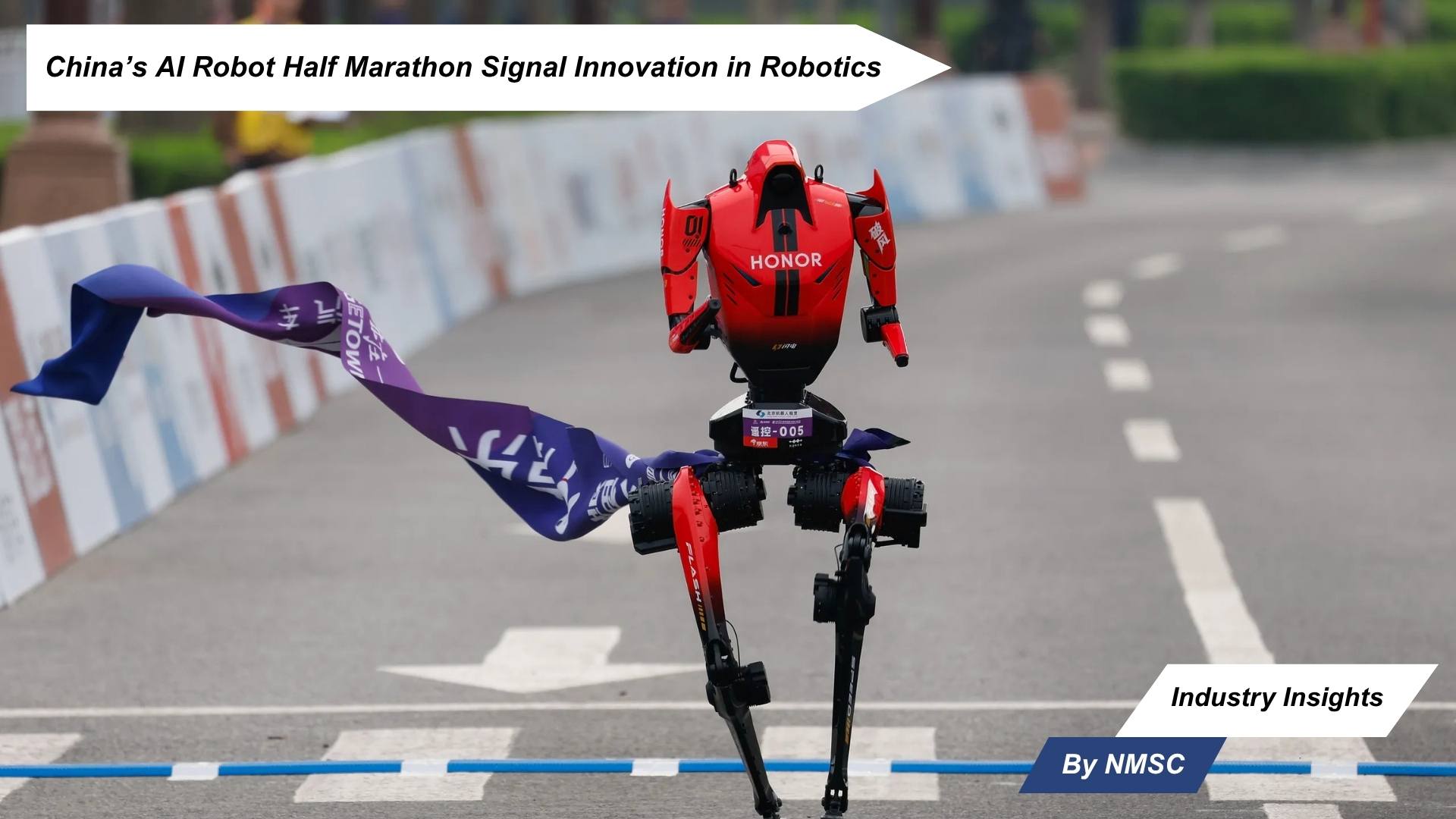
A recent demonstration in China, where an AI-powered humanoid robot successfully completed a half marathon in just 50 minutes, marks a significant milestone in the evolution of real-world robotics. This achievement reflects the accelerating pace of artificial intelligence integration into physical systems, showcasing how robots are transitioning from controlled environments to dynamic, real-world applications.
A New Benchmark for AI-Powered Mobility
The half marathon performance highlights a critical leap in robotics—endurance and sustained autonomous operation. Unlike earlier robotic demonstrations limited to short bursts of activity or confined spaces, this event underscores the growing capability of AI robots to maintain stability, coordination, and efficiency over extended periods.
The robot’s ability to complete the distance within a competitive timeframe signals advancements not only in mechanical design but also in AI-driven motion planning, energy management, and environmental adaptation. These capabilities are essential for deploying robots in industries that demand reliability over long durations.
Bridging the Gap Between Simulation and Reality
Historically, robotics development has relied heavily on controlled simulations and laboratory testing. However, real-world environments introduce unpredictable variables such as terrain variation, fatigue, and system stress. The successful completion of a half marathon demonstrates that modern AI systems are increasingly capable of handling such complexities.
This progression suggests that robots are becoming more viable for real-world tasks, including logistics, manufacturing, and field operations, where consistent performance under varying conditions is critical.
Key Capabilities Demonstrated:
-
Sustained Autonomous Operation over long-distance running
-
Advanced Motion Coordination ensuring balance and efficiency
-
Real-Time Adaptability to dynamic physical conditions
-
Energy Optimization enabling prolonged activity without failure
-
Integrated AI Control Systems for continuous performance monitoring
Implications for Industrial and Commercial Applications
The achievement reflects broader momentum in the AI robotics sector, where the focus is shifting from isolated functionality to holistic performance. Endurance-based demonstrations like this serve as proof points for industries evaluating robotic deployment in real operational settings.
As companies seek automation solutions capable of handling repetitive, physically demanding tasks, such advancements indicate that AI robots are moving closer to practical, scalable adoption. The ability to sustain performance over extended durations opens new possibilities across sectors including warehousing, transportation, and infrastructure maintenance.
Industry Response and Strategic Outlook
The demonstration has drawn attention as a clear indicator of how rapidly AI and robotics technologies are converging. It highlights the increasing sophistication of physical AI systems, where software intelligence and hardware engineering are tightly integrated to deliver consistent real-world outcomes.
According to Next Move Strategy Consulting, such endurance-focused milestones are expected to influence investment trends in AI Robots, with growing emphasis on durability, autonomy, and operational efficiency. These factors are becoming central to the next generation of AI-driven machines.
Advancing Toward Autonomous Physical Intelligence
China’s AI robot half marathon achievement represents more than a technical milestone—it signals a shift in how robotics is perceived and deployed. As AI systems continue to evolve beyond controlled environments, their ability to perform complex, sustained tasks in the physical world will define the future of automation.
This development reinforces the trajectory toward highly capable, autonomous robots that can operate seamlessly alongside humans, transforming industries and redefining the boundaries of artificial intelligence in motion.
Source: Bloomberg
Prepared by: Next Move Strategy Consulting
About the Author
 Prakhyat Chowdhury
— Prakhyat Chowdhury is a results-driven Market Analyst and data strategist specializing in business intelligence, trend forecasting, and performance-focused market growth. His competitive intelligence frameworks, and data-driven insights enhances strategic planning, operational efficiency, and organizational authority. Known for strong communication, analytical thinking, and multilingual proficiency, he delivers rigorous, objective-led solutions that support scalable business outcomes across industries with professionalism. He consistently aligns quantitative and qualitative analysis with global business goals.
Prakhyat Chowdhury
— Prakhyat Chowdhury is a results-driven Market Analyst and data strategist specializing in business intelligence, trend forecasting, and performance-focused market growth. His competitive intelligence frameworks, and data-driven insights enhances strategic planning, operational efficiency, and organizational authority. Known for strong communication, analytical thinking, and multilingual proficiency, he delivers rigorous, objective-led solutions that support scalable business outcomes across industries with professionalism. He consistently aligns quantitative and qualitative analysis with global business goals.
About the Reviewer
 Sanyukta Deb
— Sanyukta Deb is Digital Marketing Team Lead at Next Move Strategy Consulting, where she has led content strategy and technical SEO for the firm's B2B market research publications for over 2 years. Her editorial process translates NextMSC's primary and secondary research — spanning technology, industrial, and consumer sectors — into commercial narratives, backed by search-intent, keyword, and competitive analysis. She brings 5 years of overall experience in digital marketing and content strategy.
Sanyukta Deb
— Sanyukta Deb is Digital Marketing Team Lead at Next Move Strategy Consulting, where she has led content strategy and technical SEO for the firm's B2B market research publications for over 2 years. Her editorial process translates NextMSC's primary and secondary research — spanning technology, industrial, and consumer sectors — into commercial narratives, backed by search-intent, keyword, and competitive analysis. She brings 5 years of overall experience in digital marketing and content strategy.















Add Comment