FDA's GRAS Rule Reshapes Beverage Stabilizer Market as Compliance Tightens

FDA's Mandatory GRAS Rule Puts Every Carrageenan, Pectin, and Xanthan Gum Supplier on Notice — Reshaping a Market Headed for $220.7 Million by 2030
On August 10, 2026, the U.S. Food and Drug Administration issued the most consequential structural reform to food ingredient oversight since 1958: a proposed rule that would, for the first time in the agency's history, require manufacturers to formally notify the FDA every time they conclude that a substance added to human or animal food qualifies as Generally Recognized as Safe (GRAS). For the beverage stabilizers industry — where carrageenan, xanthan gum, pectin, gum arabic, and carboxymethyl cellulose (CMC) have long operated under self-affirmed GRAS determinations without mandatory federal disclosure — the rule introduces a compliance obligation that will require every ingredient supplier and beverage manufacturer to audit, document, and publicly register the safety basis for each stabilizer in their portfolio.
According to Next Move Strategy Consulting's Beverage Stabilizers Market report, the global beverage stabilizers market was valued at USD 148.5 million in 2021 and is projected to reach USD 220.7 million by 2030, growing at a CAGR of 5.8% from 2022 to 2030. The FDA's August 2026 proposed rule arrives at a pivotal inflection point: demand for stabilizers is structurally expanding across functional beverages, plant-based dairy alternatives, and fortified fruit drinks, while the regulatory cost of maintaining a compliant ingredient portfolio is simultaneously rising — a combination that will accelerate consolidation among suppliers capable of absorbing the new documentation burden and disadvantage smaller formulators relying on undisclosed self-GRAS conclusions.
For More Information: Download FREE Sample on Beverage Stabilizers Market Report
FDA's Mandatory GRAS Rule: What It Means for Beverage Stabilizer Manufacturers
The proposed rule, published in the Federal Register on August 11, 2026 (Docket No. FDA-2025-N-3262), would amend 21 CFR Parts 170 and 570 to require mandatory submission of GRAS notices for any substance introduced into interstate commerce under the GRAS provision of Section 201(s) of the Federal Food, Drug, and Cosmetic Act. The rule does not create a premarket approval requirement — manufacturers may continue marketing a substance before, during, and after the notification process — but it does mandate that the identity of the substance, its method of manufacture, dietary exposure data, and the narrative basis for the GRAS conclusion be submitted electronically and made publicly accessible within weeks of filing.
As Acting FDA Commissioner Kyle Diamantas stated in connection with the proposed rule: "What we're doing is requiring companies that utilize that pathway to notify us of their conclusions, so that we have greater visibility into those conclusions, and so that consumers have awareness."
The practical implications for beverage stabilizer suppliers are significant and specific. As of 2011, at least 1,000 human food substances had entered the U.S. market through self-GRAS pathways with no public disclosure of underlying safety information — a gap the U.S. Government Accountability Office identified in a 2010 report. Many beverage stabilizers — particularly specialty hydrocolloid blends and modified starch systems used in functional drinks — fall into this category. Under the proposed rule, manufacturers of these substances must either file a full GRAS notice or, for legacy substances already in commerce, submit a streamlined filing within one year of the final rule's effective date. The streamlined pathway requires only basic identifying information — substance name, intended conditions of use, and evidence of prior interstate commerce — without underlying safety data, making it the most accessible compliance route for established stabilizer ingredients.
The public comment period closes on December 9, 2026, and the rule cannot be finalized before 2027 at the earliest. However, the competitive exposure created by mandatory public disclosure of GRAS notice contents — including use levels, food applications, and manufacturing processes — is already prompting ingredient suppliers to evaluate which proprietary stabilizer formulations they are prepared to register publicly and which may require reformulation to protect trade-sensitive information.
The proposed rule is a flagship initiative of the Trump Administration's Make America Healthy Again (MAHA) strategy, building on earlier actions including the phase-out of petroleum-based synthetic dyes and the rollout of a post-market chemical review framework.
Tate & Lyle–CP Kelco Integration Concentrates Hydrocolloid Supply
Concurrent with the regulatory shift, the competitive structure of the beverage stabilizers supply chain underwent a fundamental realignment when Tate & Lyle PLC completed its USD 1.8 billion acquisition of CP Kelco on November 15, 2024. CP Kelco is the world's leading producer of nature-based hydrocolloids, with key product lines spanning pectin, carrageenan, gellan gum, xanthan gum, and diutan gum — ingredients that collectively underpin texture, suspension stability, and mouthfeel across fruit drinks, dairy beverages, soft drinks, and alcoholic beverages.
The combined entity now offers one of the industry's most comprehensive stabilizer portfolios, integrating CP Kelco's hydrocolloid technologies with Tate & Lyle's sweetener and fortification capabilities to create a single-source texture solutions platform. For beverage manufacturers navigating the new GRAS notification requirements, this consolidation has a direct operational consequence: sourcing carrageenan, xanthan gum, and pectin from a single integrated supplier simplifies the GRAS documentation chain, as the supplier's existing "no questions" letters and regulatory filings can cover a broader range of stabilizer applications under a single compliance umbrella.
State-Level Regulatory Patchwork Compounds Compliance Burden
Beyond the federal GRAS proposed rule, beverage stabilizer manufacturers face a fragmented and accelerating state regulatory landscape that is creating conflicting formulation requirements across U.S. distribution channels.
On June 23, 2026, the Michigan House of Representatives passed HB 5069, which would prohibit the sale of foods containing brominated vegetable oil, propylparaben, and several synthetic dyes — including Red 40, Yellow 6, Blue 1, Blue 2, and Green 3 — beginning January 1, 2029. While these specific substances are not primary beverage stabilizers, their phase-out in beverages sold in Michigan will require reformulation of color-stabilizer systems in which synthetic dyes and hydrocolloid stabilizers are co-formulated to maintain visual consistency and particle suspension.
Texas SB 25, which requires warning labels on foods containing any of 44 specified ingredients, was partially blocked by a federal district court preliminary injunction in February 2026 on First Amendment compelled-speech grounds, though the case remains ongoing. Critically, the Texas Department of State Health Services stated in the rule's preamble that ingredients considered GRAS or determined safe by the FDA are not subject to the warning requirement — meaning that beverage stabilizers with active GRAS notices on file are effectively shielded from the Texas labeling obligation, providing a direct commercial incentive for suppliers to file GRAS notices proactively rather than waiting for the federal rule to be finalized.
On June 1, 2026, Louisiana Governor Jeff Landry signed SB 57, which delayed and narrowed the state's food additive disclosure requirements enacted under SB 14, pushing the effective date from January 1, 2028 to December 31, 2028, and removing acesulfame potassium from the list of ingredients triggering QR code disclosure.
As Kristi Wolff, Partner, and Alli Condra, Of Counsel, in the food and beverage group at Davis Wright Tremaine, wrote in their March 2026 regulatory update: "2026 may not bring immediate bans. But it is shaping the environment in which ingredient decisions, labeling claims, and marketing strategies will be judged. Companies that inventory exposure, organize substantiation, and build flexibility now will be better positioned when today's policy conversations turn into tomorrow's compliance requirements."
Functional Beverage Expansion Sustains Stabilizer Demand
The regulatory complexity is unfolding against a backdrop of structurally expanding demand for beverage stabilizers, driven by the rapid growth of functional, plant-based, and fortified beverage categories that require more sophisticated stabilization systems than conventional carbonated soft drinks.
The National Restaurant Association's "What's Hot in 2026" report identifies healthier, functional beverages — including prebiotic sodas, protein-fortified drinks, and personalized hydration formats — as a leading culinary trend, with clean-label and plant-based formulations specifically cited as meeting growing consumer demand for ingredient transparency. Each of these beverage formats presents distinct stabilization challenges: plant-based protein beverages require stabilizers that prevent protein aggregation and phase separation at low pH; prebiotic sodas require suspension systems that maintain probiotic viability and carbonation stability simultaneously; and fortified fruit drinks require emulsification systems that keep oil-soluble vitamins uniformly dispersed without sedimentation.
Fermentation-derived hydrocolloids — including xanthan gum and gellan gum — are gaining particular traction in beverage stabilization for plant-based dairy alternatives, owing to their ability to deliver high functionality at extremely low inclusion levels while meeting clean-label positioning requirements. Carrageenan, extracted from red algae seaweeds, remains well-suited to neutral-pH, protein-rich systems such as dairy beverages, while pectin is the preferred stabilizer for acidic products such as fruit drinks and juice-based beverages.
2026 U.S. Food Additive Regulatory Timeline: Key Developments Affecting Beverage Stabilizers
|
Date |
Regulatory Event |
Jurisdiction |
Direct Impact on Beverage Stabilizers |
|
February 2026 |
Federal court grants preliminary injunction blocking Texas SB 25 enforcement against trade association members |
Federal / Texas |
Stabilizers with active GRAS notices shielded from warning label requirement |
|
March 6, 2026 |
Davis Wright Tremaine publishes 2026 Food Regulatory Update: Ingredients in the Crosshairs |
Federal / Multi-State |
Signals accelerating state-level ingredient scrutiny |
|
June 1, 2026 |
Louisiana Governor signs SB 57, delaying food additive disclosure requirements to December 31, 2028 |
Louisiana |
Extends compliance window for stabilizer disclosure obligations |
|
June 23, 2026 |
Michigan House passes HB 5069 banning brominated vegetable oil, propylparaben, and synthetic dyes from January 1, 2029 |
Michigan |
Requires reformulation of color-stabilizer co-formulations in Michigan-distributed beverages |
|
July 3, 2026 |
White House OIRA releases 2026 Unified Regulatory Agenda; mandatory GRAS notification rule delayed to December 2026 |
Federal |
Extends planning window for stabilizer suppliers to prepare GRAS dossiers |
|
August 10, 2026 |
FDA issues proposed rule requiring mandatory GRAS notifications (Docket No. FDA-2025-N-3262) |
Federal |
All beverage stabilizers marketed under self-GRAS conclusions must be registered; streamlined pathway available for legacy substances |
|
August 11, 2026 |
Proposed rule published in Federal Register; 120-day public comment period opens |
Federal |
Comment period closes December 9, 2026; final rule expected no earlier than 2027 |
NMSC Strategic Perspective: The GRAS Rule as a Market Restructuring Event
NextMSC primary research and analysis identifies the FDA's August 2026 mandatory GRAS notification proposed rule as a structural market event — not merely a compliance exercise — that will accelerate consolidation among beverage stabilizer suppliers and widen the competitive gap between large integrated hydrocolloid producers and smaller specialty formulators.
The mechanism is specific: under the proposed rule, all GRAS notice contents — including the substance's identity, method of manufacture, specific food applications, and use levels — become publicly accessible within weeks of filing. For large suppliers such as Tate & Lyle (now integrated with CP Kelco), Cargill, Kerry Group, and Archer Daniels Midland, this transparency obligation is manageable because their stabilizer portfolios are already extensively documented through decades of voluntary GRAS filings, food additive petitions, and regulatory submissions across multiple jurisdictions. As of March 2025, FDA's Human Foods Program had filed more than 1,200 voluntary GRAS notices — the majority submitted by large ingredient companies with established regulatory affairs infrastructure.
For smaller specialty stabilizer formulators — particularly those marketing proprietary hydrocolloid blends or modified starch systems under self-GRAS conclusions that have never been publicly disclosed — the mandatory notification requirement creates a binary choice: invest in the regulatory infrastructure to file and defend GRAS notices, or exit the market segments where the compliance cost exceeds the commercial return. NextMSC analysis indicates that this dynamic will compress the number of active stabilizer suppliers in the U.S. market over the 2027–2030 period, concentrating market share among the established players already named in NMSC's competitive landscape analysis: Cargill, Kerry Group, CP Kelco (now Tate & Lyle), Glanbia Nutritionals, Ashland, Archer Daniels Midland, DuPont, Tate & Lyle, DSM, and Actaris.
Simultaneously, the GRAS rule creates a specific commercial opportunity for suppliers whose stabilizer ingredients already carry FDA "no questions" letters — the formal response indicating the agency has no questions regarding a GRAS conclusion. These suppliers are explicitly exempted from the mandatory notification requirement for those substances, giving them a compliance cost advantage that will become a meaningful differentiator in customer procurement decisions as beverage manufacturers seek to simplify their own regulatory exposure.
From a geographic standpoint, NextMSC primary research and analysis notes that North America's regulatory leadership on GRAS reform will not immediately translate into equivalent requirements in Asia-Pacific — the region NMSC identifies as the fastest-growing market for beverage stabilizers, driven by rising disposable incomes, expanding packaged beverage consumption, and the emergence of smoothie bar chains across India, China, and Southeast Asia. This regulatory divergence creates a near-term window for Asia-Pacific-based stabilizer producers to supply U.S. beverage manufacturers with ingredients that have not yet been subjected to mandatory GRAS notification, provided those ingredients meet existing FDA food additive or GRAS standards — a compliance gap that FDA's post-market chemical review framework is specifically designed to close over time.
Competitive Landscape
The beverage stabilizers market is led by a concentrated group of multinational ingredient companies with vertically integrated hydrocolloid supply chains. The November 2024 completion of Tate & Lyle's USD 1.8 billion acquisition of CP Kelco created the industry's most comprehensive single-source stabilizer platform, combining CP Kelco's pectin, carrageenan, gellan gum, and xanthan gum technologies with Tate & Lyle's sweetener and fortification capabilities.
Cargill maintains a diversified stabilizer platform that includes carrageenan, pectin, and digital texture optimization technologies. In September 2024, Cargill inaugurated a sunflower lecithin facility designed to supply non-GMO and allergen-free emulsifiers for confectionery and beverage systems, extending its clean-label ingredient portfolio. Kerry Group has focused on enzyme-emulsifier blends designed to replace synthetic mono- and diglycerides in industrial food and beverage production, positioning its stabilizer portfolio within the clean-label reformulation trend.
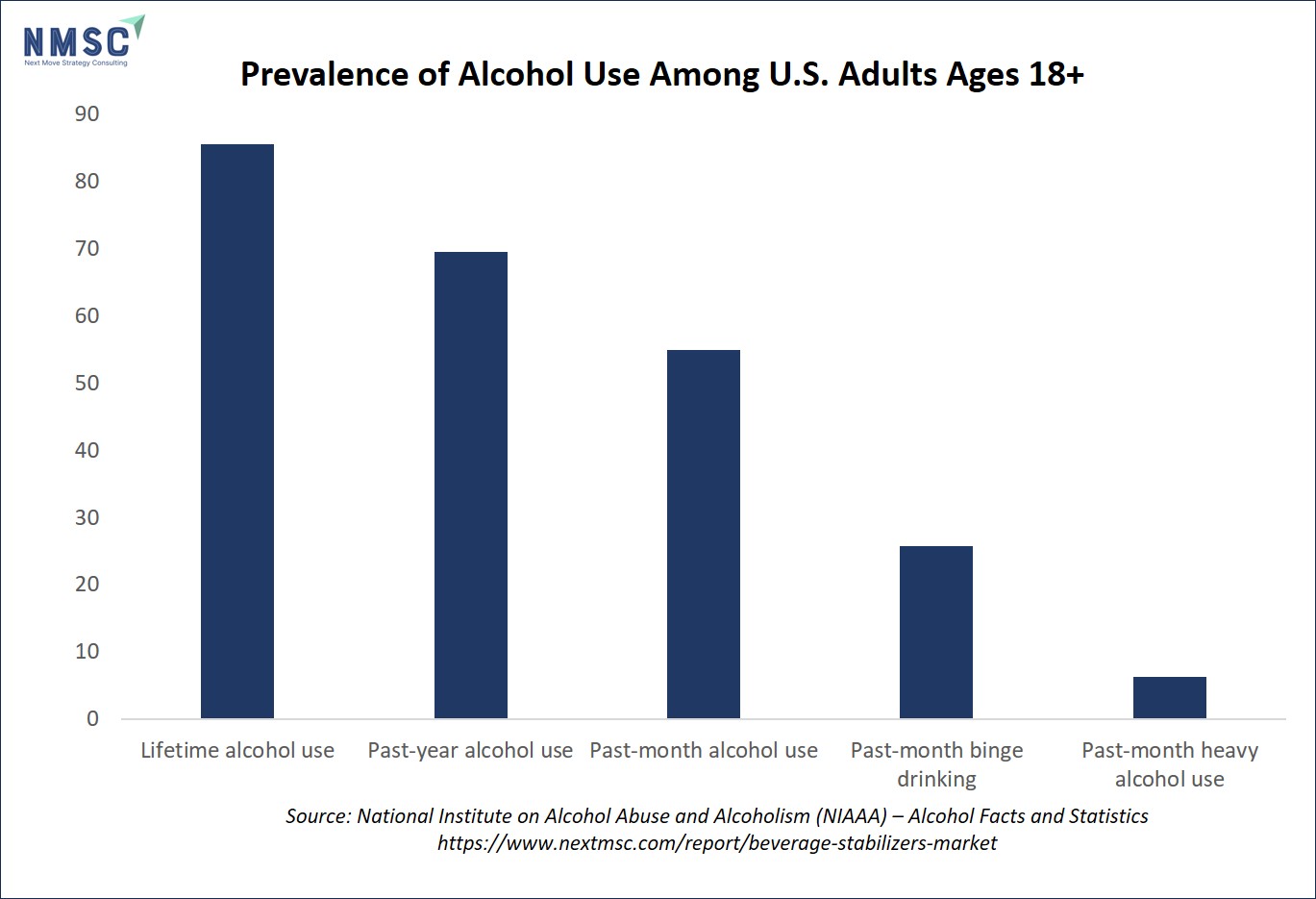
North America holds the largest regional share of the beverage stabilizers market, supported by high per-capita beverage consumption, a large and growing millennial and Gen Z consumer base with demonstrated preference for functional and fortified beverages, and the concentration of major stabilizer producers in the region. According to the National Institute on Alcohol Abuse and Alcoholism's 2022 survey, 85.6% of people aged 18 and older in the United States reported drinking alcohol at some point in their lifetime, and 54.9% reported drinking in the past month — a consumption base that sustains demand for carrageenan and CMC-based stabilizers in alcoholic beverage formulations.
Asia-Pacific is the fastest-growing regional market, with rising packaged beverage consumption driven by population growth, increasing disposable incomes, and the rapid expansion of juice and smoothie bar chains. According to the Asia Beer Challenge Organization, Asia accounted for 50% of total global beer consumption in 2022, placing it ahead of any other region and sustaining demand for carrageenan and xanthan gum-based stabilizers in beer and malt beverage formulations.
Bottom Line
The FDA's August 10, 2026 proposed rule mandating GRAS notifications for food substances is the single most consequential regulatory development for the beverage stabilizers market since the 1958 Food Additives Amendment. By converting a voluntary disclosure system into a mandatory one, the rule forces every carrageenan, xanthan gum, pectin, CMC, and gum arabic supplier operating in the U.S. market to formally register the safety basis for each stabilizer application — a process that will expose proprietary formulation details to public scrutiny and create a compliance cost differential that favors large, integrated hydrocolloid producers over smaller specialty formulators. Simultaneously, the November 2024 completion of Tate & Lyle's USD 1.8 billion acquisition of CP Kelco has already concentrated the supply of the market's most critical hydrocolloid ingredients — pectin, carrageenan, gellan gum, and xanthan gum — within a single entity, reducing supplier optionality for beverage manufacturers. Against this backdrop, NextMSC primary research and analysis projects the global beverage stabilizers market to grow from USD 148.5 million in 2021 to USD 220.7 million by 2030 at a 5.8% CAGR, with growth concentrated in functional beverages, plant-based dairy alternatives, and fortified fruit drinks — the precise categories where stabilization complexity, and therefore regulatory exposure, is highest.
About Next Move Strategy Consulting
Next Move Strategy Consulting is a premier market research and management consulting firm that has been committed to provide strategically analysed well documented latest research reports to its clients. The research industry is flooded with many firms to choose from, what makes NMSC different from the rest is its top-quality research and the obsession of turning data into knowledge by dissecting every bit of it and providing fact-based research recommendation that is supported by information collected from over 500 million websites, paid databases, industry journals and one on one consultations with industry experts across a diverse range of industry sectors. The high-quality customized research reports with actionable insights and excellent end-to-end customer service help our clients to take critical business decisions that enables them to move beyond time and have competitive edge in the industry.
We have been servicing over 1000 customers globally that includes 90% of the Fortune 500 companies over a decade. Our analysts are constantly tracking various high growth markets and identifying hidden opportunities in each sector or the industry. We provide one of the industry's best quality syndicate as well as custom research reports across 10 different industry verticals. We are committed to deliver high quality research solutions in accordance to your business needs. Our industry standard delivery solutions that ranges from the pre consultation to after-sales services, provide an excellent client experience and ensure right strategic decision making for businesses.
For more information, please contact:
Next Move Strategy Consulting
5th Floor 867 Boylston St, STE 500,
Boston, MA 02116, U.S.
E-Mail: [email protected]
Direct: +1-217-650-7991
Website: www.nextmsc.com
About the Author
 Sanyukta Deb
— Sanyukta Deb is Digital Marketing Team Lead at Next Move Strategy Consulting, where she has led content strategy and technical SEO for the firm's B2B market research publications for over 2 years. Her editorial process translates NextMSC's primary and secondary research — spanning technology, industrial, and consumer sectors — into commercial narratives, backed by search-intent, keyword, and competitive analysis. She brings 5 years of overall experience in digital marketing and content strategy.
Sanyukta Deb
— Sanyukta Deb is Digital Marketing Team Lead at Next Move Strategy Consulting, where she has led content strategy and technical SEO for the firm's B2B market research publications for over 2 years. Her editorial process translates NextMSC's primary and secondary research — spanning technology, industrial, and consumer sectors — into commercial narratives, backed by search-intent, keyword, and competitive analysis. She brings 5 years of overall experience in digital marketing and content strategy.
About the Reviewer
 Debashree Dey
— Debashree Dey is Assistant Manager at Next Move Strategy Consulting, where she supports cross-vertical market content and communications across diverse industries for 6 years. Her professional background includes senior content writing, communications, and published manuscript authorship, with experience developing audience-focused business narratives and maintaining clear, consistent messaging. Her role supports research-led content development and editorial quality across NextMSC publications.
Debashree Dey
— Debashree Dey is Assistant Manager at Next Move Strategy Consulting, where she supports cross-vertical market content and communications across diverse industries for 6 years. Her professional background includes senior content writing, communications, and published manuscript authorship, with experience developing audience-focused business narratives and maintaining clear, consistent messaging. Her role supports research-led content development and editorial quality across NextMSC publications.

















Add Comment