French BCI Firm HABS Pairs EEG Tech with China's Unitree Robot
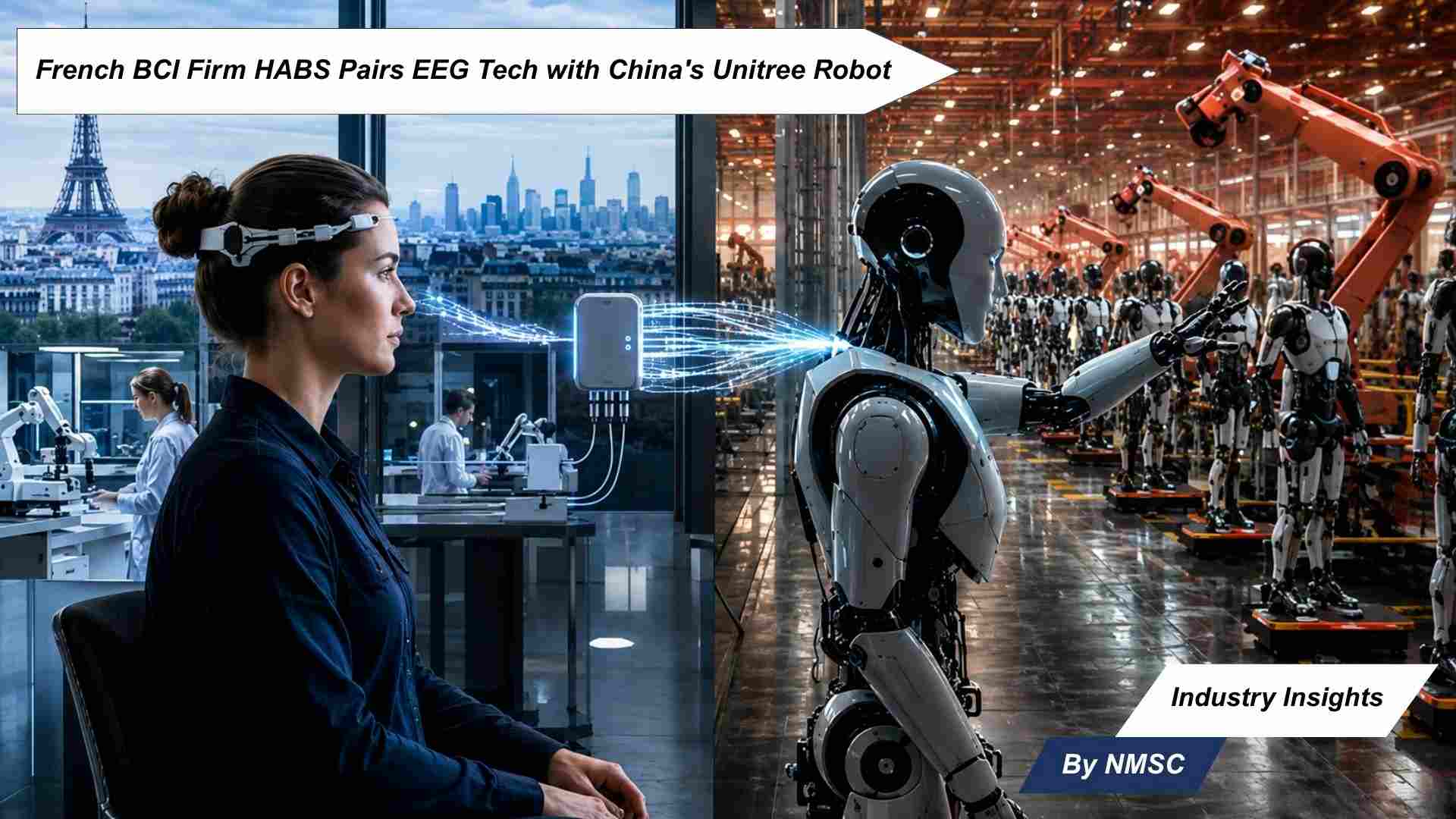
French Neurotechnology Startup HABS Integrates EEG Brain Interface with China's Unitree Robot, Raising Geopolitical Concerns
PARIS, France — July 27, 2026 — French neurotechnology startup HABS (Human Augmented Brain System) has drawn international attention after demonstrating its electroencephalography (EEG)-based brain-computer interface at the VivaTech technology show in Paris, where the system was connected to a Unitree G1 humanoid robot — one of China's most prominent robotic platforms — raising substantive questions about European neurotechnology sovereignty and cross-border intellectual property governance.
Main Development
The demonstration, facilitated by French technology integrator Innov8 Group, showed visitors wearing a lightweight EEG headband controlling the Unitree G1 robot's movements by concentrating on one of three predefined mental activities: a loved one, a favorite song, or a mathematical calculation. The HABS system classified the EEG pattern, converted it into a digital instruction, and transmitted it to the robot, which then executed a corresponding programmed movement.
HABS, formally established in France in 2023 by Olivier Locufier, develops noninvasive systems that use artificial intelligence to identify patterns in EEG signals. The company derives indicators associated with attention, cognitive workload, fatigue, pain, and emotional reactions — which it terms "NeuroMarkers."
VivaTech advertised the installation as a "Unitree × HABS" brain-machine interface and described it as a world-exclusive demonstration. However, analysts and observers have noted that no publicly available document establishes that HABS transferred its source code, complete AI models, or EEG training data to Unitree Robotics, the Hangzhou-based manufacturer.
The distinction between a protected interface and a full technology transfer carries significant strategic weight. Unitree reported shipping approximately 5,500 humanoid robots in 2025, with Chinese companies accounting for 87 percent of the approximately 13,000 humanoids deployed globally that year. TrendForce forecasts Unitree and AgiBot to account for nearly 80 percent of China's humanoid-robot shipments in 2026, with Chinese humanoid production expected to increase by 94 percent this year.
HABS also maintains a separate collaboration with Microsoft, announced in March 2026, to train and deploy neurocognitive AI models using Microsoft's cloud infrastructure, including access to 80 Nvidia H200 graphics processors. The company appears to be pursuing a hardware-neutral platform strategy, though this positions it at the intersection of American computing infrastructure and Chinese manufacturing scale.
The demonstration has prompted calls from European policy analysts for greater transparency around neural data ownership, processing location, and future commercial rights when European neurotechnology is integrated with foreign robotic platforms.
Key Highlights:
-
French BCI startup HABS demonstrated EEG-based brain-computer interface at VivaTech Paris, enabling a visitor to control a Unitree G1 humanoid robot through thought
-
Integration was facilitated by Innov8 Group, a French technology distributor representing Unitree Robotics in Europe
-
No public evidence confirms that HABS transferred its AI models, source code, or EEG training data to Unitree
-
Chinese companies accounted for 87% of approximately 13,000 humanoids deployed globally in 2025; Unitree alone shipped approximately 5,500 units
-
HABS also holds a separate cloud computing and AI infrastructure agreement with Microsoft, announced in March 2026
Analyst Insight:
According to analysts at Next Move Strategy Consulting, the global Brain Computer Interface Market is projected to reach USD 5.99 billion by 2030, growing at a compound annual growth rate (CAGR) of 15.9%. NMSC analysts note that the convergence of AI-driven signal processing and non-invasive BCI technologies is accelerating commercialization timelines globally. The HABS-Unitree integration exemplifies a broader trend in which European neurotechnology innovations are increasingly being demonstrated on Chinese robotic platforms — a dynamic that could reshape competitive positioning across the BCI and humanoid robotics sectors if data governance and intellectual property frameworks are not clearly established.
Industry Outlook:
The HABS-Unitree demonstration underscores a structural challenge facing European neurotechnology: the region produces significant research and innovation but has historically struggled to build scalable commercial platforms. As the global brain-computer interface market accelerates toward commercial deployment, industry stakeholders and policymakers are expected to scrutinize cross-border technology integrations more closely — particularly those involving sensitive neural data. Regulatory frameworks governing neural information, shared European robotics testing infrastructure, and clearer intellectual property disclosure requirements are likely to emerge as priority policy areas in the near term.
Source: ASEAN Today
For More Information – Download FREE Sample on Brain Computer Interface Market Report
Prepared By: Sanyukta Deb
About the Author
 Sanyukta Deb
— Sanyukta Deb is Digital Marketing Team Lead at Next Move Strategy Consulting, where she has led content strategy and technical SEO for the firm's B2B market research publications for over 2 years. Her editorial process translates NextMSC's primary and secondary research — spanning technology, industrial, and consumer sectors — into commercial narratives, backed by search-intent, keyword, and competitive analysis. She brings 5 years of overall experience in digital marketing and content strategy.
Sanyukta Deb
— Sanyukta Deb is Digital Marketing Team Lead at Next Move Strategy Consulting, where she has led content strategy and technical SEO for the firm's B2B market research publications for over 2 years. Her editorial process translates NextMSC's primary and secondary research — spanning technology, industrial, and consumer sectors — into commercial narratives, backed by search-intent, keyword, and competitive analysis. She brings 5 years of overall experience in digital marketing and content strategy.
About the Reviewer
 Debashree Dey
— Debashree Dey is Assistant Manager at Next Move Strategy Consulting, where she supports cross-vertical market content and communications across diverse industries for 6 years. Her professional background includes senior content writing, communications, and published manuscript authorship, with experience developing audience-focused business narratives and maintaining clear, consistent messaging. Her role supports research-led content development and editorial quality across NextMSC publications.
Debashree Dey
— Debashree Dey is Assistant Manager at Next Move Strategy Consulting, where she supports cross-vertical market content and communications across diverse industries for 6 years. Her professional background includes senior content writing, communications, and published manuscript authorship, with experience developing audience-focused business narratives and maintaining clear, consistent messaging. Her role supports research-led content development and editorial quality across NextMSC publications.


















Add Comment