Huawei Launches AI Data Center Solutions to Drive Intelligent Transformation
Industry Insights from Next Move Strategy Consulting
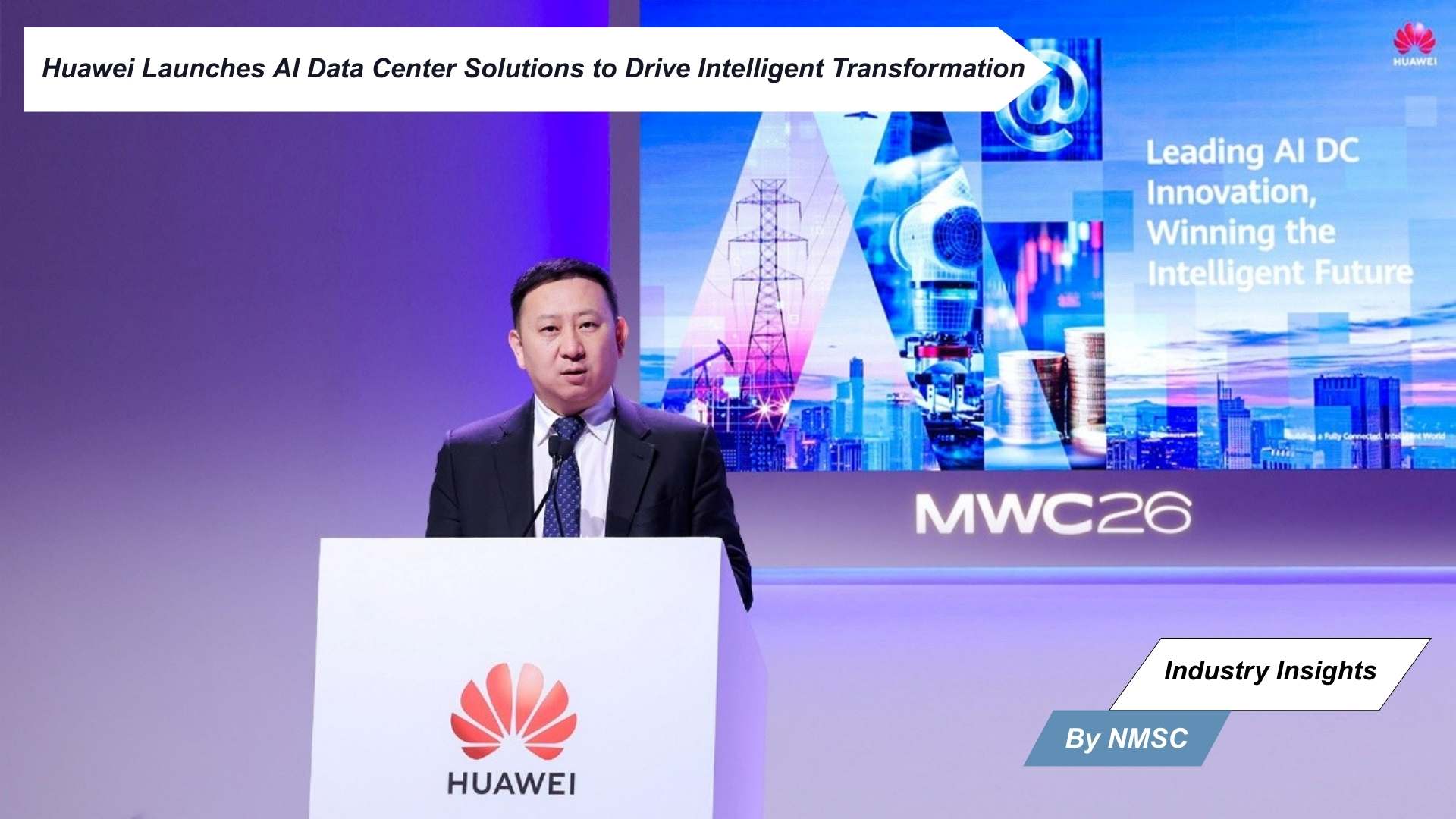
As artificial intelligence shifts toward agentic applications and industry-specific models, the global demand for robust computing infrastructure is surging. At the MWC Barcelona 2026 AI DC Innovation Session, Huawei introduced a suite of advanced products and solutions aimed at transforming data centers into efficient "productivity engines" capable of supporting the rapid expansion of intelligent services.
A Strategic Evolution for AI Infrastructure
Huawei’s latest initiatives address the mounting pressure on computing efficiency, data integration, and facility architecture. Recognizing that AI is evolving from a supporting tool to a core production application, the company is focusing on end-to-end convergence.
“AI data centers are the productivity engines of the intelligent era,” stated Michael Ma, Vice President of Huawei and President of ICT Product Portfolio Management & Solution. He emphasized that Huawei’s integrated approach-synergizing computing, storage, networking, AI platforms, and large models-provides an open, sustainable architecture for enterprises worldwide.
Key Innovations Driving the Intelligent Future:
-
Huawei AI Data Platform: Designed to overcome common barriers in AI implementation, this platform utilizes knowledge generation and retrieval, memory extraction, and inference acceleration powered by a Unified Cache Manager (UCM) to empower enterprise AI agents.
-
Xinghe AI Fabric 2.0: An evolution of the 2018 solution, this network architecture features an "AI Brain" with four core capabilities: Rock-Solid Architecture 2.0 for high reliability, StarryWing Digital Map 2.0 for automation, Xinghuan AI Turbo 2.0 for load balancing, and iFlashboot 2.0 for rapid system reboots.
-
Five-Pillar Infrastructure: To accommodate potential hundredfold growth in service requirements, Huawei’s strategy is built upon SuperPoDs, alongside compute-network, compute-storage, compute-cloud, and compute-management synergies.
Scalability and Real-World Application
The shift toward agentic AI requires infrastructure that can handle massive scale and complex deployment environments. During the session, industry leaders shared how these technologies are being applied to real-world challenges. From Macao’s economic diversification into tourism and technology to the FinTech transformation at West Africa’s Access Bank, organizations are leveraging Huawei’s resilient data center network (DCN) solutions to streamline architecture and improve operational effectiveness.
Strengthening the Foundation for Intelligent Productivity
As the focus moves from model training to unleashing real-world computing power, Huawei’s latest release aims to provide the necessary stability and performance for modern enterprises. By combining high-reliability networking, accelerated data processing, and integrated management, the company is positioning its AI data center solutions as a cornerstone for those looking to convert raw computing capacity into measurable intelligent productivity.
With these advancements, Huawei continues its commitment to collaborating with global partners to establish a reliable foundation for the next generation of AI-driven industrial intelligence.
Next Move Strategy Consulting (NMSC) Viewpoint: The Shift to AI-Native Infrastructure
Next Move Strategy Consulting observes that the release of Huawei’s AI DC products signals a fundamental transition in Data Center Landscape. As organizations pivot from general-purpose virtualization toward "agentic" AI applications, the traditional data center architecture is proving insufficient to meet the demands of high-performance computing. Architectural convergence—where storage, networking, and compute integrate into a unified, synergistic platform—is now a core prerequisite for competitiveness. Enterprises that continue to rely on siloed infrastructure will face insurmountable latency and efficiency gaps as they attempt to scale modern AI workloads.
The shift toward "hundredfold growth" infrastructure, exemplified by Huawei’s SuperPoDs and compute-synergy models, indicates a definitive change in long-term investment strategy. Industry leaders are no longer building for today’s capacity; they are designing for the massive, unpredictable scaling requirements of post-training and large-scale model inference. Consequently, the transition from basic network connectivity to intelligent, automated fabrics marks a maturation of the industry, where data center networks function as active participants in AI reliability rather than passive pathways. NMSC concludes that these modular, high-speed architectures provide a critical blueprint for organizations aiming to convert raw computing capacity into the sustainable productivity required for the next decade of digital transformation.
Source: Huawei
Prepared By: Next Move Strategy Consulting
About the Author
 Prakhyat Chowdhury
— Prakhyat Chowdhury is a results-driven Market Analyst and data strategist specializing in business intelligence, trend forecasting, and performance-focused market growth. His competitive intelligence frameworks, and data-driven insights enhances strategic planning, operational efficiency, and organizational authority. Known for strong communication, analytical thinking, and multilingual proficiency, he delivers rigorous, objective-led solutions that support scalable business outcomes across industries with professionalism. He consistently aligns quantitative and qualitative analysis with global business goals.
Prakhyat Chowdhury
— Prakhyat Chowdhury is a results-driven Market Analyst and data strategist specializing in business intelligence, trend forecasting, and performance-focused market growth. His competitive intelligence frameworks, and data-driven insights enhances strategic planning, operational efficiency, and organizational authority. Known for strong communication, analytical thinking, and multilingual proficiency, he delivers rigorous, objective-led solutions that support scalable business outcomes across industries with professionalism. He consistently aligns quantitative and qualitative analysis with global business goals.
About the Reviewer
 Sanyukta Deb
— Sanyukta Deb is Digital Marketing Team Lead at Next Move Strategy Consulting, where she has led content strategy and technical SEO for the firm's B2B market research publications for over 2 years. Her editorial process translates NextMSC's primary and secondary research — spanning technology, industrial, and consumer sectors — into commercial narratives, backed by search-intent, keyword, and competitive analysis. She brings 5 years of overall experience in digital marketing and content strategy.
Sanyukta Deb
— Sanyukta Deb is Digital Marketing Team Lead at Next Move Strategy Consulting, where she has led content strategy and technical SEO for the firm's B2B market research publications for over 2 years. Her editorial process translates NextMSC's primary and secondary research — spanning technology, industrial, and consumer sectors — into commercial narratives, backed by search-intent, keyword, and competitive analysis. She brings 5 years of overall experience in digital marketing and content strategy.















Add Comment