ISS Agrees to Buy Tomagruppen as Sodexo Wins Meta's Global Food Contract

ISS Acquires Tomagruppen and Sodexo Secures Meta's Global Food Contract as Diversified Support Services Consolidation Enters a New Phase
On May 7, 2026, ISS World Services A/S announced a binding agreement to acquire Tomagruppen AS, a Norwegian majority family-owned facility services company founded in 1978 that generated approximately DKK 1.8 billion in revenue in 2025 and employs more than 4,000 people across Norway and Denmark. The transaction, which is subject to customary regulatory approvals, positions ISS Norway as the largest facility services provider in the Norwegian market while simultaneously adding scale to ISS Denmark's integrated facility services portfolio — a structural move that illustrates the accelerating consolidation logic reshaping the global diversified support services industry. Less than ten weeks later, on July 15, 2026, Sodexo announced that it had been selected by Meta to deliver food services across more than 130 locations in over 30 countries, covering corporate offices, large campuses, data centres, and conference hubs — a contract Sodexo described as one of the largest single global workplace food services agreements it has secured to date.
These two events — one a Nordic bolt-on acquisition, the other a global enterprise contract spanning six continents — are not isolated transactions. They are symptomatic of a structural shift in how the world's largest enterprises and institutions procure operational support, and they are occurring against a market backdrop of considerable scale. According to Next Move Strategy Consulting's Diversified Support Services Market report, the global Diversified Support Services Market was valued at USD 1.46 trillion in 2026 and is projected to reach USD 1.92 trillion by 2035, advancing at a compound annual growth rate (CAGR) of 3.5% over the 2026–2035 forecast period. NMSC's proprietary research and analysis identifies healthcare infrastructure expansion, accelerating enterprise outsourcing of non-core operations, growing government procurement mandates, and the integration of digital delivery platforms as the four primary structural forces sustaining this trajectory.
For More Information: Download FREE Sample on Diversified Support Services Market Report
The ISS-Tomagruppen Transaction: What Nordic Consolidation Reveals About Global Market Dynamics
The strategic rationale behind ISS's acquisition of Tomagruppen extends well beyond geographic footprint expansion. Tomagruppen delivers cleaning, catering, property management, and other support services to both public and private sector clients — a service portfolio that maps directly onto ISS's Integrated Facility Services (IFS) model, which bundles multiple service categories under a single contractual relationship.
"We are excited to announce this agreement, welcoming more than 4,000 new colleagues — as well as new customers. Beyond expanding our presence in the Nordic region, this bolt-on acquisition is a strong strategic fit with ISS' well-performing business in both Norway and Denmark. It will drive efficiencies and unlock clear synergies, while enabling us to further scale and enhance our Integrated Facility Services offering for customers across the region," said Kasper Fangel, Group CEO of ISS, in the company's official announcement on May 7, 2026.
The Tomagruppen deal is not ISS's only significant commercial development in 2026. On September 11, 2026, ISS announced the extension and expansion of a partnership with a key account customer in North America, broadening the scope of integrated facility services delivered across that client's sites to include selected technical services. On October 2, 2026, ISS entered a new integrated facility services partnership with Tryg, the Nordic insurance group, covering catering, cleaning, indoor and related services across Tryg's sites. Taken together, these three commercial events within a five-month window demonstrate that the world's largest facility services operators are simultaneously pursuing inorganic scale through acquisition and organic revenue expansion through contract scope enlargement — a dual-track growth strategy that NMSC's proprietary research identifies as the defining competitive behaviour of the current market phase.
Sodexo-Meta: When a Food Services Contract Becomes a Statement About the Future of Enterprise Outsourcing
The Sodexo-Meta contract announced on July 15, 2026 is analytically significant not merely for its scale, but for what its award criteria reveal about how large technology enterprises now evaluate support services providers. Sustainability formed an integral part of Meta's selection process and will be fully embedded in the program, according to Sodexo's official announcement. The contract requires Sodexo to deliver integrated workplace food services through a structured global operating model that combines consistent global standards with local execution, advanced digital capabilities, and measurable sustainability outcomes across 30+ countries simultaneously.
"This success was driven by our people, anchored in strong leadership commitment and a 60-year heritage of hospitality services. Meta's ambition for exceptional culinary experiences everywhere they operate aligns perfectly with our proven expertise to deliver at scale. This contract win is a reflection of the level of commercial intensity Sodexo can unlock when our global team come together to build the right offer and showcase our global capabilities. It shows our ability to convert wide-scale competitive tenders into material growth opportunities," said Thierry Delaporte, Chief Executive Officer of Sodexo, in the company's July 15, 2026 announcement.
The Sodexo-Meta contract also illustrates a procurement pattern that NMSC's analysis identifies as structurally significant: technology sector enterprises — which operate large, geographically dispersed campus and office portfolios — are consolidating food, facilities, and workplace experience services under single global providers rather than managing fragmented regional vendor relationships. This consolidation dynamic directly benefits operators with the geographic coverage, digital infrastructure, and sustainability reporting capability to compete in global tenders of this complexity.
Iron Mountain's Record Quarter: Digital Transformation Reshapes the Storage and Records Segment
While facilities and catering operators are consolidating through M&A and global contract wins, the storage and records segment of the Diversified Support Services Market is undergoing a more fundamental structural transformation. Iron Mountain Incorporated (NYSE: IRM) reported record quarterly results for Q2 2026 on August 5, 2026, with total revenues of USD 2.0 billion — an increase of 18.5% on a reported basis compared to Q2 2025. Critically, Iron Mountain's growth businesses — comprising data centre, digital, and asset lifecycle management (ALM) services — collectively grew more than 50% year over year in Q2 2026, demonstrating that the company's strategic pivot from physical document storage toward digital vaulting, data centre infrastructure, and managed digital services is generating measurable revenue acceleration.
"We delivered another record-breaking quarter, with our second quarter results exceeding our expectations due to our team's strong execution of our growth plans and the continued trust of our clients. Our ongoing success continues to be driven by the collective strength in our physical records storage and growth businesses, together with the stewardship we provide to our more than 240,000 customers," stated William L. Meaney, President and CEO of Iron Mountain, in the company's August 5, 2026 earnings release.
Iron Mountain's Q2 2026 Adjusted EBITDA reached USD 727 million, a 15.7% increase compared to USD 628 million in Q2 2025, while the company raised its full-year 2026 revenue guidance to USD 7.94–8.01 billion. The data centre leasing pipeline — 110 megawatts leased year to date through July 2026 — signals that the boundary between traditional records management and digital infrastructure services is dissolving, creating a new category of hybrid storage-and-compute service that is expanding the addressable revenue opportunity for operators with both physical and digital capabilities.
ABM Industries: Technical Solutions and Mission-Critical Services Drive Broad-Based Revenue Growth
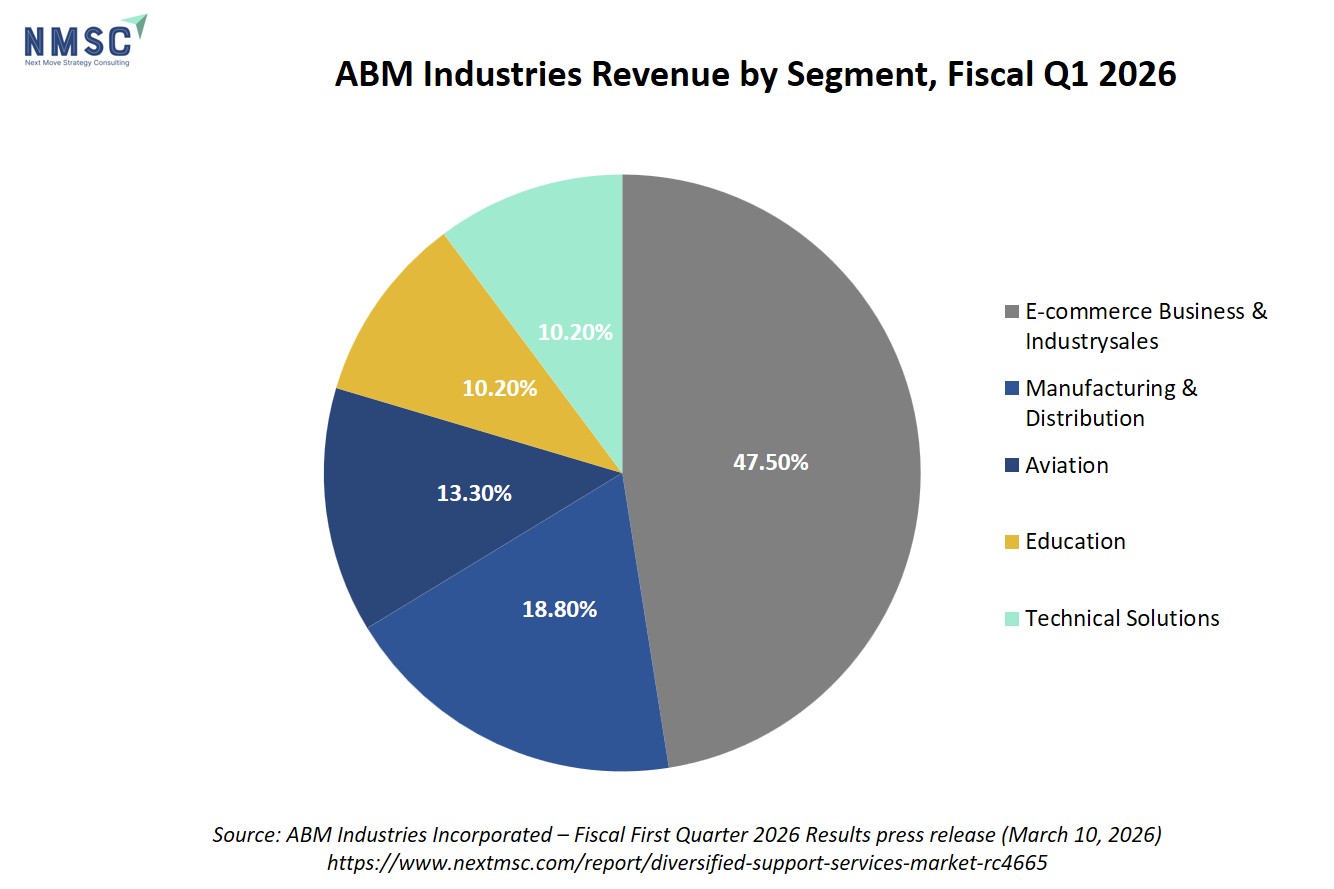
ABM Industries (NYSE: ABM), one of the world's largest providers of integrated facility, engineering, and infrastructure solutions, reported fiscal Q1 2026 revenue of USD 2.2 billion on March 10, 2026 — an increase of 6.1% year over year, including 5.5% organic growth. ABM's Technical Solutions segment grew 13.6% year over year in the quarter, driven by strong demand for mission-critical and data centre-related services, while the Aviation segment grew 10.2%, reflecting healthy air travel trends and the continued ramp of new contracts.
"ABM is off to a solid start to fiscal 2026, delivering strong organic revenue growth of 5.5% and meaningful improvement in operating cash flow and free cash flow. Growth was broad-based across our portfolio, reflecting healthy demand in our end markets and our team's continued success in expanding client relationships. This performance reinforces our confidence in the strength and resiliency of our business," said Scott Salmirs, President and Chief Executive Officer of ABM, in the company's March 10, 2026 earnings release.
ABM's Q1 FY2026 results also highlighted the WGNSTAR acquisition — closed at the beginning of Q2 FY2026 — which strengthens ABM's position in the semiconductor fabrication environment support services market, a specialized technical services niche where cleanroom cleaning, HVAC, and precision maintenance requirements command premium contract pricing relative to standard commercial facilities management.
NMSC Market Size & Segmentation Analysis
Diversified Support Services Market — Service Type Segmentation, 2025–2035
|
Service Type Segment |
2025 Revenue (USD Bn) |
2035 Revenue (USD Bn) |
CAGR (2026–2035) |
|
Facilities Services |
612.4 |
796.2 |
2.9% |
|
Technical Services |
284.6 |
451.8 |
4.8% |
|
Textile Services |
186.8 |
272.4 |
3.9% |
|
Business Support Services |
148.2 |
194.6 |
2.8% |
|
Storage and Records |
112.4 |
148.2 |
2.8% |
|
Remarketing & Transaction Services |
68.2 |
54.2 |
−2.3% |
Facilities Services, anchored by Cleaning and Janitorial as its dominant sub-segment, held the largest revenue share at USD 612.4 billion in 2025, sustained by institutional demand from healthcare, education, and commercial real estate clients that require permanently embedded on-site delivery teams. Technical Services is the fastest-growing primary segment at a CAGR of 4.8% from 2026 to 2035, propelled by enterprise outsourcing of industrial maintenance, HVAC, mechanical and electrical operations, and inspection and testing across manufacturing, energy, and defense facility portfolios — categories where ABM's Technical Solutions segment and SPIE's industrial maintenance operations are capturing disproportionate contract growth. According to NextMSC primary research and analysis, the Remarketing and Transaction Services segment is the only primary segment projected to contract over the forecast period, as digital platforms operated by Copart and RB Global displace physical auction yard revenue models, compressing per-vehicle processing fees even as transaction volumes grow.
Europe remains the largest regional market at USD 486.4 billion in 2025, underpinned by an extensive public sector outsourcing ecosystem and the EU Corporate Sustainability Reporting Directive (CSRD), which entered active implementation in 2026 and requires large European support services providers to disclose detailed ESG metrics — creating measurable competitive differentiation between sustainability leaders such as Sodexo and ISS and operators that have not yet built transparent reporting infrastructure. Asia-Pacific is the fastest-growing major region at a CAGR of 4.9%, with India advancing at 6.8% — the highest national growth rate in the market — driven by the Pradhan Mantri Jan Arogya Yojana health scheme's hospital construction pipeline, smart city development programs, and the rapid expansion of Information Technology and business process outsourcing campuses that require integrated facility management services, according to NextMSC primary research and analysis.
ESG Mandates and the CSRD: How Regulatory Architecture Is Restructuring Contract Award Criteria
The EU Corporate Sustainability Reporting Directive represents one of the most consequential regulatory developments affecting the competitive dynamics of the European Diversified Support Services Market in the current period. Under the 2026 Omnibus I Directive, large European support services providers with over 1,000 employees face mandatory ESRS disclosures starting in fiscal year 2027, increasing long-term transparency and reputational differentiation.
The practical consequence for contract competition is direct: enterprise and government buyers in Europe are embedding carbon reduction, water efficiency, ethical labor practices, and circular economy performance metrics into contract award criteria at a pace that is outrunning the sustainability reporting capabilities of smaller regional operators. Sodexo and ISS have both published science-based emissions reduction targets aligned with the Science Based Targets initiative (SBTi), positioning them to qualify for ESG-weighted procurement processes that are increasingly standard in UK, German, French, and Nordic public sector tenders. The EU's Green Public Procurement guidelines explicitly encourage sustainability performance requirements in cleaning, catering, and facilities service contracts, according to the European Commission's corporate sustainability reporting framework.
NMSC Strategic Perspective: What the Current Wave of Consolidation Signals for the Decade Ahead
The convergence of ISS's Nordic acquisition, Sodexo's global enterprise contract win, Iron Mountain's digital transformation acceleration, and ABM's technical services growth in a single six-month window is not coincidental. According to NextMSC primary research and analysis, these events collectively reflect three structural forces that will define competitive positioning in the Diversified Support Services Market through 2035.
First, the integrated facility management model is becoming the default procurement architecture for large enterprise and government clients. Clients that initially outsource a single service category — cleaning, catering, or technical maintenance — are progressively consolidating additional services under the same provider relationship, generating higher per-client revenue, longer contract durations, and improved switching cost protection for operators with multi-service capability. The Sodexo-Meta contract, which bundles food services across 130+ locations in 30+ countries under a single global operating model, is a direct expression of this consolidation dynamic at its most advanced form.
Second, the Digital Platform delivery channel is the fastest-growing revenue model in the market at a CAGR of 7.2% from 2026 to 2035, according to NextMSC proprietary research and estimates. Iron Mountain's Q2 2026 results — where growth businesses comprising data centre, digital, and asset lifecycle management collectively grew more than 50% year over year — demonstrate that operators who have invested in platform-based service delivery are generating revenue growth rates that are structurally decoupled from the 3.5% market-level CAGR, creating a widening performance gap between digitally transformed operators and those still dependent on traditional branch and field-based service models.
Third, the Healthcare end market — advancing at a CAGR of 4.6% from 2026 to 2035 — is the single most important demand concentration for providers seeking above-market growth, according to NextMSC primary research and analysis. The World Health Organization has documented rapid healthcare facility expansion across developing markets in Asia-Pacific, the Middle East, and Africa, where rising per-capita healthcare expenditure is driving large-scale hospital construction and the establishment of outsourced service support contracts for newly commissioned facilities. Providers that have built specialized healthcare cleaning, catering, linen, and technical maintenance capabilities — including Compass Group, Sodexo, and Healthcare Services Group — are positioned to capture a disproportionate share of this structural demand expansion relative to generalist operators without sector-specific compliance credentials.
NMSC's analysis further indicates that the most significant risk to market-level growth projections is not demand weakness but margin compression from wage inflation. The U.S. Department of Labor has documented sustained upward pressure on wages in cleaning, food service, maintenance, and logistics occupations — categories that collectively employ the majority of the support services industry workforce. Providers whose contract price escalation mechanisms lag wage inflation cycles face structural margin compression that can erode the financial attractiveness of long-term bundled contracts, particularly in North America and Europe where minimum wage legislation is advancing faster than contract renegotiation cycles.
Competitive Landscape: Key Market Players
The Diversified Support Services Market features multi-tiered competition among global integrated service conglomerates, specialist sector leaders, and regional operators. According to NextMSC primary research and analysis, the following companies represent the leading competitive participants across the market's primary service categories:
-
Compass Group PLC
-
Sodexo S.A.
-
Aramark
-
ISS A/S
-
Cintas Corporation
-
SPIE SA
-
ABM Industries Incorporated
-
Iron Mountain Incorporated
-
Mitie Group plc
-
Serco Group plc
-
Babcock International Group PLC
-
Bilfinger SE
-
Elis SA
-
Copart, Inc.
-
OCS Group International Limited
-
Vestis Corporation
-
UniFirst Corporation
-
GDI Integrated Facility Services Inc.
-
Healthcare Services Group, Inc.
-
RB Global, Inc.
Key Recent Competitive Developments in the Diversified Support Services Market
|
Date |
Company |
Event |
Strategic Significance |
|
May 7, 2026 |
ISS A/S |
Signed agreement to acquire Tomagruppen AS (Norway/Denmark; ~DKK 1.8Bn revenue; 4,000+ employees) |
Positions ISS Norway as market leader; expands IFS capability in Nordic region |
|
July 15, 2026 |
Sodexo S.A. |
Secured global food services contract with Meta covering 130+ locations in 30+ countries |
One of Sodexo's largest single global workplace food services contracts to date |
|
August 5, 2026 |
Iron Mountain (NYSE: IRM) |
Reported Q2 2026 record revenue of USD 2.0Bn (+18.5% YoY); growth businesses grew 50%+ YoY |
Validates digital transformation strategy; raises full-year 2026 guidance |
|
March 10, 2026 |
ABM Industries (NYSE: ABM) |
Reported Q1 FY2026 revenue of USD 2.2Bn (+6.1% YoY); Technical Solutions grew 13.6% |
Broad-based demand across mission-critical, aviation, and manufacturing sectors |
|
October 2, 2026 |
ISS A/S |
Entered new integrated facility services partnership with Tryg (Nordic insurance group) |
Demonstrates continued IFS contract expansion in European corporate sector |
Bottom Line
The Diversified Support Services Market is advancing through a period of structural consolidation and digital transformation that is simultaneously expanding the addressable opportunity for scale operators and compressing the competitive viability of single-service regional providers. According to Next Move Strategy Consulting's proprietary research and analysis, the market is projected to grow from USD 1.46 trillion in 2026 to USD 1.92 trillion by 2035 at a CAGR of 3.5%, with Technical Services (4.8% CAGR), Healthcare end market (4.6% CAGR), Digital Platform delivery (7.2% CAGR), and Asia-Pacific regional expansion (4.9% CAGR) representing the highest-conviction growth themes across the forecast period. The ISS-Tomagruppen acquisition, Sodexo's Meta contract, Iron Mountain's record Q2 2026 results, and ABM's broad-based organic growth collectively confirm that the operators best positioned to capture above-market returns are those that have invested in integrated multi-service capability, digital platform infrastructure, ESG-linked contract credentials, and healthcare sector specialization. Wage inflation remains the most significant structural constraint on profitability, requiring providers to build contract escalation mechanisms that track labor cost cycles with greater precision than traditional fixed-price frameworks have historically permitted.
About Next Move Strategy Consulting
Next Move Strategy Consulting is a premier market research and management consulting firm that has been committed to provide strategically analysed well documented latest research reports to its clients. The research industry is flooded with many firms to choose from, what makes NMSC different from the rest is its top-quality research and the obsession of turning data into knowledge by dissecting every bit of it and providing fact-based research recommendation that is supported by information collected from over 500 million websites, paid databases, industry journals and one on one consultations with industry experts across a diverse range of industry sectors. The high-quality customized research reports with actionable insights and excellent end-to-end customer service help our clients to take critical business decisions that enables them to move beyond time and have competitive edge in the industry.
We have been servicing over 1000 customers globally that includes 90% of the Fortune 500 companies over a decade. Our analysts are constantly tracking various high growth markets and identifying hidden opportunities in each sector or the industry. We provide one of the industry's best quality syndicate as well as custom research reports across 10 different industry verticals. We are committed to deliver high quality research solutions in accordance to your business needs. Our industry standard delivery solutions that ranges from the pre consultation to after-sales services, provide an excellent client experience and ensure right strategic decision making for businesses.
For more information, please contact:
Next Move Strategy Consulting
5th Floor 867 Boylston St, STE 500,
Boston, MA 02116, U.S.
E-Mail: [email protected]
Direct: +1-217-650-7991
Website: www.nextmsc.com
About the Author
 Sanyukta Deb
— Sanyukta Deb is Digital Marketing Team Lead at Next Move Strategy Consulting, where she has led content strategy and technical SEO for the firm's B2B market research publications for over 2 years. Her editorial process translates NextMSC's primary and secondary research — spanning technology, industrial, and consumer sectors — into commercial narratives, backed by search-intent, keyword, and competitive analysis. She brings 5 years of overall experience in digital marketing and content strategy.
Sanyukta Deb
— Sanyukta Deb is Digital Marketing Team Lead at Next Move Strategy Consulting, where she has led content strategy and technical SEO for the firm's B2B market research publications for over 2 years. Her editorial process translates NextMSC's primary and secondary research — spanning technology, industrial, and consumer sectors — into commercial narratives, backed by search-intent, keyword, and competitive analysis. She brings 5 years of overall experience in digital marketing and content strategy.
About the Reviewer
 Debashree Dey
— Debashree Dey is Assistant Manager at Next Move Strategy Consulting, where she supports cross-vertical market content and communications across diverse industries for 6 years. Her professional background includes senior content writing, communications, and published manuscript authorship, with experience developing audience-focused business narratives and maintaining clear, consistent messaging. Her role supports research-led content development and editorial quality across NextMSC publications.
Debashree Dey
— Debashree Dey is Assistant Manager at Next Move Strategy Consulting, where she supports cross-vertical market content and communications across diverse industries for 6 years. Her professional background includes senior content writing, communications, and published manuscript authorship, with experience developing audience-focused business narratives and maintaining clear, consistent messaging. Her role supports research-led content development and editorial quality across NextMSC publications.


















Add Comment