Midea’s MIRO U Signals a New Era in Smart Robotics
Industry Insights from Next Move Strategy Consulting
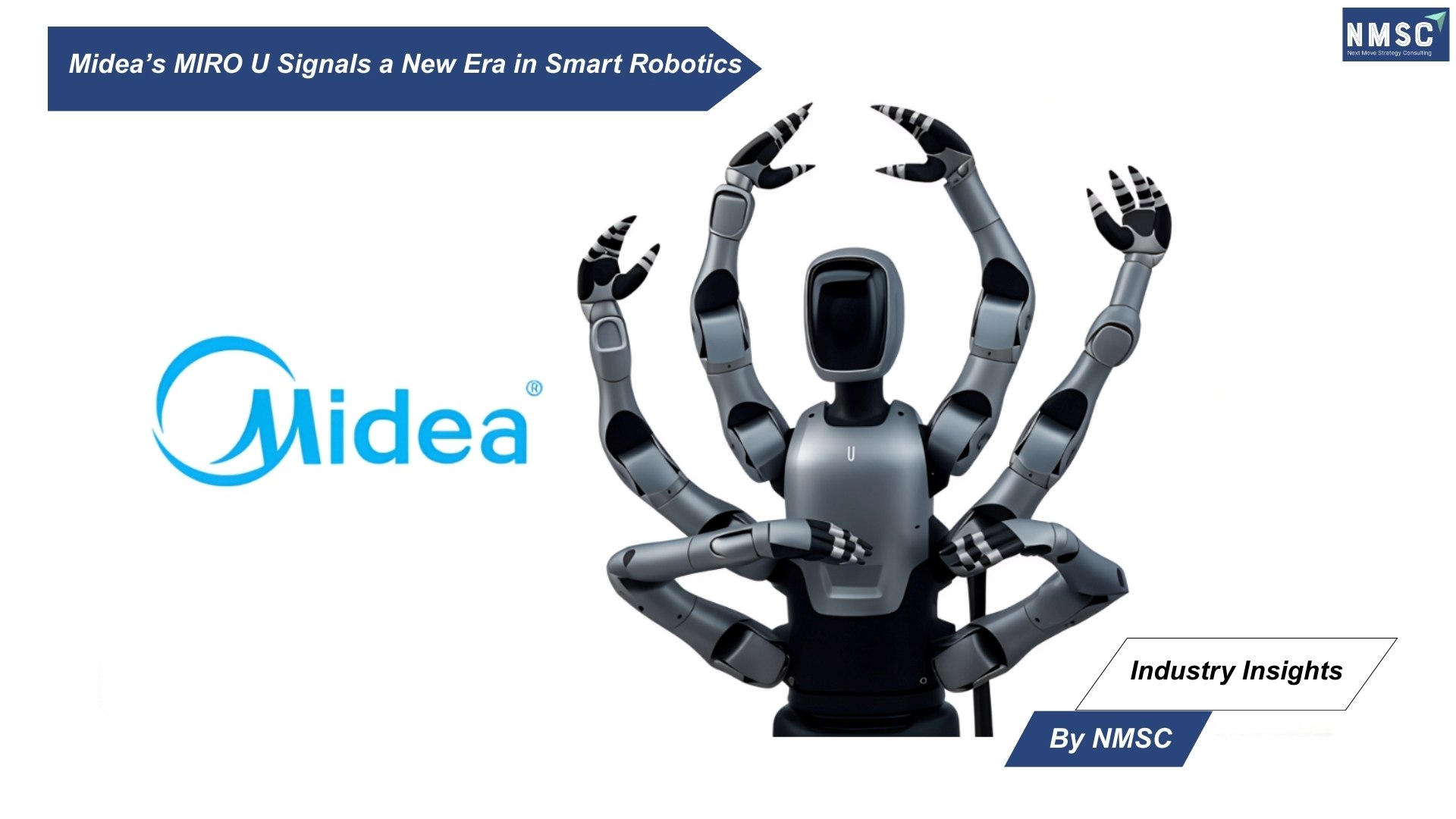
Chinese home appliance giant Midea Group has unveiled MIRO U, a bold new entrant in the industrial robotics arena. Unlike the growing wave of humanoid machines designed to replicate human form, MIRO U follows a distinctly different path-prioritizing functional performance over anthropomorphic design to deliver industrial efficiency, adaptability, and seamless production integration.
Moving Beyond Humanoid Engineering Constraints
Recent robotics developments have focused heavily on humanoid systems introduced by companies such as Tesla and Boston Dynamics. While visually impressive, such platforms require complex balance systems, high computational power, and energy-intensive actuation-factors that can constrain payload, endurance, and reliability in demanding factory settings.
MIRO U eliminates these trade-offs. Built on a wheeled mobile base and equipped with six independent robotic arms, the system emphasizes productivity rather than imitation. Its stable mobility and multi-arm configuration enhance manipulation capability while maintaining structural efficiency.
Key Capabilities at a Glance:
-
Six Independent Robotic Arms enabling simultaneous parallel operations.
-
Mobile Wheeled Base supporting flexible deployment across factory floors.
-
Coordinated Multi-Tasking allowing stabilization, assembly, fastening, and inspection within one system.
-
Reduced Automation Footprint through consolidation of multiple robotic functions.
Enabling Flexible Manufacturing and Inline Quality
By combining mobility with multi-arm coordination, MIRO U functions as a flexible manufacturing cell. It can move between stations, adapt to evolving workflows, and reduce costly infrastructure reconfiguration.
For the metrology sector, the implications are significant. A mobile, multi-arm robot creates opportunities to integrate dimensional inspection directly into production processes. Measurement tools can operate within the same coordinated system, supporting inline quality control and closed-loop manufacturing.
Strategic Expansion in Robotics
Midea’s robotics ambitions gained momentum with its 2017 acquisition of German automation leader KUKA, strengthening expertise in robot design and industrial integration. MIRO U reflects China’s broader push toward advanced, flexible robotic platforms designed for modern manufacturing challenges.
Wei Chang, Vice President and CTO of Midea Group, emphasized that MIRO U’s core value lies in enhancing operational efficiency in industrial scenarios rather than replicating human form. He noted that Midea’s global network of smart manufacturing plants provides a strong foundation for ongoing robotics development and validation.
Next Move Strategy Consulting’s Viewpoint
Next Move Strategy Consulting (NMSC) views the MIRO U as a pivotal transition from "novelty" to "utility" within the Smart Robotics landscape, marking a strategic departure from the energy-intensive humanoid trend. By utilizing a wheeled base instead of bipedal legs, the system avoids the "locomotion tax"—where up to 30% of power is typically wasted on balance-allowing 100% of its energy to be directed toward payload and precision. From a facility standpoint, the MIRO U serves as a "factory on wheels," consolidating multiple robotic functions into a single unit to reduce the automation footprint by approximately 25%.
This architecture is particularly significant for the metrology sector, as the six-arm configuration enables closed-loop manufacturing by performing simultaneous assembly and high-precision inspection. Ultimately, NMSC positions the MIRO U as a high-ROI, "special-purpose" alternative that challenges the general-purpose humanoid narrative by delivering immediate, scalable efficiency in modern industrial environments.
Shaping the Autonomous Factory
MIRO U represents a shift toward intelligent, mobile production assets capable of multitasking within dynamic factory environments. By aligning robotic architecture with functional industrial needs, Midea signals a forward-looking approach to automation-one centered on flexibility, efficiency, and integrated quality assurance.
Source: metrology.news
Prepared by: Next Move Strategy Consulting
About the Author
 Sanyukta Deb
— Sanyukta Deb is Digital Marketing Team Lead at Next Move Strategy Consulting, where she has led content strategy and technical SEO for the firm's B2B market research publications for over 2 years. Her editorial process translates NextMSC's primary and secondary research — spanning technology, industrial, and consumer sectors — into commercial narratives, backed by search-intent, keyword, and competitive analysis. She brings 5 years of overall experience in digital marketing and content strategy.
Sanyukta Deb
— Sanyukta Deb is Digital Marketing Team Lead at Next Move Strategy Consulting, where she has led content strategy and technical SEO for the firm's B2B market research publications for over 2 years. Her editorial process translates NextMSC's primary and secondary research — spanning technology, industrial, and consumer sectors — into commercial narratives, backed by search-intent, keyword, and competitive analysis. She brings 5 years of overall experience in digital marketing and content strategy.
About the Reviewer
 Debashree Dey
— Debashree Dey is Assistant Manager at Next Move Strategy Consulting, where she supports cross-vertical market content and communications across diverse industries for 6 years. Her professional background includes senior content writing, communications, and published manuscript authorship, with experience developing audience-focused business narratives and maintaining clear, consistent messaging. Her role supports research-led content development and editorial quality across NextMSC publications.
Debashree Dey
— Debashree Dey is Assistant Manager at Next Move Strategy Consulting, where she supports cross-vertical market content and communications across diverse industries for 6 years. Her professional background includes senior content writing, communications, and published manuscript authorship, with experience developing audience-focused business narratives and maintaining clear, consistent messaging. Her role supports research-led content development and editorial quality across NextMSC publications.
















Add Comment