Military IoT Cybersecurity Market: Defense Surge Ahead

Global Rearmament Wave and $15.1 Billion U.S. Cyber Budget Drive Structural Demand Across the Military IoT Cybersecurity Market Through 2035
The most comprehensive annual accounting of global defense spending has delivered a stark signal to the defense technology industry. On April 27, 2026, the Stockholm International Peace Research Institute (SIPRI) published its Trends in World Military Expenditure, 2025 fact sheet, confirming that world military expenditure reached USD 2,887 billion in 2025 — the 11th consecutive year of growth — with Europe surging 14% and Asia and Oceania rising 8.1% in real terms. The global military burden, measured as military expenditure as a share of gross domestic product, climbed to 2.5% in 2025, its highest level since 2009. This unprecedented rearmament wave, driven by geopolitical instability, the ongoing war in Ukraine, and NATO's historic 5% GDP defense spending commitment, is generating structural demand across the global Military IoT Cybersecurity Market — a sector that sits at the intersection of expanding connected battlefield infrastructure and the accelerating threat landscape targeting defense networks.
For More Information: Download FREE Sample on Military IoT Cybersecurity Market Report
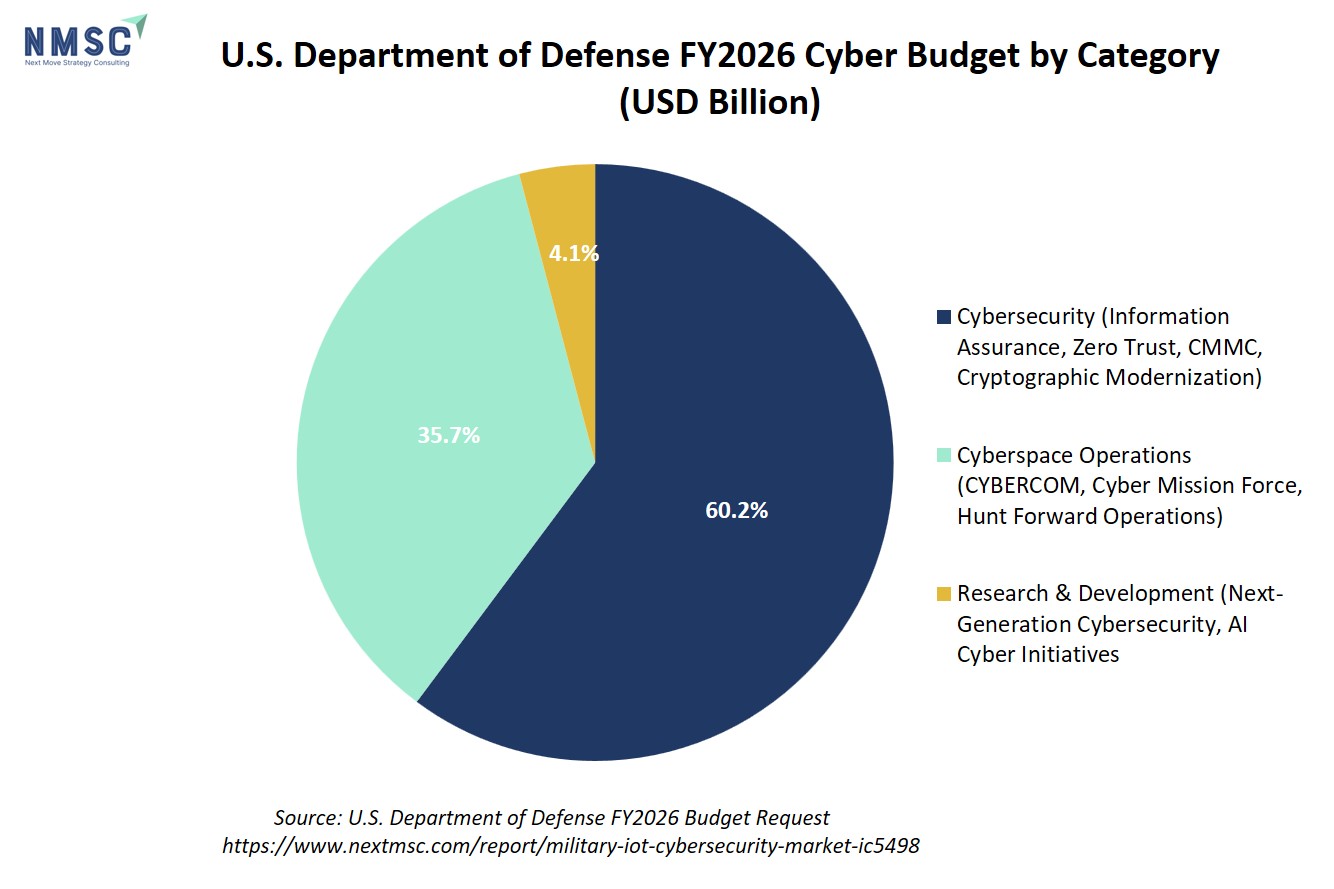
The SIPRI data arrives alongside a parallel policy development of equal significance. The U.S. Department of Defense's FY2026 cyberspace activities budget request reached USD 15.1 billion — a 4.1% increase over the FY2025 request of USD 14.5 billion — with USD 9.1 billion allocated to cybersecurity programs, USD 5.4 billion to cyberspace operations, and USD 611.9 million to research and development. The FY2026 budget explicitly prioritizes accelerating the transition to Zero Trust cybersecurity architecture, defending critical infrastructure, and modernizing cryptographic systems across connected military platforms, according to the Congressional Research Service.
Market Valuation and Growth Trajectory
According to Next Move Strategy Consulting (NMSC), the global military IoT cybersecurity market was valued at USD 17.00 billion in 2025 and is estimated at USD 18.11 billion in 2026. The market is forecast to reach USD 31.90 billion by 2035, expanding at a compound annual growth rate (CAGR) of 6.5% over the 2026–2035 forecast period. This trajectory represents an absolute dollar opportunity of USD 13.79 billion between 2026 and 2035, with above-average growth concentrated in space systems security and Asia-Pacific defense modernization programs.
NMSC's analysis identifies rising connected sensor deployment across battlefield and C4ISR networks as the primary structural growth driver, contributing an estimated +1.4% impact on the market's CAGR. Expanding defense cybersecurity procurement mandates and certification frameworks — including the U.S. Department of Defense's Cybersecurity Maturity Model Certification (CMMC) program — contribute an additional +1.1% CAGR impact. Growing space-based platform connectivity requiring dedicated security architecture adds +0.9%, while rising adoption of zero trust and identity-based security architectures contributes +0.8% to the market's growth trajectory.
The Rearmament Imperative and Its Cybersecurity Implications
The SIPRI April 2026 data reveals a defense spending environment that is structurally favorable for military IoT cybersecurity investment. Outside the United States — where spending declined 7.5% in 2025 primarily due to the absence of new Ukraine military aid appropriations — total global military spending grew by 9.2% in real terms.
"Global military spending rose again in 2025 as states responded to another year of wars, uncertainty and geopolitical upheaval with large-scale armament drives," said Xiao Liang, Researcher with SIPRI's Military Expenditure and Arms Production Programme. "Given the range of current crises, as well as many states' long-term military spending targets, this growth will probably continue through 2026 and beyond."
The direct implication for military IoT cybersecurity is substantial. As defense ministries expand their inventories of connected sensors, unmanned systems, satellite communication networks, and C4ISR platforms, the attack surface available to adversarial cyber actors expands proportionally. Every additional connected device deployed across a battlefield network — from armored vehicle telematics to satellite uplinks — represents a potential entry point for adversarial intrusion. The expansion of military IoT infrastructure without commensurate cybersecurity investment creates systemic vulnerability across allied defense networks, a risk that procurement agencies in North America, Europe, and Asia-Pacific are increasingly moving to address through dedicated cybersecurity contracts and certification mandates.
NATO's 5% Commitment: A Structural Demand Catalyst
At the 2025 NATO Summit in The Hague, Allied nations committed to investing 5% of GDP annually on defense by 2035 — a historic escalation from the previous 2% guideline established at the 2014 Wales Summit. The commitment is structured in two tiers: at least 3.5% of GDP for core defense requirements, and up to 1.5% of GDP for broader defense- and security-related investments, explicitly including the protection of critical infrastructure and the defense of networks.
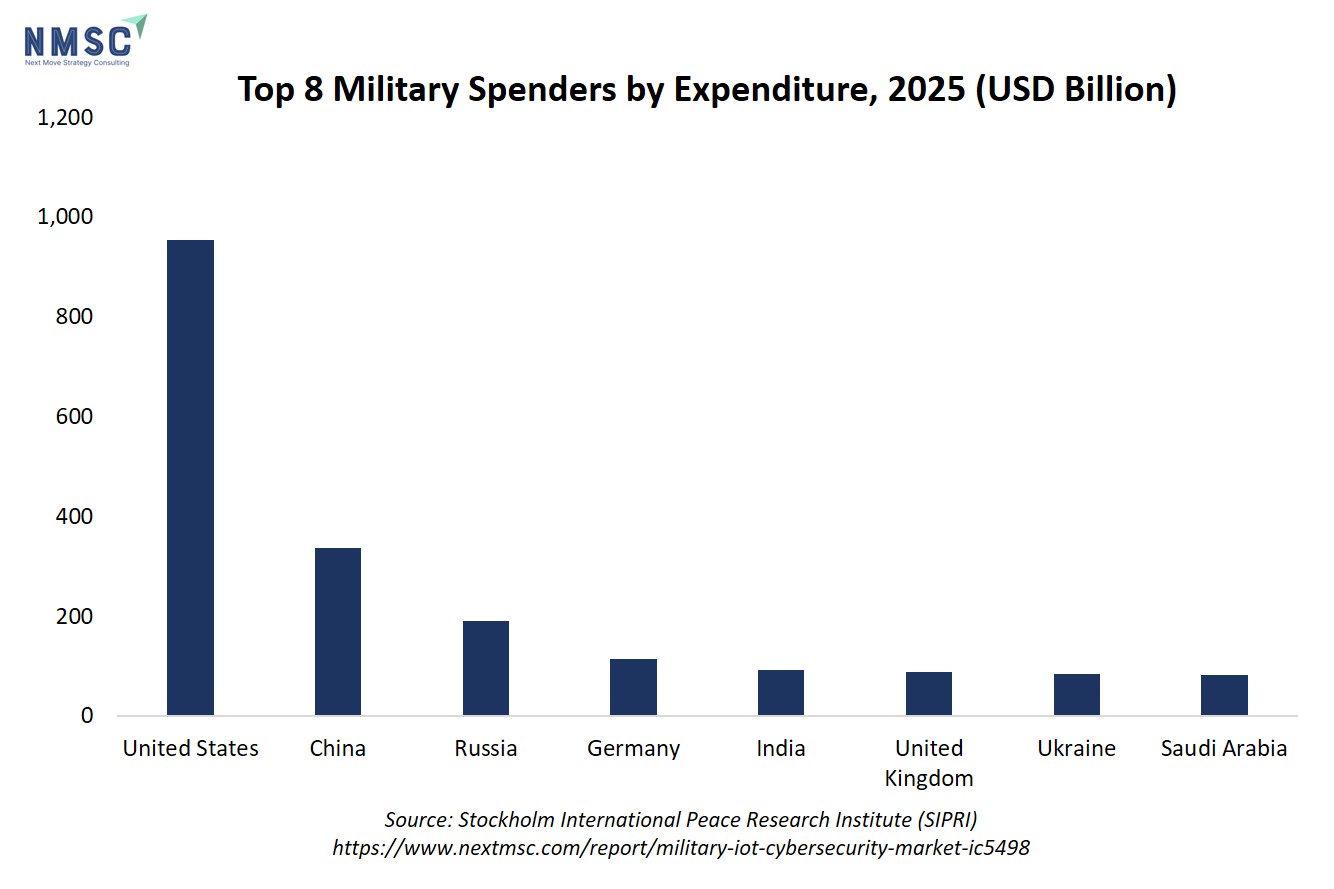
In 2025, European Allies and Canada increased their combined defense expenditure by over USD 90 billion in real terms — a nearly 20% increase compared to 2024 — bringing their combined total to more than USD 571 billion. Germany, the largest military spender among European NATO members, increased its expenditure by 24% year-on-year to USD 114 billion, surpassing the 2.0% of GDP threshold for the first time since 1990. Spain increased its military spending by 50% to USD 40.2 billion.
For the military IoT cybersecurity market, the NATO 5% commitment represents a multi-year structural demand catalyst. The explicit inclusion of network defense and critical infrastructure protection within the 1.5% security-related spending tier creates a dedicated funding stream for cybersecurity investment across 32 Allied nations. NMSC's regional analysis identifies Europe as the second-largest military IoT cybersecurity market, valued at USD 4.42 billion in 2025 and projected to reach USD 8.50 billion by 2035 at a 7.6% CAGR — the second-fastest regional growth rate — driven directly by NATO cyber defense policy and expanding national defense modernization budgets.
Top Military Spenders — Expenditure and Year-on-Year Change, 2025
|
Country |
2025 Military Expenditure (USD Bn) |
YoY Change (Real Terms) |
Military Burden (% of GDP) |
|
United States |
954.0 |
–7.5% |
~3.4% |
|
China |
336.0 |
+7.4% |
~1.7% |
|
Russia |
190.0 |
+5.9% |
7.5% |
|
Germany |
114.0 |
+24.0% |
2.3% |
|
India |
92.1 |
+8.9% |
~2.3% |
|
United Kingdom |
89.0 |
–2.0% |
~2.3% |
|
Ukraine |
84.1 |
+20.0% |
40.0% |
|
Saudi Arabia |
83.2 |
+1.4% |
~5.8% |
|
France |
68.0 |
+1.5% |
~2.1% |
|
Japan |
62.2 |
+9.7% |
1.4% |
|
Global Total |
2,887.0 |
+2.9% |
2.5% |
Space-Based Platform Security: The Fastest-Growing Frontier
Among all military platform segments, space systems represent the most dynamic growth opportunity within the military IoT cybersecurity market. NMSC's analysis projects the Space Systems segment to expand at a 12.7% CAGR from 2026 to 2035 — nearly double the overall market growth rate — growing from USD 1.53 billion in 2025 to USD 4.50 billion by 2035. The Space Force end-user segment is projected to grow at an even faster 14.1% CAGR, the highest of any end-user category.
A concrete illustration of this demand emerged in May 2026, when the U.S. Space Force awarded a combined USD 438 million contract to Viasat Inc. and Intelsat General Communications LLC to deliver space vehicles supporting the Protected Tactical Satellite-Global (PTSG) program. This contract reflects continued government investment in secured space-based connectivity — a domain that requires dedicated orbital cybersecurity capability distinct from terrestrial network security architectures.
The strategic rationale is clear. Satellite communication networks serve as the backbone of modern military command and control, intelligence collection, and precision navigation. A successful cyberattack on military satellite infrastructure could degrade or deny communications across entire theaters of operation. As the number of military satellites and space sensor networks expands — driven by programs such as the U.S. Space Development Agency's Proliferated Warfighter Space Architecture — the demand for space deployment security will accelerate commensurately.
SIPRI data reinforces this trajectory. Japan's military expenditure rose 9.7% to USD 62.2 billion in 2025, with significant investment directed toward space and cyber capabilities. Taiwan's military spending rose 14% to USD 18.2 billion — the largest annual increase since at least 1988 — as the island nation accelerates defense modernization in response to intensifying People's Liberation Army military exercises. Both developments directly expand the addressable market for space and network security solutions across the Asia-Pacific region.
Zero Trust Architecture: Redefining Military Network Defense
The U.S. Department of Defense's FY2026 cyber budget explicitly prioritizes the transition to Zero Trust cybersecurity architecture — a model that treats every connected device and user as untrusted by default, requiring continuous verification rather than relying on perimeter-based defense. The FY2026 budget request states that this investment will "defend and disrupt the efforts of advanced and persistent cyber adversaries, accelerate the transition to Zero Trust cybersecurity architecture, and increase defense of U.S. critical infrastructure and defense industrial base partners against malicious cyber attacks."
NMSC's analysis identifies zero trust architecture adoption as contributing +0.8% to the military IoT cybersecurity market's CAGR, with geographic relevance concentrated in North America and Europe through 2032. The U.S. General Services Administration's OneGov agreement with Palo Alto Networks Inc., announced in December 2025, expanded federal access to critical cybersecurity solutions supporting this architectural shift — a development that illustrates how commercial cybersecurity vendors are positioning identity-centric, continuously verified security as a competitive differentiator for federal and defense buyers.
The Threat Management security function — encompassing intrusion detection, security monitoring, and incident response — is the fastest-growing segment within the market, projected to expand at a 10.2% CAGR from 2026 to 2035, growing from USD 2.21 billion in 2025 to USD 5.30 billion by 2035. This growth reflects the expanding volume of connected sensors and devices across modern defense platforms, which generates a corresponding increase in the volume of security events requiring real-time detection and response.
Asia-Pacific: The Fastest-Growing Regional Market
Asia-Pacific is the fastest-growing military IoT cybersecurity market region, projected to expand at a 9.6% CAGR from 2026 to 2035 — the highest of any region — growing from USD 2.89 billion in 2025 to USD 6.60 billion by 2035. SIPRI's April 2026 data provides the macroeconomic foundation for this projection: military expenditure in Asia and Oceania totalled USD 681 billion in 2025, an 8.1% increase — the largest annual rise since 2009.
China, the world's second-largest military spender, increased its military spending by 7.4% to USD 336 billion in 2025 — the 31st consecutive year-on-year increase — as it continued its military modernization drive. India, the world's fifth-largest military spender, increased its spending by 8.9% to USD 92.1 billion.
Within the military IoT cybersecurity market, India is the fastest-growing country, projected to expand at a 13.3% CAGR from 2026 to 2035, growing from USD 0.75 billion in 2025 to USD 2.30 billion by 2035, according to NMSC. China's military IoT cybersecurity market is projected to grow at a 10.7% CAGR, from USD 1.10 billion in 2025 to USD 2.75 billion by 2035. The combination of expanding defense modernization budgets, rising connected sensor deployment, and growing domestic cybersecurity capability development positions Asia-Pacific as the most dynamic regional growth opportunity for military IoT cybersecurity vendors through the forecast period.
Regulatory Framework and Procurement Mandates
The regulatory environment governing military IoT cybersecurity is intensifying across all major defense markets. In the United States, the DoD's Cybersecurity Maturity Model Certification (CMMC) program establishes mandatory cybersecurity standards for defense industrial base contractors, creating a compliance-driven demand floor for cybersecurity software and services. The FY2026 cyber budget allocates USD 9.1 billion to cybersecurity programs, explicitly including CMMC implementation and cryptographic modernization.
In Europe, the EU Cyber Resilience Act (CRA) imposes a critical compliance deadline of September 11, 2026, after which IoT devices, operational technology systems, and connected hardware sold in the EU market must meet mandatory cybersecurity requirements across their entire lifecycle. While the CRA applies primarily to commercial products, its requirements are reshaping procurement standards across dual-use and defense-adjacent supply chains, elevating baseline cybersecurity expectations for connected military equipment manufactured or procured within the European Union.
NATO's cyber defense policy, reinforced by the Hague Summit's 5% GDP commitment, continues to shape procurement requirements for connected military systems across 32 Allied nations. The explicit inclusion of network defense within the 1.5% security-related spending tier creates a policy mandate for cybersecurity investment that extends beyond individual national defense budgets to encompass the entire Allied procurement ecosystem.
Competitive Landscape
The military IoT cybersecurity market features a moderately consolidated competitive landscape, with diversified defense prime contractors competing alongside commercial cybersecurity specialists on certification credentials, multi-domain security depth, and government contract track record. NMSC's competitive assessment identifies 17 validated unique companies actively shaping product innovation, government contract activity, and multi-domain security capability within the global market.
Lockheed Martin Corporation and Northrop Grumman Corporation leverage extensive platform integration experience to serve major defense programs across land, naval, air, and space systems. BAE Systems plc and Thales Group exemplify the diversified archetype through integrated platform security engineering. General Dynamics Corporation, L3Harris Technologies Inc., Leonardo S.p.A., Airbus Defence and Space, and Elbit Systems Ltd. serve specialized platform and regional defense requirements. Leidos Holdings Inc. and Booz Allen Hamilton Holding Corporation anchor the defense services and intelligence community segment, with Leidos securing a USD 120 million prime contract from the Naval Information Warfare Center Pacific in January 2025 for cryptographic key management architecture and engineering services.
Commercial cybersecurity specialists — including Palo Alto Networks Inc., Cisco Systems Inc., and Fortinet Inc. — are gaining share in network and identity security through government certification programs and strategic acquisitions. Palo Alto Networks Inc.'s announced acquisition of CyberArk for approximately USD 25 billion expanded its identity-security and privileged-access capabilities substantially, positioning the company to serve defense agencies protecting credentialed access to classified and mission-critical systems. Viasat Inc. anchors the space-based platform security segment through its Space Force satellite communication contracts.
Key Military IoT Cybersecurity Market Developments, January 2025 – May 2026
|
Date |
Entity / Program |
Development |
Strategic Significance |
|
January 2025 |
Leidos Holdings Inc. / Naval Information Warfare Center Pacific |
USD 120 million prime contract for DoD cryptographic key management architecture |
Anchors baseline demand for identity and data security across allied defense programs |
|
July 2025 |
Palo Alto Networks Inc. |
Announced acquisition of CyberArk for ~USD 25 billion |
Consolidates identity-security and privileged-access capabilities for defense and federal buyers |
|
September 2025 |
U.S. DoD / Executive Order 14347 |
Department of Defense formally designated "Department of War" under EO 14347 |
Signals intensified defense posture; reinforces cybersecurity procurement prioritization |
|
November 2025 |
U.S. DoD FY2026 Budget |
USD 15.1 billion cyber budget request; USD 9.1B for cybersecurity, USD 5.4B for cyberspace operations |
4.1% increase over FY2025; accelerates Zero Trust and CMMC implementation |
|
December 2025 |
Palo Alto Networks Inc. / GSA |
OneGov agreement expanding federal access to critical cybersecurity solutions |
Elevates demand for Zero Trust architectures across defense agencies |
|
April 2026 |
SIPRI |
World military expenditure reached USD 2,887 billion in 2025; Europe +14%, Asia +8.1% |
Confirms structural rearmament wave driving connected defense infrastructure expansion |
|
May 2026 |
Viasat Inc. / Intelsat / U.S. Space Force |
USD 438 million Protected Tactical Satellite-Global (PTSG) contract |
Expands space-based platform security demand; validates Space Systems as fastest-growing segment |
Investment Implications and Growth Pathways
The convergence of global rearmament, expanding connected battlefield infrastructure, and intensifying regulatory mandates creates a multi-vector investment thesis for the military IoT cybersecurity market. NMSC's assessment identifies three primary growth pathways for stakeholders positioning within the market over the 2026–2035 forecast period.
Zero Trust Identity Platforms present the most immediate whitespace opportunity, as defense agencies managing large, distributed sensor networks formalize Identity-as-a-Service adoption across the Identity Security segment — projected to grow at a 7.9% CAGR from 2026 to 2035. Autonomous and Unmanned System Security represents an underpenetrated opportunity, with the Autonomous Systems Security application segment growing at approximately 10.4% CAGR as robotic and unmanned ground vehicle programs scale across contested environments. Space Deployment Security offers the highest growth potential, with the Space Systems platform segment expanding at 12.7% CAGR and the Space Force end-user segment at 14.1% CAGR through 2035.
Key risks include long defense procurement cycles that restrain the pace at which new cybersecurity capability reaches deployed military systems, high costs associated with retrofitting legacy non-networked infrastructure with modern security controls, and classification and export control constraints that limit the pool of qualified vendors able to supply certified military-grade cybersecurity solutions. NMSC estimates these restraints collectively reduce the market's CAGR by approximately 1.6 percentage points relative to an unconstrained demand scenario.
The U.S. remains the dominant country-level market, valued at approximately USD 6.90 billion in 2025 and projected to reach USD 12.00 billion by 2035 at a 6.3% CAGR. However, the fastest growth is concentrated in Asia-Pacific — particularly India at 13.3% CAGR and China at 10.7% CAGR — and in European markets benefiting from NATO's 5% GDP commitment, with Germany at 7.2% CAGR and France at 7.1% CAGR.
Bottom Line
The global military IoT cybersecurity market is entering a period of sustained structural expansion, underpinned by three converging forces: the most significant global rearmament wave in decades, as confirmed by SIPRI's April 2026 data showing world military expenditure at USD 2,887 billion; the U.S. DoD's USD 15.1 billion FY2026 cyber budget explicitly prioritizing Zero Trust architecture and cryptographic modernization; and NATO's historic 5% GDP defense spending commitment driving cybersecurity investment across 32 Allied nations. With the market projected to grow from USD 18.11 billion in 2026 to USD 31.90 billion by 2035 at a 6.5% CAGR, according to NMSC, the investment opportunity is substantial and broad-based. Space systems security — growing at 12.7% CAGR — and Asia-Pacific defense modernization — growing at 9.6% CAGR — represent the highest-conviction growth vectors. Risks are material: long procurement cycles, legacy infrastructure retrofit costs, and export control constraints create execution friction. For investors and defense technology vendors, the strategic imperative is unambiguous — companies that secure government certification credentials, invest in zero trust and identity security capability, and establish early qualification on space-based platform programs will be best positioned to capture the military IoT cybersecurity market's projected USD 13.79 billion absolute dollar opportunity through 2035.
About Next Move Strategy Consulting
Next Move Strategy Consulting is a premier market research and management consulting firm that has been committed to provide strategically analysed well documented latest research reports to its clients. The research industry is flooded with many firms to choose from, what makes NMSC different from the rest is its top-quality research and the obsession of turning data into knowledge by dissecting every bit of it and providing fact-based research recommendation that is supported by information collected from over 500 million websites, paid databases, industry journals and one on one consultations with industry experts across a diverse range of industry sectors. The high-quality customized research reports with actionable insights and excellent end-to-end customer service help our clients to take critical business decisions that enables them to move beyond time and have competitive edge in the industry.
We have been servicing over 1000 customers globally that includes 90% of the Fortune 500 companies over a decade. Our analysts are constantly tracking various high growth markets and identifying hidden opportunities in each sector or the industry. We provide one of the industry's best quality syndicate as well as custom research reports across 10 different industry verticals. We are committed to deliver high quality research solutions in accordance to your business needs. Our industry standard delivery solutions that ranges from the pre consultation to after-sales services, provide an excellent client experience and ensure right strategic decision making for businesses.
For more information, please contact:
Next Move Strategy Consulting
5th Floor 867 Boylston St, STE 500,
Boston, MA 02116, U.S.
E-Mail: [email protected]
Direct: +1-217-650-7991
Website: www.nextmsc.com
About the Author
 Sanyukta Deb
— Sanyukta Deb is Digital Marketing Team Lead at Next Move Strategy Consulting, where she has led content strategy and technical SEO for the firm's B2B market research publications for over 2 years. Her editorial process translates NextMSC's primary and secondary research — spanning technology, industrial, and consumer sectors — into commercial narratives, backed by search-intent, keyword, and competitive analysis. She brings 5 years of overall experience in digital marketing and content strategy.
Sanyukta Deb
— Sanyukta Deb is Digital Marketing Team Lead at Next Move Strategy Consulting, where she has led content strategy and technical SEO for the firm's B2B market research publications for over 2 years. Her editorial process translates NextMSC's primary and secondary research — spanning technology, industrial, and consumer sectors — into commercial narratives, backed by search-intent, keyword, and competitive analysis. She brings 5 years of overall experience in digital marketing and content strategy.
About the Reviewer
 Debashree Dey
— Debashree Dey is Assistant Manager at Next Move Strategy Consulting, where she supports cross-vertical market content and communications across diverse industries for 6 years. Her professional background includes senior content writing, communications, and published manuscript authorship, with experience developing audience-focused business narratives and maintaining clear, consistent messaging. Her role supports research-led content development and editorial quality across NextMSC publications.
Debashree Dey
— Debashree Dey is Assistant Manager at Next Move Strategy Consulting, where she supports cross-vertical market content and communications across diverse industries for 6 years. Her professional background includes senior content writing, communications, and published manuscript authorship, with experience developing audience-focused business narratives and maintaining clear, consistent messaging. Her role supports research-led content development and editorial quality across NextMSC publications.

















Add Comment