Power Generation Market: $3.4T Global Investment Surge
Siemens Energy's $1 Billion U.S. Manufacturing Commitment and the European Commission's €660 Billion Annual Clean Energy Strategy Redefine the Structural Trajectory of the Global Power Generation Sector
Siemens Energy's $1 Billion U.S. Commitment Signals a Once-in-a-Generation Inflection Point
On February 3, 2026, Siemens Energy AG announced the finalization of a $1 billion investment program to scale up manufacturing operations across the United States — one of the most consequential single-company capital commitments to domestic power infrastructure in recent memory. The investment, disclosed from New York and confirmed through the company's official press release, encompasses brownfield expansions across North Carolina, Alabama, New York, Texas, and Florida, as well as the construction of a new greenfield high-voltage switchgear facility in Mississippi.
The program is projected to create more than 1,500 highly skilled roles in manufacturing, operations, and engineering. Siemens Energy's investment priorities span transformer production, large gas turbine manufacturing, gas turbine blade and vane fabrication, grid technology project execution, and the construction of an artificial intelligence digital grid technologies laboratory in partnership with NVIDIA at its Orlando Innovation Center.
The strategic rationale is unambiguous. Approximately 25% of U.S. power generation currently relies on Siemens Energy technologies, and the company generated revenue of €39.1 billion in fiscal year 2025, employing approximately 103,000 people across more than 90 countries. In the most recent fiscal year, nearly 29% of Siemens Energy's global order volume was directed to the United States — a concentration that reflects the extraordinary scale of the current U.S. power demand surge.
"The United States is experiencing an unparalleled surge in electricity demand," stated Christian Bruch, CEO and President of Siemens Energy. "The country is rapidly expanding data centers, artificial intelligence infrastructure and next generation industrial electrification. Meeting this growth requires the accelerated deployment of modern, resilient grid infrastructure and a substantial increase in power generation capacity."
Siemens Energy's announcement was not an isolated corporate decision. It arrived within weeks of a parallel policy development of comparable magnitude on the other side of the Atlantic. On March 10, 2026, the European Commission formally adopted the Clean Energy Investment Strategy (COM/2026/116), establishing a framework requiring energy sector investment levels of approximately €660 billion annually between 2026 and 2030 — rising to €695 billion annually from 2031 to 2040. This represents a near-tripling of the €240 billion annual average observed between 2011 and 2021. To support the strategy, the European Investment Bank committed to delivering more than €75 billion of financing over three years.
Together, these developments constitute a structural signal of the highest order for the global Power Generation Market — one in which policy mandates, corporate capital deployment, and accelerating electricity demand are converging to reshape the sector's investment architecture for the remainder of the decade.
For More Information: Download FREE Sample on Power Generation Market Report
Global Energy Investment Reaches $3.4 Trillion: The Age of Electricity Arrives
The macroeconomic context surrounding these corporate and policy developments is defined by an unprecedented mobilization of global energy capital. According to the International Energy Agency's World Energy Investment 2026 report, total global energy investment is expected to reach USD 3.4 trillion in 2026 — a 5% increase from 2025 — driven primarily by capital flows from China, the United States, and the European Union.
Clean energy investment is projected to reach USD 2.2 trillion in 2026, nearly double the level directed toward fossil fuels. Investments in electricity supply and infrastructure alone are expected to reach USD 1.6 trillion in 2026, rising to USD 2 trillion when spending on end-use electrification is included — a figure that underscores the IEA's characterization of the current era as the "Age of Electricity." Electricity-related spending already constitutes nearly 60% of all global energy investment.
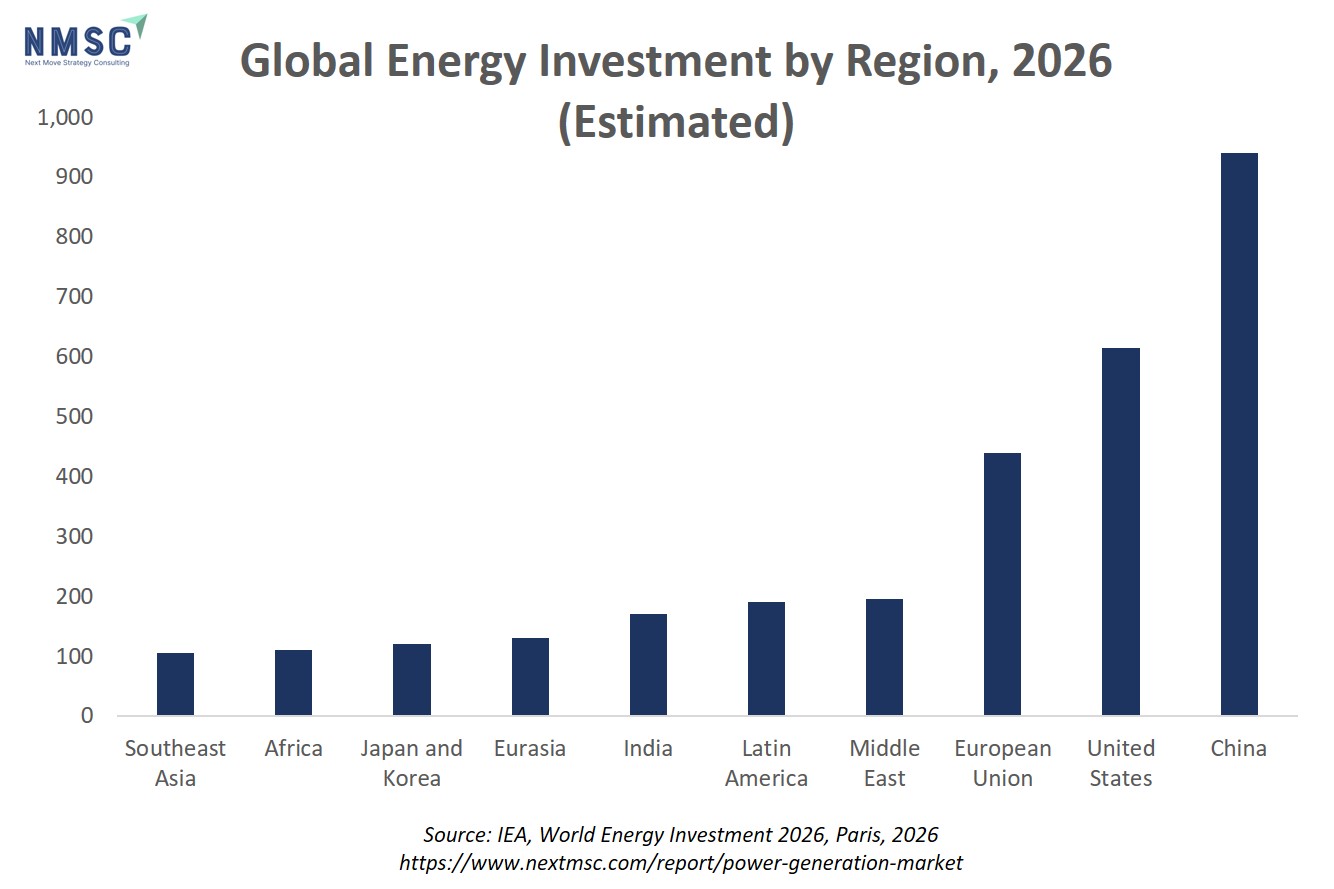
Regional investment flows reveal the geographic concentration of this capital mobilization. China leads all regions with USD 940 billion in total energy investment in 2026, followed by the United States at approximately USD 615 billion — with U.S. total energy spending rising 6% year-over-year. The European Union accounts for USD 440 billion, while the Middle East, Latin America, and India contribute USD 195 billion, USD 190 billion, and USD 170 billion, respectively.
In the United States specifically, generation sector investment is set to exceed USD 140 billion in 2026 to meet rising electricity demand, particularly from data centers. Solar investment accounts for nearly 40% of total U.S. power generation spending, while battery storage investment has expanded rapidly, exceeding spending on wind power and reflecting the growing premium placed on grid flexibility and reliability. A near-fourfold rise in LNG spending in 2026 is also reshaping the U.S. energy investment landscape, with the country projected to represent nearly half of global LNG export capacity by 2030.
Power Generation Market: Quantifying a Multi-Trillion-Dollar Opportunity
The global power generation market occupies the foundational layer of the energy investment ecosystem. According to Next Move Strategy Consulting, the global power generation market was valued at USD 1,667.57 billion in 2023 and is projected to reach USD 2,895.19 billion by 2030, expanding at a CAGR of 8.2% over the 2024–2030 forecast period. The market's growth is driven by the exponential rise in global population, increasing dependency on electrical devices, and sustained government initiatives promoting renewable energy adoption.
Electricity Demand Accelerates: Renewables Overtake Coal in 2026
The demand-side dynamics underpinning the power generation market's growth trajectory are equally compelling. According to the IEA's Electricity Mid-Year Update 2026, global electricity demand is forecast to grow by 3.6% in 2026 and accelerate further to 3.8% in 2027, up from 3% in 2025. Global electricity consumption is set to reach 30,700 terawatt hours (TWh) in 2027, up from 28,600 TWh in 2025. Structural drivers — including industrial growth, increasing appliance ownership, the accelerating uptake of electric vehicles, air conditioning and heat pumps, and expanding data center capacity — are sustaining this growth trajectory.
Among the world's largest economies, China's electricity demand growth is expected to accelerate to 5.5% in 2026, from 5.2% in 2025, supported by higher manufacturing activity and increasing EV charging. India's demand growth is forecast to rebound to 7% in 2026, up from a subdued 1.6% in 2025. In the United States, electricity consumption is forecast to rise by close to 2% in 2026, led by growing power use from data centers, air conditioning, and industries. In the European Union, demand growth is set to strengthen to 2%, supported by ongoing electrification and colder winter weather in the first quarter.
On the supply side, a landmark structural transition is underway. According to the IEA's Global Energy Review 2026, global electricity generation increased by over 850 TWh in 2025, with renewables accounting for the vast majority of growth. The share of low-emissions generation — renewables and nuclear combined — reached 43% in 2025, the highest level in the past fifty years. The share of renewables in global total electricity generation increased to 34% in 2025, up from 32% in 2024 and 23% a decade ago.
Critically, electricity generation from renewables is set to overtake coal-fired output in 2026 — a historic milestone. After reaching near parity with coal in 2025, global generation from renewables is forecast to grow by more than 8% in 2026, with its share in the electricity generation mix rising from 33% in 2025 to 37% by 2027. Solar PV remains the largest contributor to electricity supply growth, with output forecast to increase by approximately 600 TWh in 2026, broadly matching the record annual expansion seen in 2025. As a result, solar PV is set to overtake wind power in 2026 to become the world's second-largest renewable source of electricity generation after hydropower.
Nuclear power generation is expected to increase again in 2026, before accelerating strongly in 2027, when the addition of new reactors in China and India, continued strong output in the United States and France, and the completion of previously delayed projects are set to underpin growth of more than 4%.
Regional Market Analysis: Asia-Pacific Dominates, North America Accelerates
Asia Pacific holds the dominant position in the global power generation market, generating USD 607.76 billion in 2025 — equivalent to a 51.28% global market share — and is projected to reach USD 677.96 billion in 2026. The region's dominance reflects rapid economic development in China, Indonesia, India, and other countries, combined with the expansion of industrial and commercial activity. China alone is forecast to generate USD 369.61 billion in 2026, while India is estimated at USD 82.12 billion and Japan at USD 48.64 billion.
North America captured 17.56% of the global market in 2025, generating USD 208.07 billion in revenue, and is projected to reach USD 228.79 billion in 2026. The United States market is expected to reach USD 200.25 billion in 2026, driven by the rapid transition toward cleaner energy sources, growing investment in energy storage and grid modernization, and the extraordinary demand surge from data centers and AI infrastructure.
Europe maintained a 17.85% global market share in 2025, generating USD 211.60 billion in revenue, and is expected to reach USD 230.44 billion in 2026. Germany is estimated to reach USD 35.45 billion in 2026, while France is expected to generate USD 27.07 billion and the United Kingdom USD 22.25 billion. Europe's market is propelled by the growing installation of solar and wind power projects and government commitments to achieve carbon neutrality by 2050.
The Middle East & Africa recorded a market size of USD 90.92 billion in 2025 (7.67% global share), projected to reach USD 98.88 billion in 2026, driven by new city construction, growing residential and commercial sectors, and government-led tourism infrastructure expansion. Latin America generated USD 66.76 billion in 2025 (5.63% global share), projected to reach USD 72.23 billion in 2026, supported by hydroelectric power project expansion and rural electrification programs.
Global Power Generation Market — Regional Revenue Breakdown, 2025 and 2026 Projections
|
Region |
Revenue 2025 (USD Bn) |
Revenue 2026E (USD Bn) |
Key Growth Driver |
|
Asia Pacific |
607.76 |
677.96 |
Industrialization; China, India, Indonesia expansion |
|
Europe |
211.60 |
230.44 |
Solar, wind deployment; carbon neutrality targets |
|
North America |
208.07 |
228.79 |
Data centers; AI infrastructure; grid modernization |
|
Middle East & Africa |
90.92 |
98.88 |
New city construction; tourism infrastructure |
|
Latin America |
66.76 |
72.23 |
Hydroelectric expansion; rural electrification |
|
Global Total |
1,185.11 |
1,308.32 |
— |
Segmentation Analysis: Renewables Lead, Industrial Demand Anchors
By energy type, the non-conventional/renewable segment is projected to hold the largest power generation market share of 64.63% in 2026, driven by lower carbon emission profiles and the accelerating installation of renewable power plants globally in pursuit of net-zero commitments. The conventional/non-renewable segment — encompassing coal, oil, gas, and nuclear — retains a considerable share due to established infrastructure, though its relative position is declining as the energy transition accelerates.
By end-user, the industrial segment holds the dominant share of 44.87% in 2026, reflecting the extensive use of electricity for machinery, production processes, heating, cooling, and lighting across industrial operations. The commercial segment is anticipated to grow at the fastest rate in the coming years, driven by the rising electrification of commercial buildings and the transition from fossil-fuel-based products to electric alternatives.
By grid type, the on-grid segment accounts for approximately 98% of the global market, reflecting the dominance of centralized power distribution infrastructure. The off-grid segment, however, is expected to register a higher compound annual growth rate in the coming years, driven by rural electrification programs in Sub-Saharan Africa, South Asia, and Southeast Asia, where grid extension remains economically challenging.
The NMSC report identifies smart grid technologies as a particularly significant opportunity driver, with their advanced monitoring, control, and automation capabilities enabling more efficient integration of variable renewable energy sources into existing grid infrastructure — a capability that is becoming increasingly critical as solar and wind penetration rates rise across all major markets.
Competitive Landscape: GE Vernova, Siemens Energy, and the Gas Turbine Supercycle
The competitive landscape of the power generation market is defined by a small number of dominant global equipment manufacturers, large state-owned utilities, and an expanding cohort of renewable energy developers. Key market participants include Enel SpA, GE Renewable Energy (GE Vernova), Électricité de France (EDF), Engie, E.ON SE, Iberdrola S.A., Exelon Corp, AGL Energy, Southern Company, Reliance Industries, Korea Electric Power Corporation (KEPCO), China National Nuclear Corporation (CNNC), NextEra Energy Inc., Canadian Solar Inc., and Constellation Energy Corporation, among others.
The gas turbine segment is experiencing what industry analysts have characterized as a supercycle. GE Vernova reported a 52% increase in power equipment orders in 2025 and now carries a backlog roughly equivalent to 40 gigawatts of generation capacity. GE Vernova, Siemens Energy, and Mitsubishi Power collectively dominate the gas turbine market, manufacturing nearly two-thirds of the world's capacity for new gas plants.
Siemens Energy's Q3 FY2026 earnings release, published August 5, 2026, confirmed that the company is accelerating profitable growth, with Siemens Gamesa — its wind power subsidiary — delivering a positive quarterly result. The company's Mississippi factory groundbreaking, conducted by Governor Reeves on July 17, 2026, marked a tangible milestone in the execution of its $1 billion U.S. investment program.
In the renewable energy segment, NLC India and PTC India signed an agreement in December 2025 to develop 2,000 MW of renewable energy projects, focusing on solar, wind, and battery storage — a development that reflects the accelerating pace of capacity additions in emerging markets.
Market Drivers, Restraints, and Strategic Opportunities
Primary Growth Drivers
The primary drivers of the power generation market include the exponential rise in global population and the corresponding increase in electricity consumption; rapid urbanization and industrialization in developing economies; the accelerating electrification of transportation, heating, and industrial processes; sustained government investment in renewable energy capacity; and the extraordinary demand surge from data centers and artificial intelligence infrastructure. According to the IEA, data center electricity consumption is projected to grow by approximately 15% per year from 2024 to 2030 — more than four times faster than overall electricity demand growth.
The EU Clean Energy Investment Strategy's requirement for €660 billion in annual energy sector investment through 2030, combined with the EIB's €75 billion financing commitment, represents a structural policy catalyst that will sustain capital flows into power generation infrastructure across Europe for the remainder of the decade.
Key Restraints
High upfront capital costs for power plant construction remain the principal restraint on market expansion, particularly in financially constrained developing economies. Nations including South Sudan, Niger, and Yemen face significant challenges in securing affordable financing from multilateral institutions due to perceived credit risks and high interest rates. The aging electricity generation infrastructure prevalent in many developing nations further constrains market growth by limiting the efficiency and reliability of existing capacity.
The Strait of Hormuz crisis, which temporarily removed nearly 20% of global LNG supply from markets beginning in early 2026, has introduced significant price volatility into natural gas markets, pushing gas prices in Asia and Europe to their highest levels since the 2022–2023 energy crisis and prompting fuel switching from gas to coal in several markets — a development that complicates near-term decarbonization trajectories.
Strategic Opportunities
The most significant near-term strategic opportunities reside in grid modernization and energy storage — particularly battery energy storage systems (BESS) and long-duration storage technologies — which are essential for integrating growing shares of variable renewable energy. The EU Clean Energy Investment Strategy explicitly identifies long-duration energy storage, floating wind, floating solar, ocean energy, and small modular reactors (SMRs) as priority investment targets for de-risking support.
Artificial intelligence is emerging as a transformative force within the sector. AI-driven predictive maintenance has demonstrated the potential to reduce maintenance costs by up to 42% and cut unplanned downtime by half, while AI-powered smart grids are enabling real-time load balancing and autonomous trading across decentralized networks. The financial value of renewable energy sources has been shown to increase by approximately 20% through AI-enhanced output forecasting.
Emerging markets across Asia-Pacific, Latin America, and the Middle East & Africa represent additional high-growth opportunity vectors, supported by government-backed electrification programs, foreign direct investment inflows, and the declining cost of solar photovoltaic and wind technologies.
Bottom Line
The global power generation market is undergoing a structural transformation of historic proportions, driven by the convergence of policy-mandated investment, corporate capital deployment, and an unprecedented acceleration in electricity demand. The IEA's projection of USD 3.4 trillion in global energy investment in 2026 — with USD 1.6 trillion directed to electricity supply and infrastructure — establishes the financial scale of the transition underway. Siemens Energy's $1 billion U.S. manufacturing commitment and the European Commission's €660 billion annual clean energy investment mandate represent two of the most consequential near-term catalysts for the sector. Market projections from multiple authoritative sources consistently indicate a trajectory toward USD 2.2–4.9 trillion by the mid-2030s, reflecting CAGRs in the range of 7–8%. Asia Pacific retains its dominant position with over 50% of global revenues, while North America is experiencing an investment surge driven by data center demand and AI infrastructure. For investors and industrial strategists, the most compelling opportunities lie in grid modernization, battery storage, gas turbine manufacturing, solar PV deployment, and the emerging small modular reactor segment. Key risks include geopolitical supply disruptions, natural gas price volatility, high capital costs in frontier markets, and the pace of regulatory standardization for next-generation clean energy technologies.
About Next Move Strategy Consulting
Next Move Strategy Consulting is a premier market research and management consulting firm that has been committed to provide strategically analysed well documented latest research reports to its clients. The research industry is flooded with many firms to choose from, what makes NMSC different from the rest is its top-quality research and the obsession of turning data into knowledge by dissecting every bit of it and providing fact-based research recommendation that is supported by information collected from over 500 million websites, paid databases, industry journals and one on one consultations with industry experts across a diverse range of industry sectors. The high-quality customized research reports with actionable insights and excellent end-to-end customer service help our clients to take critical business decisions that enables them to move beyond time and have competitive edge in the industry.
We have been servicing over 1000 customers globally that includes 90% of the Fortune 500 companies over a decade. Our analysts are constantly tracking various high growth markets and identifying hidden opportunities in each sector or the industry. We provide one of the industry's best quality syndicate as well as custom research reports across 10 different industry verticals. We are committed to deliver high quality research solutions in accordance to your business needs. Our industry standard delivery solutions that ranges from the pre consultation to after-sales services, provide an excellent client experience and ensure right strategic decision making for businesses.
For more information, please contact:
Next Move Strategy Consulting
5th Floor 867 Boylston St, STE 500,
Boston, MA 02116, U.S.
E-Mail: [email protected]
Direct: +1-217-650-7991
Website: www.nextmsc.com
About the Author
 Sanyukta Deb
— Sanyukta Deb is Digital Marketing Team Lead at Next Move Strategy Consulting, where she has led content strategy and technical SEO for the firm's B2B market research publications for over 2 years. Her editorial process translates NextMSC's primary and secondary research — spanning technology, industrial, and consumer sectors — into commercial narratives, backed by search-intent, keyword, and competitive analysis. She brings 5 years of overall experience in digital marketing and content strategy.
Sanyukta Deb
— Sanyukta Deb is Digital Marketing Team Lead at Next Move Strategy Consulting, where she has led content strategy and technical SEO for the firm's B2B market research publications for over 2 years. Her editorial process translates NextMSC's primary and secondary research — spanning technology, industrial, and consumer sectors — into commercial narratives, backed by search-intent, keyword, and competitive analysis. She brings 5 years of overall experience in digital marketing and content strategy.
About the Reviewer
 Debashree Dey
— Debashree Dey is Assistant Manager at Next Move Strategy Consulting, where she supports cross-vertical market content and communications across diverse industries for 6 years. Her professional background includes senior content writing, communications, and published manuscript authorship, with experience developing audience-focused business narratives and maintaining clear, consistent messaging. Her role supports research-led content development and editorial quality across NextMSC publications.
Debashree Dey
— Debashree Dey is Assistant Manager at Next Move Strategy Consulting, where she supports cross-vertical market content and communications across diverse industries for 6 years. Her professional background includes senior content writing, communications, and published manuscript authorship, with experience developing audience-focused business narratives and maintaining clear, consistent messaging. Her role supports research-led content development and editorial quality across NextMSC publications.















Add Comment