White House Fintech Order and Worldpay Deal Reshape Global Payment Gateways

White House Executive Order 14405 and the $2.8 Trillion Worldpay Consolidation Signal a Structural Reset for the Global Payment Gateway Market
On May 19, 2026, President Donald J. Trump signed Executive Order 14405, "Integrating Financial Technology Innovation into Regulatory Frameworks," directing every federal financial regulator — including the Consumer Financial Protection Bureau, the Securities and Exchange Commission, the FDIC, and the Office of the Comptroller of the Currency — to complete a comprehensive review of regulations that impede fintech firms from entering partnerships with federally regulated institutions within 90 days, and mandating the Federal Reserve to submit a report on expanding non-bank access to Reserve Bank payment accounts and services within 120 days. The order, arriving simultaneously with the most consequential consolidation in U.S. merchant acquiring history — Global Payments' absorption of Worldpay, creating an entity that now processes over 20% of all U.S. card payment volume — has materially altered the competitive architecture of the global payment gateway industry.
According to Next Move Strategy Consulting's Payment Gateway Market report, the global payment gateway market was reached an estimated USD 52.40 billion in 2025, and is projected to reach USD 146.28 billion by 2030, expanding at a CAGR of 22.79% from 2025 to 2030. This trajectory — nearly tripling in five years — reflects the convergence of three structural forces now accelerating simultaneously: a U.S. regulatory environment that is actively dismantling barriers between fintech firms and federally chartered institutions, a wave of platform-level consolidation that is concentrating gateway infrastructure in fewer but more capable hands, and a global compliance overhaul in Europe that is mandating real-time payment capability as a baseline standard rather than a competitive differentiator.
For More Information: Download FREE Sample on Payment Gateway Market Report
The Regulatory Inflection: EO 14405 and the GENIUS Act Rewrite the Rules of Gateway Access
Executive Order 14405 is not a marginal policy adjustment. Its operative language explicitly targets "overly burdensome and fragmented regulations and supervisory practices that form barriers to entry and primarily benefit incumbent financial services firms," and it requests the Federal Reserve to evaluate whether non-bank payment companies — including those engaged in digital assets — can be granted direct access to Reserve Bank payment accounts and real-time payment networks. For payment gateway providers, this is consequential: direct Federal Reserve access would allow qualifying non-bank gateways to settle transactions on the FedNow network without routing through a sponsor bank intermediary, compressing settlement latency and eliminating a layer of counterparty cost that currently disadvantages independent gateway vendors relative to bank-owned acquirers.
This order builds on the legislative foundation laid by the Guiding and Establishing National Innovation for U.S. Stablecoins President Trump signed the GENIUS Act into law on July 18, 2025, establishing a federal framework for payment stablecoins. The GENIUS Act established a federal regulatory framework for private-sector stablecoin issuance, bringing payment stablecoins — digital assets designed for use as a means of payment or settlement — into the mainstream financial system under bank-like prudential oversight. According to a research working paper by the Federal Reserve Bank of Kansas City, the stablecoin market grew from a negligible size in 2020 to exceed USD 200 billion in assets by 2025, with independent forecasters projecting the market will reach trillions of dollars over the next several years. For payment gateways, the GENIUS Act's practical effect is to create a new class of settlement instrument — the payment stablecoin — that can move value at the speed of cryptocurrency with the regulatory legitimacy of a bank deposit, directly expanding the addressable transaction types that gateway infrastructure must support.
In May 2025, Stripe announced Stablecoin Financial Accounts, available to businesses in 101 countries, alongside its Payments Foundation Model by launching stablecoin account capabilities, enabling merchants to manage digital currencies alongside traditional payment flows within a single gateway interface. The company simultaneously introduced an AI-driven foundation model for fraud prevention that increased detection rates for attacks on large businesses by 64% overnight, demonstrating that the gateway layer is now the primary battleground for both payment-method diversity and transaction security.
The Consolidation Event: Global Payments-Worldpay and the New Concentration Arithmetic
Following its acquisition of Worldpay, Global Payments ranked first in TSG's 2026 U.S. merchant-acquirer directory, processing nearly USD 2.8 trillion in U.S. volume across more than 53 billion transactions. According to TSG's 2026 Directory of U.S. Merchant Acquirers, Global Payments now processes nearly USD 2.8 trillion in U.S. volume across more than 53 billion transactions annually, and the combined entity is responsible for processing over 20% of all U.S. card payment volume. The top five acquirers collectively processed nearly USD 9 trillion in card volume in 2025, representing approximately two-thirds of total tracked U.S. card volume.
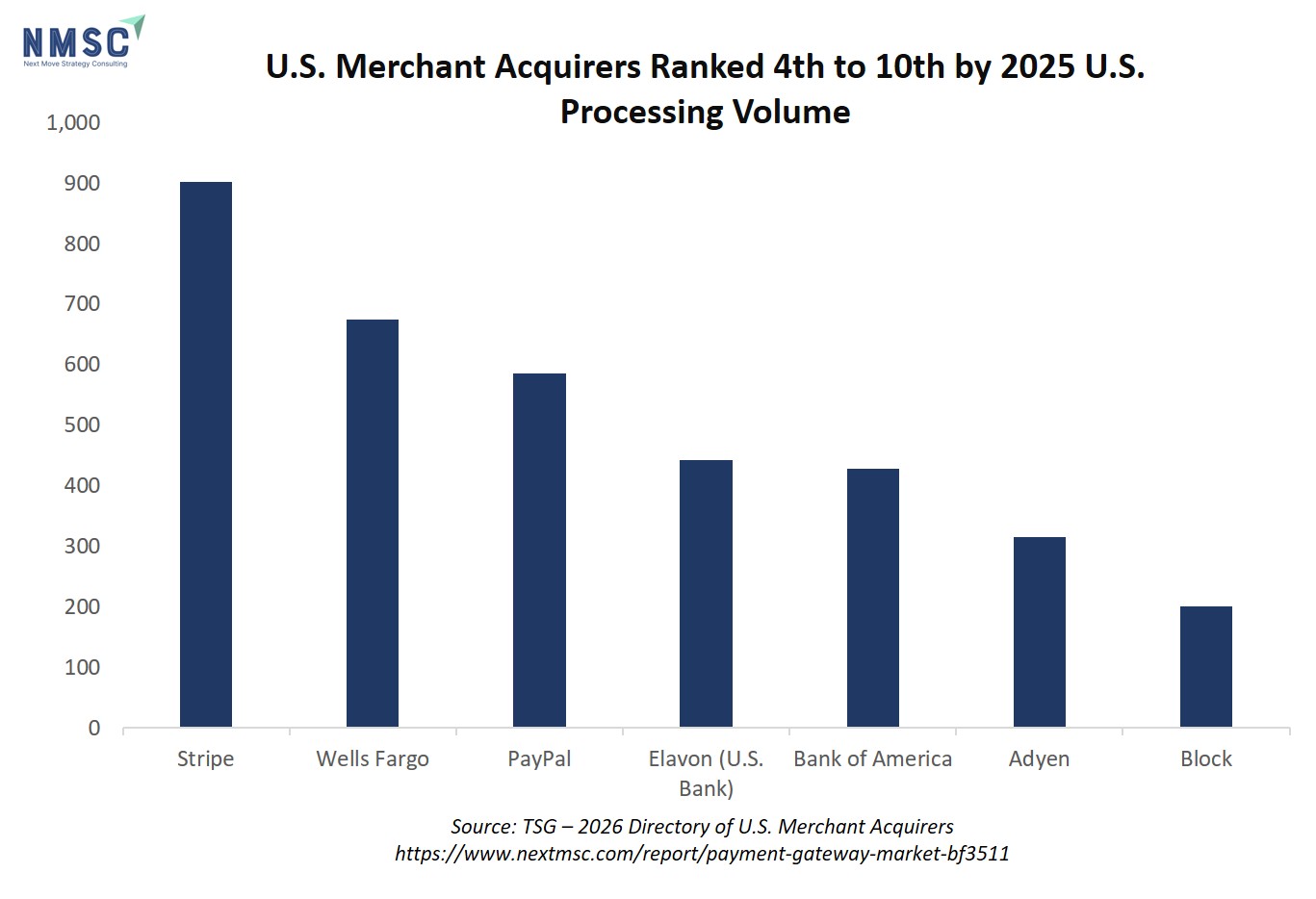
Simultaneously, Stripe entered the top five U.S. acquirers for the first time, recording over USD 900 billion in U.S. processing volume in 2025 — a 45% year-over-year increase — and is projected to eclipse USD 1 trillion in 2026. This juxtaposition — a bank-heritage giant consolidating through acquisition while an API-native gateway grows organically at 45% — illustrates the bifurcated competitive dynamic now defining the market: scale-through-M&A versus share-through-embedded-payments.
The embedded payments channel's dominance is now structural. TSG's data shows that 82% of the top 50 U.S. acquirers by volume used the ISV (independent software vendor) sales channel in 2025, up from 72% the prior year, and 41% of all acquirers in the directory operate an in-house or white-labeled payment gateway. This means that gateway functionality is increasingly embedded within vertical software platforms — point-of-sale systems, ERP software, e-commerce platforms — rather than sold as a standalone service, fundamentally changing how gateway providers must price, distribute, and differentiate their offerings.
The European Regulatory Mandate: Instant Payments, PSD3, and DAC8 as Gateway Demand Catalysts
While the United States is deregulating at the entry level, Europe is mandating capability upgrades at the infrastructure level — and both dynamics are expanding the total addressable market for payment gateway solutions.
The EU's Instant Payments Regulation (IPR), which entered into force in April 2024, reached a critical compliance milestone in April 2026 when payment service providers submitted their first mandatory reports to regulators on service availability, adoption rates, and compliance with the requirement that all euro-denominated payments be processed within seconds, 24/7, at fees matching traditional credit transfers. For gateway providers serving European merchants, this mandate converts real-time payment capability from a premium feature into a compliance baseline, directly expanding the addressable market for gateway infrastructure upgrades.
The Payment Services Directive 3 (PSD3), expected to reach final political agreement between the European Commission, European Parliament, and European Council in Q1–Q2 2026, introduces stricter risk management requirements, improved consumer transparency, and strengthened oversight for third-party payment providers. The EU's DAC8 directive, which entered into force on January 1, 2026, requires crypto-asset service providers to collect, verify, and report detailed tax information for every client, aligning with the OECD's Crypto-Asset Reporting Framework and extending compliance obligations to gateways that process digital asset transactions.
The euro area processed 72.1 billion non-cash payments worth USD 123,715 billion in the most recent reporting period, according to NextMSC primary research and analysis, underscoring the scale of transaction infrastructure that European gateway providers must now upgrade to meet IPR, PSD3, and DAC8 requirements simultaneously.
The Fraud Imperative: $12.5 Billion in Annual Losses Accelerate AI-Driven Gateway Investment
The U.S. Federal Trade Commission reported in March 2025 that consumer fraud losses reached USD 12.5 billion in 2024, a significant year-over-year increase that is directly accelerating enterprise investment in AI-powered fraud prevention at the gateway layer. According to J.P. Morgan's 2026 Payments Outlook cites an Entrust-related report stating that deepfake attacks occur every five minutes and highlights behavioral data and AI-based verification as responses to increasingly sophisticated fraud and businesses are supplementing traditional verification controls with behavioral AI that builds a digital footprint of each customer and flags anomalous transaction patterns in real time.
In May 2025, Adyen partnered with JCB to launch a Card-on-File Tokenization service designed to reduce credit card fraud and improve authorization rates for e-commerce merchants, positioning tokenization as a gateway-level security standard rather than an optional enhancement. In the same month, Global Payments introduced its Genius™ for Retail solution, integrating transaction processing, fraud prevention, and digital payment capabilities into a single point-of-sale and gateway platform targeting small and medium-sized retail businesses.
Agentic Commerce and Blockchain: The Next Gateway Frontier
J.P. Morgan's April 2026 Payments Outlook identifies agentic commerce — where AI agents autonomously research, select, and execute purchases on behalf of consumers — as a structural demand driver for gateway infrastructure, with Bain & Company forecasting that agentic AI will be responsible for up to 25% of the U.S. e-commerce market by 2030. For gateway providers, agentic commerce requires machine-readable APIs, programmable payment logic, and real-time authorization capabilities that legacy hosted gateway architectures were not designed to deliver.
Blockchain-based settlement is advancing in parallel. According to J.P. Morgan's research, nearly 60% of Fortune 500 companies are planning to implement blockchain initiatives, with many focused on payments and settlements, and 60% of institutional investors are looking to increase their exposure to digital assets. Account-to-account (A2A) payments — which bypass card networks and route directly between bank accounts via gateway infrastructure — are projected to reach USD 195 trillion in global transaction value by 2030, according to Juniper Research (September 2025).
Market Segmentation Snapshot
|
Segment |
Category |
Key Insight |
|
By Type |
Hosted Gateway |
Dominant among SMEs and micro-enterprises for ease of integration |
|
API Gateway |
Fastest-growing type; preferred by embedded-payment-first platforms |
|
|
On-Site Integrated Gateway |
Preferred by large enterprises requiring full data control |
|
|
Local Bank Connector & Direct Bank Integration |
Critical in markets with low card penetration |
|
|
By Enterprise Size |
Large Enterprises |
Highest per-transaction volume; driving AI fraud investment |
|
SMEs |
Largest merchant count segment; primary target of Global Payments Genius™ for Retail |
|
|
Micro Enterprises |
Fastest-growing by merchant count; served by embedded POS platforms |
|
|
By Payment Method |
Card Payments |
Largest revenue share; credit/debit card penetration highest in North America and Europe |
|
Digital Wallets |
Fastest-growing method; driven by Apple Pay, Google Pay, PhonePe, Alipay |
|
|
BNPL |
Global market projected to grow from USD 560B (2025) to USD 911.8B by 2030 |
|
|
Real-Time Payments (RTP) |
Mandated in EU under IPR; expanding via FedNow in the U.S. |
|
|
By End-Use Industry |
Retail & E-commerce |
Largest end-use segment; U.S. e-commerce reached USD 1.192 trillion in 2024 |
|
BFSI |
Accelerating adoption of stablecoin and blockchain settlement rails |
|
|
Healthcare |
Growing demand for secure, compliant patient payment processing |
Regional Analysis
|
Region |
Market Position |
Key Regulatory / Market Driver |
Notable Development |
|
North America |
Largest market by revenue |
White House EO 14405 (May 2026); GENIUS Act (June 2025) |
Global Payments-Worldpay merger creates entity processing 20%+ of U.S. card volume; Stripe surpasses $900B in U.S. volume |
|
Europe |
Second-largest; robust growth |
EU IPR first mandatory reporting (April 2026); PSD3 final agreement expected Q1–Q2 2026; DAC8 in force (January 2026) |
Euro area processed 72.1 billion non-cash payments; eIDAS 2.0 EUDI Wallet mandatory by November 2026 |
|
Asia-Pacific |
Fastest-growing region |
Government-led real-time payment mandates (UPI in India; national QR standards across Southeast Asia) |
India's Aadhaar national ID scheme underpins approximately 3 billion payment authentications per month |
|
Rest of World |
Emerging; high growth potential |
Digital financial inclusion initiatives across Latin America, Middle East, and Africa |
Multi-currency support, mobile-first gateway design, and localized payment method integration driving adoption |
NMSC Strategic Perspective: What the Regulatory-Consolidation Nexus Means for Gateway Providers
The simultaneous occurrence of U.S. regulatory liberalization (EO 14405), U.S. legislative mainstreaming of stablecoins (GENIUS Act), European compliance mandates (IPR, PSD3, DAC8), and platform-level consolidation (Global Payments-Worldpay) is not coincidental — it reflects a global payments infrastructure that has reached an inflection point where the cost of maintaining fragmented, legacy gateway architecture now exceeds the cost of transformation.
NMSC's analysis identifies three strategic implications for gateway market participants:
-
The Sponsor Bank Dependency Is Becoming a Competitive Liability. EO 14405's request that the Federal Reserve evaluate direct non-bank access to Reserve Bank payment accounts signals that the regulatory architecture underpinning the sponsor bank model — which currently requires most independent gateway vendors to route through an insured depository institution to access FedNow or ACH — may be restructured within the forecast period. Gateway providers that have built their settlement infrastructure around sponsor bank relationships should model scenarios in which direct Fed access becomes available to qualifying non-bank entities, as this would compress settlement costs and alter the competitive economics of the hosted gateway segment.
-
Stablecoin-Ready Gateway Architecture Is a Near-Term Differentiator, Not a Long-Term Option. With the GENIUS Act's implementing regulations expected from the OCC and Federal Reserve in 2026, and with Stripe already offering stablecoin account management within its gateway interface, the window for gateway providers to develop stablecoin-compatible infrastructure before it becomes a baseline merchant expectation is narrowing. NMSC's analysis indicates that the API Gateway segment — already the fastest-growing gateway type — will disproportionately capture stablecoin-driven transaction volume, as its programmable architecture is better suited to multi-rail settlement than hosted or on-site integrated alternatives.
-
Fraud Infrastructure Is Now a Revenue Driver, Not a Cost Center. The FTC's documentation of USD 12.5 billion in annual U.S. fraud losses, combined with the proliferation of deepfake-enabled payment fraud, has shifted enterprise procurement decisions: gateway selection is increasingly determined by the sophistication of embedded fraud prevention rather than by transaction fee schedules alone. Stripe's 64% improvement in large-enterprise attack detection through its AI foundation model, and Adyen's Card-on-File Tokenization partnership with JCB, illustrate that fraud infrastructure is now a primary basis of competitive differentiation — and a justification for premium pricing — within the gateway market.
NMSC's 22.79% CAGR projection through 2030 reflects a market in which these three forces — regulatory restructuring, stablecoin adoption, and AI-driven fraud prevention — compound rather than offset each other, creating a demand environment that is structurally more favorable than the headline e-commerce growth rate alone would suggest.
Key Players and Competitive Landscape
The global payment gateway market features a concentrated competitive tier at the top and a highly fragmented mid-market. Key players include Stripe, Inc.; PayPal Holdings, Inc.; Adyen N.V.; Checkout.com Limited; Worldpay Inc. (now integrated with Global Payments); Worldline SA; Global Payments Inc.; Fiserv Inc.; Block Inc. (Square); CyberSource Corporation (a Visa company); Ant Group Co. Ltd. (Alipay/Alipay+); PayU Payments; Razorpay Software Private Limited; Verifone Systems Inc. (including 2Checkout); and Network International LLC, according to NextMSC primary research and analysis.
The competitive dynamic is bifurcating: bank-heritage players are consolidating through M&A to achieve processing scale, while API-native platforms are capturing merchant share through embedded payment integration. TSG's 2026 data confirms that Authorize.net (a Visa solution) holds the most gateway partnerships among U.S. acquirers, partnering with 38% of listed players, while 40% of acquirers sell Fiserv's Clover point-of-sale products.
Bottom Line
The global payment gateway market is undergoing a structural transformation driven by the convergence of U.S. regulatory liberalization, legislative mainstreaming of stablecoins, European compliance mandates, and unprecedented platform consolidation. White House Executive Order 14405 (May 2026) has set in motion a regulatory review that could grant non-bank gateway providers direct access to Federal Reserve payment infrastructure — a change that would fundamentally alter settlement economics across the industry. The Global Payments-Worldpay merger has created a processing entity responsible for over 20% of U.S. card volume, while Stripe's 45% year-over-year growth to USD 900 billion in U.S. processing volume demonstrates that embedded, API-native gateways are capturing share at a rate that legacy acquirers cannot match organically. In Europe, the IPR's April 2026 mandatory reporting milestone, PSD3's imminent finalization, and DAC8's entry into force are collectively mandating real-time, multi-rail, and crypto-compliant gateway capabilities as regulatory baselines. Against this backdrop, NextMSC primary research and analysis projects the global payment gateway market to grow from USD 52.40 billion in 2025 to USD 146.28 billion by 2030 at a CAGR of 22.79% — a trajectory that reflects not incremental digitization but a wholesale restructuring of how payment infrastructure is built, regulated, and monetized globally.
About Next Move Strategy Consulting
Next Move Strategy Consulting is a premier market research and management consulting firm that has been committed to provide strategically analysed well documented latest research reports to its clients. The research industry is flooded with many firms to choose from, what makes NMSC different from the rest is its top-quality research and the obsession of turning data into knowledge by dissecting every bit of it and providing fact-based research recommendation that is supported by information collected from over 500 million websites, paid databases, industry journals and one on one consultations with industry experts across a diverse range of industry sectors. The high-quality customized research reports with actionable insights and excellent end-to-end customer service help our clients to take critical business decisions that enables them to move beyond time and have competitive edge in the industry.
We have been servicing over 1000 customers globally that includes 90% of the Fortune 500 companies over a decade. Our analysts are constantly tracking various high growth markets and identifying hidden opportunities in each sector or the industry. We provide one of the industry's best quality syndicate as well as custom research reports across 10 different industry verticals. We are committed to deliver high quality research solutions in accordance to your business needs. Our industry standard delivery solutions that ranges from the pre consultation to after-sales services, provide an excellent client experience and ensure right strategic decision making for businesses.
For more information, please contact:
Next Move Strategy Consulting
5th Floor 867 Boylston St, STE 500,
Boston, MA 02116, U.S.
E-Mail: [email protected]
Direct: +1-217-650-7991
Website: www.nextmsc.com
About the Author
 Sanyukta Deb
— Sanyukta Deb is Digital Marketing Team Lead at Next Move Strategy Consulting, where she has led content strategy and technical SEO for the firm's B2B market research publications for over 2 years. Her editorial process translates NextMSC's primary and secondary research — spanning technology, industrial, and consumer sectors — into commercial narratives, backed by search-intent, keyword, and competitive analysis. She brings 5 years of overall experience in digital marketing and content strategy.
Sanyukta Deb
— Sanyukta Deb is Digital Marketing Team Lead at Next Move Strategy Consulting, where she has led content strategy and technical SEO for the firm's B2B market research publications for over 2 years. Her editorial process translates NextMSC's primary and secondary research — spanning technology, industrial, and consumer sectors — into commercial narratives, backed by search-intent, keyword, and competitive analysis. She brings 5 years of overall experience in digital marketing and content strategy.
About the Reviewer
 Debashree Dey
— Debashree Dey is Assistant Manager at Next Move Strategy Consulting, where she supports cross-vertical market content and communications across diverse industries for 6 years. Her professional background includes senior content writing, communications, and published manuscript authorship, with experience developing audience-focused business narratives and maintaining clear, consistent messaging. Her role supports research-led content development and editorial quality across NextMSC publications.
Debashree Dey
— Debashree Dey is Assistant Manager at Next Move Strategy Consulting, where she supports cross-vertical market content and communications across diverse industries for 6 years. Her professional background includes senior content writing, communications, and published manuscript authorship, with experience developing audience-focused business narratives and maintaining clear, consistent messaging. Her role supports research-led content development and editorial quality across NextMSC publications.
















Add Comment