5G Networks in Military Communications Market

5G networks in military communications market size was USD 1.80 billion in 2025, projected to reach USD 8.40 billion by 2035 at a 16.05% CAGR from 2026 to 2035

Download Free Sample PDF
Base Year (2025)
$1.80 Billion
Forecast (2035)
$8.40 Billion
CAGR (2026-2035)
16.1%
Top Region
North America

What Is the 5G Networks in Military Communications Market Size?

The global 5G networks in military communications market size was valued at USD 1.80 billion in 2025 and is estimated at USD 2.20 billion in 2026, forecast to reach USD 8.40 billion by 2035, expanding at a 16.05% CAGR between 2026 and 2035. North America leads with approximately 52% share, while Battlefield Connectivity dominates all other application segments with approximately 32% share.

We observed that growth is broad-based across every segmentation axis, with joint and multi-domain command adoption and ISR data transmission demand driving the dominant structural shifts through 2035.

5G Networks in Military Communications Market Revenue Forecast

Values in USD Billion

2025 $1.80 Billion
2025
2026 $2.09 Billion
2026
2027 $2.42 Billion
2027
2028 $2.81 Billion
2028
2029 $3.26 Billion
2029
2030 $3.79 Billion
2030
2031 $4.40 Billion
2031
2032 $5.10 Billion
2032
2033 $5.92 Billion
2033
2034 $6.87 Billion
2034
2035 $8.40 Billion
2035

Key Takeaways

By Component: Hardware held the largest share of approximately 58% (USD 1.05 billion) in 2025; Software is the fastest-growing sub-segment at 20.8% CAGR from 2026–2035.

By Network Type: Hybrid Commercial-Military Networks held the largest share of the network type category in 2025; Standalone Tactical Networks is the fastest-growing sub-segment through 2035 on rising contested-environment deployment demand.

By Application: Battlefield Connectivity held the largest share of approximately 32% (USD 0.57 billion) in 2025; ISR Data Transmission is the fastest-growing sub-segment at 18.6% CAGR from 2026–2035.

By Platform: Ground Platforms held the largest share of the platform category in 2025; Airborne Platforms is the fastest-growing sub-segment through 2035 on rising demand for in-flight high-bandwidth connectivity.

By End User: Army held the largest share of approximately 34% (USD 0.62 billion) in 2025; Joint and Multi-Domain Commands is the fastest-growing sub-segment at 21.5% CAGR from 2026–2035.

Dominant Region: North America dominated with approximately 52% revenue share (USD 0.93 billion) in 2025.

Fastest-Growing Region: Middle East & Africa is expected to register the highest CAGR of 19.5% during 2026–2035.

Dominant Country: U.S. led with approximately USD 0.79 billion in 2025.

Fastest-Growing Country: India is the fastest-growing country at approximately 24.5% CAGR from 2026–2035.

Market Opportunity: The 5G networks in military communications market is expected to create an absolute dollar opportunity of USD 6.20 billion between 2026 and 2035, presenting significant investment potential across hybrid base station, tactical network, and joint command connectivity value chains.

According to Next Move Strategy Consulting analysis, defense primes are increasingly integrating commercial-grade 5G hardware from telecom vendors directly into military-standard hybrid base stations rather than developing proprietary radio access technology from scratch, a shift that favors partnership-based commercial-defense integration models over fully bespoke military radio development as open architecture standards mature through 2035.

What Does the 5G Networks in Military Communications Market Encompass?

The 5G networks in military communications market encompasses hybrid base stations, tactical user equipment, network management software, and integration services that bring fifth-generation cellular connectivity to battlefield, command, and logistics environments, forming a defense-specific segment of the broader 5G infrastructure market. Our assessment indicates that the scope spans ground, naval, airborne, and fixed installation platforms serving Army, Navy, Air Force, and joint command end users through hardware, software, and integration service revenue streams. The category has evolved from isolated 5G testbed demonstrations into deployable, standards-based hybrid networks integrated with existing tactical communications systems.

Regulatory frameworks such as the U.S. Army Combat Capabilities Development Command's Modular Open Suite of Standards shape hardware and software interoperability requirements across allied deployments. We observed that technology adoption is shifting toward hybrid base stations capable of seamlessly transitioning between commercial 5G and tactical waveforms without disrupting user applications. Next Move Strategy Consulting's analysis indicates that this structural shift, combined with the Department of War's open architecture and commercial-first strategy, is redefining vendor partnership models across the 5G networks in military communications market.

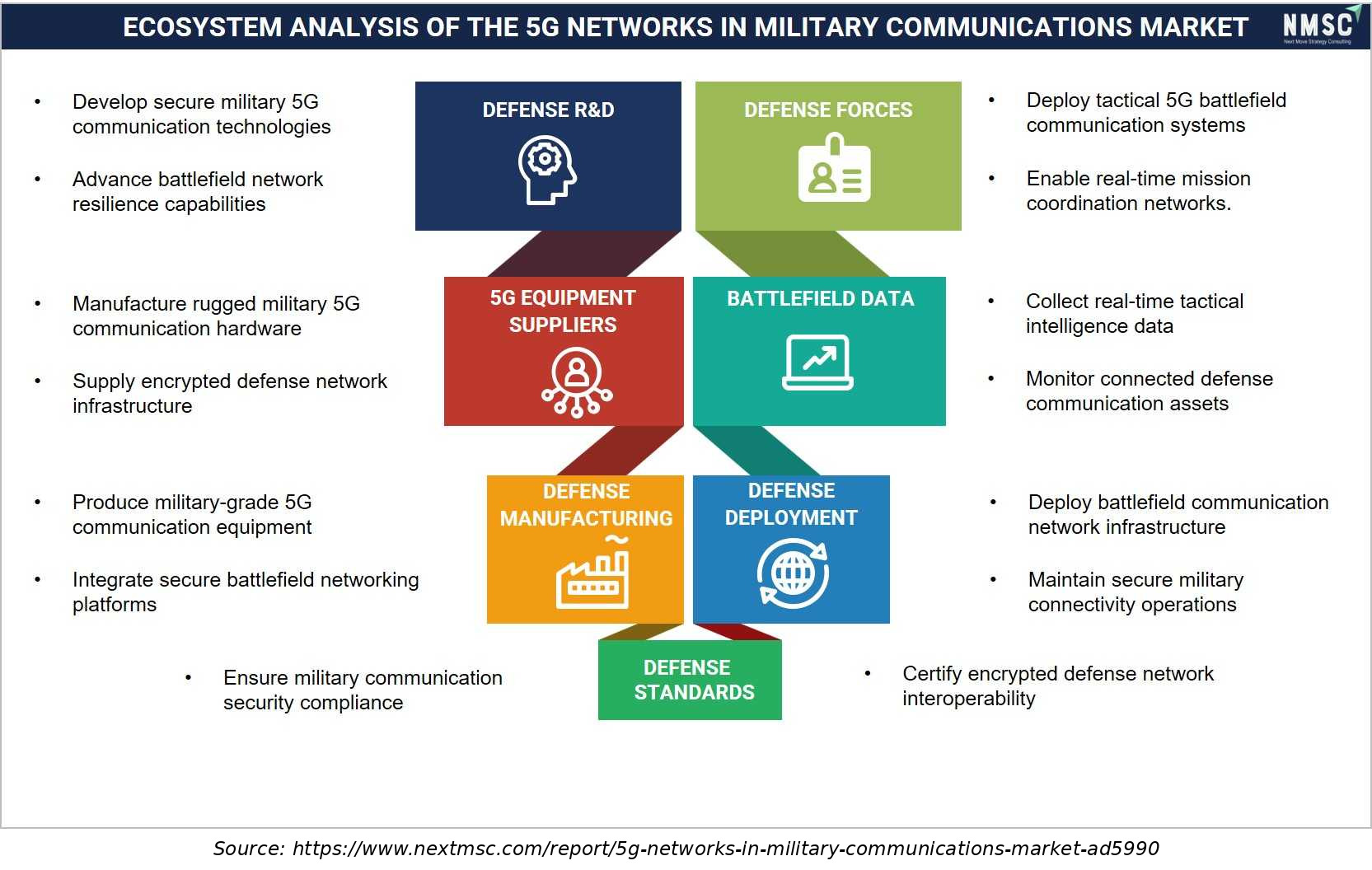
ECOSYSTEM ANALYSIS OF THE 5G NETWORKS IN MILITARY COMMUNICATIONS MARKET

The ecosystem of the 5G networks in military communications market comprises defense R&D organizations, 5G equipment suppliers, defense manufacturers, deployment partners, military forces, and standards bodies working together to deliver secure, interoperable communication networks. Real-time battlefield data, advanced wireless infrastructure, and standardized defense frameworks enable resilient command and control, intelligence sharing, unmanned system connectivity, and mission-critical operations, supporting enhanced situational awareness and operational effectiveness across modern defense environments.

Market Drivers & Dynamics

Interactive Dataset
Department of War open architecture and commercial-first procurement strategy driver +3.1% North America 2026–2035
Rising joint and multi-domain command connectivity requirements driver +2.6% North America, Europe 2026–2035
Expanding NATO and allied interoperability testing programs driver +2.1% Europe, Asia-Pacific 2026–2035
Growing ISR data transmission bandwidth requirements driver +1.9% Global 2026–2033
Rising commercial telecom vendor investment in defense-grade 5G driver +1.7% North America, Europe 2026–2033
Expanding Gulf Cooperation Council defense modernization investment driver +1.4% Middle East & Africa 2027–2035
Spectrum allocation and electromagnetic contested-environment vulnerability concerns restraint −1.4% Global 2026–2035
Long defense acquisition and certification cycles slowing deployment restraint −0.9% North America, Europe 2026–2032
High integration cost with legacy tactical communications systems restraint −0.6% Global 2026–2035
Source: Next Move Strategy Consulting

Growth Drivers

What Is the Primary Growth Driver of the 5G Networks in Military Communications Market?

The Department of War's open architecture and commercial-first procurement strategy is the primary driver of the market. Nokia Federal Solutions and Lockheed Martin's May 2026 modular 5G solution, aligned with the U.S. Army Combat Capabilities Development Command's Modular Open Suite of Standards, illustrates how this policy shift is translating into deployable products. We observed that this structural demand, reinforced by rising joint and multi-domain command connectivity requirements, continues to anchor baseline demand for Hardware and Battlefield Connectivity segments.

How Is Commercial-Defense Partnership Driving 5G Networks in Military Communications Market Growth?

Commercial-defense partnership models are accelerating market growth toward faster, lower-risk deployment pathways. The Nokia, Lockheed Martin, and Verizon collaboration, which progressed from a March 2025 integration demonstration to a field-ready May 2026 product launch, illustrates the pace at which commercial 5G technology is reaching operational military platforms. Our assessment indicates that this shift, combined with Nokia's USD 4 billion U.S. investment commitment, is compressing development timelines that previously required fully bespoke military radio development.

Growth Inhibitors

What Is Restraining 5G Networks in Military Communications Market Expansion?

Spectrum allocation and electromagnetic contested-environment vulnerability concerns restrain broader 5G deployment in forward-deployed combat scenarios where adversary jamming and detection risk remain significant. Long defense acquisition and certification cycles further slow the pace at which validated commercial technology reaches fielded units. We found that this combination of technical and procurement barriers is concentrating near-term deployment in rear-echelon, base, and logistics environments where electromagnetic risk profiles are more manageable than frontline battlefield conditions.

Segmentation Analysis

2025 (USD Billion)
2035 (USD Billion)
Hardware 2025: $1.05 Billion | 2035: $4.20 Billion
Hardware
Services 2025: $0.50 Billion | 2035: $2.52 Billion
Services
Software 2025: $0.25 Billion | 2035: $1.68 Billion
Software
Hardware $1.05 Billion $4.20 Billion 14.1%
Services $0.50 Billion $2.52 Billion 17.0%
Software $0.25 Billion $1.68 Billion 20.8%

Which Component Segment Dominates the 5G Networks in Military Communications Market?

Hardware led the market with USD 1.05 billion in 2025, supported by sustained investment in hybrid base stations and tactical user equipment across defense modernization programs. We observed that Software is the fastest-growing component segment, expanding at a 20.8% CAGR from 2026 to 2035, as network management and slicing software gain importance for orchestrating hybrid commercial-military network transitions across increasingly complex, multi-domain deployment environments.

2025 (USD Billion)
2035 (USD Billion)
Private 5G N
Hybrid Comme
Standalone T
Segment Item 2025 (USD Billion) 2035 (USD Billion) CAGR
Private 5G Networks $10.0 USD Billion $40.0 USD Billion 25.0%
Hybrid Commercial-Military Networks $17.1 USD Billion $51.1 USD Billion 11.0%
Standalone Tactical Networks $24.2 USD Billion $62.2 USD Billion 25.0%

Segment-wise data is locked

Unlock complete segment-wise numbers for By Network Type.

Unlock Full Data
2025 (USD Billion)
2035 (USD Billion)
Battlefield
Command and
ISR Data Tra
Logistics an
Training and
Segment Item 2025 (USD Billion) 2035 (USD Billion) CAGR
Battlefield Connectivity $10.0 USD Billion $40.0 USD Billion 27.0%
Command and Control Communications $17.1 USD Billion $51.1 USD Billion 9.0%
ISR Data Transmission $24.2 USD Billion $62.2 USD Billion 19.0%
Logistics and Base Operations $31.3 USD Billion $73.3 USD Billion 17.0%
Training and Simulation $38.4 USD Billion $84.4 USD Billion 18.0%

Segment-wise data is locked

Unlock complete segment-wise numbers for By Application.

Unlock Full Data

Which Application Segment Leads 5G Networks in Military Communications Demand?

Battlefield Connectivity remained the leading application within the market, valued at USD 0.57 billion in 2025 given sustained demand for resilient, high-bandwidth connectivity at the tactical edge, a use case closely tied to the broader defensetactical radio market. Our findings suggest that ISR Data Transmission is the fastest-growing application segment, registering an 18.6% CAGR from 2026 to 2035, as intelligence, surveillance, and reconnaissance platforms require increasingly high-bandwidth 5G links to transmit sensor data in near real time.

2025 (USD Billion)
2035 (USD Billion)
Ground Platf
Naval Platfo
Airborne Pla
Fixed Instal
Segment Item 2025 (USD Billion) 2035 (USD Billion) CAGR
Ground Platforms $10.0 USD Billion $40.0 USD Billion 14.0%
Naval Platforms $17.1 USD Billion $51.1 USD Billion 24.0%
Airborne Platforms $24.2 USD Billion $62.2 USD Billion 22.0%
Fixed Installations $31.3 USD Billion $73.3 USD Billion 12.0%

Segment-wise data is locked

Unlock complete segment-wise numbers for By Platform.

Unlock Full Data
2025 (USD Billion)
2035 (USD Billion)
Army
Navy
Air Force
Joint and Mu
Allied and C
Segment Item 2025 (USD Billion) 2035 (USD Billion) CAGR
Army $10.0 USD Billion $40.0 USD Billion 24.0%
Navy $17.1 USD Billion $51.1 USD Billion 22.0%
Air Force $24.2 USD Billion $62.2 USD Billion 20.0%
Joint and Multi-Domain Commands $31.3 USD Billion $73.3 USD Billion 22.0%
Allied and Coalition Forces $38.4 USD Billion $84.4 USD Billion 13.0%

Segment-wise data is locked

Unlock complete segment-wise numbers for By End User.

Unlock Full Data

Which End User Leads 5G Networks in Military Communications Adoption?

Army remained the leading end user within the market, valued at USD 0.62 billion in 2025 given its central role in ground-based tactical communications modernization programs. Our analysis shows that Joint and Multi-Domain Commands is the fastest-growing end user, registering a 21.5% CAGR from 2026 to 2035, as the Combined Joint All-Domain Command and Control initiative drives demand for network architecture that enables seamless, cross-service data fusion across the battlespace.

Growth Opportunities

Our analysis shows that three forward-looking opportunities stand out for stakeholders positioning within the 5G networks in military communications market over the 2026–2035 forecast period.

How Can Open Architecture Compliance Unlock Value for Hardware Vendors?

Open architecture compliance presents a whitespace opportunity for hardware vendors seeking to qualify for Department of War procurement programs. Vendors that replicate the Nokia Federal Solutions and Lockheed Martin CMOSS-aligned modular 5G model stand to capture recurring hardware and integration revenue as defense buyers increasingly favor plug-and-play, standards-compliant systems over proprietary, single-vendor architectures.

Where Does Allied Interoperability Testing Create New Revenue for Systems Integrators?

NATO and allied defense forces represent an underpenetrated opportunity for systems integrators offering multinational interoperability testing and certification services. Integrators that expand joint exercise participation, following the pattern of Nokia's Joint Viking 2025 demonstration, can secure long-term contracts with allied forces pursuing standardized, cross-border communications architecture ahead of expanding coalition operations.

How Can ISR-Optimized Network Slicing Benefit Software Vendors?

Intelligence, surveillance, and reconnaissance platforms represent an underpenetrated opportunity for software vendors offering network slicing capability optimized for high-bandwidth sensor data transmission. Vendors that develop validated, low-latency slicing software can secure long-term licensing agreements with defense buyers prioritizing real-time data fusion across the joint and multi-domain command environment.

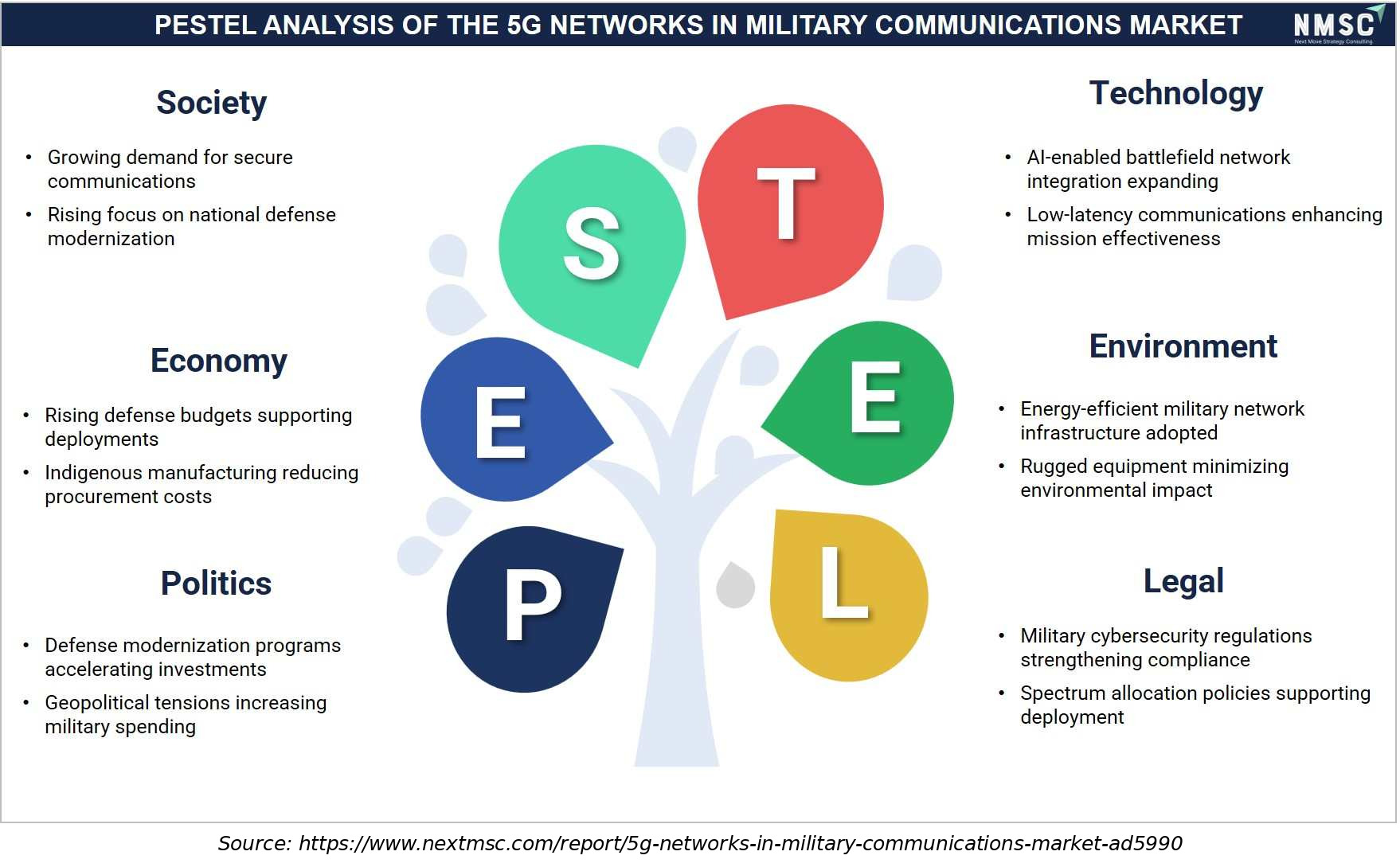
PESTEL ANALYSIS OF THE 5G NETWORKS IN MILITARY COMMUNICATIONS MARKET

PESTEL ANALYSIS OF THE 5G NETWORKS IN MILITARY COMMUNICATIONS MARKET
The PESTEL analysis of the 5G networks in military communications market highlights the external factors shaping industry growth and adoption. Rising defense modernization programs, increasing geopolitical tensions, and expanding military investments drive deployment, while advances in 5G, AI, edge computing, and secure networking enhance operational capabilities. Environmental considerations encourage energy-efficient network infrastructure, and evolving defense regulations, spectrum policies, and cybersecurity standards promote secure, interoperable, and mission-critical communication systems.

Regional Outlook

2025 (USD Billion)
2035 (USD Billion)
North Americ
Europe
Asia-Pacific
Middle East
Latin Americ
Region 2025 (USD Billion) 2035 (USD Billion) CAGR (%)
North America $10.0 USD Billion $40.0 USD Billion 9.0%
Europe $17.1 USD Billion $51.1 USD Billion 27.0%
Asia-Pacific $24.2 USD Billion $62.2 USD Billion 25.0%
Middle East & Africa $31.3 USD Billion $73.3 USD Billion 23.0%
Latin America $38.4 USD Billion $84.4 USD Billion 12.0%

Regional data is locked

Unlock complete regional numbers for this market.

Unlock Full Data

Competitive Landscape

We observed that the 5G networks in military communications market features a moderately consolidated competitive landscape, with defense primes competing alongside commercial telecom vendors on open architecture compliance and hybrid integration capability. Key Takeaways

Dimension Description
Market Structure Moderately consolidated; the top companies profiled in this report collectively account for a majority of global 5G networks in military communications market revenue, while numerous regional systems integrators serve niche testing and certification demand.
Innovation Focus Hybrid base station architecture, open standards compliance, and joint and multi-domain command network slicing dominate current innovation pipelines across leading providers.
Strategic Partnership & Collaboration Activity Selective strategic partnership formation, exemplified by the Nokia, Lockheed Martin, and Verizon collaboration progressing from a 2025 demonstration to a May 2026 field-ready modular 5G product launch.

How Do Companies Compete in the 5G Networks in Military Communications Market?

Companies compete primarily on open architecture compliance, hybrid integration capability, and demonstrated field validation across the industry. Defense primes such as Lockheed Martin and General Dynamics leverage established defense procurement relationships to serve Army, Navy, and Air Force buyers, while commercial telecom vendors such as Nokia and AT&T compete on proven commercial 5G technology maturity and rapid technology transfer to military-grade applications.

Which Competitive Archetypes Dominate the 5G Networks in Military Communications Market?

Two archetypes dominate the market: established defense primes offering deep procurement relationships and system integration expertise, and commercial telecom vendors offering proven, field-tested 5G radio access technology. Lockheed Martin and General Dynamics exemplify the defense prime archetype through combined communications and platform integration capability, while Nokia and Ericsson exemplify the commercial vendor archetype through mature, standards-based radio and core network technology.

How Are Companies Differentiating Through Innovation in 5G Networks in Military Communications?

Innovation and differentiation strategy increasingly center on open architecture compliance and demonstrated multinational interoperability. The Nokia Federal Solutions and Lockheed Martin May 2026 modular 5G launch, aligned with the Modular Open Suite of Standards, and Nokia's Joint Viking 2025 NATO exercise participation both illustrate how leading providers differentiate through standards compliance and field validation. Our analysis shows that vendors unable to demonstrate open architecture alignment risk exclusion from Department of War procurement shortlists.

What M&A and Expansion Activity Is Shaping the 5G Networks in Military Communications Market?

Strategic partnerships and joint development programs continue to shape competitive positioning within the industry more than traditional acquisition activity. The Nokia, Lockheed Martin, and Verizon collaboration illustrates how commercial telecom vendors and defense primes are pursuing joint go-to-market strategies rather than pursuing independent, siloed product development, while Nokia's broader USD 4 billion U.S. investment commitment signals sustained capital deployment toward defense-adjacent research and development.

Key Market Players

Our assessment indicates that the following 20 companies are actively shaping hybrid architecture innovation, standards compliance, and go-to-market partnership strategy within the global 5G networks in military communications market.

Lockheed Martin Corporation Nokia Corporation (Nokia Federal Solutions) AT&T Inc. Verizon Communications Inc. Telefonaktiebolaget LM Ericsson General Dynamics Corporation Booz Allen Hamilton Holding Corporation Federated Wireless, Inc. L3Harris Technologies, Inc. Northrop Grumman Corporation RTX Corporation (Collins Aerospace) BAE Systems plc CACI International Inc. Leidos Holdings, Inc. Peraton Corp Viasat, Inc. Thales Group Airbus SE (Airbus Defence and Space) Rohde & Schwarz GmbH & Co KG Elbit Systems Ltd.

Latest Developments

We found that recent developments within the 5G networks in military communications market are concentrated on hybrid base station product launches and multinational interoperability demonstrations, reflecting the industry's progression from testbed validation to fielded capability.

Date Event
May 2026 Nokia Federal Solutions and Lockheed Martin launched a modular, open-architecture 5G solution aligned with U.S. Department of War open standards. The system integrates Nokia carrier-grade 5G into Lockheed Martin’s C5ISR/CMOSS framework, enabling secure commercial-grade connectivity on military vehicles and platforms across operational environments.
April 2026 Anduril developed its 5G Comms Sentry Tower with Nokia Federal Solutions, combining Sentry hardware, onboard power and compute with Nokia private 5G technology. The infrastructure-independent system can provide secure cellular coverage in austere environments within three hours, targeting forward bases, missile fields, test ranges and other remote military operations.
February 2026 Ericsson, Leonardo and the Italian Navy completed an open-sea trial of an end-to-end 5G Standalone network. The system supported secure data exchange between naval vessels, combat-management situational awareness and video from 12 unmanned systems, validating 5G SA performance, resilience and spectrum efficiency for maritime defense operations.

Expert Insights

Niclas Backlund

Head of Ericsson Global Customer Unit Telia | Ericsson

"5G is the most versatile technology for meeting high demands for secure, fast and adaptable communication of audio, data, images and video."

Analyst Interpretation

The statement underscores the growing importance of 5G as the foundation for next-generation military communications, enabling secure, high-speed, and low-latency transmission of voice, video, imagery, and mission-critical data. As defense organizations increasingly adopt autonomous systems, intelligence, surveillance and reconnaissance (ISR) platforms, tactical edge computing, and network-centric command-and-control capabilities, demand for resilient private 5G networks is expected to accelerate. This trend is creating significant growth opportunities for providers of defense communication infrastructure, secure networking solutions, and advanced military connectivity technologies.

Investment Opportunities

What Capital Inflows Are Targeting the 5G Networks in Military Communications Market?

Capital inflows into the 5G networks in military communications market are increasingly directed toward hybrid base station development and open architecture compliance engineering. Nokia's USD 4 billion U.S. investment commitment, with approximately USD 3.5 billion earmarked for domestic research and development, illustrates the scale of capital entering defense-adjacent 5G technology. We observed that investors favor vendors demonstrating open architecture compliance, viewing standards alignment as a proxy for long-term Department of War procurement eligibility.

How Is Infrastructure Investment Supporting 5G Networks in Military Communications Deployment?

Infrastructure investment is expanding hybrid base station manufacturing and testing capacity to support rising joint and multi-domain command connectivity demand. The May 2026 Nokia Federal Solutions and Lockheed Martin modular 5G launch exemplifies the scale of infrastructure investment entering the market. Our findings suggest that vendors are investing in vehicle and expeditionary platform-compatible hardware to serve deployment across North America, Europe, and increasingly Asia-Pacific allied forces.

What ESG Considerations Are Shaping 5G Networks in Military Communications Investment Decisions?

Governance considerations are increasingly relevant to investment decisions across the industry, with supply chain security and standards transparency as key criteria. Open architecture compliance under the Modular Open Suite of Standards illustrates how vendors are prioritizing auditable, non-proprietary system design. We found that investors increasingly favor vendors with transparent, standards-compliant architecture, treating it as a governance indicator alongside conventional defense supply chain security requirements.

Key Benefits for Stakeholders

How Does This Report Benefit Enterprise and Industry Leaders?

Enterprise and industry leaders gain access to validated segmentation, competitive benchmarking, and regional demand forecasts that support sourcing and partnership decisions across the 5G networks in military communications industry. Our analysis shows that detailed component, application, and end-user breakdowns help procurement and product teams align specifications with regulatory and interoperability requirements while identifying underserved segments for portfolio expansion.

How Does This Report Benefit Investors and Financial Analysts?

Investors and financial analysts benefit from consistent, single-point market size and CAGR estimates that support valuation and capital-allocation decisions across the 5G networks in military communications supply chain. We observed that the report's regional and segment-level growth differentials help identify which providers are best positioned to capture above-market growth in Middle East & Africa and joint and multi-domain command categories through 2035.

How Does This Report Benefit Technology Vendors and Product Teams?

Technology vendors and product teams gain insight into emerging system requirements, including hybrid base station architecture, open standards compliance, and multinational interoperability validation, that are reshaping the industry. Our findings suggest that this analysis helps R&D teams prioritize development roadmaps around standards alignment and field validation increasingly required by Department of War and allied defense procurement specifications.

Key Market Segments Evaluated

By Component

  • Hardware
  • Software
  • Services

By Network Type

  • Private 5G Networks
  • Hybrid Commercial-Military Networks
  • Standalone Tactical Networks

By Application

  • Battlefield Connectivity
  • Command and Control Communications
  • ISR Data Transmission
  • Logistics and Base Operations
  • Training and Simulation

By Platform

  • Ground Platforms
  • Naval Platforms
  • Airborne Platforms
  • Fixed Installations

By End User

  • Army
  • Navy
  • Air Force
  • Joint and Multi-Domain Commands
  • Allied and Coalition Forces

By Region

  • North America (U.S., Canada, Mexico)
  • Europe (UK, Germany, France, Italy, Spain, Sweden, Denmark, Finland, Netherlands, Rest of Europe)
  • Asia-Pacific (China, India, Japan, South Korea, Taiwan, Indonesia, Vietnam, Australia, Philippines, Malaysia, Rest of APAC)
  • Middle East & Africa (Saudi Arabia, UAE, Egypt, Israel, Turkey, Nigeria, South Africa, Rest of MEA)
  • Latin America (Brazil, Argentina, Chile, Colombia, Rest of LATAM)

Conclusion & Recommendations

The global 5G networks in military communications market is estimated at USD 2.20 billion in 2026 and is projected to reach USD 8.40 billion by 2035, expanding at a 16.05% CAGR from 2026 to 2035. We observed that this trajectory rests on the Department of War's open architecture procurement strategy, rising joint and multi-domain command connectivity requirements, and expanding allied interoperability programs that together sustain demand across the forecast period.

What Strategic Positioning Should Stakeholders Pursue?

Stakeholders should pursue open architecture-compliant, hybrid network strategies combined with demonstrated multinational field validation to compete for defense procurement contracts. Our assessment indicates that vendors integrating standards compliance with proven commercial-military technology transfer, following the pattern of the Nokia, Lockheed Martin, and Verizon partnership, are best positioned to secure long-term Department of War and allied defense contracts across the 5G networks in military communications market.

How Attractive Is the 5G Networks in Military Communications Market for New Investment?

The 5G networks in military communications industry presents a highly attractive investment case, supported by a USD 6.20 billion absolute dollar opportunity between 2026 and 2035 and above-average growth in Middle East & Africa and joint and multi-domain command categories. We found that investment attractiveness is highest for vendors combining open architecture compliance with field-validated hybrid base station technology, positioning them to serve both domestic and allied defense buyer segments simultaneously.

What Market Shifts and Key Risks Should Stakeholders Monitor?

Stakeholders should monitor spectrum allocation and electromagnetic contested-environment vulnerability, long defense acquisition and certification cycles, and high legacy system integration costs as key risks to the 5G networks in military communications market. Our analysis shows that vendors unable to demonstrate resilient, contested-environment performance risk losing forward-deployed battlefield contracts to competitors with proven electromagnetic hardening, particularly as adversary jamming and detection capabilities continue to advance.

What Are the Key Growth Pathways for the 5G Networks in Military Communications Market?

Key growth pathways include scaling open architecture-compliant hybrid base station deployment, expanding joint and multi-domain command network slicing capability, and deepening allied interoperability testing programs. Next Move Strategy Consulting's analysis indicates that vendors pursuing these pathways while maintaining core commercial-military technology transfer speed will be best positioned to capture the 5G networks in military communications market's projected growth through 2035.

FAQs

About the Author

Liza Phukan

Liza Phukan

Liza Phukan is Research Associate at Next Move Strategy Consulting, where she has covered emerging industries and market research across sectors for 3.5 years. Her work includes analyzing industry developments, validating market data, and developing structured business content from research findings. She uses secondary research and data-validation practices to turn complex market information into clear decision-useful market analysis for business audiences and support report development and B2B.

About the Reviewer

Supradip Baul

Supradip Baul

Supradip Baul is an accomplished business consultant and strategist with over a decade of rich experience in market intelligence, strategy, technology, and business transformation. His work has included rigorous qualitative and quantitative analysis across multiple industries, helping clients shape investment decisions and long-term roadmaps. Earlier in his career, he was associated with Gartner, where he contributed to industry-leading reports and market share analyses. He has worked with leading global companies and holds an MBA with a dual specialization in Marketing and Finance.

Download Free Sample

Nishant Awate

NISHANT AWATE

Business Development Global Sales

Zehnder Group Deutschland GmbH

Our experience working with Next Move Strategy Consulting was positive. The team was responsive, professional, and open to incorporating our specific requirements throughout the project. The India AHU market study was comprehensive and well structured, covering market value and volume forecasts, product and application segments, and key industry trends. The inclusion of both AHU and residential MVHR market insights made the study particularly relevant for our strategic market assessment. Overall, the report provides a solid foundation for evaluating market potential, identifying priority segments, and supporting business-development decisions in India.

Ross J Mckenzie

ROSS J MCKENZIE

Business Insight Manager

Staysure Group

“Next MSC have been incredibly helpful in providing detailed & robust information on our market, alongside quantifying growth by different segments. The process to procure was simple and easy, with sample reports and regular contact to ensure we had what we needed. Succinct detail on their sources & methodologies is also greatly received, allowing transparency in this respect helps build trust in the detail you pay for. Joseph in particular was fantastic, and helped ensure efficient provision of the insight pack – thank you NMSC!”.

Rishabh Jogani

RISHABH JOGANI

Strategy Analyst

Accenture Japan

We are incredibly impressed with the market report on the real estate market in India provided by Next Move Strategy Consulting. The report was thorough, insightful, and well-structured, offering deep analysis and actionable recommendations. It not only captured the current trends and dynamics but also provided a forward-looking perspective that has been invaluable for our strategic planning. Their team demonstrated exceptional professionalism, attention to detail, and a profound understanding of the industry. The data-driven insights and clarity of presentation exceeded our expectations, making complex market trends easy to understand. We highly recommend Next Move Strategy Consulting to anyone looking for reliable and comprehensive market research services. Their expertise has given us the confidence to navigate the complexities of the Indian real estate market with clarity and foresight.

Pratyush Kumar Das

PRATYUSH KUMAR DAS

Assistant Manager

Polycab India Limited

We would like to express our appreciation for the data and insights provided by nextmsc. We are very pleased with the quality and depth of the information, which has proven to be highly valuable and beneficial for our business decision-making.

Kevin Coker

KEVIN COKER

Founder, CEO and Board Diector

Proxima Clinical Research

I have been using Next MSC reports for product positioning in a new geography for a long time. They have by far the best reports I have found and the price is reasonable too!

Custom Market Research Services

We will customize the research for you if the listed report does not fully match your requirements.

Get 30% Free Customization

Select License

This website uses cookies to ensure you get the best experience on our website. Learn more

✖