Acrylic Monomers Market Global Industry Analysis and Forecast (2026-2035)

Acrylic Monomers Market size was USD 12.48 billion in 2026, projected to reach USD 19.86 billion by 2035, growing at a CAGR of 5.3% from 2026 to 2035. Key drivers include rising waterborne coatings demand, expanding superabsorbent polymer capacity, and growing pressure-sensitive adhesive consumption, with Asia-Pacific leading the market.
Download Free Sample PDF
Base Year (2025)
$11.85 Billion
Forecast (2035)
$19.86 Billion
CAGR (2026-2035)
5.3%
Top Region
Asia Pacific

What Is the Acrylic Monomers Market Size?
The global Acrylic Monomers Market was valued at USD 11.85 Billion in 2025 and is estimated at USD 12.48 Billion in 2026, with revenue projected to reach USD 19.86 Billion by 2035, expanding at a CAGR of 5.3% between 2026 and 2035. Asia Pacific led the market with an approximate 43.0% share in 2025, and butyl acrylate remained the dominant primary sub-segment, holding close to 29.0% of 2025 revenue.
Acrylic Monomers Market Global Industry Analysis and Forecast (2026-2035) Revenue Forecast

Values in USD Billion

2025 $11.85 Billion
2025
2026 $12.48 Billion
2026
2027 $13.14 Billion
2027
2028 $13.84 Billion
2028
2029 $14.57 Billion
2029
2030 $15.34 Billion
2030
2031 $16.15 Billion
2031
2032 $17.01 Billion
2032
2033 $17.91 Billion
2033
2034 $18.86 Billion
2034
2035 $19.86 Billion
2035

Key Takeaways

By Product Type: Butyl Acrylate held the largest share, expanding from USD 3.44 billion in 2025 to USD 5.56 billion by 2035; 2-Ethylhexyl Acrylate is the fastest-growing sub-segment at 6.9% CAGR from 2026–2035.

By Application: Paints and Coatings held the largest share, expanding from USD 4.03 billion in 2025 to USD 6.45 billion by 2035; Superabsorbent Polymers is the fastest-growing sub-segment at 7.0% CAGR from 2026–2035.

By End-Use Industry: Building and Construction held the largest share, expanding from USD 3.67 billion in 2025 to USD 5.96 billion by 2035; Personal Care and Hygiene is the fastest-growing sub-segment at 7.2% CAGR from 2026–2035.

Dominant Region: Asia-Pacific dominated, expanding from USD 5.10 billion in 2025 to USD 9.04 billion by 2035.

Fastest-Growing Region: Latin America is expected to register the highest CAGR of 6.6% during 2026–2035.

Dominant Country: China led the market, expanding from USD 2.35 billion in 2025 to USD 4.25 billion by 2035.

Fastest-Growing Country: India is the fastest-growing country at a CAGR of 8.4% during 2026–2035.

Between 2026 and 2035, the Market is set to add USD 7.38 Billion in incremental revenue, an opportunity window that positions early movers in bio-based and specialty acrylate capacity to capture a disproportionate share of downstream coatings, adhesives, and hygiene demand growth.

According to NMSC analysis, the market's structural shift toward integrated, feedstock-flexible production is reshaping competitive advantage as much as raw demand growth, with producers that control upstream propylene and butanol logistics best positioned to defend margin through the forecast period.

What does the Acrylic Monomers Market Encompass?

The Market covers the production, distribution, and downstream consumption of acrylate and methacrylate monomers, including butyl acrylate, methyl acrylate, ethyl acrylate, 2-ethylhexyl acrylate, and methyl methacrylate, which serve as building blocks for acrylic polymers, resins, coatings, adhesives, and other polymer-based materials. We observed that the scope extends across paints and coatings, adhesives and sealants, plastics, textiles and fibers, and selected personal care applications where acrylate and methacrylate monomers are incorporated into downstream polymer systems.

Market structure has evolved from regionally fragmented merchant supply toward Verbund-style integration, with producers co-locating monomer units alongside acrylic acid and downstream polymer capacity to reduce logistics exposure. Regulatory frameworks under REACH in Europe and TSCA in the United States govern handling, transport, and emissions of acrylate monomers, shaping investment in closed-loop and low-emission production technology. Growing adoption of waterborne, low-VOC formulation technology across the coatings industry continues to redirect capital toward specialty acrylate grades that meet tightening environmental compliance standards.

Supply Chain Structure of the Acrylic Monomers Market

Supply Chain Structure of the Acrylic Monomers Market

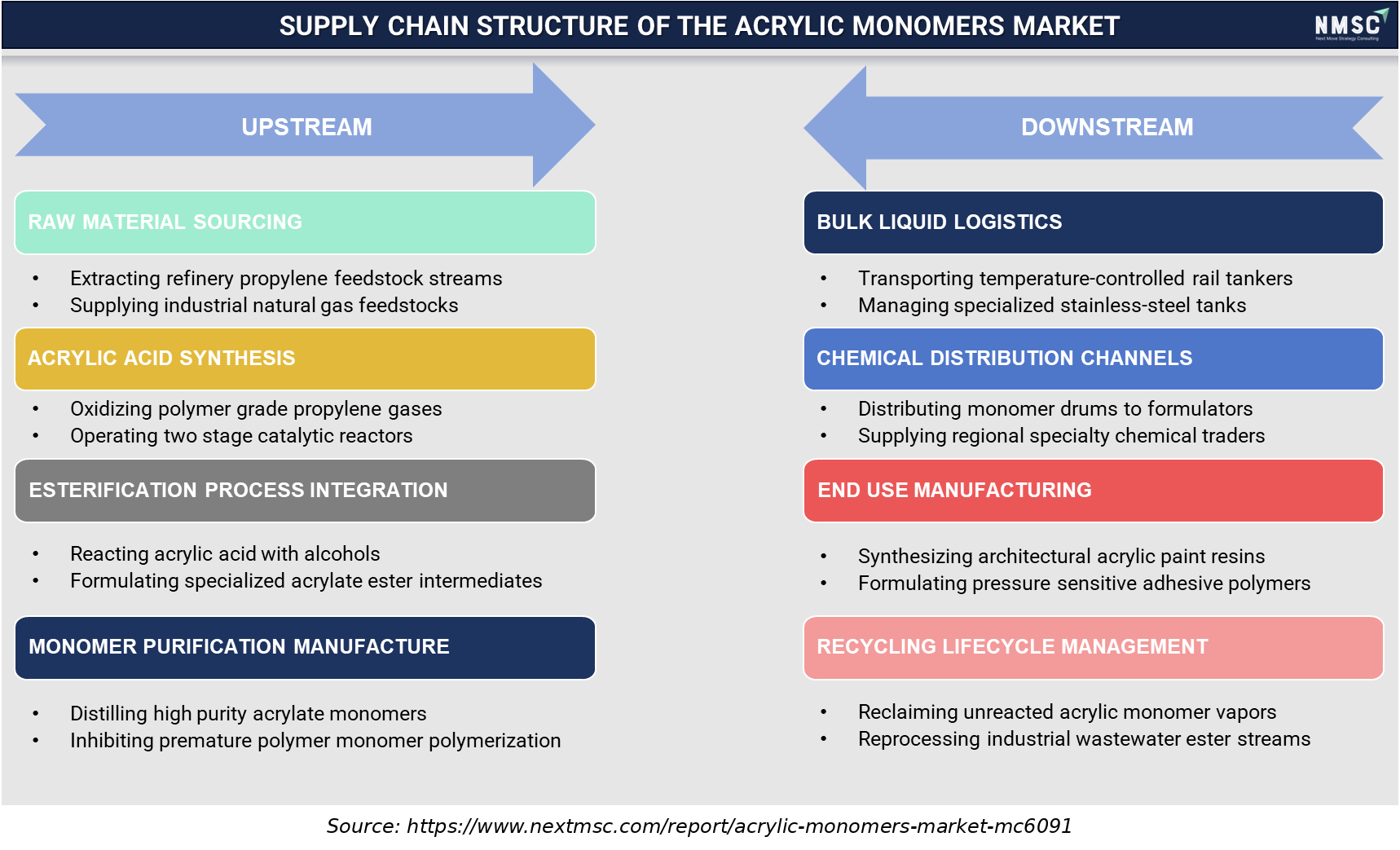
The above infographic presents the supply chain structure of the acrylic monomers market, segmented into upstream and downstream activities. Refinery propylene and natural gas feedstocks are oxidized through catalytic reactors to produce acrylic acid, which is then esterified with alcohols to form specialty acrylate intermediates. Further, purification and polymerization inhibitors ensure product stability. Bulk logistics and chemical distribution support downstream manufacturing of acrylic paints, coatings, and pressure-sensitive adhesives. Looking ahead, we observed that vapor recovery and wastewater reprocessing are becoming increasingly important for environmental compliance and material efficiency across the industry.

Market Drivers & Dynamics

Interactive Dataset
Rising waterborne architectural coatings demand driver +1.2% Global 2026-2035
Superabsorbent polymer capacity expansion for hygiene products driver +0.9% Asia Pacific 2026-2032
Growth in pressure-sensitive adhesive consumption for packaging driver +0.8% Global 2026-2035
Rising EV production requiring specialty acrylate sealants driver +0.6% North America, Europe, Asia Pacific 2026-2033
Commercialization of bio-based, low-carbon acrylic monomers driver +0.5% Europe, North America 2027-2035
Volatility in propylene and butanol feedstock pricing restraint -0.7% Global 2026-2030
Stringent VOC and REACH-type regulatory compliance costs restraint -0.5% Europe 2026-2035
Overcapacity and margin compression in merchant acrylic acid restraint -0.6% Asia Pacific 2026-2029
Health and handling hazard classification of acrylate monomers restraint -0.3% Global 2026-2032
Source: Next Move Strategy Consulting

Growth Drivers

What is the primary growth driver for the Acrylic Monomers Market?

The primary driver is expanding waterborne coatings demand tied to tightening solvent-emission rules. The U.S. Environmental Protection Agency regulates volatile organic compound content in architectural coatings under its National VOC standards, pushing formulators toward acrylic emulsion systems built on butyl acrylate and 2-ethylhexyl acrylate. Our findings suggest that this regulatory-led reformulation, combined with steady construction repair and remodeling activity, is sustaining base-load monomer demand growth across mature economies through 2035.

How is superabsorbent polymer growth driving acrylic monomer market expansion?

Rising hygiene product consumption, particularly across Asia Pacific and Latin America, is supporting growth in superabsorbent polymer production and influencing demand across the broader acrylics value chain. Nippon Shokubai Co., Ltd. has expanded its integrated superabsorbent polymer capacity, including production in Indonesia, highlighting the increasing importance of captive downstream applications within the acrylics industry.

Growth Inhibitors

What is restraining growth in the Acrylic Monomers Market?

Feedstock price volatility remains the primary restraint, as propylene and n-butanol prices fluctuate with crude oil and naphtha cracking economics, compressing monomer producer margins during periods of oversupply. The European Chemicals Agency's REACH registration and restriction obligations add compliance costs for acrylate monomer handling, transport, and worker exposure control. We observed that these combined cost pressures are contributing to capacity rationalization among smaller, non-integrated regional producers, particularly across parts of Europe.

What Are the Growth Opportunities?

What opportunity exists in bio-based and circular acrylic monomer production?

Commercialization of glycerin- and biomass-balance-derived acrylate monomers creates a premium-priced growth channel for coatings and adhesives formulators pursuing lower product carbon footprints, benefiting integrated producers with existing Verbund-style infrastructure able to scale bio-based grades fastest.

How can specialty acrylates for EV battery sealing create new revenue pools?

Electric vehicle battery pack sealing, thermal management, and busbar insulation require high-purity specialty acrylate and methacrylate monomers, opening a premium specialty segment that benefits producers with dedicated high-purity finishing lines serving automotive and battery cell manufacturers directly.

What whitespace exists in superabsorbent polymer integration across emerging hygiene markets?

Rising hygiene product penetration across India, Southeast Asia, and Latin America creates an integration opportunity for acrylic acid producers to build captive superabsorbent polymer capacity, benefiting hygiene product manufacturers and integrated chemical producers able to secure long-term acrylic acid derivative supply agreements.

Segmentation Analysis

2025 (USD Billion)
2035 (USD Billion)
Butyl Acrylate 2025: $3.44 Billion | 2035: $5.56 Billion
Butyl Acryla
Methyl Methacrylate 2025: $2.49 Billion | 2035: $4.27 Billion
Methyl Metha
2-Ethylhexyl Acrylate 2025: $2.01 Billion | 2035: $3.67 Billion
2-Ethylhexyl
Methyl Acrylate 2025: $1.78 Billion | 2035: $2.88 Billion
Methyl Acryl
Ethyl Acrylate 2025: $1.19 Billion | 2035: $1.89 Billion
Ethyl Acryla
Other Acrylic Monomers 2025: $0.95 Billion | 2035: $1.59 Billion
Other Acryli
Butyl Acrylate $3.44 Billion $5.56 Billion 5.5%
Methyl Methacrylate $2.49 Billion $4.27 Billion 6.2%
2-Ethylhexyl Acrylate $2.01 Billion $3.67 Billion 6.9%
Methyl Acrylate $1.78 Billion $2.88 Billion 5.5%
Ethyl Acrylate $1.19 Billion $1.89 Billion 5.3%
Other Acrylic Monomers $0.95 Billion $1.59 Billion 5.9%

Which product type dominates the Acrylic Monomers Market?

Butyl acrylate leads the product type axis, holding approximately 29.0% of 2025 revenue at USD 3.44 Billion, reflecting its widespread use as a softening monomer in emulsion coatings and adhesives. We found that 2-Ethylhexyl acrylate is the fastest-growing product type, projected to expand at a 6.9% CAGR from 2026 to 2035, driven by pressure-sensitive adhesive demand in packaging, labeling, and electronics assembly, where its low glass transition temperature delivers superior tack and peel performance.

2025 (USD Billion)
2035 (USD Billion)
Paints and c
Adhesives an
Superabsorbe
Plastics and
Textiles and
Segment Item 2025 (USD Billion) 2035 (USD Billion) CAGR
Paints and coatings $10.0 USD Billion $40.0 USD Billion 18.0%
Adhesives and sealants $17.1 USD Billion $51.1 USD Billion 16.0%
Superabsorbent polymers $24.2 USD Billion $62.2 USD Billion 22.0%
Plastics and polymer additives $31.3 USD Billion $73.3 USD Billion 12.0%
Textiles and fibers $38.4 USD Billion $84.4 USD Billion 19.0%

Segment-wise data is locked

Unlock complete segment-wise numbers for By Application.

Unlock Full Data

Which application segment leads the Acrylic Monomers Market?

Paints and coatings remain the dominant application, accounting for close to 34.0% of 2025 revenue as architectural, industrial, and automotive coatings formulators continue to shift toward acrylic emulsion binders in the paints and coatings market. Our analysis shows that superabsorbent polymers form the fastest-growing application at a 7.0% CAGR from 2026 to 2035, propelled by rising hygiene product consumption and demographic tailwinds across Asia Pacific and Latin America.

2025 (USD Billion)
2035 (USD Billion)
Building and
Automotive a
Packaging
Personal car
Textile and
Segment Item 2025 (USD Billion) 2035 (USD Billion) CAGR
Building and construction $10.0 USD Billion $40.0 USD Billion 20.0%
Automotive and transportation $17.1 USD Billion $51.1 USD Billion 18.0%
Packaging $24.2 USD Billion $62.2 USD Billion 12.0%
Personal care and hygiene $31.3 USD Billion $73.3 USD Billion 22.0%
Textile and apparel $38.4 USD Billion $84.4 USD Billion 25.0%

Segment-wise data is locked

Unlock complete segment-wise numbers for By End-use Industry.

Unlock Full Data

Which end-use industry leads Acrylic Monomers Market consumption?

Building and construction remains the dominant end-use industry, consuming approximately 31.0% of 2025 revenue through architectural coatings, sealants, and construction adhesives. Personal care and hygiene is the fastest-growing end-use industry, expanding at a 7.2% CAGR from 2026 to 2035, as rising disposable incomes and demographic shifts in Asia Pacific and Latin America lift diaper and adult incontinence product manufacturing, both heavily reliant on superabsorbent polymer-grade acrylic acid derivatives.

Growth Opportunities

Beyond core demand drivers, three forward-looking whitespace opportunities stand out for producers positioning capital and R&D investment through 2035, each tied to a distinct market mechanism and beneficiary segment within the acrylic monomers value chain.

What opportunity exists in bio-based and circular acrylic monomer production?

Commercialization of glycerin- and biomass-balance-derived acrylate monomers creates a premium-priced growth channel for coatings and adhesives formulators pursuing lower product carbon footprints, benefiting integrated producers with existing Verbund-style infrastructure able to scale bio-based grades fastest.

How can specialty acrylates for EV battery sealing create new revenue pools?

Electric vehicle battery pack sealing, thermal management, and busbar insulation require high-purity specialty acrylate and methacrylate monomers, opening a premium specialty segment that benefits producers with dedicated high-purity finishing lines serving automotive and battery cell manufacturers directly.

What whitespace exists in superabsorbent polymer integration across emerging hygiene markets?

Rising hygiene product penetration across India, Southeast Asia, and Latin America creates an integration opportunity for acrylic acid producers to build captive superabsorbent polymer capacity, benefiting hygiene product manufacturers and integrated chemical producers able to secure long-term acrylic acid derivative supply agreements.

Regional Outlook

2025 (USD Billion)
2035 (USD Billion)
Asia Pacific
North Americ
Europe
Latin Americ
Middle East
Region 2025 (USD Billion) 2035 (USD Billion) CAGR (%)
Asia Pacific $10.0 USD Billion $40.0 USD Billion 9.0%
North America $17.1 USD Billion $51.1 USD Billion 27.0%
Europe $24.2 USD Billion $62.2 USD Billion 25.0%
Latin America $31.3 USD Billion $73.3 USD Billion 23.0%
Middle East and Africa $38.4 USD Billion $84.4 USD Billion 12.0%

Regional data is locked

Unlock complete regional numbers for this market.

Unlock Full Data

Porter's Five Forces Analysis of the Acrylic Monomers Market

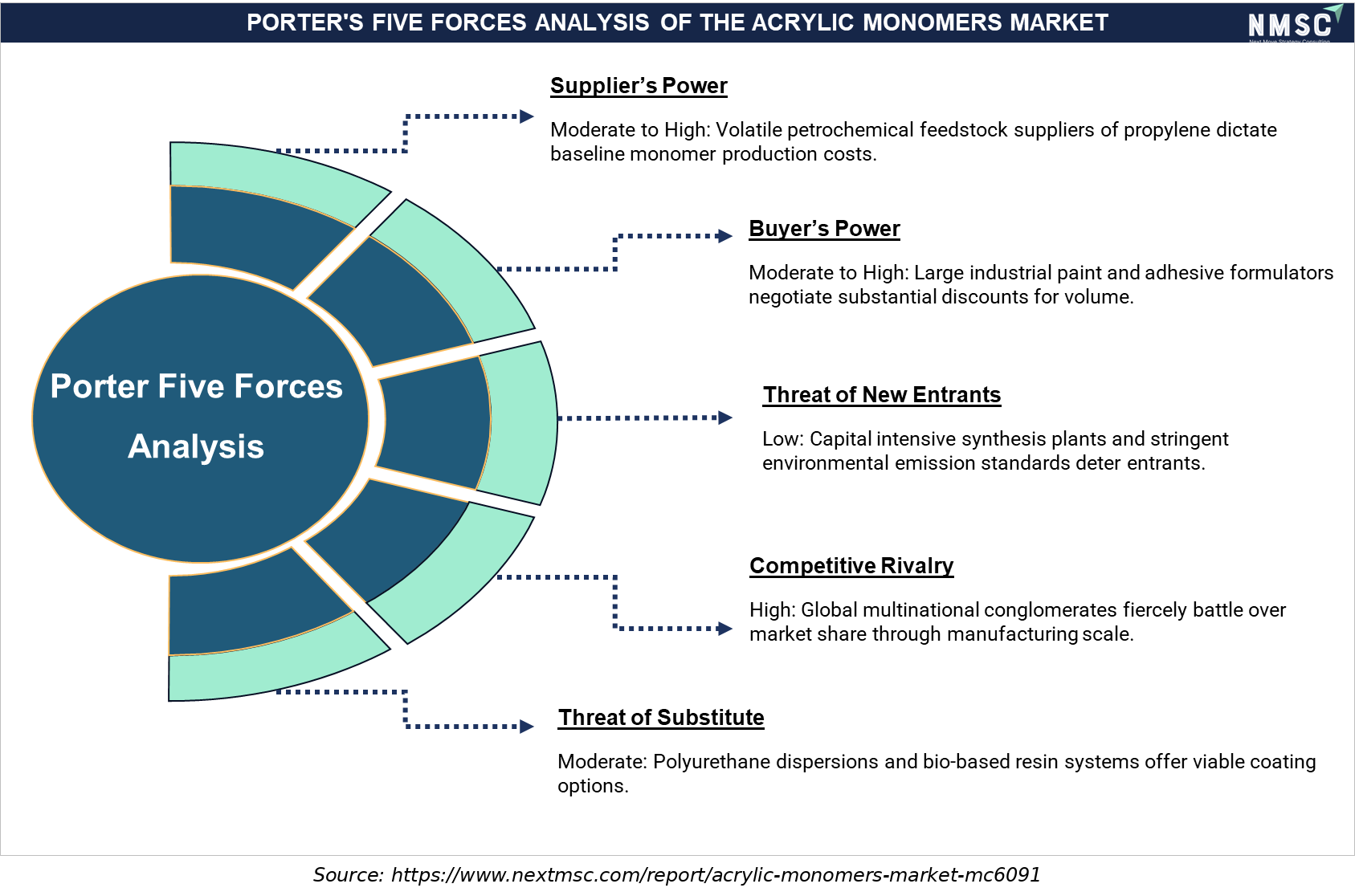
The above infographic presents a Porter's Five Forces analysis of the acrylic monomers market, wherein supplier power remains moderate to high due to volatile propylene feedstocks that influence production costs. Buyer power is also moderate to high, as large-scale paint and adhesive formulators negotiate volume-based discounts. Further, competitive rivalry is intense among global conglomerates competing through manufacturing scale. Looking ahead, we observed that the threat of substitutes remains moderate, with polyurethane and bio-based resins offering viable alternatives across select applications.

Competitive Landscape

NMSC's analysis indicates that the Acrylic Monomers Market Industry remains moderately consolidated among integrated petrochemical producers, with competitive advantage concentrated among companies controlling upstream propylene and butanol feedstock alongside downstream acrylic acid and monomer finishing capacity.

Dimension Description
Attribute Assessment
Market Structure Moderately consolidated, led by integrated global petrochemical producers with regional commodity competition from Asian manufacturers
Innovation Focus Bio-based and low-carbon monomer grades, specialty acrylates for EV and electronics, waterborne emulsion technology
M&A Activity Selective equity partnerships and feedstock integration deals concentrated in Asia Pacific and the Middle East

How do companies compete in the Acrylic Monomers Market?

Companies compete primarily on feedstock integration, production cost position, and product purity consistency, with integrated Verbund-style producers able to undercut non-integrated regional competitors on commodity-grade monomer pricing while specialty producers compete on formulation support and technical service quality for coatings and adhesives customers.

Which competitive archetypes dominate the Acrylic Monomers Market?

Two archetypes dominate: large integrated petrochemical majors such as BASF SE, Dow Inc., and Arkema S.A. that leverage Verbund-style feedstock integration for commodity-grade scale economics, and specialized Asian producers such as Nippon Shokubai Co., Ltd. and LG Chem Ltd. that combine acrylic acid production with captive superabsorbent polymer and specialty monomer capacity to capture higher-margin downstream value.

What M&A and capacity investment activity is shaping the industry?

Recent Industry activity includes feedstock-integration equity partnerships in China's downstream acrylics value chain and targeted capacity investment in acrylic acid purification and superabsorbent polymer lines across Europe and Southeast Asia. We found that producers are prioritizing organic capacity debottlenecking and specialty-grade investment over large-scale M&A, reflecting a maturing commodity segment alongside a growing specialty monomer opportunity.

Key Market Players

Based on research conducted by NMSC, we found that the following twenty companies represent the most significant global producers of acrylic and methacrylate monomers, ranked by verified production scale and market-specific revenue as of 2026.

BASF SE Dow Inc. Arkema S.A. Nippon Shokubai Co., Ltd. LG Chem Ltd. Mitsubishi Chemical Group Corporation Röhm GmbH Formosa Plastics Corporation Wanhua Chemical Group Co., Ltd. Sumitomo Chemical Co., Ltd. Satellite Chemical Co., Ltd. Sasol Limited Mitsui Chemicals, Inc. Kuraray Co., Ltd. Nippon Kayaku Co., Ltd. Toagosei Co., Ltd. SABIC Jiangsu Sanmu Group Co., Ltd. Shandong Kaisheng New Materials Co., Ltd. Perstorp Holding AB

Latest Developments

We observed that recent developments across the Market concentrate on bio-based feedstock commercialization, capacity investment, and value-chain integration among leading global producers.

Date Event
June 2026 Röhm officially opened its Bay City, Texas methyl methacrylate (MMA) plant following the successful ramp-up of its proprietary LiMA technology. With an annual production capacity of 250,000 tons, the facility is the first C2-based MMA production facility in North America and strengthens domestic MMA supply chains.
March 2026 BASF launched Butyl Acrylate RE and 2-Ethylhexyl Acrylate RE, manufactured at its Freeport, Texas site using attributed electricity from renewable sources. Developed in collaboration with Avery Dennison, the new acrylic acid esters reduce CO₂ emissions during manufacturing and improve their carbon footprint compared with conventionally produced products.
July 2025 BASF achieved mechanical completion of its acrylics complex at the Zhanjiang Verbund site in China, including the Glacial Acrylic Acid and Butyl Acrylate plants. The facilities were on track to come on stream in 2025, with the Butyl Acrylate plant designed for approximately 400,000 metric tons of annual production capacity, expanding BASF's acrylics production capabilities in China.

Expert Insights

Bir Darbar Mehta

Senior Vice President of Petrochemicals Asia Pacific | BASF

"The acrylics business has been a cornerstone of BASF Petrochemicals. With the completion of the new acrylics complex in Zhanjiang, we are further enhancing our production capacities along the acrylics value chain. These new world-scale production facilities will allow us to meet the fast-growing demand for acrylics in China and across Asia with a reliable supply of high-quality, competitive products and shorter lead times"

Analyst Interpretation

The statement highlights the increasing importance of capacity expansion and regional supply availability across the acrylics value chain. NMSC's analysis indicates that growing demand for acrylic monomers in China and other Asian markets is encouraging producers to establish large-scale, integrated manufacturing facilities closer to downstream customers. The expansion of glacial acrylic acid and butyl acrylate production is expected to strengthen regional supply capabilities while supporting demand from adhesives, coatings, and other acrylic-based applications.

Investment Opportunities

Where are capital inflows concentrating in the Acrylic Monomers Market?

Capital inflows are concentrating in acrylic acid purification, bio-based feedstock conversion, and superabsorbent polymer integration projects, particularly across Europe and Asia Pacific. Arkema S.A.'s confirmed EUR 130 million purification unit investment and Nippon Shokubai Co., Ltd.'s Indonesian superabsorbent polymer line illustrate the shift of capital toward higher-margin, integrated downstream capacity rather than standalone commodity monomer expansion.

How is infrastructure investment shaping the market's growth trajectory?

Infrastructure investment in Verbund-style integration, feedstock logistics, and regional distribution hubs continues to underpin capacity economics, with Middle Eastern and Southeast Asian governments supporting petrochemical infrastructure development through national industrial diversification programs, improving feedstock access and reducing landed cost for regional monomer producers serving downstream coatings and adhesives manufacturers.

What ESG considerations are shaping investment decisions in the Acrylic Monomers Market?

Environmental, Social, and Governance considerations increasingly govern capital allocation, with investors and customers prioritizing verified bio-based content, reduced product carbon footprint, and REACH-compliant handling standards. The European Chemicals Agency's regulatory framework directly shapes permissible emission and worker-exposure thresholds, pushing producers to prioritize ESG-aligned capacity investment to maintain market access across the European Union.

Key Benefits for Stakeholders

How does this report benefit industry leaders?

Industry leaders gain a validated view of segment-level revenue distribution, competitive positioning, and regional demand trajectories, supporting capacity planning and product portfolio decisions. The report's segmentation analysis and competitive landscape assessment provide a structured basis for prioritizing investment across product type, application, and geography through 2035.

How does this report benefit investors and financial analysts?

Investors and financial analysts benefit from consistent, internally validated market sizing across the 2025 base year, 2026 estimate, and 2035 forecast, supported by a transparent growth catalyst and risk assessment matrix. This structured data set supports comparative evaluation of producer exposure to specific demand drivers, regulatory risks, and regional growth opportunities within the Acrylic Monomers Market.

How does this report benefit technology vendors and product teams?

Technology vendors and product development teams gain visibility into emerging specialty demand pools, including bio-based monomer grades and electric vehicle sealing applications, supported by segment-level CAGR data. This enables more precise targeting of R&D investment toward the fastest-growing application and end-use categories identified within the report's segmentation and growth opportunity analysis.

Key Market Segments Evaluated

By Product Type

  • Butyl Acrylate
  • Methyl Methacrylate
  • 2-Ethylhexyl Acrylate
  • Methyl Acrylate
  • Ethyl Acrylate
  • Other Acrylic Monomers

By Application

  • Paints and Coatings
  • Adhesives and Sealants
  • Superabsorbent Polymers
  • Plastics and Polymer Additives
  • Textiles and Fibers
  • Other Applications

By End-use Industry

  • Building and Construction
  • Automotive and Transportation
  • Packaging
  • Personal Care and Hygiene
  • Textile and Apparel
  • Other End-use Industries

Conclusion & Recommendations

The long-term outlook remains constructive, with revenue projected to expand from USD 12.48 Billion in 2026 to USD 19.86 Billion by 2035 at a 5.3% CAGR, supported by durable demand from coatings, adhesives, and hygiene applications alongside emerging specialty demand from electric vehicle and electronics manufacturing across Asia Pacific and other high-growth regions.

What strategic positioning should producers pursue?

Producers should prioritize feedstock integration and bio-based monomer certification to defend margin against commodity price volatility while capturing premium specialty demand. NMSC's analysis indicates that companies balancing integrated commodity-scale production with targeted specialty capacity investment are best positioned to sustain competitive advantage through the forecast period.

How attractive is the Acrylic Monomers Market for new investment?

Investment attractiveness is moderate to high, particularly in superabsorbent polymer integration and bio-based monomer capacity, where CAGR levels of 7.0% and above outpace the broader market's 5.3% average. Regions including Asia Pacific and Latin America offer the strongest combination of demand growth and capacity investment opportunity through 2035.

What market shifts and key risks should stakeholders monitor?

Stakeholders should monitor feedstock price volatility, regional overcapacity in merchant acrylic acid, and tightening REACH-style regulatory compliance costs, each capable of compressing producer margins. We observed that continued capacity rationalization among non-integrated regional producers is likely to persist as integrated majors consolidate commodity-grade market share through 2035.

What are the primary growth pathways through 2035?

The primary growth pathways run through bio-based monomer commercialization, superabsorbent polymer capacity integration, and specialty acrylate development for electric vehicle and electronics applications. Producers pursuing these three pathways simultaneously, backed by integrated feedstock positions, are best positioned to capture the USD 7.38 Billion incremental opportunity available between 2026 and 2035.

FAQs

About the Author

Mayurima Roy

Mayurima Roy

Mayurima Roy is Research Analyst at Next Move Strategy Consulting, where she has spent 4 years working across the firm's full industry coverage rather than a single fixed vertical. Her work centers on structured research, ongoing trend tracking, competitive assessment, and insight-led content development, translating complex market data into clear, decision-ready narratives that support informed client decision-making across diverse global industries, market sectors, and world regions every day.

About the Reviewer

Supradip Baul

Supradip Baul

Supradip Baul is an accomplished business consultant and strategist with over a decade of rich experience in market intelligence, strategy, technology, and business transformation. His work has included rigorous qualitative and quantitative analysis across multiple industries, helping clients shape investment decisions and long-term roadmaps. Earlier in his career, he was associated with Gartner, where he contributed to industry-leading reports and market share analyses. He has worked with leading global companies and holds an MBA with a dual specialization in Marketing and Finance.

Download Free Sample

Kevin Coker

KEVIN COKER

Founder, CEO and Board Diector

Proxima Clinical Research

I have been using Next MSC reports for product positioning in a new geography for a long time. They have by far the best reports I have found and the price is reasonable too!

Mohit Agarwal

MOHIT AGARWAL

Chief Manager

DryChem India Pvt. Ltd.

Next Move Strategy Consulting is an amazing team of consultants. We required a market study report for our investors on top priority and the team went above and beyond our expectations to deliver the same with ample supporting data within a short time span enabling us to secure the investments and keep our project timeline maintained. Their professionalism, attention to detail, and timely delivery of actionable recommendations have left a lasting impression on our organization.

Robert Sean Trevino

ROBERT SEAN TREVINO

Sr. Director, Head of Strategic Insights & Analytics

Foundation Medicine

I realized that it was a reliable source of information. These days, there are many people who are looking for authentic data, and this is one of the only sources that can offer them with what they need;

Rishabh Jogani

RISHABH JOGANI

Strategy Analyst

Accenture Japan

We are incredibly impressed with the market report on the real estate market in India provided by Next Move Strategy Consulting. The report was thorough, insightful, and well-structured, offering deep analysis and actionable recommendations. It not only captured the current trends and dynamics but also provided a forward-looking perspective that has been invaluable for our strategic planning. Their team demonstrated exceptional professionalism, attention to detail, and a profound understanding of the industry. The data-driven insights and clarity of presentation exceeded our expectations, making complex market trends easy to understand. We highly recommend Next Move Strategy Consulting to anyone looking for reliable and comprehensive market research services. Their expertise has given us the confidence to navigate the complexities of the Indian real estate market with clarity and foresight.

Ross J Mckenzie

ROSS J MCKENZIE

Business Insight Manager

Staysure Group

“Next MSC have been incredibly helpful in providing detailed & robust information on our market, alongside quantifying growth by different segments. The process to procure was simple and easy, with sample reports and regular contact to ensure we had what we needed. Succinct detail on their sources & methodologies is also greatly received, allowing transparency in this respect helps build trust in the detail you pay for. Joseph in particular was fantastic, and helped ensure efficient provision of the insight pack – thank you NMSC!”.

Custom Market Research Services

We will customize the research for you if the listed report does not fully match your requirements.

Get 30% Free Customization

Select License

This website uses cookies to ensure you get the best experience on our website. Learn more

✖