Asia-Pacific Mobile Payment Market By Payment Channel (Contactless Card-based, QR Code-based, Account-to-Account Transfers, and Carrier Billing), By Platform Type (Web-Embedded and Native App), By Transaction Use Case (Peer-to-Peer, Point-of-Sale, Bill and Recurring Payments, and Others), By Payment Location (Remote Payment and Proximity Payment), and By Customer Type (Retail Consumers, Small and Medium Enterprises, and Others) – Opportunity Analysis and Industry Forecast, 2025–2035.
Industry: ICT & Media | Latest Edition: July 24, 2026 | No of Pages: 246 | No. of Tables: 90 | No. of Figures: 84 | Format: PDF | Report Code: IC2470
What Is the Asia-Pacific Mobile Payment Market Size?
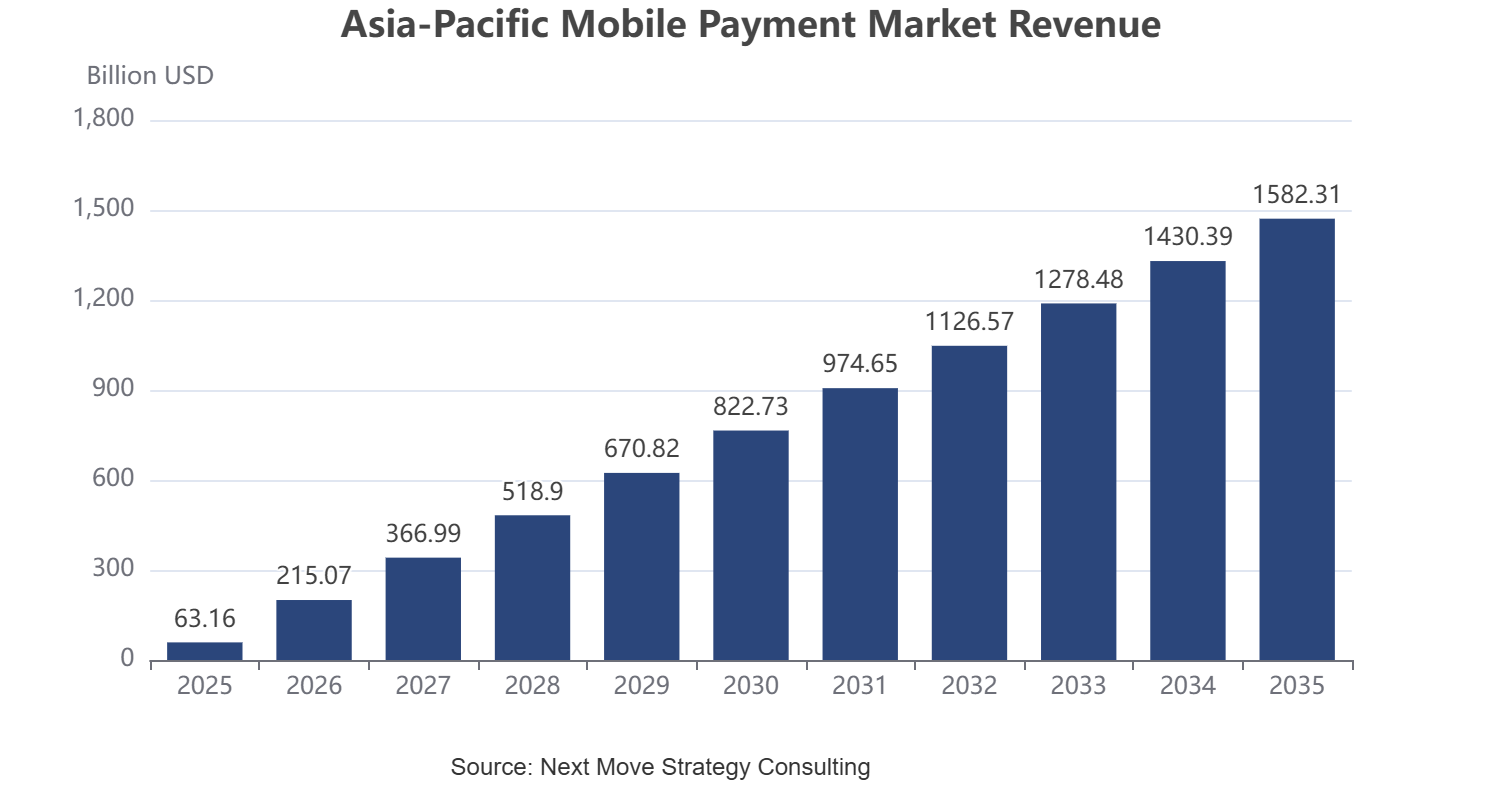
The Asia-Pacific mobile payment market size was valued at USD 63.16 billion in 2025 and is estimated at USD 106.01 billion in 2026, forecast to reach USD 1,582.31 billion by 2035, expanding at a 35.03% CAGR between 2026 and 2035. QR code-based transactions dominate the market by payment channel, supported by interoperable QR infrastructure across major Asian economies.
We observed that market growth is supported by state-backed real-time payment rails, expanding cross-border QR interoperability across China, India, and Southeast Asia, and continuous innovation in super-app ecosystems, biometric checkout, and embedded finance through 2035.
Key Takeaways
|
By Payment Channel: QR Code-based is the dominant segment, while Account-to-Account Transfers (A2A) is the fastest-growing segment. |
|
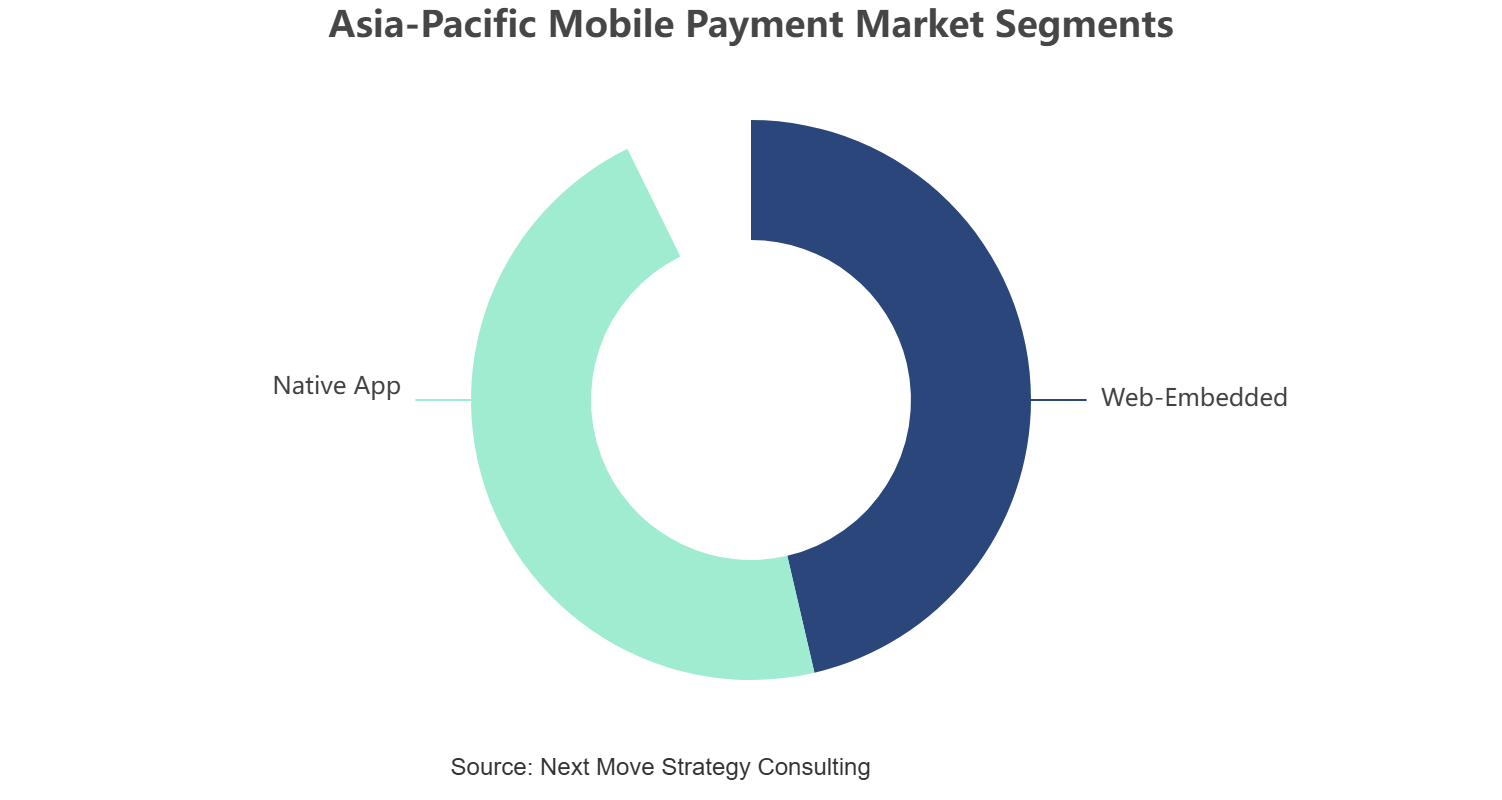
By Platform Type: Native App is the dominant segment, while Web-Embedded is the fastest-growing segment. |
|
By Transaction Use-Case: Peer-to-Peer (P2P) is the dominant segment, while Point-of-Sale (P2M) is the fastest-growing segment. |
|
By Payment Location: Proximity Payment is the dominant segment, while Remote Payment is the fastest-growing segment. |
|
By Customer Type: Retail Consumers is the dominant segment, while Small and Medium Enterprises (SMEs) is the fastest-growing segment. |
Market Opportunity: The Asia-Pacific mobile payment market is expected to create an absolute dollar opportunity of USD 1,476.30 billion between 2026 and 2035, presenting significant investment potential across cross-border QR interoperability, super-app-based checkout, and SME-focused payment gateway solutions
According to NMSC's analysis, companies are increasingly investing in interoperable payment infrastructure, biometric authentication, and cross-border settlement technologies, strengthening their competitive position in the Asia-Pacific mobile payment market through 2035.
What does the Asia-Pacific Mobile Payment Market Encompass?
The Asia-Pacific mobile payment market encompasses smartphone-enabled transaction methods that allow consumers and businesses to initiate, authorize, and settle payments through contactless cards, QR codes, account-to-account transfers, and carrier billing. Our assessment indicates that the market spans native mobile applications and web-embedded checkout experiences supporting peer-to-peer transfers, point-of-sale purchases, recurring bill payments, business-to-business settlements, and government remittances across retail consumers, SMEs, large enterprises, and public sector bodies across China, India, Japan, South Korea, and Southeast Asia.
The market has evolved from fragmented, country-specific card and wallet systems into an increasingly interoperable, state-backed and super-app-driven ecosystem shaped by regulators including the Reserve Bank of India, the People's Bank of China, and the Bank of Korea. We observed that rising adoption of biometric authentication, tokenization, and embedded checkout within retail and Mobile Commerce platforms continues to reshape merchant acceptance, cross-border settlement, and consumer trust across the market.
|
Parameter |
Details |
|
Market Size in 2025 |
USD 63.16 Billion |
|
Market Size in 2026 |
USD 106.01 Billion |
|
Revenue Forecast in 2035 |
USD 1,582.31 Billion |
|
Growth Rate |
CAGR of 35.03% from 2026 to 2035 |
|
Analysis Period |
2025–2035 |
|
Base Year Considered |
2025 |
|
Forecast Period |
2026–2035 |
|
Market Size Estimation |
USD Billion |
|
Companies Profiled |
15 |
|
Countries Covered |
10 |
|
Market Share |
Available for Top 10 Companies |
Key Emerging Trends
Based on research conducted by NMSC, we found that four structural trends are reshaping payment infrastructure, consumer behavior, and competitive dynamics across the Asia-Pacific mobile payment market.
How Is Cross-Border QR Interoperability Reshaping Regional Payments?
Cross-border QR payment linkages are expanding rapidly across Asia-Pacific, connecting national payment rails and enabling travelers to pay using familiar home apps abroad. We observed that China UnionPay Co., Ltd. has launched cross-border QR connectivity with Indonesia, following similar linkages across Southeast Asia, growing its overseas QR merchant network to more than 46 million locations and strengthening tourism-linked transaction volumes across the region.
Why Is India's UPI Model Expanding Beyond Domestic Borders?
India's Unified Payments Interface, operated through NPCI BHIM Services Limited, is expanding internationally as inbound and outbound corridors mature. Our findings suggest that the UPI One World wallet, piloted for foreign delegates at major summits, and the recent launch of UPI in Cambodia demonstrate NPCI's ambition to export its real-time, account-to-account payment model to additional Asian economies.
How Are Super Apps Consolidating Mobile Payment Ecosystems Across Asia?
Financial super apps are increasingly embedding payments, brokerage, insurance, and lending within single-app ecosystems. We observed that companies including Kakao Pay Corp. and Viva Republica Inc. continue to expand Payment Gateway and biometric checkout capabilities, with Viva Republica's FacePay service surpassing one million users across South Korean retail locations.
What Role Is Biometric Authentication Playing in Regional Payment Security?
Biometric authentication is becoming central to mobile payment security as digital adoption accelerates across the region. Our analysis indicates that providers are deploying facial recognition and tokenized credentials to reduce fraud risk while streamlining checkout speed. This dual focus on security and convenience is strengthening consumer confidence across leading payment platforms and card networks throughout Asia-Pacific.
Supply Chain Structure of the Asia-Pacific Mobile Payment Industry
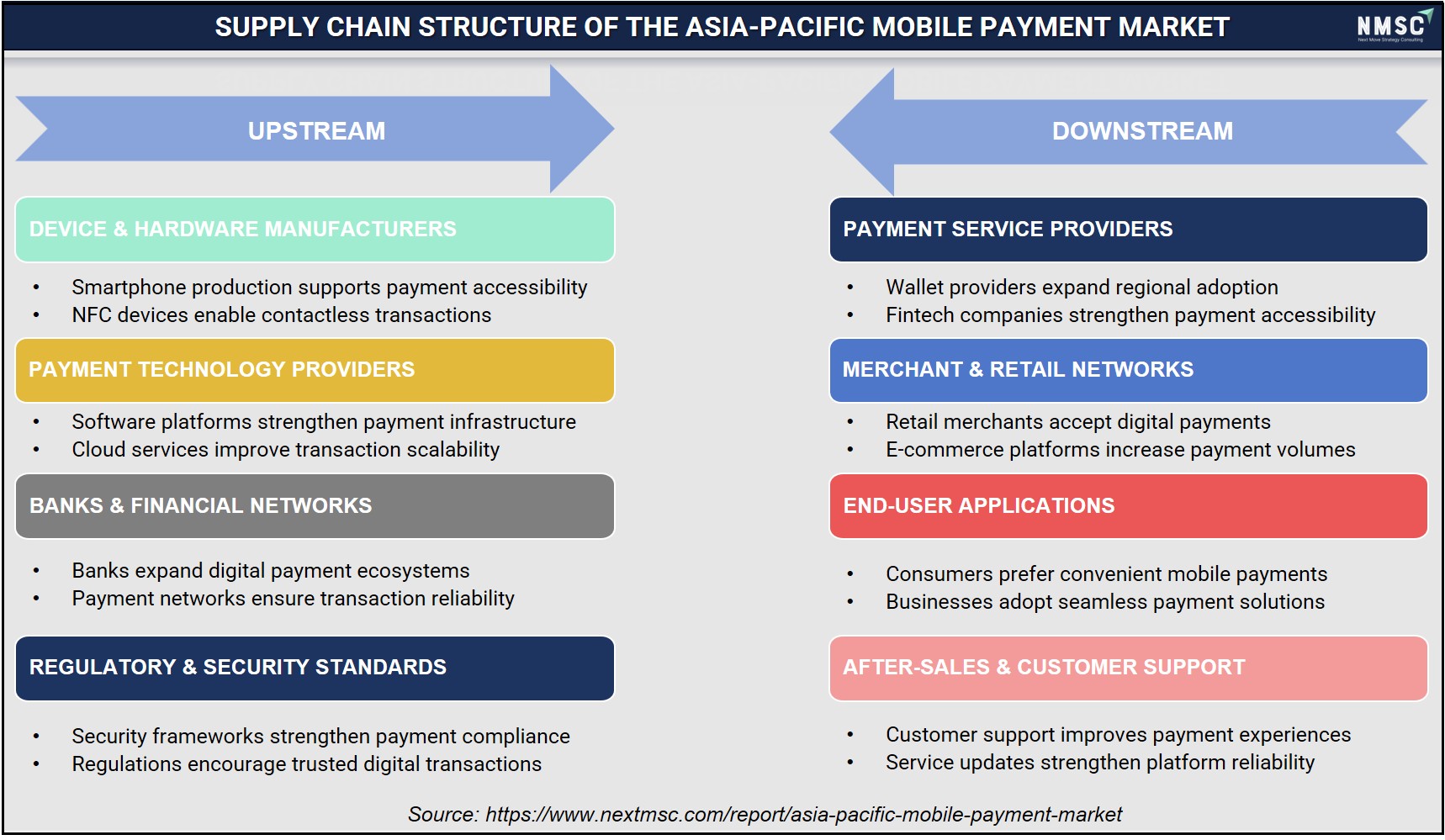
Based on our supply chain assessment, we observed that the Asia-Pacific mobile payment market is supported by a collaborative ecosystem comprising device manufacturers, payment technology providers, financial institutions, payment service providers, merchants, and end users. Smartphone manufacturers and NFC-enabled devices enable secure digital transactions, while software platforms and banks strengthen payment infrastructure and scalability. Furthermore, merchants expand digital payment acceptance, service providers improve accessibility, and regulatory frameworks reinforce security, compliance, and consumer confidence across diverse regional markets.
Growth Drivers & Restraints
Growth Catalyst & Risk Assessment Matrix
|
Factors |
Type |
(+/−) % Impact on CAGR |
Geographic Relevance |
Impact Timeline |
|
Rapid expansion of state-backed real-time payment rails such as UPI and interoperable QR standards |
Driver |
+8.45% |
Asia-Pacific (nationwide across India, China, and ASEAN economies) |
2026–2029 |
|
Growing cross-border QR payment connectivity across China, ASEAN, and India |
Driver |
+6.30% |
Asia-Pacific (border provinces and major tourism hubs) |
2026–2031 |
|
Rising super-app consolidation of payments, lending, and insurance services |
Driver |
+5.15% |
Asia-Pacific (strongest in South Korea, Japan, and China) |
2026–2030 |
|
Expanding smartphone penetration and 5G network rollout |
Driver |
+4.20% |
Asia-Pacific (nationwide; highest in urban centers) |
2026–2029 |
|
Growing e-commerce and social commerce adoption |
Driver |
+3.65% |
Asia-Pacific (nationwide) |
2026–2032 |
|
Cybersecurity and payment fraud risks amid rapid digital adoption |
Restraint |
−3.10% |
Asia-Pacific (nationwide) |
2026–2029 |
|
Regulatory fragmentation across national payment licensing regimes |
Restraint |
−2.55% |
Asia-Pacific (strongest for cross-border and smaller fintechs) |
2026–2031 |
|
Limited interoperability between proprietary domestic wallet ecosystems |
Restraint |
−1.95% |
Asia-Pacific (strongest in China and Japan) |
2026–2030 |
What Is the Primary Growth Driver of the Asia-Pacific Mobile Payment Market?
Rapid expansion of state-backed real-time payment rails and interoperable QR standards is the primary growth driver of the Asia-Pacific mobile payment market. According to the National Payments Corporation of India, UPI processed over 21 billion transactions in a single month in early 2026, reflecting the scale of state-built infrastructure. We observed that rising merchant acceptance of interoperable QR codes continues to reinforce mobile payment adoption nationwide across the region.
How Is Cross-Border QR Connectivity Driving Asia-Pacific Mobile Payment Market Growth?
Cross-border QR connectivity is accelerating growth as national payment rails link directly with one another under government-to-government cooperation frameworks. The People's Bank of China and Bank Indonesia jointly launched a cross-border QR linkage in June 2026, extending UnionPay-powered wallet acceptance to tens of millions of merchants. Our assessment indicates that this regulatory-backed connectivity is strengthening tourism-linked transaction volumes and cross-border e-commerce settlement across Asia-Pacific.
What Is Restraining Asia-Pacific Mobile Payment Market Expansion?
Rising cybersecurity concerns and payment fraud risks continue to restrain market expansion amid rapid digital adoption across diverse regulatory regimes. National regulators require payment providers to strengthen authentication and licensing compliance, increasing operational costs for smaller fintech firms. We found that regulatory fragmentation across national licensing regimes, combined with limited interoperability between proprietary wallet ecosystems in China and Japan, further limits the pace of full mobile payment adoption regionwide.
Which Country is Dominating the Asia-Pacific Mobile Payment Market?
Our comprehensive market evaluation indicates that China holds the dominant share in the Asia-Pacific Mobile Payment Market, supported by its highly developed digital payment ecosystem, extensive smartphone penetration, and widespread adoption of mobile wallet platforms. The country benefits from strong integration of mobile payments across retail, e-commerce, transportation, healthcare, and public services, enabling seamless cashless transactions for consumers and businesses. Furthermore, continuous innovation by fintech companies, expanding QR code payment infrastructure, and growing adoption of contactless payment technologies are strengthening mobile payment usage across urban and rural areas.
Additionally, China continues to witness significant collaboration among financial institutions, technology companies, payment service providers, and merchants to expand digital payment capabilities. The rapid digitalization of financial services, increasing consumer preference for cashless transactions, and ongoing development of secure payment technologies further reinforce the country's market leadership. Consequently, China remains the leading market for mobile payment adoption, technological innovation, and digital payment transactions across the Asia-Pacific region.
Which Country is Set to Witness the Fastest Growth?
China registers the fastest growth in the Asia-Pacific Mobile Payment Market, supported by continuous advancements in digital payment technologies, expanding fintech investments, and increasing adoption of mobile payment services across consumer and commercial applications. We found that the growing utilization of QR code payments, NFC-enabled transactions, digital wallets, and super-app ecosystems is accelerating market expansion. Moreover, increasing integration of mobile payment platforms with e-commerce, transportation, healthcare, entertainment, and government services strengthens digital payment adoption throughout the country.
Further, the rapid expansion of digital financial services, growing merchant acceptance of contactless payments, and continuous innovation in payment security technologies strengthen mobile payment utilization across metropolitan and lower-tier cities. The increasing deployment of AI-enabled payment solutions and expansion of cross-border digital payment services further support market growth. Consequently, China maintains its position as the fastest-growing country in the Asia-Pacific Mobile Payment Market.
Segmentation Analysis
By Payment Channel Insights
How Is the Asia-Pacific Mobile Payment Market Segmented by Payment Channel?
Based on payment channel, the Asia-Pacific mobile payment market is segmented into contactless card-based (NFC, MST), QR code-based, account-to-account transfers (A2A), and carrier billing.
QR code-based payments dominate the market, supported by interoperable QR standards accepted across retail merchants, street vendors, and cross-border tourism corridors throughout the region. Account-to-account transfers represent the fastest-growing channel, driven by state-built real-time payment rails such as UPI and expanding merchant demand for reduced transaction fees. Contactless card-based payments continue to expand through NFC-enabled wallet integration in Japan and South Korea, while carrier billing serves niche digital content and micro-transaction use cases.
By Transaction Use-Case Insights
How Is the Asia-Pacific Mobile Payment Market Segmented by Transaction Use-Case?
Based on transaction use-case, the Asia-Pacific mobile payment market is segmented into peer-to-peer (P2P), point-of-sale (P2M), bill and recurring payments, business-to-business, and government or tax remittance.
Peer-to-peer payments dominate the market, reflecting the massive scale of consumer-to-consumer transfers processed through platforms such as UPI, super apps, and regional wallet ecosystems. Point-of-sale transactions are the fastest-growing use-case as merchants across the region expand QR and NFC-enabled acceptance infrastructure. Bill and recurring payments continue to expand through account-linked billing, while business-to-business and government remittance use-cases are gradually digitizing through national switching infrastructure.
Growth Opportunities
Our analysis identifies three forward-looking whitespace opportunities positioned to shape the next phase of growth across the Asia-Pacific mobile payment market.
What Opportunity Does Cross-Border QR Interoperability Create for Payment Networks?
Expanding cross-border QR interoperability across China, ASEAN, and India creates substantial opportunity for providers such as China UnionPay Co., Ltd. to capture tourism-linked and cross-border e-commerce transaction volumes. Providers that build robust cross-border settlement infrastructure stand to capture growing intra-regional travel and trade spending.
How Can Super-App Embedded Finance Unlock New Revenue Streams?
Consumers increasingly favor unified apps combining payments, brokerage, and lending. Providers such as Viva Republica Inc. and Kakao Pay Corp. that expand embedded finance and biometric checkout features can capture rising engagement, unlocking new subscription, lending, and merchant acquiring revenue streams across the region.
Where Does State-Built Payment Infrastructure Create New Demand in Emerging Asia-Pacific Markets?
State-built real-time payment infrastructure creates new demand for interoperable acceptance technology among merchants and financial institutions in emerging Asia-Pacific economies. Companies such as NPCI BHIM Services Limited that extend account-to-account payment models to additional markets are well positioned to capture rising government-backed demand for cashless transaction infrastructure.
SWOT Analysis of the Asia-Pacific Mobile Payment Industry
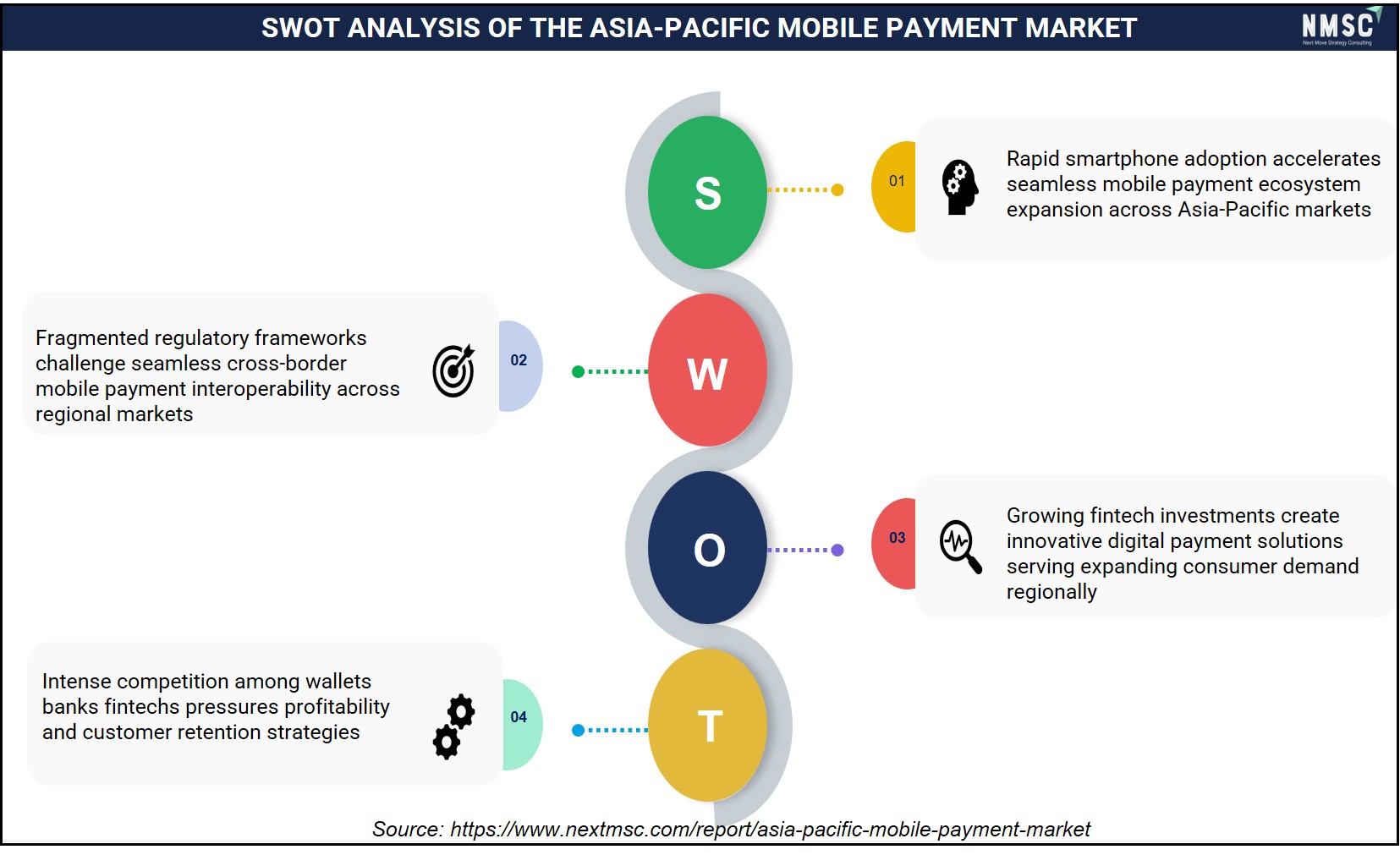
Based on our competitive assessment, we identified that the Asia-Pacific mobile payment market benefits from rapid smartphone adoption and expanding digital payment ecosystems that accelerate regional market growth. However, fragmented regulatory frameworks create interoperability challenges across countries. Growing fintech investments and continuous innovation generate significant opportunities for new payment solutions, while intense competition among digital wallets, banks, and fintech companies places pressure on profitability, customer retention, and long-term market differentiation.
Competitive Landscape
We observed that the Asia-Pacific mobile payment industry features a highly competitive landscape, with state-backed payment infrastructure operators, super-app providers, global technology firms, and card networks competing for consumer and merchant adoption.
Key Takeaways
|
Dimension |
Description |
|
Market Structure |
Highly competitive, with state-backed switching infrastructure operators, super-app providers, and global technology firms operating alongside card networks and payment gateways across the Asia-Pacific mobile payment industry. |
|
Innovation Focus |
Cross-border QR interoperability, biometric authentication, super-app embedded finance, and artificial intelligence-driven payment processing dominate current product development strategies across leading companies. |
|
M&A Activity |
Strategic partnerships, cross-border QR linkages, and IPO activity continue to shape the competitive landscape as companies strengthen regional connectivity and expand merchant acceptance networks. |
How Do Companies Compete in the Asia-Pacific Mobile Payment Market?
Companies compete primarily through transaction security, merchant network breadth, and interoperability with national and cross-border switching infrastructure. Leading providers such as China UnionPay Co., Ltd. and NPCI BHIM Services Limited leverage extensive state-backed bank and merchant partnerships to maintain infrastructure-level market leadership, while super-app providers including Kakao Pay Corp. and Viva Republica Inc. differentiate through embedded finance and biometric checkout innovation.
Which Competitive Archetypes Dominate the Asia-Pacific Mobile Payment Market?
Two primary competitive archetypes characterize the market. The first comprises state-built infrastructure and card network operators, including China UnionPay Co., Ltd., NPCI BHIM Services Limited, and JCB Co., Ltd., that control national switching and cross-border QR settlement. The second includes platform-built super-app and technology providers such as PhonePe Limited, PayPay Corporation, and Apple Japan G.K., which focus on consumer wallet adoption and device-based checkout integration.
How Are Companies Differentiating Through Innovation in Asia-Pacific Mobile Payments?
Innovation strategies increasingly focus on cross-border QR interoperability, biometric checkout authentication, and super-app embedded finance. Companies are investing in real-time fraud detection and interbank connectivity to reduce transaction friction. Our analysis indicates that providers combining strong national infrastructure integration with seamless cross-border settlement are strengthening their competitive positioning across the Asia-Pacific mobile payment industry.
What M&A and Expansion Activity Is Shaping the Asia-Pacific Mobile Payment Market?
Strategic expansion activity continues to shape competition, exemplified by Viva Republica Inc.'s planned United States public listing targeting a valuation above USD 10 billion, alongside China UnionPay Co., Ltd.'s expanding cross-border QR partnerships across Southeast Asia. Leading companies are also expanding partnerships with regional card networks and super apps, broadening embedded checkout coverage and reinforcing their positions within Asia-Pacific's evolving interoperable payment ecosystem.
Key Market Players
Our assessment indicates that the following 15 companies are actively shaping infrastructure investment, cross-border interoperability, and competitive dynamics within the Asia-Pacific mobile payment industry.
-
PhonePe Limited
-
One97 Communications Limited
-
PayPay Corporation
-
NTT DOCOMO, INC.
-
Kakao Pay Corp.
-
Google India Digital Services Private Limited
-
Apple Japan G.K.
-
JCB Co., Ltd.
-
Rakuten Payment, Inc.
-
NPCI BHIM Services Limited
-
Amazon Pay India Private Limited
-
Viva Republica Inc.
-
GMO Payment Gateway, Inc.
Latest Developments
We found that recent developments within the Asia-Pacific mobile payment industry are concentrated on cross-border QR interoperability, real-time payment expansion, and super-app innovation, reflecting the industry's shift toward interconnected regional infrastructure.
|
Date |
Event |
|
February 2026 |
PayPay Corporation entered a strategic partnership with Visa to strengthen its payment business in Japan while jointly pursuing future expansion. The agreement enhances domestic payment innovation, broadens digital financial services, and reinforces PayPay's leadership in Japan's mobile payments ecosystem through deeper collaboration with Visa. |
Investment Opportunities
What Capital Inflows Are Targeting the Asia-Pacific Mobile Payment Market?
Capital inflows into the Asia-Pacific mobile payment market are increasingly directed toward cross-border QR interoperability infrastructure, super-app embedded finance, and fraud prevention technology. We observed that investors favor companies demonstrating strong regulatory compliance, established interbank connectivity, and scalable national switching infrastructure, viewing these attributes as key indicators of long-term competitive resilience across diverse regulatory regimes.
How Is Infrastructure Investment Supporting the Asia-Pacific Mobile Payment Market?
Infrastructure investment is expanding interbank switching networks, cross-border QR connectivity, and cloud-based settlement systems across the Asia-Pacific payments industry. Our findings suggest that companies are investing in real-time payment processing and biometric authentication technologies to improve transaction speed and security, while strengthening partnerships with banks and telecom operators to broaden merchant acceptance coverage regionwide.
What ESG Considerations Are Shaping Investment Decisions in the Asia-Pacific Mobile Payment Market?
Environmental, social, and governance considerations are becoming integral to investment decisions, with financial inclusion, data privacy, and responsible lending emerging as key priorities. We found that investors increasingly favor companies demonstrating transparent fee structures, robust consumer data protection, and measurable progress in extending mobile payment access to underserved rural and emerging markets across the Asia-Pacific region.
Key Benefits for Stakeholders
How Does This Report Benefit Enterprise and Industry Leaders?
Enterprise and industry leaders gain access to validated market segmentation, competitive benchmarking, and regional demand forecasts that support strategic planning and product development across the Asia-Pacific mobile payment market. Our analysis shows that detailed assessments of payment channels, transaction use-cases, and customer types help companies identify high-growth opportunities and strengthen market positioning across diverse national markets.
How Does This Report Benefit Investors and Financial Analysts?
Investors and financial analysts benefit from consistent market size estimates, growth forecasts, and competitive assessments that support investment evaluation and capital allocation decisions across the Asia-Pacific mobile payment market. We observed that the report's detailed analysis of cross-border QR interoperability, super-app ecosystems, and state-backed infrastructure enables stakeholders to identify companies with the strongest long-term growth potential through 2035.
How Does This Report Benefit Technology Vendors and Product Teams?
Technology vendors and product development teams gain valuable insights into emerging innovation trends, including cross-border QR interoperability, biometric authentication, and super-app embedded finance technologies that are transforming the Asia-Pacific mobile payment industry. Our findings suggest that this analysis helps research and development teams prioritize future product pipelines and align offerings with evolving regulatory and consumer expectations across the region.
Key Market Segments
By Payment Channel
-
Contactless Card-based (NFC, MST)
-
QR Code-based
-
Account-to-Account Transfers (A2A)
-
Carrier Billing
By Platform Types
-
Web-Embedded
-
Native App
By Transaction Use-Case
-
Peer-to-Peer (P2P)
-
Point-of-Sale (P2M)
-
Bill and Recurring Payments
-
Business-to-Business
-
Government/Tax Remittance
By Payment Location
-
Remote Payment
-
Proximity Payment
By Customer Type
-
Retail Consumers
-
Small and Medium Enterprises (SMEs)
-
Large Enterprises
-
Government & Public Sector
By Country
-
China
-
Japan
-
India
-
South Korea
-
Vietnam
-
Philippines
-
Malaysia
-
Australia
-
Indonesia
-
Taiwan
Conclusion & Recommendations
What Is the Long-Term Outlook for the Asia-Pacific Mobile Payment Market?
The long-term outlook for the Asia-Pacific mobile payment market remains highly positive, supported by expanding state-backed real-time payment infrastructure, rising cross-border QR interoperability, and continued innovation in super-app and embedded payment solutions. We observed that growing adoption of biometric authentication and interbank connectivity will continue to drive market expansion across QR code, contactless, and A2A payment channels throughout the forecast period.
What Strategic Positioning Should Payment Companies Pursue?
Payment providers should prioritize investments in cross-border QR interoperability, biometric checkout authentication, and super-app embedded finance capabilities while strengthening merchant onboarding across diverse national markets. Our assessment indicates that companies expanding national switching integration and regional cross-border settlement will be well positioned to strengthen merchant loyalty and capture premium enterprise segments within the Asia-Pacific mobile payment market.
How Attractive Is the Asia-Pacific Mobile Payment Market for New Investment?
The Asia-Pacific mobile payment market presents an attractive investment opportunity, supported by regulatory-backed cashless payment momentum, growing e-commerce penetration, and continued innovation in cross-border QR connectivity. We found that investment potential is particularly strong for companies focused on national infrastructure integration, super-app embedded finance, and fraud prevention technology, enabling them to capitalize on long-term market growth through 2035.
What Market Shifts and Key Risks Should Stakeholders Monitor?
Stakeholders should closely monitor evolving national payment regulations, rising fraud risks, and intensifying competition among state-backed infrastructure operators and super-app providers. Our analysis shows that companies unable to continuously strengthen security infrastructure, meet licensing requirements across diverse jurisdictions, or extend cross-border interoperability may face increasing competitive pressure across the Asia-Pacific mobile payment market.
What Are the Key Growth Pathways for the Asia-Pacific Mobile Payment Market?
Key growth pathways include expanding cross-border QR settlement infrastructure, accelerating super-app embedded finance innovation, strengthening biometric fraud prevention, and extending state-backed payment access to underserved regional markets. NMSC's analysis indicates that companies successfully combining regulatory compliance, digital consumer engagement, and infrastructure investment will be best positioned to capture the Asia-Pacific mobile payment market's projected growth through 2035.
About the Author
 Saista Faiyaz
— Jayanta Das is an industry analyst and writer with a keen focus on emerging technologies and sustainable business practices. With a background in engineering and market research, he brings analytical depth to topics like renewable energy, green manufacturing, and industrial transformation. Jayanta is passionate about translating complex data into actionable insights for businesses navigating the shift toward eco-conscious operations.
Saista Faiyaz
— Jayanta Das is an industry analyst and writer with a keen focus on emerging technologies and sustainable business practices. With a background in engineering and market research, he brings analytical depth to topics like renewable energy, green manufacturing, and industrial transformation. Jayanta is passionate about translating complex data into actionable insights for businesses navigating the shift toward eco-conscious operations.
About the Reviewer
 Supradip Baul
— Supradip Baul is an accomplished business consultant and strategist with over a decade of rich experience in market intelligence, strategy, technology and business transformation. His work has included rigorous qualitative and quantitative analysis across multiple industries, helping clients shape investment decisions and long-term roadmaps. Earlier in his career, he was associated with Gartner, where he contributed to industry-leading reports and market share analyses. He has worked with leading global companies and holds an MBA with a dual specialization in Marketing and Finance.
Supradip Baul
— Supradip Baul is an accomplished business consultant and strategist with over a decade of rich experience in market intelligence, strategy, technology and business transformation. His work has included rigorous qualitative and quantitative analysis across multiple industries, helping clients shape investment decisions and long-term roadmaps. Earlier in his career, he was associated with Gartner, where he contributed to industry-leading reports and market share analyses. He has worked with leading global companies and holds an MBA with a dual specialization in Marketing and Finance.
At Next Move Strategy Consulting, we understand that insightful market research is the cornerstone of successful business decisions. That's why we employ a robust and multifaceted approach, combining various methodologies to deliver the most accurate and actionable data for our clients.

Research Landscape
We navigate the world of research with two primary approaches:
Qualitative Approach
Our qualitative research methodologies involve immersive techniques such as in-depth interviews, focus groups, and observational studies. By engaging directly with individuals and stakeholders, we uncover valuable insights that quantitative data alone may overlook.

Quantitative Research
In tandem with qualitative methodologies, NMSC leverages the power of Quantitative Research to provide a robust foundation of numerical insights. Through systematic data collection and analysis, we quantify patterns, preferences, and market trends, offering a comprehensive view of the business landscape.
Our quantitative research approach employs diverse tools, including surveys, experiments, and statistical modelling. These methodologies enable us to gather data from a large and representative sample, ensuring the statistical significance of our findings. By employing structured questionnaires and standardized data collection methods, we guarantee the reliability and validity of the information we present to our clients.
Quantitative research is particularly effective in measuring the prevalence of trends, assessing market size, and gauging the impact of various factors on consumer behavior. The numerical precision attained through this approach equips our clients with actionable insights, facilitating data-driven decision-making and strategy formulation.


Our Specialized Toolbox for Industry-Specific Market Research
We deploy a specialized arsenal of techniques tailored to meet your unique requirements. Here's a glimpse into our comprehensive toolbox:

Information Procurement
The stage entails acquiring market data or relevant information through various sources and methodologies.


Market Research Approach
We utilize both top-down and bottom-up approaches in market research analysis to achieve a comprehensive understanding of the market dynamics, leveraging the broad perspective of industry trends and macroeconomic factors alongside detailed insights from specific segments and individual companies.

Porters Five Forces Analysis
We conduct Porter's Five Forces analysis to evaluate the competitive landscape of an industry, providing us with insights into factors that affect profitability and strategic positioning.

SWOT Analysis

Forecasting
We utilize a forecasting model to predict future consumption by considering parameters like population, economics, regulations, market competition, drivers, constraints, technology, and pricing. We also employ statistical techniques such as multilinear regression, exponential smoothing, moving average, ARIMA, and Monte Carlo simulations for accurate predictions. In econometric forecasting, we analyzed short-term and long-term event impacts, attributing values based on regulatory frameworks, economic factors, and market events.





 Speak to Our Analyst