Automotive OEM Telematics Market Global Industry Analysis and Forecast (2026-2035)

The global Automotive OEM Telematics Market is valued at USD 116.22 Billion in 2026 and is projected to reach USD 344.25 Billion by 2035, growing at a CAGR of 12.82% from 2026 to 2035. Key growth factors include rising 5G-V2X adoption and OEM software monetization, with Asia-Pacific leading the market and Hardware accounting for approximately 47% share.

Download Free Sample PDF
Base Year (2025)
$90.88 Billion
Forecast (2035)
$344.25 Billion
CAGR (2026-2035)
12.8%
Top Country
Asia-Pacific

What Is the Automotive OEM Telematics Market Size?

The global automotive OEM telematics market size was valued at USD 90.88 billion in 2025 and is estimated at USD 116.22 billion in 2026, forecast to reach USD 344.25 billion by 2035, expanding at a 12.82% CAGR between 2026 and 2035. Asia-Pacific leads with approximately 38% share, while Hardware dominates the offering landscape with approximately 47% share.

We observed that 5G connectivity and OEM software platform investment are the two structural shifts compressing the value of embedded hardware relative to software and services within the same connected vehicle.

Automotive OEM Telematics Market Global Industry Analysis and Forecast (2026-2035) Revenue Forecast
Values in USD Billion

2025 $90.88 Billion
2025
2026 $116.22 Billion
2026
2027 $131.12 Billion
2027
2028 $147.93 Billion
2028
2029 $166.89 Billion
2029
2030 $188.29 Billion
2030
2031 $212.43 Billion
2031
2032 $239.66 Billion
2032
2033 $270.39 Billion
2033
2034 $305.05 Billion
2034
2035 $344.25 Billion
2035

Key Takeaways

By Offering: Hardware held the largest share of approximately 47% (USD 42.71 billion) in 2025; Software is the fastest-growing sub-segment at 16.7% CAGR from 2026–2035.

By Vehicle Type: Passenger Vehicles held the largest share of approximately 71% (USD 64.52 billion) in 2025; Heavy Commercial Vehicles and Buses and Coaches are tied as the fastest-growing vehicle types at 17.6% CAGR from 2026–2035.

By Connectivity: 4G and LTE held the largest share of approximately 54% (USD 49.08 billion) in 2025; 5G is the fastest-growing sub-segment at 23.7% CAGR from 2026–2035.

By Form Factor: Integrated Gateway Unit held the largest share of approximately 36% (USD 32.72 billion) in 2025; Distributed Module Architecture is the fastest-growing sub-segment at 22.9% CAGR from 2026–2035.

By Contracting Model: OEM Designated Tier One Supply held the largest share of approximately 62% (USD 56.35 billion) in 2025; OEM Contracted Engineering Supply is the fastest-growing sub-segment at 16.5% CAGR from 2026–2035.

Dominant Region: Asia-Pacific dominated with approximately 38% revenue share (USD 34.53 billion) in 2025.

Fastest-Growing Region: Latin America is expected to register the highest CAGR of 16.3% during 2026–2035.

Dominant Country: U.S. led with approximately USD 18.10 billion in 2025.

Fastest-Growing Country: India is the fastest-growing country at approximately 19.5% CAGR from 2026–2035.

Market Opportunity: The automotive OEM telematics market is expected to create an absolute dollar opportunity of USD 228.03 billion between 2026 and 2035, presenting significant investment potential across 5G telematics control units and OEM software platform monetization.

According to NMSC analysis, OEMs are increasingly separating the physical telematics control unit from the software that runs on it, a decoupling that lets automakers refresh connected services independently of hardware production cycles and shifts recurring revenue away from Tier One suppliers toward software platforms, a dynamic also reshaping the broader [connected car](https: //www.nextmsc.com/report/connected-car-market) ecosystem that automotive OEM telematics feeds into.

What Does the Automotive OEM Telematics Market Encompass?

The automotive OEM telematics market encompasses the embedded hardware, software, and services that connect factory-installed vehicle systems to external networks, covering telematics control units, connectivity modules, embedded and cloud telematics software, and the engineering, connectivity, and lifecycle services that support them. Our assessment indicates that the scope spans passenger vehicles, light and heavy commercial vehicles, and buses and coaches supplied directly to OEMs, through OEM-designated Tier One suppliers, or under OEM-contracted engineering arrangements, supported by the 20 companies profiled in this report. Aftermarket telematics devices and third-party fleet-installed hardware fall outside this market definition.

The category has evolved from a single-purpose emergency-call module into a software-defined connectivity platform as automakers pursue over-the-air update revenue and vehicle data monetization. The European Union's eCall mandate, requiring emergency-call systems in all new passenger cars and light commercial vehicles type-approved since March 31, 2018, established the regulatory baseline for embedded telematics hardware. We observed that technology adoption is shifting toward 5G-capable telematics control units and V2X software as the 5G Automotive Association's December 2024 roadmap projects mass deployment of 5G-V2X Direct-enabled vehicles beginning in Europe between 2026 and 2029, extending automotive telematics deeper into the advanced driver assistance systems value chain.

SWOT Analysis

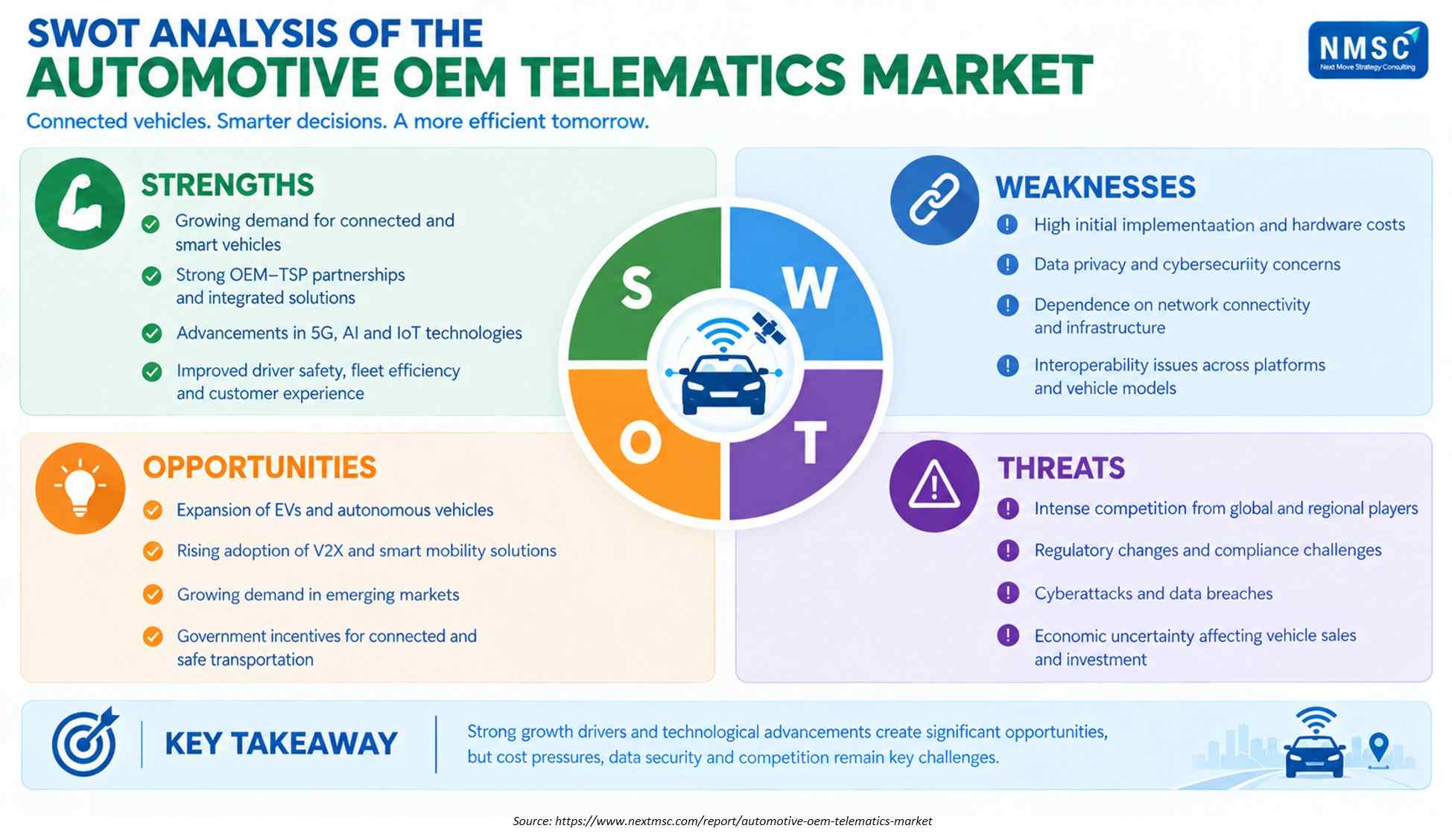
This SWOT view highlights structural strengths, strategic gaps, expansion headroom, and external risks shaping outcomes in the Automotive OEM Telematics Market Global Industry Analysis and Forecast (2026-2035).

Strengths

Growing demand for connected and smart vehicles, Strong OEM–TSP partnerships and integrated solutions, Advancements in 5G, AI and IoT technologies, Improved driver safety, fleet efficiency and customer experience

Weaknesses

High initial implementaation and hardware costs, Data privacy and cybersecuriity concerns, Dependence on network connectivity and infrastructure, Interoperability issues across platforms and vehicle models

Opportunities

Expansion of EVs and autonomous vehicles, Rising adoption of V2X and smart mobility solutions, Growing demand in emerging markets, Government incentives for connected and safe transportation

Threats

Intense competition from global and regional players, Regulatory changes and compliance challenges, Cyberattacks and data breaches, Economic uncertainty affecting vehicle sales and investment

Market Drivers & Dynamics

Interactive Dataset
EU eCall mandate and expanding regional emergency-call regulation driver +2.1% Europe 2026-2032
5G-V2X Direct deployment under the 5GAA roadmap driver +2.6% Europe, Asia-Pacific 2026-2032
OEM software platform monetization and over-the-air revenue models driver +2.4% Global 2026-2035
China domestic vehicle connectivity and smart-city V2X mandates driver +2.0% Asia-Pacific 2026-2035
Rising commercial vehicle fleet telematics penetration driver +1.5% North America, Europe, Asia-Pacific 2026-2035
EU General Safety Regulation II advanced safety system requirements driver +1.3% Europe 2026-2032
Tier One supplier consolidation and spin-off integration risk restraint -1.1% Europe 2026-2030
Semiconductor and connectivity module supply chain volatility restraint -0.9% Global 2026-2030
Fragmented regional spectrum and cybersecurity certification requirements restraint -0.7% Global 2026-2035
Source: Next Move Strategy Consulting

Growth Drivers

What Is the Primary Growth Driver of the Automotive OEM Telematics Market?

5G-V2X Direct deployment under the 5G Automotive Association's roadmap is the primary driver of the market. The association's December 2024 roadmap update projects mass deployment of 5G-V2X Direct-enabled vehicles and supporting infrastructure beginning in Europe between 2026 and 2029. This regulatory and industry-coordinated timeline gives OEMs a defined specification window, anchoring near-term demand for 5G-capable telematics control units and V2X software across new vehicle platforms entering production during this period.

How Is OEM Software Monetization Driving Automotive Telematics Market Growth?

OEM software platform monetization is accelerating market growth as automakers shift telematics economics from one-time hardware sales toward recurring connected-service revenue. Our assessment indicates that this shift is reinforced by the growing share of cloud telematics software and application software within the Software offering, which is expanding at a 16.7% CAGR from 2026 to 2035, positioning OEMs and their software partners to capture margin across the vehicle's operational life rather than at the point of sale alone.

Growth Inhibitors

What Is Restraining Automotive OEM Telematics Market Expansion?

Tier One supplier consolidation and spin-off integration risk restrains broader market expansion , particularly as large diversified suppliers separate automotive electronics units into standalone entities. We found that AUMOVIO SE's transition from a Continental AG division to an independently listed company in September 2025 illustrates the operational complexity such separations introduce, including new standalone finance, legal, and customer-contracting functions that can temporarily slow product roadmap execution during the transition period.

What Are the Growth Opportunities?

Satellite-Enabled Telematics Control Units Address Rural Connectivity Gaps

Suppliers that commercialize non-terrestrial network telematics control units, following LG Electronics Inc.'s May 2025 demonstration, can capture OEM specification wins for vehicles sold in geographically dispersed markets with limited cellular infrastructure. This positions satellite-capable hardware suppliers to secure eCall and remote diagnostics contracts that terrestrial-only systems cannot reliably fulfill .

Distributed Module Architecture Creates Opportunity for Software-Defined Vehicle Platforms

Suppliers that scale distributed module architecture, the fastest-growing form factor at a 22.9% CAGR from 2026 to 2035, can capture design wins from OEMs consolidating vehicle electronics onto centralized computing platforms. Vendors offering modular, software-updatable architectures stand to capture share from OEMs migrating away from single-purpose standalone telematics units.

OEM-Contracted Engineering Supply Expands Access for Specialized Software Suppliers

OEM-contracted engineering supply, the fastest-growing contracting model at a 16.5% CAGR from 2026 to 2035, presents an opportunity for specialized software and connectivity engineering firms to secure direct OEM relationships without full Tier One production scale. Suppliers offering deep embedded software or cybersecurity engineering expertise stand to capture contracts as OEMs selectively insource specific telematics software development.

Segmentation Analysis

2025 (USD Billion)
2035 (USD Billion)
Hardware
Telematics C
Telematics G
Connectivity
Telematics A
Segment Item 2025 (USD Billion) 2035 (USD Billion) CAGR
Hardware $10.0 USD Billion $40.0 USD Billion 15.0%
Telematics Control Units $17.1 USD Billion $51.1 USD Billion 9.0%
Telematics Gateways $24.2 USD Billion $62.2 USD Billion 19.0%
Connectivity Modules $31.3 USD Billion $73.3 USD Billion 21.0%
Telematics Antenna Systems $38.4 USD Billion $84.4 USD Billion 26.0%

Segment-wise data is locked

Unlock complete segment-wise numbers for By Offering.

Unlock Full Data

Which Offering Segment Dominates the Automotive OEM Telematics Market?

Hardware led the market with USD 42.71 billion in 2025, reflecting the fact that every connected vehicle requires a physical telematics control unit, connectivity module, and antenna system regardless of software configuration. We observed that Software is the fastest-growing offering segment, expanding at a 16.7% CAGR from 2026 to 2035 and rising from 34% to 42% of total offering revenue, as OEMs shift value capture toward embedded connectivity management, cloud telematics platforms, and application software licensed across the vehicle lifecycle.

2025 (USD Billion)
2035 (USD Billion)
Passenger Ve
Light Commer
Heavy Commer
Buses and Co
Segment Item 2025 (USD Billion) 2035 (USD Billion) CAGR
Passenger Vehicles $10.0 USD Billion $40.0 USD Billion 26.0%
Light Commercial Vehicles $17.1 USD Billion $51.1 USD Billion 16.0%
Heavy Commercial Vehicles $24.2 USD Billion $62.2 USD Billion 18.0%
Buses and Coaches $31.3 USD Billion $73.3 USD Billion 8.0%

Segment-wise data is locked

Unlock complete segment-wise numbers for By Vehicle Type.

Unlock Full Data

Which Vehicle Type Segment Is Growing Fastest in the Automotive OEM Telematics Market?

Passenger Vehicles remained the largest vehicle type, valued at USD 64.52 billion in 2025, consistent with passenger car production volume far exceeding commercial vehicle output across every major automotive market. Our findings show that Heavy Commercial Vehicles and Buses and Coaches are tied for the fastest growth, each registering a 17.6% CAGR from 2026 to 2035 , as fleet operators specify factory-installed telematics for regulatory compliance reporting, predictive maintenance, and driver behavior monitoring across long-haul freight operations.

2025 (USD Billion)
2035 (USD Billion)
2G and 3G
4G and LTE
5G
Other Connec
Segment Item 2025 (USD Billion) 2035 (USD Billion) CAGR
2G and 3G $10.0 USD Billion $40.0 USD Billion 25.0%
4G and LTE $17.1 USD Billion $51.1 USD Billion 11.0%
5G $24.2 USD Billion $62.2 USD Billion 25.0%
Other Connectivity $31.3 USD Billion $73.3 USD Billion 11.0%

Segment-wise data is locked

Unlock complete segment-wise numbers for By Connectivity.

Unlock Full Data

Which Connectivity Segment Is Growing Fastest in the Automotive OEM Telematics Market?

4G and LTE remained the dominant connectivity standard in 2025, reflecting its status as the default specification across current-generation vehicle platforms still in production. We found that 5G is the fastest-growing connectivity segment, registering a 23.7% CAGR from 2026 to 2035 and overtaking 4G and LTE in absolute revenue before the end of the forecast period, consistent with the 5G Automotive Association's projected 2026-2029 rollout of 5G-V2X Direct-enabled vehicles beginning in Europe.

2025 (USD Billion)
2035 (USD Billion)
Standalone U
Integrated A
Integrated G
Distributed
Segment Item 2025 (USD Billion) 2035 (USD Billion) CAGR
Standalone Unit $10.0 USD Billion $40.0 USD Billion 16.0%
Integrated Antenna Unit $17.1 USD Billion $51.1 USD Billion 26.0%
Integrated Gateway Unit $24.2 USD Billion $62.2 USD Billion 24.0%
Distributed Module Architecture $31.3 USD Billion $73.3 USD Billion 26.0%

Segment-wise data is locked

Unlock complete segment-wise numbers for By Form Factor.

Unlock Full Data
2025 (USD Billion)
2035 (USD Billion)
Direct OEM S
OEM Designat
OEM Contract
Segment Item 2025 (USD Billion) 2035 (USD Billion) CAGR
Direct OEM Supply $10.0 USD Billion $40.0 USD Billion 25.0%
OEM Designated Tier One Supply $17.1 USD Billion $51.1 USD Billion 23.0%
OEM Contracted Engineering Supply $24.2 USD Billion $62.2 USD Billion 9.0%

Segment-wise data is locked

Unlock complete segment-wise numbers for By Contracting Model.

Unlock Full Data

Growth Opportunities

Our analysis shows that three forward-looking opportunities stand out for stakeholders positioning within the automotive OEM telematics market over the 2026-2035 forecast period.

Satellite-Enabled Telematics Control Units Address Rural Connectivity Gaps

Suppliers that commercialize non-terrestrial network telematics control units, following LG Electronics Inc.'s May 2025 demonstration, can capture OEM specification wins for vehicles sold in geographically dispersed markets with limited cellular infrastructure. This positions satellite-capable hardware suppliers to secure eCall and remote diagnostics contracts that terrestrial-only systems cannot reliably fulfill .

Distributed Module Architecture Creates Opportunity for Software-Defined Vehicle Platforms

Suppliers that scale distributed module architecture, the fastest-growing form factor at a 22.9% CAGR from 2026 to 2035, can capture design wins from OEMs consolidating vehicle electronics onto centralized computing platforms. Vendors offering modular, software-updatable architectures stand to capture share from OEMs migrating away from single-purpose standalone telematics units.

OEM-Contracted Engineering Supply Expands Access for Specialized Software Suppliers

OEM-contracted engineering supply, the fastest-growing contracting model at a 16.5% CAGR from 2026 to 2035, presents an opportunity for specialized software and connectivity engineering firms to secure direct OEM relationships without full Tier One production scale. Suppliers offering deep embedded software or cybersecurity engineering expertise stand to capture contracts as OEMs selectively insource specific telematics software development.

Strategic Framework of the Automotive OEM Telematics Market

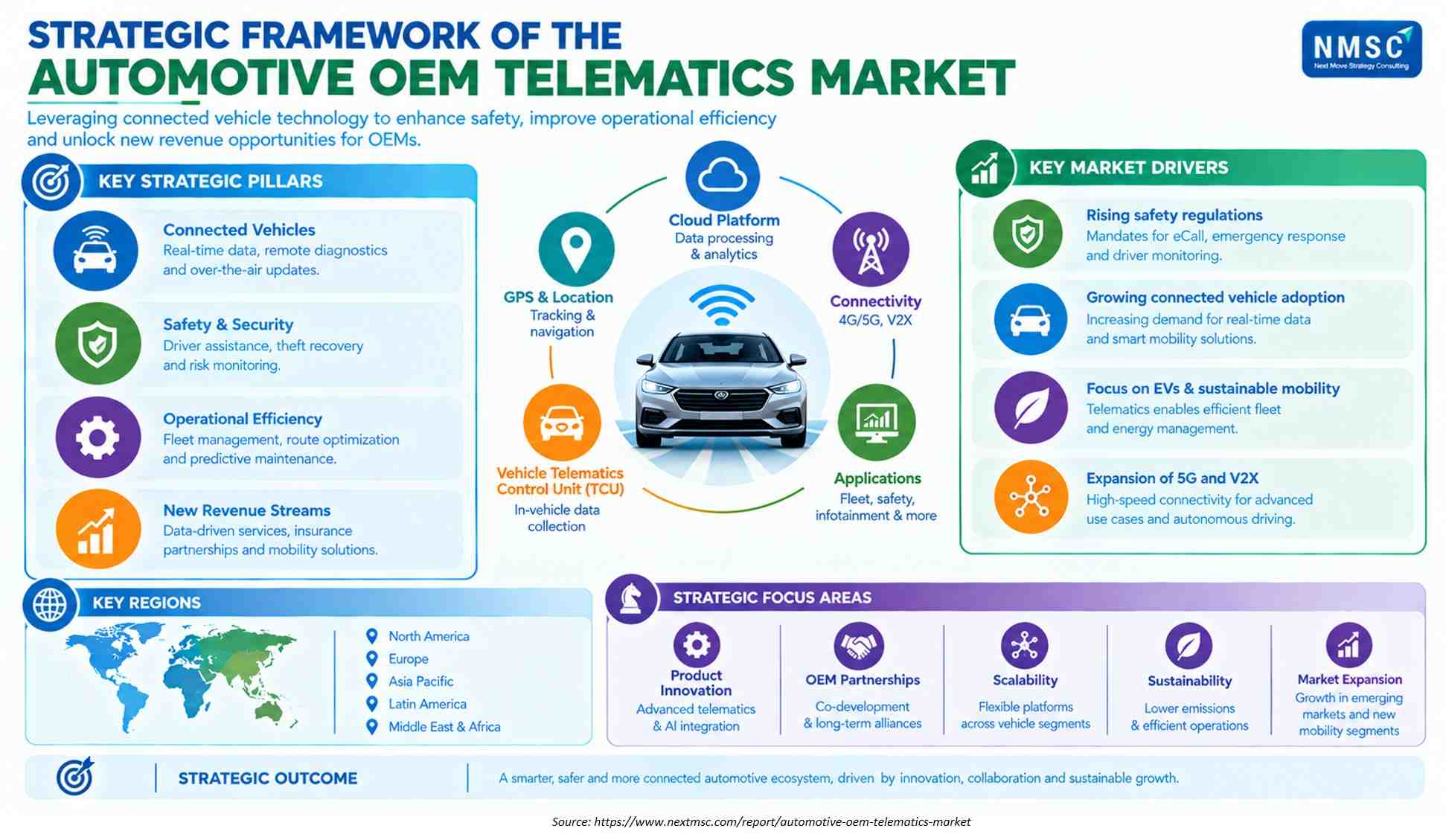
Strategic Framework of the Automotive OEM Telematics Market

The Automotive OEM Telematics market is shaped by connected vehicle adoption, safety requirements, operational efficiency, and emerging revenue opportunities. Strategic priorities include telematics innovation, OEM partnerships, scalable connectivity, sustainability, and market expansion. Integration of GPS, cloud platforms, 4G/5G, V2X, and AI-enabled applications is strengthening vehicle intelligence, fleet management, predictive maintenance, and connected mobility services.

Regional Outlook

2025 (USD Billion)
2035 (USD Billion)
Asia-Pacific
Europe
North Americ
Middle East
Latin Americ
Region 2025 (USD Billion) 2035 (USD Billion) CAGR (%)
Asia-Pacific $10.0 USD Billion $40.0 USD Billion 9.0%
Europe $17.1 USD Billion $51.1 USD Billion 27.0%
North America $24.2 USD Billion $62.2 USD Billion 25.0%
Middle East & Africa $31.3 USD Billion $73.3 USD Billion 23.0%
Latin America $38.4 USD Billion $84.4 USD Billion 12.0%

Regional data is locked

Unlock complete regional numbers for this market.

Unlock Full Data

Competitive Landscape

We observed that the automotive OEM telematics Industry features a moderately consolidated competitive landscape, with diversified global Tier One suppliers competing alongside consumer electronics conglomerates and China-based domestic specialists.

Dimension Description
Market Structure Moderately consolidated; global Tier One suppliers such as Robert Bosch GmbH, DENSO Corporation, and AUMOVIO SE compete alongside consumer electronics conglomerates including LG Electronics Inc. and Panasonic Automotive Systems Co., Ltd., while China-based specialists serve domestic OEM programs.
Innovation Focus 5G and V2X-capable telematics control units, satellite non-terrestrial network connectivity, distributed module architecture, and software-defined vehicle platform integration dominate current innovation pipelines across leading suppliers.
M&A Activity to M&A / Corporate Restructuring Corporate restructuring reshaping supplier scale, exemplified by Continental AG's September 2025 spin-off of its Automotive group sector as the independently listed AUMOVIO SE.

How Do Companies Compete in the Automotive OEM Telematics Market?

Companies compete primarily on OEM design-win depth, connectivity technology readiness, and software platform breadth across the Industry . Diversified Tier One suppliers such as Robert Bosch GmbH and DENSO Corporation leverage long-standing OEM engineering relationships to secure multi-platform telematics contracts, while consumer electronics conglomerates such as LG Electronics Inc. and HARMAN International Industries, Incorporated compete on connectivity module and semiconductor integration expertise developed outside the automotive sector.

Which Competitive Archetypes Dominate the Automotive OEM Telematics Market?

Three archetypes dominate the market: diversified global Tier One suppliers with multi-decade OEM relationships, consumer electronics conglomerates applying connectivity expertise to automotive platforms, and China-based domestic specialists serving local OEM programs. Robert Bosch GmbH and DENSO Corporation exemplify the diversified Tier One archetype, LG Electronics Inc. and HARMAN International Industries, Incorporated exemplify the consumer electronics archetype, and Desay SV Automotive Co., Ltd. and Neusoft Corporation exemplify the domestic specialist archetype.

How Are Companies Differentiating Through Innovation in OEM Telematics?

Innovation and differentiation strategy increasingly center on 5G and satellite connectivity readiness ahead of the industry's 2026-2029 V2X deployment window. LG Electronics Inc. exemplifies this direction through its May 2025 satellite-based non-terrestrial network telematics control unit demonstration. Our analysis shows that suppliers unable to demonstrate 5G and V2X hardware readiness risk exclusion from next-generation OEM platform sourcing decisions as automakers finalize specifications for vehicles launching between 2027 and 2030.

What M&A and Restructuring Activity Is Shaping the Automotive OEM Telematics Market?

Corporate restructuring continues to reshape supplier scale within the Industry . Continental AG's spin-off of its Automotive group sector as the independently listed AUMOVIO SE, completed on the Frankfurt Stock Exchange on September 18, 2025, illustrates how diversified suppliers are separating automotive electronics operations to pursue focused capital allocation, a structural shift that may prompt comparable restructuring among other multi-division Tier One suppliers in this market.

Key Market Players

Our assessment indicates that the following 20 companies are actively shaping product innovation, connectivity readiness, and OEM contracting strategy within the global automotive OEM telematics market.

AUMOVIO SE HARMAN International Industries, Incorporated Robert Bosch GmbH DENSO Corporation Hyundai Mobis Co., Ltd. Marelli Holdings Co., Ltd. Valeo SE Visteon Corporation Aptiv PLC Panasonic Automotive Systems Co., Ltd. ZF Friedrichshafen AG Lear Corporation Ficosa International, S.A. Neusoft Corporation Desay SV Automotive Co., Ltd. Huawei Technologies Co., Ltd. ACTIA Group S.A. Gosuncn WeLink Technology Co., Ltd. Flaircomm Microelectronics Inc.

Latest Developments

We found that recent activity within the automotive OEM telematics market is concentrated on 5G-enabled telematics hardware, virtual validation, antenna-integrated connectivity solutions, and localized OEM production, reflecting the industry's shift toward higher-bandwidth and software-defined vehicle architectures.

Date Event
August 2026 LG Electronics began mass production of its 5G Release 16 smart telematics solution and started deliveries to a premium European automaker. The integrated unit combines communications hardware with up to 12 antennas, reducing wiring complexity while supporting OTA updates, V2X and autonomous-driving data transmission.
February 2026 Valeo and Anritsu partnered to develop virtual validation capabilities for software-defined vehicles, including telematics units. Their approach combines a virtual telematics unit with simulated cellular-network and V2X environments, enabling scalable virtualized testing across diverse connectivity conditions and reducing reliance on physical validation setups.
January 2026 Hyundai Mobis announced development of an antenna-integrated 5G Multi-function Telematics Control Unit for next-generation connected vehicles. The solution is designed to support high-precision maps, remote control, ultra-high-definition streaming and SDV applications while integrating antenna functionality into the built-in controller and eliminating externally protruding antennas.
January 2026 HARMAN’s Ready Connect 5G-ready telematics control unit debuted in the Tata Sierra, providing emergency calling, stolen-vehicle tracking, OTA updates, diagnostics, remote operations and cloud integration. HARMAN also initiated Make-in-India production of Ready Connect at Pune, expanding its connected-vehicle technology collaboration with Tata Motors Passenger Vehicles.

Expert Insights

Sanjiv Ghate

Sanjiv Ghate

CEO | Mobilisights , Stellantis

"“Harnessed effectively, sensor and other data available from connected vehicles can enable a wide range of services and applications with compelling benefits, ranging from personalized usage-based insurance to road hazard detection and traffic management.”"

Analyst Interpretation

The comment highlights the expanding role of connected-vehicle data in the Automotive OEM Telematics Market. OEM telematics systems are evolving beyond basic vehicle tracking, navigation, and emergency functions toward data-driven services that use real-time vehicle information. Applications such as usage-based insurance, road-hazard detection, traffic management, predictive maintenance, fleet optimization, and personalized mobility services are increasing the strategic value of embedded telematics platforms. As connected-vehicle penetration expands, OEMs are increasingly seeking to collect, analyze , and securely share vehicle-generated data with external service ecosystems.

Investment Opportunities

Capital Inflows Are Concentrating in Standalone Connectivity Suppliers

NMSC analysis indicates that supplier restructuring and focused automotive-electronics strategies are increasing the strategic importance of standalone connectivity businesses. AUMOVIO SE's establishment as an independently listed automotive electronics supplier in September 2025 reflects the industry's broader shift toward specialized automotive technology businesses with dedicated strategic and capital allocation priorities.

Infrastructure Investment Is Expanding 5G and V2X Testing Capacity

Infrastructure investment is expanding 5G and V2X testing and validation capacity across Europe and Asia-Pacific ahead of the 2026-2029 mass deployment window projected by the 5G Automotive Association. Our findings suggest that suppliers are investing in dedicated connectivity validation facilities, complementing adjacent investment in the broader vehicle-to-everything infrastructure supporting next-generation telematics platforms.

Cybersecurity Certification Shapes ESG and Governance Priorities

Environmental, social, and governance considerations increasingly influence investment decisions, with cybersecurity certification and data governance as key criteria for automotive OEM telematics investment. We found that investors increasingly favor suppliers demonstrating validated cybersecurity management system compliance for connected vehicle software, treating device and data security certification as a governance indicator alongside traditional hardware reliability metrics.

Key Benefits for Stakeholders

Enterprise and Industry Leaders Gain Sourcing and Platform Planning Support

Enterprise and industry leaders gain access to validated segmentation, competitive benchmarking, and regional demand forecasts that support sourcing and platform-planning decisions across the automotive OEM telematics industry. Our analysis shows that detailed offering, connectivity, and form factor breakdowns help OEM procurement teams align telematics specifications with rising 5G and V2X requirements while identifying underserved segments for expansion.

Investors and Financial Analysts Gain Consistent Valuation Benchmarks

Investors and financial analysts benefit from consistent, single-point market size and CAGR estimates that support valuation and capital-allocation decisions across the automotive OEM telematics supply chain. We observed that the report's regional and segment-level growth differentials help identify which suppliers are best positioned to capture above-market growth in Latin America and Software categories through 2035.

Technology Vendors and Product Teams Gain Design Requirement Insight

Technology vendors and product teams gain insight into emerging design requirements, including 5G and satellite connectivity, distributed module architecture, and cybersecurity certification, that are reshaping the industry. Our findings suggest that this analysis helps product teams prioritize development roadmaps around software-defined telematics platforms increasingly required by OEM procurement processes ahead of the 2026-2029 V2X deployment window.

Key Market Segments Evaluated

By Offering

  • Hardware
  • Software
  • Services

By Vehicle Type

  • Passenger Vehicles
  • Light Commercial Vehicles
  • Heavy Commercial Vehicles
  • Buses and Coaches

By Connectivity

  • 4G and LTE
  • 5G
  • 2G and 3G
  • Other Connectivity

By Form Factor

  • Standalone Unit
  • Integrated Antenna Unit
  • Integrated Gateway Unit
  • Distributed Module Architecture

By Contracting Model

  • Direct OEM Supply
  • OEM Designated Tier One Supply
  • OEM Contracted Engineering Supply

Conclusion & Recommendations

The long-term outlook for the market remains strongly positive, with global revenue projected to expand nearly fourfold from USD 90.88 billion in 2025 to USD 344.25 billion by 2035 at a 12.82% CAGR. We observed that 5G-V2X deployment, OEM software monetization, and rising commercial vehicle fleet telematics adoption will continue underpinning demand across passenger and commercial vehicle applications through the forecast period.

What Strategic Positioning Should Automotive OEM Telematics Suppliers Pursue?

Suppliers should prioritize 5G and satellite connectivity readiness and software platform capability to secure long-term OEM contracts ahead of the 2026-2029 V2X deployment window. Our assessment indicates that suppliers investing early in distributed module architecture and standalone corporate structures, following AUMOVIO SE's model, will be best positioned to capture premium pricing within the automotive OEM telematics market.

How Attractive Is the Automotive OEM Telematics Market for New Investment?

The automotive OEM telematics industry presents a highly attractive investment case, supported by a USD 228.03 billion absolute dollar opportunity between 2026 and 2035 and above-average growth in Latin America and Software categories. We found that investment attractiveness is highest for suppliers combining 5G and V2X hardware readiness with scaled software platform capability, positioning them to serve both passenger and commercial vehicle OEM programs simultaneously.

What Market Shifts and Key Risks Should Stakeholders Monitor?

Stakeholders should monitor Tier One supplier consolidation and spin-off integration risk, semiconductor and connectivity module supply chain volatility, and fragmented regional spectrum and cybersecurity certification requirements as key risks to the automotive OEM telematics market. Our analysis shows that suppliers unable to demonstrate standalone execution capability during corporate restructuring risk losing OEM contracts to competitors with more stable operational continuity.

What Are the Key Growth Pathways for the Automotive OEM Telematics Market?

Key growth pathways include expanding 5G and satellite-capable hardware portfolios, scaling cloud telematics and application software platforms, and deepening penetration into heavy commercial vehicle and bus fleet applications. NMSC's analysis indicates that suppliers pursuing these pathways while maintaining OEM design-win continuity through ongoing corporate restructuring will be best positioned to capture the automotive OEM telematics market's projected growth through 2035.

Delivered Customizations

We have successfully delivered the following deep-dive customizations:

Client Request Customization Delivered Value Adds
Historical Market Growth Analysis
  • Historical OEM telematics revenue and connected-vehicle unit analysis by offering, vehicle type, connectivity, form factor, and contracting model.
  • Identifies high-growth segments and shifts in demand to guide portfolio and investment priorities.
Company-Level Telematics Unit Volume Analysis
  • Company-level OEM telematics control unit shipments and connected-vehicle installed base benchmarking by vehicle type and connectivity.
  • Highlights supplier scale, OEM penetration, and share gaps to support competitive positioning.
Country-Level Trade Assessment
  • Country-wise import and export analysis of telematics control units, modules, and related components.
  • Supports sourcing, localization, and supply chain risk decisions.
Connectivity Migration Assessment
  • Mapping of the shift between 4G LTE, 5G, and embedded versus tethered connectivity by vehicle type and OEM launch timelines.
  • Guides technology roadmap and module investment timing.
OEM Telematics Sourcing and Contracting Benchmarking
  • OEM-level mapping of in-house versus outsourced telematics programs, supplier awards, and contracting models, drawing on company disclosures and press releases.
  • Identifies partnership, win-back, and account targeting opportunities by OEM.
Regulatory-Driven Telematics Demand Assessment
  • Country-wise mapping of eCall, cybersecurity, and data access regulations and their effect on telematics fitment by vehicle type and form factor.
  • Prioritizes regulated markets and sizes mandate-driven demand for market entry and compliance planning.

FAQs

Consolidated Source Table

Source Name / Organization URL
European Commission
5G Automotive Association (5GAA)
LG Electronics Inc.
AUMOVIO SE
Continental AG
Robert Bosch GmbH
DENSO Corporation
Valeo SE
Aptiv PLC
Hyundai Mobis Co., Ltd.
Methodology Note
Market size, segment, and regional figures presented in this report reflect the user-supplied 2025 base-year, 2026 estimate, 2035 forecast, and 2026–2035 CAGR, disaggregated by NMSC using a proprietary bottom-up segmentation model informed by company disclosures, government and regulatory data, and industry association information.

About the Author

Mihul Sharma

Mihul Sharma

Mihul Sharma is Research Associate at Next Move Strategy Consulting, where he has covered technology, industrial, and healthcare markets for 3 years. His work applies structured business research, market analysis, and secondary-source review to assess market trends, competitive developments, and growth opportunities. He supports report development by fully synthesizing industry data, company information, and market signals into concise findings for strategy and investment-focused research teams.

About the Reviewer

Supradip Baul

Supradip Baul

Supradip Baul is an accomplished business consultant and strategist with over a decade of rich experience in market intelligence, strategy, technology, and business transformation. His work has included rigorous qualitative and quantitative analysis across multiple industries, helping clients shape investment decisions and long-term roadmaps. Earlier in his career, he was associated with Gartner, where he contributed to industry-leading reports and market share analyses. He has worked with leading global companies and holds an MBA with a dual specialization in Marketing and Finance.

Kishu Kanda

KISHU KANDA

Strategy Analyst

Accenture

We purchased the AI Consumer Market Report from this company. Not only did they customize the report to meet our specific requirements, but they also showed great flexibility in accommodating our budget. The report we received fully met our expectations. Additionally, they provided prompt and thorough responses to both our pre-purchase and follow-up questions. We look forward to working with this company again in the future.

Gustaf Hummel Burstrom

GUSTAF HUMMEL BURSTROM

Founder

Revline Tools AB

Joseph and the team at Next Move Strategy Consulting have been excellent to work with, in supplying us with relevant market data and forecasts for our specific category. We had some special requirements and they were able to do a custom package to suit our needs. We would definitely recommend them to any other company needing market data and forecasts

Kevin Coker

KEVIN COKER

Founder, CEO and Board Diector

Proxima Clinical Research

I have been using Next MSC reports for product positioning in a new geography for a long time. They have by far the best reports I have found and the price is reasonable too!

Semih Kavaklioglu

SEMIH KAVAKLIOGLU

Co-Founder & Sales Manager

Decortie

I work a lot in the marketing industry and I know that research is an essential part of any campaign. I have used Market research reports for my own products and I found them to be very informative and well-researched. The team here produces insightful reports for a good price

Ross J Mckenzie

ROSS J MCKENZIE

Business Insight Manager

Staysure Group

“Next MSC have been incredibly helpful in providing detailed & robust information on our market, alongside quantifying growth by different segments. The process to procure was simple and easy, with sample reports and regular contact to ensure we had what we needed. Succinct detail on their sources & methodologies is also greatly received, allowing transparency in this respect helps build trust in the detail you pay for. Joseph in particular was fantastic, and helped ensure efficient provision of the insight pack – thank you NMSC!”.

Custom Market Research Services

We will customize the research for you if the listed report does not fully match your requirements.

Get 30% Free Customization

Select License

This website uses cookies to ensure you get the best experience on our website. Learn more

✖