Bioprocessing Market Global Industry Analysis and Forecast (2026-2035)

Bioprocessing Market size was USD 48.68 billion in 2025, projected to reach USD 128.30 billion by 2035, growing at a CAGR of 9.51% from 2026 to 2035. Key drivers include expanding biologics pipelines and monoclonal antibody approvals, increasing cell and gene therapy manufacturing investments, and rising demand for advanced bioprocessing equipment and consumables, with North America leading the market .

Download Free Sample PDF
Base Year (2025)
$48.68 Billion
Forecast (2035)
$128.30 Billion
CAGR (2026-2035)
9.5%
Top Region
North America

What Is the Bioprocessing Market Size?

The global bioprocessing market size was valued at USD 48.68 billion in 2025 and is estimated at USD 56.65 billion in 2026, forecast to reach USD 128.30 billion by 2035, expanding at a 9.51% CAGR between 2026 and 2035. North America leads with approximately a 40% share, while Consumables & Reagents dominate all other offerings with approximately a 44% share.

We observed that growth is broad-based across every segmentation axis, with single-use system adoption and cell and gene therapy manufacturing capacity expansion driving the dominant structural shifts through 2035.

Bioprocessing Market Global Industry Analysis and Forecast (2026-2035) Revenue Forecast

Values in USD Billion

2025 $48.68 Billion
2025
2026 $53.31 Billion
2026
2027 $58.38 Billion
2027
2028 $63.93 Billion
2028
2029 $70.01 Billion
2029
2030 $76.67 Billion
2030
2031 $83.96 Billion
2031
2032 $91.94 Billion
2032
2033 $100.69 Billion
2033
2034 $110.26 Billion
2034
2035 $128.30 Billion
2035

Key Takeaways

By Offering: Consumables & Reagents held the largest share of approximately 44% (USD 21.42 billion) in 2025; Software is the fastest-growing sub-segment at 14.6% CAGR from 2026–2035.

By Workflow: Upstream held the largest share of approximately 42% (USD 20.45 billion) in 2025; Analytics & Quality Control is the fastest-growing sub-segment at 11.7% CAGR from 2026–2035.

By System Type: Single-use held the largest share of approximately 58% (USD 28.23 billion) in 2025; Single-use is also the fastest-growing sub-segment at 10.9% CAGR from 2026–2035.

By Process Mode: Fed-batch held the largest share of approximately 46% (USD 22.39 billion) in 2025; Continuous is the fastest-growing sub-segment at 14.1% CAGR from 2026–2035.

By Scale of Operation: Commercial Scale held the largest share of approximately 36% (USD 17.52 billion) in 2025; Commercial Scale is also the fastest-growing sub-segment at 12.0% CAGR from 2026–2035.

By Modality: Monoclonal Antibodies (mAbs) held the largest share of approximately 34% (USD 16.55 billion) in 2025; Gene Therapy is the fastest-growing sub-segment at 13.9% CAGR from 2026–2035.

By Sales Channel: Direct Sales held the largest share of approximately 61% (USD 29.69 billion) in 2025; Online is the fastest-growing sub-segment at 18.3% CAGR from 2026–2035.

By End-User Industry: Pharmaceutical held the largest share of approximately 38% (USD 18.50 billion) in 2025; Industrial Biotechnology is the fastest-growing sub-segment at 14.6% CAGR from 2026–2035.

Dominant Region: North America dominated with approximately 40% revenue share (USD 19.47 billion) in 2025.

Fastest-Growing Region: Asia-Pacific is expected to register the highest CAGR of 13.1% during 2026–2035.

Dominant Country: The U.S. led with approximately USD 16.16 billion in 2025.

Fastest-Growing Country: India is the fastest-growing country at approximately 16.6% CAGR from 2026–2035.

Ecosystem Analysis of theBioprocessing Industry

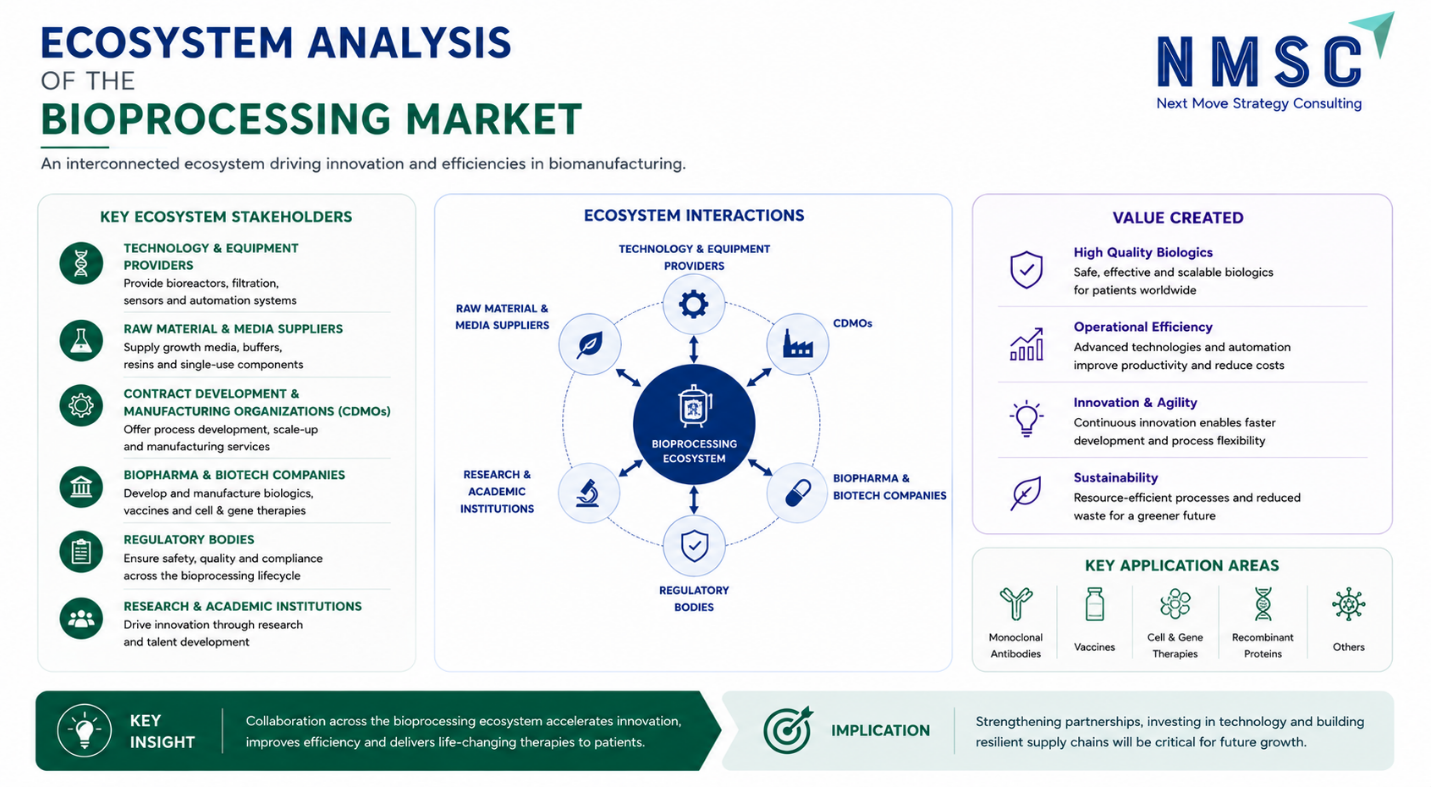
The above infographic provides a detailed ecosystem analysis of the bioprocessing market, mapping out key stakeholders ranging from technology providers and CDMOs to regulatory bodies and academic institutions. It illustrates how the interactions among these interconnected players drive value, such as high-quality biologics, improved operational efficiency, and sustainability. The analysis further highlights critical application areas, including monoclonal antibodies and cell and gene therapies, while emphasizing the central role of collaboration. Ultimately, it concludes that strengthening partnerships, investing in technology, and building resilient supply chains are essential for accelerating innovation and future market growth .

What Does the Bioprocessing Market Encompass?

The bioprocessing market encompasses the equipment, consumables, software, and services used to cultivate, harvest, and purify biologic drug substances across upstream and downstream manufacturing workflows. Our assessment indicates that the scope spans bioreactors, chromatography and filtration systems, single-use consumables, control and analytics software, and contract manufacturing services supplied to pharmaceutical, biotechnology, and CDMO customers producing monoclonal antibodies, vaccines, cell and gene therapies, and other biologic modalities.
Regulatory frameworks such as the U.S. Food and Drug Administration's current Good Manufacturing Practice requirements shape process validation and equipment qualification standards, while evolving guidance on continuous manufacturing increasingly influences process mode selection. We observed that technology adoption is shifting toward single-use systems and digital process analytics that reduce changeover time between batches, a structural change that NMSC's analysis indicates is redefining facility design priorities across the biopharmaceutical manufacturing value chain.

Market Drivers & Dynamics

Interactive Dataset
Rising biologics pipeline expansion and monoclonal antibody approvals driver +2.4% Global 2026–2035
Expanding cell and gene therapy manufacturing capacity investment driver +2.0% North America, Europe 2026–2033
Growing CDMO capacity expansion for biologics manufacturing driver +1.6% Global 2026–2035
Rising single-use system adoption across commercial-scale production driver +1.2% North America, Europe, Asia-Pacific 2026–2034
Expanding biopharmaceutical manufacturing capacity across Asia-Pacific driver +1.0% Asia-Pacific 2026–2035
Growing continuous bioprocessing and digital analytics adoption driver +0.8% North America, Europe 2026–2032
High capital costs for advanced bioprocessing equipment restraint −1.3% Global 2026–2035
Supply chain constraints for single-use consumables and specialty resins restraint −0.9% Global 2026–2032
Complex regulatory validation requirements for novel modalities restraint −0.6% North America, Europe 2026–2033
Shortage of skilled bioprocessing personnel restraint −0.4% Global 2028–2035
Source: Next Move Strategy Consulting

Growth Drivers

What Is the Primary Growth Driver of the Bioprocessing Market?

Rising biologics pipeline expansion and monoclonal antibody approvals are the primary drivers of the market. The U.S. Food and Drug Administration continues to approve a growing volume of biologics license applications annually, reflecting sustained industry investment in monoclonal antibody, protein therapeutic, and biosimilar development. We observed that this approval activity, reinforced by expanding late-stage clinical pipelines, continues to anchor consistent procurement of upstream and downstream bioprocessing equipment and consumables across pharmaceutical and biotechnology manufacturers globally.

How Is Cell and Gene Therapy Manufacturing Driving Market Growth?

Expanding cell and gene therapy manufacturing capacity investment is accelerating demand for specialized bioreactors, viral vector production systems, and modality-specific consumables. Lonza's continued expansion of its cell and gene therapy manufacturing network reflects the pace at which CDMOs are scaling capacity to serve advancing clinical pipelines. Our assessment indicates that this demand-side pressure, combined with growing gene therapy program approvals, is compressing capacity availability across specialized viral vector and cell therapy manufacturing suites.

Growth Inhibitors

What Is Restraining Bioprocessing Market Expansion?

High capital costs for advanced bioprocessing equipment restrain broader adoption, particularly among smaller biotechnology companies and academic research institutes with constrained capital budgets. Supply chain constraints for single-use consumables and specialty chromatography resins further complicate production planning for manufacturers scaling commercial output. We found that complex regulatory validation requirements for novel modalities such as cell and gene therapy further slow facility qualification timelines across the industry.

What Are the Growth Opportunities?

How Can Vendors Capture Continuous Bioprocessing Conversion Demand?

Continuous bioprocessing conversion represents a whitespace opportunity for vendors developing perfusion-compatible equipment that allows manufacturers to transition incrementally from fed-batch operation. Vendors that commercialize modular, retrofit-friendly continuous processing systems stand to capture recurring procurement as commercial-scale manufacturers pursue facility footprint and yield efficiency improvements through 2035.

Where Does Modality-Flexible CDMO Capacity Create New Demand?

Modality-flexible manufacturing suites represent an underpenetrated opportunity for CDMOs developing platforms capable of switching between mammalian cell culture, microbial fermentation, and viral vector production. Companies that qualify flexible facility designs for biologics contract development can secure long-term supply agreements with sponsors seeking to de-risk single-modality capacity commitments.

How Can Digital Process Analytics Expand Recurring Software Revenue?

Digital process analytics and real-time release testing platforms create a sustained opportunity for vendors seeking recurring subscription revenue beyond one-time equipment sales. Early movers that bundle predictive analytics and digital twin capability with process equipment can differentiate with manufacturers pursuing data-driven quality control and batch consistency improvements across distributed manufacturing networks.

Segmentation Analysis

2025 (USD Billion)
2035 (USD Billion)
Equipment 2025: $14.60 Billion | 2035: $33.36 Billion
Equipment
Consumables & Reagents 2025: $21.42 Billion | 2035: $53.89 Billion
Consumables
Software 2025: $2.92 Billion | 2035: $11.55 Billion
Software
Services 2025: $9.74 Billion | 2035: $29.51 Billion
Services
Equipment $14.60 Billion $33.36 Billion 7.8%
Consumables & Reagents $21.42 Billion $53.89 Billion 8.9%
Software $2.92 Billion $11.55 Billion 14.6%
Services $9.74 Billion $29.51 Billion 11.2%

Which Offering Segment Dominates the Bioprocessing Market?

Consumables & Reagents led the market with USD 21.42 billion in 2025, supported by recurring per-batch procurement of media, single-use assemblies, and purification consumables across every manufacturing run. Our findings suggest that Software is the fastest-growing segment, registering a 14.6% CAGR from 2026 to 2035, as manufacturers increasingly adopt control, analytics, and digital twin platforms to manage growing process complexity and support real-time release testing initiatives.

2025 (USD Billion)
2035 (USD Billion)
Upstream
Downstream
Analytics &
Segment Item 2025 (USD Billion) 2035 (USD Billion) CAGR
Upstream $10.0 USD Billion $40.0 USD Billion 25.0%
Downstream $17.1 USD Billion $51.1 USD Billion 11.0%
Analytics & Quality Control $24.2 USD Billion $62.2 USD Billion 25.0%

Segment-wise data not detailed in this view

Unlock complete segment-wise numbers for By Workflow.

Unlock Full Data
2025 (USD Billion)
2035 (USD Billion)
Single-use
Stainless St
Hybrid
Segment Item 2025 (USD Billion) 2035 (USD Billion) CAGR
Single-use $10.0 USD Billion $40.0 USD Billion 27.0%
Stainless Steel $17.1 USD Billion $51.1 USD Billion 9.0%
Hybrid $24.2 USD Billion $62.2 USD Billion 19.0%

Segment-wise data not detailed in this view

Unlock complete segment-wise numbers for By System Type.

Unlock Full Data
2025 (USD Billion)
2035 (USD Billion)
Batch
Fed-batch
Continuous
Segment Item 2025 (USD Billion) 2035 (USD Billion) CAGR
Batch $10.0 USD Billion $40.0 USD Billion 14.0%
Fed-batch $17.1 USD Billion $51.1 USD Billion 24.0%
Continuous $24.2 USD Billion $62.2 USD Billion 22.0%

Segment-wise data not detailed in this view

Unlock complete segment-wise numbers for By Process Mode.

Unlock Full Data
2025 (USD Billion)
2035 (USD Billion)
Lab Scale
Pilot Scale
Clinical Sca
Commercial S
Segment Item 2025 (USD Billion) 2035 (USD Billion) CAGR
Lab Scale $10.0 USD Billion $40.0 USD Billion 24.0%
Pilot Scale $17.1 USD Billion $51.1 USD Billion 22.0%
Clinical Scale $24.2 USD Billion $62.2 USD Billion 20.0%
Commercial Scale $31.3 USD Billion $73.3 USD Billion 22.0%

Segment-wise data not detailed in this view

Unlock complete segment-wise numbers for By Scale of Operation.

Unlock Full Data
2025 (USD Billion)
2035 (USD Billion)
Monoclonal Antibodies (mAbs) 2025: $16.55 Billion | 2035: $35.92 Billion
Monoclonal A
Recombinant Proteins 2025: $7.30 Billion | 2035: $16.68 Billion
Recombinant
Vaccines 2025: $6.33 Billion | 2035: $14.11 Billion
Vaccines
Cell Therapy 2025: $4.38 Billion | 2035: $15.40 Billion
Cell Therapy
Gene Therapy 2025: $3.41 Billion | 2035: $12.83 Billion
Gene Therapy
Viral Vectors 2025: $2.92 Billion | 2035: $10.26 Billion
Viral Vector
mRNA 2025: $2.92 Billion | 2035: $10.26 Billion
mRNA
Oligonucleotides 2025: $1.95 Billion | 2035: $6.42 Billion
Oligonucleot
Microbial Proteins 2025: $1.95 Billion | 2035: $3.85 Billion
Microbial Pr
Other Modalities 2025: $0.97 Billion | 2035: $2.57 Billion
Other Modali
Monoclonal Antibodies (mAbs) $16.55 Billion $35.92 Billion 7.2%
Recombinant Proteins $7.30 Billion $16.68 Billion 7.8%
Vaccines $6.33 Billion $14.11 Billion 7.5%
Cell Therapy $4.38 Billion $15.40 Billion 13.1%
Gene Therapy $3.41 Billion $12.83 Billion 13.9%
Viral Vectors $2.92 Billion $10.26 Billion 13.1%
mRNA $2.92 Billion $10.26 Billion 13.1%
Oligonucleotides $1.95 Billion $6.42 Billion 12.3%
Microbial Proteins $1.95 Billion $3.85 Billion 6.1%
Other Modalities $0.97 Billion $2.57 Billion 9.5%

Which Modality Segment Leads Bioprocessing Market Demand?

Monoclonal Antibodies (mAbs) remained the leading modality within the market, valued at USD 16.55 billion in 2025 on sustained commercial production volume across established oncology, immunology, and autoimmune disease therapeutics. Based on research conducted by NMSC, we found that Gene Therapy is the fastest-growing modality, registering a 13.9% CAGR from 2026 to 2035, as viral vector and gene editing platforms advance through clinical development toward broader commercial manufacturing scale-up.

2025 (USD Billion)
2035 (USD Billion)
Direct Sales
Distributor
OEM
Online
Segment Item 2025 (USD Billion) 2035 (USD Billion) CAGR
Direct Sales $10.0 USD Billion $40.0 USD Billion 21.0%
Distributor $17.1 USD Billion $51.1 USD Billion 23.0%
OEM $24.2 USD Billion $62.2 USD Billion 25.0%
Online $31.3 USD Billion $73.3 USD Billion 15.0%

Segment-wise data not detailed in this view

Unlock complete segment-wise numbers for By Sales Channel.

Unlock Full Data
2025 (USD Billion)
2035 (USD Billion)
Pharmaceutical 2025: $18.50 Billion | 2035: $43.62 Billion
Pharmaceutic
Biotechnology 2025: $13.63 Billion | 2035: $34.64 Billion
Biotechnolog
CDMO 2025: $10.71 Billion | 2035: $32.08 Billion
CDMO
Academic & Research Institute 2025: $3.89 Billion | 2035: $10.26 Billion
Academic & R
Industrial Biotechnology 2025: $1.95 Billion | 2035: $7.70 Billion
Industrial B
Pharmaceutical $18.50 Billion $43.62 Billion 8.2%
Biotechnology $13.63 Billion $34.64 Billion 9.1%
CDMO $10.71 Billion $32.08 Billion 11.1%
Academic & Research Institute $3.89 Billion $10.26 Billion 9.5%
Industrial Biotechnology $1.95 Billion $7.70 Billion 14.6%

Which End-User Industry Segment Is Most Significant in the Bioprocessing Market?

Pharmaceutical companies remained the dominant end-user industry across the market, reaching USD 18.50 billion in 2025 given their scale of commercial biologics production and established manufacturing infrastructure. Our analysis shows that Industrial Biotechnology is the fastest-growing end-user industry at a 14.6% CAGR from 2026 to 2035, reflecting expanding bioprocessing adoption for enzyme, biofuel, and specialty chemical production applications beyond traditional pharmaceutical manufacturing.

Growth Opportunities

Our analysis shows that three forward-looking opportunities stand out for stakeholders positioning within the bioprocessing market over the 2026–2035 forecast period.

How Can Vendors Capture Continuous Bioprocessing Conversion Demand?

Continuous bioprocessing conversion represents a whitespace opportunity for vendors developing perfusion-compatible equipment that allows manufacturers to transition incrementally from fed-batch operation. Vendors that commercialize modular, retrofit-friendly continuous processing systems stand to capture recurring procurement as commercial-scale manufacturers pursue facility footprint and yield efficiency improvements through 2035.

Where Does Modality-Flexible CDMO Capacity Create New Demand?

Modality-flexible manufacturing suites represent an underpenetrated opportunity for CDMOs developing platforms capable of switching between mammalian cell culture, microbial fermentation, and viral vector production. Companies that qualify flexible facility designs for biologics contract development can secure long-term supply agreements with sponsors seeking to de-risk single-modality capacity commitments.

How Can Digital Process Analytics Expand Recurring Software Revenue?

Digital process analytics and real-time release testing platforms create a sustained opportunity for vendors seeking recurring subscription revenue beyond one-time equipment sales. Early movers that bundle predictive analytics and digital twin capability with process equipment can differentiate with manufacturers pursuing data-driven quality control and batch consistency improvements across distributed manufacturing networks.

Regional Outlook

North America $19.47 Billion $44.91 Billion 7.9%
Europe $13.14 Billion $29.51 Billion 7.6%
Asia-Pacific $11.68 Billion $41.06 Billion 13.1%
Middle East & Africa $2.43 Billion $7.70 Billion 11.7%
Latin America $1.95 Billion $5.13 Billion 9.5%

Supply Chain Analysis of theBioprocessing Industry

Supply Chain Analysis of theBioprocessing Industry
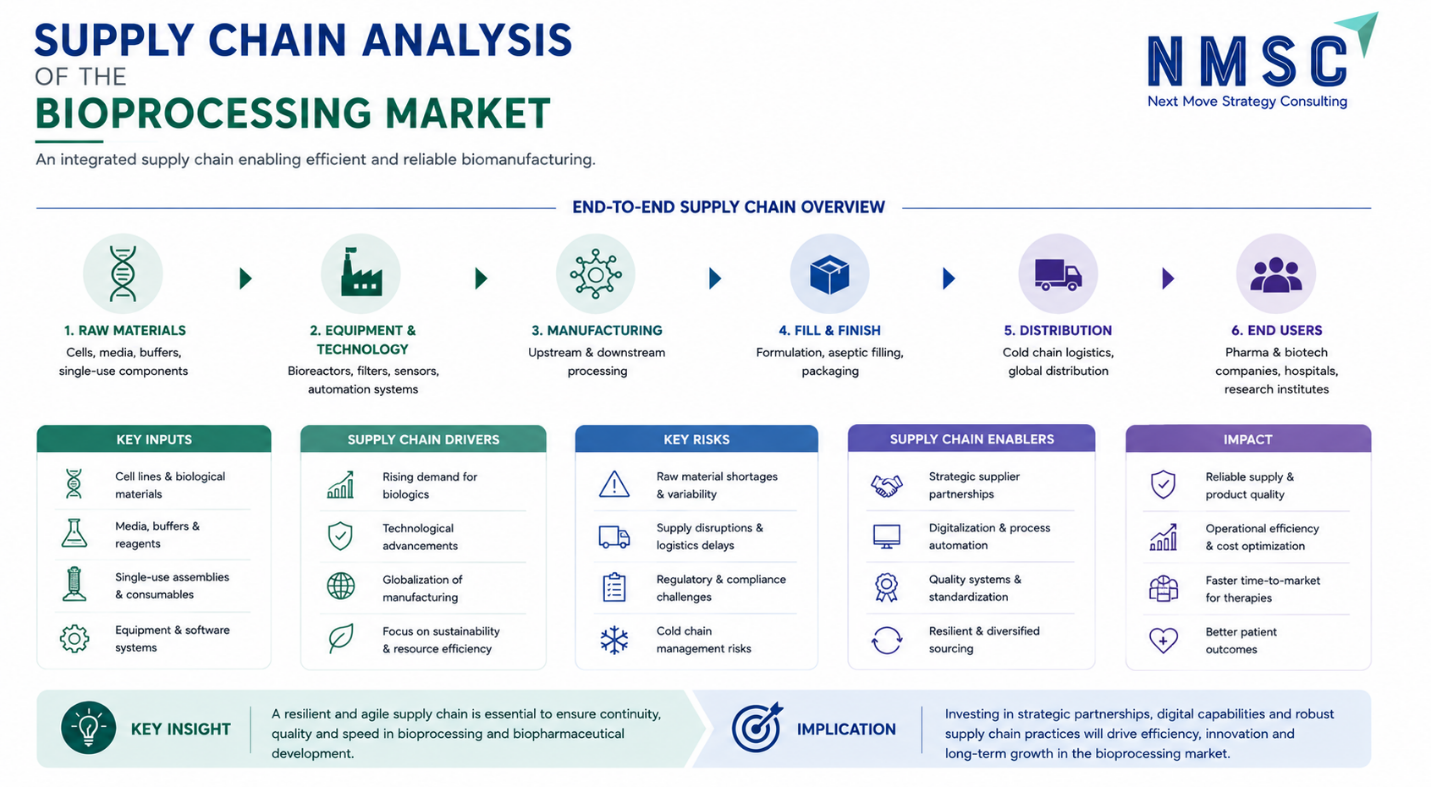
The above infographic provides a detailed supply chain analysis of the bioprocessing market, tracing the end-to-end flow from raw materials through manufacturing and fill/finish to final distribution and end users. It outlines key inputs, supply chain drivers, and enablers, while highlighting significant risks such as raw material shortages and cold chain management issues. The analysis further emphasizes the impact of a resilient supply chain in ensuring high-quality product delivery and operational efficiency. Ultimately, it concludes that investing in strategic partnerships and digital capabilities is essential for driving innovation and long-term growth in the market .

Competitive Landscape

We observed that the bioprocessing market features a moderately consolidated competitive landscape, with diversified life sciences majors competing alongside specialized equipment and CDMO providers on platform breadth, regulatory expertise, and global manufacturing footprint.

Dimension Description
Market Structure Moderately consolidated; the top companies profiled in this report collectively account for a majority of global bioprocessing market revenue, given the capital-intensive and regulatory-intensive nature of biologics manufacturing equipment and services.
Innovation Focus Continuous bioprocessing platforms, single-use system scale-up, and digital process analytics dominate current innovation pipelines across leading vendors.
M&A Activity Selective capability acquisitions, exemplified by continued portfolio expansion among diversified life sciences majors to broaden integrated equipment, consumables, and services offerings.

How Do Companies Compete in the Bioprocessing Market?

Companies compete primarily on platform breadth, regulatory expertise, and global manufacturing footprint across the industry. Diversified life sciences majors such as Danaher Corporation and Thermo Fisher Scientific Inc. leverage integrated equipment, consumables, and software portfolios to serve global biomanufacturing customers, while specialized providers such as Repligen Corporation and Sartorius AG compete through deep technical expertise in specific process steps such as chromatography and single-use systems.

Which Competitive Archetypes Dominate the Bioprocessing Market?

Two archetypes dominate the market: diversified life sciences majors offering end-to-end equipment and consumables portfolios, and specialized CDMOs providing outsourced manufacturing capacity. Danaher Corporation and Thermo Fisher Scientific Inc. exemplify the diversified archetype through comprehensive bioprocessing product lines, while Samsung Biologics Co., Ltd. and WuXi Biologics (Cayman) Inc. exemplify the CDMO archetype through large-scale contract manufacturing capacity serving global biopharmaceutical sponsors.

How Are Companies Differentiating Through Innovation in Bioprocessing?

Innovation and differentiation strategy increasingly center on continuous processing platforms and digital process analytics capability. Sartorius's continuous bioprocessing portfolio expansion and Thermo Fisher Scientific's process analytics software development both illustrate how vendors extend platform relevance through next-generation manufacturing technology. Our analysis shows that vendors unable to demonstrate credible single-use and digital analytics capability risk losing specification wins with biopharmaceutical manufacturers modernizing legacy facilities.

What M&A and Expansion Activity Is Shaping the Bioprocessing Market?

Capacity expansion and portfolio broadening activity continue to reshape competitive positioning within the industry. Lonza's continued expansion of its cell and gene therapy manufacturing network strengthens its CDMO capacity position, while Sartorius and Thermo Fisher Scientific's ongoing expansions in single-use and continuous bioprocessing technologies reinforce their leadership in the equipment and consumables segments .

Key Market Players

Our assessment indicates that the following 20 companies are actively shaping platform innovation, capacity expansion, and manufacturing strategy within the global bioprocessing market.

Danaher Corporation Thermo Fisher Scientific Inc. Sartorius AG Merck KGaA Lonza Group AG FUJIFILM Holdings Corporation Samsung Biologics Co., Ltd. WuXi Biologics (Cayman) Inc. Avantor, Inc. Repligen Corporation Bio-Rad Laboratories, Inc. Boehringer Ingelheim International GmbH Agilent Technologies, Inc. Waters Corporation Corning Incorporated Eppendorf SE AGC Inc. Getinge AB Tosoh Corporation GEA Group AG

Latest Developments

We found that recent activity within the bioprocessing market is concentrated on cell and gene therapy capacity expansion, continuous processing platform development, and digital analytics portfolio growth, reflecting the industry's response to accelerating biologics manufacturing demand.

Date Event
July 2026 AGC Biologics entered a long-term agreement to develop and manufacture multiple biopharmaceutical products. The partnership utilizes capacity at AGC’s new Yokohama site, which supports mammalian-cell biologics, mRNA therapeutics, and cell therapies and is scheduled to begin GMP services in 2027.
March 2026 Samsung Biologics completed its acquisition of GSK’s Rockville manufacturing site, adding two cGMP plants with combined 60,000-liter drug-substance capacity. The company plans additional investments to increase capacity and upgrade technologies, expanding its geographically diversified biomanufacturing network.
December 2025 Thermo Fisher launched a new Bioprocess Design Center in Hyderabad, India, while expanding centers in Incheon, Korea, and Singapore. The network provides process design , simulation, optimization, scale-up, pilot-scale capabilities, training, and access to single-use and hybrid bioprocessing systems.
September 2025 FUJIFILM Biotechnologies opened its Holly Springs, North Carolina facility, representing one of North America’s largest commercial-scale cell-culture biomanufacturing sites. The first phase provides eight 20,000-liter mammalian cell-culture bioreactors, with a planned second phase doubling capacity to 16 bioreactors.

Expert Insights

Daniella Cramp

Daniella Cramp

Senior Vice President and President, BioProduction | Thermo Fisher Scientific

"“ Asia continues to play an increasingly important role in advancing innovation across the global biopharma industry . By expanding our network in Korea, Singapore and India, we’re bringing world-class infrastructure and expertise closer to our customers, helping them deliver high-quality biologics faster, more cost-effectively and more sustainably. ”"

Analyst Interpretation

Thestatement highlights the increasing importance of Asia as a strategic hub for biopharmaceutical innovation and bioprocessing capacity, supported by investments in localized infrastructure, technical expertise, and advanced manufacturing technologies. Next Move Strategy Consulting’s analysis indicates that the expansion of regional bioprocessing capabilities is strengthening access to process development, scale-up, single-use systems, and manufacturing support across emerging biopharma ecosystems. Our findings suggest that investments focused on faster development cycles, cost-efficient production, sustainability, and localized technical capabilities will remain important growth drivers for the global bioprocessing market through 2035 .

Investment Opportunities

What Capital Inflows Are Fueling Bioprocessing Market Development?

Capital investment is flowing into cell and gene therapy manufacturing capacity and continuous processing technology, exemplified by continued CDMO network expansion among leading contract manufacturers. Our findings suggest that this capital inflow is validating bioprocessing infrastructure as a durable, investment-grade life sciences category rather than a cyclical capital expenditure segment, attracting continued vendor investment in platform breadth and manufacturing capacity.

How Is Infrastructure Investment Shaping Bioprocessing Market Expansion?

Manufacturing facility investment, including expanded single-use and continuous processing capacity, is shaping how CDMOs and biopharmaceutical manufacturers scale biologics production globally. We observed that this infrastructure investment reflects sustained commitment to reducing manufacturing lead times while maintaining the regulatory compliance required for commercial-scale biologics and advanced therapy production.

What ESG Considerations Influence Bioprocessing Market Investment?

Environmental, social, and governance considerations increasingly influence bioprocessing investment as manufacturers prioritize single-use waste reduction strategies and energy-efficient facility design. Our analysis shows that continuous bioprocessing systems that reduce water and energy consumption compared with traditional batch operations align with sustainability reporting requirements, strengthening the investment case for vendors with demonstrated efficiency credentials.

Key Benefits for Stakeholders

How Does This Report Benefit Industry Leaders?

This report equips biopharmaceutical and life sciences industry leaders with segmented revenue forecasts, modality adoption trends, and competitive benchmarking needed to prioritize manufacturing investment across offering and workflow segments. Our findings suggest that leaders can use the segmentation analysis and regional outlook to align capacity planning with the fastest-growing offering, modality, and end-user segments identified in this report.

How Does This Report Benefit Investors and Financial Analysts?

Investors and financial analysts gain a data-driven view of market sizing, CAGR trajectories, and company-level competitive positioning to evaluate capital allocation across the bioprocessing value chain. We found that the investment opportunities and competitive landscape sections provide the forecast granularity needed to assess equipment vendor and CDMO capacity expansion opportunities.

How Does This Report Benefit Technology Vendors and Product Teams?

Technology vendors and product teams benefit from detailed segmentation across offering, system type, and modality axes that clarify where product development investment will generate the strongest returns. Our assessment indicates that the growth opportunities and emerging trends sections help product teams prioritize continuous processing and digital analytics roadmaps ahead of competitors.

Key Market Segments Evaluated

By Offering

  • Equipment
  • Consumables & Reagents
  • Software
  • Services

By Workflow

  • Upstream
  • Downstream
  • Analytics & Quality Control

By System Type

  • Single-use
  • Stainless Steel
  • Hybrid

By Process Mode

  • Batch
  • Fed-batch
  • Continuous

By Scale of Operation

  • Lab Scale
  • Pilot Scale
  • Clinical Scale
  • Commercial Scale

By Modality

  • Monoclonal Antibodies (mAbs)
  • Recombinant Proteins
  • Vaccines
  • Cell Therapy
  • Gene Therapy
  • Viral Vectors
  • mRNA
  • Oligonucleotides
  • Microbial Proteins
  • Other Modalities

By Sales Channel

  • Direct Sales
  • Distributor
  • OEM
  • Online

By End-User Industry

  • Pharmaceutical
  • Biotechnology
  • CDMO
  • Academic & Research Institute
  • Industrial Biotechnology

Conclusion & Recommendations

The long-term outlook remains strongly positive, with the market projected to expand from USD 56.65 billion in 2026 to USD 128.30 billion by 2035 at a 9.51% CAGR. We observed that sustained biologics pipeline expansion and cell and gene therapy manufacturing investment provide durable, structural tailwinds that extend well beyond the current forecast window, supporting continued vendor investment across equipment, consumables, software, and services segments.

What Strategic Positioning Should Suppliers Pursue?

Suppliers should prioritize integrated equipment, consumables, and software offerings that reduce customer procurement complexity across upstream and downstream workflows. Our assessment indicates that vendors combining proven manufacturing platforms with credible digital analytics and continuous processing capability will be best positioned to win recurring facility contracts, particularly as biomanufacturers consolidate vendor relationships to simplify long-term process management.

How Attractive Is the Bioprocessing Market for New Investment?

The bioprocessing industry presents an attractive investment case, supported by a USD 71.65 billion absolute dollar opportunity between 2026 and 2035 and above-average growth in Asia-Pacific and Gene Therapy modality categories. We found that investment attractiveness is highest for vendors combining platform breadth with modality-specific manufacturing expertise, positioning them to serve both established monoclonal antibody customers and emerging cell and gene therapy programs simultaneously.

What Market Shifts and Key Risks Should Stakeholders Monitor?

Stakeholders should monitor high capital costs, supply chain constraints for single-use consumables, and skilled personnel shortages as key risks to the bioprocessing market. Our analysis shows that vendors unable to demonstrate reliable delivery timelines and regulatory validation support risk losing facility specification wins, particularly as biomanufacturers increasingly prioritize supply chain resilience following prior consumables shortage disruptions.

What Are the Key Growth Pathways for the Bioprocessing Market?

Key growth pathways include expanding cell and gene therapy manufacturing capacity, scaling continuous bioprocessing platforms, and deepening penetration into digital process analytics and modality-flexible CDMO services. NMSC's analysis indicates that vendors pursuing these pathways while maintaining cost competitiveness in core monoclonal antibody manufacturing categories will be best positioned to capture the bioprocessing market's projected growth through 2035.

FAQs

About the Author

Reshma Dey

Reshma Dey

Reshma Dey is an experienced HR & Operations professional with over seven years of expertise in people management, organizational planning, and internal operations. In her role at Next Move Strategy Consulting, she supports business growth through effective HR leadership and streamlined operational processes. With a Master’s degree in Human Resource Management, her interests include leadership development, workplace culture, and evolving HR practices that enable long-term organizational success.

About the Reviewer

Supradip Baul

Supradip Baul

Supradip Baul is an accomplished business consultant and strategist with over a decade of rich experience in market intelligence, strategy, technology, and business transformation. His work has included rigorous qualitative and quantitative analysis across multiple industries, helping clients shape investment decisions and long-term roadmaps. Earlier in his career, he was associated with Gartner, where he contributed to industry-leading reports and market share analyses. He has worked with leading global companies and holds an MBA with a dual specialization in Marketing and Finance.

Download Free Sample

Mohit Agarwal

MOHIT AGARWAL

Chief Manager

DryChem India Pvt. Ltd.

Next Move Strategy Consulting is an amazing team of consultants. We required a market study report for our investors on top priority and the team went above and beyond our expectations to deliver the same with ample supporting data within a short time span enabling us to secure the investments and keep our project timeline maintained. Their professionalism, attention to detail, and timely delivery of actionable recommendations have left a lasting impression on our organization.

Amos Chang

AMOS CHANG

Strategy Consultant

Kardex Group

I have bought the intralogistics market reports from NMSC two times so far. Joseph and his team are always very helpful and flexible in responding to any customization requirements on the report. Their expertise in market reports really helps us steer the day-to-day business. I will definitely recommend and come back myself whenever there is a need.

Robert Sean Trevino

ROBERT SEAN TREVINO

Sr. Director, Head of Strategic Insights & Analytics

Foundation Medicine

I realized that it was a reliable source of information. These days, there are many people who are looking for authentic data, and this is one of the only sources that can offer them with what they need;

Gustaf Hummel Burstrom

GUSTAF HUMMEL BURSTROM

Founder

Revline Tools AB

Joseph and the team at Next Move Strategy Consulting have been excellent to work with, in supplying us with relevant market data and forecasts for our specific category. We had some special requirements and they were able to do a custom package to suit our needs. We would definitely recommend them to any other company needing market data and forecasts

Ross J Mckenzie

ROSS J MCKENZIE

Business Insight Manager

Staysure Group

“Next MSC have been incredibly helpful in providing detailed & robust information on our market, alongside quantifying growth by different segments. The process to procure was simple and easy, with sample reports and regular contact to ensure we had what we needed. Succinct detail on their sources & methodologies is also greatly received, allowing transparency in this respect helps build trust in the detail you pay for. Joseph in particular was fantastic, and helped ensure efficient provision of the insight pack – thank you NMSC!”.

Custom Market Research Services

We will customize the research for you if the listed report does not fully match your requirements.

Get 30% Free Customization

Select License

This website uses cookies to ensure you get the best experience on our website. Learn more