Bluetooth 5.0 Market

The Bluetooth 5.0 Market was valued at USD 7.8 billion in 2025 and is projected to reach USD 22.6 billion by 2035, at a CAGR of 11.2% from 2026 to 2035.
Download Free Sample PDF
Base Year (2025)
$7.80 Billion
Forecast (2035)
$22.60 Billion
CAGR (2026-2035)
11.2%
Top Country
North America

What Is the Bluetooth 5.0 Market Size?

The global Bluetooth 5.0 Market was valued at USD 7.8 billion in 2025 and is expected to reach USD 8.7 billion in 2026. Continuous expansion in IoT deployments, surging adoption of wireless wearables, and the rapid proliferation of smart home devices are projected to propel the market to USD 22.6 billion by 2035, advancing at a CAGR of 11.2% from 2026 to 2035. Key growth drivers include the widespread integration of Bluetooth 5.0 into consumer electronics, automotive infotainment systems, industrial diagnostics, and healthcare monitoring platforms, all underpinned by superior range, throughput, and broadcast capacity compared with earlier Bluetooth standards.

Bluetooth 5.0 Market Revenue Forecast

Values in USD Billion

2025 $7.80 Billion
2025
2026 $8.67 Billion
2026
2027 $9.65 Billion
2027
2028 $10.73 Billion
2028
2029 $11.93 Billion
2029
2030 $13.26 Billion
2030
2031 $14.75 Billion
2031
2032 $16.40 Billion
2032
2033 $18.24 Billion
2033
2034 $20.28 Billion
2034
2035 $22.60 Billion
2035

Key Takeaways

By Component, the Hardware segment dominated the Bluetooth 5.0 Market at USD 4.7 billion in 2025, with System-On-Chip (SoC) sub-segments constituting the largest share, driven by integrated single-chip solutions that reduce device footprint and power consumption in consumer electronics and IoT applications.

The Software segment is the fastest-growing component category in the Bluetooth 5.0 Market, led by Software Development Kits (SDKs) expanding at a CAGR of 13.1% from 2026 to 2035, as developers accelerate app ecosystem creation across wearables, smart home, and healthcare monitoring platforms.

By Organisation Size, Large Enterprises dominated the Bluetooth 5.0 Market at USD 4.9 billion in 2025, supported by large-scale IoT deployments, managed connectivity services, and enterprise-grade security requirements across manufacturing, logistics, and healthcare verticals.

The SME segment is the fastest-growing organisation size category in the Bluetooth 5.0 Market at a CAGR of 12.6% from 2026 to 2035, fueled by the accessibility of turnkey Bluetooth 5.0 modules, low-code development environments, and affordable managed connectivity services targeting smaller business operations.

By Application, the Smart Home & IoT segment dominated the Bluetooth 5.0 Market at USD 2.1 billion in 2025, anchored by mass-market adoption of smart speakers, lighting systems, thermostats, and home security devices leveraging Bluetooth Mesh networking capabilities.

The Location-based Services application is the fastest-growing segment in the Bluetooth 5.0 Market at a CAGR of 14.8% from 2026 to 2035, propelled by Bluetooth 5.1 direction-finding capabilities enabling centimeter-level indoor positioning for retail, logistics, and healthcare asset tracking.
By End-User, the Consumer Electronics segment dominated the Bluetooth 5.0 Market at USD 2.8 billion in 2025, reflecting the ubiquitous integration of Bluetooth 5.0 into smartphones, true wireless stereo (TWS) earbuds, smartwatches, and personal computing devices.

The Healthcare end-user segment is the fastest-growing in the Bluetooth 5.0 Market at a CAGR of 15.2% from 2026 to 2035, advancing from USD 0.7 billion in 2025 to USD 2.8 billion by 2035, driven by the proliferation of connected medical devices, remote patient monitoring, and hospital asset tracking systems requiring certified BLE solutions.

North America dominated the Bluetooth 5.0 Market at USD 3.1 billion in 2025 and is forecast to reach USD 8.2 billion by 2035 at a CAGR of 11.4%, anchored by the highest concentration of Bluetooth SoC developers, healthcare technology innovators, and automotive OEM headquarters.

Asia-Pacific is the fastest-growing major region in the Bluetooth 5.0 Market at a CAGR of 12.9% from 2026 to 2035, driven by China's dominant semiconductor manufacturing base, India's expanding consumer electronics sector, and South Korea's leadership in TWS earphone and wearable innovation.

The United States is the single largest country market in the Bluetooth 5.0 Market, representing over 75% of North American revenue in 2025, underpinned by the world's highest per-capita consumer electronics spend and the headquarters of leading Bluetooth SoC vendors including Qualcomm and Broadcom.

China is the fastest-growing national market in Asia-Pacific within the Bluetooth 5.0 Market, advancing at a CAGR of 13.4% from 2026 to 2035, propelled by domestic TWS earphone production dominance, smart home expansion, and government-led industrial IoT initiatives under the Made in China 2025 program.

What Is the Bluetooth 5.0 Market?

The Bluetooth 5.0 Market encompasses the global ecosystem of semiconductor components, software tools, and managed services that enable the design, deployment, and operation of Bluetooth 5.0-based wireless connectivity solutions. Bluetooth 5.0, released by the Bluetooth Special Interest Group (Bluetooth SIG) in 2016 and ratified in 2017, delivers up to four times the range, two times the speed, and eight times the broadcast message capacity relative to Bluetooth 4.2. The market supports a broad continuum of applications spanning consumer electronics, smart home, automotive, healthcare, industrial automation, and location-based services.

How Has the Bluetooth 5.0 Market Evolved?

The Bluetooth 5.0 Market has evolved through distinct phases of adoption. The initial phase focused on consumer electronics integration, primarily smartphones, earbuds, and smartwatches. The second phase saw broader industrial and automotive uptake driven by Bluetooth Low Energy (BLE) profiles and mesh networking capabilities introduced alongside Bluetooth 5.0. NMSC's analysis indicates that the current phase is characterized by convergence with IoT platforms, AI-enabled edge devices, and location services infrastructure, where Bluetooth 5.0's enhanced advertising extensions and direction-finding capabilities unlock high-value enterprise and healthcare use cases at scale.

How Do Regulations Influence the Bluetooth 5.0 Market?

Regulatory frameworks significantly shape adoption patterns in the Bluetooth 5.0 Market. The U.S. Federal Communications Commission (FCC) and European Telecommunications Standards Institute (ETSI) govern radio frequency emissions and interoperability requirements for Bluetooth-enabled devices. Medical-grade Bluetooth deployments are subject to FDA clearance pathways in the United States and CE marking under the EU Medical Devices Regulation. Automotive Bluetooth integration is influenced by UNECE Regulation No. 155 on cybersecurity and IEC standards for wireless connectivity. These regulatory requirements raise the compliance bar for component manufacturers while reinforcing long-term demand for certified Bluetooth 5.0 solutions.

How Is Technology Adoption Expanding Across the Bluetooth 5.0 Market?

Technology adoption across the Bluetooth 5.0 Market is accelerating as device manufacturers, system integrators, and enterprise technology buyers increasingly standardize on Bluetooth 5.0 as the default short-range wireless protocol. Our findings suggest that the proliferation of ultra-wideband (UWB) and Bluetooth 5.0 combination chipsets, advanced System-on-Chip integration, and protocol stack optimization for battery-constrained devices are collectively lowering power consumption and bill-of-material costs. This convergence is enabling mass adoption across mid-tier consumer devices, industrial sensors, retail asset tracking, and healthcare monitoring ecosystems.

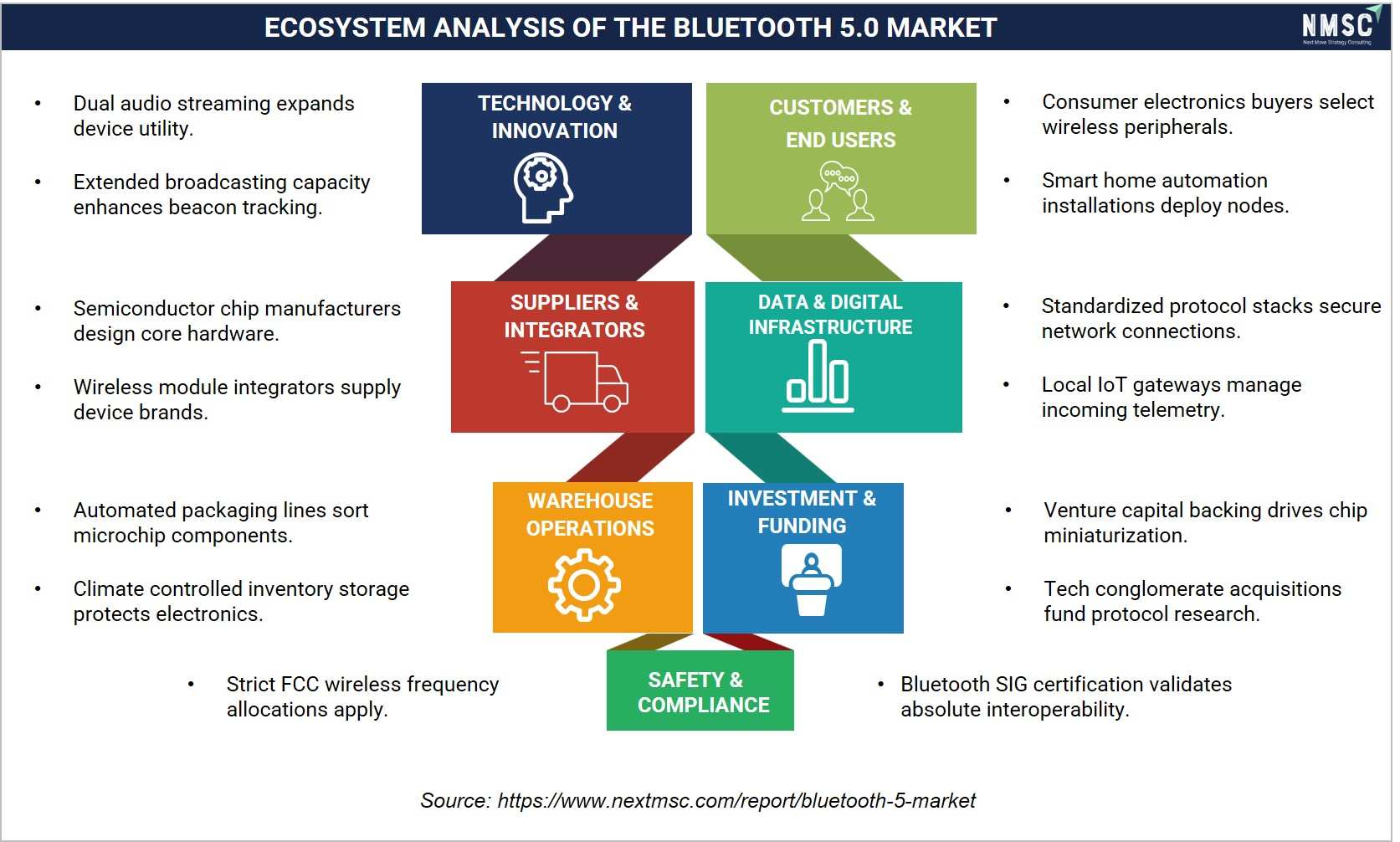
Ecosystem Analysis of the Bluetooth 5.0 Market

The Bluetooth 5.0 Market ecosystem comprises technology developers, semiconductor manufacturers, device OEMs, software integrators, infrastructure providers, investors, and end users working together to enable seamless wireless connectivity. Innovation in low-power communication, IoT devices, smart consumer electronics, and industrial automation continues to drive market expansion. Data infrastructure, regulatory compliance, and strategic investments support ecosystem growth, while suppliers and integrators facilitate the deployment of Bluetooth-enabled solutions across healthcare, automotive, consumer electronics, and smart building applications.

Market Drivers & Dynamics

Interactive Dataset
Surging IoT Device Proliferation driver +2.1% Global (led by APAC, North America) 2025–2030
Healthcare BLE Device Adoption driver +1.8% North America, Europe, APAC 2025–2035
Smart Home & Consumer Electronics Growth driver +1.5% Global (all regions) 2025–2030
Automotive Bluetooth Integration driver +1.2% North America, Europe, East Asia 2025–2032
Location-based Services Expansion driver +1.1% North America, Europe 2026–2035
AR/VR & Gaming Connectivity Demand driver +0.8% North America, APAC 2026–2035
Spectrum Interference & Coexistence Issues restraint -0.9% Dense urban markets globally Ongoing
RF Regulatory Fragmentation restraint -0.7% MEA, Latin America, APAC 2025–2030
Competition from Wi-Fi 6E and UWB restraint -0.6% All regions Ongoing
SDK & Protocol Stack Standardization driver +0.9% Global 2026–2033
Source: Next Move Strategy Consulting

Growth Drivers

How Is the Rapid Proliferation of IoT Devices Driving Demand in the Bluetooth 5.0 Market?

The exponential growth of Internet of Things deployments is one of the most powerful structural tailwinds for the Bluetooth 5.0 Market. Bluetooth 5.0's combination of extended range up to 400 meters in open air, enhanced broadcast message capacity, and BLE energy efficiency makes it the preferred short-range wireless standard for IoT sensors, actuators, and gateways. The International Telecommunication Union (ITU) has projected that global connected device counts will continue expanding substantially through 2030, with industrial and consumer IoT applications representing the largest share. Smart meters, environmental sensors, agricultural monitoring systems, and asset trackers are among the high-volume IoT categories driving sustained Bluetooth 5.0 chipset demand.

How Is the Acceleration of Connected Healthcare Device Adoption Fueling Bluetooth 5.0 Market Growth?

The rapid digitization of healthcare delivery is creating strong structural demand for certified Bluetooth 5.0 connectivity in clinical and home health environments. The U.S. Food and Drug Administration (FDA) has cleared multiple Bluetooth-enabled devices under its Digital Health Center of Excellence, including continuous glucose monitors, cardiac rhythm monitors, and remote patient monitoring kits that rely on BLE protocols compliant with Bluetooth 5.0. Based on NMSC's research, we found that hospitals are deploying Bluetooth 5.0 real-time location systems to track medical equipment, reduce search time, and improve asset utilization. This healthcare digitization trend is driving significant incremental demand for Bluetooth 5.0 SoCs, protocol stacks, and integration services.

How Is the Mass Market Adoption of True Wireless Stereo Earphones and Smartwatches Sustaining Consumer Electronics Demand in the Bluetooth 5.0 Market?

The consumer electronics sector remains the highest-volume end market for Bluetooth 5.0 chipsets, driven by explosive growth in true wireless stereo (TWS) earphone shipments and smartwatch adoption. Our findings suggest that Bluetooth 5.0's dual-audio capability, enabling simultaneous streaming to two devices, has been a key feature differentiator for premium TWS earphone brands. The Bluetooth SIG's Bluetooth LE Audio standard, built on Bluetooth 5.2 and backward-compatible with Bluetooth 5.0 hardware in many configurations, further extends the technology's relevance in audio applications with enhanced codec efficiency and hearing aid support, reinforcing sustained chipset replacement cycles in this high-volume consumer segment.

Growth Inhibitors

How Does Radio Frequency Interference and Spectrum Congestion Constrain Bluetooth 5.0 Market Performance in Dense Deployments?

Radio frequency interference in the 2.4 GHz ISM band, which is shared by Bluetooth 5.0, Wi-Fi, ZigBee, and numerous other wireless technologies, poses a persistent operational constraint. In high-density environments such as hospitals, warehouses, and sports venues, Bluetooth 5.0 networks experience increased packet loss, latency variability, and throughput degradation. NMSC's analysis indicates that this interference challenge is a significant inhibitor for enterprise-scale Bluetooth 5.0 deployments requiring deterministic performance. While Bluetooth 5.0's adaptive frequency hopping partially mitigates the issue, coexistence management in multi-protocol environments requires sophisticated engineering resources that increase deployment complexity and total cost of ownership.

How Does Regulatory Fragmentation Across Emerging Markets Limit the Pace of Bluetooth 5.0 Market Expansion?

Radio frequency regulatory requirements vary substantially across national jurisdictions, creating compliance complexity for Bluetooth 5.0 device manufacturers targeting global markets. Emerging markets in Africa, parts of Southeast Asia, and Latin America maintain differing maximum transmit power limits, frequency band assignments, and equipment certification processes that require product variants and additional certification expenditure. Based on our market assessment, we observed that regulatory approval timelines in markets such as Indonesia, Nigeria, and Brazil can extend product launch cycles by six to eighteen months, slowing revenue recognition and discouraging investment in product customization for smaller emerging markets within the global Bluetooth 5.0 ecosystem.

What Are the Growth Opportunities?

How Does the Expansion of Automotive Bluetooth Integration Create a High-Value Opportunity in the Bluetooth 5.0 Market?

The automotive industry represents a significant and expanding opportunity for the Bluetooth 5.0 Market, with Bluetooth 5.0 increasingly specified as standard equipment in vehicles for hands-free calling, audio streaming, vehicle diagnostics, and digital key functions. The U.S. National Highway Traffic Safety Administration (NHTSA) has supported hands-free connectivity standards that indirectly reinforce Bluetooth adoption in automotive environments. Our analysis shows that electric vehicle manufacturers are integrating Bluetooth 5.0 into battery management systems, over-the-air update notifications, and passenger experience platforms. Premium automotive OEMs in Europe and East Asia are also exploring BLE-based passive entry and digital key use cases that represent premium-priced software-defined feature opportunities for Bluetooth module suppliers.

How Is the Growth of Augmented Reality, Virtual Reality, and Gaming Peripherals Opening New Opportunities in the Bluetooth 5.0 Market?

The expanding AR/VR and gaming peripheral market is creating new high-throughput, low-latency demand vectors for Bluetooth 5.0 chipsets. Through NMSC's assessment, we found that gaming headset manufacturers, VR controller makers, and AR glass producers require sub-10-millisecond audio latency and reliable high-bandwidth data transfer that Bluetooth 5.0's 2 Mbps PHY mode can deliver. Sony's PlayStation wireless peripherals and Microsoft's Xbox controllers have both transitioned to Bluetooth 5.0 compatibility, validating the platform's adequacy for gaming-grade performance. The projected growth of the global AR/VR hardware market represents a durable incremental demand driver for the premium segment of Bluetooth 5.0 SoC and RF component suppliers.

How Does the Deployment of Large-Scale Indoor Positioning Networks Present a Structural Revenue Opportunity for the Bluetooth 5.0 Market?

Large-scale indoor positioning and real-time location system (RTLS) deployments represent one of the most structurally attractive growth opportunities in the Bluetooth 5.0 Market, enabled by Bluetooth 5.1 direction-finding capabilities and LE Audio broadcast. The U.S. Centers for Disease Control and Prevention (CDC) has documented the operational benefits of RTLS in healthcare settings for equipment tracking and workflow optimization. Our assessment indicates that logistics operators, airport authorities, and large-format retail chains are investing in Bluetooth 5.0 beacon infrastructure to support dynamic wayfinding, asset utilization analytics, and proximity-triggered customer engagement. Each large-scale deployment requires hundreds to thousands of Bluetooth 5.0 beacon nodes, creating high-unit-volume hardware procurement opportunities for SoC and development board suppliers.

Segmentation Analysis

2025 (USD Billion)
2035 (USD Billion)
Hardware
System-On-Ch
RF Component
Development
Sensors & Co
Segment Item 2025 (USD Billion) 2035 (USD Billion) CAGR
Hardware $10.0 USD Billion $40.0 USD Billion 27.0%
System-On-Chip $17.1 USD Billion $51.1 USD Billion 17.0%
RF Components $24.2 USD Billion $62.2 USD Billion 15.0%
Development Board $31.3 USD Billion $73.3 USD Billion 17.0%
Sensors & Controls $38.4 USD Billion $84.4 USD Billion 26.0%

Segment-wise data is locked

Unlock complete segment-wise numbers for Component.

Unlock Full Data

How Do Hardware and Software Components Define the Core Architecture of the Bluetooth 5.0 Market?

Based on our analysis of Bluetooth 5.0 component adoption patterns, we observed that the market is structured across Hardware, Software, and Services. The Hardware segment dominates, led by System-On-Chip solutions that integrate Bluetooth radio, processor, memory, and power management within a single package. RF Components and Development Boards serve design prototyping and module integration needs, while Sensors and Controls represent IoT-specific hardware sub-segments. The Software segment is growing fastest, with SDK demand accelerating as platform ecosystems mature. Managed Services are expanding as enterprises outsource Bluetooth 5.0 network operations and device management responsibilities.

2025 (USD Billion)
2035 (USD Billion)
SMEs
Large Enterp
Segment Item 2025 (USD Billion) 2035 (USD Billion) CAGR
SMEs $10.0 USD Billion $40.0 USD Billion 14.0%
Large Enterprises $17.1 USD Billion $51.1 USD Billion 20.0%

Segment-wise data is locked

Unlock complete segment-wise numbers for Organisation Size.

Unlock Full Data

How Does Organisation Size Influence Bluetooth 5.0 Market Procurement and Deployment Patterns?

Through our market assessment, we observed that the Bluetooth 5.0 Market is segmented by Large Enterprises and SMEs. Large Enterprises currently dominate due to large-scale IoT rollouts, complex managed connectivity requirements, and enterprise security mandates that necessitate premium-grade Bluetooth 5.0 hardware and professional integration services. SMEs are the fastest-growing category, benefiting from the increasing availability of low-cost turnkey Bluetooth 5.0 modules, cloud-managed device platforms, and simplified SDK environments that lower the barrier for small business adoption in retail, hospitality, and light industrial applications.

2025 (USD Billion)
2035 (USD Billion)
Audio & Ente
Data Transfe
Wearables &
Smart Home &
Location-bas
Segment Item 2025 (USD Billion) 2035 (USD Billion) CAGR
Audio & Entertainment $10.0 USD Billion $40.0 USD Billion 15.0%
Data Transfer $17.1 USD Billion $51.1 USD Billion 21.0%
Wearables & Personal Devices $24.2 USD Billion $62.2 USD Billion 11.0%
Smart Home & IoT $31.3 USD Billion $73.3 USD Billion 21.0%
Location-based Services $38.4 USD Billion $84.4 USD Billion 14.0%

Segment-wise data is locked

Unlock complete segment-wise numbers for Application.

Unlock Full Data

Which Application Segments Are Driving the Highest Revenue Growth in the Bluetooth 5.0 Market?

Our analysis shows that the Bluetooth 5.0 Market is segmented by application into Audio & Entertainment, Data Transfer, Wearables & Personal Devices, Smart Home & IoT, Location-based Services, Wireless Device Networks, and Others. The Smart Home & IoT segment dominates, driven by the proliferation of smart speakers, lighting, thermostats, and home security devices using Bluetooth Mesh. Location-based Services is the fastest-growing application, enabled by Bluetooth 5.1 direction finding. Audio & Entertainment remains the highest-volume application by device count. Wearables and Wireless Device Networks are recording strong growth fueled by healthcare monitoring and industrial sensor network deployments.

2025 (USD Billion)
2035 (USD Billion)
Consumer Ele
Automotive
Retail
Logistics
Industrial M
Segment Item 2025 (USD Billion) 2035 (USD Billion) CAGR
Consumer Electronics $10.0 USD Billion $40.0 USD Billion 25.0%
Automotive $17.1 USD Billion $51.1 USD Billion 23.0%
Retail $24.2 USD Billion $62.2 USD Billion 9.0%
Logistics $31.3 USD Billion $73.3 USD Billion 23.0%
Industrial Measurements and Diagnostics $38.4 USD Billion $84.4 USD Billion 24.0%

Segment-wise data is locked

Unlock complete segment-wise numbers for End-User.

Unlock Full Data

How Does End-User Segmentation Reveal the Vertical Market Composition of the Bluetooth 5.0 Market?

Based on NMSC's research, we found that the Bluetooth 5.0 Market is segmented by end-user into Consumer Electronics, Automotive, Retail, Logistics, Industrial Measurements and Diagnostics, Healthcare, AR/VR and Gaming, and Others. Consumer Electronics dominates by revenue volume, reflecting the enormous global scale of smartphone, TWS earphone, and wearable device shipments. Healthcare is the fastest-growing end-user segment at a CAGR of 15.2%, propelled by connected medical device proliferation and hospital RTLS deployments. AR/VR and Gaming is the second-fastest growing vertical, benefiting from the migration of major gaming peripherals to Bluetooth 5.0 connectivity. Logistics and Retail are expanding rapidly on the basis of asset tracking and indoor navigation adoption.

Regional Outlook

2025 (USD Billion)
2035 (USD Billion)
North Americ
Europe
Asia-Pacific
Middle East
Latin Americ
Region 2025 (USD Billion) 2035 (USD Billion) CAGR (%)
North America $10.0 USD Billion $40.0 USD Billion 9.0%
Europe $17.1 USD Billion $51.1 USD Billion 27.0%
Asia-Pacific $24.2 USD Billion $62.2 USD Billion 25.0%
Middle East & Africa $31.3 USD Billion $73.3 USD Billion 23.0%
Latin America $38.4 USD Billion $84.4 USD Billion 12.0%

Regional data is locked

Unlock complete regional numbers for this market.

Unlock Full Data

Competitive Landscape

Dimension Description
Market Structure The Bluetooth 5.0 Market features multi-tiered competition among global semiconductor majors (Qualcomm, Broadcom, Texas Instruments), specialized wireless SoC vendors (Nordic Semiconductor, Silicon Laboratories, Microchip), and module-level suppliers (Murata, u-blox, Ezurio), each competing on distinct value propositions across application-specific market segments.
Innovation Focus Innovation in the Bluetooth 5.0 Market centers on ultra-low-power SoC architecture, multi-protocol combo chips integrating Bluetooth 5.0 with Wi-Fi and UWB, Bluetooth LE Audio codec implementation, direction-finding accuracy enhancement, and AI-enabled edge processing integration within Bluetooth-connected devices.
M&A Activity Renesas Electronics' acquisition of Dialog Semiconductor consolidates ultra-low-power Bluetooth SoC capability within a broader MCU and analog portfolio. Infineon's acquisition of Cypress Semiconductor significantly expanded its Bluetooth 5.0 SoC product line. Nordic Semiconductor and Silicon Laboratories are actively expanding through IP acquisitions and protocol stack investments targeting enterprise IoT and industrial BLE market segments.

How Do Companies Compete in the Bluetooth 5.0 Market?

The Bluetooth 5.0 Market is characterized by multi-tiered competition across semiconductor majors, specialized wireless SoC vendors, and module-level systems integrators. Global semiconductor leaders including Qualcomm, Broadcom, and Texas Instruments compete on integration breadth, multi-protocol capability, and ecosystem scale across mobile, automotive, and industrial application segments. Specialized Bluetooth SoC vendors including Nordic Semiconductor and Silicon Laboratories differentiate on ultra-low-power design excellence, development tool quality, and dedicated wireless expertise for IoT and healthcare applications. Module and connectivity platform vendors including Murata, u-blox, and Telit compete on integration simplicity, certifications breadth, and supply chain reliability for OEM customers requiring fast time-to-market.

Which Kind of Companies Dominate the Bluetooth 5.0 Market?

Three distinct categories of companies dominate the Bluetooth 5.0 Market. First, global semiconductor conglomerates including Qualcomm, Broadcom, Texas Instruments, MediaTek, Infineon, Renesas, and STMicroelectronics leverage multi-protocol integration, extensive reference design libraries, and large enterprise sales infrastructure to serve high-volume consumer electronics and automotive customers. Second, pure-play or dedicated wireless connectivity specialists including Nordic Semiconductor, Silicon Laboratories, Microchip Technology, and Goodix compete on best-in-class BLE performance, advanced SDK ecosystems, and deep developer community engagement. Third, connectivity module and solution providers including Murata, u-blox, Ezurio, and Telit serve OEM customers requiring pre-certified, integration-ready Bluetooth 5.0 hardware platforms.

AI-Native Differentiation and Open Standards Drive Market Success in the Bluetooth 5.0 Market

Innovation leadership in the Bluetooth 5.0 Market is increasingly defined by the ability to integrate artificial intelligence processing alongside Bluetooth radio capabilities within power-constrained SoC architectures. Vendors that successfully embed machine learning inference engines, neural accelerators, and efficient sensor fusion algorithms alongside Bluetooth 5.0 radios are capturing design wins in premium wearable, healthcare, and smart home platforms. Open development ecosystems including Zephyr RTOS, supported by the Linux Foundation, and the Bluetooth SIG's Qualification Program are becoming strategic differentiation tools that influence developer platform selection across the global Bluetooth 5.0 design community.

Key Market Players

Qualcomm Technologies, Inc.

Qualcomm Technologies, Inc. Nordic Semiconductor ASA Broadcom Inc. Silicon Laboratories Inc. Texas Instruments Incorporated Microchip Technology Incorporated MediaTek Inc. Renesas Electronics Corporation STMicroelectronics N.V. Infineon Technologies AG Realtek Semiconductor Corp. Murata Manufacturing Co., Ltd. Shenzhen Goodix Technology Co., Ltd. Espressif Systems (Shanghai) Co., Ltd. Qorvo, Inc. Telit Cinterion Deutschland GmbH Ezurio LLC Synopsys, Inc. CEVA, Inc. NXP Semiconductors N.V.

Latest Developments

Date Event
Mar 2026 Arduino (acquired by Qualcomm) announced the Arduino VENTUNO Q platform powered by Qualcomm Dragonwing IQ8 Series processors, targeting AI, robotics, industrial IoT and next-generation connected devices.
Mar 2026 NXP launched the i.MX 93W applications processor, integrating Edge AI with Wi-Fi 6, Bluetooth LE, and IEEE 802.15.4 connectivity for industrial IoT and smart-edge applications.
Jan 2026 Qualcomm announced completion of its Industrial & Embedded IoT expansion strategy, integrating acquisitions including Arduino, Edge Impulse, Foundries.io, Focus.AI and Augentix to strengthen AI-enabled IoT connectivity solutions.
Jun 2025 Nordic Semiconductor acquired Memfault, creating a chip-to-cloud platform for lifecycle management, OTA updates, diagnostics and large-scale IoT deployments.
Jun 2025 STMicroelectronics entered mass production of the ST67W611 Wi-Fi 6 and Bluetooth LE 5.4 module developed in collaboration with Qualcomm Technologies for STM32-based IoT systems.

Expert Insights

Bjørnar Hernes

Bjørnar Hernes

Senior Product Director of Short-Range | Nordic Semiconductor

"By combining our expertise in Bluetooth LE, Thread, and Wi-Fi with Qorvo’s UWB technology, we are enabling developers to create the next generation of smart access solutions with ease. "

Analyst Interpretation

The comment highlights the increasing importance of Bluetooth Low Energy as a foundational connectivity technology in next-generation smart access and digital key applications. As demand grows for secure, interoperable, and low-power access control systems, Bluetooth LE is becoming a critical component alongside complementary wireless technologies such as UWB and Thread. The statement also reflects a broader market trend toward multi-protocol connectivity platforms that enable seamless integration across smart home, IoT, and building automation ecosystems, creating new growth opportunities for Bluetooth-enabled devices and solutions.

What Are the Investment Opportunities in the Bluetooth 5.0 Market?

Capital Inflows and Venture Activity

The Bluetooth 5.0 Market continues to attract both strategic corporate investment and venture capital activity, particularly at the intersection of Bluetooth connectivity and AI-enabled health monitoring, industrial IoT, and location intelligence. Nordic Semiconductor and Silicon Laboratories have both maintained substantial R&D investment programs targeting next-generation BLE architecture. The National Venture Capital Association (NVCA) has noted sustained investor interest in wireless connectivity startups targeting healthcare and industrial IoT applications, with Bluetooth 5.0 featuring prominently as the preferred short-range wireless platform. CEVA Inc.'s licensing of Bluetooth IP cores to major SoC vendors reflects healthy royalty-based investment returns in the semiconductor IP segment.

Infrastructure Investment

Infrastructure investment in the Bluetooth 5.0 Market encompasses semiconductor fabrication capacity, indoor positioning network deployments, and IoT platform cloud infrastructure. TSMC and GlobalFoundries' expansion of advanced node capacity supports production of cutting-edge Bluetooth 5.0 SoCs. Real estate operators, healthcare systems, and logistics companies are making capital investments in Bluetooth 5.0 anchor beacon infrastructure for indoor positioning systems. The U.S. Department of Energy's building energy efficiency programs indirectly stimulate investment in Bluetooth Mesh-based smart building automation. Our assessment indicates that these infrastructure investment flows create durable multi-year hardware procurement demand across the Bluetooth 5.0 component supply chain.

ESG and Sustainable Connectivity

Environmental, Social, and Governance considerations are increasingly relevant to investment decisions in the Bluetooth 5.0 Market. Bluetooth 5.0's BLE profile, delivering sub-milliwatt operational power consumption, positions it as an inherently energy-efficient connectivity standard aligned with enterprise and government sustainability mandates. The EU's Ecodesign Regulation for electronics and the U.S. EPA ENERGY STAR program create regulatory incentives favoring low-power wireless standards such as Bluetooth LE over higher-power alternatives. ESG-focused institutional investors are increasingly assigning positive screening criteria to semiconductor companies with strong BLE efficiency roadmaps and supply chain sustainability programs. Our findings suggest that Bluetooth 5.0's power efficiency profile is becoming a measurable ESG investment consideration.

Digital Transformation Enablement

Bluetooth 5.0 platforms serve as critical digital transformation enablers across healthcare, retail, logistics, and manufacturing sectors. Hospitals digitizing patient monitoring and asset tracking, retailers deploying omnichannel customer engagement platforms, and manufacturers implementing Industry 4.0 condition monitoring programs all require Bluetooth 5.0 hardware and software infrastructure as foundational components. The NIST Cybersecurity Framework's guidance on IoT device security creates a compliance-driven investment case for upgrading legacy wireless sensor networks to Bluetooth 5.0 standards with enhanced authentication and encryption capabilities. These enterprise digital transformation investment cycles create predictable multi-year demand for Bluetooth 5.0 hardware, SDKs, and integration services.

Private Equity and Strategic M&A Activity

Private equity and strategic M&A activity represent significant investment themes within the Bluetooth 5.0 Market. Semiconductor consolidators are actively acquiring specialized Bluetooth IP developers, ultra-low-power SoC designers, and healthcare-grade BLE certification platform providers to expand vertical market reach. Thoma Bravo and other technology-focused PE firms have historically demonstrated appetite for wireless connectivity software and platform companies. Our assessment indicates that Bluetooth protocol stack software companies, indoor positioning platform vendors, and medical-grade BLE integration service providers represent structurally attractive M&A targets, offering premium valuation multiples for acquirers with established customer relationships in healthcare, industrial automation, and enterprise IoT market segments.

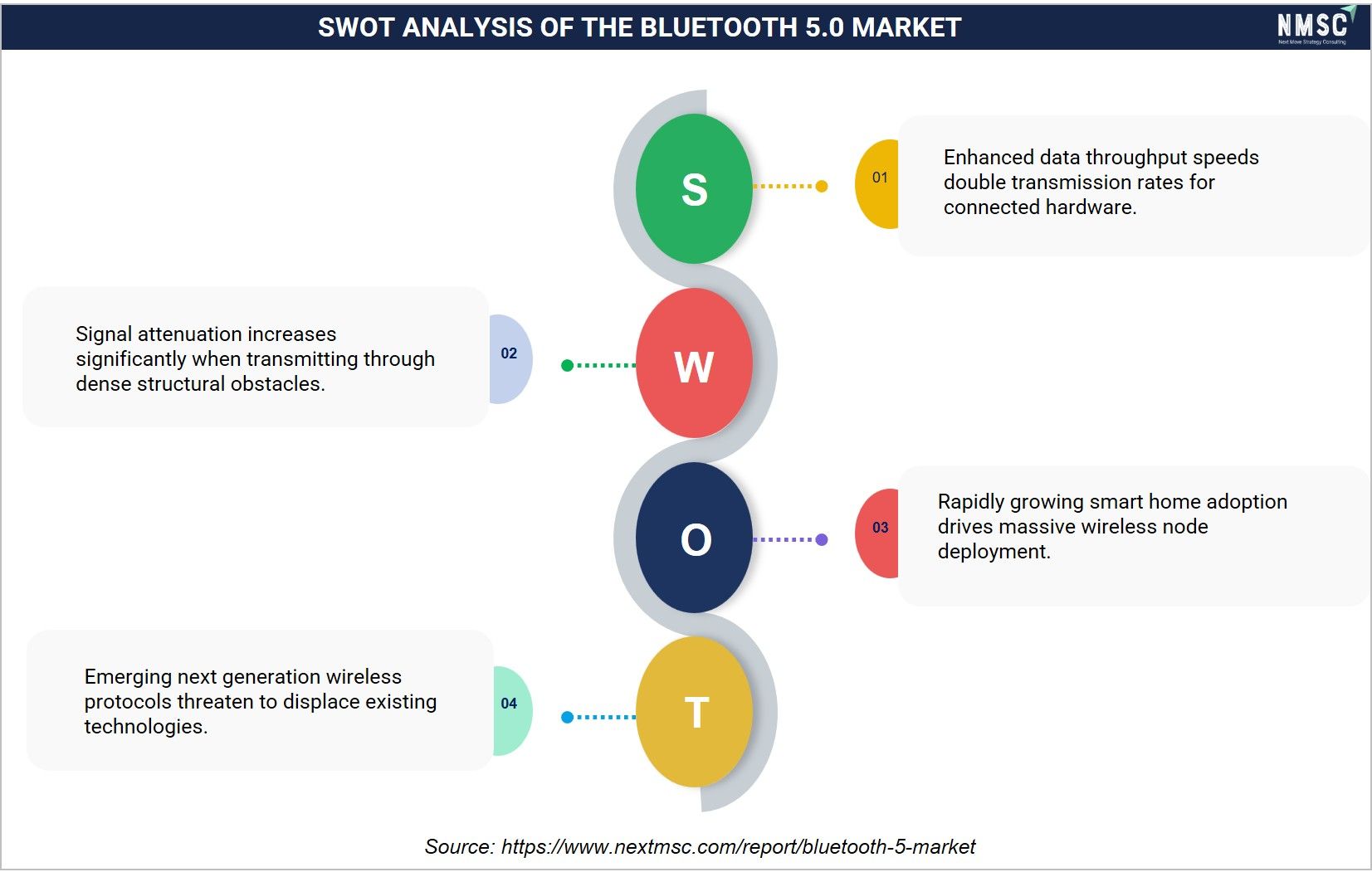
SWOT Analysis

This SWOT view highlights structural strengths, strategic gaps, expansion headroom, and external risks shaping outcomes in the Bluetooth 5.0 Market.

Strengths

Enhanced data throughput speeds double transmission rates for connected hardware.

Weaknesses

Signal attenuation increases significantly when transmitting through dense structural obstacles.

Opportunities

Rapidly growing smart home adoption drives massive wireless node deployment.

Threats

Emerging next generation wireless protocols threaten to displace existing technologies.

Key Benefits for Stakeholders

For Enterprise Buyers and Device Manufacturers

Enterprise buyers and device manufacturers gain comprehensive, vendor-neutral intelligence on the Bluetooth 5.0 Market, including quantitative sizing across all component categories, application segments, and end-user verticals. This analysis supports product roadmap planning, SoC vendor evaluation, and market entry strategy development. Competitive landscape assessment enables procurement teams to benchmark chipset pricing, development tool quality, and support ecosystem depth across the full range of Bluetooth 5.0 component and module suppliers. Regional analysis identifies geographic priority markets for product certification and distribution investment.

For Investors and Financial Analysts

Investors and financial analysts access a structured, data-rich assessment of the Bluetooth 5.0 Market's growth trajectory, competitive dynamics, and segment-level revenue forecasts through 2035. CAGR analysis by component, application, end-user, and region enables precise portfolio construction and public company valuation modeling. Detailed coverage of all 20 profiled companies, including latest product development tracking and M&A activity, provides an early-signal framework for identifying acquisition targets, emerging leaders, and at-risk incumbents within the global Bluetooth 5.0 semiconductor and platform ecosystem.

For Bluetooth 5.0 Technology Vendors and Protocol Stack Developers

Bluetooth 5.0 technology vendors and protocol stack developers gain actionable intelligence on white-space application opportunities, fastest-growing end-user verticals, and emerging geographic markets within the Bluetooth 5.0 Market. Segmentation analysis identifies underserved areas including healthcare-grade BLE and industrial mesh networking. Regional outlook sections provide regulatory and market maturity context for international expansion prioritization. The competitive landscape analysis enables strategic assessment of partnership and acquisition opportunities within the broader Bluetooth 5.0 ecosystem spanning SoC, SDK, module, and managed connectivity platform categories.

For Government and Standards Bodies

Government agencies and standards bodies including the Bluetooth Special Interest Group, national telecommunications regulators, and healthcare device approval authorities gain structured market intelligence on how Bluetooth 5.0 adoption patterns are evolving across application verticals and geographic markets. Country-level insights provide evidence-based context for policymakers developing IoT spectrum management frameworks, device certification standards, and digital health technology regulatory pathways. The competitive landscape and M&A analysis offers relevant intelligence for technology sovereignty and supply chain security assessments in regions prioritizing domestic wireless semiconductor capability development.

Key Market Segments Evaluated

Component

  • Hardware
  • System-On-Chip
  • RF Components
  • Development Board
  • Sensors & Controls
  • Software
  • Software Development Kits
  • Protocol Stacks
  • Services
  • Professional Services
  • Managed Services

Organisation Size

  • Large Enterprises
  • SMEs

Application

  • Audio & Entertainment
  • Data Transfer
  • Wearables & Personal Devices
  • Smart Home & IoT
  • Location-based Services
  • Wireless Device Networks
  • Others

End-User

  • Consumer Electronics
  • Automotive
  • Retail
  • Logistics
  • Industrial Measurements & Diagnostics
  • Healthcare
  • AR/VR and Gaming
  • Others

Conclusion & Recommendations

The Bluetooth 5.0 Market is entering a decade of diversified, multi-vertical growth driven by IoT proliferation, healthcare digitization, smart building expansion, and the integration of AI processing at the wireless edge. The market is forecast to grow from USD 8.7 billion in 2026 to USD 22.6 billion by 2035 at a CAGR of 11.2%. Our analysis indicates that this growth reflects both the structural expansion of connected device volumes and the increasing value content per device as Bluetooth 5.0 SoCs incorporate AI inference, direction finding, and LE Audio capabilities that command premium pricing across healthcare, industrial, and automotive segments.

Strategic Positioning Recommendations

SoC vendors should prioritize multi-protocol integration combining Bluetooth 5.0 with Wi-Fi 6E and UWB to capture premium smart home, automotive, and enterprise IoT design wins that require co-existence management. Healthcare-grade BLE certification investment is non-negotiable for vendors targeting the fastest-growing end-user segment through 2035. SDK and developer ecosystem quality is increasingly a primary differentiation factor as platform-level competition intensifies across Zephyr RTOS, Mbed OS, and proprietary development environments. Module-level vendors should invest in pre-certification portfolios across FCC, ETSI, MIC Japan, and emerging market regulatory frameworks to accelerate customer time-to-market.

Investment Attractiveness

The Bluetooth 5.0 Market represents a structurally attractive investment environment given durable multi-decade secular drivers, recurring chipset replacement cycles driven by new Bluetooth specification revisions, and expanding application portfolio diversification into healthcare, industrial, and location services. The highest-conviction investment themes include healthcare BLE device connectivity at a CAGR of 15.2%, location-based services at 14.8% CAGR, AR/VR and gaming at 14.8% CAGR, and logistics at 12.9% CAGR. Investors should monitor Nordic Semiconductor and Silicon Laboratories for premium specialty wireless positioning, and Qualcomm and Broadcom for large-scale multi-protocol integration plays.

Market Shifts and Key Risks

The most significant market shift underway is the transition from single-protocol Bluetooth devices toward multi-protocol combo chips integrating Bluetooth 5.0 with Wi-Fi, UWB, or Zigbee on a single die. This shift benefits large semiconductor conglomerates with multi-protocol design capability at the expense of single-protocol specialists. Key risks for the Bluetooth 5.0 Market include accelerated competition from Wi-Fi 6E for short-range data transfer applications, regulatory fragmentation in emerging markets constraining geographic expansion velocity, supply chain concentration in East Asian semiconductor manufacturing, and the potential for Thread and Matter protocol ecosystems to displace Bluetooth Mesh in smart home IoT network infrastructure.

Growth Pathways

Organizations seeking to maximize value from the Bluetooth 5.0 Market should pursue a three-horizon strategy. In the near term from 2025 to 2027, prioritize LE Audio and Bluetooth 5.1 direction-finding capability deployment to capture premium healthcare and location services design wins. In the mid-term from 2027 to 2031, invest in AI-edge integration within Bluetooth SoC platforms, multi-protocol combo chip development, and healthcare regulatory certification to capture the highest-growth application segments. In the long term from 2031 to 2035, position for ubiquitous ambient sensing and positioning infrastructure where Bluetooth 5.0 and its successors serve as foundational connectivity layers across smart cities, precision medicine, and autonomous logistics environments.

FAQs

About the Author

Mihul Sharma

Mihul Sharma

Mihul Sharma is Research Associate at Next Move Strategy Consulting, where he has covered technology, industrial, and healthcare markets for 3 years. His work applies structured business research, market analysis, and secondary-source review to assess market trends, competitive developments, and growth opportunities. He supports report development by fully synthesizing industry data, company information, and market signals into concise findings for strategy and investment-focused research teams.

About the Reviewer

Supradip Baul

Supradip Baul

Supradip Baul is an accomplished business consultant and strategist with over a decade of rich experience in market intelligence, strategy, technology, and business transformation. His work has included rigorous qualitative and quantitative analysis across multiple industries, helping clients shape investment decisions and long-term roadmaps. Earlier in his career, he was associated with Gartner, where he contributed to industry-leading reports and market share analyses. He has worked with leading global companies and holds an MBA with a dual specialization in Marketing and Finance.

Download Free Sample

Kishu Kanda

KISHU KANDA

Strategy Analyst

Accenture

We purchased the AI Consumer Market Report from this company. Not only did they customize the report to meet our specific requirements, but they also showed great flexibility in accommodating our budget. The report we received fully met our expectations. Additionally, they provided prompt and thorough responses to both our pre-purchase and follow-up questions. We look forward to working with this company again in the future.

Nishant Awate

NISHANT AWATE

Business Development Global Sales

Zehnder Group Deutschland GmbH

Our experience working with Next Move Strategy Consulting was positive. The team was responsive, professional, and open to incorporating our specific requirements throughout the project. The India AHU market study was comprehensive and well structured, covering market value and volume forecasts, product and application segments, and key industry trends. The inclusion of both AHU and residential MVHR market insights made the study particularly relevant for our strategic market assessment. Overall, the report provides a solid foundation for evaluating market potential, identifying priority segments, and supporting business-development decisions in India.

Gustaf Hummel Burstrom

GUSTAF HUMMEL BURSTROM

Founder

Revline Tools AB

Joseph and the team at Next Move Strategy Consulting have been excellent to work with, in supplying us with relevant market data and forecasts for our specific category. We had some special requirements and they were able to do a custom package to suit our needs. We would definitely recommend them to any other company needing market data and forecasts

Rishabh Jogani

RISHABH JOGANI

Strategy Analyst

Accenture Japan

We are incredibly impressed with the market report on the real estate market in India provided by Next Move Strategy Consulting. The report was thorough, insightful, and well-structured, offering deep analysis and actionable recommendations. It not only captured the current trends and dynamics but also provided a forward-looking perspective that has been invaluable for our strategic planning. Their team demonstrated exceptional professionalism, attention to detail, and a profound understanding of the industry. The data-driven insights and clarity of presentation exceeded our expectations, making complex market trends easy to understand. We highly recommend Next Move Strategy Consulting to anyone looking for reliable and comprehensive market research services. Their expertise has given us the confidence to navigate the complexities of the Indian real estate market with clarity and foresight.

Amos Chang

AMOS CHANG

Strategy Consultant

Kardex Group

I have bought the intralogistics market reports from NMSC two times so far. Joseph and his team are always very helpful and flexible in responding to any customization requirements on the report. Their expertise in market reports really helps us steer the day-to-day business. I will definitely recommend and come back myself whenever there is a need.

Custom Market Research Services

We will customize the research for you if the listed report does not fully match your requirements.

Get 30% Free Customization

Select License

This website uses cookies to ensure you get the best experience on our website. Learn more

✖