Corrugated Board Market Global Industry Analysis and Forecast (2026–2035)

Corrugated Board Market size was USD 186.79 Billion in 2025, projected to reach USD 313.07 Billion by 2035, growing at a CAGR of 5.3% from 2026 to 2035. Key drivers include sustained e-commerce and industrial shipping volumes, recyclability and circular fiber economy, and lightweight high-strength board innovation, with North America leading the global market.
Download Free Sample PDF
Base Year (2025)
$186.79 Billion
Forecast (2035)
$313.07 Billion
CAGR (2026-2035)
5.3%
Top Region
North America

What Is the Corrugated Board Market Size?
The global corrugated board market reached USD 186.79 Billion in 2025 and is estimated at USD 196.69 Billion in 2026, forecast to reach USD 313.07 Billion by 2035 at a CAGR of 5.3% between 2026 and 2035. North America leads with approximately 34% revenue share in 2025, while Single Wall is the dominant product type, holding approximately 43% of total market revenue.

We observed that technological shifts in fluting geometry, high-performance linerboard, and water-resistant starch and wax treatments are reshaping how corrugated board performs under humidity, compression, and transit stress. Manufacturers are investing in wider corrugators and inline digital print systems to meet short-run customization requirements from e-commerce retailers and manufacturing OEMs. Our findings suggest that operational scale, measured by mill capacity and converting footprint, has become a decisive factor in controlling conversion costs and securing long-term supply contracts across the corrugated board value chain.

Corrugated Board Market Global Industry Analysis and Forecast (2026–2035) Revenue Forecast
Values in USD Billion

2025 $186.79 Billion
2025
2026 $196.69 Billion
2026
2027 $207.11 Billion
2027
2028 $218.09 Billion
2028
2029 $229.65 Billion
2029
2030 $241.82 Billion
2030
2031 $254.64 Billion
2031
2032 $268.13 Billion
2032
2033 $282.35 Billion
2033
2034 $297.31 Billion
2034
2035 $313.07 Billion
2035

Key Takeaways

Product Type: Single Wall held the largest share, expanding from USD 80.48 Billion in 2025 to USD 120.33 Billion by 2035, supported by robust standard commercial shipping carton demand.

Application: Food & Beverage Packaging held the largest share, expanding from USD 79.07 Billion in 2025 to USD 124.44 Billion by 2035, driven by fresh produce and processed food transit requirements.

End User: Food & Beverage Manufacturers held the largest share, expanding from USD 82.39 Billion in 2025 to USD 127.04 Billion by 2035, anchored by high-volume bulk shipper and private label contracts.

Distribution Channel: Direct Sales to Converters & Manufacturers held the largest share, expanding from USD 71.03 Billion in 2025 to USD 105.01 Billion by 2035, driven by annual volume and key account contracts.

Dominant Region: North America dominated the market with approximately 34% revenue share (USD 63.51 Billion) in 2025, anchored by integrated mill-to-converter networks, strong e-commerce and industrial shipping demand, and high concentrations of established producers.

Fastest-Growing Region: Asia-Pacific is expected to register the highest CAGR of 8.38% during 2026–2035, driven by expanding manufacturing hubs, e-commerce logistics growth, and rising domestic consumer and business demand.

Dominant Country: The U.S. led the market with an estimated USD 48.27 Billion in 2025 (~76% of North America), supported by extensive e-commerce and industrial shipping demand, established supplier networks, and large integrated mill and converting footprints.

Fastest-Growing Country: India is the fastest-growing country, projected to expand from USD 10.09 Billion in 2025 at a CAGR of approximately 10.18%, driven by rapid retail formalisation, expanding pharmaceutical and quick-commerce distribution, and rising local demand.

The corrugated board market presents an absolute dollar opportunity of USD 116.38 billion between 2026 and 2035, representing the incremental value that suppliers can capture as the market expands from USD 196.69 billion to USD 313.07 billion. This expansion is anchored in fundamental packaging needs rather than discretionary consumption, which supports revenue visibility for converters and mill operators. Capturing this opportunity requires disciplined capacity additions, selective portfolio pruning, and a focus on grades that command premium pricing for performance, certification, and sustainability credentials.

Competitive consolidation in the corrugated board market has accelerated as large integrated producers pursue scale in [containerboard](https: //www.nextmsc.com/report/containerboard-market) production and converting networks. International Paper (including DS Smith) and Smurfit Westrock PLC illustrate how combined mill and box plant footprints improve fiber procurement and logistics efficiency. During our market evaluation, we noticed that divestitures of selected converting assets, such as those required by regulatory commitments, are reshaping regional ownership structures. Long-term OEM partnerships with equipment and packaging-line suppliers further tie supply chain scale to production reliability and throughput.

Supply Chain Structure of the Corrugated Board Industry

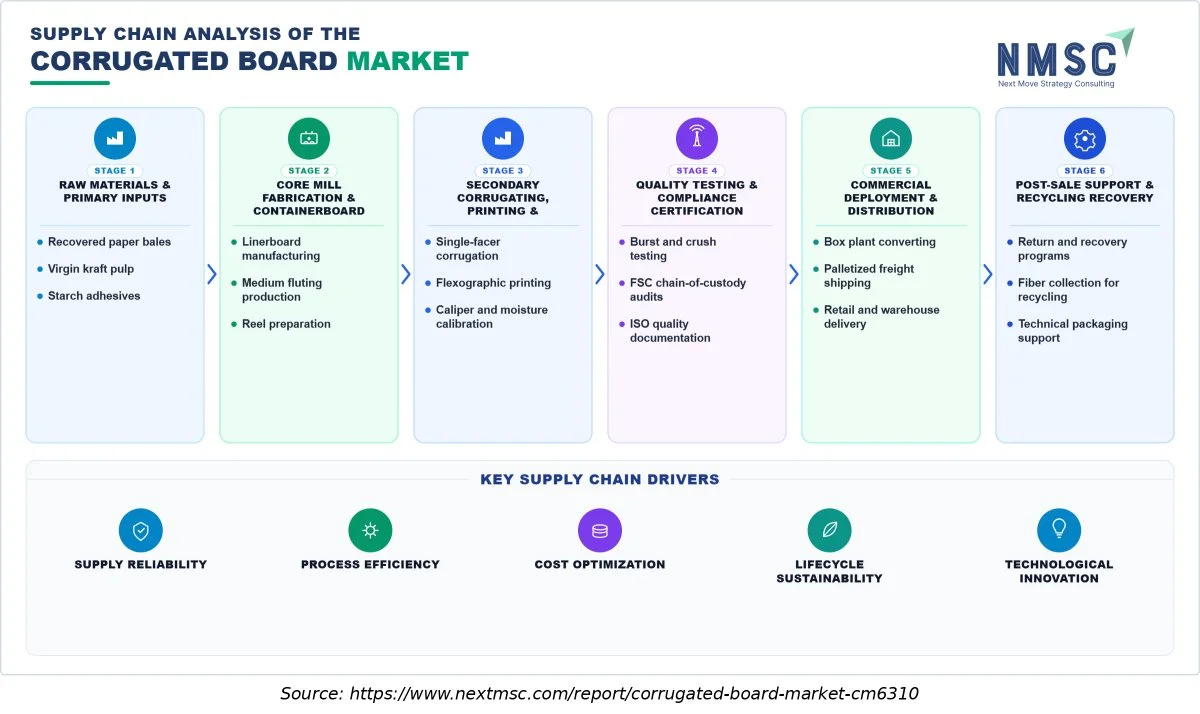
Supply Chain Structure of the Corrugated Board Industry
This infographic traces the corrugated board value chain from fiber recovery and containerboard production through corrugating, converting, and final delivery. It highlights how mill scale, converting proximity, and logistics networks determine cost competitiveness. Stakeholders gain clarity on where bottlenecks and pricing pressures originate across the chain.

What Does the Corrugated Board Market Encompass?
The corrugated board market encompasses single-face, single-wall, double-wall, and triple-wall board, formed by bonding fluted medium to one or more linerboard facings. Corrugated board is supplied in sheets or rolls and is converted downstream into regular-slotted containers, die-cut trays, protective inserts, and bulk industrial packaging. Core technologies include corrugating lines, flexographic and digital printing units, and automated die-cutting equipment that together convert raw paper grades into finished packaging components for food and beverage, e-commerce, and manufactured goods.

Design specifications typically address burst strength, edge crush resistance, flat crush performance, and moisture tolerance measured against industry test methods. Material innovations include recycled fiber blends, starch-based adhesives, and barrier coatings that extend performance in humid or high-stacking environments. Certifications such as FSC chain-of-custody and ISO quality management frameworks increasingly determine supplier eligibility, while food-contact compliance expands the market scope for specialized corrugated grades.

Market Drivers & Dynamics

Interactive Dataset
Sustained e-commerce and industrial shipping volumes driver High Drives continuous demand for protective corrugated shipping cases and palletized bulk packaging Immediate
Recyclability and circular fiber economy driver High Supports corrugated board adoption as a recyclable alternative to plastic packaging formats Immediate
Lightweight high-strength board innovation driver Medium Enables engineered double-wall grades that reduce material use while maintaining compression strength Medium-term
Volatility in recycled fiber and virgin pulp costs restraint High Compresses converter margins because containerboard prices fluctuate with fiber availability Immediate
Capacity rationalization and mill closures restraint Medium Limits regional supply flexibility when converting assets are divested or idled Medium-term
Competition from reusable transit packaging restraint Low Gradually shifts selected closed-loop logistics flows toward returnable crates and bins Long-term
Source: Next Move Strategy Consulting

Growth Drivers

What Is the Primary Growth Driver in the Corrugated Board Market?

The primary catalyst for the corrugated board market is the continuing expansion of parcel shipping and industrial distribution, which requires large volumes of protective and structural packaging. Corrugated board offers a favorable balance of cushioning, stacking strength, and printability that alternative materials struggle to match at comparable cost. Our findings suggest that as supply chains prioritize speed and damage reduction, converters that deliver consistent performance grades will capture disproportionate incremental volume.

How Are Industry Standards and Directives Driving the Corrugated Board Market?

Packaging waste directives and extended producer responsibility frameworks in Europe and North America encourage manufacturers to adopt recyclable fiber-based formats such as corrugated board. Quality standards governing burst strength, edge crush, and food-contact suitability also shape which grades are eligible for specific end uses. Certification bodies such as the Forest Stewardship Council validate responsible fiber sourcing, which increasingly determines supplier qualification in procurement programs.

Growth Inhibitors

What Is Restraining the Corrugated Board Market?

The principal commercial restraint is volatility in containerboard and recycled fiber prices, which directly affects converter cost structures and contract pricing. Fiber availability fluctuates with collection rates and mill operating schedules, making it difficult for converters to lock in stable margins over long procurement cycles. Consequently, smaller box plants face greater pressure than integrated producers that control fiber supply and capacity.

Segmentation Analysis

2025 (USD Billion)
2035 (USD Billion)
Single Wall 2025: $80.48 Billion | 2035: $84.74 Billion
Single Wall
Double Wall 2025: $51.50 Billion | 2035: $54.23 Billion
Double Wall
Triple Wall 2025: $33.92 Billion | 2035: $35.72 Billion
Triple Wall
Single Face / Flat Sheets 2025: $20.89 Billion | 2035: $22.00 Billion
Single Face
Single Wall $80.48 Billion $84.74 Billion USD 120.33 Billion
Double Wall $51.50 Billion $54.23 Billion USD 88.77 Billion
Triple Wall $33.92 Billion $35.72 Billion USD 60.87 Billion
Single Face / Flat Sheets $20.89 Billion $22.00 Billion USD 43.1 Billion

Which Product Type Segment Dominates the Corrugated Board Market?

Single Wall holds the leading position in the corrugated board market with approximately 43% share and USD 80.48 billion in 2025, reflecting its versatility across everyday shipping cartons, folding boxes, and general-purpose protective packaging. Its balance of structural strength and material efficiency makes it the default specification for converters serving high-volume commercial programs. Single Face and Flat Sheets are advancing at a 7.76% CAGR through 2035, driven by converters seeking lightweight cushioning, interleaving, and custom inserts that reduce material consumption while maintaining product protection.

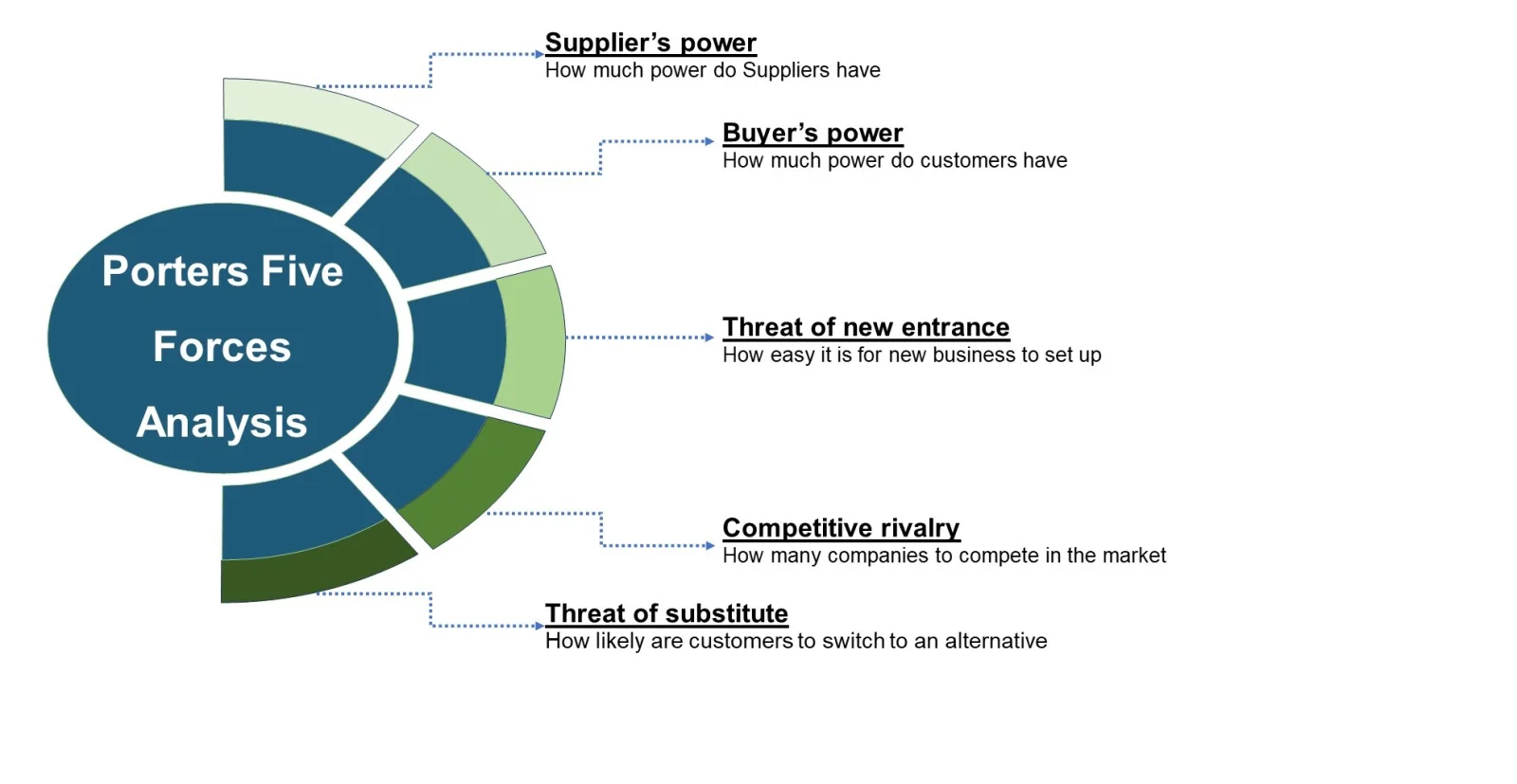
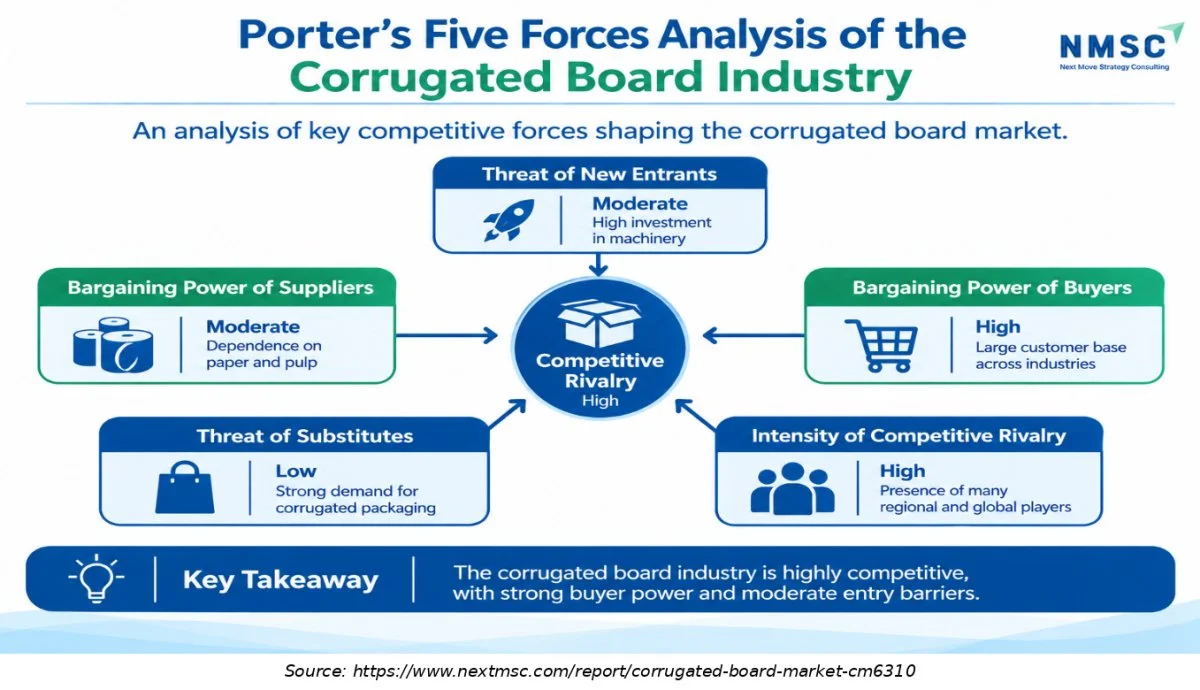
Porter's Five Forces Analysis of the Corrugated Board Market

This infographic evaluates buyer power, supplier influence on fiber pricing, entry barriers, substitution threats, and rivalry intensity. It shows how integrated producers and regional converters face distinct competitive pressures. Strategic implications point toward differentiation through performance grades and secure fiber sourcing.

Growth Opportunities

Our analysis shows that three structural whitespace opportunities are positioned to generate disproportionate commercial returns in the Corrugated Board Market through 2035:

Can Engineered Heavy-Duty Grades Capture High-Density Deployments?

Heavy-duty double-wall and triple-wall corrugated grades offer a pathway into applications such as machinery component shipping and heavy manufactured goods. These grades command higher value per square meter than standard shipping cartons because they replace wooden crates in selected uses. Suppliers that certify performance under stacked and humid conditions can secure long-term supply agreements with industrial buyers seeking alternatives to timber.

How Is Mid-Tier and Regional Facility Adoption Unlocking New Corrugated Board Market Volume?

Regional converting plants serving local manufacturing clusters are expanding their role by offering short lead times and tailored die-cut designs. These facilities reduce freight distances and inventory carrying costs for mid-sized customers that cannot justify large centralized orders. Our assessment indicates that investment in compact corrugator lines and digital print capability will allow regional hubs to capture volume that national producers have historically overlooked.

Can Specialized Vertical Implementations Become Distinct Premium Markets?

Specialized corrugated solutions such as water-resistant seafood cartons and moisture-barrier liners for sensitive goods are establishing distinct premium niches. Brands serving these segments accept higher unit prices in exchange for verified performance and reduced product loss during transit. Recent product launches by leading producers indicate that targeted formulations can support differentiated pricing within the broader corrugated board market.

Regional Outlook

2025 (USD Billion)
2035 (USD Billion)
North Americ
Europe
Asia-Pacific
Latin Americ
Middle East
Region 2025 (USD Billion) 2035 (USD Billion) CAGR (%)
North America $10.0 USD Billion $40.0 USD Billion 9.0%
Europe $17.1 USD Billion $51.1 USD Billion 27.0%
Asia-Pacific $24.2 USD Billion $62.2 USD Billion 25.0%
Latin America $31.3 USD Billion $73.3 USD Billion 23.0%
Middle East & Africa $38.4 USD Billion $84.4 USD Billion 12.0%

Regional data is locked

Unlock complete regional numbers for this market.

Unlock Full Data

Competitive Landscape

The corrugated board market is shaped by a concentrated group of integrated producers, including International Paper Company, Smurfit Westrock PLC, Packaging Corporation of America, Mondi PLC, Stora Enso Oyj, Oji Holdings Corporation, Nine Dragons Paper (Holdings) Limited, and Cascades Inc. Scale in containerboard production, fiber sourcing, and mill integration remains a decisive factor in cost competitiveness. Regional players continue to hold meaningful positions in local converting networks, particularly across North America and Asia-Pacific.

How Do Companies Compete in the Corrugated Board Market?

Leading corrugated board producers compete primarily on-board grade performance, consistency of supply, and the ability to serve converters with tailored specifications. Pricing is closely tied to containerboard and recycled fiber costs, which pushes producers toward operational efficiency and long-term customer contracts. Distribution strength depends on mill proximity to converting plants, allowing suppliers to reduce freight costs and shorten lead times for high-volume buyers.

Which Competitive Archetypes Dominate the Corrugated Board Market?

Market participants in corrugated board fall into three archetypes: fully integrated producers that operate containerboard mills and converting networks, such as International Paper Company, Smurfit Westrock PLC, and Packaging Corporation of America; diversified paper and packaging groups with European and Asian corrugated board operations, including Mondi PLC, Stora Enso Oyj, Oji Holdings Corporation, and Nine Dragons Paper (Holdings) Limited; and specialty or regional producers focused on niche board grades and local converting relationships, such as Cascades Inc. and Pratt Industries, Inc. in regional corrugated board supply.

What Innovation and Differentiation Strategies Are Companies Pursuing?

Sustainable advantage in corrugated board increasingly stems from fiber sourcing security, recycled content capability, and mill-to-converter integration that stabilizes supply during periods of volatile input costs. Producers able to demonstrate lower material intensity per shipping unit gain preference among food and beverage manufacturers and consumer brands. Investments in design support and lightweighting capabilities further strengthen customer retention across application segments.

What M&A and Partnership Activity Is Shaping the Market?

Mergers, acquisitions, and portfolio reshaping have been prominent in corrugated board, as producers rebalance asset footprints to improve returns and meet regulatory conditions. Divestitures of European corrugated box plants and the sale of German corrugated board units illustrate how groups optimize regional capacity. Acquisitions by converters such as Enjay Converters Ltd signal continued consolidation among downstream players seeking specialized food packaging capabilities.

Key Market Players

Based on research conducted by NMSC, the following 20 companies represent the validated leadership set across Corrugated Board Market manufacturers and converters:

International Paper Company Smurfit Westrock PLC Pratt Industries, Inc. Packaging Corporation of America Mondi PLC Stora Enso Oyj Oji Holdings Corporation Nine Dragons Paper (Holdings) Limited Rengo Co., Ltd. Cascades Inc. Visy Industries Klabin S.A. Orora Limited Saica Group VPK Group Georgia-Pacific LLC Cheng Loong Corporation Hood Container Corporation Port Townsend Paper Company Lee & Man Paper Manufacturing Ltd

Latest Developments

During our market evaluation, we noticed that recent commercial activities, platform introductions, and partnerships within the industry reflect the latest market developments:

Date Event
June 2026 President Container Group announced the integration of RHE Container Company's product offerings into its portfolio in June 2026, following an acquisition completed in December 2023.
March 2025 DS Smith introduced its Drypack solution, a water-resistant corrugated board packaging for the seafood industry.

Expert Insights

Adam Wood

Adam Wood

Vice President, Industrial Paper Products Europe | Sonoco

"“OCC generation has been low across Europe which has resulted in rising prices in March.”"

Analyst Interpretation

This executive observation highlights tightening recovered-fiber availability in Europe, providing contextual insight into upstream fiber dynamics without implying structural shortage persistence across the 2026–2035 forecast period.

Investment Opportunities

Where Are Capital Inflows Concentrating in the Corrugated Board Market?

Capital inflows in corrugated board are concentrating on mill modernization, recycled fiber processing, and converting capacity located close to high-demand food and beverage clusters. Producers are directing spending toward board grades that deliver strength with lower material intensity. Technology investments in digital order management and production scheduling further support efficiency across the converting network.

How Is Infrastructure Investment Shaping Market Capacity?

Infrastructure investment in corrugated board is shaping capacity through automated corrugators, high-speed converting lines, and regional distribution hubs that shorten delivery cycles. Producers are rationalizing older facilities while expanding in locations with strong access to fiber supply and customer demand.

What ESG Considerations Are Influencing Market Investment?

Environmental performance is becoming a central investment criterion in corrugated board, as producers and buyers evaluate recycled content, energy efficiency, and the carbon profile of mill operations. Circular material flows, including the reuse of old corrugated containers, reinforce the material's recyclability advantage. Safety compliance in production facilities also guides capital allocation toward automation that reduces manual handling risks.

Key Benefits for Stakeholders

How Does This Report Benefit Industry Leaders and Enterprise Operators?

Operational executives, procurement directors, and commercial leaders in corrugated board gain empirical benchmarks for planning capacity, contracting raw material supply, and pricing packaging programs. The segmentation by product type, application, end user, and channel supports precise targeting of high-volume customers. Forecasts through 2035 help enterprise operators align investment timing with demand trajectories across regions.

How Does This Report Benefit Investors and Financial Analysts?

Investors and financial analysts can use the market valuation of USD 186.79 billion in 2025 and the projected expansion to USD 313.07 billion by 2035 to assess opportunity scale in corrugated board. The 5.3% CAGR across 2026 to 2035 provides a consistent baseline for modeling revenue and returns. Regional and segment data help analysts evaluate where margin resilience and growth momentum are strongest.

How Does This Report Benefit Technology Vendors and Solution Platform Teams?

Technology vendors serving corrugated board producers and converters can use segment-level growth rates to prioritize product roadmaps, particularly for digital procurement platforms growing at a 7.39% CAGR. Insights into fast-growing applications such as consumer goods and retail support targeted development of design, quoting, and production planning tools. Competitive context helps vendors position solutions against established converting workflows.

Key Market Segments Evaluated

By Product Type

  • Single Wall 
    • A-Flute Single Wall
      • High-cushion protective grades
      • Retail shipping grades
  • B-Flute / C-Flute Single Wall 
    • Printable retail grades
    • Lightweight e-commerce grades
  • Double Wall 
    • B/C Double Wall
      • Food-service box grades
      • Appliance packaging grades
  • Heavy-Duty Double Wall 
    • Export-grade reinforced grades
    • Machinery packaging grades
  • Triple Wall 
    • Standard Triple Wall
      • Heavy-load pallet grades
      • Bulk industrial grades
  • Heavy Industrial Triple Wall
  • Engineered load-bearing grades
  • Cross-laminated grades
  • Single Face / Flat Sheets 
    • Single Face Rolls
      • Void-fill and wrap grades
      • Interleaving rolls
  • Flat Corrugated Sheets 
    • Partition and dividers
    • Converter blank stock

By Application

  • Food & Beverage Packaging 
    • Fresh Produce Cartons
      • Ventilated grades
      • Moisture-resistant grades
  • Processed Food Shippers 
    • Food-contact liner grades
    • Recycled-content grades
  • E-Commerce & Shipping 
    • Mailer Boxes
      • Lightweight single wall
      • Printed mailer grades
  • Corrugated Shipping Cartons 
    • Crush-resistant grades
    • Automated-erector grades
  • Industrial & Heavy Goods 
    • Machinery Crates
      • Reinforced double wall
      • Export-grade triple wall
  • Automotive Parts Packaging 
    • Divider and insert grades
    • Returnable box grades
  • Consumer Goods & Retail 
    • Point-of-Sale Displays
      • High-print display grades
      • Die-cut display grades
  • Retail Ready Packaging 
    • Shelf-ready tray grades
    • Carry-case grades

By End User

  • Food & Beverage Manufacturers 
    • Packaged Food Producers
      • Bulk shipper contracts
      • Private label contracts
  • Beverage Bottlers 
    • Multipack carrier contracts
    • Seasonal supply agreements
  • E-Commerce Retailers & 3PLs 
    • Online Marketplaces
      • Direct fulfillment grades
      • Custom-sized mailer programs
  • Third-Party Logistics Providers 
    • High-volume distribution contracts
    • Cross-dock packaging programs
  • Industrial Manufacturers 
    • Automotive Suppliers
      • Just-in-time returnable packaging
      • Export crate programs
  • Electronics Manufacturers 
    • ESD-safe packaging inserts
    • Protective interleaving programs
  • Consumer Goods Brands 
    • Apparel & Footwear Brands
      • Branded mailer programs
      • Retail display programs
  • Household Goods Brands 
    • Retail-ready case programs
    • Promotional packaging programs

By Distribution Channel

  • Direct Sales to Converters & Manufacturers 
    • Key Account Contracts
    • Annual volume contracts
    • Index-linked pricing contracts
  • Spot Orders 
    • Short-cycle purchase orders
    • Project-based orders
  • Distributor & Merchant Networks 
    • Regional Distributors
      • Stocking distributor programs
      • Value-added distributor programs
  • Packaging Merchants 
    • Small-lot merchant sales
    • Custom cut-to-size programs
  • Integrated Mill-to-Converter Supply 
    • Captive Converting Plants
      • Internal transfer supply
      • Integrated sheet feeding
  • Long-Term Supply Agreements 
    • Multi-year mill supplies contracts
    • Co-located supply arrangements
  • Digital & E-Commerce Procurement 
    • B2B Procurement Platforms
      • Marketplace catalog orders
      • Auction-based sourcing
  • Online Ordering Portals 
    • Direct web ordering
    • Reorder and subscription programs

By Region

  • North America 
    • U.S.
    • Canada
    • Mexico.
  • Europe 
    • UK
    • Germany
    • France
    • Italy
    • Rest of Europe.
  • Asia-Pacific 
    • China
    • India
    • Japan
    • South Korea
    • Australia
    • Rest of APAC.
  • Latin America 
    • Brazil
    • Argentina
    • Colombia
    • Rest of Latin America.
  • Middle East & Africa 
    • UAE
    • Saudi Arabia
    • South Africa
    • Rest of MEA.

Conclusion & Recommendations

What Is the Long-Term Outlook for the Corrugated Board Market?

The long-term outlook for the corrugated board market is strongly positive, with revenue expanding from USD 196.69 billion in 2026 to USD 313.07 billion by 2035 at a 5.3% CAGR. Growth is underpinned by durable commercial demand expansion, the structural shift toward high-performance specialized solutions, and continuous technological innovation across core operational workflows. Producers that align capacity and product design with these trends are best positioned for sustained returns.

What Strategic Positioning Recommendations Does NMSC Offer?

Market participants in corrugated board should prioritize secure recycled fiber access, lightweight board grades that reduce material use per shipment, and converting capacity located near food, beverage, and consumer goods clusters. Suppliers should expand design support for retail-ready and e-commerce formats to capture growth in consumer goods and retail applications. Digital procurement capabilities should be strengthened to serve the fastest-growing channel while maintaining direct relationships with large converters.

How Attractive Is the Corrugated Board Market for Investment?

Investment attractiveness is high, supported by the USD 116.38 billion absolute growth opportunity between 2026 and 2035, which reflects broad-based demand across food, beverage, and consumer packaging. Stable baseline demand from food and beverage manufacturers provides earnings visibility, while faster-growing segments offer upside. Margin performance remains closely linked to fiber costs and mill efficiency, making integrated producers particularly well placed.

What Are the Key Market Shifts and Risks in the Corrugated Board Market?

Structural shifts in corrugated board include consolidation among producers, portfolio reshaping in Europe, and rising demand for lightweight and retail-ready formats. Primary risks involve volatility in recycled fiber and containerboard costs, which can compress converter margins when pricing adjustments lag. Supply chain disruptions affecting mill output and freight availability also pose operational challenges for converters serving time-sensitive food and beverage programs.

What Are the Primary Growth Pathways Through 2035?

Primary growth pathways in corrugated board include expanding single face and flat sheet solutions, which are advancing at a 7.76% CAGR, and scaling consumer goods and retail packaging at a 7.41% CAGR. Producers can capture a disproportionate share of the USD 116.38 billion absolute growth opportunity by investing in Asia-Pacific capacity, where growth is strongest at 8.38% CAGR. Digital and e-commerce procurement channels offer additional pathways for reaching smaller converters efficiently.

Delivered Customizations

We have successfully delivered the following deep-dive customizations:

Client Request Customization Delivered Value Adds
Historical Market Volume and Revenue Analysis
  • Historical global corrugated board production, shipments, and revenue analysis by product type over the last five years.
  • Establishes a validated volume and pricing baseline to anchor 2026-2035 forecast assumptions for each board type.
Company-Level Board Type Share Analysis
  • Company-level shipment and capacity share benchmarking across single-wall, double-wall, and triple-wall board types.
  • Reveals leading producers' product mix and identifies share-gain opportunities by board type.
Country-Level Trade Flow Assessment
  • Country-wise import and export analysis of corrugated paper and paperboard (HS 4808) by board grade.
  • Identifies import-dependent regions and export corridors to support market entry and sourcing decisions.
Board Type Substitution Opportunity Assessment
  • Quantified analysis of demand shifts between single-wall, double-wall, and triple-wall boards as alternative shipping packaging gains or loses share.
  • Shows which board types are likely to gain or lose volume, guiding product portfolio and capacity priorities.
Converting Capacity and Board Supply Balance
  • Mapping of containerboard mill and box-plant capacity by board type and region, with a regional supply-demand balance based on company disclosures and government data.
  • Supports capacity investment, mill-converter partnership, and regional sourcing decisions.
Raw Material Cost Pass-Through by Board Type
  • Analysis of recycled fiber and containerboard price movements against board pricing by product type, using published government price indices and company disclosures.
  • Quantifies margin exposure per board type to guide pricing strategy and contract structuring.

FAQs

About the Author

Mayurima Roy

Mayurima Roy

Mayurima Roy is Research Analyst at Next Move Strategy Consulting, where she has spent 4 years working across the firm's full industry coverage rather than a single fixed vertical. Her work centers on structured research, ongoing trend tracking, competitive assessment, and insight-led content development, translating complex market data into clear, decision-ready narratives that support informed client decision-making across diverse global industries, market sectors, and world regions every day.

About the Reviewer

Supradip Baul

Supradip Baul

Supradip Baul is an accomplished business consultant and strategist with over a decade of rich experience in market intelligence, strategy, technology, and business transformation. His work has included rigorous qualitative and quantitative analysis across multiple industries, helping clients shape investment decisions and long-term roadmaps. Earlier in his career, he was associated with Gartner, where he contributed to industry-leading reports and market share analyses. He has worked with leading global companies and holds an MBA with a dual specialization in Marketing and Finance.

Download Free Sample

Rishabh Jogani

RISHABH JOGANI

Strategy Analyst

Accenture Japan

We are incredibly impressed with the market report on the real estate market in India provided by Next Move Strategy Consulting. The report was thorough, insightful, and well-structured, offering deep analysis and actionable recommendations. It not only captured the current trends and dynamics but also provided a forward-looking perspective that has been invaluable for our strategic planning. Their team demonstrated exceptional professionalism, attention to detail, and a profound understanding of the industry. The data-driven insights and clarity of presentation exceeded our expectations, making complex market trends easy to understand. We highly recommend Next Move Strategy Consulting to anyone looking for reliable and comprehensive market research services. Their expertise has given us the confidence to navigate the complexities of the Indian real estate market with clarity and foresight.

Melanie Samko

MELANIE SAMKO

Director of Marketing

TOSOH BIOSCIENCE, INC.

The information provided by NMSC is incredibly valuable, thank you so much for such a excellent work. I really appreciate it. I will make sure to reference all of it, in my summary document.

Mohit Agarwal

MOHIT AGARWAL

Chief Manager

DryChem India Pvt. Ltd.

Next Move Strategy Consulting is an amazing team of consultants. We required a market study report for our investors on top priority and the team went above and beyond our expectations to deliver the same with ample supporting data within a short time span enabling us to secure the investments and keep our project timeline maintained. Their professionalism, attention to detail, and timely delivery of actionable recommendations have left a lasting impression on our organization.

Robert Sean Trevino

ROBERT SEAN TREVINO

Sr. Director, Head of Strategic Insights & Analytics

Foundation Medicine

I realized that it was a reliable source of information. These days, there are many people who are looking for authentic data, and this is one of the only sources that can offer them with what they need;

Ross J Mckenzie

ROSS J MCKENZIE

Business Insight Manager

Staysure Group

“Next MSC have been incredibly helpful in providing detailed & robust information on our market, alongside quantifying growth by different segments. The process to procure was simple and easy, with sample reports and regular contact to ensure we had what we needed. Succinct detail on their sources & methodologies is also greatly received, allowing transparency in this respect helps build trust in the detail you pay for. Joseph in particular was fantastic, and helped ensure efficient provision of the insight pack – thank you NMSC!”.

Custom Market Research Services

We will customize the research for you if the listed report does not fully match your requirements.

Get 30% Free Customization

Select License

This website uses cookies to ensure you get the best experience on our website. Learn more

✖