Curly Haircare Products Market

Curly haircare products market size was USD 14.66 bn in 2025, projected to reach USD 30.42 bn by 2035 at a 7.6% CAGR from 2026 to 2035, per this report.

Download Free Sample PDF
Base Year (2025)
$14.66 Billion
Forecast (2035)
$30.42 Billion
CAGR (2026-2035)
7.6%
Top Region
North America

What Is the Curly Haircare Products Market Size?

The global curly haircare products market size was valued at USD 14.66 billion in 2025 and is estimated at USD 15.73 billion in 2026, forecast to reach USD 30.42 billion by 2035, expanding at a 7.6% CAGR between 2026 and 2035. North America leads with approximately 46% share, while conditioner dominates all other product categories with approximately 24% share.

We observed that growth is broad-based across every segmentation axis, with treatment products and coily hair pattern demand driving the dominant structural shifts through 2035.

Curly Haircare Products Market Revenue Forecast

Values in USD Billion

2025 $14.66 Billion
2025
2026 $15.77 Billion
2026
2027 $16.97 Billion
2027
2028 $18.26 Billion
2028
2029 $19.65 Billion
2029
2030 $21.14 Billion
2030
2031 $22.75 Billion
2031
2032 $24.48 Billion
2032
2033 $26.34 Billion
2033
2034 $28.34 Billion
2034
2035 $30.42 Billion
2035

Key Takeaways

By Product Category: Conditioner held the largest share of approximately 24% (USD 3.51 billion) in 2025; Treatment is the fastest-growing sub-segment at 11.3% CAGR from 2026–2035.

By Hair Pattern: Curly held the largest share of approximately 38% (USD 5.58 billion) in 2025; Coily is the fastest-growing sub-segment at 10.5% CAGR from 2026–2035.

By Price Tier: Mass held the largest share of approximately 34% (USD 4.98 billion) in 2025; Prestige is the fastest-growing sub-segment at 14.1% CAGR from 2026–2035.

By Distribution Channel: Mass Retail held the largest share of approximately 32% (USD 4.69 billion) in 2025; Third-Party E-Commerce is the fastest-growing sub-segment at 13.2% CAGR from 2026–2035.

By End User: Women held the largest share of approximately 72% (USD 10.56 billion) in 2025; Men is the fastest-growing sub-segment at 12.6% CAGR from 2026–2035.

Dominant Region: North America dominated with approximately 46% revenue share (USD 6.74 billion) in 2025.

Fastest-Growing Region: Asia-Pacific is expected to register the highest CAGR of 12.5% during 2026–2035.

Dominant Country: U.S. led with approximately USD 5.75 billion in 2025.

Fastest-Growing Country: India is the fastest-growing country at approximately 15.5% CAGR from 2026–2035.

Market Opportunity: The curly haircare products market is expected to create an absolute dollar opportunity of USD 14.69 billion between 2026 and 2035, presenting significant investment potential across treatment, prestige-tier, and direct-to-consumer product categories.

According to Next Move Strategy Consulting analysis, independent textured-hair brands are increasingly reclaiming direct-to-consumer distribution from conglomerate ownership structures, a shift that favors community-centered brand positioning over mass-market genericization as consumer loyalty to founder-led labels intensifies through 2035.

What Does the Curly Haircare Products Market Encompass?

The curly haircare products market encompasses cleansers, conditioners, treatments, stylers, refresh and protection products, and tools and accessories formulated specifically for wavy, curly, coily, and multi-texture hair patterns. Our assessment indicates that the scope spans mass, masstige, premium, prestige, and professional price tiers distributed through mass retail, beauty specialty retail, professional salons, direct-to-consumer, and third-party e-commerce channels serving women, men, children, and unisex end users. The category has evolved from a niche natural-hair movement into a mainstream retail segment, with major beauty conglomerates acquiring founder-led textured-hair brands to access loyal, underserved consumer bases.
Regulatory frameworks such as U.S. Food and Drug Administration cosmetic labeling requirements and European Union cosmetic product safety regulations shape how formulators disclose ingredients and marketing claims. We observed that technology adoption is shifting toward curl-pattern diagnostic tools and personalized formulation platforms that match products to specific texture and porosity profiles. Next Move Strategy Consulting's analysis indicates that this structural shift, combined with renewed brand independence movements, is redefining distribution and marketing priorities across the curly haircare products market.

CONSUMER BEHAVIOR ANALYSIS OF THE CURLY HAIRCARE PRODUCTS MARKET

CONSUMER BEHAVIOR ANALYSIS OF THE CURLY HAIRCARE PRODUCTS MARKET

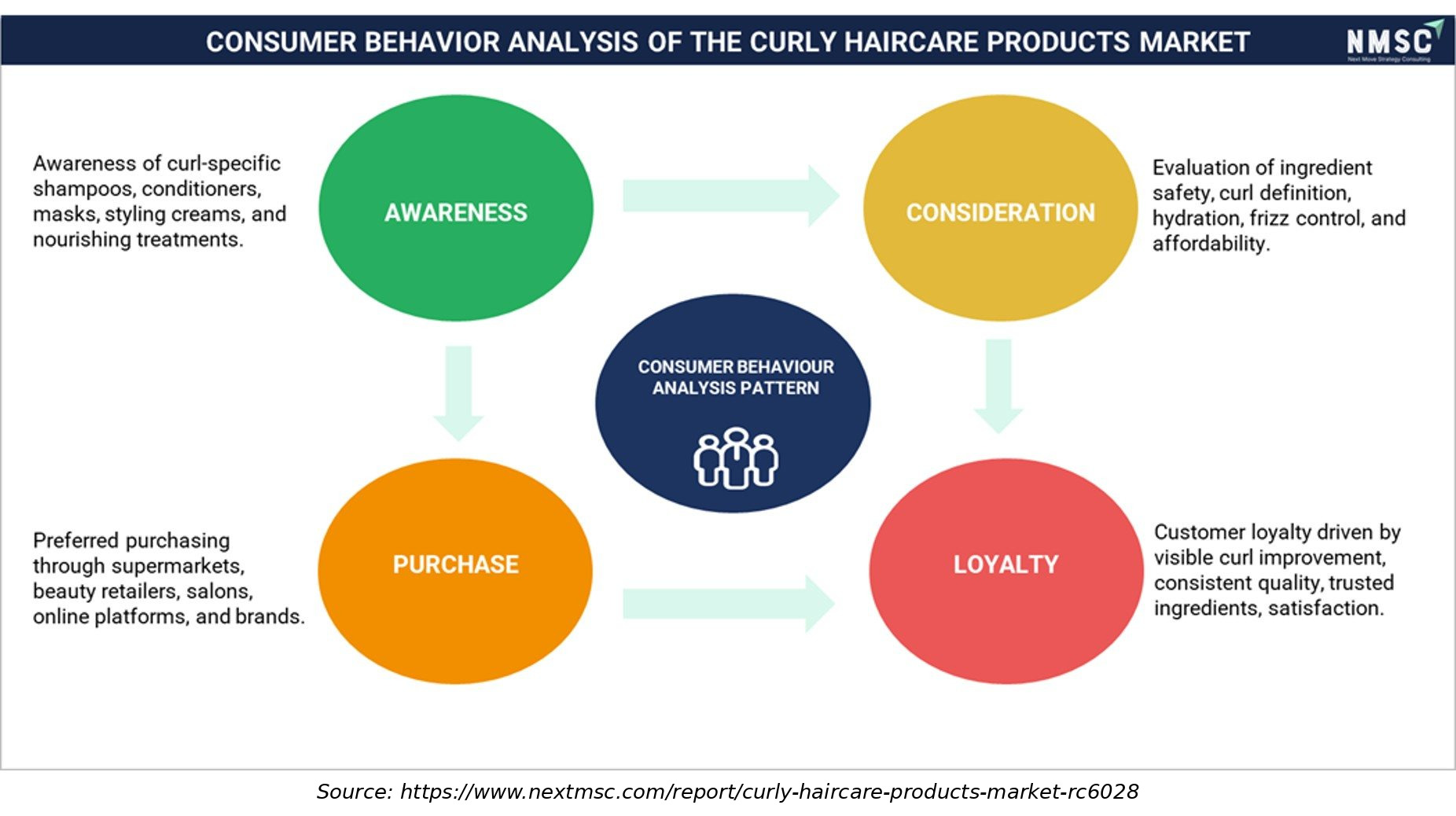
The figure illustrates the consumer behavior journey in the curly haircare products market. Consumers first gain awareness through curl-specific shampoos, conditioners, masks, styling creams, and nourishing treatments. During the consideration stage, they evaluate ingredient safety, curl definition, hydration, frizz control, and affordability. They then purchase through supermarkets, salons, beauty retailers, online platforms, or brand stores. Positive product performance and trusted formulations foster loyalty, encouraging repeat purchases and long-term brand preference.

Market Drivers & Dynamics

Interactive Dataset
Rising natural and textured hair movement adoption driver +2.0% North America, Europe 2026–2035
Expanding retail distribution into mainstream channels driver +1.6% Global 2026–2035
Growing men's and children's curly haircare demand driver +1.2% North America 2026–2035
Rising direct-to-consumer and e-commerce adoption driver +1.0% Global 2026–2035
Expanding Asia-Pacific and Middle East & Africa awareness driver +0.8% Asia-Pacific, Middle East & Africa 2026–2035
Growing prestige-tier treatment product innovation driver +0.6% Global 2026–2032
Ingredient and pricing competition from mass-market entrants restraint −1.0% Global 2026–2035
Cosmetic ingredient disclosure and labeling regulations restraint −0.6% North America, Europe 2026–2032
Brand fragmentation across independent and conglomerate labels restraint −0.4% Global 2026–2032
Source: Next Move Strategy Consulting

Growth Drivers

What Is the Primary Growth Driver of the Curly Haircare Products Market?

Rising natural and textured hair movement adoption is the primary driver of the market. We observed that consumer adoption of textured-haircare routines, reinforced by expanding mainstream retail distribution, continues to support demand for curl-specific conditioner and styling categories. We observed that this adoption pattern, reinforced by expanding mainstream retail distribution, continues to anchor baseline demand for conditioner and styler categories across developed and emerging economies alike.

How Is Retail Distribution Expansion Driving Market Growth?

Expanding mainstream retail distribution is accelerating market growth as textured-hair brands secure shelf placement beyond specialty and independent beauty channels. U.S. Food and Drug Administration cosmetic labeling frameworks support consistent ingredient disclosure that underpins retailer confidence in category expansion. Our assessment indicates that national retail rollouts, exemplified by Mielle Organics reaching more than 100,000 global store locations, are compressing time-to-shelf for emerging textured-hair product lines.

Growth Inhibitors

What Is Restraining Curly Haircare Products Market Expansion?

Ingredient and pricing competition from mass-market entrants restrains premium and prestige-tier brand differentiation as larger conglomerates introduce lower-priced textured-hair lines. Industry reporting indicates that established Black-owned brands such as SheaMoisture and Carol's Daughter faced significant competitive pressure following conglomerate acquisitions in prior years. We found that brand fragmentation across independent and conglomerate-owned labels continues to complicate consumer navigation, though founder-led brand relaunches are gradually restoring differentiated positioning.

Segmentation Analysis

2025 (USD Billion)
2035 (USD Billion)
Conditioner 2025: $3.51 Billion | 2035: $6.39 Billion
Conditioner
Styler 2025: $3.23 Billion | 2035: $6.39 Billion
Styler
Cleanser 2025: $2.64 Billion | 2035: $4.87 Billion
Cleanser
Treatment 2025: $2.05 Billion | 2035: $5.78 Billion
Treatment
Refresh and Protection 2025: $1.76 Billion | 2035: $3.95 Billion
Refresh and
Tools and Accessories 2025: $1.47 Billion | 2035: $3.04 Billion
Tools and Ac
Conditioner $3.51 Billion $6.39 Billion 6.0%
Styler $3.23 Billion $6.39 Billion 7.0%
Cleanser $2.64 Billion $4.87 Billion 6.2%
Treatment $2.05 Billion $5.78 Billion 11.3%
Refresh and Protection $1.76 Billion $3.95 Billion 8.5%
Tools and Accessories $1.47 Billion $3.04 Billion 7.6%

Which Product Category Segment Dominates the Curly Haircare Products Market?

Conditioner led the market with USD 3.51 billion in 2025, supported by its role as a high-frequency, repeat-purchase staple across every hair pattern and price tier. We observed that Treatment is the fastest-growing product category, expanding at an 11.3% CAGR from 2026 to 2035, as consumers increasingly add scalp, bond repair, and protein treatments to address specific textured-hair health concerns beyond basic cleansing and conditioning.

2025 (USD Billion)
2035 (USD Billion)
Wavy
Curly
Coily
Multi-textur
Other hair p
Segment Item 2025 (USD Billion) 2035 (USD Billion) CAGR
Wavy $10.0 USD Billion $40.0 USD Billion 25.0%
Curly $17.1 USD Billion $51.1 USD Billion 11.0%
Coily $24.2 USD Billion $62.2 USD Billion 25.0%
Multi-texture $31.3 USD Billion $73.3 USD Billion 11.0%
Other hair pattern $38.4 USD Billion $84.4 USD Billion 16.0%

Segment-wise data is locked

Unlock complete segment-wise numbers for By Hair Pattern.

Unlock Full Data

Which Hair Pattern Segment Leads Market Demand?

Curly hair pattern products remained the leading category within the market, valued at USD 5.58 billion in 2025 on sustained demand for curl-defining conditioners and stylers. Our findings suggest that Coily is the fastest-growing hair pattern, registering a 10.5% CAGR from 2026 to 2035, as brands increasingly formulate dedicated moisture-retention and definition products addressing the specific structural needs of tightly coiled hair textures.

2025 (USD Billion)
2035 (USD Billion)
Mass
Masstige
Premium
Prestige
Professional
Segment Item 2025 (USD Billion) 2035 (USD Billion) CAGR
Mass $10.0 USD Billion $40.0 USD Billion 14.0%
Masstige $17.1 USD Billion $51.1 USD Billion 24.0%
Premium $24.2 USD Billion $62.2 USD Billion 22.0%
Prestige $31.3 USD Billion $73.3 USD Billion 12.0%
Professional $38.4 USD Billion $84.4 USD Billion 27.0%

Segment-wise data is locked

Unlock complete segment-wise numbers for By Price Tier.

Unlock Full Data
2025 (USD Billion)
2035 (USD Billion)
Mass retail
Beauty speci
Professional
Direct-to-co
Third-party
Segment Item 2025 (USD Billion) 2035 (USD Billion) CAGR
Mass retail $10.0 USD Billion $40.0 USD Billion 27.0%
Beauty specialty retail $17.1 USD Billion $51.1 USD Billion 9.0%
Professional salon $24.2 USD Billion $62.2 USD Billion 19.0%
Direct-to-consumer $31.3 USD Billion $73.3 USD Billion 17.0%
Third-party e-commerce $38.4 USD Billion $84.4 USD Billion 18.0%

Segment-wise data is locked

Unlock complete segment-wise numbers for By Distribution Channel.

Unlock Full Data

Which Distribution Channel Is Most Widely Adopted?

Mass Retail remained the dominant distribution channel across the market, reaching USD 4.69 billion in 2025 due to broad national footprint and accessible pricing across grocery and drugstore formats. Based on research conducted by Next Move Strategy Consulting, we found that Third-Party E-Commerce represents the fastest-growing channel at a 13.2% CAGR from 2026 to 2035, reflecting consumers' preference for expansive product discovery and review-driven purchase decisions across online marketplaces.

2025 (USD Billion)
2035 (USD Billion)
Women
Men
Children
Unisex
Segment Item 2025 (USD Billion) 2035 (USD Billion) CAGR
Women $10.0 USD Billion $40.0 USD Billion 24.0%
Men $17.1 USD Billion $51.1 USD Billion 22.0%
Children $24.2 USD Billion $62.2 USD Billion 20.0%
Unisex $31.3 USD Billion $73.3 USD Billion 22.0%

Segment-wise data is locked

Unlock complete segment-wise numbers for By End User.

Unlock Full Data

Growth Opportunities

Our analysis shows that three forward-looking opportunities stand out for stakeholders positioning within the curly haircare products market over the 2026–2035 forecast period.

How Can Prestige-Tier Treatments Unlock Value in Textured Hair Health?

Prestige-tier bond repair and scalp treatment products present a whitespace opportunity for brands seeking to capture consumers prioritizing hair health over basic styling. Suppliers that scale clinically substantiated treatment formulations stand to capture premium pricing as textured-hair consumers increasingly view treatment as essential rather than optional.

Where Does Men's Curly Haircare Create New Demand?

Men's grooming routines increasingly incorporating curl-specific products represent an underpenetrated opportunity for brands developing dedicated men's textured-hair lines. Manufacturers that secure distribution partnerships with men's grooming retailers can capture recurring volume as awareness of curl-specific care extends beyond traditionally women-focused marketing.

How Can Asia-Pacific Market Entry Benefit Regional Brands?

Asia-Pacific urban markets with growing textured-hair populations create an opportunity for brands adapting formulations and marketing to regional hair-texture diversity. Early movers that localize product development for India, China, and the Philippines can differentiate ahead of multinational competitors scaling distribution across the region's underserved textured-hair consumer base.

PRICE POINT ANALYSIS OF THE CURLY HAIRCARE PRODUCTS MARKET

PRICE POINT ANALYSIS OF THE CURLY HAIRCARE PRODUCTS MARKET
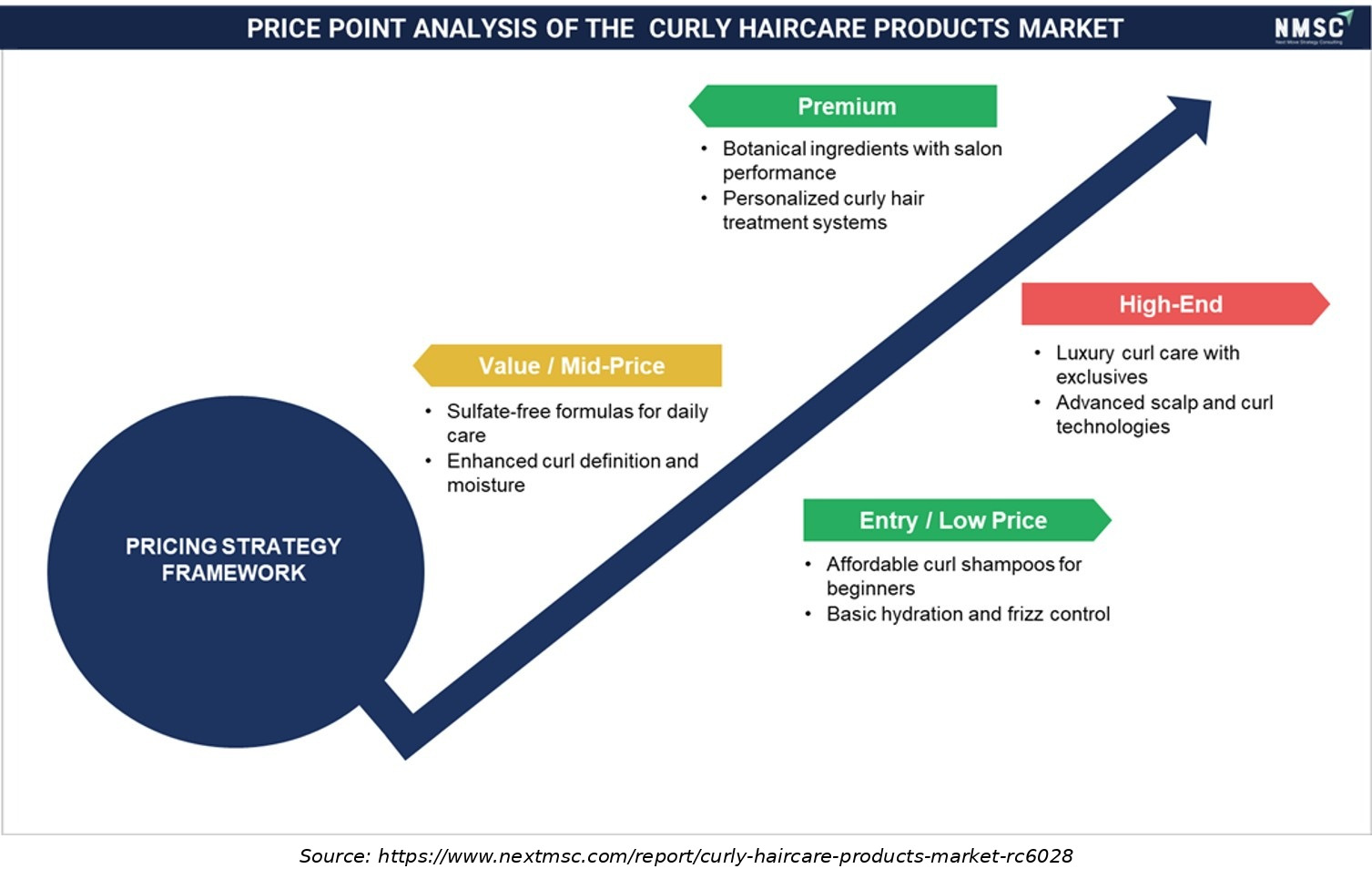
The figure illustrates the pricing strategy framework for the curly haircare products market across four price tiers. Entry/Low Price products emphasize affordability and essential hydration, while Value/Mid-Price offerings provide sulfate-free formulations with enhanced curl definition and moisture. Premium products feature botanical ingredients and personalized treatment systems, whereas High-End offerings focus on luxury formulations, exclusive ingredients, and advanced scalp and curl care technologies for discerning consumers.

Regional Outlook

2025 (USD Billion)
2035 (USD Billion)
North Americ
Europe
Asia-Pacific
Middle East
Latin Americ
Region 2025 (USD Billion) 2035 (USD Billion) CAGR (%)
North America $10.0 USD Billion $40.0 USD Billion 9.0%
Europe $17.1 USD Billion $51.1 USD Billion 27.0%
Asia-Pacific $24.2 USD Billion $62.2 USD Billion 25.0%
Middle East & Africa $31.3 USD Billion $73.3 USD Billion 23.0%
Latin America $38.4 USD Billion $84.4 USD Billion 12.0%

Regional data is locked

Unlock complete regional numbers for this market.

Unlock Full Data

Competitive Landscape

We observed that the curly haircare products market features a moderately fragmented competitive landscape, with founder-led independent brands competing alongside conglomerate-backed labels on formulation credibility, community engagement, and distribution scale.

Dimension Description
Market Structure Moderately fragmented; a mix of independent founder-led brands and conglomerate-owned labels compete for retail shelf placement, with numerous specialty brands serving niche hair-pattern and price-tier segments.
Innovation Focus Specialized botanical ingredient formulation, curl-pattern diagnostic tools, and direct-to-consumer community platforms dominate current innovation pipelines across leading brands.
M&A Activity Selective brand reclamation and independence, exemplified by Carol's Daughter founder Lisa Price reclaiming ownership in April 2025 and relaunching direct-to-consumer distribution in November 2025.

How Do Companies Compete in the Curly Haircare Products Market?

Companies compete primarily on formulation credibility, community authenticity, and distribution reach across the industry. Established brands such as Mielle Organics LLC leverage broad retail partnerships and ingredient-story marketing to serve mainstream consumers, while independent labels such as Bouclème Ltd and Jessicurl LLC compete on niche formulation expertise and direct-to-consumer community relationships within specific hair-pattern segments.

Which Competitive Archetypes Dominate the Curly Haircare Products Market?

Two archetypes dominate the market: scaled brands with broad multi-channel retail distribution and mainstream marketing reach, and independent founder-led labels focused on community authenticity and specialized formulation. Mielle Organics LLC exemplifies the scaled archetype through its presence in more than 100,000 stores globally, while Carol's Daughter LLC exemplifies the independence archetype through its 2025 reclamation of founder-led, community-centered ownership.

How Are Companies Differentiating Through Innovation in Curly Haircare?

Innovation and differentiation strategy increasingly center on distinctive ingredient sourcing and community-driven digital platforms. Mielle Organics' formulations featuring sea moss and tulsi and Carol's Daughter's planned Lisa's Love List curation platform both illustrate how brands extend differentiation beyond product performance into ingredient storytelling and community investment. Our analysis shows that brands unable to demonstrate authentic community connection risk losing loyal consumers to more culturally resonant competitors.

What M&A and Expansion Activity Is Shaping the Curly Haircare Products Market?

Brand ownership restructuring continues to reshape competitive positioning within the industry. Lisa Price's reclamation of Carol's Daughter from conglomerate ownership in April 2025, followed by its direct-to-consumer platform relaunch in November 2025, illustrates a broader pattern of founder-led brands regaining independence after years under large beauty conglomerate structures, reversing the acquisition wave that characterized the prior decade.

Key Market Players

Our assessment indicates that the following 20 companies are actively shaping product innovation, distribution strategy, and brand positioning within the global curly haircare products market.

Sundial Brands LLC Mielle Organics LLC Deva Concepts LLC PDC Beauty Option TopCo Inc. Recipe Products Ltd Carol's Daughter LLC OuidadLicensing LLC Pattern Beauty LLC Avlon Industries Inc. Camille Rose LLC Thank God It's Natural LLC House of Cheatham LLC McBride Research Laboratories Inc. Curls LLC Kinky-Curly Beauty Products LLC Bouclème Ltd Bread Beauty Supply Pty Ltd Jessicurl LLC Mixed Chicks LLC Miss Jessie's LLC

Latest Developments

We found that recent brand ownership changes and retail expansions within the curly haircare products market are concentrated on founder-led independence and mainstream distribution growth, reflecting the industry's structural shift.

Date Event
January 2025 Mielle Organics launched the Kalahari Melon & Aloe Vera Collection, expanding its textured-haircare portfolio with products designed for curly, coily and heat-styled hair. The collection focuses on deep hydration and long-lasting moisture retention for up to five days, while its Curl Forming Glaze helps define curls, add shine and provide a moisturizing hold.

Expert Insights

Julian Addo

Julian Addo

Founder & CEO | Adwoa Beauty

"Textured hair formulations need to have high moisture for softening and shine and also slip for detangling purposes. It is important to me that our ingredients continue to be used at every step of your wash day."

Analyst Interpretation

The statement highlights the growing consumer demand for comprehensive curl-care routines rather than standalone products. As consumers increasingly prioritize hydration, detangling, curl definition, and long-term hair health, manufacturers are expanding multi-step product portfolios that include cleansers, conditioners, leave-in treatments, masks, stylers, and refresh products. This trend is accelerating innovation in moisture-rich, ingredient-focused formulations specifically designed for curly, coily, and textured hair, supporting premiumization and sustained growth in the global curly haircare products market.

Investment Opportunities

What Capital Inflows Are Targeting the Curly Haircare Products Market?

Capital inflows into the curly haircare products market are increasingly directed toward founder-led brand buybacks and direct-to-consumer platform investment rather than pure conglomerate consolidation. Lisa Price's reclamation of Carol's Daughter illustrates this trend toward independence-focused capital structures. We observed that investors favor brands demonstrating validated community loyalty as a proxy for long-term direct-to-consumer revenue retention.

How Is Infrastructure Investment Supporting Curly Haircare Products Distribution?

Infrastructure investment is expanding e-commerce fulfillment and retail distribution capacity across North America, Europe, and Asia-Pacific to serve rising textured-hair demand. Our findings suggest that brands are investing in direct-to-consumer digital platforms, exemplified by Carol's Daughter's November 2025 relaunch, to compress the distance between formulation innovation and community-driven consumer feedback, supporting the responsiveness required for prestige and treatment category growth.

What ESG Considerations Are Shaping Curly Haircare Products Investment Decisions?

Environmental, social, and governance considerations are increasingly relevant to investment decisions across the industry, with diverse ownership and community investment as key criteria. Carol's Daughter's planned Lisa's Love List platform, spotlighting other Black- and Brown-owned beauty brands, illustrates this governance-linked community investment trend. We found that investors increasingly favor brands with transparent, founder-diverse ownership structures, treating cultural authenticity as a governance indicator alongside formulation transparency.

Key Benefits for Stakeholders

How Does This Report Benefit Enterprise and Industry Leaders?

Enterprise and industry leaders gain access to validated segmentation, competitive benchmarking, and regional demand forecasts that support product-development and distribution decisions across the curly haircare products industry. Our analysis shows that detailed product category, hair pattern, and distribution channel breakdowns help brand and category teams align formulation priorities with treatment and e-commerce growth categories.

How Does This Report Benefit Investors and Financial Analysts?

Investors and financial analysts benefit from consistent, single-point market size and CAGR estimates that support valuation and capital-allocation decisions across the curly haircare products supply chain. We observed that the report's regional and segment-level growth differentials help identify which brands are best positioned to capture above-market growth in Asia-Pacific and prestige-tier categories through 2035.

How Does This Report Benefit Technology Vendors and Product Teams?

Technology vendors and product teams gain insight into emerging formulation and distribution requirements, including curl-pattern diagnostics, direct-to-consumer platform capability, and community-driven marketing tools, that are reshaping the industry. Our findings suggest that this analysis helps R&D teams prioritize development roadmaps around treatment innovation and personalization technology increasingly demanded by textured-hair consumers.

Key Market Segments Evaluated

By Product Category

  • Conditioner
  • Styler
  • Cleanser
  • Treatment
  • Refresh and Protection
  • Tools and Accessories

By Hair Pattern

  • Curly
  • Wavy
  • Coily
  • Multi-Texture
  • Other Hair Pattern

By Price Tier

  • Mass
  • Masstige
  • Premium
  • Prestige
  • Professional

By Distribution Channel

  • Mass Retail
  • Beauty Specialty Retail
  • Professional Salon
  • Direct-to-Consumer
  • Third-Party E-Commerce
  • Other Channel

By End User

  • Women
  • Men
  • Children
  • Unisex

Conclusion & Recommendations

The long-term outlook for the market remains positive, with global revenue projected to more than double from USD 14.66 billion in 2025 to USD 30.42 billion by 2035 at a 7.6% CAGR. We observed that sustained natural hair movement adoption, treatment category expansion, and brand independence trends will continue underpinning demand across product categories through the forecast period.

What Strategic Positioning Should Curly Haircare Products Suppliers Pursue?

Suppliers should prioritize treatment innovation and direct-to-consumer platform investment while pursuing community-centered brand positioning to secure long-term consumer loyalty. Our assessment indicates that brands investing early in coily hair pattern formulations and prestige-tier treatments, alongside authentic community engagement, will be best positioned to capture premium pricing within the curly haircare products market.

How Attractive Is the Curly Haircare Products Market for New Investment?

The curly haircare products industry presents an attractive investment case, supported by a USD 14.69 billion absolute dollar opportunity between 2026 and 2035 and above-average growth in Asia-Pacific and men's end-user categories. We found that investment attractiveness is highest for brands combining formulation credibility with direct-to-consumer distribution capability across mass and prestige price tiers.

What Market Shifts and Key Risks Should Stakeholders Monitor?

Stakeholders should monitor mass-market pricing competition, cosmetic labeling regulations, and brand fragmentation as key risks to the curly haircare products market. Our analysis shows that brands unable to adapt to community-authentic positioning expectations risk losing loyal consumers to competitors with stronger cultural credibility, particularly within North America's increasingly independence-focused retail environment.

What Are the Key Growth Pathways for the Curly Haircare Products Market?

Key growth pathways include expanding treatment product portfolios, scaling direct-to-consumer and third-party e-commerce distribution, and deepening penetration into Asia-Pacific and men's end-user channels. Next Move Strategy Consulting's analysis indicates that brands pursuing these pathways while maintaining cost competitiveness in core conditioner and cleanser categories will be best positioned to capture the curly haircare products market's projected growth through 2035.

FAQs

About the Author

Liza Phukan

Liza Phukan

Liza Phukan is Research Associate at Next Move Strategy Consulting, where she has covered emerging industries and market research across sectors for 3.5 years. Her work includes analyzing industry developments, validating market data, and developing structured business content from research findings. She uses secondary research and data-validation practices to turn complex market information into clear decision-useful market analysis for business audiences and support report development and B2B.

About the Reviewer

Supradip Baul

Supradip Baul

Supradip Baul is an accomplished business consultant and strategist with over a decade of rich experience in market intelligence, strategy, technology, and business transformation. His work has included rigorous qualitative and quantitative analysis across multiple industries, helping clients shape investment decisions and long-term roadmaps. Earlier in his career, he was associated with Gartner, where he contributed to industry-leading reports and market share analyses. He has worked with leading global companies and holds an MBA with a dual specialization in Marketing and Finance.

Download Free Sample

Semih Kavaklioglu

SEMIH KAVAKLIOGLU

Co-Founder & Sales Manager

Decortie

I work a lot in the marketing industry and I know that research is an essential part of any campaign. I have used Market research reports for my own products and I found them to be very informative and well-researched. The team here produces insightful reports for a good price

Gustaf Hummel Burstrom

GUSTAF HUMMEL BURSTROM

Founder

Revline Tools AB

Joseph and the team at Next Move Strategy Consulting have been excellent to work with, in supplying us with relevant market data and forecasts for our specific category. We had some special requirements and they were able to do a custom package to suit our needs. We would definitely recommend them to any other company needing market data and forecasts

Robert Sean Trevino

ROBERT SEAN TREVINO

Sr. Director, Head of Strategic Insights & Analytics

Foundation Medicine

I realized that it was a reliable source of information. These days, there are many people who are looking for authentic data, and this is one of the only sources that can offer them with what they need;

Kishu Kanda

KISHU KANDA

Strategy Analyst

Accenture

We purchased the AI Consumer Market Report from this company. Not only did they customize the report to meet our specific requirements, but they also showed great flexibility in accommodating our budget. The report we received fully met our expectations. Additionally, they provided prompt and thorough responses to both our pre-purchase and follow-up questions. We look forward to working with this company again in the future.

Melanie Samko

MELANIE SAMKO

Director of Marketing

TOSOH BIOSCIENCE, INC.

The information provided by NMSC is incredibly valuable, thank you so much for such a excellent work. I really appreciate it. I will make sure to reference all of it, in my summary document.

Custom Market Research Services

We will customize the research for you if the listed report does not fully match your requirements.

Get 30% Free Customization

Select License

This website uses cookies to ensure you get the best experience on our website. Learn more

✖