Ethernet SSDs Market Global Industry Analysis and Forecast (2026-2035)

Ethernet SSDs Market size was USD 545.0 million in 2026, projected to reach USD 4,684.1 million by 2035, growing at a CAGR of 27.0% from 2026 to 2035. Key drivers include rising AI data center storage disaggregation demand, expanding hyperscale cloud capacity investment, and growing high-bandwidth Ethernet fabric deployment, with North America leading the market.

Download Free Sample PDF
Base Year (2025)
$420.0 Million
Forecast (2035)
$4,684.1 Million
CAGR (2026-2035)
27.0%
Top Region
North America

What Is the Ethernet SSDs Market Size?

The global Ethernet SSDs market size was valued at USD 420.0 million in 2025 and is estimated at USD 545.0 million in 2026, forecast to reach USD 4,684.1 million by 2035, expanding at a 27.0% CAGR between 2026 and 2035. North America leads with approximately 54% share, while Ethernet SSD Drives dominate all other product types with approximately 62% share.

We observed that growth is broad-based across every segmentation axis, with 100GbE and above connectivity and software-defined storage platforms driving the dominant structural shifts through 2035.

Ethernet SSDs Market Global Industry Analysis and Forecast (2026-2035) Revenue Forecast

Values in USD Million

2025 $420.0 Million
2025
2026 $545.0 Million
2026
2027 $692.2 Million
2027
2028 $879.0 Million
2028
2029 $1,116.4 Million
2029
2030 $1,417.8 Million
2030
2031 $1,800.6 Million
2031
2032 $2,286.8 Million
2032
2033 $2,904.2 Million
2033
2034 $3,688.3 Million
2034
2035 $4,684.1 Million
2035

Key Takeaways

By Product Type: Ethernet SSD Drives held the largest share of approximately 62% (USD 260.4 million) in 2025; Software-Defined Storage Platforms is the fastest-growing sub-segment at 37.9% CAGR from 2026–2035.

By Ethernet Speed: 25GbE held the largest share of approximately 38% (USD 159.6 million) in 2025; 200GbE and Above is the fastest-growing sub-segment at 48.1% CAGR from 2026–2035.

By Storage Capacity: 15–30 TB held the largest share of approximately 48% (USD 201.6 million) in 2025; Above 30 TB is the fastest-growing sub-segment at 34.2% CAGR from 2026–2035.

By NAND Type: TLC NAND held the largest share of approximately 64% (USD 268.8 million) in 2025; QLC NAND is the fastest-growing sub-segment at 32.5% CAGR from 2026–2035.

By Deployment Model: Disaggregated Storage Architecture held the largest share of approximately 68% (USD 285.6 million) in 2025; Direct-Attached Ethernet Storage is the fastest-growing sub-segment at 29.4% CAGR from 2026–2035.

By Application: Cloud Data Centers held the largest share of approximately 52% (USD 218.4 million) in 2025; Telecommunications is the fastest-growing sub-segment at 34.4% CAGR from 2026–2035.

By End User: Hyperscale Cloud Providers held the largest share of approximately 58% (USD 243.6 million) in 2025; Telecom Operators is the fastest-growing sub-segment at 33.8% CAGR from 2026–2035.

Dominant Region: North America dominated with approximately 54% revenue share (USD 226.8 million) in 2025.

Fastest-Growing Region: Asia-Pacific is expected to register the highest CAGR of 31.6% during 2026–2035.

Dominant Country: U.S. led with approximately USD 204.1 million in 2025.

Fastest-Growing Country: India is the fastest-growing country at approximately 33.8% CAGR from 2026–2035.

Market Opportunity: The Ethernet SSDs market is expected to create an absolute dollar opportunity of USD 4,139.1 million between 2026 and 2035, presenting significant investment potential across software-defined storage orchestration and 100GbE-and-above Ethernet SSD drive production.

According to Next Move Strategy Consulting analysis, hyperscale cloud operators are increasingly piloting Ethernet-attached storage architectures to eliminate the cost and power overhead of traditional CPU-controlled JBOF enclosures, a shift that favors SSD manufacturers and controller developers with proven NVMe-oF interoperability over conventional PCIe-attached drive suppliers as AI-driven storage disaggregation accelerates through 2035.

Parameter | Details

Market Size in 2025 | USD 420.0 Million

Market Size in 2026 | USD 545.0 Million

Revenue Forecast in 2035 | USD 4,684.1 Million

Growth Rate | CAGR of 27.0% from 2026 to 2035

Analysis Period | 2025–2035

Base Year Considered | 2025

Forecast Period | 2026–2035

Market Size Estimation | USD Million

Companies Profiled | 19

Countries Covered | 33

Market Share | Available for Top 10 Companies

What Does the Ethernet SSDs Market Encompass?

The market encompasses solid-state drives natively attached to Ethernet fabric using NVMe over Fabrics protocol, alongside Ethernet Bunch of Flash enclosure systems and software-defined orchestration platforms that manage disaggregated flash storage. Our assessment indicates that the scope spans drives, enclosures, and management software sold to hyperscale cloud, enterprise, and telecommunications customers seeking to decouple storage capacity from compute nodes. The category has evolved from early sampling programs first demonstrated in 2020 into commercially available, NVIDIA GPUDirect Storage-certified products deployed within artificial intelligence and high performance computing infrastructure.
Industry interoperability standards maintained by NVM Express, Inc. and the Storage Networking Industry Association shape protocol compliance and product certification across the ecosystem. We observed that technology adoption is shifting from 25 gigabit Ethernet connections toward 100 gigabit and above configurations as data center fabric bandwidth scales to meet artificial intelligence workload demands. Next Move Strategy Consulting's analysis indicates that this structural shift, combined with rising hyperscaler interest in storage-compute disaggregation, is redefining data center architecture decisions across the Ethernet SSDs market.

SUPPLY CHAIN STRUCTURE OF THE ETHERNET SSDS MARKET

SUPPLY CHAIN STRUCTURE OF THE ETHERNET SSDS MARKET
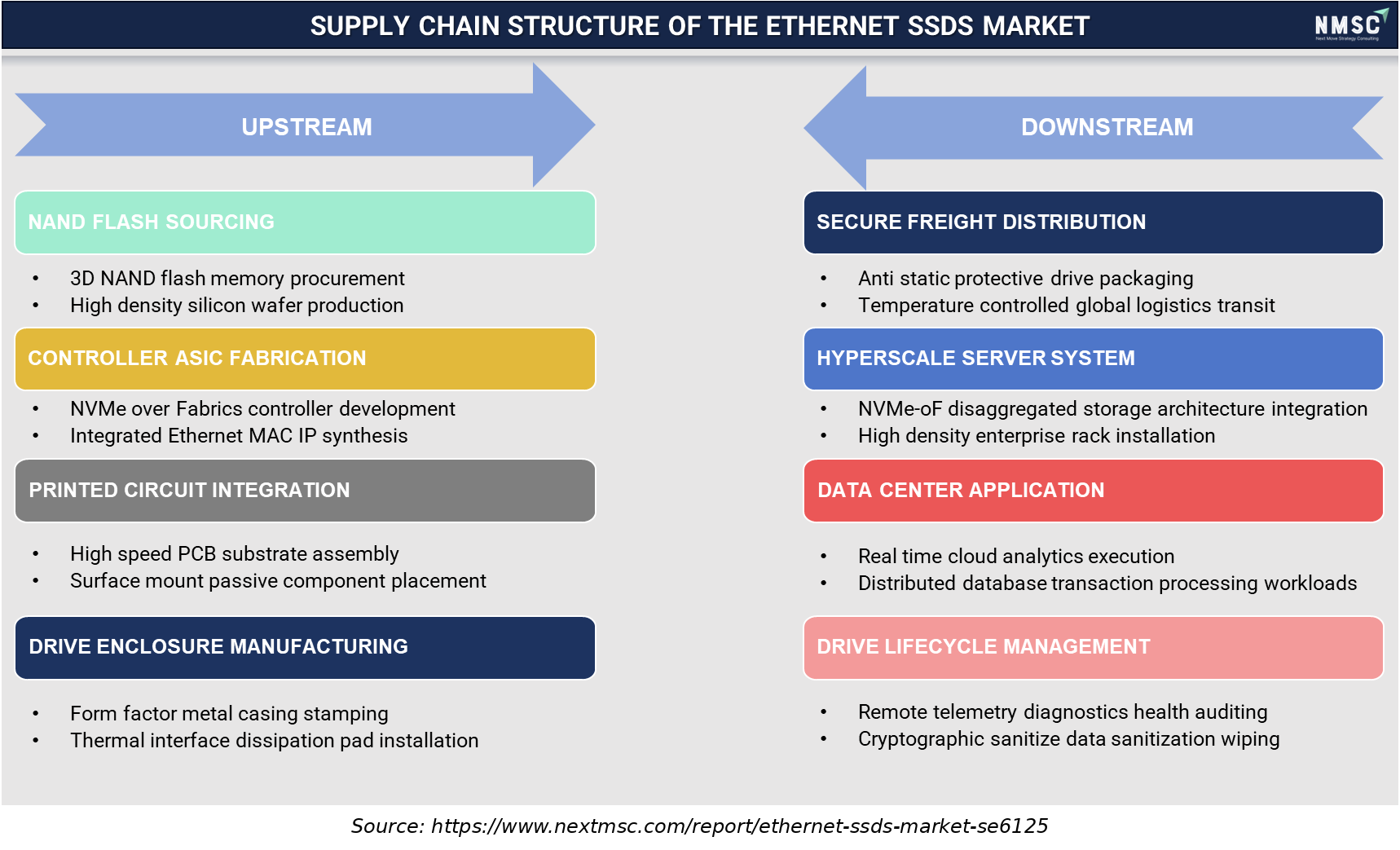
The supply chain structure of the market spans upstream activities such as 3D NAND flash sourcing, NVMe-oF controller development, PCB integration, and drive enclosure manufacturing. Downstream operations include secure freight distribution, hyperscale server integration, data center applications, and drive lifecycle management. This interconnected ecosystem supports the production, deployment, security, performance optimization, and long-term management of Ethernet-based SSD storage solutions.

Market Drivers & Dynamics

Interactive Dataset
Rising AI data center storage disaggregation demand driver +5.8% North America, Global 2026–2035
Expanding hyperscale cloud capacity investment driver +4.6% North America, Asia-Pacific 2026–2035
Growing high-bandwidth Ethernet fabric deployment driver +3.9% Global 2026–2032
Rising NVMe-oF interoperability certification adoption driver +3.1% North America, Europe 2026–2035
Expanding high performance computing infrastructure investment driver +2.6% Asia-Pacific, Europe 2026–2032
Growing telecommunications network edge storage demand driver +2.0% Asia-Pacific, Global 2026–2035
High component cost relative to conventional PCIe SSDs restraint −2.4% Latin America, MEA 2026–2032
Limited software ecosystem maturity for disaggregated storage restraint −1.8% Global 2026–2030
Early-stage vendor interoperability and standardization gaps restraint −1.3% Global 2026–2028
Source: Next Move Strategy Consulting

Growth Drivers

What Is the Primary Growth Driver of the Ethernet SSDs Market?

Rising AI data center storage disaggregation demand is the primary driver of the market. The U.S. Department of Energy continues to report accelerating data center electricity consumption tied to artificial intelligence workload expansion, reinforcing operator interest in power-efficient storage architectures that eliminate redundant CPU and DRAM components. We observed that this behavioral shift, reinforced by expanding GPU cluster deployments, continues to anchor baseline consumption of Ethernet-attached flash storage across hyperscale and enterprise data centers alike.

How Is Hyperscale Cloud Investment Driving Ethernet SSDs Market Growth?

Expanding hyperscale cloud capacity investment is accelerating market growth toward large-scale disaggregated storage deployment. Marvell Technology, Inc. announced a USD 250 million investment in India, expanding its Bangalore facility to drive next-generation artificial intelligence and data infrastructure technology development supporting Ethernet fabric silicon. Our assessment indicates that this expansion, combined with sustained hyperscaler capital expenditure growth, is compressing adoption timelines for Ethernet SSD architectures across North America and Asia-Pacific.

Growth Inhibitors

What Is Restraining Ethernet SSDs Market Expansion?

High component cost relative to conventional PCIe-attached SSDs restrains broader adoption among cost-sensitive enterprise data center operators. The U.S. Bureau of Labor Statistics continues to document elevated semiconductor component and specialized networking hardware costs that contribute to Ethernet SSD system pricing. We found that smaller regional datacenter operators face particular exposure, as limited procurement scale constrains their ability to justify the incremental cost of disaggregated Ethernet SSD architectures over established direct-attached storage.

What Are the Growth Opportunities?

How Can NVIDIA GPUDirect Certification Unlock AI Infrastructure Revenue?

GPUDirect Storage-certified Ethernet SSD portfolios present a whitespace opportunity for manufacturers seeking to serve artificial intelligence training and inference infrastructure. Vendors that secure formal certification stand to capture recurring contracts as hyperscale and high performance computing customers increasingly specify validated GPU-storage interoperability, particularly among cloud data center and research institution end users.

Where Does Telecom Edge Deployment Create Storage Whitespace?

Telecommunications edge computing infrastructure represents an underpenetrated opportunity for manufacturers offering compact, power-efficient Ethernet SSD configurations. Vendors that develop ruggedized, edge-optimized drives can secure long-term contracts, benefiting from expanding 5G network function virtualization investment among telecom operators pursuing distributed, low-latency storage architectures.

How Can Orchestration Software Partnerships Unlock Recurring Revenue?

Software-defined storage orchestration represents a substantial opportunity for vendors seeking to convert one-time hardware sales into recurring, subscription-based revenue. Early movers that secure deep integration partnerships with hyperscale cloud and enterprise IT customers can differentiate with high-margin management software layered atop commoditizing Ethernet SSD hardware.

Segmentation Analysis

2025 (USD Million)
2035 (USD Million)
Ethernet SSD Drives 2025: $260.4 Million | 2035: $2,623.1 Million
Ethernet SSD
EBOF Enclosure Systems 2025: $117.6 Million | 2035: $1,077.3 Million
EBOF Enclosu
Software-Defined Storage Platforms 2025: $42.0 Million | 2035: $983.7 Million
Software-Def
Ethernet SSD Drives $260.4 Million $2,623.1 Million 25.6%
EBOF Enclosure Systems $117.6 Million $1,077.3 Million 24.3%
Software-Defined Storage Platforms $42.0 Million $983.7 Million 37.9%

Which Product Type Segment Dominates the Ethernet SSDs Market?

Ethernet SSD Drives led the market with USD 260.4 million in 2025, supported by their role as the foundational hardware component within every disaggregated storage deployment regardless of enclosure or software configuration. We observed that Software-Defined Storage Platforms is the fastest-growing product type, expanding at a 37.9% CAGR from 2026 to 2035, as data center operators increasingly prioritize orchestration software to manage fleets of independently addressable network-attached drives.

2025 (USD Million)
2035 (USD Million)
25GbE
50GbE
100GbE
200GbE and A
Segment Item 2025 (USD Million) 2035 (USD Million) CAGR
25GbE $10.0 USD Million $40.0 USD Million 25.0%
50GbE $17.1 USD Million $51.1 USD Million 11.0%
100GbE $24.2 USD Million $62.2 USD Million 25.0%
200GbE and Above $31.3 USD Million $73.3 USD Million 11.0%

Segment-wise data is locked

Unlock complete segment-wise numbers for By Ethernet Speed.

Unlock Full Data

Which Ethernet Speed Segment Leads Ethernet SSDs Market Adoption?
25GbE remained the leading Ethernet speed segment, valued at USD 159.6 million in 2025, reflecting its role as the original connection standard used in the earliest commercially available Ethernet SSD products. Based on research conducted by Next Move Strategy Consulting, we found that 200GbE and Above is the fastest-growing speed segment at a 48.1% CAGR from 2026 to 2035, as data center fabric upgrades accelerate to match artificial intelligence workload bandwidth requirements.

2025 (USD Million)
2035 (USD Million)
Up to 15 TB
15–30 TB
Above 30 TB
Segment Item 2025 (USD Million) 2035 (USD Million) CAGR
Up to 15 TB $10.0 USD Million $40.0 USD Million 27.0%
15–30 TB $17.1 USD Million $51.1 USD Million 9.0%
Above 30 TB $24.2 USD Million $62.2 USD Million 19.0%

Segment-wise data is locked

Unlock complete segment-wise numbers for By Storage Capacity.

Unlock Full Data
2025 (USD Million)
2035 (USD Million)
TLC NAND
QLC NAND
Segment Item 2025 (USD Million) 2035 (USD Million) CAGR
TLC NAND $10.0 USD Million $40.0 USD Million 14.0%
QLC NAND $17.1 USD Million $51.1 USD Million 24.0%

Segment-wise data is locked

Unlock complete segment-wise numbers for By NAND Type.

Unlock Full Data
2025 (USD Million)
2035 (USD Million)
Direct-Attac
Disaggregate
Segment Item 2025 (USD Million) 2035 (USD Million) CAGR
Direct-Attached Ethernet Storage $10.0 USD Million $40.0 USD Million 24.0%
Disaggregated Storage Architecture $17.1 USD Million $51.1 USD Million 22.0%

Segment-wise data is locked

Unlock complete segment-wise numbers for By Deployment Model.

Unlock Full Data
2025 (USD Million)
2035 (USD Million)
Cloud Data C
Enterprise D
High Perform
Telecommunic
Segment Item 2025 (USD Million) 2035 (USD Million) CAGR
Cloud Data Centers $10.0 USD Million $40.0 USD Million 23.0%
Enterprise Data Centers $17.1 USD Million $51.1 USD Million 9.0%
High Performance Computing $24.2 USD Million $62.2 USD Million 19.0%
Telecommunications $31.3 USD Million $73.3 USD Million 13.0%

Segment-wise data is locked

Unlock complete segment-wise numbers for By Application.

Unlock Full Data

Which Application Leads Ethernet SSDs Market Demand?

Cloud Data Centers remained the leading application, valued at USD 218.4 million in 2025, on the strength of hyperscale operators' early adoption of disaggregated storage architectures to support artificial intelligence training clusters. Our findings suggest that Telecommunications is the fastest-growing application, registering a 34.4% CAGR from 2026 to 2035, as network operators deploy Ethernet-attached flash storage to support edge computing and 5G network function virtualization workloads.

2025 (USD Million)
2035 (USD Million)
Hyperscale C
Enterprise I
Telecom Oper
Research and
Segment Item 2025 (USD Million) 2035 (USD Million) CAGR
Hyperscale Cloud Providers $10.0 USD Million $40.0 USD Million 21.0%
Enterprise IT $17.1 USD Million $51.1 USD Million 23.0%
Telecom Operators $24.2 USD Million $62.2 USD Million 25.0%
Research and Academic Institutions $31.3 USD Million $73.3 USD Million 15.0%

Segment-wise data is locked

Unlock complete segment-wise numbers for By End User.

Unlock Full Data

Growth Opportunities

Our analysis shows that three forward-looking opportunities stand out for stakeholders positioning within the Ethernet SSDs market over the 2026–2035 forecast period.

How Can NVIDIA GPUDirect Certification Unlock AI Infrastructure Revenue?

GPUDirect Storage-certified Ethernet SSD portfolios present a whitespace opportunity for manufacturers seeking to serve artificial intelligence training and inference infrastructure. Vendors that secure formal certification stand to capture recurring contracts as hyperscale and high performance computing customers increasingly specify validated GPU-storage interoperability, particularly among cloud data center and research institution end users.

Where Does Telecom Edge Deployment Create Storage Whitespace?

Telecommunications edge computing infrastructure represents an underpenetrated opportunity for manufacturers offering compact, power-efficient Ethernet SSD configurations. Vendors that develop ruggedized, edge-optimized drives can secure long-term contracts, benefiting from expanding 5G network function virtualization investment among telecom operators pursuing distributed, low-latency storage architectures.

How Can Orchestration Software Partnerships Unlock Recurring Revenue?

Software-defined storage orchestration represents a substantial opportunity for vendors seeking to convert one-time hardware sales into recurring, subscription-based revenue. Early movers that secure deep integration partnerships with hyperscale cloud and enterprise IT customers can differentiate with high-margin management software layered atop commoditizing Ethernet SSD hardware.

PORTER'S FIVE FORCES ANALYSIS OF THE ETHERNET SSDS MARKET

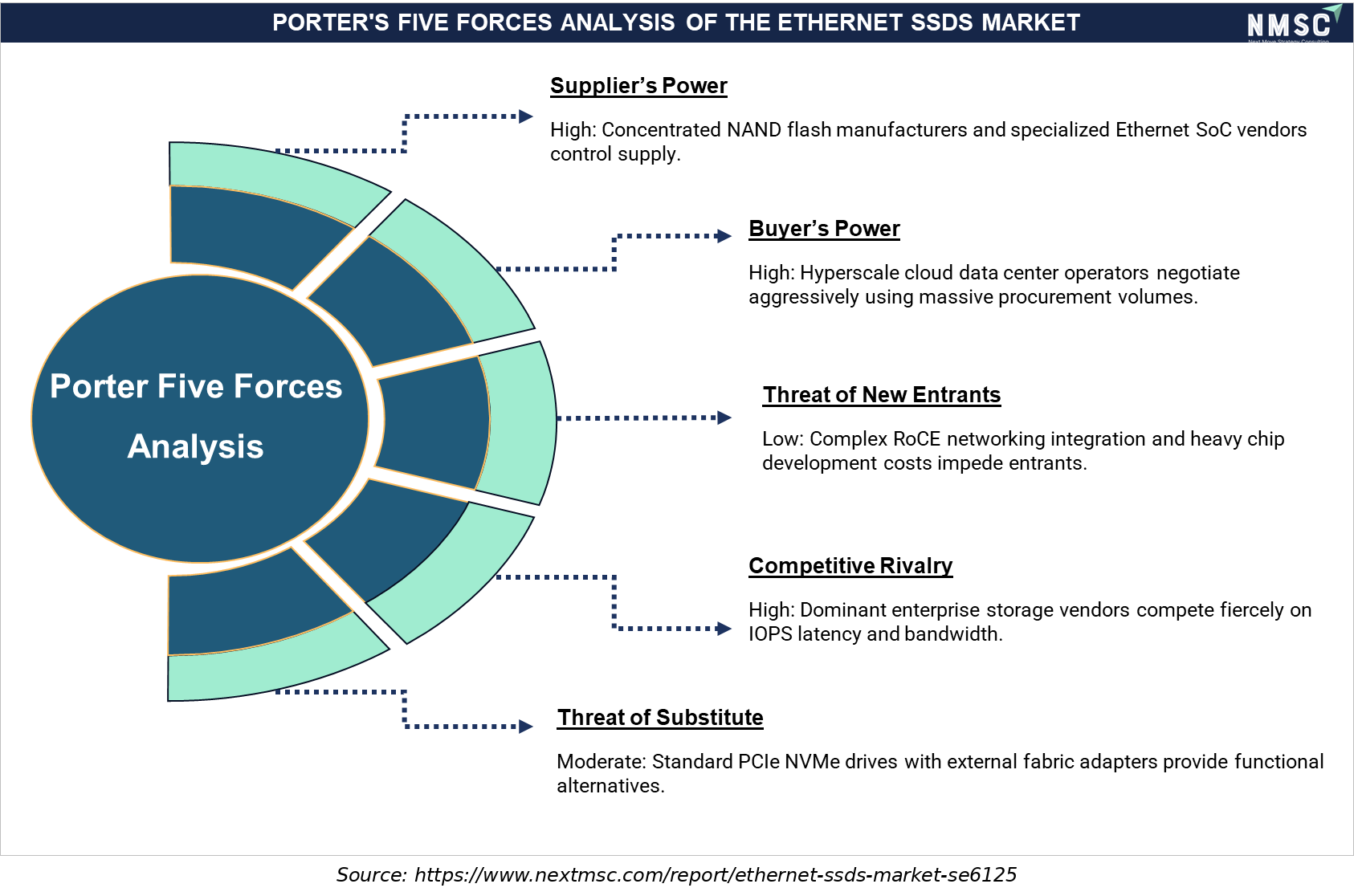
Porter’s Five Forces analysis of the market evaluates competitive rivalry, threat of new entrants, bargaining power of suppliers, bargaining power of buyers, and threat of substitutes. The market is shaped by established semiconductor and storage manufacturers, specialized NVMe-over-Fabrics technologies, high-performance infrastructure requirements, supplier concentration in NAND and controllers, and growing demand from hyperscale data centers and enterprise applications.

Regional Outlook

2025 (USD Million)
2035 (USD Million)
North Americ
Asia-Pacific
Europe
Middle East
Latin Americ
Region 2025 (USD Million) 2035 (USD Million) CAGR (%)
North America $10.0 USD Million $40.0 USD Million 9.0%
Asia-Pacific $17.1 USD Million $51.1 USD Million 27.0%
Europe $24.2 USD Million $62.2 USD Million 25.0%
Middle East & Africa $31.3 USD Million $73.3 USD Million 23.0%
Latin America $38.4 USD Million $84.4 USD Million 12.0%

Regional data is locked

Unlock complete regional numbers for this market.

Unlock Full Data

Competitive Landscape

We observed that the Ethernet SSDs market features a highly concentrated competitive landscape, with a small number of drive manufacturers, controller developers, and enclosure integrators collaborating closely across the industry's emerging ecosystem.

Dimension Description
Market Structure Highly concentrated; the top companies profiled in this report collectively account for a majority of global Ethernet SSDs revenue, reflecting the category's early-stage commercialization and limited supplier base.
Innovation Focus NVMe-oF interoperability certification, high-bandwidth Ethernet fabric integration, and software-defined orchestration dominate current innovation pipelines across leading companies.
M&A Activity Selective ecosystem partnership expansion, exemplified by continued multi-vendor collaboration between drive manufacturers, controller developers, and enclosure integrators to accelerate joint product certification.

How Do Companies Compete in the Ethernet SSDs Market?

Companies compete primarily on NVMe-oF interoperability certification, Ethernet bandwidth support, and ecosystem partnership depth across the industry. Drive manufacturers such as KIOXIA America, Inc. and Samsung Electronics Co., Ltd. leverage established enterprise SSD manufacturing scale to serve hyperscale customers, while controller developers such as Marvell Technology, Inc. and Broadcom Inc. compete on silicon performance and Ethernet fabric integration depth.

Which Competitive Archetypes Dominate the Ethernet SSDs Market?

Two archetypes dominate the market: established enterprise SSD manufacturers extending existing NAND flash portfolios into Ethernet-attached form factors, and specialized networking silicon and software vendors enabling the underlying fabric and orchestration layer. KIOXIA America, Inc. and Western Digital Corporation exemplify the manufacturer archetype through proven enterprise SSD production scale, while Marvell Technology, Inc. and Lightbits Labs Ltd. exemplify the enabling technology archetype serving controller and software-defined storage demand.

How Are Companies Differentiating Through Innovation in Ethernet SSDs?

Innovation and differentiation strategy increasingly center on certified GPU-storage interoperability and next-generation Ethernet bandwidth support. KIOXIA America, Inc.'s NVIDIA GPUDirect Storage-certified EM6 Series drives and Marvell Technology, Inc.'s 102.4 terabits-per-second switch silicon both extend certified performance credentials into AI infrastructure deployments. Our analysis shows that vendors unable to demonstrate credible interoperability certification risk exclusion from hyperscale procurement shortlists.

What M&A and Expansion Activity Is Shaping the Ethernet SSDs Market?

Ecosystem partnership expansion and regional engineering investment continue to shape capability within the industry. Marvell Technology, Inc.'s USD 250 million Bangalore facility expansion broadened its India-based engineering capacity for next-generation Ethernet fabric silicon, while continued multi-vendor collaboration between KIOXIA America, Inc., Ingrasys Technology Inc., and Accton Technology Corporation illustrates the industry's reliance on tightly coordinated ecosystem partnerships rather than traditional acquisition-led consolidation.

Key Market Players

Our assessment indicates that the following 19 companies are actively shaping product innovation, ecosystem partnership, and certification strategy within the global Ethernet SSDs market.

KIOXIA America, Inc. Marvell Technology, Inc. Samsung Electronics Co., Ltd. SK hynix Inc. Western Digital Corporation Broadcom Inc. Ingrasys Technology Inc. Accton Technology Corporation Super Micro Computer, Inc. New H3C Technologies Co., Limited Liqid Inc. Lightbits Labs Ltd. Huawei Technologies Co., Ltd. Micron Technology, Inc. Sandisk Corporation Phison Electronics Corporation ScaleFlux, Inc. Pliops Inc. Kalray S.A.

Latest Developments

We found that recent developments within the Ethernet SSDs market are concentrated on Ethernet fabric bandwidth expansion and continued ecosystem collaboration, reflecting the industry's steady progression from early commercialization toward broader deployment.

Date Event
June 2026 KIOXIA demonstrated a disaggregated storage architecture combining three 30.72TB KIOXIA CM7 Series NVMe SSDs with a Western Digital OpenFlex Data24 4200 storage platform using NVMe-oF over RoCE v2 and 200GbE connectivity. Testing with Milvus vector databases and DiskANN showed that multipath NVMe-oF could deliver strong remote-storage performance, including higher query throughput than an in-memory HNSW baseline at 1M and 10M vector scales, while maintaining more than 99% recall across tested configurations. The results support disaggregated NVMe storage as a viable architecture for AI-native vector database workloads.

Investment Opportunities

What Capital Inflows Are Targeting the Ethernet SSDs Market?

Capital inflows into the Ethernet SSDs market are increasingly directed toward Ethernet fabric silicon development and regional engineering capacity expansion. Marvell Technology, Inc.'s USD 250 million investment in its Bangalore facility reflects sustained capital commitment toward next-generation AI and data infrastructure technology supporting Ethernet-attached storage. We observed that investors favor companies demonstrating credible NVMe-oF interoperability credentials and multi-vendor ecosystem partnerships.

How Is Infrastructure Investment Supporting Ethernet SSDs Delivery?

Infrastructure investment is expanding Ethernet fabric bandwidth and manufacturing capacity to support Ethernet SSDs delivery at scale. Our findings suggest that Marvell Technology, Inc.'s 102.4 terabits-per-second switch silicon represents a foundational infrastructure investment enabling next-generation Ethernet SSD deployments. Manufacturers are prioritizing controller silicon development and enclosure engineering capacity as the binding constraint on production-scale deployment.

What ESG Considerations Are Shaping Ethernet SSDs Investment Decisions?

Environmental, social, and governance considerations are central to investment decisions across the industry, with data center power efficiency as a key environmental criterion. Disaggregated Ethernet SSD architectures eliminate redundant CPU and DRAM components found in conventional storage enclosures, directly reducing per-terabyte power consumption. We found that investors increasingly scrutinize manufacturers' power efficiency credentials and total cost of ownership disclosures as governance indicators alongside product certification transparency.

Key Benefits for Stakeholders

How Does This Report Benefit Enterprise and Industry Leaders?

Enterprise and industry leaders gain access to validated segmentation, competitive benchmarking, and regional demand forecasts that support product design and ecosystem partnership decisions across the Ethernet SSDs industry. Our analysis shows that detailed product type, Ethernet speed, and application breakdowns help procurement teams align specifications with interoperability and certification requirements while identifying underserved categories for portfolio expansion.

How Does This Report Benefit Investors and Financial Analysts?

Investors and financial analysts benefit from consistent, single-point market size and CAGR estimates that support valuation and capital-allocation decisions across the Ethernet SSDs market supply chain during its early commercialization phase. We observed that the report's regional and segment-level growth differentials help identify which companies are best positioned to capture above-market growth in software-defined storage and high-bandwidth Ethernet categories through 2035.

How Does This Report Benefit Technology Vendors and Product Teams?

Technology vendors and product teams gain insight into emerging design requirements, including NVMe-oF certification, high-bandwidth Ethernet integration, and software-defined orchestration compatibility, that are reshaping the industry. Our findings suggest that this analysis helps research and development teams prioritize roadmaps around interoperability certification increasingly required by hyperscale and enterprise procurement processes.

Key Market Segments Evaluated

By Product Type

  • Ethernet SSD Drives
  • EBOF Enclosure Systems
  • Software-Defined Storage Platforms

By Ethernet Speed

  • 25GbE
  • 50GbE
  • 100GbE
  • 200GbE and Above

By Storage Capacity

  • Up to 15 TB
  • 15–30 TB
  • Above 30 TB

By NAND Type

  • TLC NAND
  • QLC NAND

By Deployment Model

  • Direct-Attached Ethernet Storage
  • Disaggregated Storage Architecture

By Application

  • Cloud Data Centers
  • Enterprise Data Centers
  • High Performance Computing
  • Telecommunications

By End User

  • Hyperscale Cloud Providers
  • Enterprise IT
  • Telecom Operators
  • Research and Academic Institutions

Conclusion & Recommendations

The long-term outlook for the Ethernet SSDs market remains highly constructive, supported by accelerating AI infrastructure investment, expanding hyperscale cloud capacity, and maturing NVMe-oF interoperability standards. Next Move Strategy Consulting's analysis indicates that the market's expansion from USD 420.0 million in 2025 to USD 4,684.1 million by 2035 reflects structural, durable demand rather than short-term cyclical growth, positioning the industry for sustained high-growth expansion through the forecast period.

What Strategic Positioning Should Companies Pursue?

Companies should prioritize NVMe-oF interoperability certification and multi-vendor ecosystem partnerships to differentiate from unproven competitors in this early-stage market. Our assessment indicates that companies combining certified GPU-storage interoperability with scaled manufacturing capability will be best positioned to capture premium hyperscale and high performance computing contracts within the Ethernet SSDs market's rapidly maturing segments.

How Attractive Is the Ethernet SSDs Market for New Investment?

The Ethernet SSDs industry presents a highly attractive investment case, supported by a USD 4,139.1 million absolute dollar opportunity between 2026 and 2035 and above-average growth in Asia-Pacific and software-defined storage categories. We found that investment attractiveness is highest for companies combining proven interoperability certification with scaled Ethernet fabric silicon capability, positioning them to serve both hyperscale and emerging telecommunications edge segments simultaneously.

What Market Shifts and Key Risks Should Stakeholders Monitor?

Stakeholders should monitor limited software ecosystem maturity, high component costs relative to conventional PCIe SSDs, and early-stage interoperability standardization gaps as key risks to the Ethernet SSDs market. Our analysis shows that vendors unable to demonstrate credible multi-vendor certification risk losing hyperscale contracts to competitors with established ecosystem partnerships, particularly as procurement standards continue to formalize.

What Are the Key Growth Pathways for the Ethernet SSDs Market?

Key growth pathways include expanding NVIDIA GPUDirect Storage-certified product portfolios, scaling 100GbE and above Ethernet speed configurations, and deepening penetration into telecommunications edge computing infrastructure. Next Move Strategy Consulting's analysis indicates that companies pursuing these pathways while maintaining ecosystem partnership depth will be best positioned to capture the Ethernet SSDs market's projected growth through 2035.

FAQs

About the Author

Mihul Sharma

Mihul Sharma

Mihul Sharma is Research Associate at Next Move Strategy Consulting, where he has covered technology, industrial, and healthcare markets for 3 years. His work applies structured business research, market analysis, and secondary-source review to assess market trends, competitive developments, and growth opportunities. He supports report development by fully synthesizing industry data, company information, and market signals into concise findings for strategy and investment-focused research teams.

About the Reviewer

Supradip Baul

Supradip Baul

Supradip Baul is an accomplished business consultant and strategist with over a decade of rich experience in market intelligence, strategy, technology, and business transformation. His work has included rigorous qualitative and quantitative analysis across multiple industries, helping clients shape investment decisions and long-term roadmaps. Earlier in his career, he was associated with Gartner, where he contributed to industry-leading reports and market share analyses. He has worked with leading global companies and holds an MBA with a dual specialization in Marketing and Finance.

Download Free Sample

Ross J Mckenzie

ROSS J MCKENZIE

Business Insight Manager

Staysure Group

“Next MSC have been incredibly helpful in providing detailed & robust information on our market, alongside quantifying growth by different segments. The process to procure was simple and easy, with sample reports and regular contact to ensure we had what we needed. Succinct detail on their sources & methodologies is also greatly received, allowing transparency in this respect helps build trust in the detail you pay for. Joseph in particular was fantastic, and helped ensure efficient provision of the insight pack – thank you NMSC!”.

Mohit Agarwal

MOHIT AGARWAL

Chief Manager

DryChem India Pvt. Ltd.

Next Move Strategy Consulting is an amazing team of consultants. We required a market study report for our investors on top priority and the team went above and beyond our expectations to deliver the same with ample supporting data within a short time span enabling us to secure the investments and keep our project timeline maintained. Their professionalism, attention to detail, and timely delivery of actionable recommendations have left a lasting impression on our organization.

Kishu Kanda

KISHU KANDA

Strategy Analyst

Accenture

We purchased the AI Consumer Market Report from this company. Not only did they customize the report to meet our specific requirements, but they also showed great flexibility in accommodating our budget. The report we received fully met our expectations. Additionally, they provided prompt and thorough responses to both our pre-purchase and follow-up questions. We look forward to working with this company again in the future.

Gaurav Jaiswal

GAURAV JAISWAL

Founder & CEO

Yano Charge Private Limited

The EV Charging market research report provided by the NextMSC was exceptionally detailed and insightful. It offered a comprehensive analysis that proved to be a game-changer for our strategic planning. Truly a testament to the NextMSC’s expertise and thoroughness in EV market landscape & analysis.

Rishabh Jogani

RISHABH JOGANI

Strategy Analyst

Accenture Japan

We are incredibly impressed with the market report on the real estate market in India provided by Next Move Strategy Consulting. The report was thorough, insightful, and well-structured, offering deep analysis and actionable recommendations. It not only captured the current trends and dynamics but also provided a forward-looking perspective that has been invaluable for our strategic planning. Their team demonstrated exceptional professionalism, attention to detail, and a profound understanding of the industry. The data-driven insights and clarity of presentation exceeded our expectations, making complex market trends easy to understand. We highly recommend Next Move Strategy Consulting to anyone looking for reliable and comprehensive market research services. Their expertise has given us the confidence to navigate the complexities of the Indian real estate market with clarity and foresight.

Custom Market Research Services

We will customize the research for you if the listed report does not fully match your requirements.

Get 30% Free Customization

Select License

This website uses cookies to ensure you get the best experience on our website. Learn more

✖