Germany Mobile Payment Market By Payment Channel (Contactless Card-based, QR Code-based, Account-to-Account Transfers, and Carrier Billing), By Platform Type (Web-Embedded and Native App), By Transaction Use Case (Peer-to-Peer, Point-of-Sale, Bill and Recurring Payments, and Others), By Payment Location (Remote Payment and Proximity Payment), and By Customer Type (Retail Consumers, Small and Medium Enterprises, and Others) – Opportunity Analysis and Industry Forecast, 2025–2035.
Industry: ICT & Media | Latest Edition: July 28, 2026 | No of Pages: 137 | No. of Tables: 33 | No. of Figures: 28 | Format: PDF | Report Code: IC2475
What Is the Germany Mobile Payment Market Size?
The Germany mobile payment market size was valued at USD 3.28 billion in 2025 and is estimated at USD 5.17 billion in 2026, forecast to reach USD 42.00 billion by 2035, expanding at a 26.21% CAGR between 2026 and 2035. Contactless card-based transactions dominate the market share, driven by mature NFC infrastructure and widespread retail terminal upgrades.
We observed that market growth is supported by rapid smartphone penetration, expanding open banking rails under PSD2, and continued merchant adoption of QR code and account-to-account payment rails across German retail, transport, and public-sector channels through 2035.
Key Takeaways
|
By Payment Channel: Contactless Card-based (NFC, MST) is the dominant segment, while QR Code-based is the fastest-growing segment. |
|
By Platform Type: Native App is the dominant segment, while Web-Embedded is the fastest-growing segment. |
|
By Transaction Use-Case: Point-of-Sale (P2M) is the dominant segment, while Peer-to-Peer (P2P) is the fastest-growing segment. |
|
By Payment Location: Proximity Payment is the dominant segment, while Remote Payment is the fastest-growing segment. |
|
By Customer Type: Retail Consumers is the dominant segment, while Small and Medium Enterprises (SMEs) is the fastest-growing segment. |
Market Opportunity: The Germany mobile payment market is expected to create an absolute dollar opportunity of USD 36.83 billion between 2026 and 2035, presenting significant investment potential across contactless infrastructure, embedded finance, and account-to-account payment rails.
According to NMSC's analysis, integration of mobile payment credentials into wearable devices and digital identity wallets is emerging as a key differentiator for issuers and platform operators competing in the Germany mobile payment market.
What does the Germany Mobile Payment Market Encompass?
The Germany mobile payment market encompasses smartphone-based and wearable-based transaction methods that enable consumers, businesses, and public-sector entities to initiate, authorize, and settle payments without physical cash or card swipes. Our assessment indicates that the market includes contactless card-based payments, QR code transactions, account-to-account transfers, and carrier billing, delivered through native applications and web-embedded checkout flows. The market has evolved from a niche contactless-card overlay into a full digital payment ecosystem spanning retail, transit, government remittance, and business-to-business settlement.
Regulatory frameworks, including the revised Payment Services Directive (PSD2) transposed into German law and Bundesbank oversight of payment institutions, govern licensing, strong customer authentication, and data-sharing obligations for mobile payment providers. We observed that BaFin-regulated fintech entrants are increasingly partnering with established card networks and banks to accelerate account-to-account rails. NMSC's analysis indicates that rising smartphone penetration, near-field communication terminal density, and consumer comfort with digital wallets continue to reshape merchant acceptance and mobile commerce behavior across Germany.
|
Parameter |
Details |
|
Market Size in 2025 |
USD 3.28 Billion |
|
Market Size in 2026 |
USD 5.17 Billion |
|
Revenue Forecast in 2035 |
USD 42.00 Billion |
|
Growth Rate |
CAGR of 26.21% from 2026 to 2035 |
|
Analysis Period |
2025–2035 |
|
Base Year Considered |
2025 |
|
Forecast Period |
2026–2035 |
|
Market Size Estimation |
USD Billion |
|
Companies Profiled |
15 |
|
Market Share |
Available for Top 10 Companies |
Key Emerging Trends
Based on research conducted by NMSC, we found that four structural trends are reshaping payment infrastructure, consumer behavior, and competitive dynamics across the Germany mobile payment market.
How Is Open Banking Reshaping Account-to-Account Payments?
Open banking rails enabled under PSD2 are transforming how German consumers and merchants settle transactions directly between bank accounts. We observed that fintech providers are building account-to-account checkout flows that bypass card networks, reducing merchant fees while giving retail banks a renewed role in payment initiation. Deutsche Bank and Sparkassen-affiliated institutions have expanded instant-payment infrastructure, and adoption is accelerating among e-commerce merchants seeking lower interchange exposure.
Why Is QR Code Payment Adoption Accelerating Among German Retailers?
QR code-based payment acceptance is expanding rapidly among small and medium German retailers due to low terminal-hardware requirements. Our findings suggest that platform operators such as PAYBACK are embedding QR checkout into loyalty ecosystems, lowering onboarding friction for merchants that previously lacked contactless terminals. This trend is particularly visible in independent food service and farmers-market retail segments across urban centers including Berlin, Munich, and Hamburg.
How Are Digital Wallets Expanding Into Everyday Utility Payments?
Native mobile wallets are extending beyond point-of-sale purchases into recurring bill payment and public transit fare collection. We observed that transport operators in cities including Berlin and Munich have integrated NFC-based fare validation compatible with Apple Pay and Google Pay credentials. This expansion into utility and government-adjacent use cases is broadening the addressable transaction base for wallet providers operating in Germany.
What Role Does Embedded Finance Play in Business Payment Innovation?
Embedded finance is emerging as a differentiator for business-to-business mobile payment flows, as software platforms integrate payment initiation directly into invoicing and procurement tools. Our analysis indicates that providers such as Adyen and Stripe Payments Europe are embedding settlement capabilities into vertical software used by German SMEs. This integration reduces reconciliation overhead and is expanding mobile payment penetration into business-to-business remittance workflows previously dominated by bank transfers.
Ecosystem Analysis of the Germany Mobile Payment Industry
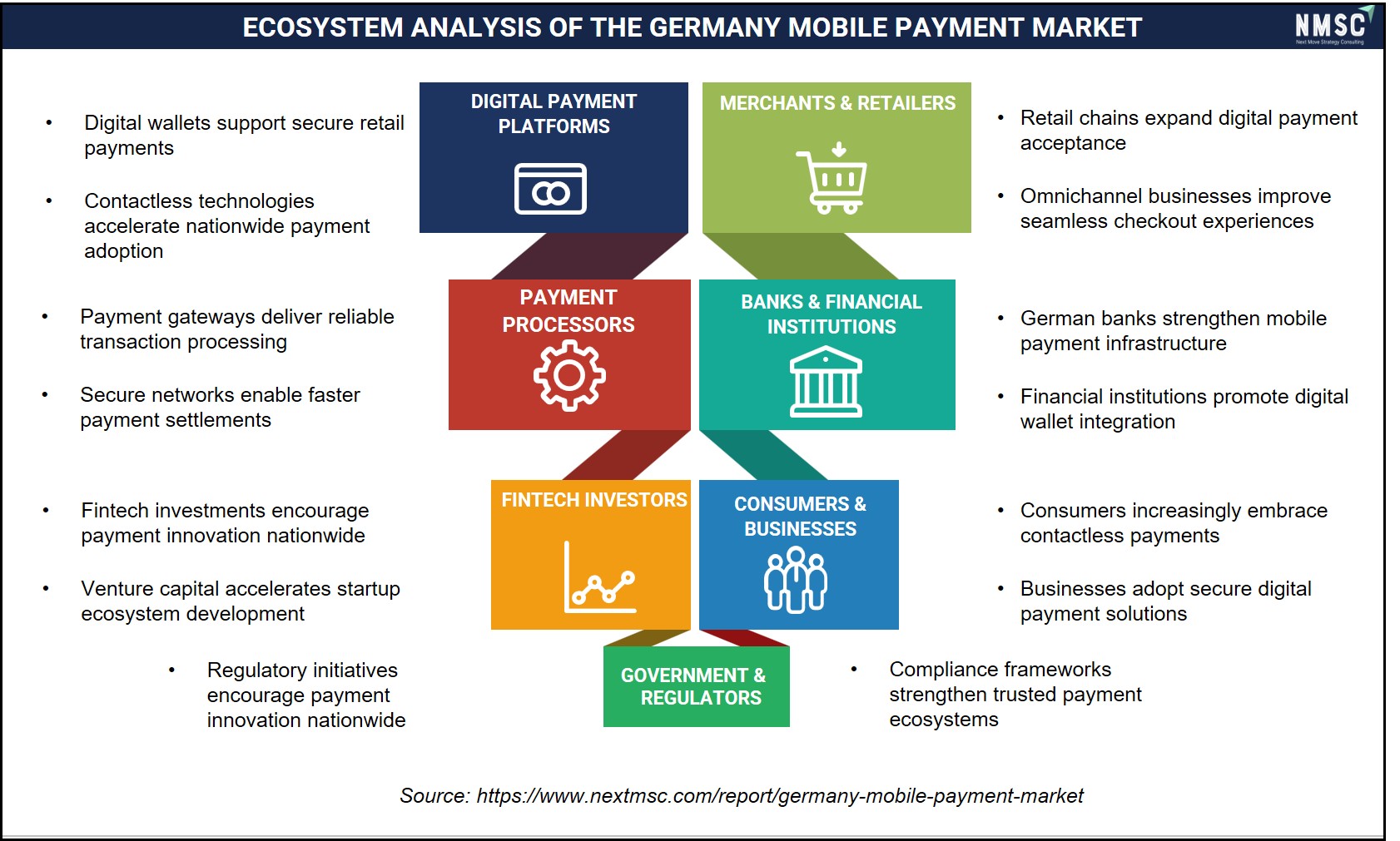
Our analysis indicates that the ecosystem of the Germany Mobile Payment Market integrates digital payment platforms, payment processors, banks, merchants, fintech investors, consumers, and regulatory authorities to strengthen secure and seamless digital transactions. Strong collaboration among financial institutions, payment technology providers, and merchants accelerates mobile payment adoption, while PSD2 compliance and robust cybersecurity frameworks reinforce transaction security and consumer trust. Continuous fintech investment, expanding digital commerce, and widespread contactless payment acceptance further strengthen ecosystem resilience, innovation, and sustainable market growth.
Growth Drivers and Restraints
Growth Catalyst and Risk Assessment Matrix
|
Factors |
Type |
(+/−) % Impact on CAGR |
Geographic Relevance |
Impact Timeline |
|
Rising smartphone penetration and NFC terminal density across German retail |
Driver |
+3.85% |
Germany (nationwide; strongest in urban centers) |
2026–2032 |
|
Expansion of open banking and account-to-account payment rails under PSD2 |
Driver |
+3.20% |
Germany (nationwide) |
2026–2033 |
|
Growing merchant adoption of QR code checkout among SMEs |
Driver |
+2.65% |
Germany (strongest in Berlin, Munich, Hamburg) |
2026–2031 |
|
Integration of mobile wallets into public transit and utility payments |
Driver |
+2.10% |
Germany (major metropolitan transit networks) |
2027–2033 |
|
Increasing embedded finance adoption among SME software platforms |
Driver |
+1.90% |
Germany (nationwide; SME concentration in Baden-Württemberg, Bavaria) |
2027–2034 |
|
Consumer trust concerns around data privacy and fraud in mobile transactions |
Restraint |
−1.75% |
Germany (nationwide) |
2026–2030 |
|
Fragmented terminal infrastructure among small independent merchants |
Restraint |
−1.40% |
Germany (rural and semi-urban regions) |
2026–2029 |
|
Regulatory compliance costs under strong customer authentication requirements |
Restraint |
−1.20% |
Germany (nationwide) |
2026–2028 |
What Is the Primary Growth Driver of the Germany Mobile Payment Market?
Rising smartphone penetration combined with expanding near-field communication terminal density is the primary growth driver of the Germany mobile payment market. The Bundesverband Digitale Wirtschaft has documented consistent growth in smartphone-based commerce activity across German consumers. We observed that retailers are upgrading point-of-sale infrastructure to accept contactless credentials, reinforcing consumer habituation toward tap-and-pay transactions across grocery, food service, and general retail channels nationwide.
How Is Open Banking Driving Germany Mobile Payment Market Growth?
Open banking infrastructure mandated under the revised Payment Services Directive is accelerating account-to-account payment adoption across Germany. Deutsche Bundesbank data confirms sustained growth in instant-payment transaction volumes processed through German settlement systems. Our assessment indicates that fintech entrants are leveraging this infrastructure to offer merchants lower-cost checkout alternatives to card networks, strengthening account-to-account transaction share within the broader mobile payment ecosystem.
What Is Restraining Germany Mobile Payment Market Expansion?
Consumer concerns regarding data privacy and transaction fraud continue to restrain broader mobile payment adoption in Germany. The Bundesamt für Sicherheit in der Informationstechnik has flagged rising phishing and payment-fraud incident reports tied to digital transaction channels. We found that fragmented terminal infrastructure among smaller independent merchants, particularly in rural regions, further limits acceptance breadth, requiring sustained investment in merchant onboarding and consumer trust-building initiatives.
Segmentation Analysis
By Payment Channel Insights
How Is the Germany Mobile Payment Market Segmented by Payment Channel?
Based on payment channel, the Germany mobile payment market is segmented into contactless card-based (NFC, MST), QR code-based, account-to-account transfers (A2A), and carrier billing.
Contactless card-based transactions remain the dominant channel, supported by mature NFC terminal infrastructure across German retail and transit networks and strong consumer familiarity with tap-and-pay credentials linked to major wallet providers. QR code-based payments represent the fastest-growing channel, driven by low-cost merchant onboarding among independent retailers and loyalty-platform integrations that bypass traditional card-terminal requirements. Account-to-account transfers are gaining structural relevance as open banking infrastructure matures, while carrier billing remains a niche channel concentrated in low-value digital content purchases.
By Customer Type Insights
How Is the Germany Mobile Payment Market Segmented by Customer Type?
Based on customer type, the Germany mobile payment market is segmented into retail consumers, small and medium enterprises (SMEs), large enterprises, and government and public sector.
Retail consumers dominate the customer base, reflecting widespread day-to-day use of mobile wallets for grocery, food service, and general retail purchases across German cities. Small and medium enterprises represent the fastest-growing customer type, as embedded finance tools and low-cost QR acceptance lower the barrier for independent merchants to accept mobile payments. Large enterprises continue integrating mobile-enabled procurement and payroll disbursement, while government and public-sector adoption is expanding gradually through transit-fare and tax-remittance digitization initiatives.
Growth Opportunities
Our analysis shows that three forward-looking opportunities stand out for stakeholders operating in the Germany mobile payment market over the 2026–2035 forecast period.
How Can Embedded Finance Unlock New Growth for SME Software Platforms?
Embedded finance presents a significant opportunity as German SME software vendors integrate payment initiation directly into invoicing and procurement workflows. Providers such as Stripe Payments Europe and Adyen that offer embedded settlement APIs can capture recurring transaction volume from vertical software platforms, strengthening merchant retention while reducing reconciliation friction for business customers.
Where Do Transit and Public-Sector Integrations Create New Demand?
Expanding NFC and QR-based fare validation across German transit networks creates substantial opportunity for wallet providers and payment processors. Companies that secure integration partnerships with municipal transit operators and government remittance platforms can capture high-frequency, low-value transaction volume, establishing durable relationships with government and public-sector customer segments.
How Can Cross-Border A2A Rails Benefit Neobanks and Payment Processors?
Growing account-to-account transfer volume creates opportunity for neobanks and payment processors offering cross-border settlement within the European instant-payment framework. Providers such as N26 Bank and Revolut Bank that combine competitive foreign-exchange pricing with instant A2A rails are positioned to capture SME and retail-consumer transaction share previously routed through traditional card networks.
Supply Chain Structure of the Germany Mobile Payment Industry
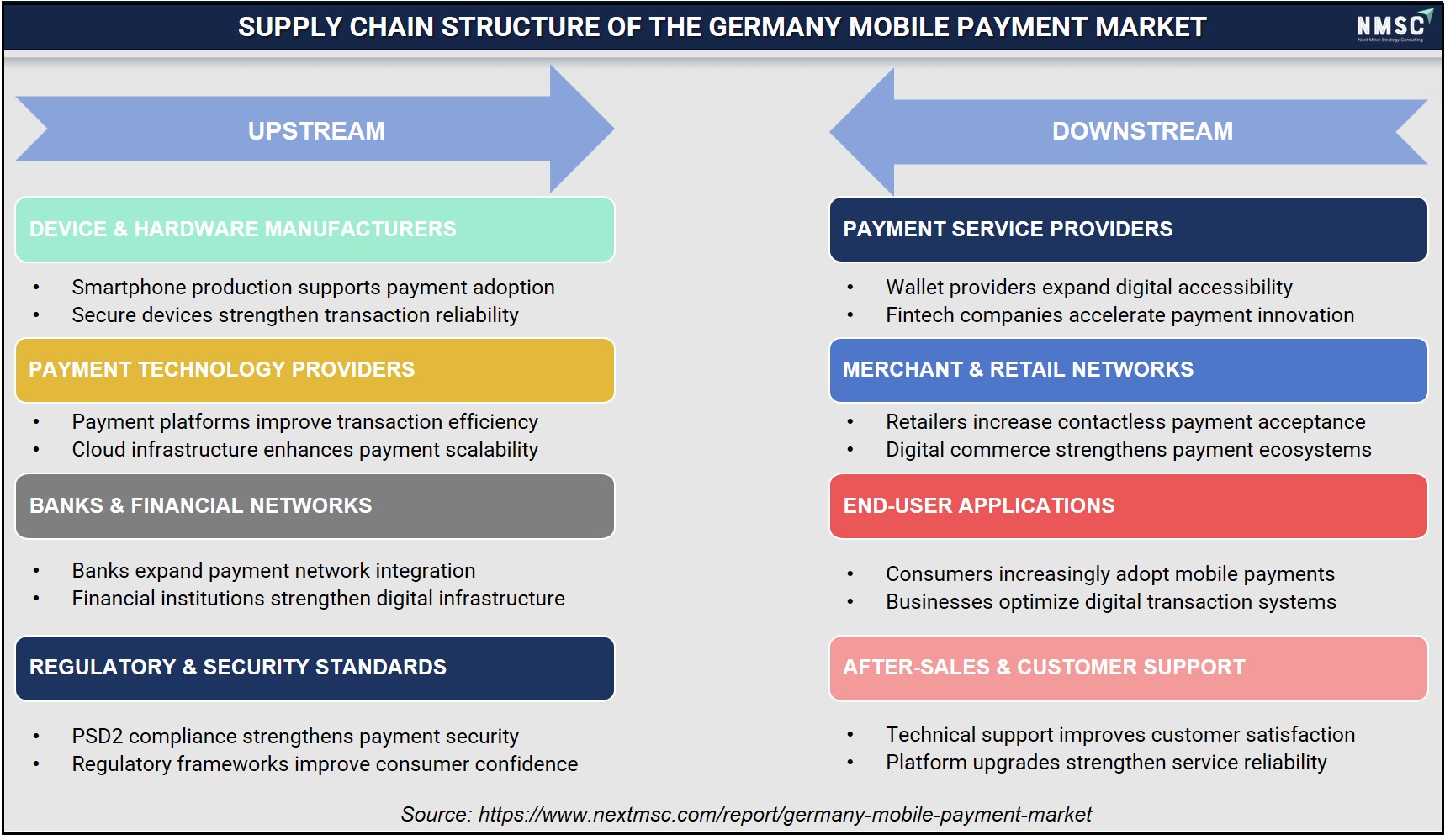
Our comprehensive market evaluation indicates that the supply chain of the Germany Mobile Payment industry begins with device manufacturers, payment technology providers, banking networks, and regulatory institutions that establish the technological and security foundation for digital transactions. Payment service providers, merchants, retailers, businesses, and consumers drive downstream market adoption through expanding wallet acceptance, integrated payment platforms, and omnichannel commerce. Continuous platform upgrades, customer support services, and regulatory compliance strengthen operational efficiency, transaction security, and service reliability across the entire mobile payment value chain.
Competitive Landscape
We observed that the Germany mobile payment market features a highly competitive landscape, with global technology platforms competing alongside domestic banks, card networks, and specialized fintech processors.
Key Takeaways
|
Dimension |
Description |
|
Market Structure |
Highly competitive with global technology platforms, card networks, and domestic banks operating alongside specialized fintech processors. Multinational platform operators account for a significant share of transaction volume, while domestic entities such as PAYBACK and S-Payment maintain strong merchant relationships through loyalty and banking integrations. |
|
Innovation Focus |
Account-to-account payment rails, embedded finance APIs, QR code checkout, and biometric authentication dominate current product development strategies across leading providers in the Germany mobile payment market. |
|
M&A Activity |
Strategic partnerships between fintech processors and domestic banks, alongside targeted acquisitions of embedded-finance capabilities, continue to shape the competitive landscape as companies strengthen account-to-account and cross-border settlement offerings. |
How Do Companies Compete in the Germany Mobile Payment Market?
Companies compete primarily through transaction processing reliability, merchant acceptance breadth, and integration depth with domestic banking infrastructure. Leading platform operators such as Apple Inc. and Google LLC leverage device-level wallet integration and consumer trust to maintain transaction share, while processors including Adyen N.V. and Stripe Payments Europe, Limited compete on merchant-side payment gateway flexibility and settlement speed across German e-commerce and point-of-sale channels.
Which Competitive Archetypes Dominate the Germany Mobile Payment Market?
Two primary competitive archetypes characterize the market. The first comprises global technology and card-network platforms offering device-integrated wallets and broad merchant acceptance, represented by Apple Inc., Google LLC, and Visa Europe Management Services Limited, German Branch. The second includes domestic and regional fintech specialists such as PAYBACK GmbH, S-Payment GmbH, and N26 Bank SE, which differentiate through loyalty integration, banking-native account-to-account rails, and localized merchant relationships.
How Are Companies Differentiating Through Innovation in Germany Mobile Payment?
Innovation strategies increasingly focus on account-to-account settlement, embedded finance APIs, and biometric authentication layered onto existing wallet credentials. Companies including Klarna Bank AB, extending its core buy now pay later offering, and Blue Code International AG are investing in checkout technologies that reduce merchant interchange costs while preserving transaction speed. NMSC's analysis indicates that providers combining regulatory compliance strength with rapid API integration are strengthening competitive positioning across German merchant segments.
What M&A and Expansion Activity Is Shaping the Germany Mobile Payment Market?
Strategic partnerships between international payment processors and domestic banking institutions continue to shape competition across the market. Leading companies are strengthening their positions through integration agreements with German retail banks, expansion of embedded finance capabilities, and increased investment in fraud-prevention infrastructure. These initiatives enable providers to broaden merchant acceptance networks and respond more effectively to evolving demand for account-to-account and QR-based settlement.
Key Market Players
Our assessment indicates that the following 15 companies are actively shaping product innovation, merchant acceptance expansion, and competitive dynamics within the Germany mobile payment market.
-
Apple Inc.
-
PayPal (Europe) S.à r.l. et Cie, S.C.A.
-
Google LLC
-
EPI Company SE
-
Klarna Bank AB (publ)
-
PAYBACK GmbH
-
S-Payment GmbH
-
Blue Code International AG
-
SumUp EU S.à r.l.
-
N26 Bank SE
-
Revolut Bank UAB, Zweigniederlassung Deutschland
-
bunq B.V.
-
Adyen N.V.
-
Visa Europe Management Services Limited, German Branch
Latest Developments
We found that recent developments within the Germany mobile payment market are concentrated on account-to-account infrastructure, embedded finance partnerships, and expanded merchant acceptance, reflecting the industry's growing emphasis on interoperability and checkout innovation.
|
Date |
Event |
|
December 2025 |
N26 Bank SE announced a membership agreement with the European Payment Initiative (EPI) to integrate the Wero digital wallet into its banking app. The rollout will begin with Germany, enabling customers to access secure account-to-account mobile payments and expanding domestic digital payment capabilities from 2026 onward |
|
May 2025 |
PayPal (Europe) S.à r.l. et Cie, S.C.A. announced the launch of its first contactless mobile wallet in Germany, making the country its inaugural market for in-store mobile payments. The service enables Tap-to-Pay purchases via the PayPal app and introduces in-store installment payment functionality for German consumers. |
Investment Opportunities
What Capital Inflows Are Targeting the Germany Mobile Payment Market?
Capital inflows into the Germany mobile payment market are increasingly directed toward account-to-account infrastructure, embedded finance APIs, and fraud-prevention technology. Leading global processors continue to invest in merchant onboarding and checkout optimization to strengthen competitive positioning. We observed that investors favor companies demonstrating regulatory compliance strength, banking-partnership depth, and scalable transaction-processing infrastructure as key indicators of long-term growth potential.
How Is Infrastructure Investment Supporting the Germany Mobile Payment Market?
Infrastructure investment is expanding NFC terminal density, instant-payment settlement rails, and API-based merchant integration across the German payment ecosystem. Our findings suggest that banks and fintech processors are investing in cloud-based transaction infrastructure and fraud-detection systems to improve reliability. Continued investment in transit and public-sector fare-collection integration is further expanding the addressable base for mobile payment infrastructure providers.
What ESG Considerations Are Shaping Investment Decisions in the Germany Mobile Payment Market?
Environmental, social, and governance considerations are increasingly relevant to investment decisions in the Germany mobile payment market, with data-privacy governance, financial-inclusion initiatives, and energy-efficient data-center operations emerging as priorities. We found that investors increasingly favor companies demonstrating measurable progress in cybersecurity governance and transparent handling of consumer transaction data under German and EU regulatory frameworks.
Key Benefits for Stakeholders
How Does This Report Benefit Enterprise and Industry Leaders?
Enterprise and industry leaders gain access to validated market segmentation, competitive benchmarking, and merchant-adoption trend analysis that support strategic planning and product development across the Germany mobile payment market. Our analysis shows that detailed assessments of payment channel, platform type, and customer-type trends help companies identify high-growth opportunities and strengthen market positioning.
How Does This Report Benefit Investors and Financial Analysts?
Investors and financial analysts benefit from consistent market size estimates, growth forecasts, and competitive assessments that support investment evaluation across the Germany mobile payment market. We observed that the report's detailed analysis of account-to-account rails, embedded finance, and QR-based checkout enables stakeholders to identify companies with the strongest long-term growth potential through 2035.
How Does This Report Benefit Technology Vendors and Product Teams?
Technology vendors and product development teams gain valuable insights into emerging innovation trends, including embedded finance, biometric authentication, and account-to-account settlement, that are transforming the German payment industry. Our findings suggest that this analysis helps research and development teams prioritize product roadmaps and align offerings with evolving merchant and regulatory expectations.
Key Market Segments
By Payment Channel
-
Contactless Card-based (NFC, MST)
-
QR Code-based
-
Account-to-Account Transfers (A2A)
-
Carrier Billing
By Platform Types
-
Web-Embedded
-
Native App
By Transaction Use-Case
-
Peer-to-Peer (P2P)
-
Point-of-Sale (P2M)
-
Bill and Recurring Payments
-
Business-to-Business
-
Government/Tax Remittance
By Payment Location
-
Remote Payment
-
Proximity Payment
By Customer Type
-
Retail Consumers
-
Small and Medium Enterprises (SMEs)
-
Large Enterprises
-
Government and Public Sector
Conclusion and Recommendations
What Is the Long-Term Outlook for the Germany Mobile Payment Market?
The long-term outlook for the Germany mobile payment market remains strongly positive, supported by expanding open banking infrastructure, rising NFC terminal density, and growing merchant adoption of QR-based checkout. We observed that continued integration of mobile credentials into transit, government remittance, and business-to-business workflows will sustain double-digit growth across contactless, account-to-account, and embedded finance segments throughout the forecast period.
What Strategic Positioning Should Mobile Payment Companies Pursue?
Providers should prioritize investment in account-to-account settlement capabilities, embedded finance APIs, and biometric authentication while strengthening partnerships with domestic German banks. Our assessment indicates that companies expanding merchant acceptance among SMEs and integrating transit and public-sector use cases will be well positioned to capture durable transaction share within the Germany mobile payment market.
How Attractive Is the Germany Mobile Payment Market for New Investment?
The Germany mobile payment market presents an attractive investment opportunity, supported by rising digital transaction volume, expanding open banking rails, and continued innovation in embedded finance. We found that investment potential is particularly strong for companies focused on account-to-account infrastructure, SME-focused embedded finance, and cross-border settlement, enabling them to capitalize on long-term structural growth.
What Market Shifts and Key Risks Should Stakeholders Monitor?
Stakeholders should closely monitor evolving data-privacy regulation, fragmented terminal infrastructure among smaller merchants, and intensifying competition from global technology platforms. Our analysis shows that companies unable to maintain regulatory compliance or scale merchant acceptance efficiently may face increasing competitive pressure in the German mobile payment landscape.
What Are the Key Growth Pathways for the Germany Mobile Payment Market?
Key growth pathways include expanding account-to-account payment rails, accelerating embedded finance integration for SME software platforms, strengthening transit and public-sector partnerships, and enhancing biometric authentication capabilities. NMSC's analysis indicates that companies successfully combining regulatory compliance, banking partnerships, and merchant-side innovation will be best positioned to capture the Germany mobile payment market's projected growth through 2035.


About the Author
 Saista Faiyaz
— Saista Faiyaz is Research Associate at Next Move Strategy Consulting, where she has covered consumer markets and healthcare technologies for 3 years. Her work includes primary interview review, secondary-source validation, market sizing, and structured analysis of company and industry data. She supports research by comparing evidence across sources, organizing findings into market narratives, and documenting assumptions used in analysis. Her scope includes cross-market benchmarking, and reports.
Saista Faiyaz
— Saista Faiyaz is Research Associate at Next Move Strategy Consulting, where she has covered consumer markets and healthcare technologies for 3 years. Her work includes primary interview review, secondary-source validation, market sizing, and structured analysis of company and industry data. She supports research by comparing evidence across sources, organizing findings into market narratives, and documenting assumptions used in analysis. Her scope includes cross-market benchmarking, and reports.
About the Reviewer
 Supradip Baul
— Supradip Baul is an accomplished business consultant and strategist with over a decade of rich experience in market intelligence, strategy, technology, and business transformation. His work has included rigorous qualitative and quantitative analysis across multiple industries, helping clients shape investment decisions and long-term roadmaps. Earlier in his career, he was associated with Gartner, where he contributed to industry-leading reports and market share analyses. He has worked with leading global companies and holds an MBA with a dual specialization in Marketing and Finance.
Supradip Baul
— Supradip Baul is an accomplished business consultant and strategist with over a decade of rich experience in market intelligence, strategy, technology, and business transformation. His work has included rigorous qualitative and quantitative analysis across multiple industries, helping clients shape investment decisions and long-term roadmaps. Earlier in his career, he was associated with Gartner, where he contributed to industry-leading reports and market share analyses. He has worked with leading global companies and holds an MBA with a dual specialization in Marketing and Finance.
At Next Move Strategy Consulting, we understand that insightful market research is the cornerstone of successful business decisions. That's why we employ a robust and multifaceted approach, combining various methodologies to deliver the most accurate and actionable data for our clients.

Research Landscape
We navigate the world of research with two primary approaches:
Qualitative Approach
Our qualitative research methodologies involve immersive techniques such as in-depth interviews, focus groups, and observational studies. By engaging directly with individuals and stakeholders, we uncover valuable insights that quantitative data alone may overlook.

Quantitative Research
In tandem with qualitative methodologies, NMSC leverages the power of Quantitative Research to provide a robust foundation of numerical insights. Through systematic data collection and analysis, we quantify patterns, preferences, and market trends, offering a comprehensive view of the business landscape.
Our quantitative research approach employs diverse tools, including surveys, experiments, and statistical modelling. These methodologies enable us to gather data from a large and representative sample, ensuring the statistical significance of our findings. By employing structured questionnaires and standardized data collection methods, we guarantee the reliability and validity of the information we present to our clients.
Quantitative research is particularly effective in measuring the prevalence of trends, assessing market size, and gauging the impact of various factors on consumer behavior. The numerical precision attained through this approach equips our clients with actionable insights, facilitating data-driven decision-making and strategy formulation.


Our Specialized Toolbox for Industry-Specific Market Research
We deploy a specialized arsenal of techniques tailored to meet your unique requirements. Here's a glimpse into our comprehensive toolbox:

Information Procurement
The stage entails acquiring market data or relevant information through various sources and methodologies.


Market Research Approach
We utilize both top-down and bottom-up approaches in market research analysis to achieve a comprehensive understanding of the market dynamics, leveraging the broad perspective of industry trends and macroeconomic factors alongside detailed insights from specific segments and individual companies.

Porters Five Forces Analysis
We conduct Porter's Five Forces analysis to evaluate the competitive landscape of an industry, providing us with insights into factors that affect profitability and strategic positioning.

SWOT Analysis

Forecasting
We utilize a forecasting model to predict future consumption by considering parameters like population, economics, regulations, market competition, drivers, constraints, technology, and pricing. We also employ statistical techniques such as multilinear regression, exponential smoothing, moving average, ARIMA, and Monte Carlo simulations for accurate predictions. In econometric forecasting, we analyzed short-term and long-term event impacts, attributing values based on regulatory frameworks, economic factors, and market events.





 Speak to Our Analyst