Italy TinyML Market By Component {Hardware (Processors, Modules & Peripherals, and Others), Software (Development Tools, Inference Frameworks, and Others), Services (Professional, Managed, and Others}, By Application (Vision & Imaging, Audio & Speech, and Others), By Deployment Mode (On-Device, Cloud-Assisted, Edge-Assisted), By Industry Vertical (Consumer Electronics, Healthcare, and Others), and By Buyer Type (OEMs & Device Makers, ODMs, and others) – Analysis & Forecast, 2025–2035
Industry: ICT & Media | Latest Edition: September 30, 2026 | No of Pages: 202 | No. of Tables: 64 | No. of Figures: 59 | Format: PDF | Report Code: IC4690
Italy TinyML Market Size & Forecast
|
Parameters |
Details |
|
Market Size in 2026 |
USD 56.83 Million |
|
Revenue Forecast in 2035 |
USD 394.55 Million |
|
Growth Rate |
CAGR of 24.02% from 2026 to 2035 |
|
Analysis Period |
2025–2035 |
|
Base Year Considered |
2025 |
|
Forecast Period |
2026–2035 |
|
Market Size Estimation |
Million (USD) |
|
Companies Profiled |
15 |
|
Market Share |
Available for 10 companies |
Industry Outlook
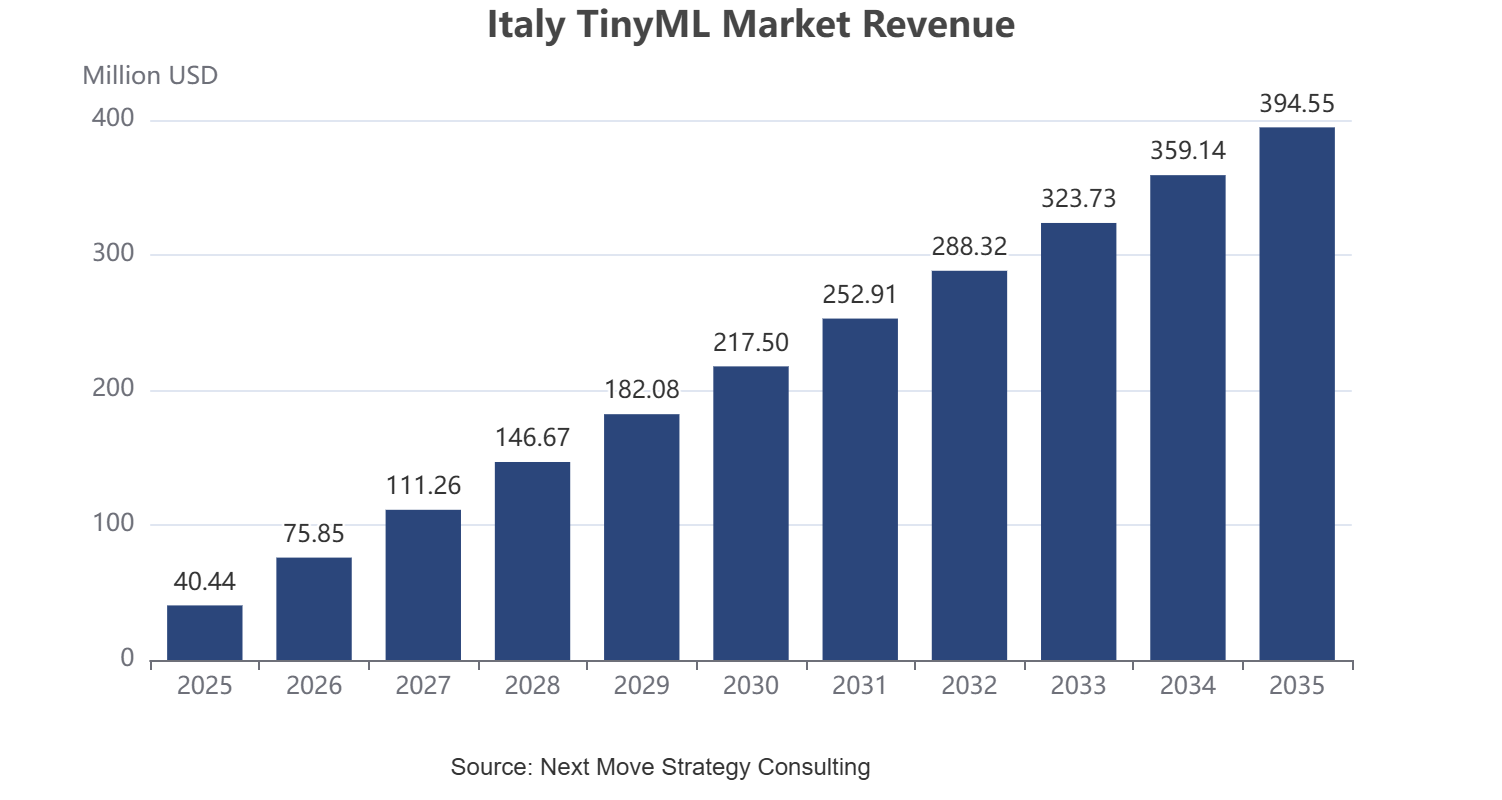
The Italy TinyML Market size was valued at USD 40.44 million in 2025 and is expected to be valued at USD 56.83 million by the end of 2026. The industry is projected to grow, hitting USD 394.55 million by 2035, with a CAGR of 24.02% between 2026 and 2035.
What are the Key Market Drivers, Breakthroughs, and Investment Opportunities that will Shape the TinyML Industry in the Next Decade?
Growth Catalyst & Risk Assessment Matrix
|
DRIVERS / TRENDS / RESTRAINTS |
(+/–) % IMPACT ON CAGR FORECAST |
GEOGRAPHIC RELEVANCE |
IMPACT TIMELINE |
|
Government digital transformation initiatives promoting smart infrastructure and embedded AI adoption |
+2.1% |
Nationwide, with focus on Rome, Milan, Turin industrial and public infrastructure ecosystems |
Short to medium term (1–4 years) |
|
Expansion of consumer IoT devices including smart homes, wearables, and connected electronics driving on-device intelligence |
+1.8% |
Urban regions including Milan, Rome, Bologna, and Northern Italy consumer tech hubs |
Medium term (2–5 years) |
|
Increasing adoption of predictive maintenance across manufacturing, energy, and transportation sectors |
+1.9% |
Industrial clusters in Northern Italy, Lombardy, Emilia-Romagna, and Veneto |
Medium term (2–6 years) |
|
Rising demand for energy-efficient, low-latency embedded AI solutions across distributed environments |
+1.7% |
Nationwide across industrial and consumer embedded ecosystems |
Medium to long term (2–7 years) |
|
Fragmentation across hardware platforms, AI frameworks, and embedded toolchains limiting interoperability |
-2.0% |
Across Italy’s embedded AI ecosystem including OEMs and industrial solution providers |
Medium term (2–5 years) |
|
Integration complexity due to a lack of standardized deployment frameworks across heterogeneous systems |
-1.6% |
Nationwide across developers, system integrators, and enterprise deployments |
Medium term (2–5 years) |
Government-led digital transformation initiatives, expanding consumer IoT adoption, and increasing use of predictive maintenance are collectively driving growth in the Italy TinyML market by strengthening demand for real-time, on-device intelligence. National programs focused on smart infrastructure, public services, and industrial modernization are creating a supportive environment for deploying embedded AI across transportation, energy, and safety systems.
At the same time, the proliferation of smart home devices, wearables, and connected electronics is generating continuous data streams that require immediate processing, encouraging manufacturers to integrate compact machine learning models directly into devices. From our analysis, we found that the growing emphasis on localized processing, privacy, and responsiveness is further accelerating the adoption of energy-efficient TinyML solutions across both consumer and industrial ecosystems.
However, scalability is constrained by persistent fragmentation across hardware platforms, AI frameworks, and embedded toolchains, which increases integration complexity and limits seamless interoperability. The need for repeated customization across heterogeneous systems continues to slow deployment cycles and affect long-term consistency. Our evaluation indicates that the emergence of edge-to-cloud hybrid intelligence is expected to address these limitations by enabling distributed processing architectures where real-time inference occurs at the edge while centralized systems handle model training and updates. This evolving approach, supported by advancements in standardized communication protocols and unified deployment frameworks, is likely to enhance system adaptability, improve efficiency, and support scalable expansion of TinyML applications across Italy.
Growth Drivers:
How Are Government Digital Initiatives Driving Growth in the Italy TinyML Market?
Government-driven digital transformation initiatives in Italy are accelerating the adoption of TinyML by promoting the integration of intelligent edge technologies across public infrastructure and industrial systems. Our analysis shows that national efforts focused on smart infrastructure, digital public services, and industrial modernization are creating favorable conditions for deploying low-power, on-device AI solutions. These initiatives are encouraging the use of embedded intelligence in applications such as transportation systems, energy management, and public safety networks, where real-time data processing is essential. Moreover, increased public and private sector collaboration is supporting innovation and faster implementation of scalable TinyML solutions. Consequently, organizations are increasingly adopting compact machine learning models to enhance system responsiveness, reduce latency, and improve operational efficiency across distributed environments, strengthening the overall growth trajectory of the Italy TinyML market.
How Is the Expansion of Consumer IoT Devices Fueling Demand in the Italy TinyML Market?
The growing adoption of consumer IoT devices in Italy is driving demand for TinyML by increasing the need for real-time, on-device data processing capabilities. Additionally, the widespread use of smart home systems, wearables, and connected consumer electronics is generating continuous streams of data that require immediate analysis. This is encouraging manufacturers to integrate lightweight machine learning models directly into devices to enable faster and more efficient functionality without relying heavily on cloud connectivity. From our evaluation, we found that rising consumer expectations for privacy and responsiveness are reinforcing the shift toward localized processing. As a result, companies are focusing on developing energy-efficient AI solutions that can operate within limited hardware resources. This trend is supporting the expansion of embedded intelligence across consumer applications and contributing to the steady growth of the Italian TinyML market.
How Is Predictive Maintenance Adoption Accelerating the Italy TinyML Market?
The increasing adoption of predictive maintenance across industrial sectors in Italy is accelerating the growth of the TinyML market by enabling real-time monitoring and analysis at the edge. Our research indicates that industries such as manufacturing, energy, and transportation are integrating embedded AI systems to continuously assess equipment performance and detect anomalies before failures occur. This approach helps reduce downtime, optimize maintenance schedules, and improve overall operational efficiency. Furthermore, TinyML allows these systems to function effectively in environments with limited connectivity by processing data directly on devices. This ensures timely insights and faster response actions without dependence on centralized infrastructure. As industries continue to prioritize efficiency and reliability, the deployment of compact and energy-efficient machine learning models is expanding, reinforcing the role of TinyML in supporting scalable and intelligent industrial operations across Italy.
Growth Inhibitor:
What Technical Fragmentation Challenge is Limiting Scalability in the Italy TinyML Market?
Persistent interoperability gaps between hardware platforms and AI deployment frameworks constrain scalable system integration within the Italy TinyML market, particularly where cross-vendor compatibility remains uneven across embedded ecosystems. Our evaluation shows that this lack of standardization creates operational inefficiencies for solution providers, as models must be continuously adapted to align with evolving hardware architectures. As a result, maintenance overhead increases, while long-term deployment consistency is affected across industrial and consumer applications relying on edge intelligence at scale across complex ecosystems.
Our investigation identifies technical fragmentation across embedded toolchains, hardware abstraction layers, and model optimization frameworks as a core scalability challenge within the Italian TinyML market, limiting seamless deployment across heterogeneous edge environments. This fragmentation also increases integration complexity for developers and system architects, as inconsistent software stacks require repeated customization across platforms. Consequently, deployment cycles slow down while interoperability gaps persist across devices, affecting system-level efficiency in distributed embedded AI ecosystems across industrial and consumer use cases.
Growth Opportunity:
How Will Edge-to-Cloud Hybrid Intelligence Shape Future Expansion in the Italy TinyML Market?
Our research suggests that edge-to-cloud hybrid intelligence is emerging as a strategic architectural shift within the Italian TinyML market, enabling distributed processing where lightweight inference occurs at the device level while complex model training and refinement are managed in centralized cloud environments over time. This integration supports adaptive workload distribution, optimizing latency, bandwidth usage, and energy efficiency across connected systems. Additionally, it enables continuous model updates, improving system adaptability and ensuring consistent performance across dynamic edge deployments and evolving operational requirements.
The future expansion of edge-to-cloud hybrid intelligence within the Italy TinyML market will depend on the maturation of standardized communication protocols and unified deployment frameworks across heterogeneous embedded systems. Our assessment shows that this evolution is expected to enhance interoperability between low-power edge nodes and centralized computing layers. Consequently, organizations may achieve improved resilience, scalable integration, and more efficient orchestration of distributed intelligence across industrial and infrastructure domains at scale across complex ecosystems.
SWOT Analysis of the Italy TinyML Market
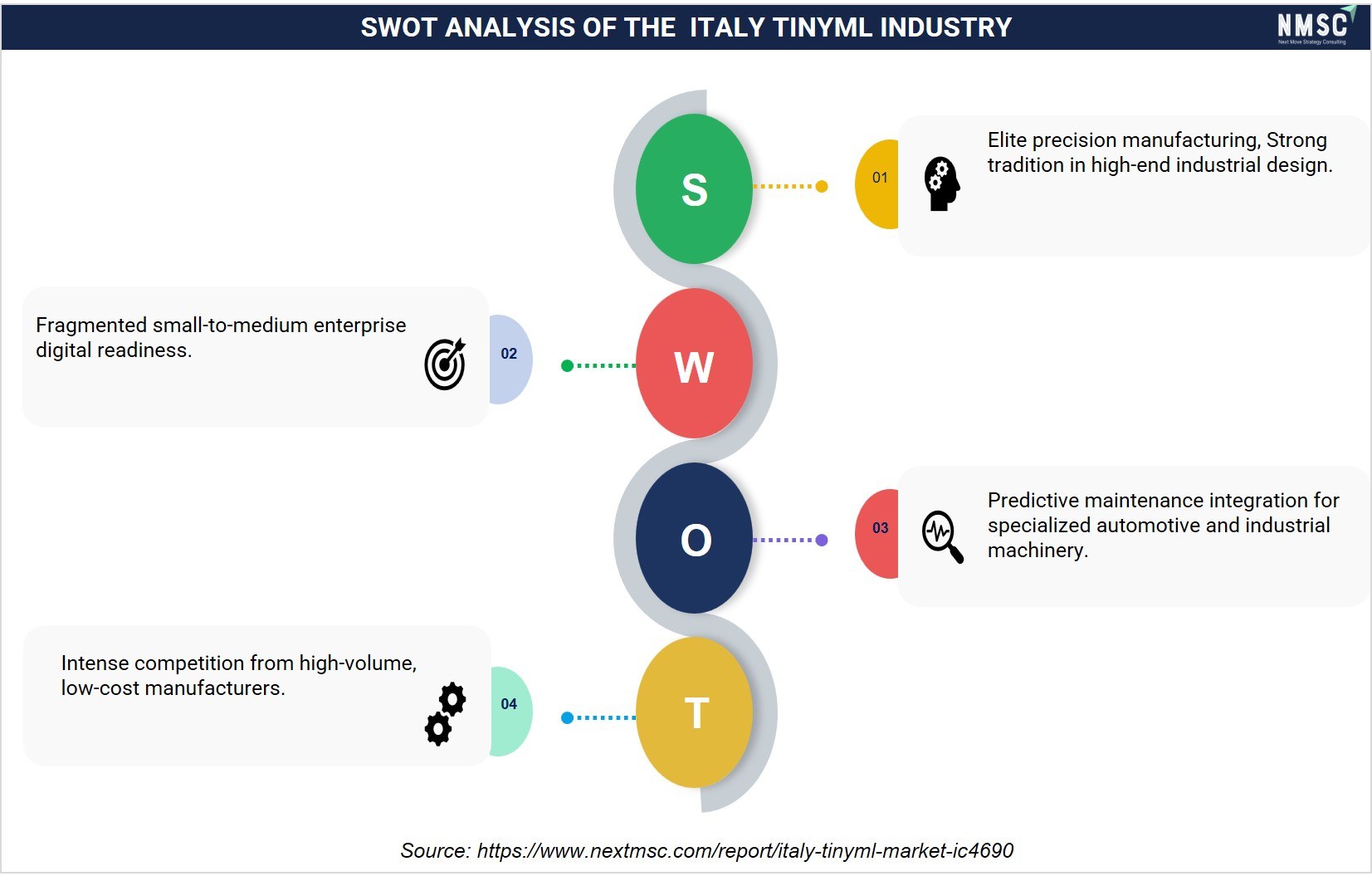
Our analysis shows that the Italy TinyML industry is supported by strong precision manufacturing capabilities and a well-established industrial design heritage. However, fragmented digital readiness among SMEs and limited large-scale coordination continue to slow full-scale adoption. Opportunities are emerging in predictive maintenance applications, particularly across automotive and industrial machinery sectors where smart, failure-predicting systems add value. Additionally, intense global competition from low-cost, high-volume producers is increasing pricing pressure on specialized Italian manufacturers. Therefore, Italy’s TinyML growth depends on improving digital transformation while leveraging its high-end industrial expertise for niche applications.
How is the Italy TinyML Market Segmented in this Report, and What are the Key Insights from the Segmentation Analysis?
By Deployment
How Is Deployment Mode Structuring System-Level Intelligence in the Italy TinyML Market?
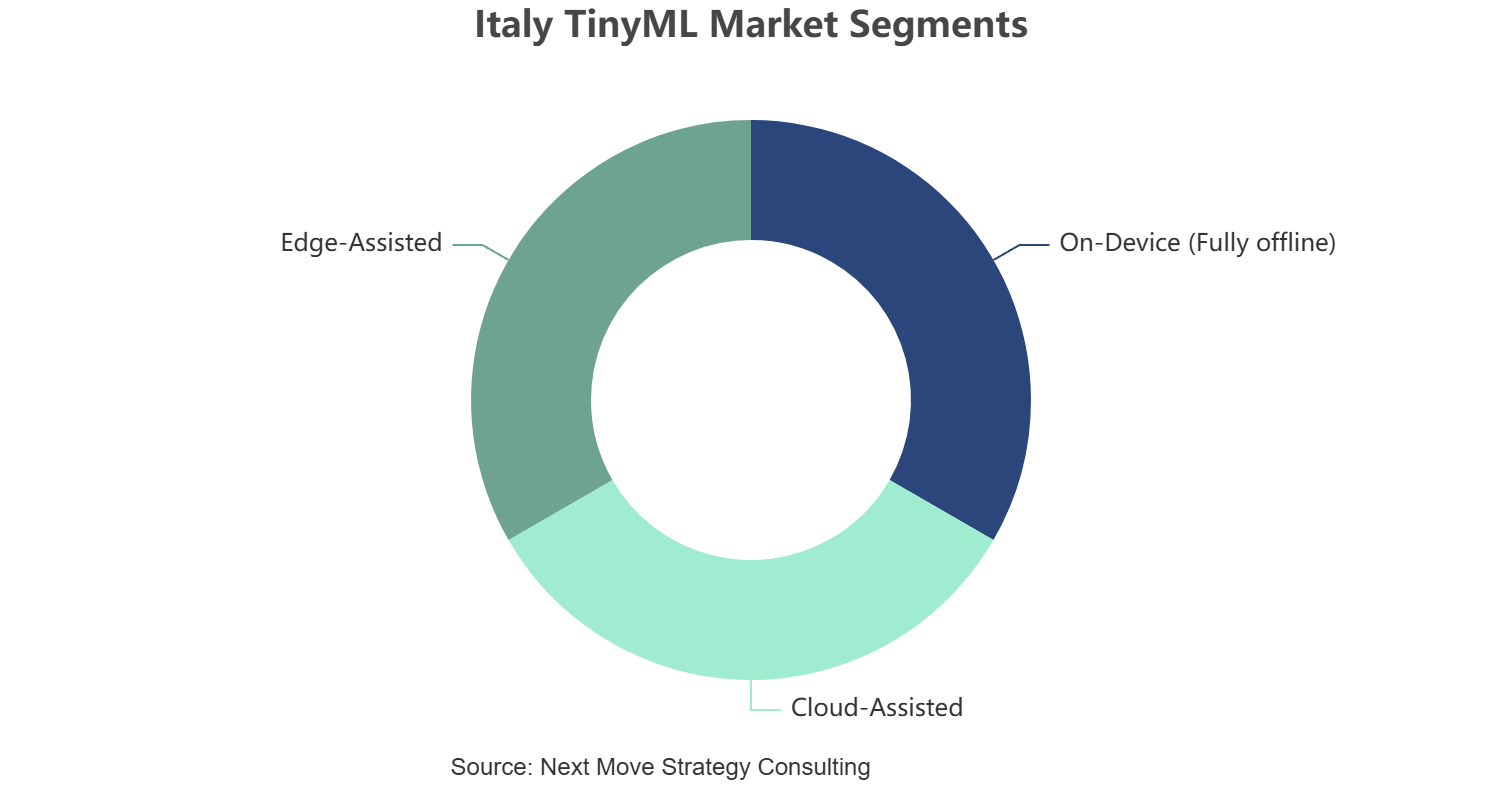
The Deployment Mode segment in the Italy TinyML market is structured into On Device Fully offline, Cloud Assisted, and Edge Assisted categories. On Device deployment refers to models running entirely on embedded hardware without external connectivity. In addition, Cloud Assisted deployment combines local inference with cloud-based computation for training, updates, or heavier processing tasks. Similarly, Edge Assisted deployment distributes processing between edge gateways and nearby devices to balance latency and compute efficiency across distributed environments.
Deployment preferences are shaped by latency sensitivity, data governance requirements, and infrastructure readiness across different application environments. On-device models are preferred in use cases requiring strict offline operation, such as industrial monitoring and remote asset management, whereas Cloud Assisted approaches support scalable updates and centralised optimisation. Meanwhile, Edge Assisted deployment is increasingly used in connected industrial and mobility ecosystems where coordination between devices is necessary. Our market analysis suggests that hybrid deployment strategies are expanding as organizations balance real-time processing needs with centralized intelligence capabilities.
By Industry Vertical
How Are Application Domains Influencing Deployment Priorities in the Italian TinyML Market?
The Application segment in the Italy TinyML market includes Vision and Imaging, Audio and Speech Processing, Time-Series and Anomaly Detection, Health and Biosignal Monitoring, Environmental Sensing, Security and Authentication, Gesture and Activity Recognition, Localization and Navigation, and Other Applications.
Our sector study reveals that adoption patterns vary across industry verticals depending on operational complexity, data sensitivity, and real-time processing requirements across edge environments. Industrial and Manufacturing settings are shaped by continuous monitoring and automation needs, Healthcare and Medical Devices are driven by patient-centric monitoring and diagnostic accuracy requirements, and Automotive and Transportation environments are defined by safety critical latency constraints. Additionally, Consumer Electronics and Smart Home deployments focus on responsiveness and user interaction efficiency, while Energy and Utilities prioritize distributed asset monitoring and grid stability use cases. Procurement decisions are further influenced by regulatory frameworks, integration feasibility, and lifecycle reliability expectations across embedded systems in the Italy TinyML ecosystem.
Competitive Landscape
Our assessment indicates that the Italy TinyML industry reflects a diversified semiconductor and embedded AI ecosystem where ultra-low-power machine learning is increasingly integrated into industrial electronics, automotive systems, and connected IoT devices. The market is anchored by Texas Instruments Incorporated, Analog Devices, Inc., Microchip Technology Inc., NXP Semiconductors N.V., STMicroelectronics Inc., Infineon Technologies Americas Corp., Silicon Laboratories Inc., Espressif Systems (Shanghai) Co., Ltd., Qualcomm Incorporated, Renesas Electronics Corporation, Nordic Semiconductor ASA, Ambiq Micro, Inc., Lattice Semiconductor, Arduino S.A., and Arm Limited, which collectively strengthen embedded processing, low-power inference, and edge connectivity capabilities. From a structural perspective, this ecosystem demonstrates coordinated hardware-software integration supported by MCU, NPU, and IoT platform advancements, aligned with Italy’s growing focus on smart manufacturing and edge-enabled digital transformation.
Pain Point Analysis of the Italy TinyML Market:
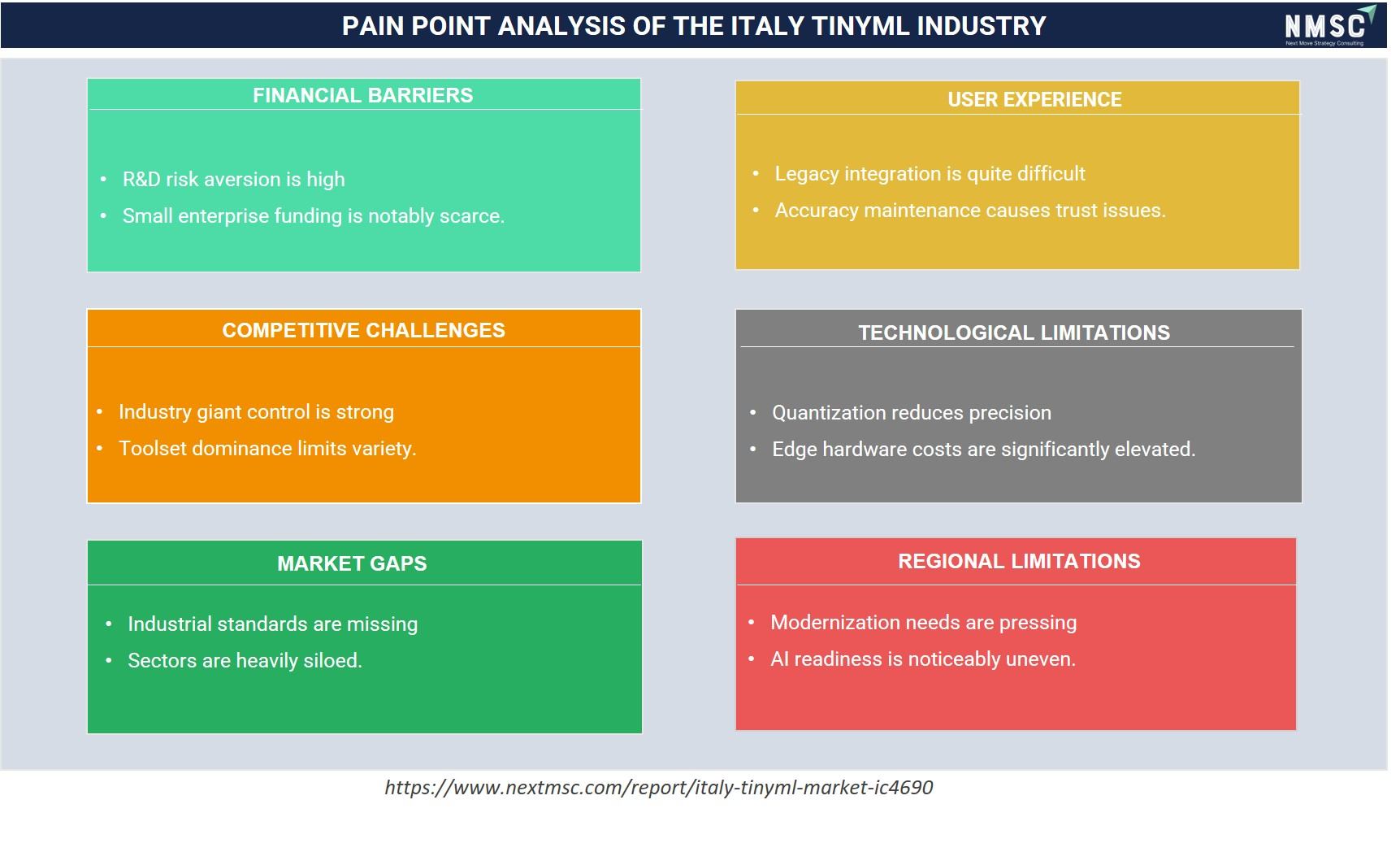
Our research demonstrates that the Italy TinyML industry faces financial constraints driven by high R&D risk aversion and limited funding access for small enterprises. Market fragmentation, lack of industrial standards, and sectoral silos further restrict innovation sharing across industries. Technological challenges such as model quantization, reduced precision, and high edge hardware costs also hinder scalable deployment. Additionally, reliance on legacy systems and uneven AI readiness across regions creates operational inefficiencies and a digital divide. Therefore, overcoming capital limitations and improving interoperability is essential for strengthening Italy’s TinyML ecosystem.
Key Players
-
Texas Instruments Incorporated
-
Analog Devices, Inc.
-
Microchip Technology Inc.
-
Infineon Technologies Americas Corp.
-
Silicon Laboratories Inc.
-
Espressif Systems (Shanghai) Co., Ltd.
-
Qualcomm Incorporated
-
Renesas Electronics Corporation
-
Nordic Semiconductor ASA
-
Ambiq Micro, Inc.
-
Lattice Semiconductor
-
Arduino S.A.
-
Arm Limited
Our analysis indicates that competitive dynamics in the Italy TinyML market are increasingly shaped by energy-efficient model performance, hardware-software co-optimization, and deployment scalability rather than raw processing power alone. We observe that leading players are actively investing in ultra-low-power microcontrollers, specialized neural processing units, and model compression techniques such as quantization and pruning to enable real-time inference on edge devices. The growing preference for on-device intelligence, in our view, reflects end-user priorities around latency reduction, data privacy, and bandwidth optimization across applications, including industrial monitoring, consumer electronics, healthcare devices, and smart infrastructure.
We also identified that market leaders are strengthening their positions through integrated development ecosystems, localized partnerships, and end-to-end TinyML deployment platforms that simplify model training, optimization, and edge integration. These strategies enable broader adoption while reducing the complexity associated with edge AI implementation and cloud dependency. As per our assessment, companies are increasingly focusing on developer tools, pre-trained model libraries, and cross-platform compatibility to enhance usability and accelerate time-to-market. Overall, we expect continued investment in edge AI hardware innovation, software frameworks, and application-specific model development to remain the key determinant of competitive positioning in the Italy TinyML market.
Italy TinyML Market Key Segments
By Component
-
Hardware
-
Processors
-
Microcontroller (MCU)
-
Application Processor (APU)
-
Neural Processing Unit (NPU)
-
Digital Signal Processor (DSP)
-
FPGA and Programmable Logic
-
-
Modules and Peripherals
-
Sensor Modules
-
Camera Modules
-
Microphone and Audio Modules
-
Connectivity Modules
-
-
-
Software
-
Development Tools and SDKs
-
Inference Frameworks and Runtimes
-
Model Optimization Tools
-
Device Management and Monitoring
-
Pretrained Models and Model Stores
-
-
Services
-
Professional and Integration Services
-
Managed and Support Services
-
Data Services and Model Training
-
By Application
-
Vision and Imaging
-
Audio and Speech Processing
-
Time-Series & Anomaly Detection
-
Health and Biosignal Monitoring
-
Environmental Sensing
-
Security and Authentication
-
Gesture and Activity Recognition
-
Localization and Navigation
-
Other Applications
By Deployment Mode
-
On-Device (Fully offline)
-
Cloud-Assisted
-
Edge-Assisted
By Industry Vertical
-
Consumer Electronics & Smart Home
-
Healthcare and Medical Devices
-
Industrial and Manufacturing
-
Automotive and Transportation
-
Agriculture
-
Retail
-
Aerospace and Defense
-
Energy and Utilities
-
Other Verticals
By Buyer Type
-
OEM and Device Makers
-
ODM and Contract Manufacturers
-
System Integrators and SI Partners
-
Distributors and Resellers
-
Direct to Enterprise
Key Benefits for Stakeholders:
Next Move Strategy Consulting (NMSC) presents a comprehensive analysis of the Italy TinyML market trends, covering historical developments from 2020 to 2025 and providing forward-looking forecasts through 2035. The study evaluates the market across regional levels, combining quantitative assessment with qualitative insights into key growth drivers, deployment trends, edge computing adoption, hardware-software integration, energy efficiency requirements, and investment activity across major TinyML components and end-use industries. Our analysis highlights how the evolution of low-power AI processing is reshaping embedded intelligence across sectors such as industrial automation, consumer electronics, healthcare, and smart infrastructure.
Our evaluation suggests that the Italy TinyML market delivers strong value across the technology ecosystem. Device manufacturers benefit from ultra-low-power AI capabilities that enable real-time data processing, reduced latency, and enhanced device autonomy without reliance on cloud connectivity. Investors gain exposure to long-term growth driven by the expansion of IoT ecosystems, increasing demand for edge intelligence, and advancements in semiconductor architectures. Developers, system integrators, and platform providers benefit from recurring opportunities through optimized model deployment, hardware-software co-design, and scalable edge AI solutions. Overall, the market supports digital transformation, operational efficiency, and the advancement of intelligent edge systems, reinforcing its strategic role in Italy’s emerging AI-driven economy.
|
Parameters |
Details |
|
Customization Scope |
Free Customization (equivalent to up to 80 analyst-working hours) after purchase. |
|
Pricing and Purchase Options |
Avail Customization purchase options to meet your exact research needs. |
|
Approach |
In-depth primary and secondary research; proprietary databases; rigorous quality control and validation measures. |
|
Analytical Tools |
Porter's Five Forces, SWOT, value chain, and Harvey ball analysis to assess competitive intensity, stakeholder roles, and relative impact of key factors. |
About the Author
 Tushmi Dutta
— Tushmi Dutta is a focused researcher specializing in detailed analysis and insight-driven research across diverse business landscapes. She supports strategic initiatives through structured data interpretation, thorough validation, and clear communication of findings that aid informed decision-making. With a strong interest in writing, she enjoys presenting research insights in an engaging and accessible manner. Beyond work, she enjoys traveling, reading, painting, and continuously learning new skills that contribute to her creative and professional growth.
Tushmi Dutta
— Tushmi Dutta is a focused researcher specializing in detailed analysis and insight-driven research across diverse business landscapes. She supports strategic initiatives through structured data interpretation, thorough validation, and clear communication of findings that aid informed decision-making. With a strong interest in writing, she enjoys presenting research insights in an engaging and accessible manner. Beyond work, she enjoys traveling, reading, painting, and continuously learning new skills that contribute to her creative and professional growth.
About the Reviewer
 Supradip Baul
— Supradip Baul is an accomplished business consultant and strategist with over a decade of rich experience in market intelligence, strategy, technology, and business transformation. His work has included rigorous qualitative and quantitative analysis across multiple industries, helping clients shape investment decisions and long-term roadmaps. Earlier in his career, he was associated with Gartner, where he contributed to industry-leading reports and market share analyses. He has worked with leading global companies and holds an MBA with a dual specialization in Marketing and Finance.
Supradip Baul
— Supradip Baul is an accomplished business consultant and strategist with over a decade of rich experience in market intelligence, strategy, technology, and business transformation. His work has included rigorous qualitative and quantitative analysis across multiple industries, helping clients shape investment decisions and long-term roadmaps. Earlier in his career, he was associated with Gartner, where he contributed to industry-leading reports and market share analyses. He has worked with leading global companies and holds an MBA with a dual specialization in Marketing and Finance.
At Next Move Strategy Consulting, we understand that insightful market research is the cornerstone of successful business decisions. That's why we employ a robust and multifaceted approach, combining various methodologies to deliver the most accurate and actionable data for our clients.

Research Landscape
We navigate the world of research with two primary approaches:
Qualitative Approach
Our qualitative research methodologies involve immersive techniques such as in-depth interviews, focus groups, and observational studies. By engaging directly with individuals and stakeholders, we uncover valuable insights that quantitative data alone may overlook.

Quantitative Research
In tandem with qualitative methodologies, NMSC leverages the power of Quantitative Research to provide a robust foundation of numerical insights. Through systematic data collection and analysis, we quantify patterns, preferences, and market trends, offering a comprehensive view of the business landscape.
Our quantitative research approach employs diverse tools, including surveys, experiments, and statistical modelling. These methodologies enable us to gather data from a large and representative sample, ensuring the statistical significance of our findings. By employing structured questionnaires and standardized data collection methods, we guarantee the reliability and validity of the information we present to our clients.
Quantitative research is particularly effective in measuring the prevalence of trends, assessing market size, and gauging the impact of various factors on consumer behavior. The numerical precision attained through this approach equips our clients with actionable insights, facilitating data-driven decision-making and strategy formulation.


Our Specialized Toolbox for Industry-Specific Market Research
We deploy a specialized arsenal of techniques tailored to meet your unique requirements. Here's a glimpse into our comprehensive toolbox:

Information Procurement
The stage entails acquiring market data or relevant information through various sources and methodologies.


Market Research Approach
We utilize both top-down and bottom-up approaches in market research analysis to achieve a comprehensive understanding of the market dynamics, leveraging the broad perspective of industry trends and macroeconomic factors alongside detailed insights from specific segments and individual companies.

Porters Five Forces Analysis
We conduct Porter's Five Forces analysis to evaluate the competitive landscape of an industry, providing us with insights into factors that affect profitability and strategic positioning.

SWOT Analysis

Forecasting
We utilize a forecasting model to predict future consumption by considering parameters like population, economics, regulations, market competition, drivers, constraints, technology, and pricing. We also employ statistical techniques such as multilinear regression, exponential smoothing, moving average, ARIMA, and Monte Carlo simulations for accurate predictions. In econometric forecasting, we analyzed short-term and long-term event impacts, attributing values based on regulatory frameworks, economic factors, and market events.





 Speak to Our Analyst