Live Cell Encapsulation Market Global Industry Analysis and Forecast (2026–2035)

The global Live Cell Encapsulation Market size was valued at USD 342.6 million in 2025 and is estimated at USD 376.9 million in 2026, forecast to reach USD 891.4 million by 2035, expanding at a 10.0% CAGR between 2025 and 2035. North America leads with approximately 45.2% share, while Alginate-Based Encapsulation dominates all other material types with approximately 41.9% share.

Download Free Sample PDF
Base Year (2025)
$342.6 Million
Forecast (2035)
$891.4 Million
CAGR (2026-2035)
10.0%
Top Region
North America

What Is the Live Cell Encapsulation Market Size?

The global live cell encapsulation market size was valued at USD 342.6 million in 2025 and is estimated at USD 376.9 million in 2026, forecast to reach USD 891.4 million by 2035, expanding at a 10.0% CAGR between 2025 and 2035. North America leads with approximately 45.2% share, while alginate-based encapsulation remains the largest material type with approximately 41.9% share.

We observed that growth is concentrated around diabetes-focused cell therapy programs, with regenerative medicine applications emerging as the fastest-expanding structural driver through 2035.

Live Cell Encapsulation Market Global Industry Analysis and Forecast (2026–2035) Revenue Forecast

Values in USD Million

2025 $342.6 Million
2025
2026 $376.9 Million
2026
2027 $414.6 Million
2027
2028 $456.0 Million
2028
2029 $501.7 Million
2029
2030 $551.8 Million
2030
2031 $607.0 Million
2031
2032 $667.7 Million
2032
2033 $734.5 Million
2033
2034 $807.9 Million
2034
2035 $891.4 Million
2035

Key Takeaways

By Material Type: Alginate-Based Encapsulation held the largest share of approximately 41.9% (USD 143.4 million) in 2025; Hydrogel-Based Encapsulation is the fastest-growing sub-segment at 12.3% CAGR from 2025–2035.

By Application: Diabetes & Islet Cell Therapy held the largest share of approximately 45.2% (USD 155.0 million) in 2025; Regenerative Medicine & Tissue Engineering is the fastest-growing sub-segment at 12.7% CAGR from 2025–2035.

By End User: Biotechnology & Pharmaceutical Companies held the largest share of approximately 52.4% (USD 179.5 million) in 2025; Contract Research Organizations is the fastest-growing sub-segment at 15.3% CAGR from 2025–2035.

Dominant Region: North America dominated with approximately 45.2% revenue share (USD 155.0 million) in 2025.

Fastest-Growing Region: Asia-Pacific is expected to register the highest CAGR of 14.4% during 2025–2035.

Dominant Country: U.S. led with approximately USD 118.3 million in 2025.

Fastest-Growing Country: China is the fastest-growing country at approximately 15.6% CAGR from 2025–2035.

Market Opportunity: The live cell encapsulation market is expected to create an absolute dollar opportunity of USD 514.5 million between 2026 and 2035, presenting significant investment potential across encapsulation biomaterials, islet cell therapy manufacturing, and regenerative medicine delivery platforms.

According to Next Move Strategy Consulting analysis, biopharmaceutical developers are increasingly pairing encapsulation platforms with stem cell-derived islet programs, a shift that favors vendors with integrated biomaterial and cell-manufacturing capabilities over standalone device suppliers as clinical pipelines mature through 2035.

What Does the Live Cell Encapsulation Market Encompass?

The live cell encapsulation market encompasses biomaterial-based devices and platforms that immunoprotect living therapeutic cells, most commonly pancreatic islet cells, within semi-permeable membranes for implantation with the aim of reducing or avoiding chronic immunosuppression. The scope spans alginate, hydrogel, and chitosan-based encapsulation materials supplied to biotechnology developers, academic research institutes, contract research organizations, and hospitals pursuing diabetes, regenerative medicine, and oncology applications. The category has evolved from experimental islet transplantation research toward clinical-stage development as stem cell-derived cell therapy pipelines advance.
Regulatory frameworks such as the U.S. FDA’s regenerative medicine advanced therapy designation and the European Union’s advanced therapy medicinal product framework influence clinical development and review for qualifying encapsulated cell products. We observed that technology adoption is shifting toward retrievable, vascularized encapsulation devices designed to improve oxygen and nutrient exchange for implanted cells. Next Move Strategy Consulting’s analysis indicates that this structural shift, combined with continued development of stem cell-derived islet programs, is influencing platform design priorities across the live cell encapsulation market.

Ecosystem Analysis of the Live Cell Encapsulation Market

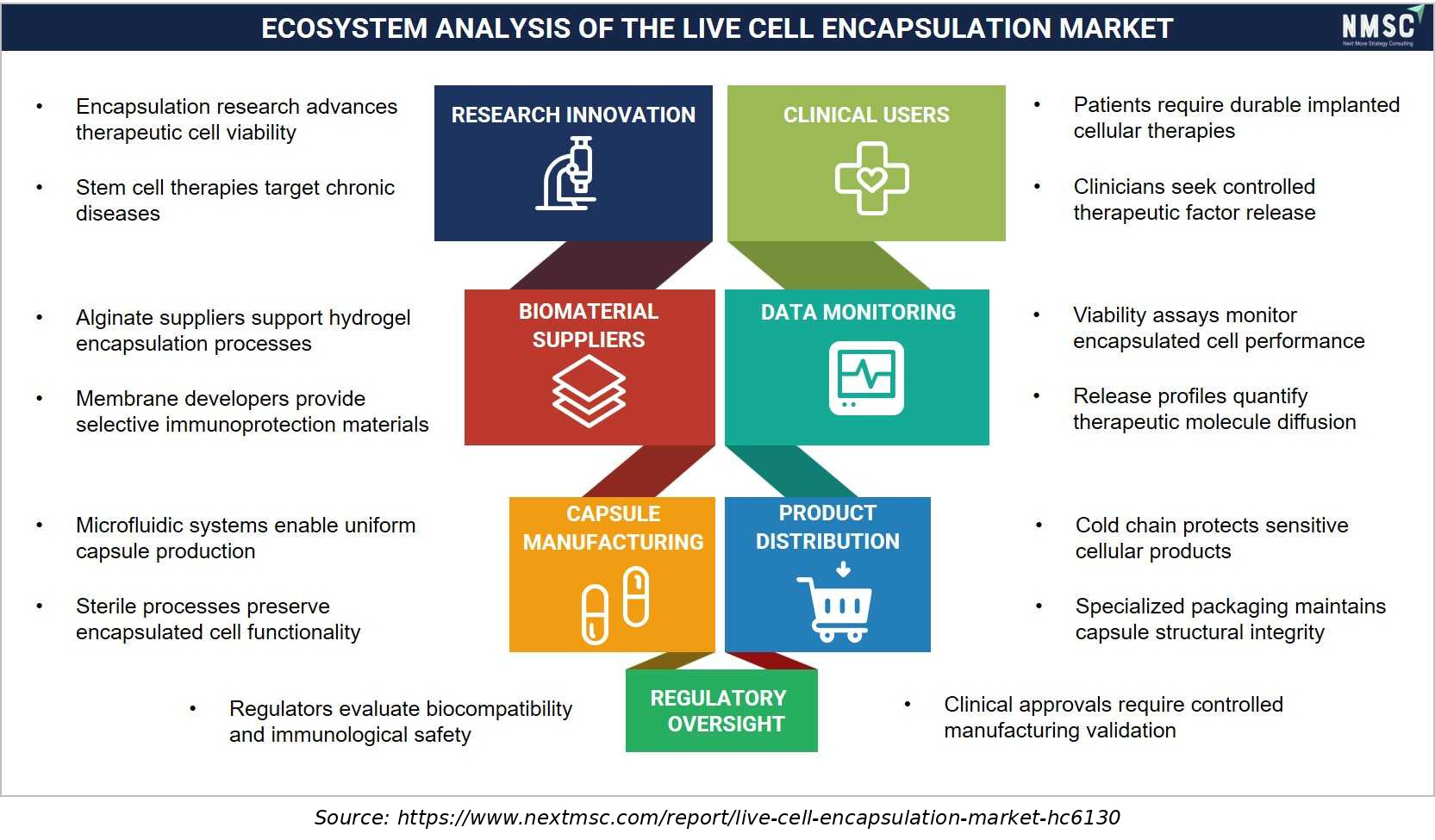
The Live Cell Encapsulation Market operates within an ecosystem connecting biomaterial suppliers, microfluidic capsule manufacturers, clinical users, and cold-chain distributors. Biocompatible hydrogels and selective immunoprotection membranes preserve cell viability for stem cell therapies. Ultimately, data monitoring through viability assays tracks performance, while regulatory oversight evaluates immunological safety and mandates controlled manufacturing validation to ensure compliant product distribution across the Live Cell Encapsulation Industry.

Market Drivers & Dynamics

Interactive Dataset
Rising prevalence of type 1 diabetes driving islet therapy demand driver Qualitative Global 2026–2035
Advancing stem cell-derived islet cell manufacturing capability driver Qualitative North America, Europe 2026–2035
Expanding regenerative medicine clinical pipelines driver Qualitative Global 2026–2033
Growing academic and government research funding for encapsulation biomaterials driver Qualitative North America, Europe 2026–2032
Rising contract research organization involvement in cell therapy trials driver Qualitative Global 2027–2035
High manufacturing complexity of clinical-grade encapsulation devices restraint Qualitative Global 2026–2031
Limited long-term clinical data on graft durability restraint Qualitative Global 2026–2030
High cost of stem cell-derived cell therapy programs restraint Qualitative Global 2026–2032
Regulatory complexity across advanced therapy approval pathways restraint Qualitative Europe, Asia-Pacific 2027–2035
Source: Next Move Strategy Consulting

Growth Drivers

What Is the Primary Growth Driver for the Live Cell Encapsulation Market?

Rising global prevalence of type 1 diabetes is the primary growth driver, as encapsulated islet cell therapy offers a potential alternative to lifelong insulin dependence. According to the U.S. National Institute of Diabetes and Digestive and Kidney Diseases, type 1 diabetes prevalence has continued rising among younger populations, sustaining demand for immunoprotected cell therapy approaches that avoid chronic immunosuppression. This epidemiological trend directly expands the addressable patient population for encapsulated islet programs.

How Is Stem Cell-Derived Manufacturing Driving Market Growth?

Advancing stem cell-derived islet cell manufacturing is driving market growth by removing the donor-tissue supply constraint that historically limited islet transplantation volume. We found that expanding capacity within broader cell therapy manufacturing infrastructure is enabling encapsulation developers to scale device production alongside growing manufactured-cell supply, a structural advantage supporting continued category growth.

Growth Inhibitors

What Is Restraining Live Cell Encapsulation Market Growth?

The high manufacturing complexity of clinical-grade encapsulation devices restrains broader market penetration, particularly for smaller biotechnology developers with limited process-engineering resources. Maintaining consistent membrane permeability and sterility at clinical scale remains technically demanding, while U.S. Food and Drug Administration guidance emphasizes process validation, material controls, and product consistency for cellular and regenerative medicine products, increasing development requirements for emerging entrants.

What Are the Growth Opportunities?

How Can Oxygen-Generating Encapsulation Materials Unlock New Revenue?

Oxygen-generating biomaterial additives designed to support encapsulated graft survival create an opportunity for material science suppliers serving islet therapy developers. Suppliers that commercialize enhanced-performance encapsulation components can pursue higher-value contracts without requiring biotechnology developers to redesign entire device platforms.

What Opportunity Exists in Regenerative Medicine Platform Licensing?

Licensing encapsulation platform technology to regenerative medicine developers pursuing non-diabetes indications creates an expansion opportunity for device originators. Neurological and orthopedic cell therapy developers gain access to established immunoprotection technology without bearing the full cost of platform development from first principles, while originators gain potential royalty-based revenue streams.

How Does Contract Manufacturing Create Recurring Service Revenue?

Contract manufacturing of clinical-grade encapsulation devices for smaller biotechnology sponsors creates recurring, trial-phase-linked service revenue for organizations with established production capacity. Emerging biotechnology developers gain access to compliant manufacturing capability without building dedicated in-house production infrastructure ahead of clinical trials, supporting readiness for early-stage studies.

Segmentation Analysis

2025 (USD Million)
2035 (USD Million)
Alginate-Based Encapsulation 2025: $143.4 Million | 2035: $303.3 Million
Alginate-Bas
Hydrogel-Based Encapsulation (Non-Alginate) 2025: $111.5 Million | 2035: $356.6 Million
Hydrogel-Bas
Chitosan & Other Polymer-Based Encapsulation 2025: $87.7 Million | 2035: $231.5 Million
Chitosan & O
Alginate-Based Encapsulation $143.4 Million $303.3 Million 7.8%
Hydrogel-Based Encapsulation (Non-Alginate) $111.5 Million $356.6 Million 12.3%
Chitosan & Other Polymer-Based Encapsulation $87.7 Million $231.5 Million 10.2%

Which Material Type Leads the Live Cell Encapsulation Market?

The material type axis defines the biomaterial platform used to immunoprotect encapsulated cells, spanning alginate, hydrogel, and chitosan-based systems. We observed that alginate-based encapsulation leads in 2025 given its established biocompatibility profile and extensive clinical-stage precedent. Hydrogel-based encapsulation is the fastest-growing sub-segment at a 12.3% CAGR, driven by improving oxygen permeability and mechanical stability that support long-term graft viability in vascularized implantation sites.

2025 (USD Million)
2035 (USD Million)
Diabetes & I
Regenerative
Cancer Thera
CNS & Neurol
Others (Opht
Segment Item 2025 (USD Million) 2035 (USD Million) CAGR
Diabetes & Islet Cell Therapy $10.0 USD Million $40.0 USD Million 18.0%
Regenerative Medicine & Tissue Engineering $17.1 USD Million $51.1 USD Million 16.0%
Cancer Therapy $24.2 USD Million $62.2 USD Million 22.0%
CNS & Neurological Disorders $31.3 USD Million $73.3 USD Million 12.0%
Others (Ophthalmic $38.4 USD Million $84.4 USD Million 19.0%

Segment-wise data is locked

Unlock complete segment-wise numbers for By Application.

Unlock Full Data

Which Application Segment Leads the Live Cell Encapsulation Market?

The application axis reflects the clinical use case for encapsulated cell products, from diabetes therapy to broader regenerative medicine. Diabetes and islet cell therapy lead in 2025 given the largest base of clinical-stage programs and established transplantation precedent. Regenerative medicine and tissue engineering applications are the fastest-growing segment at a 12.7% CAGR, as encapsulation platforms extend into neurological and orthopedic cell therapy pipelines beyond islet-focused programs.

2025 (USD Million)
2035 (USD Million)
Biotechnolog
Academic & R
Contract Res
Hospitals &
Segment Item 2025 (USD Million) 2035 (USD Million) CAGR
Biotechnology & Pharmaceutical Companies $10.0 USD Million $40.0 USD Million 26.0%
Academic & Research Institutes $17.1 USD Million $51.1 USD Million 16.0%
Contract Research Organizations $24.2 USD Million $62.2 USD Million 18.0%
Hospitals & Clinics $31.3 USD Million $73.3 USD Million 8.0%

Segment-wise data is locked

Unlock complete segment-wise numbers for By End User.

Unlock Full Data

Which End User Segment Leads the Live Cell Encapsulation Market?

The end user axis captures which organizations procure and deploy encapsulation platforms across the development and delivery chain. Biotechnology and pharmaceutical companies lead in 2025 as the primary sponsors of clinical-stage encapsulated cell therapy programs. We found that contract research organizations are the fastest-growing end user segment at a 15.3% CAGR, as biotechnology developers increasingly outsource specialized encapsulation trial management to organizations with dedicated cell therapy expertise.

Growth Opportunities

Beyond current demand drivers, three forward-looking market opportunities stand out for stakeholders positioning ahead of 2035.

How Can Oxygen-Generating Encapsulation Materials Unlock New Revenue?

Oxygen-generating biomaterial additives designed to support encapsulated graft survival create an opportunity for material science suppliers serving islet therapy developers. Suppliers that commercialize enhanced-performance encapsulation components can pursue higher-value contracts without requiring biotechnology developers to redesign entire device platforms.

What Opportunity Exists in Regenerative Medicine Platform Licensing?

Licensing encapsulation platform technology to regenerative medicine developers pursuing non-diabetes indications creates an expansion opportunity for device originators. Neurological and orthopedic cell therapy developers gain access to established immunoprotection technology without bearing the full cost of platform development from first principles, while originators gain potential royalty-based revenue streams.

How Does Contract Manufacturing Create Recurring Service Revenue?

Contract manufacturing of clinical-grade encapsulation devices for smaller biotechnology sponsors creates recurring, trial-phase-linked service revenue for organizations with established production capacity. Emerging biotechnology developers gain access to compliant manufacturing capability without building dedicated in-house production infrastructure ahead of clinical trials, supporting readiness for early-stage studies.

Regional Outlook

2025 (USD Million)
2035 (USD Million)
North Americ
Europe
Asia-Pacific
Middle East
Latin Americ
Region 2025 (USD Million) 2035 (USD Million) CAGR (%)
North America $10.0 USD Million $40.0 USD Million 9.0%
Europe $17.1 USD Million $51.1 USD Million 27.0%
Asia-Pacific $24.2 USD Million $62.2 USD Million 25.0%
Middle East & Africa $31.3 USD Million $73.3 USD Million 23.0%
Latin America $38.4 USD Million $84.4 USD Million 12.0%

Regional data is locked

Unlock complete regional numbers for this market.

Unlock Full Data

Regulatory Framework Impacting the Live Cell Encapsulation Market

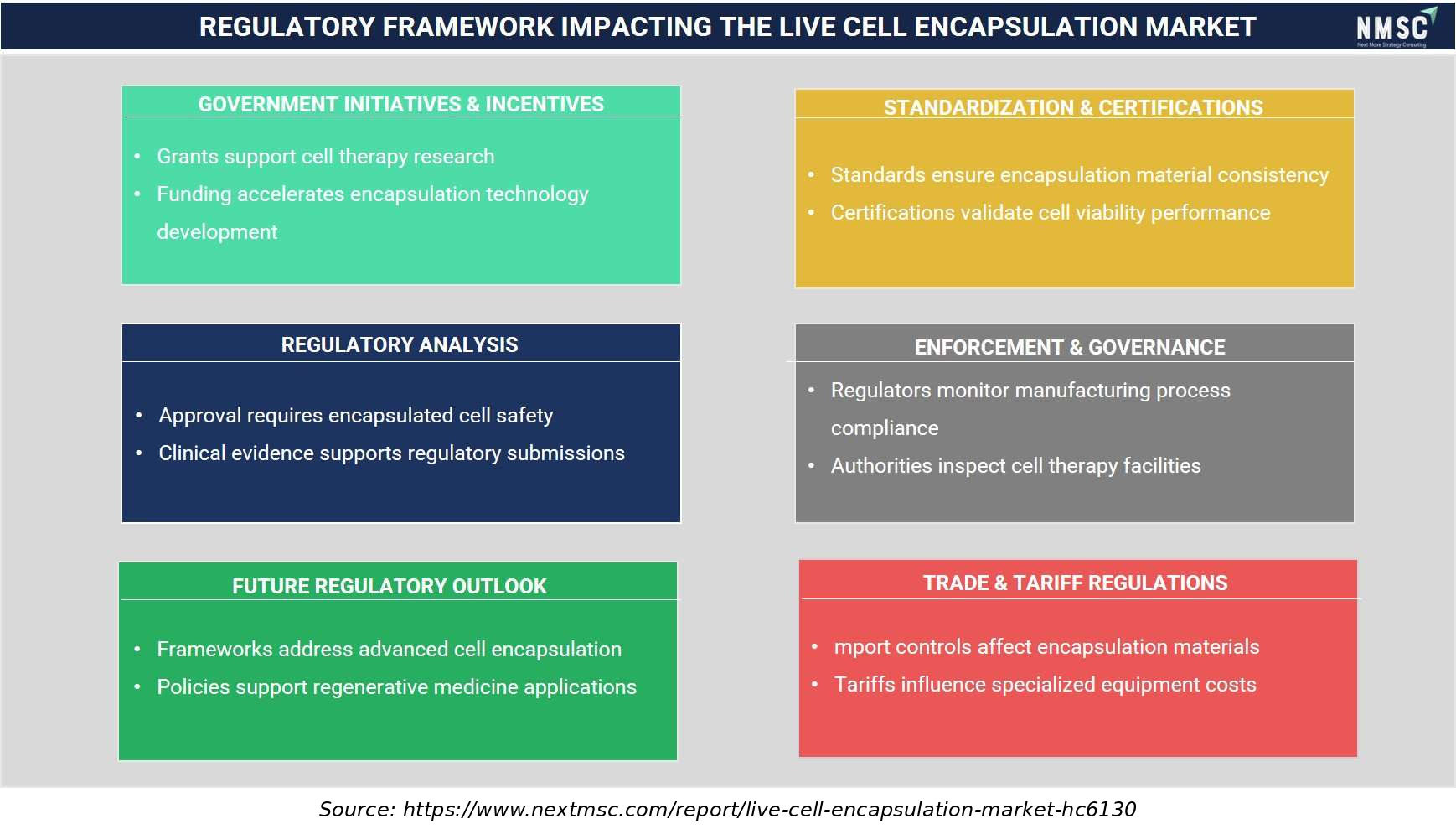
Government grants and funding support development in the Live Cell Encapsulation Market. Furthermore, material standards and certifications support consistent encapsulation performance, while clinical evidence supports regulatory submissions. Concurrently, manufacturing facility inspections and import controls influence product deployment, while evolving regulatory policies continue to shape regenerative medicine applications across the Live Cell Encapsulation Industry.

Competitive Landscape

The competitive landscape is fragmented across specialized device originators and diversified biomaterial suppliers, with clinical-stage biotechnology developers playing a central role in higher-value parts of the value chain.

Dimension Description
Market Structure Moderately fragmented, with specialized cell-encapsulation developers and biomaterial suppliers competing alongside diversified biotechnology and pharmaceutical companies across clinical-stage cell-therapy programs.
Innovation Focus Concentrated on vascularized and retrievable device architectures, oxygen-generating membrane technologies, and stem cell-derived islet integration.
M&A Activity Selective strategic collaborations and platform-focused transactions among biotechnology developers and cell-therapy technology providers to strengthen specialized capabilities and clinical development capacity.

How Do Companies Compete in the Live Cell Encapsulation Market?

Companies compete primarily on device immunoprotection performance, graft longevity data, and depth of clinical trial evidence. biotechnology developers with integrated cell-manufacturing and device capabilities reduce partnering friction with clinical sites, while specialized biomaterial suppliers compete on membrane permeability and biocompatibility performance for licensing to device originators.

Which Competitive Archetypes Dominate the Live Cell Encapsulation Market?

Two archetypes dominate: integrated biotechnology developers advancing proprietary encapsulated cell therapy candidates through clinical trials, and specialized biomaterial and device suppliers licensing platform technology to multiple developers. We found that the integrated developer archetype currently commands greater investor attention due to direct clinical pipeline ownership, while biomaterial suppliers differentiate through cross-platform licensing reach across multiple indications.

What Innovation and Differentiation Strategies Define Market Leadership?

Leading organizations are investing in vascularized and retrievable device architectures, oxygen-generating membrane technology, and stem cell-derived islet integration to improve graft survival outcomes. Next Move Strategy Consulting’s analysis indicates that developers pairing device innovation with transparent clinical trial disclosure are best positioned to advance regulatory review and secure downstream partnership interest.

How Active Is M&A in the Live Cell Encapsulation Market?

M&A activity remains limited in publicly disclosed live cell encapsulation-specific transactions, while larger biotechnology and pharmaceutical developers pursue strategic collaborations to access specialized encapsulation capabilities and clinical-stage platforms.

Key Market Players

The following companies represent key live cell encapsulation developers and biomaterial suppliers included in this report.

Vertex Pharmaceuticals Incorporated Sernova Corp. Beta-O2 Technologies Ltd. Defymed SA Giner Life Sciences, Inc. Living Cell Technologies Limited Cellec Biotek AG Cell Ideas Pty Ltd Corning Incorporated Merck KGaA Thermo Fisher Scientific Inc. Evonik Industries AG Danaher Corporation (Cytiva)

Latest Developments

Recent developments reflect mixed clinical progress and expanding biomaterial partnership activity across leading developers.

Date Event
July 2025 Sernova entered a Collaborative Research Agreement with Eledon Pharmaceuticals to evaluate tegoprubart as the immunosuppressive agent in Cohort C of its Cell Pouch Phase 1/2 trial. The collaboration directly addresses immune rejection surrounding transplanted islet cells and supports development of Sernova's implantable cell-containment platform for potential functional cures.
May 2025 Sernova reported interim findings from 12 patients receiving human donor islet cells through its Cell Pouch Bio-hybrid Organ. Results included islet engraftment, survival, function, improved glycemic control and insulin independence in eight patients. The findings strengthen clinical evidence supporting implantable cell-containment approaches for therapeutic islet transplantation.
March 2025 Vertex reported that its VX-264 Phase 1/2 program, using stem-cell-derived pancreatic islet cells encapsulated in a proprietary immunoprotective device, did not produce efficacy results supporting further clinical advancement. Vertex nevertheless stated it would continue developing novel research-stage immunoprotective approaches, highlighting critical performance challenges for encapsulation technologies.

Investment Opportunities

How Are Capital Inflows Shaping the Live Cell Encapsulation Market?

Research and development funding continues to support encapsulated cell therapy and biomaterial innovation, while private capital is increasingly directed toward developers with late-stage clinical data. This funding pattern places greater emphasis on programs with clearer clinical and regulatory pathways.

What Infrastructure Investment Trends Are Emerging in the Live Cell Encapsulation Market?

Infrastructure investment is concentrated in expanding clinical-grade manufacturing capacity for both encapsulation devices and stem cell-derived cell products. We found that integrated manufacturing planning is increasingly used to reduce logistical complexity and support sterility and quality requirements across advanced therapy development programs.

What ESG Considerations Apply to Live Cell Encapsulation Investment?

Environmental, social, and governance considerations center on equitable patient access to encapsulated cell therapies given potentially high per-patient treatment costs. We found that developers and investors are engaging with patient advocacy organizations such as JDRF on access and affordability frameworks, alongside clinical performance metrics when evaluating long-term program sustainability.

Key Benefits for Stakeholders

How Does This Report Benefit Biotechnology and Industry Leaders?

Biotechnology and industry leaders gain a structured view of segment-level growth rates and material type adoption patterns, supporting informed platform investment and partnership decisions. The report’s regional and application-level forecasts help industry leaders prioritize clinical development resources toward the highest-return indications within their therapeutic focus area, while competitive benchmarking clarifies which partnership archetypes are best suited to their pipeline stage.

How Does This Report Benefit Investors and Financial Analysts?

Investors and financial analysts gain access to validated market sizing, competitive positioning, and company-level rankings that support due diligence on both public and private encapsulated cell therapy investments. The report’s growth driver and restraint analysis clarifies which structural factors are most likely to influence near-term commercial revenue trajectories, helping analysts assess clinical and manufacturing execution risk.

How Does This Report Benefit Technology Vendors and Product Teams?

Technology vendors and product teams gain segment-level sizing that supports roadmap prioritization across material type, application, and end user offerings. The report’s regional outlook helps product teams sequence market-entry decisions based on regulatory maturity and competitive intensity across covered geographies, while the competitive landscape section benchmarks differentiation strategies used by leading developers.

Key Market Segments Evaluated

By Material Type

  • Alginate-Based Encapsulation
  • Hydrogel-Based Encapsulation (Non-Alginate)
  • Chitosan & Other Polymer-Based Encapsulation

By Application

  • Diabetes & Islet Cell Therapy
  • Regenerative Medicine & Tissue Engineering
  • Cancer Therapy
  • CNS & Neurological Disorders
  • Others (Ophthalmic, Wound Care)

By End User

  • Biotechnology & Pharmaceutical Companies
  • Academic & Research Institutes
  • Contract Research Organizations
  • Hospitals & Clinics

Conclusion & Recommendations

The long-term outlook remains strongly positive, with the market projected to expand from USD 342.6 million in 2025 to USD 891.4 million by 2035 at a 10.0% CAGR. The growth outlook is supported by stem cell-derived islet development and expanding regenerative medicine applications, while clinical development setbacks underscore the need for differentiated device and cell-manufacturing capabilities.

What Strategic Positioning Should Vendors Pursue?

Vendors should prioritize vascularized device architecture and integrated stem cell-derived cell manufacturing partnerships while pursuing licensing agreements with regenerative medicine developers beyond diabetes. developers combining biomaterial innovation with transparent clinical trial disclosure will be best positioned to capture premium partnership and licensing engagements within the live cell encapsulation market.

How Attractive Is the Live Cell Encapsulation Market for New Investment?

The live cell encapsulation industry presents an attractive investment case, supported by a USD 514.5 million absolute dollar opportunity between 2026 and 2035 and above-average growth in Asia-Pacific and regenerative medicine application categories. We found that investment attractiveness is highest for developers combining late-stage clinical data with integrated device and cell-manufacturing capabilities, positioning them to capture both diabetes and broader regenerative medicine opportunities simultaneously.

What Market Shifts and Key Risks Should Stakeholders Monitor?

Stakeholders should monitor manufacturing complexity, limited long-term graft durability data, and regulatory approval timelines as key risks to the live cell encapsulation market. Developers that fail to demonstrate consistent clinical-grade manufacturing face greater regulatory scrutiny, particularly within Europe’s structured advanced therapy medicinal product review environment.

What Are the Key Growth Pathways for the Live Cell Encapsulation Market?

Key growth pathways include scaling stem cell-derived islet manufacturing, expanding regenerative medicine licensing partnerships, and deepening contract research organization involvement in encapsulation clinical trials. Next Move Strategy Consulting’s analysis indicates that developers pursuing these pathways while maintaining rigorous clinical data disclosure will be best positioned to capture the live cell encapsulation market's projected growth through 2035.

FAQs

About the Author

Saista Faiyaz

Saista Faiyaz

Saista Faiyaz is Research Associate at Next Move Strategy Consulting, where she has covered consumer markets and healthcare technologies for 3 years. Her work includes primary interview review, secondary-source validation, market sizing, and structured analysis of company and industry data. She supports research by comparing evidence across sources, organizing findings into market narratives, and documenting assumptions used in analysis. Her scope includes cross-market benchmarking, and reports.

About the Reviewer

Supradip Baul

Supradip Baul

Supradip Baul is an accomplished business consultant and strategist with over a decade of rich experience in market intelligence, strategy, technology, and business transformation. His work has included rigorous qualitative and quantitative analysis across multiple industries, helping clients shape investment decisions and long-term roadmaps. Earlier in his career, he was associated with Gartner, where he contributed to industry-leading reports and market share analyses. He has worked with leading global companies and holds an MBA with a dual specialization in Marketing and Finance.

Download Free Sample

Mohit Agarwal

MOHIT AGARWAL

Chief Manager

DryChem India Pvt. Ltd.

Next Move Strategy Consulting is an amazing team of consultants. We required a market study report for our investors on top priority and the team went above and beyond our expectations to deliver the same with ample supporting data within a short time span enabling us to secure the investments and keep our project timeline maintained. Their professionalism, attention to detail, and timely delivery of actionable recommendations have left a lasting impression on our organization.

Rishabh Jogani

RISHABH JOGANI

Strategy Analyst

Accenture Japan

We are incredibly impressed with the market report on the real estate market in India provided by Next Move Strategy Consulting. The report was thorough, insightful, and well-structured, offering deep analysis and actionable recommendations. It not only captured the current trends and dynamics but also provided a forward-looking perspective that has been invaluable for our strategic planning. Their team demonstrated exceptional professionalism, attention to detail, and a profound understanding of the industry. The data-driven insights and clarity of presentation exceeded our expectations, making complex market trends easy to understand. We highly recommend Next Move Strategy Consulting to anyone looking for reliable and comprehensive market research services. Their expertise has given us the confidence to navigate the complexities of the Indian real estate market with clarity and foresight.

Gustaf Hummel Burstrom

GUSTAF HUMMEL BURSTROM

Founder

Revline Tools AB

Joseph and the team at Next Move Strategy Consulting have been excellent to work with, in supplying us with relevant market data and forecasts for our specific category. We had some special requirements and they were able to do a custom package to suit our needs. We would definitely recommend them to any other company needing market data and forecasts

Amos Chang

AMOS CHANG

Strategy Consultant

Kardex Group

I have bought the intralogistics market reports from NMSC two times so far. Joseph and his team are always very helpful and flexible in responding to any customization requirements on the report. Their expertise in market reports really helps us steer the day-to-day business. I will definitely recommend and come back myself whenever there is a need.

Robert Sean Trevino

ROBERT SEAN TREVINO

Sr. Director, Head of Strategic Insights & Analytics

Foundation Medicine

I realized that it was a reliable source of information. These days, there are many people who are looking for authentic data, and this is one of the only sources that can offer them with what they need;

Custom Market Research Services

We will customize the research for you if the listed report does not fully match your requirements.

Get 30% Free Customization

Select License

This website uses cookies to ensure you get the best experience on our website. Learn more

✖