Lower Respiratory Tract Infection Treatment Market

Lower Respiratory Tract Infection Treatment Market size was USD 64.18 Billion in 2025, projected to reach USD 127.14 Billion by 2035, growing at a CAGR of 6.78% from 2026 to 2035. Key drivers include the rising global burden of pneumonia and bronchiolitis, increasing antimicrobial resistance, and demand for advanced antibacterial therapies, while pricing pressure on generic treatments remains a key restraint.

Download Free Sample PDF
Base Year (2025)
$64.18 Billion
Forecast (2035)
$127.14 Billion
CAGR (2026-2035)
6.8%
Top Region
North America

What Is the Lower Respiratory Tract Infection Treatment Market Size?

The global lower respiratory tract infection treatment market size was valued at USD 64.18 Billion in 2025 and is estimated to grow from USD 70.47 Billion in 2026 to USD 127.14 Billion by 2035, expanding at a CAGR of 6.78% between 2026 and 2035. North America led the lower respiratory tract infection treatment market with an approximate 30% revenue share in 2025, while Antibacterial Treatment remained the dominant product class with an approximate 62% share of global revenue.

We observed that the lower respiratory tract infection treatment market's momentum is best captured through a concise set of indicators before deeper analysis follows.

Lower Respiratory Tract Infection Treatment Market Revenue Forecast

Values in USD Billion

2025 $64.18 Billion
2025
2026 $68.53 Billion
2026
2027 $73.18 Billion
2027
2028 $78.14 Billion
2028
2029 $83.44 Billion
2029
2030 $89.09 Billion
2030
2031 $95.13 Billion
2031
2032 $101.58 Billion
2032
2033 $108.47 Billion
2033
2034 $115.83 Billion
2034
2035 $127.14 Billion
2035

Key Takeaways

By Product Class: Antibacterial Treatment held the largest share of approximately USD 39.79 billion in 2025 and is projected to reach USD 73.74 billion by 2035; Antimycobacterial Treatment is the fastest-growing sub-segment at 8.72% CAGR from 2026–2035.

By Clinical Indication: Pneumonia held the largest share of approximately USD 44.93 billion in 2025 and is projected to reach USD 86.46 billion by 2035; Bronchiolitis is the fastest-growing sub-segment at 9.49% CAGR from 2026–2035.

By Age Group: Adult held the largest share of approximately USD 25.67 billion in 2025 and is projected to reach USD 48.31 billion by 2035; Older Adult is the fastest-growing sub-segment at 9.03% CAGR from 2026–2035.

Dominant Region: North America dominated with approximately USD 19.25 billion in 2025 and is projected to reach USD 33.06 billion by 2035.

Fastest-Growing Region: Latin America is expected to register the highest CAGR of 10.94% during 2026–2035.

Dominant Country: U.S. was the largest single national contributor within North America in 2025.

Fastest-Growing Country: Brazil is the fastest-growing country, with its CAGR outpacing the regional Latin America average.

Market Opportunity: The lower respiratory tract infection treatment market is projected to generate an incremental revenue opportunity of approximately USD 56.67 Billion between 2026 and 2035, reflecting the absolute dollar gap between the 2035 forecast and the 2026 base value a signal of sustained investment in both established antibacterial regimens and newer antiviral and antimycobacterial therapies.

According to NMSC analysis, rising antimicrobial resistance is progressively shifting prescriber preference toward newer beta-lactam and lipoglycopeptide classes, a dynamic not fully captured in aggregate revenue figures but material to future product-class mix.

What does the Lower Respiratory Tract Infection Treatment Market Encompass?

The lower respiratory tract infection treatment market encompasses pharmaceutical therapies used to treat infections of the trachea, bronchi, bronchioles, and lungs, including pneumonia, acute bronchitis, and bronchiolitis, across antibacterial, antiviral, antifungal, antimycobacterial, and antiparasitic drug classes. Our assessment indicates that the market's scope spans originator and generic products delivered through oral, parenteral, and inhaled routes, dispensed across hospital, retail, specialty, and government procurement channels to pediatric, adult, and older adult patients.
Structurally, the market has evolved from broad-spectrum empirical therapy toward etiology-guided and resistance-aware prescribing supported by rapid diagnostics. We found that regulatory environments administered by the U.S. Food and Drug Administration and the European Medicines Agency continue to prioritize antimicrobial stewardship guidance, while technology adoption trends in point-of-care pathogen testing are shortening time-to-appropriate-therapy and influencing product-class selection across hospital and outpatient settings.

Regulatory Pillars Shaping the Lower Respiratory Tract Infection Treatment Market

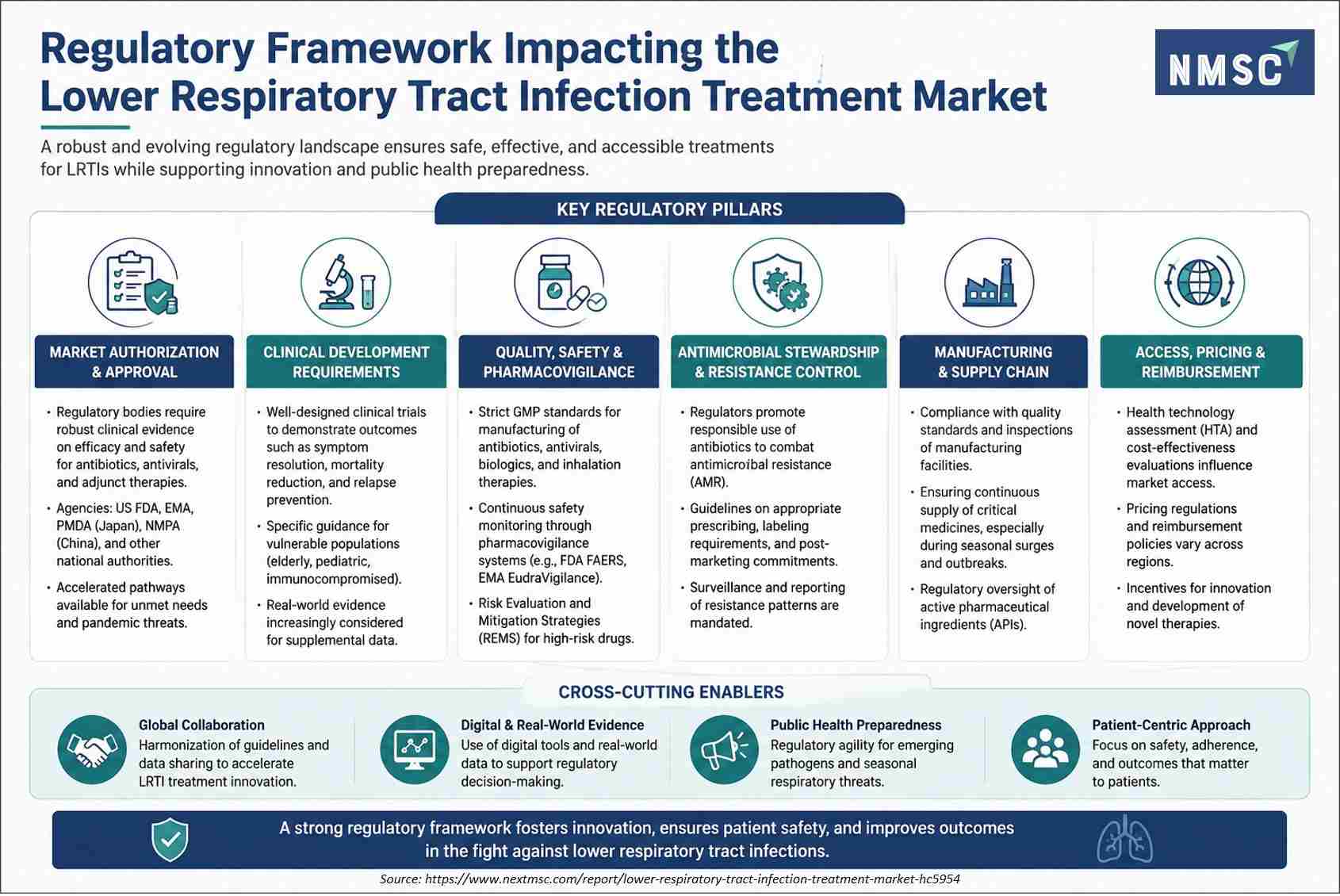
Regulatory Pillars Shaping the Lower Respiratory Tract Infection Treatment Market
This infographic presents the key regulatory pillars shaping the Lower Respiratory Tract Infection Treatment Market, covering market authorization, clinical development, quality and safety, antimicrobial stewardship, manufacturing, supply chain, access, pricing, and reimbursement. It also highlights cross-cutting enablers such as global collaboration, digital real-world evidence, public health preparedness, and patient-centric care, emphasizing how strong regulation supports innovation, patient safety, treatment accessibility, and improved outcomes.

Market Drivers & Dynamics

Interactive Dataset
Rising global burden of pneumonia and bronchiolitis driver +1.6% Global 2026–2035
Expansion of antimicrobial resistance-targeted therapies driver +1.3% North America, Europe 2026–2035
Growth of point-of-care diagnostic-guided prescribing driver +0.9% North America, Europe, APAC 2026–2032
Rising elderly population susceptible to LRTI driver +0.8% North America, Europe, Japan 2026–2035
Expansion of generic manufacturing capacity driver +0.7% Asia-Pacific, Latin America 2026–2035
Pricing pressure on generic antibacterial therapies restraint −0.6% Asia-Pacific, Latin America 2026–2035
Stringent regulatory approval pathways for new antibacterials restraint −0.5% North America, Europe 2026–2032
Limited reimbursement for newer high-cost therapies restraint −0.4% Middle East & Africa, Latin America 2026–2033
Source: Next Move Strategy Consulting

Growth Drivers

What Is the Primary Growth Driver for the Lower Respiratory Tract Infection Treatment Market?

The rising global burden of pneumonia and bronchiolitis is the primary growth driver, sustaining consistent treatment demand across pediatric and older adult populations. The World Health Organization identifies lower respiratory infections as remaining among the leading infectious causes of death worldwide, underscoring the scale of the addressable patient population from which treatment demand is expanding through the forecast period.

How Is Antimicrobial Resistance Driving the Market Growth?

Antimicrobial resistance is driving growth by increasing reliance on newer, higher-cost antibacterial classes when first-line generic therapy fails. Company analysis indicates that hospital systems are expanding stewardship-linked formulary spend on beta-lactam combinations and lipoglycopeptides. Based on research conducted by NMSC, we found that this shift is most pronounced in intensive care and hospital-acquired pneumonia treatment settings.

Growth Inhibitors

What Is Restraining the Lower Respiratory Tract Infection Treatment Market?

Pricing pressure on generic antibacterial therapies is restraining overall revenue growth, as government procurement and retail pharmacy channels in price-sensitive markets negotiate aggressive volume-based discounts. We observed that this restraint is most pronounced across Asia-Pacific and Latin American public procurement systems, compressing per-unit revenue even as treated patient volumes continue to rise.

Segmentation Analysis

2025 (USD Billion)
2035 (USD Billion)
Antibacterial Treatment 2025: $39.79 Billion | 2035: $73.74 Billion
Antibacteria
Antiviral Treatment 2025: $12.84 Billion | 2035: $27.97 Billion
Antiviral Tr
Antifungal Treatment 2025: $5.13 Billion | 2035: $11.44 Billion
Antifungal T
Antimycobacterial Treatment 2025: $3.85 Billion | 2035: $8.90 Billion
Antimycobact
Antiparasitic Treatment 2025: $1.28 Billion | 2035: $2.54 Billion
Antiparasiti
Other Anti-Infective Treatment 2025: $1.29 Billion | 2035: $2.55 Billion
Other Anti-I
Antibacterial Treatment $39.79 Billion $73.74 Billion 6.34%
Antiviral Treatment $12.84 Billion $27.97 Billion 8.17%
Antifungal Treatment $5.13 Billion $11.44 Billion 8.39%
Antimycobacterial Treatment $3.85 Billion $8.90 Billion 8.72%
Antiparasitic Treatment $1.28 Billion $2.54 Billion 7.05%
Other Anti-Infective Treatment $1.29 Billion $2.55 Billion 7.00%

Which Product Class Dominates the Lower Respiratory Tract Infection Treatment Market?

Antibacterial Treatment dominates product-class segmentation with an estimated USD 39.79 Billion in 2025, rising to USD 73.74 Billion by 2035, reflecting the bacterial etiology of most treated pneumonia and bronchitis cases. Antimycobacterial Treatment is the fastest-growing segment at a 8.72% CAGR, reflecting expanded tuberculosis treatment access programs and newer diarylquinoline-class therapies entering broader clinical use.

2025 (USD Billion)
2035 (USD Billion)
Pneumonia 2025: $44.93 Billion | 2035: $86.46 Billion
Pneumonia
Acute Bronchitis 2025: $11.55 Billion | 2035: $21.61 Billion
Acute Bronch
Bronchiolitis 2025: $5.13 Billion | 2035: $12.71 Billion
Bronchioliti
Other Lower Respiratory Tract Infections 2025: $2.57 Billion | 2035: $6.36 Billion
Other Lower
Pneumonia $44.93 Billion $86.46 Billion 6.79%
Acute Bronchitis $11.55 Billion $21.61 Billion 6.46%
Bronchiolitis $5.13 Billion $12.71 Billion 9.49%
Other Lower Respiratory Tract Infections $2.57 Billion $6.36 Billion 9.48%

Which Clinical Indication Leads and Which Is Growing Fastest?

Pneumonia leads clinical-indication segmentation with USD 44.93 Billion in 2025 revenue, reflecting its status as the largest single cause of lower respiratory tract infection-related mortality and hospitalization. Bronchiolitis is the fastest-growing indication at a 9.49% CAGR, driven by rising diagnosed incidence among infants and expanded treatment protocols in neonatal and pediatric intensive care settings.

2025 (USD Billion)
2035 (USD Billion)
Pediatric 2025: $17.97 Billion | 2035: $30.51 Billion
Pediatric
Adult 2025: $25.67 Billion | 2035: $48.31 Billion
Adult
Older Adult 2025: $20.54 Billion | 2035: $48.32 Billion
Older Adult
Pediatric $17.97 Billion $30.51 Billion 5.44%
Adult $25.67 Billion $48.31 Billion 6.53%
Older Adult $20.54 Billion $48.32 Billion 9.03%

Which Age Group Segment Is Gaining the Most Ground?

Adult remains the largest age-group segment with USD 25.67 Billion in 2025 revenue, reflecting the broad working-age population base treated for community-acquired pneumonia and bronchitis. Older Adult is growing fastest at a 9.03% CAGR as aging populations across North America, Europe, and Japan drive rising hospital-acquired and aspiration pneumonia treatment volumes.

2025 (USD Billion)
2035 (USD Billion)
Oral
Tablet
Capsule
Oral Suspens
Oral Solutio
Segment Item 2025 (USD Billion) 2035 (USD Billion) CAGR
Oral $10.0 USD Billion $40.0 USD Billion 19.0%
Tablet $17.1 USD Billion $51.1 USD Billion 25.0%
Capsule $24.2 USD Billion $62.2 USD Billion 23.0%
Oral Suspension $31.3 USD Billion $73.3 USD Billion 13.0%
Oral Solution $38.4 USD Billion $84.4 USD Billion 22.0%

Segment-wise data not detailed in this view

Unlock complete segment-wise numbers for By Route of Administration.

Unlock Full Data
2025 (USD Billion)
2035 (USD Billion)
Originator
Generic
Branded Gene
Unbranded Ge
Segment Item 2025 (USD Billion) 2035 (USD Billion) CAGR
Originator $10.0 USD Billion $40.0 USD Billion 24.0%
Generic $17.1 USD Billion $51.1 USD Billion 22.0%
Branded Generic $24.2 USD Billion $62.2 USD Billion 16.0%
Unbranded Generic $31.3 USD Billion $73.3 USD Billion 22.0%

Segment-wise data not detailed in this view

Unlock complete segment-wise numbers for By Product Status.

Unlock Full Data
2025 (USD Billion)
2035 (USD Billion)
Bacterial
Gram-Positiv
Gram-Negativ
Atypical Bac
Mixed Bacter
Segment Item 2025 (USD Billion) 2035 (USD Billion) CAGR
Bacterial $10.0 USD Billion $40.0 USD Billion 24.0%
Gram-Positive $17.1 USD Billion $51.1 USD Billion 10.0%
Gram-Negative $24.2 USD Billion $62.2 USD Billion 8.0%
Atypical Bacteria $31.3 USD Billion $73.3 USD Billion 10.0%
Mixed Bacterial $38.4 USD Billion $84.4 USD Billion 21.0%

Segment-wise data not detailed in this view

Unlock complete segment-wise numbers for By Etiology.

Unlock Full Data
2025 (USD Billion)
2035 (USD Billion)
Inpatient
General Ward
Intensive Ca
Outpatient
Physician Cl
Segment Item 2025 (USD Billion) 2035 (USD Billion) CAGR
Inpatient $10.0 USD Billion $40.0 USD Billion 19.0%
General Ward $17.1 USD Billion $51.1 USD Billion 9.0%
Intensive Care $24.2 USD Billion $62.2 USD Billion 11.0%
Outpatient $31.3 USD Billion $73.3 USD Billion 21.0%
Physician Clinic $38.4 USD Billion $84.4 USD Billion 18.0%

Segment-wise data not detailed in this view

Unlock complete segment-wise numbers for By Treatment Setting.

Unlock Full Data
2025 (USD Billion)
2035 (USD Billion)
Hospital and
Retail Pharm
Specialty Ph
Government P
Other Licens
Segment Item 2025 (USD Billion) 2035 (USD Billion) CAGR
Hospital and Health-System Procurement $10.0 USD Billion $40.0 USD Billion 17.0%
Retail Pharmacy $17.1 USD Billion $51.1 USD Billion 15.0%
Specialty Pharmacy $24.2 USD Billion $62.2 USD Billion 21.0%
Government Procurement $31.3 USD Billion $73.3 USD Billion 15.0%
Other Licensed Pharmaceutical Channels $38.4 USD Billion $84.4 USD Billion 12.0%

Segment-wise data not detailed in this view

Unlock complete segment-wise numbers for By Distributional Channel.

Unlock Full Data

Growth Opportunities

Beyond current demand drivers, three whitespace opportunities stand out as forward-looking mechanisms for revenue expansion through 2035.

Can Diagnostic-Linked Therapy Bundles Expand Outpatient Access?

Bundling rapid point-of-care diagnostics with matched first-line therapy protocols can expand appropriate treatment access in outpatient physician clinics and urgent care settings. This mechanism primarily benefits generic antibacterial manufacturers positioned to supply diagnostic-linked prescribing programs at scale.

Will Inhaled Combination Therapies Address Resistant Hospital-Acquired Pneumonia?

Targeted inhaled combination therapies for ventilator-associated and hospital-acquired pneumonia offer a mechanism to address resistant pathogens without the systemic exposure of intravenous alternatives. Specialty pharmaceutical manufacturers with inhaled delivery expertise stand to benefit most from this narrow but high-value clinical niche.

Can Expanded Antimycobacterial Access Programs Unlock Emerging-Market Demand?

Government and NGO-backed tuberculosis treatment access programs can unlock incremental antimycobacterial demand across high-burden Asia-Pacific and African markets. Generic manufacturers with established government procurement relationships are best positioned to capture this opportunity as national treatment programs expand coverage.

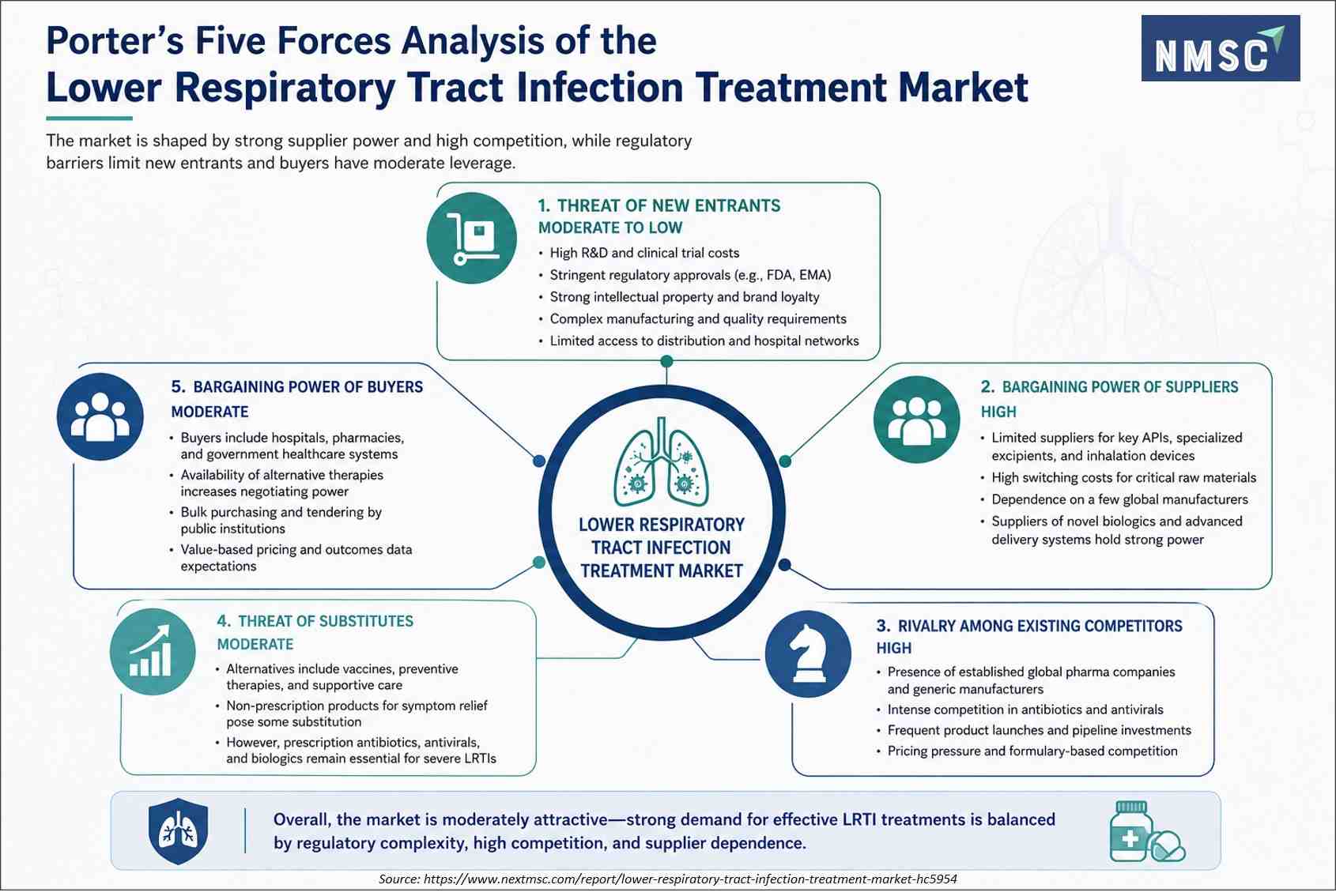
Porter’s Five Forces analysis of the Lower Respiratory Tract Infection Treatment Market

This infographic presents a Porter’s Five Forces analysis of the Lower Respiratory Tract Infection Treatment Market. It highlights moderate-to-low threat of new entrants, high supplier bargaining power, high rivalry among existing competitors, moderate threat of substitutes, and moderate buyer bargaining power. The analysis emphasizes regulatory complexity, dependence on specialized APIs and manufacturing capabilities, intense pharmaceutical competition, alternative treatment options, and procurement dynamics, concluding that the market is moderately attractive due to strong demand balanced by competitive and structural pressures.

Regional Outlook

North America $19.25 Billion $33.06 Billion 5.53%
Europe $14.12 Billion $24.16 Billion 5.50%
Asia-Pacific $21.18 Billion $45.77 Billion 8.05%
Middle East & Africa $5.13 Billion $11.44 Billion 8.38%
Latin America $4.50 Billion $12.71 Billion 10.94%

Competitive Landscape

Our findings suggest that the competitive landscape spans diversified originator pharmaceutical majors and large-scale generic manufacturers, each pursuing distinct differentiation strategies across the treatment value chain. Dimension | Assessment Market Structure | Moderately consolidated; originator majors hold branded-therapy share while generic manufacturers compete intensely on volume and price Innovation Focus | Resistance-targeted antibacterial development, inhaled delivery formulations, antimycobacterial regimen shortening M&A Activity | Moderate; generic manufacturers pursue capacity expansion while originators license novel resistance-targeted assets Source: www.nextmsc.com

How Do Companies Compete in the Lower Respiratory Tract Infection Treatment Market?

Companies compete primarily on breadth of product-class portfolio, regulatory approval pipeline strength, and manufacturing scale for generic volume. Our analysis shows that originator firms with novel resistance-targeted therapies sustain premium pricing, while generic manufacturers compete on cost efficiency and government procurement relationships across high-volume public health markets.

Which Competitive Archetypes Dominate the Industry?

Two archetypes dominate: diversified originator pharmaceutical majors with broad anti-infective portfolios, and large-scale generic manufacturers concentrated in India and Israel. We observed that the differentiation between these archetypes is narrowing as generic manufacturers expand into specialty and branded-generic segments previously reserved for originators.

What Innovation and Differentiation Strategies Are Companies Pursuing?

Company analysis indicates that leading firms are differentiating through resistance-targeted beta-lactam and lipoglycopeptide development, alongside inhaled delivery formulation investment for severe hospital-acquired infections. Investment in shortened-course antimycobacterial regimens continues, alongside expanded generic manufacturing capacity in Asia-Pacific and Latin America.

How Active Is M&A in the Lower Respiratory Tract Infection Treatment Industry?

M&A activity remains moderate as generic manufacturers pursue capacity-expanding acquisitions while originator firms license novel resistance-targeted assets from smaller biotechnology developers. Based on research conducted by NMSC, we found that licensing deals increasingly target antimycobacterial and inhaled antibacterial assets, reflecting strategic pivots toward the fastest-growing product classes.

Key Market Players

Our assessment indicates that the following companies represent the validated set of key players shaping competitive dynamics across antibacterial, antiviral, antifungal, and antimycobacterial treatment within the lower respiratory tract infection treatment market.

Pfizer Inc. Merck & Co., Inc. Gilead Sciences, Inc. GSK plc F. Hoffmann-La Roche Ltd Viatris Inc. Teva Pharmaceutical Industries Ltd. Sandoz Group AG Fresenius Kabi AG Hikma Pharmaceuticals PLC Cipla Limited Sun Pharmaceutical Industries Limited Lupin Limited Aurobindo Pharma Limited Dr. Reddy’s Laboratories Limited AbbVie Inc. Alkem Laboratories Limited Shionogi & Co., Ltd. Basilea Pharmaceutica Ltd Wockhardt Limited

Latest Developments

We observed that recent developments across the industry reflect continued investment in resistance-targeted therapy development and generic manufacturing capacity.

Date Event
December 2025 Hikma launched TYZAVAN™, a room-temperature-stable, ready-to-use vancomycin premix supplied in pre-filled bags in the United States. The formulation is indicated for lower respiratory tract infections, among other serious infections. Its ready-to-use format eliminates the need for thawing, compounding, or dilution, potentially supporting faster and more convenient hospital antibiotic administration in time-critical infections.

Expert Insights

Dr. Kate O’Brien

Dr. Kate O’Brien

Director, Department of Immunization, Vaccines and Biologicals | World Health Organization (WHO)

"“The WHO-recommended RSV immunization products can transform the fight against severe RSV disease, dramatically reduce hospitalizations, and deaths, ultimately saving many infant lives globally.”"

Analyst Interpretation

The statement highlights the growing shift in the Lower Respiratory Tract Infection Treatment Market toward prevention and early intervention alongside conventional treatment. RSV is a major cause of lower respiratory tract disease in infants, and severe infections can require hospitalization and respiratory support. The increasing availability of maternal RSV vaccines and long-acting monoclonal antibodies is therefore creating an important complementary pathway within the respiratory infection treatment landscape. Wider adoption of these preventive interventions could reduce the incidence of severe RSV-associated LRTIs and subsequently influence demand for hospitalization, supportive care and other downstream respiratory treatments.

Investment Opportunities

Where Is Capital Flowing Within the Lower Respiratory Tract Infection Treatment Market?

Capital inflows are concentrated in resistance-targeted antibacterial development licensing deals and generic manufacturing capacity expansion across Asia-Pacific. We found that public health-linked funding continues to support antimycobacterial treatment access programs, signaling sustained institutional interest in tuberculosis-focused therapy development.

How Significant Is Infrastructure Investment in This Market?

Infrastructure investment is substantial, with generic manufacturers expanding sterile injectable and oral solid dosage production capacity to meet rising government procurement demand. Our assessment indicates that continued investment in point-of-care diagnostic infrastructure is becoming a prerequisite for resistance-aware prescribing to scale across outpatient settings.

What ESG Considerations Are Relevant to This Market?

ESG considerations center on responsible antimicrobial stewardship, equitable access to newer high-cost therapies in low-income markets, and environmental management of pharmaceutical manufacturing discharge linked to resistance development. We observed that manufacturers increasingly disclose stewardship and access-program commitments in annual sustainability reporting.

Key Benefits for Stakeholders

How Does This Report Benefit Industry Leaders?

Industry and enterprise leaders gain a structured view of product-class, indication, and regional revenue distribution, supporting prioritization decisions across pipeline investment and manufacturing capacity planning. Our analysis shows that this structured segmentation clarifies where competitive intensity is rising fastest ahead of resource-allocation decisions.

How Does This Report Benefit Investors and Financial Analysts?

Investors and financial analysts gain reconciled market-size, CAGR, and regional-growth data supporting valuation and portfolio-allocation decisions. Company analysis indicates that segment-level growth differentials, particularly around antimycobacterial and antiviral classes, are material inputs for evaluating manufacturer growth durability.

How Does This Report Benefit Technology Vendors and Product Teams?

Technology vendors and product teams gain visibility into diagnostic and treatment-setting trends shaping point-of-care testing and inhaled delivery infrastructure demand. We found that this analysis supports prioritization of engineering investment toward the fastest-growing clinical delivery mechanisms identified across the forecast period.

Key Market Segments Evaluated

By Product Class

  • Antibacterial Treatment
  • Antiviral Treatment
  • Antifungal Treatment
  • Antimycobacterial Treatment
  • Antiparasitic Treatment
  • Other Anti-Infective Treatment

By Clinical Indication

  • Pneumonia
  • Acute Bronchitis
  • Bronchiolitis
  • Other Lower Respiratory Tract Infections

By Age Group

  • Pediatric
  • Adult
  • Older Adult

By Route of Administration

  • Oral
  • Tablet
  • Capsule
  • Oral Suspension
  • Oral Solution
  • Other Oral Forms
  • Parenteral
  • Intravenous
  • Intramuscular
  • Other Injectable
  • Inhaled
  • Nebulized
  • Dry Powder
  • Other Inhaled
  • Other Routes

By Product Status

  • Originator
  • Generic
  • Branded Generic
  • Unbranded Generic

By Etiology

  • Bacterial
  • Gram-Positive
  • Gram-Negative
  • Atypical Bacteria
  • Mixed Bacterial
  • Viral
  • Fungal
  • Mycobacterial
  • Parasitic
  • Mixed or Undetermined

By Treatment Setting

  • Inpatient
  • General Ward
  • Intensive Care
  • Outpatient
  • Physician Clinic
  • Urgent Care
  • Community Health Facility
  • Home
  • Long-Term Care

By Distributional Channel

  • Hospital and Health-System Procurement
  • Retail Pharmacy
  • Specialty Pharmacy
  • Government Procurement
  • Other Licensed Pharmaceutical Channels

Conclusion & Recommendations

The long-term outlook remains steadily expansionary, with revenue projected to grow from USD 70.47 Billion in 2026 to USD 127.14 Billion by 2035 at a 6.78% CAGR. Our analysis shows that this trajectory is underpinned by sustained disease burden and rising resistance-targeted therapy adoption rather than cyclical outbreak-driven demand alone.

What Strategic Positioning Should Companies Pursue?

Companies should prioritize resistance-targeted antibacterial pipeline investment alongside continued generic manufacturing scale. We found that firms combining novel therapy development with broad generic portfolios sustain more resilient revenue than those reliant on a single product class or geography.

How Attractive Is the Market for Investment?

Investment attractiveness is moderate to high given steady double-digit country-level growth in emerging markets alongside a large, stable base of demand in mature markets. Our assessment indicates that capital allocators should weight exposure toward firms with proven resistance-targeted development pipelines over generic-only competitors facing pricing pressure.

What Market Shifts and Key Risks Should Stakeholders Monitor?

Key risks include continued pricing pressure on generic antibacterial therapies, stringent regulatory approval pathways for new antibacterials, and limited reimbursement for newer high-cost therapies in lower-income markets. We observed that pricing pressure poses the most immediate risk to generic manufacturer revenue durability.

What Are the Primary Growth Pathways Through 2035?

Primary growth pathways include diagnostic-linked therapy bundles for outpatient access, inhaled combination therapies for resistant hospital-acquired pneumonia, and expanded antimycobacterial access programs in high-burden markets. Our findings suggest that companies combining all three pathways will outpace single-lever competitors through the forecast period.

FAQs

About the Author

Liza Phukan

Liza Phukan

Liza Phukan is Research Associate at Next Move Strategy Consulting, where she has covered emerging industries and market research across sectors for 3.5 years. Her work includes analyzing industry developments, validating market data, and developing structured business content from research findings. She uses secondary research and data-validation practices to turn complex market information into clear decision-useful market analysis for business audiences and support report development and B2B.

About the Reviewer

Supradip Baul

Supradip Baul

Supradip Baul is an accomplished business consultant and strategist with over a decade of rich experience in market intelligence, strategy, technology, and business transformation. His work has included rigorous qualitative and quantitative analysis across multiple industries, helping clients shape investment decisions and long-term roadmaps. Earlier in his career, he was associated with Gartner, where he contributed to industry-leading reports and market share analyses. He has worked with leading global companies and holds an MBA with a dual specialization in Marketing and Finance.

Download Free Sample

Ross J Mckenzie

ROSS J MCKENZIE

Business Insight Manager

Staysure Group

“Next MSC have been incredibly helpful in providing detailed & robust information on our market, alongside quantifying growth by different segments. The process to procure was simple and easy, with sample reports and regular contact to ensure we had what we needed. Succinct detail on their sources & methodologies is also greatly received, allowing transparency in this respect helps build trust in the detail you pay for. Joseph in particular was fantastic, and helped ensure efficient provision of the insight pack – thank you NMSC!”.

Pratyush Kumar Das

PRATYUSH KUMAR DAS

Assistant Manager

Polycab India Limited

We would like to express our appreciation for the data and insights provided by nextmsc. We are very pleased with the quality and depth of the information, which has proven to be highly valuable and beneficial for our business decision-making.

Diana Trejo

DIANA TREJO

Assistant Manager

Sumitomo Corporation de Mexico, S.A. de C.V.

Recently, we purchased a report on the Mexico Data Center Market from Next Move Strategy Consulting. The service has been excellent, with support that is always timely and thoroughly professional. The information provided is interesting, highly useful, and delivered with clarity. I would highly recommend NextMSC for anyone seeking insightful and dependable analysis.

Robert Sean Trevino

ROBERT SEAN TREVINO

Sr. Director, Head of Strategic Insights & Analytics

Foundation Medicine

I realized that it was a reliable source of information. These days, there are many people who are looking for authentic data, and this is one of the only sources that can offer them with what they need;

Gustaf Hummel Burstrom

GUSTAF HUMMEL BURSTROM

Founder

Revline Tools AB

Joseph and the team at Next Move Strategy Consulting have been excellent to work with, in supplying us with relevant market data and forecasts for our specific category. We had some special requirements and they were able to do a custom package to suit our needs. We would definitely recommend them to any other company needing market data and forecasts

Custom Market Research Services

We will customize the research for you if the listed report does not fully match your requirements.

Get 30% Free Customization

Select License

This website uses cookies to ensure you get the best experience on our website. Learn more