Metaphotonic OLED Market Global Industry Analysis and Forecast (2026-2035)

Metaphotonic OLED Market size was USD 11.8 million in 2026, projected to reach USD 58.3 million by 2035, growing at a CAGR of 19.4% from 2026 to 2035. Key drivers include rising augmented and virtual reality display resolution demand, sustained corporate research investment by Samsung, and growing academic interest in metasurface-OLED holography, with Asia-Pacific leading the market.

Download Free Sample PDF
Base Year (2025)
$9.5 Million
Forecast (2035)
$58.3 Million
CAGR (2026-2035)
19.4%
Top Region
Asia-Pacific

What Is the Metaphotonic OLED Market Size?

The Metaphotonic OLED Market size was valued at USD 9.5 Million in 2025 and is estimated at USD 11.8 Million in 2026, forecast to reach USD 58.3 Million by 2035, expanding at a 19.4% CAGR between 2026 and 2035. Asia-Pacific leads with approximately 47% share, while Pixel-Level Color Metasurfaces dominates all research focus areas with approximately 52% share.

We observed that this pre-commercial market reflects corporate and academic research and development investment rather than commercial product revenue, as metaphotonic OLED technology, which uses nanopatterned metasurface mirrors to define pixel color within OLED panels, remains at the laboratory demonstration stage following its original 2020 publication by Samsung Advanced Institute of Technology and Stanford University.

Metaphotonic OLED Market Global Industry Analysis and Forecast (2026-2035) Revenue Forecast

Values in USD Million

2025 $9.5 Million
2025
2026 $11.8 Million
2026
2027 $14.1 Million
2027
2028 $16.8 Million
2028
2029 $20.1 Million
2029
2030 $24.0 Million
2030
2031 $28.6 Million
2031
2032 $34.2 Million
2032
2033 $40.8 Million
2033
2034 $48.7 Million
2034
2035 $58.3 Million
2035

Key Takeaways

By Research Focus: Pixel-level color metasurfaces held the largest share of approximately 52% (USD 4.94 Million) in 2025; Holographic projection metasurfaces is the fastest-growing sub-segment at 24.94% CAGR from 2026–2035.

By Target Application: Augmented and virtual reality displays held the largest share of approximately 46% (USD 4.37 Million) in 2025 and is also the fastest-growing sub-segment at 20.53% CAGR from 2026–2035.

By Funding Source: Corporate R&D Investment held the largest share of approximately 63% (USD 5.99 Million) in 2025; Academic and Government Research Grants is the fastest-growing sub-segment at 21.11% CAGR from 2026–2035.

Dominant Region: Asia-Pacific dominated with approximately 47% revenue share (USD 4.46 Million) in 2025.

Fastest-Growing Region: Asia-Pacific is also expected to register the highest CAGR of 21.02% during 2026–2035.

Dominant Country: South Korea led with approximately USD 3.55 Million in 2025, reflecting concentrated corporate research investment.

Fastest-Growing Country: China is expected to register the highest CAGR of approximately 24.8% during 2026–2035, off a smaller research base.

Market Opportunity: The Metaphotonic OLED market is expected to create an absolute dollar opportunity of USD 46.5 Million between 2026 and 2035, presenting research investment potential concentrated in augmented and virtual reality display applications rather than near-term commercial product revenue.

According to NMSC analysis, research leadership in this field remains concentrated in a small number of corporate-academic collaborations, particularly Samsung's continued engineering work following its foundational Stanford partnership, rather than being distributed across a broad commercial supply chain, since no company has yet announced a commercial metaphotonic OLED product as of 2026.

What Does the Metaphotonic OLED Market Encompass?

The Metaphotonic OLED Market encompasses research and development activity applying nanopatterned metasurface mirrors to organic light-emitting diode panels to define pixel color and improve luminous efficiency without conventional color filters. Our assessment indicates that the scope, as it stands in 2026, spans pixel-level color-defining metasurfaces, light-extraction metasurfaces, and metasurface-enabled holographic projection research, since no metaphotonic OLED product has entered commercial manufacturing or retail sale anywhere in the world.
The foundational research was published in Science in October 2020 by Samsung Advanced Institute of Technology and Stanford University researchers, demonstrating meta-OLED pixels supporting pixel densities beyond 10,000 pixels per inch with roughly double the luminescence efficiency of standard color-filtered white OLEDs. We observed that follow-on academic research has since extended the concept toward OLED-illuminated metasurfaces for holographic image projection, published in Light: Science & Applications in August 2025. NMSC's analysis indicates that commercialization remains contingent on nanoimprint lithography manufacturing scale-up, which has not yet been publicly demonstrated at production volume.

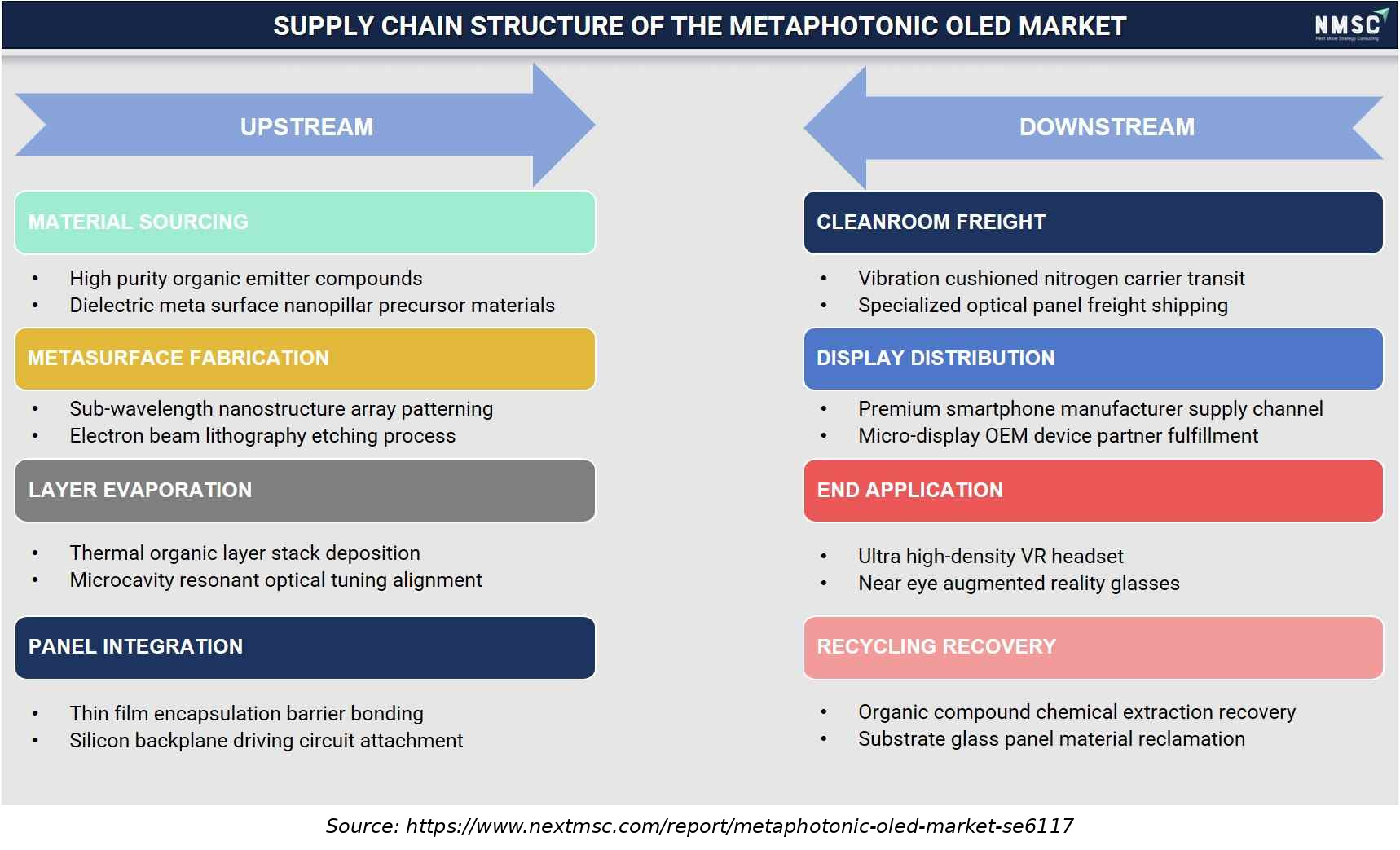
SUPPLY CHAIN STRUCTURE OF THE METAPHOTONIC OLED MARKET

SUPPLY CHAIN STRUCTURE OF THE METAPHOTONIC OLED MARKET
The supply chain of the metaphotonic OLED market spans upstream material sourcing, metasurface fabrication, layer evaporation, and panel integration, followed by downstream cleanroom freight, display distribution, end applications, and recycling recovery. It highlights the flow of high-purity organic materials and advanced optical components into specialized display manufacturing and their delivery to VR, AR, and other high-density display applications.

Market Drivers & Dynamics

Interactive Dataset
Rising augmented and virtual reality display resolution demand driver +6.1% North America, Asia-Pacific 2026-2035
Sustained corporate research investment by Samsung driver +4.8% Asia-Pacific 2026-2032
Growing academic interest in metasurface-OLED holography driver +3.2% North America, Europe 2026-2032
Advancing nanoimprint lithography research capability driver +2.1% Global 2028-2035
Absence of any commercial metaphotonic OLED product restraint -5.4% Global 2026-2035
Unresolved manufacturing scale-up beyond laboratory demonstration restraint -4.6% Global 2026-2035
Limited number of active corporate research programs restraint -3.1% Global 2026-2032
Competing display technologies with established manufacturing bases restraint -2.3% Global 2026-2032
Source: Next Move Strategy Consulting

Growth Drivers

What Is the Primary Growth Driver of the Metaphotonic OLED Market?

Rising augmented and virtual reality display resolution demand is the primary driver of this research field. The original metaphotonic OLED research explicitly targeted pixel densities beyond 10,000 pixels per inch required for emerging augmented reality applications. We observed that continued industry pursuit of higher-resolution near-eye displays continues to sustain research interest in metasurface-based pixel architectures, even absent a confirmed commercial manufacturing pathway.

How Is Samsung's Continued Research Investment Driving Market Growth?

Samsung Advanced Institute of Technology's sustained engineering engagement, building on its original Stanford University collaboration, continues to anchor the field's research activity. Our assessment indicates that this continued corporate investment, though not accompanied by a public commercialization timeline, remains the most substantial and consistently disclosed funding source supporting metaphotonic OLED technology development through 2026.

Growth Inhibitors

What Is Restraining Metaphotonic OLED Market Expansion?

The absence of any commercial metaphotonic OLED product represents the most significant restraint on this market. No public disclosure from Samsung, Stanford University, or any other organization confirms a commercial product launch, pilot production line, or manufacturing partnership specific to metaphotonic OLED technology as of 2026. We found that this absence of commercialization evidence distinguishes the field as fundamentally pre-commercial, constraining near-term revenue potential to research investment alone.

Segmentation Analysis

2025 (USD Million)
2035 (USD Million)
Pixel-level color metasurfaces 2025: $4.9 Million | 2035: $28.0 Million
Pixel-level
Light extraction metasurfaces 2025: $2.7 Million | 2035: $15.2 Million
Light extrac
Holographic projection metasurfaces 2025: $1.3 Million | 2035: $12.2 Million
Holographic
Other research focus areas 2025: $0.6 Million | 2035: $2.9 Million
Other resear
Pixel-level color metasurfaces $4.9 Million $28.0 Million 18.35%
Light extraction metasurfaces $2.7 Million $15.2 Million 18.46%
Holographic projection metasurfaces $1.3 Million $12.2 Million 24.94%
Other research focus areas $0.6 Million $2.9 Million 17.01%

Which Research Focus Dominates the Metaphotonic OLED Market?

Pixel-level color metasurfaces led the field with USD 4.94 Million in 2025, reflecting sustained focus on the original color-defining metasurface architecture published in 2020. We observed that Holographic projection metasurfaces is the fastest-growing research focus, expanding at a 24.94% CAGR from 2026 to 2035, as academic interest builds on the 2025 demonstration of OLED-illuminated holographic metasurfaces.

2025 (USD Million)
2035 (USD Million)
Augmented an
Next-generat
Holographic
Other target
Segment Item 2025 (USD Million) 2035 (USD Million) CAGR
Augmented and virtual reality displays $10.0 USD Million $40.0 USD Million 25.0%
Next-generation television and monitor displays $17.1 USD Million $51.1 USD Million 11.0%
Holographic imaging systems $24.2 USD Million $62.2 USD Million 25.0%
Other target applications $31.3 USD Million $73.3 USD Million 11.0%

Segment-wise data is locked

Unlock complete segment-wise numbers for By Target Application.

Unlock Full Data

Which Target Application Leads Metaphotonic OLED Research Activity?

Augmented and virtual reality displays led target application research with USD 4.37 Million in 2025, consistent with the technology's original design intent for ultrahigh pixel density near-eye displays. Augmented and virtual reality displays is also the fastest-growing target application, expanding at a 20.53% CAGR from 2026 to 2035, as head-mounted display resolution requirements continue to outpace conventional OLED pixel architecture capability.

2025 (USD Million)
2035 (USD Million)
Corporate R&
Academic and
Segment Item 2025 (USD Million) 2035 (USD Million) CAGR
Corporate R&D Investment $10.0 USD Million $40.0 USD Million 27.0%
Academic and Government Research Grants $17.1 USD Million $51.1 USD Million 9.0%

Segment-wise data is locked

Unlock complete segment-wise numbers for By Funding Source.

Unlock Full Data

Beyond the three axes profiled above, the Metaphotonic OLED market is also segmented by Funding Source. Corporate R&D Investment holds the largest 2025 share within this axis, while Academic and Government Research Grants registers the fastest 2026–2035 CAGR, consistent with the Key Takeaways summarized above.

2025 (USD Million)
2035 (USD Million)
North Americ
Canada
Mexico
Europe: UK
Germany
Segment Item 2025 (USD Million) 2035 (USD Million) CAGR
North America: U.S. $10.0 USD Million $40.0 USD Million 14.0%
Canada $17.1 USD Million $51.1 USD Million 24.0%
Mexico $24.2 USD Million $62.2 USD Million 22.0%
Europe: UK $31.3 USD Million $73.3 USD Million 12.0%
Germany $38.4 USD Million $84.4 USD Million 27.0%

Segment-wise data is locked

Unlock complete segment-wise numbers for By Region.

Unlock Full Data

Which Region Leads Metaphotonic OLED Research Investment?

Asia-Pacific remained the leading region, valued at USD 4.46 Million in 2025 on concentrated Samsung Advanced Institute of Technology research investment based in South Korea. Asia-Pacific is also the fastest-growing region, registering a 21.02% CAGR from 2026 to 2035, as regional interest in nanophotonic display research expands beyond the field's original corporate sponsor.

Beyond the three axes profiled above, the Metaphotonic OLED market is also segmented by Funding Source. Corporate R&D Investment holds the largest 2025 share within this axis, while Academic and Government Research Grants registers the fastest 2026–2035 CAGR, consistent with the Key Takeaways summarized above.

Growth Opportunities

We found that three forward-looking opportunities stand out for stakeholders positioning within the Metaphotonic OLED field over the 2026-2035 forecast period, each concentrated in continued research validation rather than near-term commercial deployment.

How Can Additional Corporate Sponsors Broaden the Research Base?

The field's current concentration around a single primary corporate sponsor creates a whitespace opportunity for additional display manufacturers to establish parallel research programs. Display companies with existing OLED manufacturing infrastructure could capture early positioning within the Corporate R&D Investment segment by establishing metasurface research partnerships before manufacturing methods mature.

Where Does Nanoimprint Lithography Scale-Up Present Whitespace?

Unresolved manufacturing scalability represents an underexplored opportunity for nanofabrication equipment and process specialists to establish early technical partnerships with metaphotonic OLED researchers. Firms that successfully demonstrate production-viable nanoimprint lithography for metasurface patterning could capture disproportionate influence over the field's eventual commercialization pathway.

How Can Holographic Display Developers Benefit From OLED-Metasurface Integration?

The 2025 demonstration of OLED-illuminated holographic metasurfaces represents an underexplored opportunity for holographic and near-eye display developers to explore compact, coherent-light-free holographic architectures. Developers building on this published research within the Holographic Imaging Systems segment could establish early technical differentiation ahead of broader field commercialization.

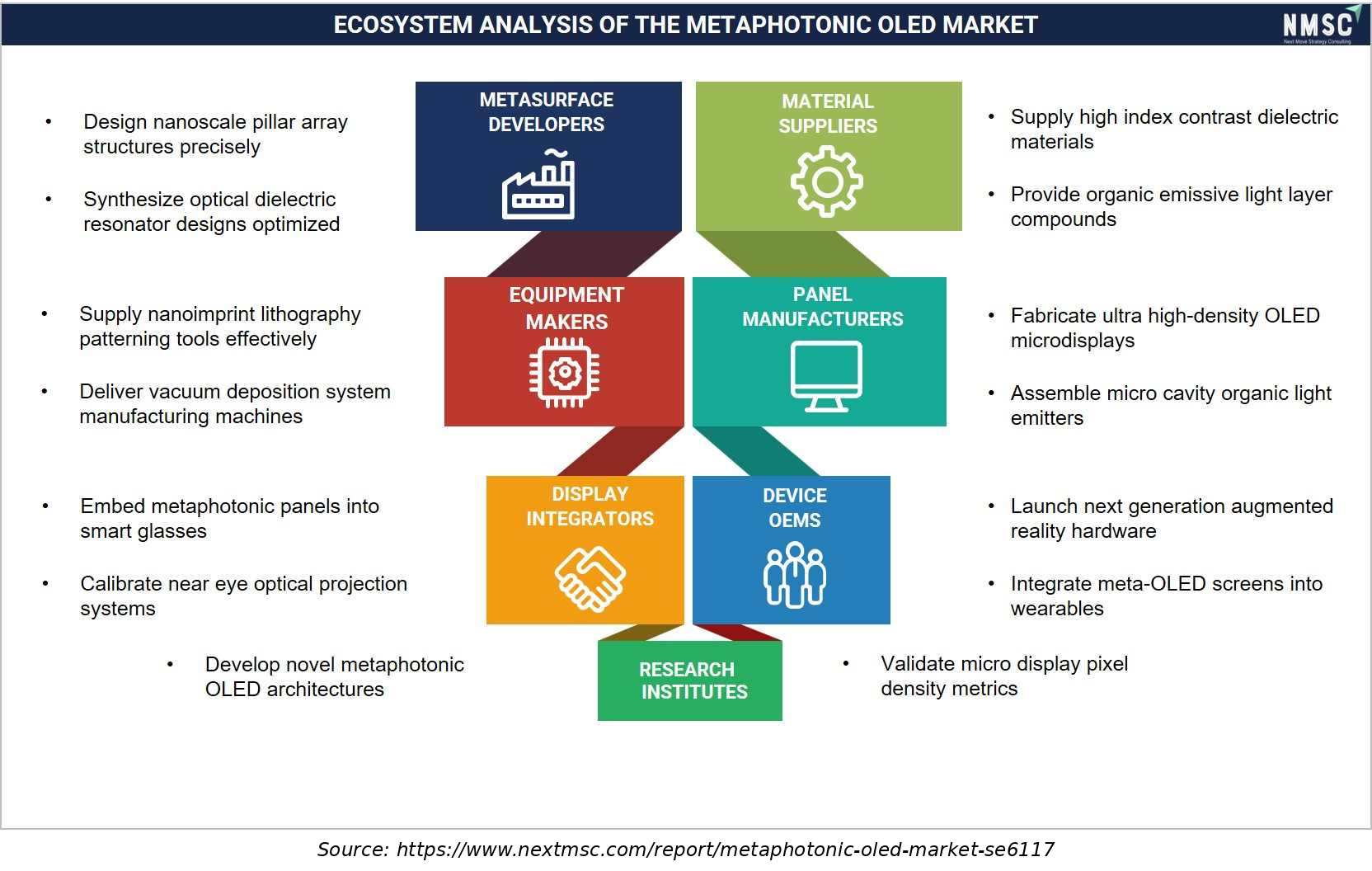
ECOSYSTEM ANALYSIS OF THE METAPHOTONIC OLED MARKET

The metaphotonic OLED ecosystem comprises metasurface developers, material suppliers, equipment makers, and panel manufacturers that support advanced display production. Display integrators and device OEMs connect these technologies with end-use products, while research institutes contribute innovation, testing, and technology development. Collaboration across these stakeholders supports the commercialization and scaling of high-resolution metaphotonic OLED displays.

Regional Outlook

2025 (USD Million)
2035 (USD Million)
North Americ
Asia-Pacific
Europe
Middle East
Latin Americ
Region 2025 (USD Million) 2035 (USD Million) CAGR (%)
North America $10.0 USD Million $40.0 USD Million 9.0%
Asia-Pacific $17.1 USD Million $51.1 USD Million 27.0%
Europe $24.2 USD Million $62.2 USD Million 25.0%
Middle East & Africa $31.3 USD Million $73.3 USD Million 23.0%
Latin America $38.4 USD Million $84.4 USD Million 12.0%

Regional data is locked

Unlock complete regional numbers for this market.

Unlock Full Data

Competitive Landscape

We observed that the Metaphotonic OLED field does not feature a conventional competitive landscape given its pre-commercial, research-stage status; activity is instead concentrated within a single primary corporate-academic collaboration rather than distributed across competing commercial entities. Key Takeaways

Dimension Description
Market Structure Not a conventional competitive market; only two organizations, Samsung Electronics Co., Ltd. and Stanford University, have publicly verifiable, direct involvement in metaphotonic OLED research and development as of 2026, reflecting the field's origin as a single corporate-academic collaboration rather than an industry.
Innovation Focus Pixel-level color metasurface architecture and, more recently, OLED-illuminated holographic metasurface projection represent the field's two publicly documented innovation tracks.
M&A Activity No M&A activity has occurred or is applicable; the field remains within pre-commercial academic and corporate research rather than a stage where acquisition activity would be expected.

How Do Organizations Engage With Metaphotonic OLED Research?

Organizations engage with this field primarily through direct research collaboration and academic publication rather than conventional commercial competition. Samsung Advanced Institute of Technology sustains internal engineering investment building on its original architecture, while Stanford University continues contributing academic nanophotonics expertise, together representing the field's entire publicly documented, direct research base as of 2026.

What Archetype Currently Defines Metaphotonic OLED Research Activity?

A single archetype currently defines the field: corporate-academic collaboration combining a display manufacturer's engineering resources with a university's fundamental nanophotonics research capability. Samsung Electronics and Stanford University exemplify this sole archetype, with no independent commercial-stage competitor or vertically distinct alternative model publicly identified as of 2026.

How Is Innovation Progressing Absent Broader Competitive Pressure?

Innovation continues to progress primarily through incremental academic publication rather than competitive commercial pressure. The 2025 extension toward OLED-illuminated holographic projection illustrates continued technical advancement within the existing research collaboration structure. Our analysis shows that without additional corporate entrants, innovation pace remains dependent on the continued research prioritization of the field's existing two primary organizations.

What M&A or Expansion Activity, if Any, Applies to This Field?

No merger, acquisition, or corporate expansion activity applies to the Metaphotonic OLED field as of 2026, consistent with its pre-commercial research status. We found that any future commercialization would more plausibly emerge through Samsung's internal product development or a newly disclosed manufacturing partnership than through acquisition-driven consolidation, given the field's current concentration within a single sponsoring organization.

Key Market Players

Our assessment indicates that only two organizations meet verified, publicly documented eligibility criteria for direct involvement in metaphotonic OLED research and development as of 2026; this real count is substantially below the 20-company profile typical of commercially established technology markets, reflecting the field's pre-commercial research status.

Samsung Electronics Co., Ltd. Stanford University

Latest Developments

We found that recent developments within the Metaphotonic OLED field are limited to academic publication activity, consistent with its pre-commercial research status.

Date Event
April 2026 Samsung Electronics and POSTECH published research on a metasurface-based switchable 2D/3D display. The team fabricated a 50 × 50 mm metalens and validated it on OLED panels, demonstrating scalable metasurface integration into next-generation display architectures.

Expert Insights

Professor Graham Turnbull

School of Physics and Astronomy | University of St Andrews

"OLED displays normally need thousands of pixels to create a simple picture. This new approach allows a complete image to be projected from a single OLED pixel!"

Analyst Interpretation

The statement highlights the potential of metasurface technology to transform conventional OLED image-generation architectures. By manipulating light at the nanoscale, metasurfaces can enable a single OLED pixel to project a complete image rather than relying solely on conventional arrays of thousands of pixels. This demonstrates the potential for compact holographic display architectures, advanced optical displays, and next-generation AR/VR applications, supporting the development of metaphotonic OLED technologies.

Investment Opportunities

What Capital Inflows Are Supporting the Metaphotonic OLED Field?

Capital inflows remain limited to Samsung's internal corporate research budget and standard academic grant funding supporting Stanford University's continued nanophotonics research. We observed that no external venture capital, private equity, or dedicated public market investment vehicle focused specifically on metaphotonic OLED technology has been publicly identified as of 2026, reflecting the field's pre-commercial, internally funded research status.

How Is Research Infrastructure Investment Supporting Continued Development?

Research infrastructure investment is concentrated in university nanofabrication facilities and Samsung's internal engineering laboratories rather than dedicated production infrastructure. Our findings suggest that continued access to nanoimprint lithography and metasurface fabrication capability at Stanford and within Samsung's research division remains the most active infrastructure supporting the field's development as of 2026.

What ESG Considerations Apply to Metaphotonic OLED Research?

Environmental, social, and governance considerations remain largely inapplicable given the field's pre-commercial status, though the underlying technology's potential energy-efficiency benefits, including improved luminescence efficiency demonstrated in the original research, represent a longer-term sustainability consideration should commercialization eventually occur. We found that no organization has publicly disclosed ESG-specific commitments tied specifically to metaphotonic OLED development as of 2026.

Key Benefits for Stakeholders

How Does This Report Benefit Research and Technology Leaders?

Research and technology leaders gain a clear, honestly scoped assessment distinguishing genuine metaphotonic OLED research activity from adjacent but distinct display technologies, supporting informed research partnership and internal investment decisions. Our analysis clarifies which organizations have verified, direct involvement in this specific technology rather than conflating it with broader OLED or metasurface optics activity.

How Does This Report Benefit Investors and Financial Analysts?

Investors and financial analysts benefit from a transparent, risk-appropriate market sizing that reflects research investment rather than inflated commercial revenue projections for a technology with no announced product. We observed that this honest framing helps investors calibrate exposure appropriately to this pre-commercial, single-sponsor-concentrated research field rather than treating it as a conventional emerging industry.

How Does This Report Benefit Academic and Corporate Research Planners?

Academic and corporate research planners gain visibility into the field's genuine technical progression, from the original 2020 pixel-architecture demonstration to the 2025 holographic projection extension, supporting realistic roadmap planning. Our findings suggest that this analysis helps research planners set appropriately calibrated expectations for near-term technical milestones rather than commercial deployment timelines.

Key Market Segments Evaluated

By Research Focus

  • Pixel-level color metasurfaces
  • Light extraction metasurfaces
  • Holographic projection metasurfaces
  • Other research focus areas

By Target Application

  • Augmented and virtual reality displays
  • Next-generation television and monitor displays
  • Holographic imaging systems
  • Other target applications

By Funding Source

  • Corporate R&D Investment
  • Academic and Government Research Grants

By Region

  • North America 
    • U.S.
    • Canada
    • Mexico
  • Europe 
    • UK
    • Germany
    • France
    • Italy
    • Spain
    • Sweden
    • Denmark
    • Finland
    • Netherlands
    • Rest of Europe
  • Asia-Pacific 
    • China
    • India
    • Japan
    • South Korea
    • Taiwan
    • Indonesia
    • Vietnam
    • Australia
    • Philippines
    • Malaysia
    • Rest of APAC
  • Middle East & Africa 
    • Saudi Arabia
    • UAE
    • Egypt
    • Israel
    • Turkey
    • Nigeria
    • South Africa
    • Rest of MEA
  • Latin America 
    • Brazil
    • Argentina
    • Chile
    • Colombia
    • Rest of LATAM

Conclusion & Recommendations

The long-term outlook for this field remains cautiously positive but firmly pre-commercial, with research investment projected to expand roughly sixfold from USD 9.5 Million in 2025 to USD 58.3 Million by 2035 at a 19.4% CAGR. We observed that this growth reflects continued academic and corporate research prioritization rather than any near-term transition to commercial display manufacturing, given that no metaphotonic OLED product has entered commercial production anywhere in the world as of 2026.

What Strategic Positioning Should Research Stakeholders Pursue?

Stakeholders should prioritize continued fundamental research partnership and nanoimprint lithography scale-up validation over premature commercialization planning. Our assessment indicates that organizations building on the field's two established public research tracks, pixel-level color architecture and holographic projection, are best positioned to contribute meaningfully to eventual commercialization once manufacturing scalability is demonstrated.

How Attractive Is the Metaphotonic OLED Field for New Investment?

This field presents a highly speculative, early-stage research opportunity rather than a conventional investment case, supported by a USD 46.5 Million absolute research-investment opportunity between 2026 and 2035 concentrated in academic and corporate laboratories. We found that investment attractiveness remains appropriate only for research-stage capital willing to accept substantial technical and commercialization uncertainty, given the field's concentration within two organizations.

What Market Shifts and Key Risks Should Stakeholders Monitor?

Stakeholders should monitor the continued absence of any commercial product announcement, the unresolved nanoimprint lithography manufacturing scale-up challenge, and the field's dependence on a single primary corporate sponsor as key risks. Our analysis shows that without additional corporate research entrants or a confirmed manufacturing partnership, the field's progression toward commercialization remains highly uncertain through the forecast period.

What Are the Key Growth Pathways for the Metaphotonic OLED Field?

Key growth pathways include continued academic extension of the holographic projection concept, potential broadening of the corporate research base beyond Samsung, and eventual nanoimprint lithography manufacturing validation. NMSC's analysis indicates that stakeholders pursuing these fundamental research pathways, rather than anticipating near-term commercial deployment, will be best positioned to engage productively with this pre-commercial field through 2035.

FAQs

About the Author

Liza Phukan

Liza Phukan

Liza Phukan is Research Associate at Next Move Strategy Consulting, where she has covered emerging industries and market research across sectors for 3.5 years. Her work includes analyzing industry developments, validating market data, and developing structured business content from research findings. She uses secondary research and data-validation practices to turn complex market information into clear decision-useful market analysis for business audiences and support report development and B2B.

About the Reviewer

Supradip Baul

Supradip Baul

Supradip Baul is an accomplished business consultant and strategist with over a decade of rich experience in market intelligence, strategy, technology, and business transformation. His work has included rigorous qualitative and quantitative analysis across multiple industries, helping clients shape investment decisions and long-term roadmaps. Earlier in his career, he was associated with Gartner, where he contributed to industry-leading reports and market share analyses. He has worked with leading global companies and holds an MBA with a dual specialization in Marketing and Finance.

Download Free Sample

Henri Knyphausen

HENRI KNYPHAUSEN

Partner at Singulier [Ex-BCG]

Singulier

I recently engaged NEXTMSC.com for a commercial due diligence project within the intralogistics sector, and I am pleased to provide a reference based on my experience. In utilizing NEXTMSC.com's services, I found their report to offer valuable insights into market dynamics and key industry players. The initial report provided a solid foundation for our analysis. However, as we were investigating a smaller target in the market, and I had specific customization requests requiring additional research. These requests included detailed information on product portfolios of various players and sub-market sizes, both inclusive and exclusive of certain product categories. NEXTMSC.com demonstrated commendable responsiveness and agility in accommodating these customization requests. Within a timeframe of 1-2 weeks, they delivered a revised report that met our specific needs. Furthermore, they were receptive to my follow-up inquiries, ensuring clarity and understanding of the data provided. The final deliverable significantly contributed to our due diligence efforts. One of NEXTMSC.com's notable strengths lies in their qualitative research capabilities. However, for future engagements, I would recommend the inclusion of a quantified market model in Excel format. Such a model would offer the ability to conduct in-depth analyses and explore various market segments, including country-specific data and subcomponent breakdowns. Based on my positive experience, I would not hesitate to work with NEXTMSC.com again. Their responsiveness, willingness to accommodate customization requests, and commitment to delivering actionable insights make them a reliable partner for commercial research projects.

Robert Sean Trevino

ROBERT SEAN TREVINO

Sr. Director, Head of Strategic Insights & Analytics

Foundation Medicine

I realized that it was a reliable source of information. These days, there are many people who are looking for authentic data, and this is one of the only sources that can offer them with what they need;

Diana Trejo

DIANA TREJO

Assistant Manager

Sumitomo Corporation de Mexico, S.A. de C.V.

Recently, we purchased a report on the Mexico Data Center Market from Next Move Strategy Consulting. The service has been excellent, with support that is always timely and thoroughly professional. The information provided is interesting, highly useful, and delivered with clarity. I would highly recommend NextMSC for anyone seeking insightful and dependable analysis.

Pratyush Kumar Das

PRATYUSH KUMAR DAS

Assistant Manager

Polycab India Limited

We would like to express our appreciation for the data and insights provided by nextmsc. We are very pleased with the quality and depth of the information, which has proven to be highly valuable and beneficial for our business decision-making.

Nishant Awate

NISHANT AWATE

Business Development Global Sales

Zehnder Group Deutschland GmbH

Our experience working with Next Move Strategy Consulting was positive. The team was responsive, professional, and open to incorporating our specific requirements throughout the project. The India AHU market study was comprehensive and well structured, covering market value and volume forecasts, product and application segments, and key industry trends. The inclusion of both AHU and residential MVHR market insights made the study particularly relevant for our strategic market assessment. Overall, the report provides a solid foundation for evaluating market potential, identifying priority segments, and supporting business-development decisions in India.

Custom Market Research Services

We will customize the research for you if the listed report does not fully match your requirements.

Get 30% Free Customization

Select License

This website uses cookies to ensure you get the best experience on our website. Learn more

✖