Planting Equipment Market Global Industry Analysis and Forecast (2025–2035)

The global Planting Equipment Market size was valued at USD 21.30 billion in 2025 and is forecast to reach USD 35.80 billion by 2035, expanding at a 5.33% CAGR between 2025 and 2035. North America leads with approximately 30% share, while Planters dominate all other equipment types with approximately 40% share.

Download Free Sample PDF
Base Year (2025)
$21.30 Billion
Forecast (2035)
$35.80 Billion
CAGR (2026-2035)
5.3%
Top Region
North America

What Is the Planting Equipment Market Size?

The global Planting Equipment Market size was valued at USD 21.30 billion in 2025 and is forecast to reach USD 35.80 billion by 2035, expanding at a 5.33% CAGR between 2025 and 2035. North America leads with approximately 30% share, while planters dominate all other equipment types with approximately 40% share.

We observed that growth is anchored in rising farm mechanization across emerging economies and accelerating adoption of precision-guided planting systems among large commercial operations through 2035.

Planting Equipment Market Global Industry Analysis and Forecast (2025–2035) Revenue Forecast

Values in USD Billion

2025 $21.30 Billion
2025
2026 $22.44 Billion
2026
2027 $23.63 Billion
2027
2028 $24.89 Billion
2028
2029 $26.22 Billion
2029
2030 $27.61 Billion
2030
2031 $29.09 Billion
2031
2032 $30.64 Billion
2032
2033 $32.27 Billion
2033
2034 $33.99 Billion
2034
2035 $35.80 Billion
2035

Key Takeaways

By Equipment Type: Planters held the largest share of approximately 40% (USD 8.52 Billion) in 2025; the Planters segment is the fastest-growing sub-segment at 6.34% CAGR from 2025–2035.

By Mechanization Level: Conventional held the largest share of approximately 63% (USD 13.42 Billion) in 2025; the Precision and Automated segment is the fastest-growing sub-segment at 8.55% CAGR from 2025–2035.

By Farm Size: Large Commercial Farms held the largest share of approximately 58% (USD 12.35 Billion) in 2025; the Large Commercial Farms segment is the fastest-growing sub-segment at 6.04% CAGR from 2025–2035.

Dominant Region: North America dominated with approximately 30% revenue share (USD 6.39 Billion) in 2025.

Fastest-Growing Region: Asia-Pacific is projected to register the highest CAGR of 7.01% from 2025–2035.

Dominant Country: U.S. led with approximately USD 4.35 billion in 2025.

Fastest-Growing Country: India is the fastest-growing country at approximately 8.88% CAGR from 2025–2035.

Planting Equipment Market Overview

The planting equipment market report covers seed drills, planters, transplanters, and broadcast spreaders used to establish row crops, cereals, and grains across commercial and smallholder farms. Our assessment indicates that the market has evolved from ground-driven mechanical seed metering toward GPS-guided, section-controlled precision planting systems that reduce seed overlap and input waste for large-acreage operations.
Regulatory frameworks such as the U.S. Department of Agriculture's conservation-tillage incentive programs and the European Union's Common Agricultural Policy sustainability measures influence equipment specifications, while national farm-mechanization subsidy schemes in India and China influence procurement of tractor-mounted planting units. We observed that technology adoption is shifting toward variable-rate seeding and telematics-enabled diagnostics, while rising farm labor costs are also influencing equipment sourcing criteria.

Porter’s Five Forces Analysis of the Planting Equipment Industry

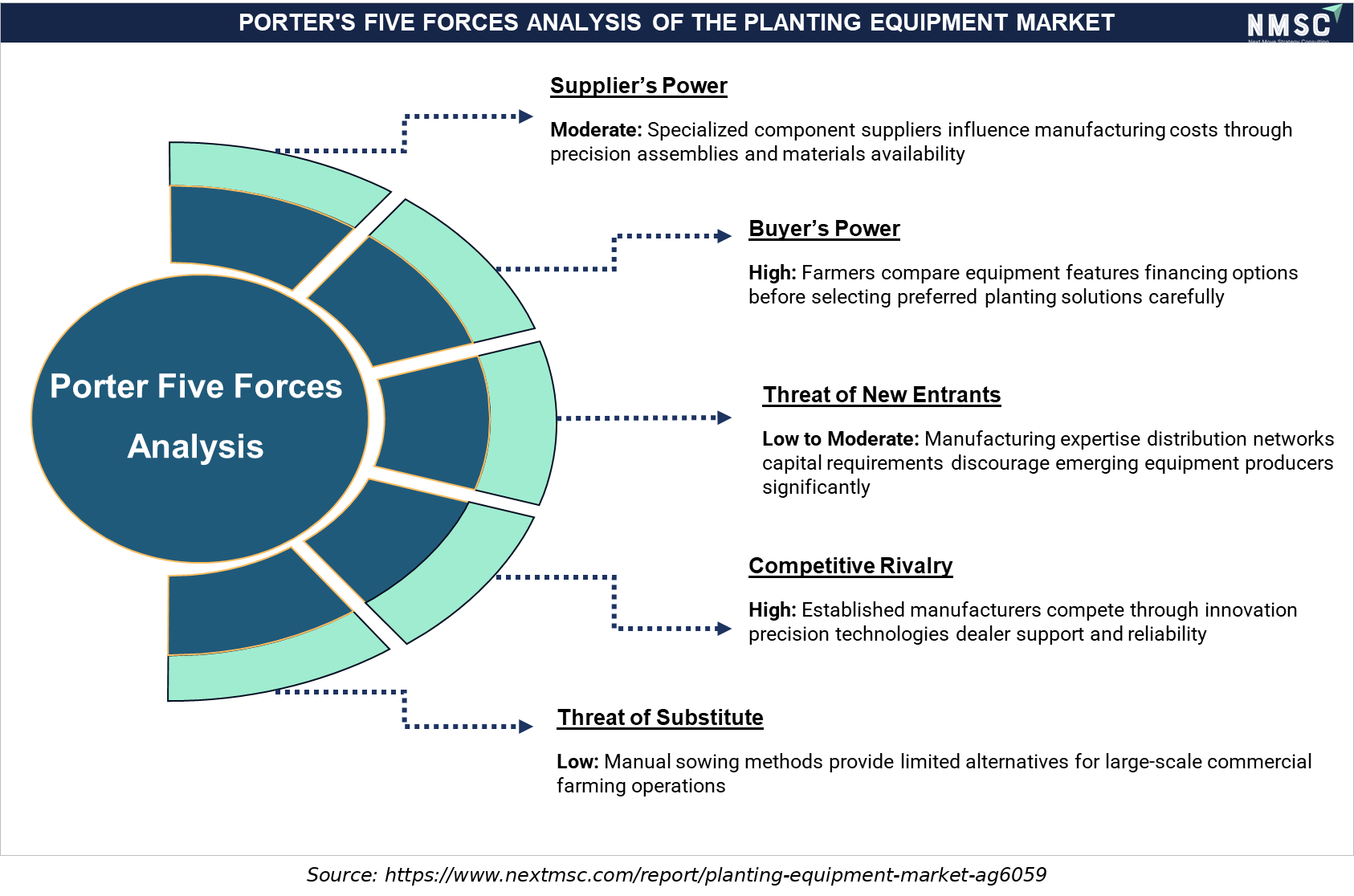
Through our market assessment, we observed that competitive rivalry in the Planting Equipment Market remains high as established manufacturers compete through precision technologies, dealer support, and reliability. Meanwhile, farmers hold strong buyer power by evaluating features and financing options carefully. Furthermore, capital requirements and distribution barriers deter new entrants, while specialized component suppliers exert moderate power and manual sowing poses a low substitution threat for large-scale operations.

Market Drivers & Dynamics

Interactive Dataset
Rising farm mechanization in emerging economies driver +1.3% Asia-Pacific, Latin America 2026-2035
Expansion of precision and variable-rate seeding systems driver +1.1% Global 2026-2035
Government farm-equipment subsidy programs driver +0.9% Asia-Pacific, MEA 2026-2035
Rising farm labor cost and shrinking rural workforce driver +0.7% North America, Europe 2026-2035
Growth of large-scale commercial and contract farming driver +0.6% North America, Latin America 2026-2032
Replacement demand from aging planter fleets driver +0.5% Global 2026-2035
High upfront cost of precision planting equipment restraint -0.6% Asia-Pacific, MEA, Latin America 2026-2035
Volatility in farm income and commodity prices restraint -0.5% Global 2026-2032
Limited service and repair infrastructure in rural areas restraint -0.4% MEA, Latin America 2026-2035
Source: Next Move Strategy Consulting

Growth Drivers

Rising farm mechanization in emerging economies is the primary driver of the market. India's Ministry of Agriculture and Farmers Welfare continues to expand its Sub-Mission on Agricultural Mechanization, subsidizing tractor-mounted planting equipment for smallholder farms. We observed that this policy-supported adoption curve, reinforced by shrinking rural labor availability, continues to anchor baseline equipment replacement and first-time purchase demand across South Asian and African markets alike.

How Is Precision Agriculture Driving Market Growth?

Expansion of precision and variable-rate seeding systems is accelerating adoption among large commercial farms seeking to optimize input cost per acre. The U.S. Department of Agriculture continues to report rising adoption of precision-agriculture technologies among large-acreage row-crop operations through its farm-practices survey programs. Our assessment indicates that this shift, combined with growing dealer-level data-service bundling, is compressing replacement cycles for planters equipped with legacy mechanical metering systems.

Growth Inhibitors

What Is Restraining Planting Equipment Market Expansion?

The high upfront cost of precision planting equipment restrains adoption among small and medium farms with limited access to equipment financing. The Food and Agriculture Organization continues to highlight capital-access constraints facing smallholder farmers seeking mechanization upgrades in developing regions. We found that manufacturers offering retrofit kits and lease-based financing face lower adoption barriers than those requiring full-planter replacement, particularly across price-sensitive Asia-Pacific and Latin American markets.

What Are the Growth Opportunities?

How Can Retrofit Precision Kits Unlock Value for Equipment Manufacturers?

Retrofit precision-seeding kits represent a market opportunity for manufacturers seeking incremental revenue from farms unwilling to replace existing planter fleets. Providers that build compatible, brand-agnostic retrofit hardware stand to capture upgrade spending from small and medium farms transitioning toward variable-rate seeding without full-equipment replacement.

Where Do Equipment-Leasing Models Create New Demand?

Equipment-leasing and pay-per-acre financing models represent an underpenetrated opportunity across price-sensitive Asia-Pacific and African markets. Manufacturers that partner with agricultural finance institutions can secure long-term equipment-utilization contracts, benefiting from government mechanization-subsidy cycles targeting the small and medium farm segment.

How Can Compact Transplanters Benefit Vegetable and Specialty-Crop Growers?

Vegetable and specialty-crop growers seeking labor-saving transplant automation create an opportunity for compact, precision transplanter developers. Early movers that secure distribution partnerships with specialty-crop cooperatives can differentiate with growers pursuing scalable transplant mechanization across the transplanters equipment-type segment.

Segmentation Analysis

2025 (USD Billion)
2035 (USD Billion)
Seed Drills 2025: $7.24 Billion | 2035: $10.74 Billion
Seed Drills
Planters 2025: $8.52 Billion | 2035: $15.75 Billion
Planters
Transplanters 2025: $2.98 Billion | 2035: $5.37 Billion
Transplanter
Broadcast Spreaders 2025: $2.56 Billion | 2035: $3.94 Billion
Broadcast Sp
Seed Drills $7.24 Billion $10.74 Billion 4.02%
Planters $8.52 Billion $15.75 Billion 6.34%
Transplanters $2.98 Billion $5.37 Billion 6.07%
Broadcast Spreaders $2.56 Billion $3.94 Billion 4.41%

Which Equipment Type Dominates the Planting Equipment Market?

Planters, encompassing row-crop and precision planting units, led the market with USD 8.52 billion in 2025, supported by widespread adoption on large-acreage corn and soybean operations across North America and Latin America. We observed that the Planters segment is also the fastest-growing equipment type, expanding at a 6.34% CAGR from 2025 to 2035, as variable-rate and section-controlled technology adoption drives upgrade cycles across commercial-farm fleets.

2025 (USD Billion)
2035 (USD Billion)
Conventional
Precision an
Segment Item 2025 (USD Billion) 2035 (USD Billion) CAGR
Conventional $10.0 USD Billion $40.0 USD Billion 22.0%
Precision and Automated $17.1 USD Billion $51.1 USD Billion 8.0%

Segment-wise data is locked

Unlock complete segment-wise numbers for By Mechanization Level.

Unlock Full Data

Which Mechanization Level Leads Planting Equipment Market Demand?

Conventional mechanization remained the leading category within the market, valued at USD 13.42 billion in 2025 on continued reliance on ground-driven metering across small and medium farms globally. Our findings suggest that Precision and Automated systems represent the fastest-growing category, registering an 8.55% CAGR from 2025 to 2035, as large commercial farms increasingly specify GPS-guided, variable-rate planting technology to reduce input cost per acre.

2025 (USD Billion)
2035 (USD Billion)
Large Commer
Small and Me
Segment Item 2025 (USD Billion) 2035 (USD Billion) CAGR
Large Commercial Farms $10.0 USD Billion $40.0 USD Billion 23.0%
Small and Medium Farms $17.1 USD Billion $51.1 USD Billion 25.0%

Segment-wise data is locked

Unlock complete segment-wise numbers for By Farm Size.

Unlock Full Data

Which Farm Size Segment Is Most Significant in the Planting Equipment Market?

Large Commercial Farms remained the dominant farm-size segment, reaching USD 12.35 billion in 2025 due to greater capital access and faster payback on precision-planting investment. Based on research conducted by Next Move Strategy Consulting, we found that Large Commercial Farms is also the fastest-growing segment at a 6.04% CAGR from 2025 to 2035, reflecting continued consolidation of farmland into larger, mechanization-ready operating units.

Growth Opportunities

Our analysis shows that three forward-looking opportunities stand out for stakeholders positioning within the planting equipment market over the 2026-2035 forecast period.

How Can Retrofit Precision Kits Unlock Value for Equipment Manufacturers?

Retrofit precision-seeding kits represent a market opportunity for manufacturers seeking incremental revenue from farms unwilling to replace existing planter fleets. Providers that build compatible, brand-agnostic retrofit hardware stand to capture upgrade spending from small and medium farms transitioning toward variable-rate seeding without full-equipment replacement.

Where Do Equipment-Leasing Models Create New Demand?

Equipment-leasing and pay-per-acre financing models represent an underpenetrated opportunity across price-sensitive Asia-Pacific and African markets. Manufacturers that partner with agricultural finance institutions can secure long-term equipment-utilization contracts, benefiting from government mechanization-subsidy cycles targeting the small and medium farm segment.

How Can Compact Transplanters Benefit Vegetable and Specialty-Crop Growers?

Vegetable and specialty-crop growers seeking labor-saving transplant automation create an opportunity for compact, precision transplanter developers. Early movers that secure distribution partnerships with specialty-crop cooperatives can differentiate with growers pursuing scalable transplant mechanization across the transplanters equipment-type segment.

Regional Outlook

2025 (USD Billion)
2035 (USD Billion)
North Americ
Europe
Asia-Pacific
Middle East
Latin Americ
Region 2025 (USD Billion) 2035 (USD Billion) CAGR (%)
North America $10.0 USD Billion $40.0 USD Billion 9.0%
Europe $17.1 USD Billion $51.1 USD Billion 27.0%
Asia-Pacific $24.2 USD Billion $62.2 USD Billion 25.0%
Middle East and Africa $31.3 USD Billion $73.3 USD Billion 23.0%
Latin America $38.4 USD Billion $84.4 USD Billion 12.0%

Regional data is locked

Unlock complete regional numbers for this market.

Unlock Full Data

Supply Chain Structure of the Planting Equipment Industry

Supply Chain Structure of the Planting Equipment Industry
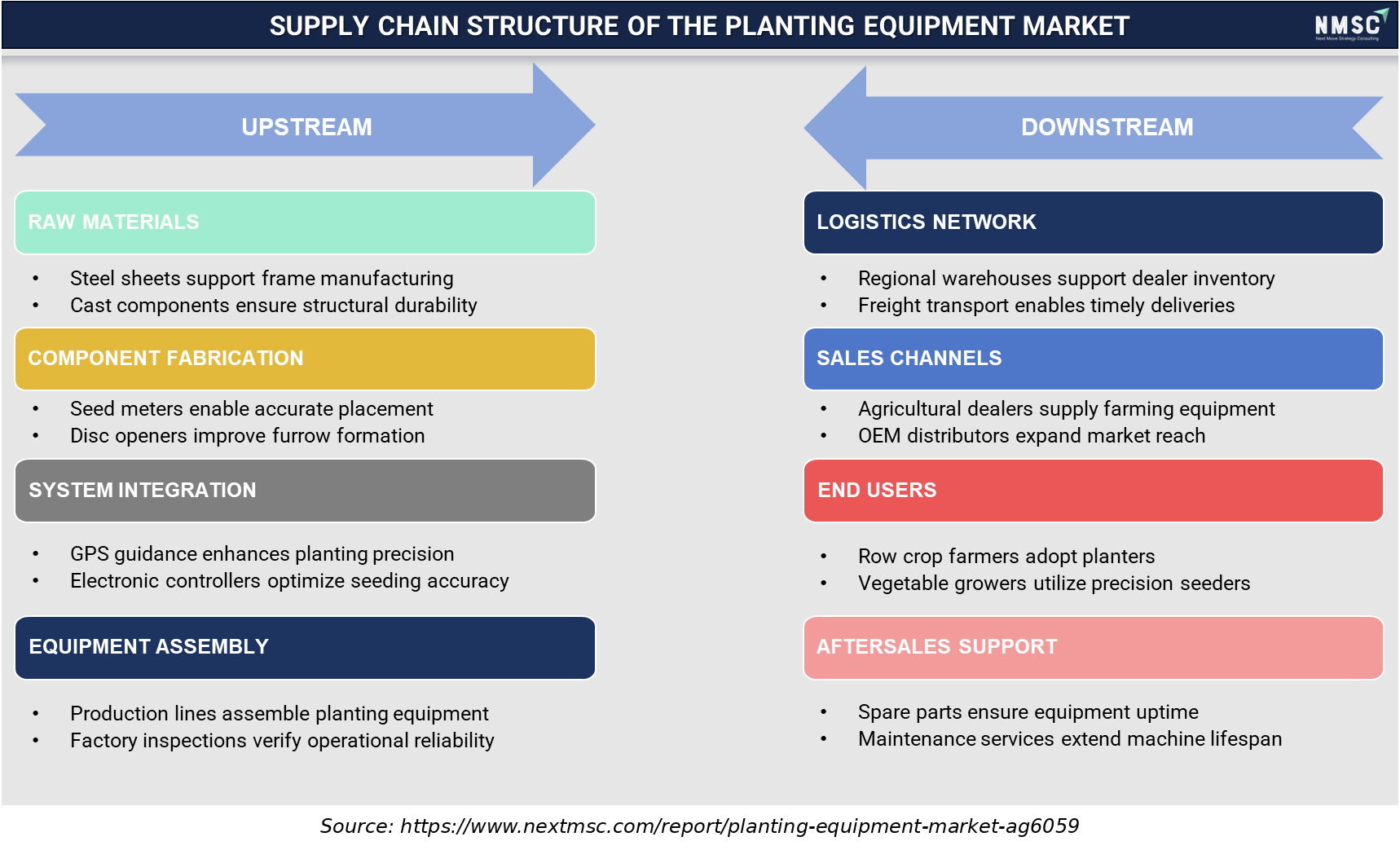
Based on our market evaluation, we noticed that the supply chain of the Planting Equipment Market integrates upstream steel fabrication, seed meters, and GPS guidance with downstream execution. Manufacturers conduct quality-control inspections before regional warehouses and agricultural dealers deliver units to row crop and vegetable growers. Subsequently, essential spare parts supply and ongoing maintenance services support equipment uptime and extend operational lifespan.

Competitive Landscape

We observed that the planting equipment market remains competitive, with global full-line manufacturers, European precision-seeding specialists, and regional implement makers all competing for commercial and smallholder farm procurement budgets.

Dimension Description
Market Structure Competitive, with global full-line manufacturers, European precision-seeding specialists, and regional implement makers active across commercial and smallholder farm segments.
Innovation Focus Precision and variable-rate seeding, telematics-enabled diagnostics, and retrofit hardware kits
M&A Activity Consolidation among full-line manufacturers and precision-agriculture technology specialists

How Do Companies Compete Within the Planting Equipment Market?

Companies compete primarily on row-unit precision accuracy, dealer-service network depth, and integration with existing tractor and guidance-system fleets. Our analysis shows that manufacturers increasingly differentiate through telematics and data-service bundling rather than mechanical durability alone, as large-farm buyers prioritize measurable input-cost savings.

Which Competitive Archetypes Characterize the Planting Equipment Market?

Three competitive archetypes characterize the market: global full-line manufacturers such as Deere & Company and CNH Industrial N.V.; European precision-seeding specialists such as Väderstad Holding AB and Horsch Maschinen GmbH; and regional implement makers such as Mahindra & Mahindra Limited and Escorts Kubota Limited. Each archetype leverages distinct distribution channels, from integrated dealer networks to regional cooperative partnerships.

What Innovation and Differentiation Strategies Are Companies Pursuing?

Companies are pursuing variable-rate seeding, telematics-enabled diagnostics, and retrofit-kit partnerships as core differentiation strategies. We found that industry leaders are also investing in compact, low-cost planting units to expand reach across smallholder and price-sensitive emerging-market segments.

Key Market Players

The following 20 companies represent key verified manufacturers active in the planting equipment market as of 2026, reflecting market-specific revenue presence and scale of operations.

Deere & Company CNH Industrial N.V. AGCO Corporation Kubota Corporation CLAAS KGaA mbH Väderstad Holding AB Horsch Maschinen GmbH Amazonen-Werke H. Dreyer SE & Co. KG Mahindra & Mahindra Limited Escorts Kubota Limited Yanmar Holdings Co., Ltd. SDF S.p.A. Kinze Manufacturing, Inc. Salford Group Inc. Bourgault Industries Ltd. Maschio Gaspardo S.p.A. Lemken GmbH & Co. KG Sfoggia Costruzioni Meccaniche S.p.A. TAFE — Tractors and Farm Equipment Limited Sitrex S.p.A.

Latest Developments

We observed that recent product launches and platform expansions reflect the industry's continued shift toward precision seeding and telematics-enabled equipment.

Date Event
October 2025 Kubota Corporation introduced its next-generation Smart Farming Solutions Hub at Agritechnica, highlighting automation, connectivity, and digital agriculture initiatives across its agricultural-equipment portfolio.
August 2025 AGCO Corporation announced the launch of the Fendt Optimum planter at the 2025 Farm Progress Show in Decatur, Illinois. The planter features stack-fold precision, terrain-flexing capabilities, and integrated Precision Planting technology including 20|20 display, vSet, vDrive, and DeltaForce to deliver superior seed placement accuracy.
February 2025 Deere & Company announced new planter technologies designed to improve planting efficiency and provide real-time operating data. The technologies include seed-level sensing, fertilizer-level sensing, and active vacuum automation, with information available to operators in the cab and through John Deere Operations Center.

Investment Opportunities

What Capital Inflows Are Targeting the Planting Equipment Market?

Capital inflows continue to target precision-seeding technology and telematics infrastructure, with manufacturers serving large commercial farms attracting sustained investor interest. Our assessment indicates that measurable input-cost-reduction outcomes are becoming an increasingly important consideration alongside unit-volume growth metrics.

How Is Infrastructure Investment Shaping Market Expansion?

Dealer-network and service-infrastructure investment continues to expand equipment availability, supporting the 8.55% CAGR projected for Precision and Automated systems through 2035. We found that manufacturers are prioritizing rural service-center expansion to serve smallholder farms across Asia-Pacific, Latin America, and the Middle East and Africa regions.

What ESG Considerations Are Relevant to Planting Equipment Investment?

Environmental, Social, and Governance considerations increasingly favor manufacturers expanding low-disturbance, conservation-tillage-compatible seeding equipment and equipment-leasing access for smallholder farmers. Our analysis shows that institutional investors are prioritizing manufacturers with transparent soil-health and input-reduction performance disclosures aligned with regional agricultural-sustainability frameworks.

Key Benefits for Stakeholders

How Does This Report Benefit Farm Equipment and Industry Leaders?

Farm equipment and industry leaders gain access to verified segmentation, regional sizing, and competitive benchmarking that inform product-line and dealer-network investment decisions. Our analysis, data, and forecasts help leaders prioritize precision-seeding and telematics investments aligned with projected segment growth.

How Does This Report Benefit Investors and Financial Analysts?

Investors and financial analysts benefit from validated market-sizing, CAGR methodology, and company-level competitive positioning that support capital-allocation and valuation decisions. Our findings suggest that segment-level growth differentials, particularly in Precision and Automated systems and large commercial farms, offer actionable signals for portfolio construction.

How Does This Report Benefit Equipment Dealers and Product Teams?

Equipment dealers and product teams gain strategic insight into emerging trends, competitive archetypes, and regional demand patterns that inform product-roadmap and inventory-planning prioritization. We observed that this analysis supports go-to-market planning for precision-seeding features and retrofit-kit partnerships across target farm-size segments.

Key Market Segments Evaluated

By Equipment Type

  • Seed Drills
  • Planters
  • Transplanters
  • Broadcast Spreaders

By Mechanization Level

  • Conventional
  • Precision and Automated

By Farm Size

  • Large Commercial Farms
  • Small and Medium Farms

Conclusion & Recommendations

The long-term outlook remains positive, with the market projected to expand from USD 21.30 billion in 2025 to USD 35.80 billion by 2035 at a 5.33% CAGR. Our assessment indicates that sustained farm-mechanization investment and precision-agriculture adoption will anchor growth across both mature and emerging economies through the forecast horizon.

What Strategic Positioning Should Companies Pursue?

Companies should prioritize variable-rate seeding capability and telematics-service bundling to differentiate within an increasingly precision-focused equipment landscape. Our findings suggest that manufacturers combining broad dealer networks with verified input-cost-reduction data will be best positioned to retain large-farm replacement contracts.

How Attractive Is the Market for New Investment?

The market presents a steady investment case, supported by a USD 14.50 billion absolute dollar opportunity between 2025 and 2035 and above-average growth in Asia-Pacific and the Precision and Automated segment. We found that investment attractiveness is highest for manufacturers combining precision-seeding technology with scaled dealer distribution.

What Market Shifts and Key Risks Should Stakeholders Monitor?

Stakeholders should monitor commodity-price volatility, high upfront precision-equipment costs, and limited rural service infrastructure as key risks. Our analysis shows that manufacturers unable to offer financing or retrofit pathways risk losing smallholder and mid-size farm customers to lower-cost, conventional equipment alternatives.

What Are the Key Growth Pathways for the Market?

Key growth pathways include expanding retrofit precision-kit catalogs, scaling telematics-enabled service infrastructure, and deepening penetration into compact mechanization across Asia-Pacific and Africa. Next Move Strategy Consulting's analysis indicates that manufacturers pursuing these pathways while maintaining dealer-network breadth will be best positioned to capture the market's projected growth through 2035.

FAQs

About the Author

Saista Faiyaz

Saista Faiyaz

Saista Faiyaz is Research Associate at Next Move Strategy Consulting, where she has covered consumer markets and healthcare technologies for 3 years. Her work includes primary interview review, secondary-source validation, market sizing, and structured analysis of company and industry data. She supports research by comparing evidence across sources, organizing findings into market narratives, and documenting assumptions used in analysis. Her scope includes cross-market benchmarking, and reports.

About the Reviewer

Supradip Baul

Supradip Baul

Supradip Baul is an accomplished business consultant and strategist with over a decade of rich experience in market intelligence, strategy, technology, and business transformation. His work has included rigorous qualitative and quantitative analysis across multiple industries, helping clients shape investment decisions and long-term roadmaps. Earlier in his career, he was associated with Gartner, where he contributed to industry-leading reports and market share analyses. He has worked with leading global companies and holds an MBA with a dual specialization in Marketing and Finance.

Download Free Sample

Henri Knyphausen

HENRI KNYPHAUSEN

Partner at Singulier [Ex-BCG]

Singulier

I recently engaged NEXTMSC.com for a commercial due diligence project within the intralogistics sector, and I am pleased to provide a reference based on my experience. In utilizing NEXTMSC.com's services, I found their report to offer valuable insights into market dynamics and key industry players. The initial report provided a solid foundation for our analysis. However, as we were investigating a smaller target in the market, and I had specific customization requests requiring additional research. These requests included detailed information on product portfolios of various players and sub-market sizes, both inclusive and exclusive of certain product categories. NEXTMSC.com demonstrated commendable responsiveness and agility in accommodating these customization requests. Within a timeframe of 1-2 weeks, they delivered a revised report that met our specific needs. Furthermore, they were receptive to my follow-up inquiries, ensuring clarity and understanding of the data provided. The final deliverable significantly contributed to our due diligence efforts. One of NEXTMSC.com's notable strengths lies in their qualitative research capabilities. However, for future engagements, I would recommend the inclusion of a quantified market model in Excel format. Such a model would offer the ability to conduct in-depth analyses and explore various market segments, including country-specific data and subcomponent breakdowns. Based on my positive experience, I would not hesitate to work with NEXTMSC.com again. Their responsiveness, willingness to accommodate customization requests, and commitment to delivering actionable insights make them a reliable partner for commercial research projects.


Gustaf Hummel Burstrom

GUSTAF HUMMEL BURSTROM

Founder

Revline Tools AB

Joseph and the team at Next Move Strategy Consulting have been excellent to work with, in supplying us with relevant market data and forecasts for our specific category. We had some special requirements and they were able to do a custom package to suit our needs. We would definitely recommend them to any other company needing market data and forecasts

Rishabh Jogani

RISHABH JOGANI

Strategy Analyst

Accenture Japan

We are incredibly impressed with the market report on the real estate market in India provided by Next Move Strategy Consulting. The report was thorough, insightful, and well-structured, offering deep analysis and actionable recommendations. It not only captured the current trends and dynamics but also provided a forward-looking perspective that has been invaluable for our strategic planning. Their team demonstrated exceptional professionalism, attention to detail, and a profound understanding of the industry. The data-driven insights and clarity of presentation exceeded our expectations, making complex market trends easy to understand. We highly recommend Next Move Strategy Consulting to anyone looking for reliable and comprehensive market research services. Their expertise has given us the confidence to navigate the complexities of the Indian real estate market with clarity and foresight.

Diana Trejo

DIANA TREJO

Assistant Manager

Sumitomo Corporation de Mexico, S.A. de C.V.

Recently, we purchased a report on the Mexico Data Center Market from Next Move Strategy Consulting. The service has been excellent, with support that is always timely and thoroughly professional. The information provided is interesting, highly useful, and delivered with clarity. I would highly recommend NextMSC for anyone seeking insightful and dependable analysis.

Kishu Kanda

KISHU KANDA

Strategy Analyst

Accenture

We purchased the AI Consumer Market Report from this company. Not only did they customize the report to meet our specific requirements, but they also showed great flexibility in accommodating our budget. The report we received fully met our expectations. Additionally, they provided prompt and thorough responses to both our pre-purchase and follow-up questions. We look forward to working with this company again in the future.

Custom Market Research Services

We will customize the research for you if the listed report does not fully match your requirements.

Get 30% Free Customization

Select License

This website uses cookies to ensure you get the best experience on our website. Learn more

✖