Process Digital Twin Market Size, Share, Trends and Growth Analysis, By Offering (Software [Engineering Twin, Process Twin, Asset Twin, Data Platform, Other Software], and Services), By Deployment (On Premises, Cloud, and Hybrid), By Buyer (Owner Operator, EPC and EPCM, and Other Buyer), By Commercial Model, By Distribution Channel, By End User (Oil and Gas, Chemicals and Petrochemicals, Other Process Industries), and Region — Global Industry Report and Forecast, 2026–2035
Industry: ICT & Media | Publishing Date: July 24, 2026 | Last Updated: September 30, 2026 | No of Pages: N/A | No. of Tables: N/A | No. of Figures: N/A | Format: PDF | Report Code: IC5373
What Is the Process Digital Twin Market Size?
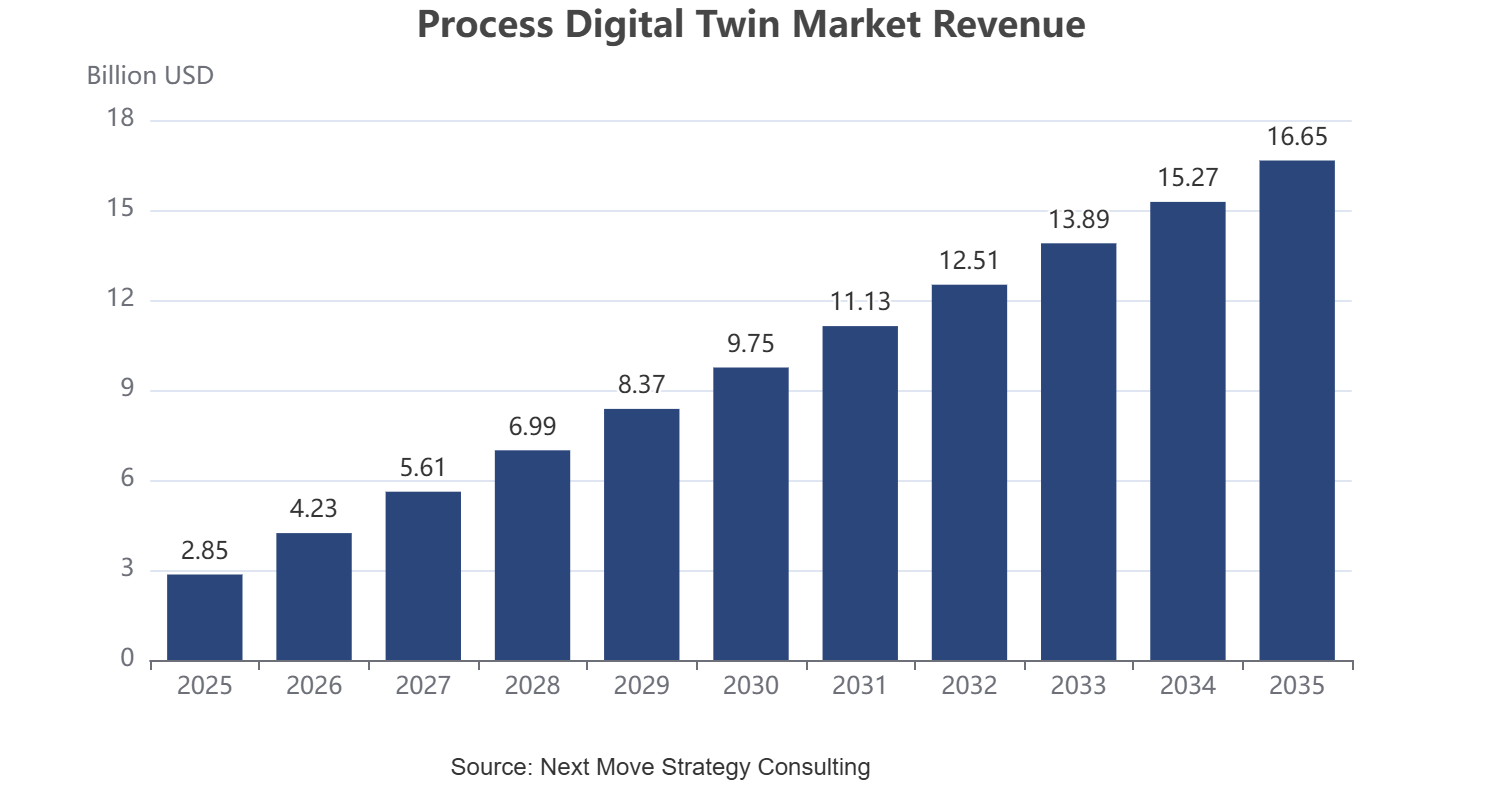
The global Process Digital Twin Market size was valued at USD 2.85 billion in 2025 and is estimated at USD 3.35 billion in 2026, forecast to reach USD 16.65 billion by 2035, expanding at a 19.5% CAGR between 2026 and 2035. North America leads with approximately 34% share, while software solutions dominate all other offerings with approximately 65% share.
We observed that growth is broad-based across every segmentation axis, with cloud-native process twins and pharmaceutical adoption driving the dominant structural shifts through 2035.
|
Key Takeaways |
|
By Offering: Software held the largest share of approximately 65% (USD 1.85 Billion) in 2025; Services is the fastest-growing sub-segment at 22.9% CAGR from 2026–2035. |
|
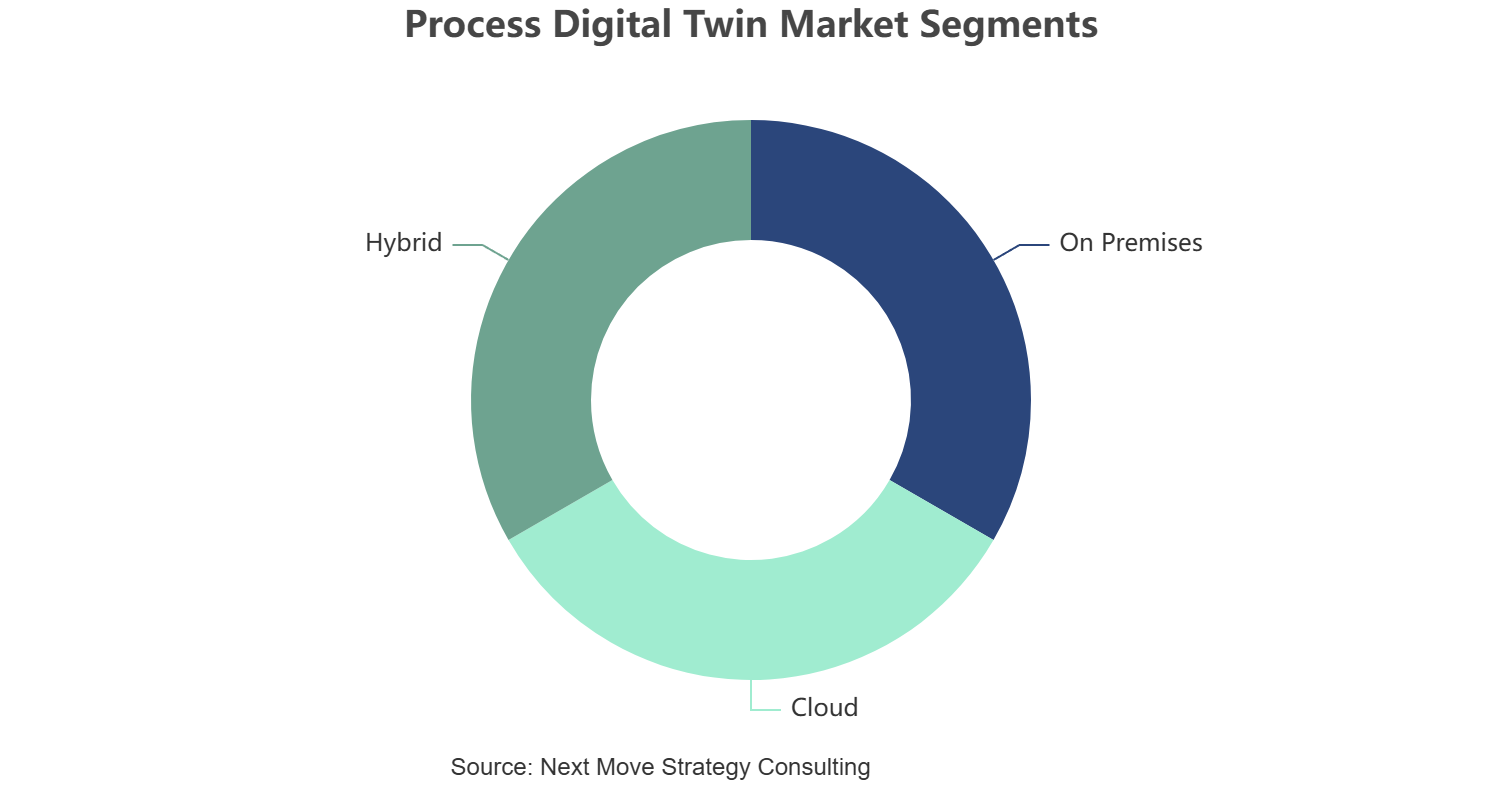
By Deployment: Cloud held the largest share of approximately 48% (USD 1.37 Billion) in 2025; Hybrid is the fastest-growing sub-segment at 25.8% CAGR from 2026–2035. |
|
By Buyer: Owner Operator held the largest share of approximately 52% (USD 1.48 Billion) in 2025; System Integrator is the fastest-growing sub-segment at 24.3% CAGR from 2026–2035. |
|
By Commercial Model: Subscription held the largest share of approximately 38% (USD 1.08 Billion) in 2025; Managed Services is the fastest-growing sub-segment at 26.5% CAGR from 2026–2035. |
|
By Distribution Channel: Direct held the largest share of approximately 44% (USD 1.25 Billion) in 2025; Partner is the fastest-growing sub-segment at 23.8% CAGR from 2026–2035. |
|
By End User: Oil and Gas held the largest share of approximately 24% (USD 0.68 Billion) in 2025; Pharmaceuticals and Life Sciences is the fastest-growing sub-segment at 25.6% CAGR from 2026–2035. |
|
Dominant Region: North America dominated with approximately 34% revenue share (USD 0.97 Billion) in 2025. |
|
Fastest-Growing Region: Asia-Pacific is expected to register the highest CAGR of 24.7% during 2026–2035. |
|
Dominant Country: U.S. led with approximately USD 0.68 Billion in 2025. |
|
Fastest-Growing Country: India is the fastest-growing country at approximately 27.0% CAGR from 2026–2035. |
Market Opportunity: The process digital twin market is expected to create an absolute dollar opportunity of USD 13.30 billion between 2026 and 2035, presenting significant investment potential across the oil and gas, chemicals, power, and pharmaceutical process-optimization value chain.
According to Next Move Strategy Consulting analysis, owner-operators are increasingly consolidating process twin deployments onto single data platforms to eliminate model duplication across engineering, operations, and maintenance teams, a shift that favors vendors offering unified asset-to-process twin architectures over point-solution providers.
What Does the Process Digital Twin Market Encompass?
The process digital twin market encompasses software and services that create dynamic, data-connected virtual replicas of continuous and batch process operations, spanning engineering twins, live process twins, asset twins, and the underlying data platforms that integrate them. Our assessment indicates that scope extends across owner-operators, EPC and EPCM firms, OEMs, system integrators, and public utilities that deploy these tools to simulate, monitor, and optimize plant-wide performance from front-end engineering design through operational lifecycle management.
Regulatory frameworks such as the U.S. Occupational Safety and Health Administration's Process Safety Management standard and the European Union's Industrial Emissions Directive shape process-twin adoption by mandating rigorous hazard and operability documentation that digital models increasingly support. We observed that technology adoption is shifting toward cloud and hybrid deployment models that connect engineering twins to live operational data, enabling predictive maintenance and real-time yield optimization. Next Move Strategy Consulting's analysis indicates that this convergence of engineering and operational technology is redefining capital planning across the process digital twin market.
|
Parameters |
Details |
|
Market Size in 2025 |
USD 2.85 Billion |
|
Market Size in 2026 |
USD 3.35 Billion |
|
Revenue Forecast in 2035 |
USD 16.65 Billion |
|
Growth Rate |
CAGR of 19.5% from 2026 to 2035 |
|
Analysis Period |
2025–2035 |
|
Base Year Considered |
2025 |
|
Forecast Period |
2026–2035 |
|
Market Size Estimation |
Revenue (USD Billion) |
|
Companies Profiled |
20 |
|
Countries Covered |
33 |
|
Market Share |
Available for Top 10 Companies |
Key Emerging Trends
Based on research conducted by Next Move Strategy Consulting, we found that four structural trends are reshaping platform architecture, adoption patterns, and stakeholder engagement across the industry.
How Is Generative AI Transforming Process Twin Simulation?
Generative AI is being embedded into process twin platforms to accelerate scenario simulation and anomaly root-cause analysis across continuous operations. We observed that AspenTech's generative AI-enabled simulation tools, expanded through 2025, allow process engineers to query plant models in natural language rather than building bespoke simulation scripts. Owner-operators are adopting these capabilities to compress engineering cycle time, while system integrators retrain workforce personnel to supervise AI-assisted model validation across refining and chemicals applications.
Why Are Cloud-Native Data Platforms Gaining Adoption in Process Industries?
Cloud-native data platforms that unify engineering, process, and asset twin data are gaining share as owner-operators consolidate historically siloed OT systems. Our findings suggest that Cognite's industrial data platform, deployed across multiple oil and gas majors through 2025, exemplifies this shift toward contextualized data models accessible to both engineers and data scientists. Vendors such as AVEVA and Honeywell are expanding cloud subscription offerings, positioning recurring-revenue models as a strategic priority within the broader market.
How Is Predictive Maintenance Reshaping Asset Twin Deployment?
Asset twins paired with predictive maintenance analytics are becoming standard specifications for rotating equipment and critical process assets. We observed that Yokogawa's asset health monitoring suite increasingly integrates vibration, thermal, and process data into unified digital twin dashboards. This trend is elevating demand for sensor-to-cloud connectivity among refining, power, and mining end users, while reducing unplanned downtime through earlier failure detection.
What Role Does Sustainability Reporting Play in Process Twin Innovation?
Sustainability and emissions-reporting mandates are driving process twin vendors to embed carbon and energy-intensity tracking directly into simulation models. Our analysis shows that Siemens's process simulation suite now incorporates emissions modeling modules aligned with evolving disclosure requirements. Owner-operators in chemicals and power generation are piloting these modules to quantify decarbonization pathways alongside traditional yield and throughput optimization objectives.
Ecosystem Analysis of the Process Digital Twin Market
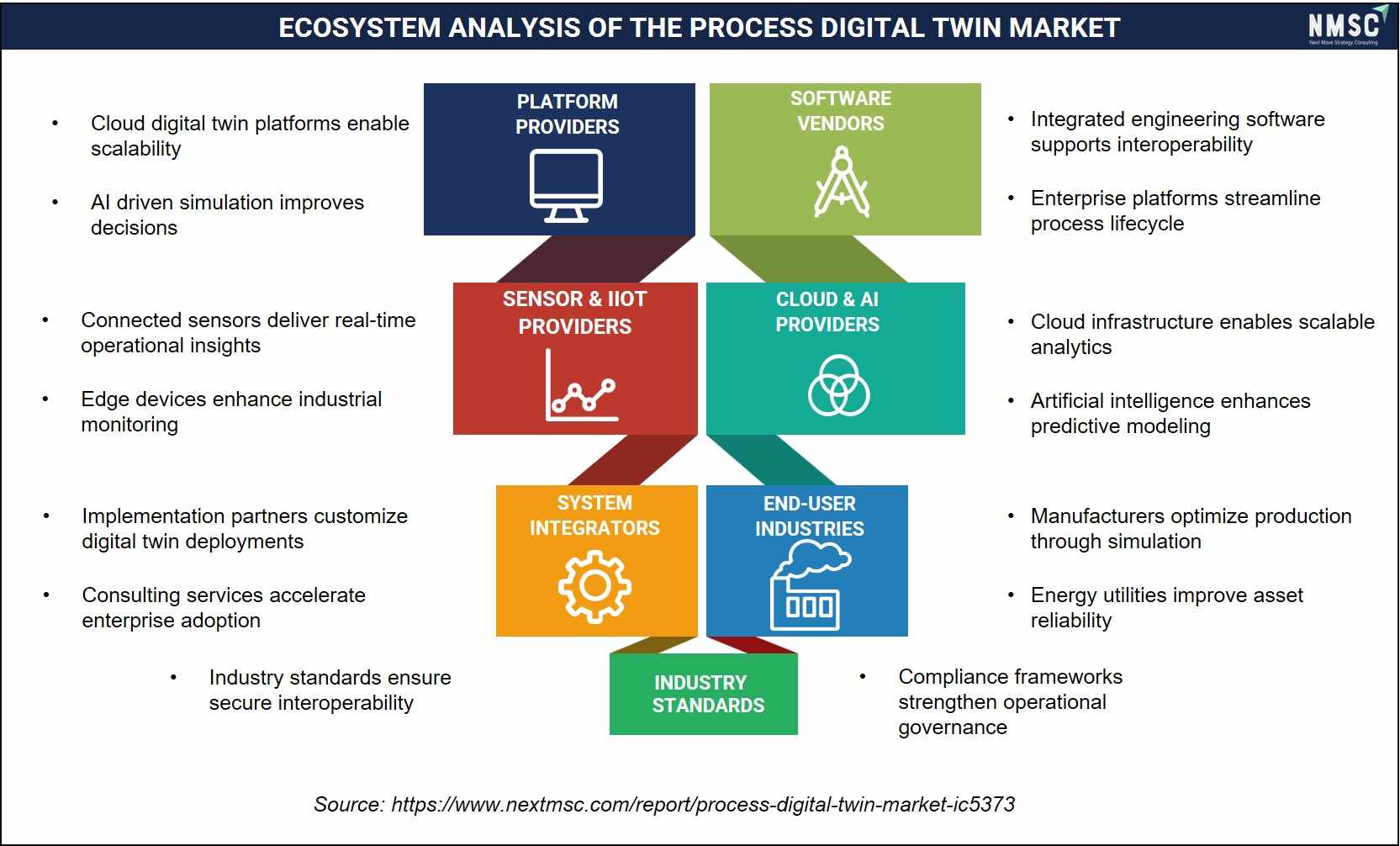
Our analysis indicates that the ecosystem connects platform providers, software vendors, sensor and IIoT providers, cloud and AI providers, system integrators, end-user industries, and industry standards organizations. Collaboration among these participants enables real-time process monitoring, predictive analytics, interoperability, and scalable digital transformation across industrial operations.
Growth Drivers and Restraints
Growth Catalyst and Risk Assessment Matrix
|
Factors |
Type |
(+/-) % Impact on CAGR |
Geographic Relevance |
Impact Timeline |
|
Rising demand for real-time process optimization |
Driver |
+3.2% |
Global |
2026–2035 |
|
Expansion of cloud and hybrid OT data platforms |
Driver |
+2.6% |
North America, Europe |
2026–2035 |
|
Regulatory push for process safety documentation |
Driver |
+1.9% |
North America, Europe |
2026–2035 |
|
Growing adoption of generative AI in engineering |
Driver |
+2.1% |
Global |
2026–2032 |
|
Decarbonization and emissions-reporting mandates |
Driver |
+1.5% |
Europe, Asia-Pacific |
2026–2035 |
|
Expansion of process industries in Asia-Pacific |
Driver |
+1.8% |
Asia-Pacific |
2026–2035 |
|
High upfront integration and change-management cost |
Restraint |
−1.4% |
Global |
2026–2032 |
|
Legacy OT system interoperability challenges |
Restraint |
−1.1% |
Global |
2026–2035 |
|
Shortage of skilled process-simulation engineers |
Restraint |
−0.7% |
North America, Europe |
2026–2032 |
What Is the Primary Growth Driver of the Process Digital Twin Market?
Rising demand for real-time process optimization across continuous manufacturing is the primary driver of the market. The U.S. Department of Energy's Industrial Efficiency and Decarbonization Office continues to promote digital twin adoption as a mechanism to reduce energy intensity across refining and chemicals operations. We observed that this efficiency mandate, reinforced by rising energy costs, continues to anchor baseline investment in engineering and process twin platforms across developed and emerging process-industry economies alike.
How Is Cloud Infrastructure Expansion Driving Market Growth?
Expansion of cloud computing infrastructure is accelerating market growth by lowering the barrier to deploying scalable process twin platforms without heavy on-premises capital investment. The U.S. National Institute of Standards and Technology's cloud computing framework continues to guide secure OT-to-cloud connectivity standards adopted by major process twin vendors. Our assessment indicates that this infrastructure expansion, combined with subscription-based commercial models, is compressing adoption timelines for mid-size process operators across North America and Asia-Pacific.
What Is Restraining Process Digital Twin Market Expansion?
High upfront integration and change-management costs restrain broader market expansion, particularly among small and mid-size process operators. The U.S. Government Accountability Office has documented recurring cost overruns in large-scale industrial software integration projects tied to legacy system compatibility. We found that smaller regional operators face particular exposure, as limited internal engineering capacity reduces their ability to absorb the workforce retraining required for full digital twin adoption compared with larger, vertically integrated process companies.
Segmentation Analysis
Segment Sizing: By Offering
|
Segment |
2025 (USD) |
2035 (USD) |
CAGR% (2026–2035) |
|
Software |
USD 1.85 Billion |
USD 10.30 Billion |
20.9% |
|
Services |
USD 1.00 Billion |
USD 6.35 Billion |
22.9% |
|
Total |
USD 2.85 Billion |
USD 16.65 Billion |
19.5% |
Which Offering Dominates the Process Digital Twin Market?
Software dominates the market with approximately 65% share in 2025, reflecting owner-operator preference for licensed engineering, process, and asset twin platforms that integrate directly with existing OT infrastructure. We observed that Services is the fastest-growing sub-segment at 22.9% CAGR, driven by rising demand for implementation and advisory support as first-time adopters in chemicals and pharmaceuticals seek external expertise to configure complex process models across brownfield facilities.
Segment Sizing: By Deployment
|
Segment |
2025 (USD) |
2035 (USD) |
CAGR% (2026–2035) |
|
On Premises |
USD 0.91 Billion |
USD 3.00 Billion |
14.1% |
|
Cloud |
USD 1.37 Billion |
USD 9.16 Billion |
23.5% |
|
Hybrid |
USD 0.57 Billion |
USD 4.49 Billion |
25.8% |
|
Total |
USD 2.85 Billion |
USD 16.65 Billion |
19.5% |
Which Deployment Model Leads the Process Digital Twin Market?
Cloud deployment leads the market with approximately 48% share in 2025, as owner-operators favor subscription-based access to process twin platforms without heavy on-premises infrastructure investment. Our analysis shows that Hybrid deployment is the fastest-growing sub-segment at 25.8% CAGR, as safety-critical facilities retain on-premises control layers while extending analytics and visualization functions to the cloud, balancing cybersecurity requirements with scalability.
Segment Sizing: By End User
|
Segment |
2025 (USD) |
2035 (USD) |
CAGR% (2026–2035) |
|
Oil and Gas |
USD 0.68 Billion |
USD 3.50 Billion |
19.9% |
|
Chemicals and Petrochemicals |
USD 0.57 Billion |
USD 3.16 Billion |
21.0% |
|
Power and Utilities |
USD 0.46 Billion |
USD 2.50 Billion |
20.8% |
|
Pharmaceuticals and Life Sciences |
USD 0.34 Billion |
USD 2.66 Billion |
25.6% |
|
Food and Beverage |
USD 0.29 Billion |
USD 1.67 Billion |
21.7% |
|
Water and Wastewater |
USD 0.23 Billion |
USD 1.33 Billion |
21.6% |
|
Mining and Metals |
USD 0.17 Billion |
USD 1.00 Billion |
21.6% |
|
Pulp and Paper |
USD 0.09 Billion |
USD 0.50 Billion |
21.5% |
|
Other Process Industries |
USD 0.03 Billion |
USD 0.33 Billion |
31.5% |
|
Total |
USD 2.85 Billion |
USD 16.65 Billion |
19.5% |
Which End User Segment Leads Process Digital Twin Adoption?
Oil and Gas leads end-user adoption with approximately 24% share in 2025, reflecting long-standing use of process simulation for refining yield optimization and safety compliance. We found that Pharmaceuticals and Life Sciences is the fastest-growing named sub-segment at 25.6% CAGR, as regulatory-driven continuous manufacturing initiatives push drug producers toward validated process twin models that document batch consistency and support real-time release testing.
Segment Sizing: By Buyer
|
Segment |
2025 (USD) |
2035 (USD) |
CAGR% (2026–2035) |
|
Owner Operator |
USD 1.48 Billion |
USD 7.48 Billion |
17.6% |
|
EPC and EPCM |
USD 0.51 Billion |
USD 2.90 Billion |
19.0% |
|
OEM |
USD 0.34 Billion |
USD 2.10 Billion |
20.0% |
|
System Integrator |
USD 0.29 Billion |
USD 2.56 Billion |
24.3% |
|
Public Utility |
USD 0.17 Billion |
USD 1.24 Billion |
22.0% |
|
Other Buyer |
USD 0.06 Billion |
USD 0.37 Billion |
20.0% |
|
Total |
USD 2.85 Billion |
USD 16.65 Billion |
19.5% |
Which Buyer Segment Leads the Process Digital Twin Market?
Owner Operator leads buyer-side adoption with approximately 52% share (USD 1.48 billion) in 2025, reflecting direct investment by asset-owning operators in refining, chemicals, and power generation seeking unified visibility across engineering, process, and asset twins. We observed that System Integrator is the fastest-growing buyer sub-segment at 24.3% CAGR, as integrators increasingly package process twin deployment alongside broader automation and OT-to-IT modernization contracts.
Segment Sizing: By Commercial Model
|
Segment |
2025 (USD) |
2035 (USD) |
CAGR% (2026–2035) |
|
Subscription |
USD 1.08 Billion |
USD 7.42 Billion |
21.3% |
|
Perpetual License |
USD 0.68 Billion |
USD 2.52 Billion |
14.0% |
|
Maintenance |
USD 0.46 Billion |
USD 2.21 Billion |
17.0% |
|
Project Services |
USD 0.40 Billion |
USD 2.09 Billion |
18.0% |
|
Managed Services |
USD 0.23 Billion |
USD 2.41 Billion |
26.5% |
|
Total |
USD 2.85 Billion |
USD 16.65 Billion |
19.5% |
Which Commercial Model Dominates the Process Digital Twin Market?
Subscription holds the largest commercial-model share at approximately 38% (USD 1.08 billion) in 2025, as owner-operators shift away from perpetual licensing toward recurring-revenue access that bundles updates, cloud hosting, and analytics. We found that Managed Services is the fastest-growing commercial model at 26.5% CAGR, driven by resource-constrained mid-market operators outsourcing process twin operation and upkeep to specialized vendors.
Segment Sizing: By Distribution Channel
|
Segment |
2025 (USD) |
2035 (USD) |
CAGR% (2026–2035) |
|
Direct |
USD 1.25 Billion |
USD 5.73 Billion |
16.5% |
|
Partner |
USD 0.86 Billion |
USD 7.27 Billion |
23.8% |
|
Embedded OEM |
USD 0.51 Billion |
USD 2.45 Billion |
17.0% |
|
Marketplace |
USD 0.23 Billion |
USD 1.20 Billion |
18.0% |
|
Total |
USD 2.85 Billion |
USD 16.65 Billion |
19.5% |
Which Distribution Channel Leads the Process Digital Twin Market?
Direct distribution leads with approximately 44% share (USD 1.25 billion) in 2025, as large owner-operators favor direct vendor relationships for complex, mission-critical process twin deployments requiring dedicated engineering support. We observed that Partner distribution is the fastest-growing channel at 23.8% CAGR, as vendors expand system integrator and regional reseller networks to reach mid-market process operators beyond direct sales coverage.
Growth Opportunities
Beyond baseline segmentation growth, three whitespace opportunities stand out for vendors and investors positioning across the process digital twin value chain.
How Can Retrofit Programs Unlock Brownfield Process Twin Demand?
Retrofitting legacy continuous-process plants with sensor-enabled asset twins presents a substantial mechanism for vendors to capture brownfield demand. Owner-operators managing multi-decade refining and chemicals assets stand to benefit from phased retrofit programs that avoid full-shutdown capital projects.
What Opportunity Does Public Utility Digitalization Present?
Public utilities modernizing water treatment and power generation infrastructure represent an underpenetrated buyer segment for process twin vendors. Government-funded infrastructure modernization programs create a mechanism for utilities to adopt subsidized digital twin pilots, benefiting system integrators positioned to deliver turnkey deployments.
How Does Managed Services Expansion Create Recurring Revenue Opportunity?
Expanding managed services offerings around process twin platforms creates a recurring-revenue mechanism for vendors serving resource-constrained mid-size operators. Owner-operators lacking dedicated in-house simulation teams benefit from outsourced model maintenance, positioning managed service providers to capture long-tail demand beyond large enterprise accounts.
Regional Outlook
|
Region |
2025 (USD) |
2035 (USD) |
CAGR% (2026–2035) |
Key Driver |
|
North America |
USD 0.97 Billion |
USD 5.00 Billion |
20.0% |
Refining and chemicals digitalization |
|
Europe |
USD 0.74 Billion |
USD 3.83 Billion |
20.0% |
Emissions and safety regulation |
|
Asia-Pacific |
USD 0.68 Billion |
USD 5.00 Billion |
24.7% |
Process industry capacity expansion |
|
Middle East and Africa |
USD 0.26 Billion |
USD 1.50 Billion |
21.6% |
National oil company modernization |
|
Latin America |
USD 0.20 Billion |
USD 1.32 Billion |
23.4% |
Mining and energy digital investment |
|
Total |
USD 2.85 Billion |
USD 16.65 Billion |
19.5% |
— |
North America Process Digital Twin Market
North America's process digital twin market reflects a mature stage of adoption, anchored by large refining, chemicals, and power generation operators with established OT-to-IT integration budgets. Regulatory emphasis on process safety management sustains steady baseline demand, while technology adoption favors cloud-native asset twin platforms. Strategic outlook favors vendors offering predictive maintenance modules that reduce unplanned downtime across aging infrastructure.
Europe Process Digital Twin Market
Europe's market maturity reflects strong regulatory-driven demand from emissions-reporting and process safety mandates across chemicals and power generation sectors. Adoption levels remain high among large owner-operators, while regulatory influence from the European Union's industrial emissions framework shapes vendor product roadmaps. Strategic outlook favors platforms integrating sustainability reporting alongside traditional process optimization functions.
Asia-Pacific Process Digital Twin Market
Asia-Pacific represents a growth-stage market shaped by rapid expansion of refining, chemicals, and power generation capacity across China and India. Demand structure favors cloud deployment given greenfield facility construction, while regulatory influence remains comparatively lighter than in Europe. Strategic outlook favors vendors partnering with regional system integrators to navigate fragmented procurement processes across diverse national markets.
Middle East and Africa Process Digital Twin Market
The Middle East and Africa market reflects steady adoption led by national oil companies modernizing legacy refining and petrochemical assets. Demand structure favors owner-operator-led deployments given the concentration of large state-backed energy companies. Strategic outlook favors vendors offering asset twin platforms that support extended equipment lifecycles across aging Gulf-region infrastructure.
Latin America Process Digital Twin Market
Latin America's market reflects growth-stage adoption concentrated in mining, energy, and pulp and paper sectors across Brazil and Argentina. Demand structure favors hybrid deployment models given variable connectivity infrastructure in remote extraction sites. Strategic outlook favors vendors offering ruggedized asset twin solutions suited to mining and energy operational environments.
U.S. Process Digital Twin Market
Based on our estimates, the U.S. process digital twin market was valued at approximately USD 0.68 billion in 2025 and is projected to reach approximately USD 3.40 billion by 2035, expanding at a CAGR of 19.5% from 2026 to 2035. Demand structure remains concentrated among large refining and chemicals operators with mature digital adoption. Technology penetration is high, with predictive maintenance and cloud data platforms widely deployed. Regulatory influence from process safety management standards reinforces steady baseline investment, and strategic outlook favors continued consolidation of point solutions onto unified data platforms.
Canada Process Digital Twin Market
The market in Canada was valued at approximately USD 0.20 billion in 2025 and is projected to reach approximately USD 1.05 billion by 2035, expanding at a CAGR of 18.1% from 2026 to 2035, driven primarily by oil sands and chemicals processing demand. Adoption levels remain moderate to high among large operators, while regulatory influence from federal emissions targets shapes technology investment. Strategic outlook favors vendors offering asset twin platforms tailored to cold-climate operational conditions and remote-site connectivity requirements.
United Kingdom Process Digital Twin Market
As per our estimate, the United Kingdom process digital twin market was valued at approximately USD 0.18 billion in 2025 and is projected to reach approximately USD 0.94 billion by 2035, expanding at a CAGR of 18.0% from 2026 to 2035. Technology penetration favors cloud deployment among mid-size operators navigating post-Brexit regulatory alignment with European emissions standards, while competitive intensity remains moderate. Strategic outlook favors vendors supporting decommissioning and lifecycle extension of North Sea energy infrastructure.
Germany Process Digital Twin Market
According to our analysis, Germany's process digital twin market was valued at approximately USD 0.24 billion in 2025 and is projected to reach approximately USD 1.24 billion by 2035, expanding at a CAGR of 17.9% from 2026 to 2035. Adoption levels are high among large chemicals and pharmaceuticals operators, benefiting from a strong engineering software vendor presence, while regulatory influence from EU emissions directives sustains consistent demand. Strategic outlook favors vendors integrating sustainability reporting modules into existing process simulation platforms.
France Process Digital Twin Market
Based on our estimates, France's process digital twin market was valued at approximately USD 0.15 billion in 2025 and is projected to reach approximately USD 0.77 billion by 2035, expanding at a CAGR of 17.8% from 2026 to 2035. Adoption remains moderate and concentrated among chemicals, pharmaceuticals, and power generation operators, while regulatory influence from national decarbonization targets supports steady technology investment. Strategic outlook favors continued expansion of cloud-based process twin deployments among mid-size operators.
China Process Digital Twin Market
The market in China was valued at approximately USD 0.22 billion in 2025 and is projected to reach approximately USD 1.68 billion by 2035, expanding at a CAGR of 25.3% from 2026 to 2035, supported by rapid expansion of chemicals and power generation capacity. Adoption levels are rising quickly among large state-owned enterprises, while regulatory influence from national emissions-reduction policy accelerates technology investment. Strategic outlook favors vendors partnering with domestic system integrators to navigate localization requirements across greenfield facility construction.
India Process Digital Twin Market
As per our estimate, the India process digital twin market was valued at approximately USD 0.14 billion in 2025 and is projected to reach approximately USD 1.29 billion by 2035, expanding at a CAGR of 27.0% from 2026 to 2035, as refining and chemicals capacity additions accelerate. Adoption levels remain moderate but rising quickly among large owner-operators, while regulatory influence from national manufacturing policy supports technology investment. Strategic outlook favors vendors offering cost-effective cloud deployment models suited to India's fragmented mid-size operator base.
Japan Process Digital Twin Market
According to our analysis, Japan's process digital twin market was valued at approximately USD 0.10 billion in 2025 and is projected to reach approximately USD 0.62 billion by 2035, expanding at a CAGR of 20.1% from 2026 to 2035. Technology penetration is high among established chemicals and power generation operators, with strong domestic vendor presence, while regulatory influence from national energy efficiency targets sustains steady investment. Strategic outlook favors continued integration of predictive maintenance analytics across aging industrial infrastructure.
South Korea Process Digital Twin Market
Based on our estimates, South Korea's process digital twin market was valued at approximately USD 0.08 billion in 2025 and is projected to reach approximately USD 0.58 billion by 2035, expanding at a CAGR of 22.0% from 2026 to 2035, benefiting from a strong petrochemicals manufacturing base. Adoption levels are rising among large chemicals operators, while regulatory influence from national carbon-neutrality targets supports technology investment. Strategic outlook favors vendors offering integrated asset and process twin platforms suited to large-scale petrochemical complexes.
Australia Process Digital Twin Market
The market in Australia was valued at approximately USD 0.06 billion in 2025 and is projected to reach approximately USD 0.38 billion by 2035, expanding at a CAGR of 20.4% from 2026 to 2035, driven by mining and energy sector digitalization. Adoption levels remain moderate among large resource companies, while regulatory influence from national emissions-reporting requirements supports steady investment. Strategic outlook favors vendors offering ruggedized asset twin platforms suited to remote mining and energy operations.
UAE Process Digital Twin Market
As per our estimate, the UAE process digital twin market was valued at approximately USD 0.09 billion in 2025 and is projected to reach approximately USD 0.52 billion by 2035, expanding at a CAGR of 21.4% from 2026 to 2035, reflecting strong national oil company investment in refining and petrochemicals modernization. Adoption levels are high relative to regional peers, while regulatory influence from national diversification strategy supports continued technology investment. Strategic outlook favors vendors partnering with state-backed energy companies on large-scale digital transformation programs.
Saudi Arabia Process Digital Twin Market
According to our analysis, Saudi Arabia's process digital twin market was valued at approximately USD 0.11 billion in 2025 and is projected to reach approximately USD 0.62 billion by 2035, expanding at a CAGR of 21.0% from 2026 to 2035, anchored by large-scale refining and petrochemicals investment tied to national economic diversification programs. Adoption levels are rising quickly among major state-owned operators, while regulatory influence from national industrial strategy accelerates technology investment. Strategic outlook favors vendors offering integrated engineering-to-operations twin platforms for greenfield petrochemical complexes.
South Africa Process Digital Twin Market
Based on our estimates, South Africa's process digital twin market was valued at approximately USD 0.03 billion in 2025 and is projected to reach approximately USD 0.16 billion by 2035, expanding at a CAGR of 19.8% from 2026 to 2035. Adoption remains concentrated in mining and energy sectors and constrained by capital availability, while regulatory influence from national energy policy supports gradual technology investment. Strategic outlook favors vendors offering cost-effective asset twin solutions suited to mining sector operational requirements.
Brazil Process Digital Twin Market
The market in Brazil was valued at approximately USD 0.09 billion in 2025 and is projected to reach approximately USD 0.62 billion by 2035, expanding at a CAGR of 23.7% from 2026 to 2035, supported by expanding oil and gas, mining, and pulp and paper sector digitalization. Adoption levels are rising among large national operators, while regulatory influence from national energy policy supports continued investment. Strategic outlook favors vendors offering process twin platforms tailored to offshore energy and mining sector requirements.
Argentina Process Digital Twin Market
As per our estimate, the Argentina process digital twin market was valued at approximately USD 0.04 billion in 2025 and is projected to reach approximately USD 0.26 billion by 2035, expanding at a CAGR of 23.1% from 2026 to 2035, reflecting early-stage adoption concentrated in energy and mining sectors. Adoption levels remain moderate, while regulatory influence from national energy investment policy supports gradual technology uptake. Strategic outlook favors vendors offering scalable cloud deployment models suited to Argentina's developing process-industry infrastructure.
Strategic Framework of the Process Digital Twin Market
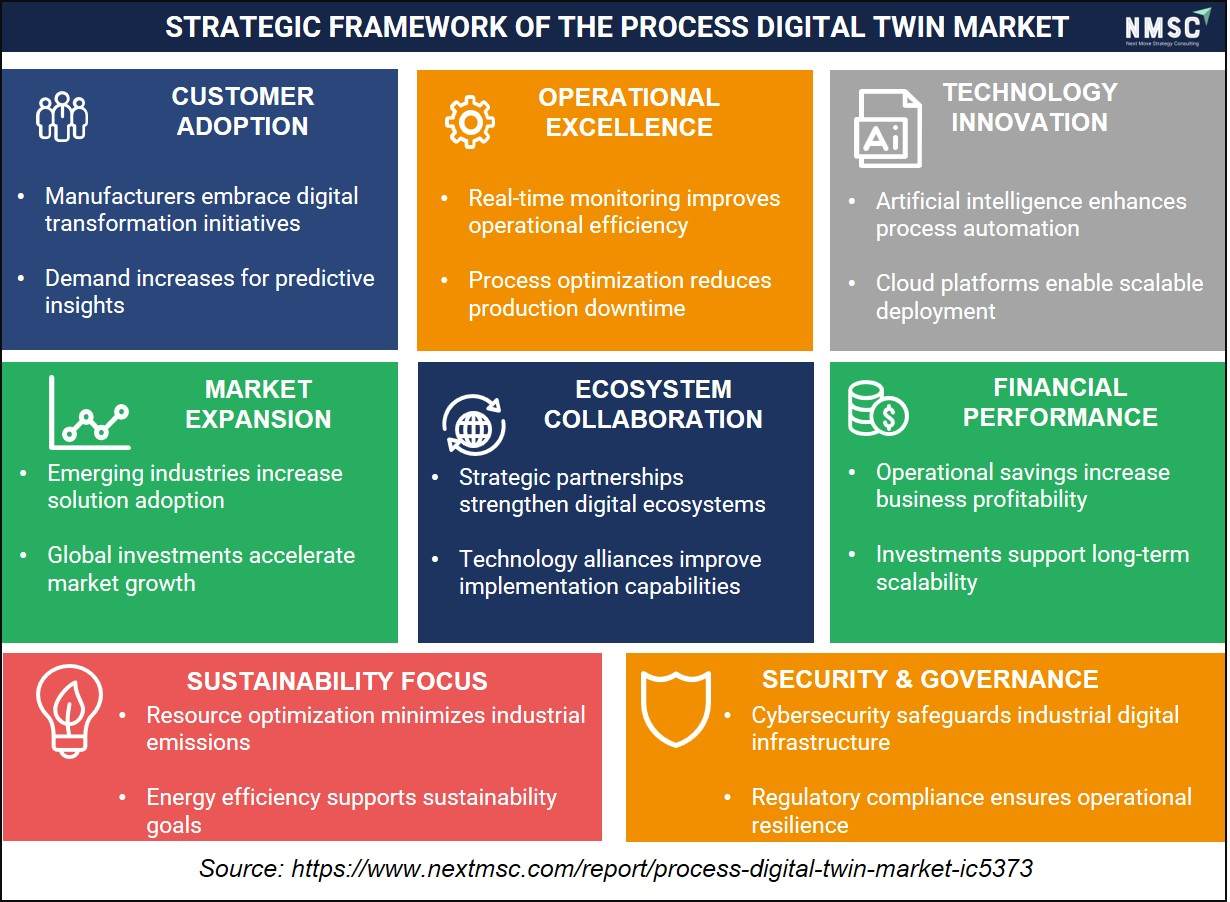
Our findings suggest that the market is shaped by increasing customer adoption, operational excellence, ecosystem collaboration, financial performance improvements, technology innovation, sustainability initiatives, and cybersecurity governance. Artificial intelligence, cloud computing, strategic partnerships, and regulatory compliance collectively enhance operational resilience, productivity, and long-term industrial digital transformation.
Competitive Landscape
We observed that the competitive landscape spans established industrial automation conglomerates, specialized simulation software vendors, and emerging industrial data platform providers, each competing on breadth of integration and depth of process-specific modeling capability.
Key Takeaways
|
Category |
Details |
|
Market Structure |
Moderately consolidated, led by diversified automation vendors alongside specialized simulation and data platform providers |
|
Innovation Focus |
Generative AI-assisted simulation, cloud-native data platforms, and predictive maintenance analytics |
|
M&A Activity |
Selective acquisitions of data platform and analytics specialists by larger automation vendors |
How Do Companies Compete in the Process Digital Twin Market?
Companies compete primarily on breadth of process-specific modeling libraries, depth of OT-to-IT integration, and the ability to unify engineering and operational data within a single platform. Vendors with decades of process simulation heritage, such as AspenTech and Honeywell, compete on domain-specific accuracy, while newer industrial data platform entrants compete on interoperability and speed of deployment across heterogeneous OT environments.
Which Competitive Archetypes Dominate the Market?
Two archetypes dominate the process digital twin market: legacy process simulation specialists with deep chemical-engineering modeling heritage, and industrial data platform providers offering cloud-native contextualization layers. The former differentiates through decades of validated thermodynamic and kinetic models, while the latter differentiates through rapid data integration across disparate historian and SCADA systems, together defining the competitive core of the industry.
What Innovation and Differentiation Strategies Define the Market?
Vendors differentiate through embedding generative AI copilots into simulation workflows, expanding cloud subscription commercial models, and building open connectivity frameworks that reduce integration timelines. AVEVA and Siemens have invested heavily in unified data platforms, while Cognite differentiates through contextualized industrial knowledge graphs that accelerate cross-system data modeling for owner-operators.
What M&A Activity Is Shaping the Competitive Landscape?
M&A activity remains selective, with larger automation vendors acquiring specialized analytics and data platform providers to close capability gaps rather than pursuing broad consolidation. This pattern reflects a market still maturing around interoperability standards, where targeted acquisitions of niche software capabilities offer faster time-to-market than internal development for expanding process twin portfolios.
Key Market Players
We observed that the competitive set spans diversified automation conglomerates, specialized simulation software vendors, and industrial data platform providers positioned across the process digital twin value chain.
-
Siemens AG
-
AVEVA Group Limited
-
Aspen Technology, Inc.
-
Rockwell Automation, Inc.
-
Yokogawa Electric Corporation
-
Dassault Systèmes SE
-
Bentley Systems, Incorporated
-
Hexagon AB
-
Ansys, Inc.
-
PTC Inc.
-
Cognite AS
-
GE Vernova Inc.
-
SLB
-
Baker Hughes Company
-
MathWorks, Inc.
-
Seeq Corporation
-
Kongsberg Digital AS
-
Aize AS
Latest Developments
We observed steady product and partnership activity among leading vendors through 2025 and 2026 as the market matures around cloud and AI-enabled process twin capabilities.
|
Date |
Event |
|
March 2026 |
AVEVA Group Limited integrated its engineering and operations software into the NVIDIA Omniverse DSX Blueprint, establishing a new lifecycle digital twin architecture designed to accelerate the deployment and maximize GPU and cooling efficiency of gigawatt-scale AI Factories. |
|
February 2026 |
Siemens AG unveiled its Digital Twin Composer software at CES 2026 (slated for the Siemens Xcelerator Marketplace mid-2026), built using NVIDIA Omniverse libraries to let industrial enterprises simulate and visualize products, lines, and entire factories in real time. |
|
March 2025 |
Emerson completed its acquisition of all remaining outstanding shares of Aspen Technology, Inc., making AspenTech a wholly owned independent business unit consolidated into Emerson's Control Systems & Software segment. |
Expert Insights
 “The process manufacturing industry is undergoing a significant change as more companies take advantage of advanced technologies like AI, machine learning and the cloud to better operate their critical assets.”
— Antonio Pietri, President & CEO, Aspen Technology
Statement made in the context of digital transformation initiatives in process industries leveraging AI, machine learning, and cloud-based solutions.
Market Interpretation
The statement highlights a major transformation within the process digital twin market, driven by the increasing adoption of advanced technologies such as AI, machine learning, and cloud computing. These technologies form the backbone of process digital twin solutions, enabling real-time monitoring, simulation, and optimization of critical industrial assets. As industries move toward data-driven operations, digital twins are becoming essential tools for improving operational efficiency, reducing downtime, and enhancing asset performance. This shift is accelerating demand across sectors such as oil & gas, chemicals, and manufacturing, where organizations are prioritizing predictive insights and intelligent asset management to remain competitive in a rapidly evolving industrial landscape.
Investment Opportunities
How Are Capital Inflows Shaping the Process Digital Twin Market?
Capital inflows into industrial software vendors have accelerated as investors recognize recurring-revenue potential within process digital twin platforms. Venture and private equity interest in industrial data platform providers such as Cognite reflects growing confidence in subscription-based OT software models, with funding increasingly directed toward AI-enabled simulation and predictive maintenance capabilities that extend platform stickiness across owner-operator accounts.
What Infrastructure Investment Supports Market Expansion?
Infrastructure investment in data center capacity and industrial cloud connectivity underpins broader process digital twin deployment, particularly across Asia-Pacific greenfield facility construction. Owner-operators are increasingly budgeting for dedicated OT-to-cloud gateway infrastructure alongside traditional automation capital expenditure, reflecting the convergence of information technology and operational technology investment priorities across process industries.
How Do ESG Considerations Influence Investment Decisions?
Environmental, Social, and Governance considerations increasingly influence capital allocation toward process digital twin platforms that support emissions tracking and energy-efficiency optimization. Investors evaluating industrial software vendors are placing growing weight on decarbonization-enabling capabilities, favoring platforms that quantify measurable emissions reductions alongside traditional yield and throughput improvements across chemicals and power generation operations.
Key Benefits for Stakeholders
How Does This Report Benefit Enterprise and Industry Leaders?
Enterprise and industry leaders gain a structured view of segmentation, regional demand, and competitive positioning that supports capital allocation decisions across process twin deployment programs. Our forecasts and strategic insights help operations leadership benchmark technology investment against regional peers while identifying which offering and deployment models align with their specific process industry vertical.
How Does This Report Benefit Investors and Financial Analysts?
Investors and financial analysts benefit from quantified market sizing, segmentation-level growth rates, and competitive landscape analysis that supports valuation and due diligence across industrial software investment opportunities. Our data-driven forecasts through 2035 provide a reference framework for assessing vendor positioning within the broader USD 16.65 billion process digital twin opportunity.
How Does This Report Benefit Technology Vendors and Product Teams?
Technology vendors and product teams gain visibility into underserved segments, emerging trend trajectories, and competitive differentiation strategies that inform product roadmap prioritization. Our analysis of segment-level CAGR figures and regional demand drivers supports go-to-market planning for vendors evaluating expansion across cloud, hybrid, and services-led offering strategies.
Key Market Segments
By Offering
-
Software
-
Engineering Twin
-
Process Twin
-
Asset Twin
-
Data Platform
-
Other Software
-
-
Services
-
Advisory
-
Implementation
-
Support
-
By Deployment
-
On Premises
-
Cloud
-
Hybrid
By Buyer
-
Owner Operator
-
EPC and EPCM
-
OEM
-
System Integrator
-
Public Utility
-
Other Buyer
By Commercial Model
-
Perpetual License
-
Subscription
-
Maintenance
-
Project Services
-
Managed Services
By Distribution Channel
-
Direct
-
Partner
-
Embedded OEM
-
Marketplace
By End User
-
Oil and Gas
-
Chemicals and Petrochemicals
-
Power and Utilities
-
Pharmaceuticals and Life Sciences
-
Food and Beverage
-
Water and Wastewater
-
Mining and Metals
-
Pulp and Paper
-
Other Process Industries
By Region
-
North America: U.S., Canada, Mexico.
-
Europe: UK, Germany, France, Italy, Spain, Sweden, Denmark, Finland, Netherlands, Rest of Europe.
-
Asia-Pacific: China, India, Japan, South Korea, Taiwan, Indonesia, Vietnam, Australia,Philippines, Malaysia, Rest of APAC.
-
Middle East & Africa: Saudi Arabia, UAE, Egypt, Israel, Turkey, Nigeria, South Africa, Rest of MEA.
-
Latin America: Brazil, Argentina, Chile, Colombia, Rest of LATAM.
Conclusion and Recommendations
What Is the Long-Term Outlook for the Process Digital Twin Market?
The long-term outlook for the process digital twin market remains highly positive, with global revenue projected to increase from USD 2.85 billion in 2025 to USD 16.65 billion by 2035 at a CAGR of 19.5%. We observed that the increasing convergence of engineering, operational, and sustainability data onto unified digital platforms will continue to position process digital twins as essential infrastructure for continuous and batch process industries.
What Strategic Positioning Should Process Digital Twin Vendors Pursue?
Vendors should prioritize unified data platform architectures that seamlessly integrate engineering, process, and asset twins within a single environment instead of relying on fragmented point solutions. Our assessment indicates that strengthening partnerships with system integrators and industrial automation providers, particularly across Asia-Pacific and the Middle East, will enhance market penetration and support long-term competitive positioning.
How Attractive Is the Process Digital Twin Market for New Investment?
The process digital twin market presents a highly attractive investment opportunity, supported by strong recurring software revenue potential, expanding cloud adoption, and increasing demand for managed digital transformation services. We found that vendors demonstrating sustained cloud subscription growth, scalable AI-enabled capabilities, and comprehensive lifecycle service portfolios are best positioned to capitalize on the market's long-term expansion.
What Market Shifts and Key Risks Should Stakeholders Monitor?
Stakeholders should closely monitor integration challenges across legacy operational technology environments, cybersecurity requirements, evolving interoperability standards, and the ongoing shortage of skilled process simulation professionals. Our analysis shows that organizations investing in workforce development, open digital architectures, and secure industrial connectivity will be better positioned to accelerate adoption while mitigating implementation risks.
What Are the Key Growth Pathways for the Process Digital Twin Market?
Key growth pathways include expanding adoption among public utilities and mid-sized industrial operators, integrating generative AI into simulation and optimization workflows, and accelerating deployment across high-growth regions such as Asia-Pacific and Latin America. Next Move Strategy Consulting's analysis indicates that vendors combining advanced AI capabilities with scalable cloud platforms and industry-specific expertise will be best positioned to capture the process digital twin market's projected growth through 2035.
About the Author
 Saista Faiyaz
— Saista Faiyaz is Research Associate at Next Move Strategy Consulting, where she has covered consumer markets and healthcare technologies for 3 years. Her work includes primary interview review, secondary-source validation, market sizing, and structured analysis of company and industry data. She supports research by comparing evidence across sources, organizing findings into market narratives, and documenting assumptions used in analysis. Her scope includes cross-market benchmarking, and reports.
Saista Faiyaz
— Saista Faiyaz is Research Associate at Next Move Strategy Consulting, where she has covered consumer markets and healthcare technologies for 3 years. Her work includes primary interview review, secondary-source validation, market sizing, and structured analysis of company and industry data. She supports research by comparing evidence across sources, organizing findings into market narratives, and documenting assumptions used in analysis. Her scope includes cross-market benchmarking, and reports.
About the Reviewer
 Supradip Baul
— Supradip Baul is an accomplished business consultant and strategist with over a decade of rich experience in market intelligence, strategy, technology, and business transformation. His work has included rigorous qualitative and quantitative analysis across multiple industries, helping clients shape investment decisions and long-term roadmaps. Earlier in his career, he was associated with Gartner, where he contributed to industry-leading reports and market share analyses. He has worked with leading global companies and holds an MBA with a dual specialization in Marketing and Finance.
Supradip Baul
— Supradip Baul is an accomplished business consultant and strategist with over a decade of rich experience in market intelligence, strategy, technology, and business transformation. His work has included rigorous qualitative and quantitative analysis across multiple industries, helping clients shape investment decisions and long-term roadmaps. Earlier in his career, he was associated with Gartner, where he contributed to industry-leading reports and market share analyses. He has worked with leading global companies and holds an MBA with a dual specialization in Marketing and Finance.
At Next Move Strategy Consulting, we understand that insightful market research is the cornerstone of successful business decisions. That's why we employ a robust and multifaceted approach, combining various methodologies to deliver the most accurate and actionable data for our clients.

Research Landscape
We navigate the world of research with two primary approaches:
Qualitative Approach
Our qualitative research methodologies involve immersive techniques such as in-depth interviews, focus groups, and observational studies. By engaging directly with individuals and stakeholders, we uncover valuable insights that quantitative data alone may overlook.

Quantitative Research
In tandem with qualitative methodologies, NMSC leverages the power of Quantitative Research to provide a robust foundation of numerical insights. Through systematic data collection and analysis, we quantify patterns, preferences, and market trends, offering a comprehensive view of the business landscape.
Our quantitative research approach employs diverse tools, including surveys, experiments, and statistical modelling. These methodologies enable us to gather data from a large and representative sample, ensuring the statistical significance of our findings. By employing structured questionnaires and standardized data collection methods, we guarantee the reliability and validity of the information we present to our clients.
Quantitative research is particularly effective in measuring the prevalence of trends, assessing market size, and gauging the impact of various factors on consumer behavior. The numerical precision attained through this approach equips our clients with actionable insights, facilitating data-driven decision-making and strategy formulation.


Our Specialized Toolbox for Industry-Specific Market Research
We deploy a specialized arsenal of techniques tailored to meet your unique requirements. Here's a glimpse into our comprehensive toolbox:

Information Procurement
The stage entails acquiring market data or relevant information through various sources and methodologies.


Market Research Approach
We utilize both top-down and bottom-up approaches in market research analysis to achieve a comprehensive understanding of the market dynamics, leveraging the broad perspective of industry trends and macroeconomic factors alongside detailed insights from specific segments and individual companies.

Porters Five Forces Analysis
We conduct Porter's Five Forces analysis to evaluate the competitive landscape of an industry, providing us with insights into factors that affect profitability and strategic positioning.

SWOT Analysis

Forecasting
We utilize a forecasting model to predict future consumption by considering parameters like population, economics, regulations, market competition, drivers, constraints, technology, and pricing. We also employ statistical techniques such as multilinear regression, exponential smoothing, moving average, ARIMA, and Monte Carlo simulations for accurate predictions. In econometric forecasting, we analyzed short-term and long-term event impacts, attributing values based on regulatory frameworks, economic factors, and market events.





 Speak to Our Analyst