Seed Coating Materials Market Global Industry Analysis and Forecast (2026–2035)

The global Seed Coating Materials Market size was valued at USD 2.35 billion in 2025 and is estimated at USD 2.54 billion in 2026, projected to reach USD 5.32 billion by 2035, expanding at a CAGR of 8.55% from 2026 to 2035. Key drivers include rising precision agriculture adoption and expanding hybrid seed adoption, supported by growing demand for coated seeds compatible with variable-rate planting equipment and increasing use of certified hybrid varieties across emerging-market farming regions, with North America leading the global market.
Download Free Sample PDF
Base Year (2025)
$2.35 Billion
Forecast (2035)
$5.32 Billion
CAGR (2026-2035)
8.6%
Top Region
North America

What Is the Seed Coating Materials Market Size?

The global seed coating materials market size was valued at USD 2.35 billion in 2025 and is estimated at USD 2.54 billion in 2026, projected to reach USD 5.32 billion by 2035, expanding at a CAGR of 8.55% between 2026 and 2035, with North America holding approximately a 33.2% share and Polymers accounting for nearly 49% of 2025 revenue.

We observed that demand is broadening across cereal, oilseed, and horticultural seed treatment as growers adopt precision agriculture practices requiring uniform seed sizing, targeted nutrient delivery, and improved germination consistency across diverse growing conditions.

Seed Coating Materials Market Global Industry Analysis and Forecast (2026–2035) Revenue Forecast
Values in USD Billion

2025 $2.35 Billion
2025
2026 $2.55 Billion
2026
2027 $2.77 Billion
2027
2028 $3.01 Billion
2028
2029 $3.26 Billion
2029
2030 $3.54 Billion
2030
2031 $3.84 Billion
2031
2032 $4.17 Billion
2032
2033 $4.53 Billion
2033
2034 $4.92 Billion
2034
2035 $5.32 Billion
2035

Key Takeaways

By Product Type: Polymers held the largest share of approximately 49% (USD 1.15 Billion) in 2025; Pellets is the fastest-growing sub-segment at 10.2% CAGR from 2026-2035.

By Crop Type: Cereals & Grains held the largest share of approximately 44.7% (USD 1.05 Billion) in 2025; Fruits & Vegetables is the fastest-growing sub-segment at 10.3% CAGR from 2026-2035.

By Technology: Film Coating held the largest share of approximately 55.3% (USD 1.30 Billion) in 2025; Pelleting is the fastest-growing sub-segment at 9.2% CAGR from 2026-2035.

Dominant Region: North America dominated with approximately 33.2% revenue share (USD 0.78 Billion) in 2025.

Fastest-Growing Region: Asia-Pacific is expected to register the highest CAGR of 11.3% during 2026-2035.

Dominant Country: U.S. led with approximately USD 0.58 Billion in 2025.

Fastest-Growing Country: India is the fastest-growing country at approximately 12.8% CAGR from 2026-2035.

Market Opportunity: The seed coating materials market is expected to create an absolute dollar opportunity of USD 2.78 billion between 2026 and 2035, positioning polymer and pelleting technologies as priority allocations for agricultural input suppliers.

According to Next Move Strategy Consulting analysis, seed treatment applicators are increasingly bundling biostimulant and micronutrient carriers within coating formulations, reflecting stakeholder demand for multifunctional seed treatment solutions.

Seed Coating Materials Market Overview

The seed coating materials market encompasses polymers, colorants, and pelleting compounds applied to seeds to improve handling, germination uniformity, and targeted delivery of nutrients or protectants. Our analysis shows that the market has evolved from basic dust-reduction coatings toward multifunctional formulations integrating biostimulants, micronutrients, and precision-release polymers tailored to specific crop and soil conditions.
Regulatory frameworks, including the U.S. Environmental Protection Agency's pesticide seed treatment guidance and the European Union's plant protection product regulations, shape permissible active ingredients within coating formulations. We found that technology adoption trends, including precision film-coating equipment and biodegradable polymer carriers, are accelerating differentiation among established agrochemical manufacturers and specialty seed treatment vendors.

Supply Chain Structure of the Seed Coating Materials Market
Supply Chain Structure of the Seed Coating Materials Market
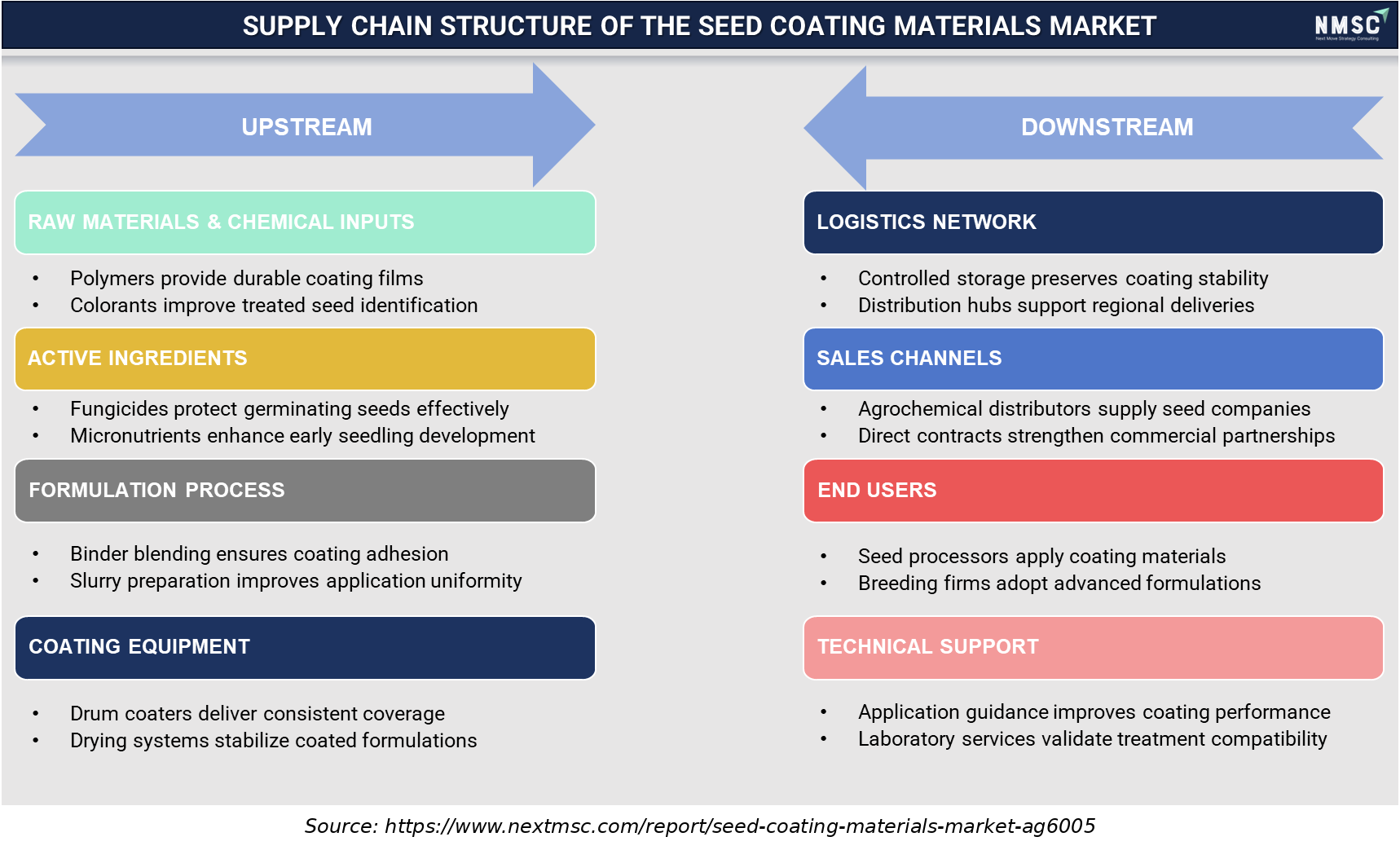
Based on research conducted by NMSC, we found that the supply chain structure of the Seed Coating Materials Market integrates polymers, fungicides, and micronutrients during binder slurry formulation and equipment application. Furthermore, controlled logistics and agrochemical sales channels supply seed processors and breeding firms. Finally, technical application guidance combined with laboratory compatibility testing validates treatment performance to ensure maximum seed protection and crop uniformity.
Market Drivers & Dynamics

Interactive Dataset
Rising precision agriculture adoption driver +2.4% North America, Europe 2026-2035
Expanding hybrid seed adoption in emerging markets driver +2.1% Asia-Pacific, Latin America 2026-2033
Growth in biostimulant-enhanced coatings driver +1.6% Global 2026-2032
Government seed quality certification programs driver +1.3% Asia-Pacific, MEA 2026-2031
Rising demand for uniform mechanized planting driver +1.1% Global 2026-2035
Regulatory restrictions on certain active ingredients restraint -1.4% Europe, North America 2026-2030
High cost of advanced polymer coatings restraint -1.0% Latin America, MEA 2026-2029
Volatility in polymer resin raw material prices restraint -0.8% Global 2026-2030
Limited farmer awareness in developing regions restraint -0.6% MEA, Latin America 2026-2028
Source: Next Move Strategy Consulting

Growth Drivers

What Is the Primary Growth Driver of the Seed Coating Materials Market?

Rising precision agriculture adoption is the primary driver of the market, as growers increasingly demand seed inputs compatible with variable-rate planting equipment. The U.S. Department of Agriculture reports expanding adoption of precision planting technologies across major row-crop states, prompting seed companies to fund coating research aimed at improving planter singulation accuracy.

How Is Hybrid Seed Adoption Driving Market Growth?

Expanding hybrid seed adoption is driving market growth as emerging-market growers transition from farm-saved seed toward certified hybrid varieties requiring coating for handling and identification. India's Ministry of Agriculture and Farmers Welfare has promoted certified seed distribution programs, industry-derived estimate indicating meaningful coating material demand growth across smallholder farming regions.

Growth Inhibitors

What Is Restraining Seed Coating Materials Market Expansion?
Regulatory restrictions on certain active ingredients are restraining market expansion, particularly across jurisdictions restricting neonicotinoid-based seed treatments. The European Union's plant protection product framework has narrowed permissible active ingredients, and industry-derived estimates indicate that compliance reformulation disproportionately affects smaller coating material suppliers.

Segmentation Analysis

2025 (USD Billion)
2035 (USD Billion)
Polymers 2025: $1.15 Billion | 2035: $2.55 Billion
Polymers
Colorants 2025: $0.65 Billion | 2035: $1.35 Billion
Colorants
Pellets 2025: $0.55 Billion | 2035: $1.42 Billion
Pellets
Polymers $1.15 Billion $2.55 Billion 8.3%
Colorants $0.65 Billion $1.35 Billion 7.5%
Pellets $0.55 Billion $1.42 Billion 10.2%

Which Product Type Segment Dominates the Seed Coating Materials Market?

Polymers led the market, valued at USD 1.15 billion in 2025 and projected to reach USD 2.55 billion by 2035, supported by widespread use as binding agents for micronutrient and protectant delivery. Pellets is the fastest-growing sub-segment at a CAGR of 10.2%, driven by rising demand for uniform seed sizing among vegetable and forage seed producers.

2025 (USD Billion)
2035 (USD Billion)
Cereals & Gr
Oilseeds & P
Fruits & Veg
Others
Segment Item 2025 (USD Billion) 2035 (USD Billion) CAGR
Cereals & Grains $10.0 USD Billion $40.0 USD Billion 27.0%
Oilseeds & Pulses $17.1 USD Billion $51.1 USD Billion 17.0%
Fruits & Vegetables $24.2 USD Billion $62.2 USD Billion 27.0%
Others $31.3 USD Billion $73.3 USD Billion 9.0%

Segment-wise data is locked

Unlock complete segment-wise numbers for By Crop Type.

Unlock Full Data

Which Crop Type Segment Is Growing Fastest?

Fruits & Vegetables is the fastest-growing crop type segment, expanding at a CAGR of 10.3% between 2026 and 2035, driven by rising precision pelleting adoption among horticultural seed producers. Cereals & Grains remains the dominant segment given its established row-crop coating volumes, while Others includes forage and turf seed applications.

2025 (USD Billion)
2035 (USD Billion)
Film Coating
Pelleting
Encrusting
Segment Item 2025 (USD Billion) 2035 (USD Billion) CAGR
Film Coating $10.0 USD Billion $40.0 USD Billion 16.0%
Pelleting $17.1 USD Billion $51.1 USD Billion 22.0%
Encrusting $24.2 USD Billion $62.2 USD Billion 16.0%

Segment-wise data is locked

Unlock complete segment-wise numbers for By Technology.

Unlock Full Data

Why Does Film Coating Lead the Market?

Film Coating dominated the market, reaching USD 1.30 billion in 2025 due to its compatibility with a broad range of active ingredients and minimal impact on seed weight. Pelleting is expanding at a faster CAGR of 9.2% as mechanized planting of small-seeded crops requires precise sizing that film coating alone cannot achieve.

Growth Opportunities

Our analysis shows that three forward-looking opportunities stand out for stakeholders positioning within the seed coating materials market.

How Can Biodegradable Pelleting Materials Unlock Value for Vegetable Seed Producers?

Biodegradable pelleting materials that disintegrate rapidly under variable moisture conditions present a whitespace opportunity for vegetable seed producers seeking to meet tightening environmental packaging expectations from institutional buyers.

Where Does Microbial Carrier Technology Create Demand in Row-Crop Markets?

Microbial carrier coatings compatible with nitrogen-fixing inoculants create an underpenetrated opportunity across soybean and pulse-growing regions, where biological seed treatment adoption remains limited relative to conventional chemical protectants.

How Can Smart Coating Diagnostics Benefit Certified Seed Distributors?

Coating-embedded diagnostic markers that verify seed lot authenticity create an opportunity for certified seed distributors to combat counterfeit seed circulation, particularly across emerging markets with expanding hybrid seed adoption.

Regional Outlook

2025 (USD Billion)
2035 (USD Billion)
North Americ
Europe
Asia-Pacific
Middle East
Latin Americ
Region 2025 (USD Billion) 2035 (USD Billion) CAGR (%)
North America $10.0 USD Billion $40.0 USD Billion 9.0%
Europe $17.1 USD Billion $51.1 USD Billion 27.0%
Asia-Pacific $24.2 USD Billion $62.2 USD Billion 25.0%
Middle East & Africa $31.3 USD Billion $73.3 USD Billion 23.0%
Latin America $38.4 USD Billion $84.4 USD Billion 12.0%

Regional data is locked

Unlock complete regional numbers for this market.

Unlock Full Data

Regulatory Framework Impacting the Seed Coating Material Market

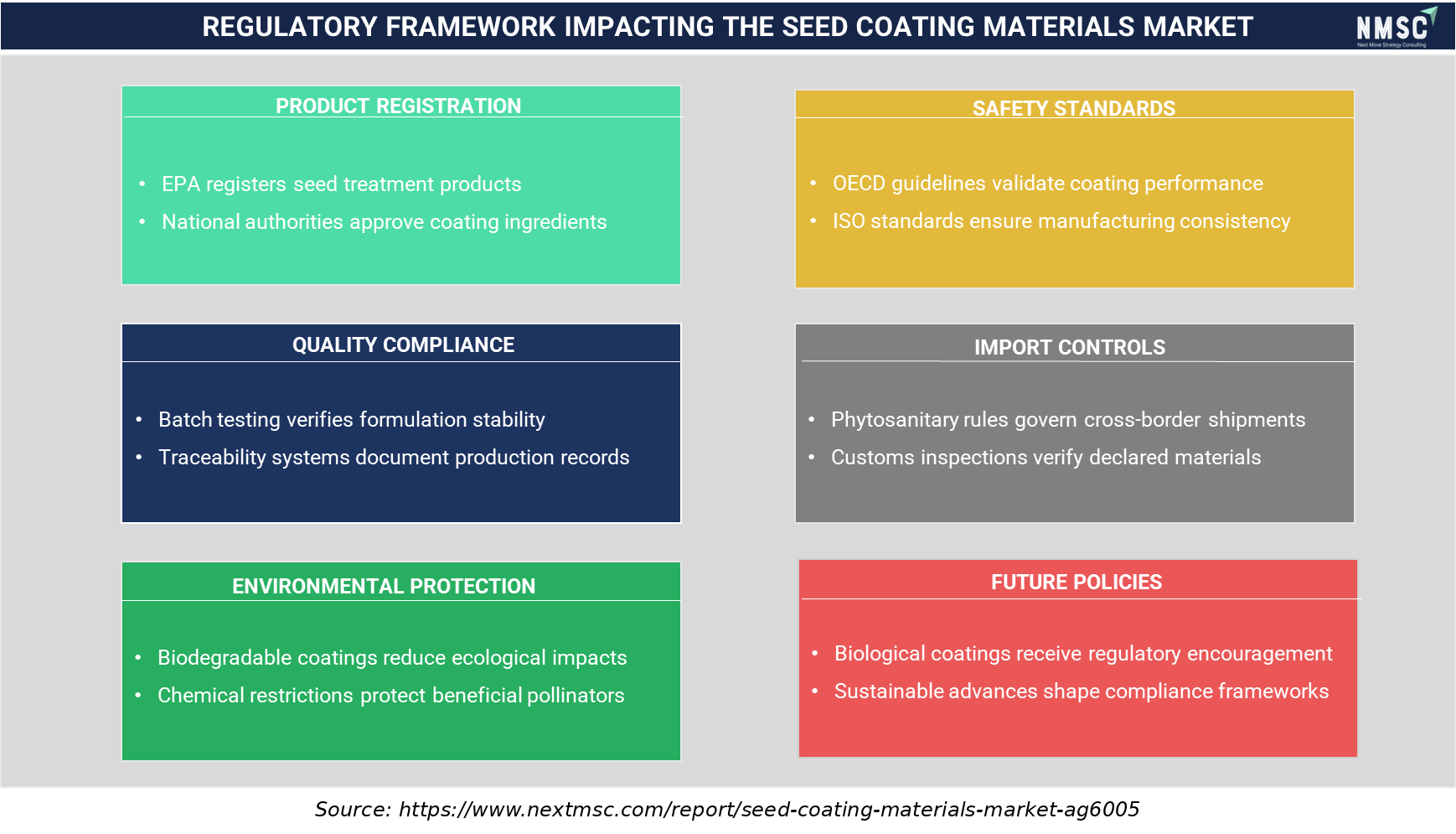
NMSC's analysis indicates that the regulatory framework governing the Seed Coating Materials Market relies on EPA registration, OECD guidelines, and ISO manufacturing standards to ensure safety and quality. Moreover, batch testing, phytosanitary import rules, and chemical restrictions protect pollinators and maintain compliance. Consequently, rising support for biological and biodegradable coatings is actively shaping future sustainable agricultural policy frameworks worldwide.
Competitive Landscape

We found that the competitive landscape is moderately consolidated, with global agrochemical conglomerates competing alongside specialized seed treatment vendors across distinct crop verticals.

Dimension Description
Market Structure Moderately consolidated, with 20 profiled vendors spanning diversified agrochemical companies and specialized seed treatment providers
Innovation Focus Biodegradable polymer carriers, micronutrient-enriched formulations, and precision pelleting for mechanized planting
M&A Activity Selective acquisitions of specialty seed treatment and biological carrier technology firms by larger agrochemical vendors

How Do Companies Compete in the Seed Coating Materials Market?

Companies compete primarily on formulation compatibility with active ingredients, regulatory compliance breadth across covered geographies, and depth of agronomic support services offered to seed company customers. Pricing strategies increasingly favor volume-based supply agreements tied to multi-year seed treatment contracts.

Which Competitive Archetypes Dominate the Market?

Three archetypes dominate: diversified agrochemical conglomerates such as Bayer AG offering integrated crop protection and coating portfolios, specialty coating formulators such as Croda International Plc focused on polymer chemistry, and seed technology specialists such as Incotec Group B.V. emphasizing pelleting and precision sizing services.

What Innovation and Differentiation Strategies Are Vendors Pursuing?

Vendors are differentiating through proprietary biodegradable polymer chemistries, expanded biostimulant carrier compatibility, and regulatory dossier support partnerships with seed companies, aiming to strengthen defensibility against commoditized generic coating formulations offered by smaller entrants.

Key Market Players

We found that the following companies represent the leading providers of seed coating materials based on market-specific revenue and scale of operations as of 2026.

Bayer AG Corteva, Inc. Syngenta Group Co., Ltd. UPL Limited Croda International Plc Clariant AG Precision Laboratories, LLC Sensient Technologies Corporation Balchem Corporation Nufarm Limited Sumitomo Chemical Co., Ltd. Advanced Biological Marketing, Inc. Plant Health Care plc American Vanguard Corporation Milliken & Company Chromatic Technologies, Inc. Precision Pak, Inc. Incotec Group B.V.

Latest Developments

We observed the following recent developments shaping vendor positioning and formulation capability within the market.

Date Event
June 2026 Bayer expanded commercialization of its Guardião integrated seed treatment platform in Brazil, bringing together insecticide, fungicide and biological seed treatment technologies into a unified offering for soybean, corn, wheat and cotton. The commercial rollout strengthens Bayer's seed treatment portfolio and customer access.
April 2026 Incotec officially launched a high-performance, microplastic-free seed film coating specifically engineered for cereal crops. The new seed coating solution provides high-performance seed treatment while eliminating microplastics, enabling commercial seed producers to meet tightening European Union dust norms and sustainability mandates without sacrificing application efficiency.
November 2025 BASF announced that Integral Pro, a biological fungicide seed treatment based on Bacillus amyloliquefaciens MBI600, received regulatory registration in France for sunflower. BASF stated that the product would be available to sunflower growers across the European Union from the 2026 sowing season, expanding its BioSolutions-based seed treatment offering.

Expert Insights

Erik-Jan Bartels

Erik-Jan Bartels

Managing Director, Incotec Seed Enhancement Business | Croda International Plc

"Microplastics in agriculture in total account for 10% of the world’s microplastics problem, and within that seed coatings account for 1%, but that makes it no less important to change the industry, as we have been doing now for some time."

Analyst Interpretation

The statement emphasizes the seed coating industry's growing focus on reducing the environmental impact of conventional coating materials by adopting sustainable alternatives. As regulatory scrutiny on intentionally added microplastics intensifies and demand for environmentally responsible agricultural inputs increases, manufacturers are accelerating the development of biodegradable and plant-based seed coating materials. This transition is expected to drive innovation, support regulatory compliance, and create new growth opportunities in the global seed coating materials market.

Investment Opportunities

What Capital Inflows Are Supporting Market Expansion?

Corporate and agrochemical investment continue to flow into biodegradable polymer and biological carrier formulation startups. Our findings suggest that investor interest is concentrated on formulations demonstrating measurable germination improvements alongside recurring multi-year supply agreements.

How Is Infrastructure Investment Shaping Coating Material Scalability?

Manufacturing capacity investment by established polymer producers, including BASF SE and Clariant AG, underpins coating material scalability for expanding seed treatment volumes. This infrastructure investment supports consistent formulation quality across geographically distributed seed processing facilities.

What ESG Considerations Are Relevant to Market Investment?

Environmental, Social, and Governance considerations increasingly influence procurement, with seed companies evaluating vendor biodegradability commitments and active-ingredient stewardship practices. Government funding programs in several regions now require ESG disclosure as a condition of certified seed program participation.

Key Benefits for Stakeholders

How Does This Report Benefit Industry Leaders?

Industry leaders gain access to detailed segmentation, regional forecasts, and competitive benchmarking that support formulation investment and supply agreement decisions across cereal, oilseed, and horticultural seed treatment markets.

How Does This Report Benefit Investors and Financial Analysts?

Investors and financial analysts benefit from validated market sizing, CAGR forecasts, and company-level competitive positioning that inform capital allocation decisions across the seed coating materials value chain.

How Does This Report Benefit Seed Companies and Product Teams?

Seed companies and product teams gain insight into emerging trends, growth opportunities, and regional demand patterns that inform coating formulation prioritization and go-to-market strategy across covered geographies.

Key Market Segments Evaluated

By Product Type

  • Polymers
  • Colorants
  • Pellets

By Crop Type

  • Cereals & Grains
  • Oilseeds & Pulses
  • Fruits & Vegetables
  • Others

By Technology

  • Film Coating
  • Pelleting
  • Encrusting

Conclusion & Recommendations

The long-term outlook remains positive, with the market projected to expand from USD 2.54 billion in 2026 to USD 5.32 billion by 2035 as seed companies deepen reliance on multifunctional coating formulations across crop treatment programs.

What Strategic Positioning Should Vendors Pursue?

Vendors should prioritize biodegradable formulation readiness and regulatory compliance breadth to differentiate against commoditized generic coatings, while pursuing strategic partnerships with seed companies to strengthen supply agreement credibility.

How Attractive Is the Market for Investment?

Investment attractiveness remains moderate to high given sustained mid-single-digit to high-single-digit CAGR expectations and expanding hybrid seed adoption, though investors should weigh regulatory compliance costs and raw material price volatility.

What Market Shifts and Key Risks Should Stakeholders Monitor?

Stakeholders should monitor tightening active-ingredient regulation, polymer raw material price volatility, and potential certified-seed funding changes, each of which could affect procurement timelines across covered geographies.

What Are the Primary Growth Pathways for Market Participants?

Primary growth pathways include expansion into underpenetrated horticultural pelleting markets, deeper biostimulant carrier integration, and strategic acquisition of specialty biological carrier startups to accelerate proprietary formulation capability development.

FAQs

About the Author

Saista Faiyaz

Saista Faiyaz

Saista Faiyaz is Research Associate at Next Move Strategy Consulting, where she has covered consumer markets and healthcare technologies for 3 years. Her work includes primary interview review, secondary-source validation, market sizing, and structured analysis of company and industry data. She supports research by comparing evidence across sources, organizing findings into market narratives, and documenting assumptions used in analysis. Her scope includes cross-market benchmarking, and reports.

About the Reviewer

Supradip Baul

Supradip Baul

Supradip Baul is an accomplished business consultant and strategist with over a decade of rich experience in market intelligence, strategy, technology, and business transformation. His work has included rigorous qualitative and quantitative analysis across multiple industries, helping clients shape investment decisions and long-term roadmaps. Earlier in his career, he was associated with Gartner, where he contributed to industry-leading reports and market share analyses. He has worked with leading global companies and holds an MBA with a dual specialization in Marketing and Finance.

Download Free Sample

Kishu Kanda

KISHU KANDA

Strategy Analyst

Accenture

We purchased the AI Consumer Market Report from this company. Not only did they customize the report to meet our specific requirements, but they also showed great flexibility in accommodating our budget. The report we received fully met our expectations. Additionally, they provided prompt and thorough responses to both our pre-purchase and follow-up questions. We look forward to working with this company again in the future.

Mohit Agarwal

MOHIT AGARWAL

Chief Manager

DryChem India Pvt. Ltd.

Next Move Strategy Consulting is an amazing team of consultants. We required a market study report for our investors on top priority and the team went above and beyond our expectations to deliver the same with ample supporting data within a short time span enabling us to secure the investments and keep our project timeline maintained. Their professionalism, attention to detail, and timely delivery of actionable recommendations have left a lasting impression on our organization.

Nishant Awate

NISHANT AWATE

Business Development Global Sales

Zehnder Group Deutschland GmbH

Our experience working with Next Move Strategy Consulting was positive. The team was responsive, professional, and open to incorporating our specific requirements throughout the project. The India AHU market study was comprehensive and well structured, covering market value and volume forecasts, product and application segments, and key industry trends. The inclusion of both AHU and residential MVHR market insights made the study particularly relevant for our strategic market assessment. Overall, the report provides a solid foundation for evaluating market potential, identifying priority segments, and supporting business-development decisions in India.

Pratyush Kumar Das

PRATYUSH KUMAR DAS

Assistant Manager

Polycab India Limited

We would like to express our appreciation for the data and insights provided by nextmsc. We are very pleased with the quality and depth of the information, which has proven to be highly valuable and beneficial for our business decision-making.

Ross J Mckenzie

ROSS J MCKENZIE

Business Insight Manager

Staysure Group

“Next MSC have been incredibly helpful in providing detailed & robust information on our market, alongside quantifying growth by different segments. The process to procure was simple and easy, with sample reports and regular contact to ensure we had what we needed. Succinct detail on their sources & methodologies is also greatly received, allowing transparency in this respect helps build trust in the detail you pay for. Joseph in particular was fantastic, and helped ensure efficient provision of the insight pack – thank you NMSC!”.

Custom Market Research Services

We will customize the research for you if the listed report does not fully match your requirements.

Get 30% Free Customization

Select License

This website uses cookies to ensure you get the best experience on our website. Learn more

✖