Tracked Vehicle Mobility Market

Tracked Vehicle Mobility Market size was USD 22.18 billion in 2025, projected to reach USD 36.47 billion by 2035, growing at a CAGR of 5.10% from 2026 to 2035. Key drivers include rising NATO and allied defense modernization spending, increasing infrastructure and mining investment, and growing adoption of next-generation intelligent tracked construction machines, with Asia-Pacific leading the market.

Download Free Sample PDF
Base Year (2025)
$22.18 Billion
Forecast (2035)
$36.47 Billion
CAGR (2026-2035)
5.1%
Top Region
Asia-Pacific

What Is the Tracked Vehicle Mobility Market Size?

The global tracked vehicle mobility industry size was valued at USD 22.18 billion in 2025 and is estimated at USD 23.31 billion in 2026, forecast to reach USD 36.47 billion by 2035, expanding at a 5.10% CAGR between 2026 and 2035. Asia-Pacific leads with approximately a 30% share, while Tracked Construction and Earthmoving Vehicles dominate all other product types with approximately a 42% share.

We observed that growth is broad-based across every segmentation axis, with battery electric propulsion and autonomous operating modes driving the dominant structural shifts through 2035.

Tracked Vehicle Mobility Market Revenue Forecast

Values in USD Billion

2025 $22.18 Billion
2025
2026 $23.31 Billion
2026
2027 $24.50 Billion
2027
2028 $25.75 Billion
2028
2029 $27.06 Billion
2029
2030 $28.44 Billion
2030
2031 $29.89 Billion
2031
2032 $31.42 Billion
2032
2033 $33.02 Billion
2033
2034 $34.70 Billion
2034
2035 $36.47 Billion
2035

Key Takeaways

By Product Type: Tracked Construction and Earthmoving Vehicles held the largest share of approximately 42% (USD 9.32 billion) in 2025; Specialty Tracked Mobility Vehicles is the fastest-growing sub-segment at 7.3% CAGR from 2026–2035.

By Propulsion: ICE held the largest share of approximately 86% (USD 19.07 billion) in 2025; Battery Electric is the fastest-growing sub-segment at 19.8% CAGR from 2026–2035.

By Track Technology: Steel Track held the largest share of approximately 46% (USD 10.20 billion) in 2025; Composite Track is the fastest-growing sub-segment at 9.9% CAGR from 2026–2035.

By Vehicle Weight: Medium Weight held the largest share of approximately 38% (USD 8.43 billion) in 2025; Light Weight is the fastest-growing sub-segment at 5.9% CAGR from 2026–2035.

By Operating Mode: Manned held the largest share of approximately 82% (USD 18.19 billion) in 2025; Fully Autonomous is the fastest-growing sub-segment at 22.7% CAGR from 2026–2035.

By Buyer Type: Defense Organizations held the largest share of approximately 24% (USD 5.32 billion) in 2025; Other Institutional Buyers is the fastest-growing sub-segment at 8.9% CAGR from 2026–2035.

Dominant Region: Asia-Pacific dominated with approximately 30% revenue share (USD 6.65 billion) in 2025.

Fastest-Growing Region: Asia-Pacific is expected to register the highest CAGR of 6.2% during 2026–2035.

Dominant Country: The U.S. led with approximately USD 5.10 billion in 2025.

Fastest-Growing Country: India is the fastest-growing country at approximately 8.3% CAGR from 2026–2035.

Market Opportunity: The tracked vehicle mobility market is expected to create an absolute dollar opportunity of USD 13.16 billion between 2026 and 2035, presenting significant investment potential across autonomous construction machine deployment, electrified crawler platforms, and NATO-aligned defense modernization programs.

According to NMSC analysis, manufacturers are increasingly pairing autonomous jobsite systems with electrified drivetrains on the same platform architecture, a shift that favors vertically integrated original equipment manufacturers over component-only suppliers as both construction contractors and defense organizations prioritize operator safety and reduced total cost of ownership through 2035.

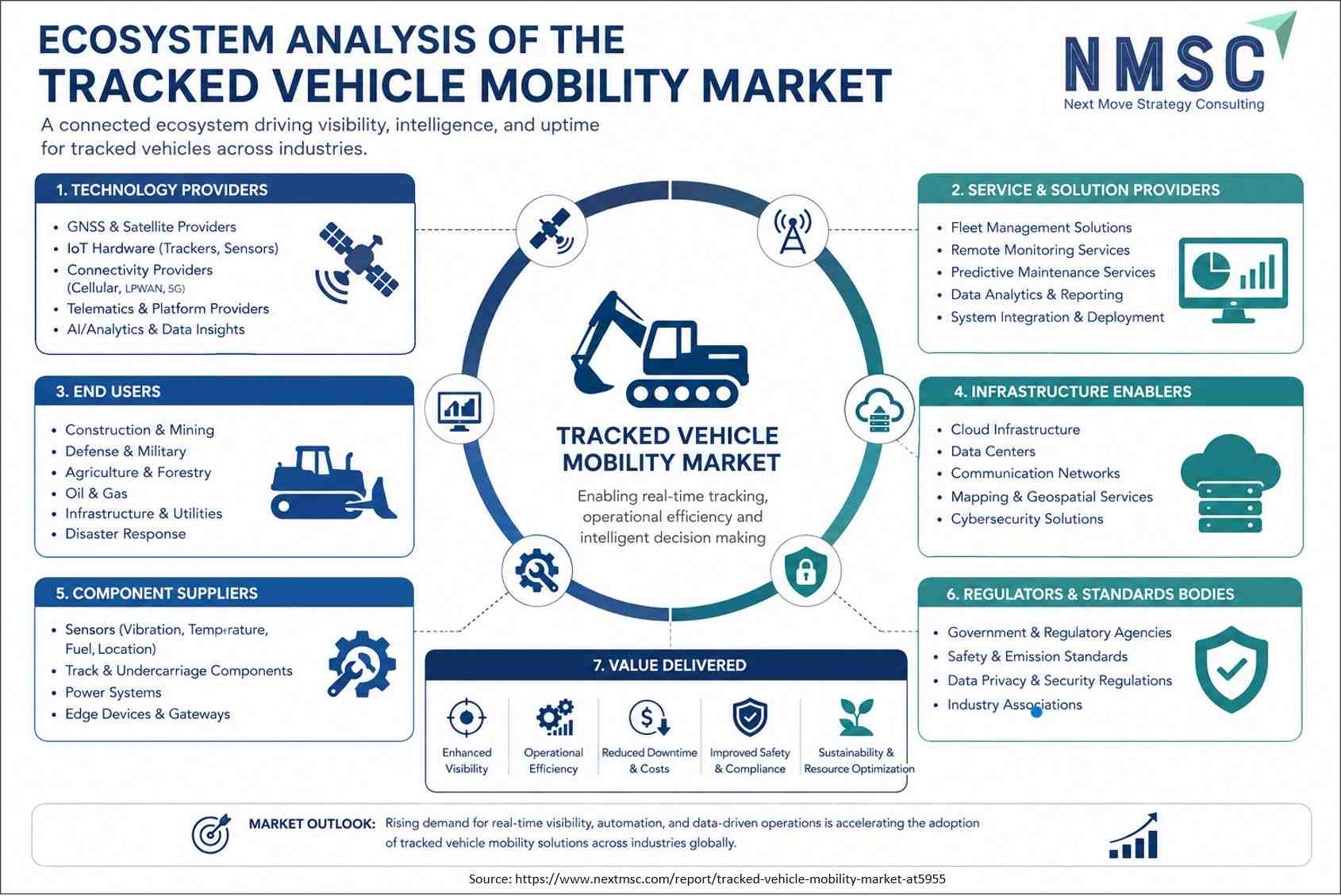
Ecosystem Analysis of the Tracked Vehicle Mobility Industry

The above infographic provides a detailed ecosystem analysis of the tracked vehicle mobility market, outlining the interconnected network of technology, service, and component providers that support its operations. It maps out the key players, end-user industries, and the regulatory and infrastructure enablers that facilitate real-time tracking and intelligent decision-making. Ultimately, the diagram highlights the immense value delivered through enhanced visibility and operational efficiency, driven by a rising market demand for automation and data-driven solutions .

What Does the Tracked Vehicle Mobility Market Encompass?

The tracked vehicle mobility market encompasses the design, manufacture, and sale of continuous-track ground vehicles spanning construction and earthmoving equipment, agricultural and forestry machines, material transport carriers, military combat vehicles, and specialty mobility platforms deployed across snow, arctic, and amphibious terrain. Our assessment indicates that the scope spans heavy equipment original equipment manufacturers, defense primes, and specialty track technology suppliers serving construction contractors, mining operators, agricultural enterprises, and defense organizations within the broader autonomous vehicle and heavy machinery ecosystem worldwide.
Regulatory frameworks , including emissions standards for off-road diesel engines and NATO interoperability requirements for armored platforms , directly shape propulsion and design choices across the industry. We observed that technology adoption is shifting decisively toward autonomous and remotely operated systems that reduce operator exposure in hazardous mining, construction, and combat environments. NMSC's analysis indicates that this structural shift, combined with accelerating hybrid and battery electric drivetrain development, is redefining manufacturer prioritization across the market.

Market Drivers & Dynamics

Interactive Dataset
Rising NATO and allied defense modernization budgets driver +1.6% Europe, North America 2026-2035
Expanding infrastructure and mining investment in Asia-Pacific driver +1.3% Asia-Pacific 2026-2035
Accelerating autonomous and remotely operated machine adoption driver +1.1% Global 2026-2035
Growing hybrid and battery electric drivetrain commercialization driver +0.8% North America, Europe 2026-2033
Rising agricultural mechanization in emerging markets driver +0.5% Asia-Pacific, Latin America 2026-2035
High capital cost of autonomous and electrified platforms restraint -0.9% Global 2026-2033
Extended replacement cycles for capital-intensive tracked equipment restraint -0.7% Global 2026-2035
Ammunition and component supply chain constraints for defense platforms restraint -0.6% North America, Europe 2026-2030
Regulatory complexity around emissions standards for off-road diesel engines restraint -0.4% North America, Europe 2026-2032
Source: Next Move Strategy Consulting

Growth Drivers

What Is the Primary Growth Driver of the Tracked Vehicle Mobility Market?

Rising NATO and allied defense modernization budgets are the primary driver of the market. NATO reported that European Allies and Canada increased combined defense spending by nearly 20% in real terms in 2025 compared with 2024, and Allies committed to a minimum of 2 % of GDP defense investment target by 2035. We observed that sustained multi-country procurement activity provides demand visibility for tracked armored vehicles and artillery platforms across the defense segment .

How Is Infrastructure Investment Driving Tracked Vehicle Mobility Market Growth?

Infrastructure and mining investment across Asia-Pacific is accelerating market growth by expanding demand for tracked excavators, crawler dozers, and material transport carriers. Government-backed infrastructure programs across China and India continue supporting sustained construction equipment demand alongside mining sector capacity expansion. NMSC's analysis indicates that this regional infrastructure investment, combined with Caterpillar and Komatsu's parallel autonomy rollouts unveiled at CES 2026 and ConExpo 2026, is compressing the adoption timeline for next-generation intelligent tracked construction machines.

Growth Inhibitors

What Is Restraining Tracked Vehicle Mobility Market Expansion?

High capital cost of autonomous and electrified platforms restrains near-term adoption among cost-sensitive buyers. Complex tracked equipment integrating autonomy sensors, electrified drivetrains, and hybrid power management systems commands significant price premiums over conventional diesel platforms. We found that smaller construction contractors and equipment rental companies face particular exposure, as the capital outlay required to adopt next-generation autonomous or electrified tracked equipment often exceeds what fleet economics can justify absent proven total cost of ownership advantages.

Segmentation Analysis

2025 (USD Billion)
2035 (USD Billion)
Tracked Construction and Earthmoving Vehicles 2025: $9.32 Billion | 2035: $14.59 Billion
Tracked Cons
Tracked Agricultural and Forestry Vehicles 2025: $2.88 Billion | 2035: $5.11 Billion
Tracked Agri
Tracked Material Transport and Carrier Vehicles 2025: $2.00 Billion | 2035: $3.65 Billion
Tracked Mate
Tracked Military Vehicles 2025: $6.88 Billion | 2035: $10.94 Billion
Tracked Mili
Specialty Tracked Mobility Vehicles 2025: $1.10 Billion | 2035: $2.18 Billion
Specialty Tr
Tracked Construction and Earthmoving Vehicles $9.32 Billion $14.59 Billion 4.5%
Tracked Agricultural and Forestry Vehicles $2.88 Billion $5.11 Billion 6.0%
Tracked Material Transport and Carrier Vehicles $2.00 Billion $3.65 Billion 6.3%
Tracked Military Vehicles $6.88 Billion $10.94 Billion 4.7%
Specialty Tracked Mobility Vehicles $1.10 Billion $2.18 Billion 7.3%

Which Product Type Dominates the Tracked Vehicle Mobility Market?

Tracked Construction and Earthmoving Vehicles led the market with USD 9.32 billion in 2025, reflecting sustained global infrastructure and mining capacity investment across tracked excavators, crawler dozers, and compact track loaders. Our findings suggest that Specialty Tracked Mobility Vehicles is the fastest-growing product type, registering a 7.3% CAGR from 2026 to 2035, as demand for snow and ice vehicles, amphibious carriers, and emergency and rescue platforms expands alongside growing Arctic and disaster-response infrastructure investment.

2025 (USD Billion)
2035 (USD Billion)
ICE 2025: $19.07 Billion | 2035: $24.80 Billion
ICE
Hybrid Electric 2025: $2.22 Billion | 2035: $6.93 Billion
Hybrid Elect
Battery Electric 2025: $0.89 Billion | 2035: $4.74 Billion
Battery Elec
ICE $19.07 Billion $24.80 Billion 2.4%
Hybrid Electric $2.22 Billion $6.93 Billion 12.9%
Battery Electric $0.89 Billion $4.74 Billion 19.8%

Which Propulsion Type Leads Tracked Vehicle Mobility Market Demand?

ICE propulsion remained dominant within the market, reaching USD 19.07 billion in 2025 on the continued reliance of heavy construction and military platforms on proven diesel powertrains, closely tied to broader battery electric vehicle adoption trends across adjacent equipment categories. Based on research conducted by NMSC, we found that Battery Electric is the fastest-growing propulsion type at a 19.8% CAGR from 2026 to 2035, reflecting accelerating electrified drivetrain commercialization exemplified by Komatsu's electric swing excavator technology.

2025 (USD Billion)
2035 (USD Billion)
Manned 2025: $18.19 Billion | 2035: $22.61 Billion
Manned
Remotely Operated 2025: $2.22 Billion | 2035: $6.20 Billion
Remotely Ope
Semi-Autonomous 2025: $1.33 Billion | 2035: $4.74 Billion
Semi-Autonom
Fully Autonomous 2025: $0.44 Billion | 2035: $2.92 Billion
Fully Autono
Manned $18.19 Billion $22.61 Billion 1.9%
Remotely Operated $2.22 Billion $6.20 Billion 11.5%
Semi-Autonomous $1.33 Billion $4.74 Billion 14.5%
Fully Autonomous $0.44 Billion $2.92 Billion 22.7%

Which Operating Mode Leads Tracked Vehicle Mobility Market Demand?

Manned operation remained the leading mode within the market, valued at USD 18.19 billion in 2025, reflecting the continued predominance of human-operated construction, agricultural, and military platforms across the installed equipment base. Our findings suggest that Fully Autonomous is the fastest-growing operating mode, registering a 22.7% CAGR from 2026 to 2035, as Caterpillar's CES 2026 autonomous machine lineup and comparable Komatsu Smart Quarry Autonomous systems extend automation from mining haul trucks into excavators, dozers, and compactors.

Growth Opportunities

Our analysis shows that three forward-looking opportunities stand out for stakeholders positioning within the tracked vehicle mobility market over the 2026-2035 forecast period.

How Can Retrofit Autonomy Kits Unlock Value for Existing Fleet Owners?

Retrofit autonomy kits present a whitespace opportunity for manufacturers seeking to extend automation value to existing tracked equipment fleets. Companies that commercialize validated retrofit solutions, following the precedent set by Komatsu's Smart Quarry Autonomous availability for both new and existing quarry trucks, stand to capture share from fleet owners unwilling to fully replace capital-intensive tracked machines.

Where Does Hybrid Tactical Vehicle Demand Create New Opportunity for Defense Suppliers?

Hybrid-electric tracked vehicle development is creating new opportunities for defense suppliers as drone-contested battlefields increase demand for lower-signature and energy-efficient mobility platforms. General Dynamics Land Systems’ AbramsX technology demonstrator incorporates a hybrid-electric powertrain designed to improve fuel efficiency, onboard power availability, and silent-watch capability while enabling some silent mobility. This development highlights opportunities for suppliers of hybrid powertrains, energy-storage systems, and advanced electrical architectures for next-generation tracked combat vehicles .

How Can Electrified Compact Track Loaders Benefit Rental and Landscaping Buyers?

Equipment rental companies and landscaping contractors seeking reduced noise and emissions create an opportunity for manufacturers offering electrified compact track loaders and mini excavators suited to urban and residential job sites . Early movers that deliver validated battery-electric compact platforms can capture share from noise-restricted and emissions-sensitive urban construction applications.

Regional Outlook

North America $6.21 Billion $9.48 Billion 4.2%
Europe $5.77 Billion $8.75 Billion 4.2%
Asia-Pacific $6.65 Billion $12.04 Billion 6.2%
Middle East & Africa $2.22 Billion $4.01 Billion 6.2%
Latin America $1.33 Billion $2.19 Billion 5.1%

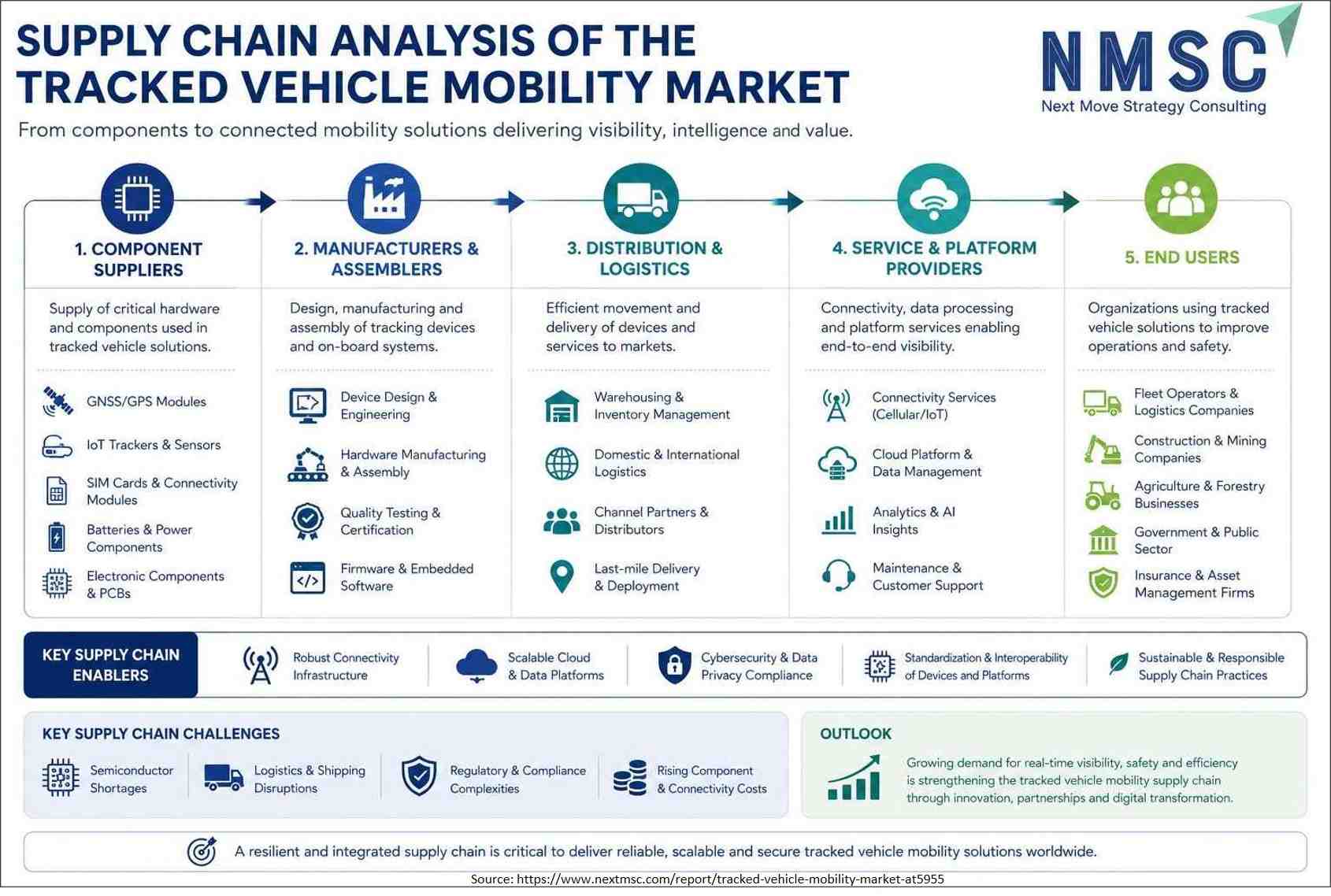
Supply Chain Analysis of the Tracked Vehicle Mobility Industry

Supply Chain Analysis of the Tracked Vehicle Mobility Industry
The above infographic provides a detailed supply chain analysis of the tracked vehicle mobility market, outlining the five-step flow from component suppliers to end-users. It highlights crucial enablers like robust connectivity and cloud platforms, while also addressing key challenges such as semiconductor shortages and regulatory complexities. Ultimately, the diagram emphasizes that a resilient, integrated supply chain is essential for delivering reliable and secure mobility solutions driven by growing market demand .

Competitive Landscape

We observed that the tracked vehicle mobility market features a moderately concentrated competitive landscape, with diversified heavy equipment manufacturers competing alongside dedicated defense primes on platform breadth, autonomy capability, and multi-country procurement relationships across the Industry.

Dimension Description
Market Structure Moderately concentrated; Caterpillar, Komatsu, and CNH Industrial anchor the construction and agricultural equipment segment, while Rheinmetall, BAE Systems, General Dynamics, KNDS, and Hanwha Aerospace anchor the defense tracked vehicle segment.
Innovation Focus Autonomous jobsite machine deployment, hybrid-electric drivetrain commercialization, and signature-reduction hybrid tactical vehicle development dominate current innovation pipelines across leading manufacturers.
Competitive Activity Competitive contracting and platform expansion rather than large-scale acquisition activity characterize recent positioning, exemplified by Hanwha Defense USA’s Mobile Tactical Cannon prototype win .

How Do Companies Compete in the Tracked Vehicle Mobility Market?

Companies compete primarily on platform breadth, autonomy capability, and multi-country procurement relationships across the industry. Diversified heavy equipment manufacturers such as Caterpillar and Komatsu leverage decades of construction and mining fleet data to scale autonomous jobsite technology, while defense primes such as Rheinmetall and Hanwha Aerospace compete through validated combat platform track records and expanding export contracts across NATO and allied markets.

Which Competitive Archetypes Dominate the Tracked Vehicle Mobility Market?

Two archetypes dominate the market: diversified heavy equipment manufacturers offering full-scope construction, agricultural, and material transport platforms, and dedicated defense primes offering armored and artillery systems validated through multi-country procurement. Caterpillar and Komatsu exemplify the diversified equipment archetype, while Rheinmetall and Hanwha Aerospace exemplify the defense prime archetype competing for artillery and armored vehicle modernization contracts .

How Are Companies Differentiating Through Innovation in Tracked Vehicle Mobility?

Innovation and differentiation strategy increasingly center on autonomy integration and signature-reduction propulsion. Caterpillar's CES 2026 autonomous machine unveiling and Rheinmetall's Ermine hybrid tactical vehicle both illustrate how manufacturers pursue technical differentiation beyond conventional platform performance. Our analysis shows that manufacturers unable to demonstrate credible autonomous or hybrid-electric capability risk exclusion from next-generation construction fleet and defense modernization contracts as both civilian and military buyers increasingly prioritize these capabilities.

What M&A and Expansion Activity Is Shaping the Tracked Vehicle Mobility Market?

Competitive contracting and platform export expansion continue to shape positioning within the industry more than large-scale acquisition activity. Hanwha Defense USA’s August 2026 Mobile Tactical Cannon prototype contract illustrates defense-prime expansion, although the K9 Mobile Howitzer selected for the program is a wheeled platform and should be treated as adjacent artillery activity rather than direct tracked-vehicle demand. Hanwha Aerospace’s continued K9 howitzer exports also demonstrate sustained multi-country tracked-platform expansion .

Key Market Players

Our assessment indicates that the following 20 companies are actively shaping platform development, autonomy technology, and defense and commercial manufacturing strategy within the global tracked vehicle mobility market.

Caterpillar Inc. Komatsu Ltd. Rheinmetall AG BAE Systems plc General Dynamics Corporation Deere & Company Liebherr-International AG CNH Industrial N.V. SANY Heavy Industry Co., Ltd. XCMG Group Volvo Construction Equipment AB Hitachi Construction Machinery Co., Ltd. JCB Ltd. Hanwha Aerospace Co., Ltd. KNDS N.V. Kobelco Construction Machinery Co., Ltd. Doosan Bobcat Inc. Kubota Corporation Hyundai Rotem Company ST Engineering Ltd.

Latest Developments

We found that recent milestones within the tracked vehicle mobility market are concentrated on autonomy unveilings and defense contract awards, reflecting the industry's parallel push toward automation and modernized artillery platforms.

Date Event
November 2025 BAE Systems received a contract to deliver 44 additional CV90 tracked infantry fighting vehicles to Denmark. The CV90 is designed for high tactical and strategic mobility across varied terrain. The order directly expands demand for modern tracked combat vehicles and supports continued fleet modernization in Europe.
September 2025 KNDS signed a contract for an initial 44 LEOPARD 2 A8 tracked main battle tanks for the Czech Republic, with an option for 14 additional vehicles. The program includes country-specific adaptations, training, logistics, and long-term support for the tracked combat-vehicle fleet.
October 2025 Hanwha Aerospace unveiled an 8×8 wheeled K9A2 self-propelled howitzer concept at AUSA 2025. The concept integrates the K9A2’s automated ammunition-handling and loading system onto a wheeled platform, increasing the firing rate from six to more than nine rounds per minute and targeting enhanced mobility and long-range artillery capabilities.
January 2025 Sweden announced a USD 1,97 billion agreement with KNDS for 44 new LEOPARD 2 A8 tanks and upgrades to 66 existing tanks. The program expands Sweden’s tracked armored-vehicle fleet and upgrades existing platforms, with deliveries scheduled from 2028 through 2031.

Investment Opportunities

What Capital Inflows Are Targeting the Tracked Vehicle Mobility Market?

Capital inflows into the tracked vehicle mobility market are increasingly directed toward autonomy engineering and hybrid-electric drivetrain development. Caterpillar’s CES 2026 autonomous machine program illustrates sustained strategic investment in construction automation, while defense primes continue investing in tracked artillery and armored vehicle production capacity. We observed that investors favor manufacturers demonstrating validated multi-country procurement relationships and established production capabilities .

How Significant Is Infrastructure Investment in the Tracked Vehicle Mobility Market?

Infrastructure investment tied to domestic manufacturing capacity and autonomous systems integration is a critical enabler of tracked vehicle mobility market scalability. Defense primes continue expanding production facilities to meet sustained artillery and armored vehicle procurement demand. Our assessment indicates that both civilian equipment manufacturers and defense primes increasingly condition capacity expansion decisions on confirmed multi-year contract backlogs rather than speculative demand forecasts.

What ESG Considerations Are Shaping Tracked Vehicle Mobility Investment?

Environmental, social, and governance considerations shape tracked vehicle mobility investment primarily through emissions reduction and operator safety priorities. Komatsu's electric-swing excavator technology, delivering measurable fuel consumption reductions, exemplifies industry-wide investment in lower-emissions construction equipment. NMSC's analysis indicates that autonomous and remotely operated systems reducing operator exposure to hazardous mining, construction, and combat environments are increasingly framed as a core safety-driven investment priority across both commercial and defense segments.

Key Benefits for Stakeholders

How Does This Report Benefit Heavy Equipment and Defense Industry Leaders?

Heavy equipment and defense industry leaders gain access to validated segmentation, product type benchmarking, and regional regulatory analysis that supports tracked vehicle mobility development strategy decisions. The report's propulsion and operating mode breakdowns help executives evaluate autonomous, hybrid, and electric platform investment priorities against evolving construction, agricultural, and defense procurement requirements, supporting more informed portfolio decisions across this diversified market.

How Does This Report Benefit Investors and Financial Analysts?

Investors and financial analysts benefit from consolidated market sizing, regional growth forecasts, and competitive positioning data that inform capital allocation across the tracked vehicle mobility value chain. The report's country-level revenue estimates and growth catalyst matrix support due diligence on heavy equipment manufacturers and defense primes positioned to capture forecast demand growth through 2035.

How Does This Report Benefit Technology Vendors and Product Teams?

Technology vendors and product teams gain competitive intelligence on autonomy integration trends, hybrid-electric drivetrain advancement, and recent developments among the 20 companies profiled. This supports product roadmap decisions around retrofit autonomy kits, signature-reduction propulsion, and electrified compact platforms aligned with the fastest-growing product type and regional segments identified in this report.

Key Market Segments Evaluated

By Product Type

  • Tracked Construction and Earthmoving Vehicles
  • Tracked Agricultural and Forestry Vehicles
  • Tracked Material Transport and Carrier Vehicles
  • Tracked Military Vehicles
  • Specialty Tracked Mobility Vehicles

By Propulsion

  • ICE
  • Hybrid Electric
  • Battery Electric

By Operating Mode

  • Manned
  • Remotely Operated
  • Semi-Autonomous
  • Fully Autonomous

Conclusion & Recommendations

The long-term outlook remains structurally positive, supported by a USD 13.16 billion absolute dollar opportunity between 2026 and 2035 and sustained defense modernization commitments alongside accelerating construction automation. We found that Tracked Construction and Earthmoving Vehicles will continue commanding the largest revenue share while autonomous and electrified platforms gain disproportionate share as operator safety and total cost of ownership priorities reshape purchasing decisions through the forecast period.

What Strategic Positioning Should Stakeholders Pursue?

Stakeholders should pursue strategic positioning that combines autonomous systems capability with hybrid-electric propulsion to serve both commercial fleet operators and defense organizations prioritizing signature reduction. NMSC's analysis indicates that manufacturers bundling autonomy retrofit options with electrified drivetrain platforms are best positioned to capture recurring, multi-year revenue across the tracked vehicle mobility market.

How Attractive Is the Tracked Vehicle Mobility Market for New Investment?

The tracked vehicle mobility industry presents an attractive investment case, supported by a USD 13.16 billion absolute dollar opportunity between 2026 and 2035 and above-average growth in Asia-Pacific and battery electric propulsion categories. We found that investment attractiveness is highest for manufacturers combining validated autonomous capability with multi-country defense export relationships, positioning them to capture share across both civilian and military end markets simultaneously.

What Market Shifts and Key Risks Should Stakeholders Monitor?

Stakeholders should monitor high capital cost constraining autonomous and electrified platform adoption, extended replacement cycles for capital-intensive equipment, and ammunition and component supply chain constraints as key risks to the tracked vehicle mobility market. Our analysis shows that manufacturers unable to demonstrate credible total cost of ownership advantages risk slower adoption of next-generation platforms, particularly among smaller construction contractors and equipment rental companies operating with tighter capital constraints.

What Are the Key Growth Pathways for the Tracked Vehicle Mobility Market?

Key growth pathways include scaling autonomous jobsite machine deployment, expanding hybrid and battery electric drivetrain commercialization, and deepening defense export relationships for artillery and armored combat support platforms. NMSC's analysis indicates that manufacturers pursuing these pathways while maintaining cost competitiveness in conventional ICE platforms will be best positioned to capture the tracked vehicle mobility market's projected growth through 2035.

FAQs

About the Author

Mayurima Roy

Mayurima Roy

Mayurima Roy is Research Analyst at Next Move Strategy Consulting, where she has spent 4 years working across the firm's full industry coverage rather than a single fixed vertical. Her work centers on structured research, ongoing trend tracking, competitive assessment, and insight-led content development, translating complex market data into clear, decision-ready narratives that support informed client decision-making across diverse global industries, market sectors, and world regions every day.

About the Reviewer

Supradip Baul

Supradip Baul

Supradip Baul is an accomplished business consultant and strategist with over a decade of rich experience in market intelligence, strategy, technology, and business transformation. His work has included rigorous qualitative and quantitative analysis across multiple industries, helping clients shape investment decisions and long-term roadmaps. Earlier in his career, he was associated with Gartner, where he contributed to industry-leading reports and market share analyses. He has worked with leading global companies and holds an MBA with a dual specialization in Marketing and Finance.

Download Free Sample

Kishu Kanda

KISHU KANDA

Strategy Analyst

Accenture

We purchased the AI Consumer Market Report from this company. Not only did they customize the report to meet our specific requirements, but they also showed great flexibility in accommodating our budget. The report we received fully met our expectations. Additionally, they provided prompt and thorough responses to both our pre-purchase and follow-up questions. We look forward to working with this company again in the future.

Amos Chang

AMOS CHANG

Strategy Consultant

Kardex Group

I have bought the intralogistics market reports from NMSC two times so far. Joseph and his team are always very helpful and flexible in responding to any customization requirements on the report. Their expertise in market reports really helps us steer the day-to-day business. I will definitely recommend and come back myself whenever there is a need.

Diana Trejo

DIANA TREJO

Assistant Manager

Sumitomo Corporation de Mexico, S.A. de C.V.

Recently, we purchased a report on the Mexico Data Center Market from Next Move Strategy Consulting. The service has been excellent, with support that is always timely and thoroughly professional. The information provided is interesting, highly useful, and delivered with clarity. I would highly recommend NextMSC for anyone seeking insightful and dependable analysis.

Nishant Awate

NISHANT AWATE

Business Development Global Sales

Zehnder Group Deutschland GmbH

Our experience working with Next Move Strategy Consulting was positive. The team was responsive, professional, and open to incorporating our specific requirements throughout the project. The India AHU market study was comprehensive and well structured, covering market value and volume forecasts, product and application segments, and key industry trends. The inclusion of both AHU and residential MVHR market insights made the study particularly relevant for our strategic market assessment. Overall, the report provides a solid foundation for evaluating market potential, identifying priority segments, and supporting business-development decisions in India.

Gustaf Hummel Burstrom

GUSTAF HUMMEL BURSTROM

Founder

Revline Tools AB

Joseph and the team at Next Move Strategy Consulting have been excellent to work with, in supplying us with relevant market data and forecasts for our specific category. We had some special requirements and they were able to do a custom package to suit our needs. We would definitely recommend them to any other company needing market data and forecasts

Custom Market Research Services

We will customize the research for you if the listed report does not fully match your requirements.

Get 30% Free Customization

Select License

This website uses cookies to ensure you get the best experience on our website. Learn more