UAE Mobile Payment Market By Payment Channel (Contactless Card-based, QR Code-based, Account-to-Account Transfers, and Carrier Billing), By Platform Type (Web-Embedded and Native App), By Transaction Use Case (Peer-to-Peer, Point-of-Sale, Bill and Recurring Payments, and Others), By Payment Location (Remote Payment and Proximity Payment), and By Customer Type (Retail Consumers, Small and Medium Enterprises, and Others) – Opportunity Analysis and Industry Forecast, 2025–2035.
Industry: ICT & Media | Latest Edition: August 5, 2026 | No of Pages: 132 | No. of Tables: 33 | No. of Figures: 28 | Format: PDF | Report Code: IC5564
What Is the UAE Mobile Payment Market Size?
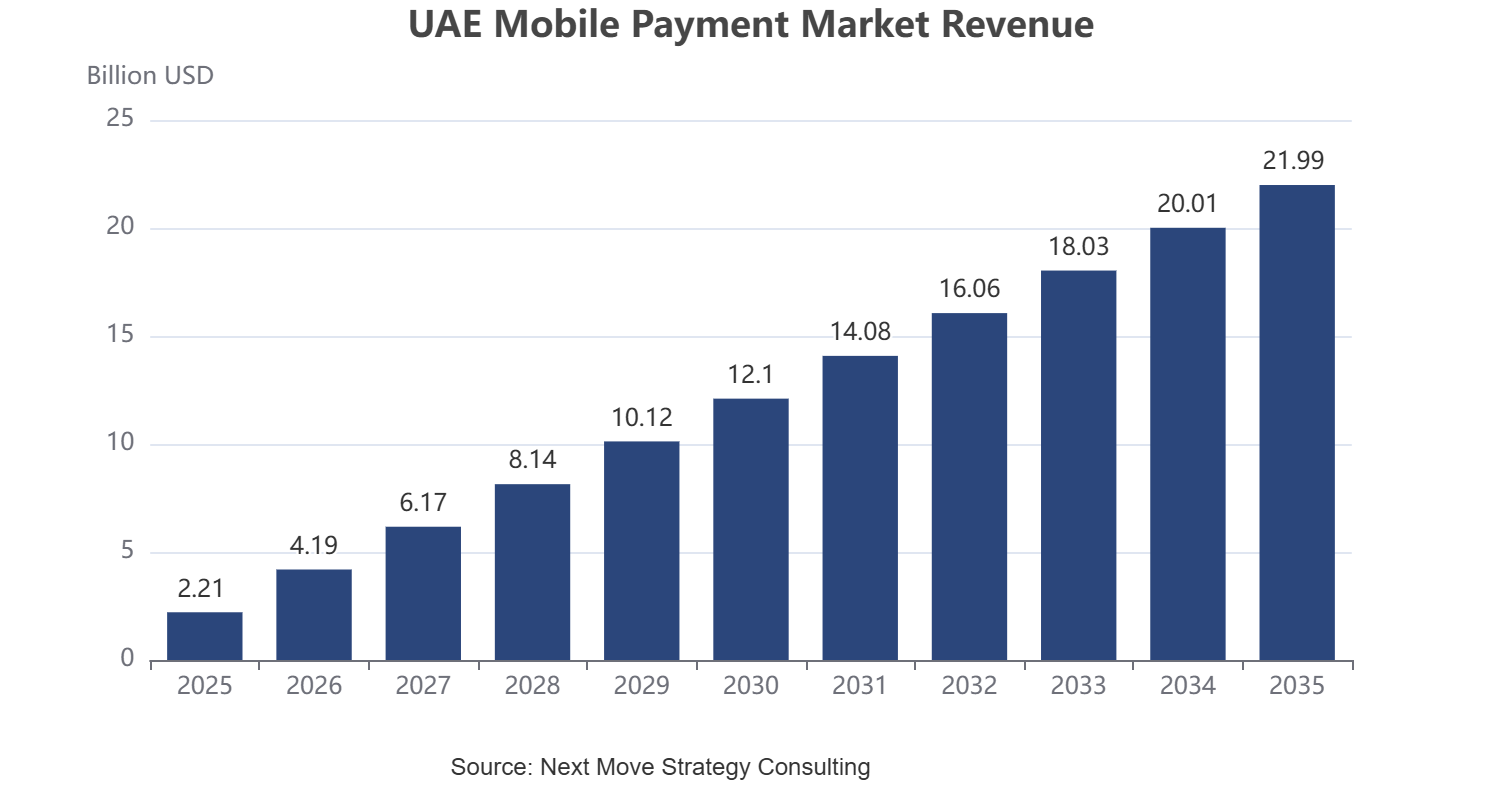
The UAE mobile payment market size was valued at USD 2.21 billion in 2025 and is estimated at USD 3.42 billion in 2026, forecast to reach USD 21.99 billion by 2035, expanding at a 22.99% CAGR between 2026 and 2035. Contactless card-based payments dominate the market by payment channel, driven by widespread NFC-enabled terminal adoption across Emirati retail.
|
Key Takeaways |
|
By Payment Channel: Contactless Card-based is the dominant segment, while QR Code-based is the fastest-growing segment. |
|
By Platform Type: Native App is the dominant segment, while Web-Embedded is the fastest-growing segment. |
|
By Transaction Use-Case: Point-of-Sale (P2M) is the dominant segment, while Peer-to-Peer (P2P) is the fastest-growing segment. |
|
By Payment Location: Proximity Payment is the dominant segment, while Remote Payment is the fastest-growing segment. |
|
By Customer Type: Retail Consumers is the dominant segment, while Small and Medium Enterprises is the fastest-growing segment. |
Market Opportunity: The UAE mobile payment market is expected to create an absolute dollar opportunity of USD 18.57 billion between 2026 and 2035, presenting significant investment potential across contactless infrastructure, account-to-account payment rails, and embedded checkout technologies.
According to NMSC's analysis, growing regulatory support for the CBUAE Aani instant payment platform is accelerating account-to-account transfer adoption, positioning it as a structurally important channel alongside card-based contactless payments through 2035.
Ecosystem Analysis of the UAE Mobile Payment Industry:
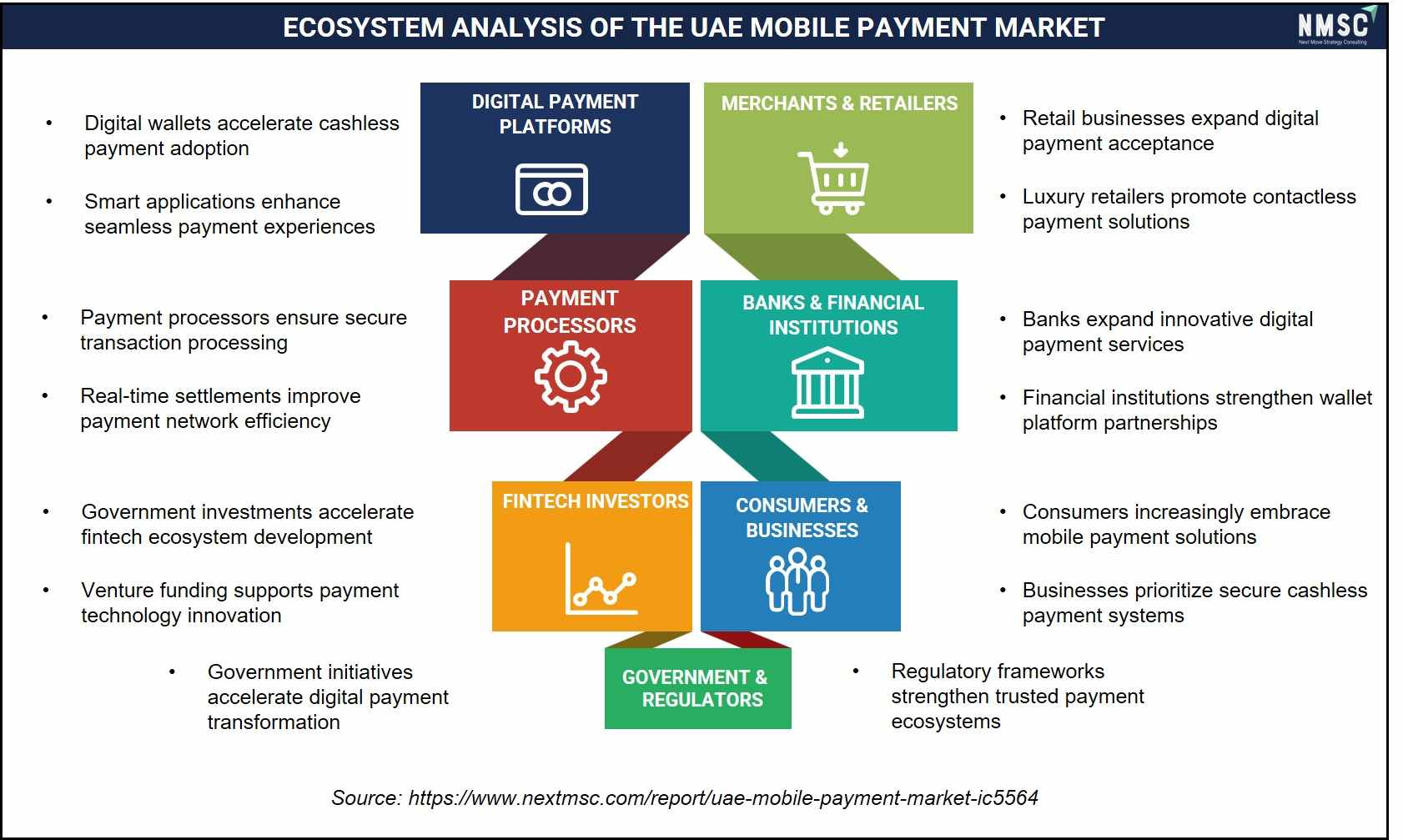
Based on NMSC’s research, we found that the UAE Mobile Payment Market is supported by a collaborative ecosystem comprising digital payment platforms, payment processors, banks, merchants, fintech investors, consumers, and government regulators. Furthermore, real-time settlements, smart payment applications, and government-led digital transformation initiatives strengthen payment efficiency and innovation. Consequently, regulatory frameworks, secure cashless solutions, retail acceptance, and strategic financial partnerships collectively reinforce a trusted, scalable, and technology-driven mobile payment ecosystem.
What does the UAE Mobile Payment Market Encompass?
The UAE mobile payment market encompasses smartphone-enabled transaction methods, including contactless card-based payments, QR code transfers, account-to-account payments, and carrier billing, used across retail, government, and business settings. We observed that the market spans native mobile applications and web-embedded checkout experiences supporting peer-to-peer transfers, point-of-sale purchases, recurring bill payments, business-to-business settlement, and tax remittance, reflecting the diversification of digital payment infrastructure across the country.
Regulatory frameworks administered by the Central Bank of the UAE (CBUAE) govern payment institution licensing, open finance access, and consumer protection standards under the Retail Payment Services and Card Schemes Regulation. Our assessment indicates that CBUAE's national instant payment platform, Aani, operated through Al Etihad Payments LLC, is reshaping merchant and consumer settlement infrastructure. NMSC's analysis indicates that rising smartphone penetration and near-field communication terminal rollouts continue to accelerate technology adoption across Dubai, Abu Dhabi, and other emirates.
|
Parameter |
Details |
|
Market Size in 2025 |
USD 2.21 Billion |
|
Market Size in 2026 |
USD 3.42 Billion |
|
Revenue Forecast in 2035 |
USD 21.99 Billion |
|
Growth Rate |
CAGR of 22.99% from 2026 to 2035 |
|
Analysis Period |
2025–2035 |
|
Base Year Considered |
2025 |
|
Forecast Period |
2026–2035 |
|
Market Size Estimation |
USD Billion |
|
Companies Profiled |
15 |
|
Market Share |
Available for Top 10 Companies |
Key Emerging Trends
Based on research conducted by NMSC, we found that four structural trends are reshaping technology adoption, consumer behavior, and competitive dynamics across the UAE mobile payment market.
How Is Contactless Infrastructure Expanding Across Emirati Retail?
Contactless-enabled point-of-sale terminals are becoming the default acceptance infrastructure across Emirati merchants of all sizes. We observed that banks and payment processors are equipping small and medium retailers with low-cost NFC readers, reducing cash dependency in daily transactions. This expansion is improving checkout speed and consumer convenience, encouraging broader adoption among older demographics previously reliant on cash and card swipe payments.
Why Is Account-to-Account Payment Adoption Accelerating?
The CBUAE Aani instant payment platform is allowing app-based providers to initiate direct bank transfers without card network intermediaries. Our findings suggest that account-to-account payments are gaining traction for peer-to-peer transfers and bill settlement due to lower merchant fees and instant settlement. Providers such as Al Etihad Payments LLC have built substantial infrastructure around this model, pressuring traditional card-based processors to innovate.
How Is QR Code Payment Adoption Reshaping Small Merchant Acceptance?
QR code-based payment acceptance is expanding rapidly among small businesses, street vendors, and service providers that previously lacked affordable card acceptance infrastructure. We observed that QR-based systems require minimal hardware investment, enabling faster onboarding for micro-merchants. This trend is broadening the overall merchant acceptance network and supporting financial inclusion across underserved retail segments.
What Role Does Embedded Finance Play in Mobile Payment Innovation?
Embedded finance is integrating payment functionality directly into e-commerce platforms, ride-hailing applications, and marketplace checkout flows. Our analysis indicates that Emirati consumers increasingly expect one-tap payment experiences within third-party applications rather than separate banking apps. This shift is prompting payment providers to expand application programming interface partnerships with retailers, transport operators, and government service portals.
Growth Drivers and Restraints
Growth Catalyst and Risk Assessment Matrix
|
Factors |
Type |
(+/-) % Impact on CAGR |
Geographic Relevance |
Impact Timeline |
|
Rising smartphone penetration and NFC-enabled device adoption expanding contactless payment access |
Driver |
+7.12% |
UAE (nationwide; strongest in Dubai and Abu Dhabi) |
2026–2032 |
|
CBUAE Aani instant payment platform incentivizing account-to-account transaction adoption |
Driver |
+6.04% |
UAE (nationwide) |
2026–2033 |
|
Large expatriate population driving demand for low-cost cross-border remittance apps |
Driver |
+4.58% |
UAE (nationwide; strongest in Dubai and Sharjah) |
2026–2031 |
|
Expanding e-commerce and ride-hailing embedded checkout integration across retail and mobility platforms |
Driver |
+3.71% |
UAE (nationwide; strongest in metropolitan emirates) |
2026–2034 |
|
Government-led digitalization of tax and utility payments through smart government portals |
Driver |
+2.63% |
UAE (nationwide) |
2027–2033 |
|
High cost of point-of-sale terminal deployment restraining acceptance among micro-merchants |
Restraint |
−2.86% |
UAE (nationwide; strongest in Northern Emirates) |
2026–2030 |
|
Data privacy and cybersecurity concerns restraining adoption of app-based payment platforms |
Restraint |
−2.14% |
UAE (nationwide) |
2026–2029 |
|
Fragmented interoperability between bank-issued wallets and independent fintech applications |
Restraint |
−1.67% |
UAE (nationwide) |
2026–2031 |
What Is the Primary Growth Driver of the UAE Mobile Payment Market?
Rising smartphone penetration combined with near-field communication terminal expansion is the primary growth driver of the UAE mobile payment market. According to Central Bank of the UAE payment statistics, electronic transaction volumes have grown consistently as merchants replace legacy point-of-sale hardware with contactless-enabled systems. We observed that this infrastructure shift is reducing friction at checkout, encouraging broader consumer migration away from cash across both Dubai, Abu Dhabi, and the Northern Emirates.
How Is Regulatory Policy Driving UAE Mobile Payment Market Growth?
Regulatory support through the Central Bank of the UAE's Aani instant payment platform and the Retail Payment Services and Card Schemes Regulation is accelerating UAE Mobile Payment Market growth by expanding merchant acceptance networks and enabling new account-to-account payment models. Our assessment indicates that CBUAE's continued promotion of instant payment infrastructure is reducing settlement times for app-based transfers. This regulatory momentum is strengthening consumer confidence in electronic payment rails across retail, government, and business-to-business use cases.
What Is Restraining UAE Mobile Payment Market Expansion?
High point-of-sale terminal deployment costs and fragmented interoperability between bank-issued wallets and independent fintech applications continue to restrain market expansion. Many micro-merchants across the Northern Emirates still lack affordable acceptance technology, limiting mobile payment penetration outside Dubai and Abu Dhabi. We found that data privacy and cybersecurity concerns further slow adoption among consumers hesitant to link banking credentials to third-party mobile applications.
Segmentation Analysis
By Payment Channel Insights
How Is the UAE Mobile Payment Market Segmented by Payment Channel?
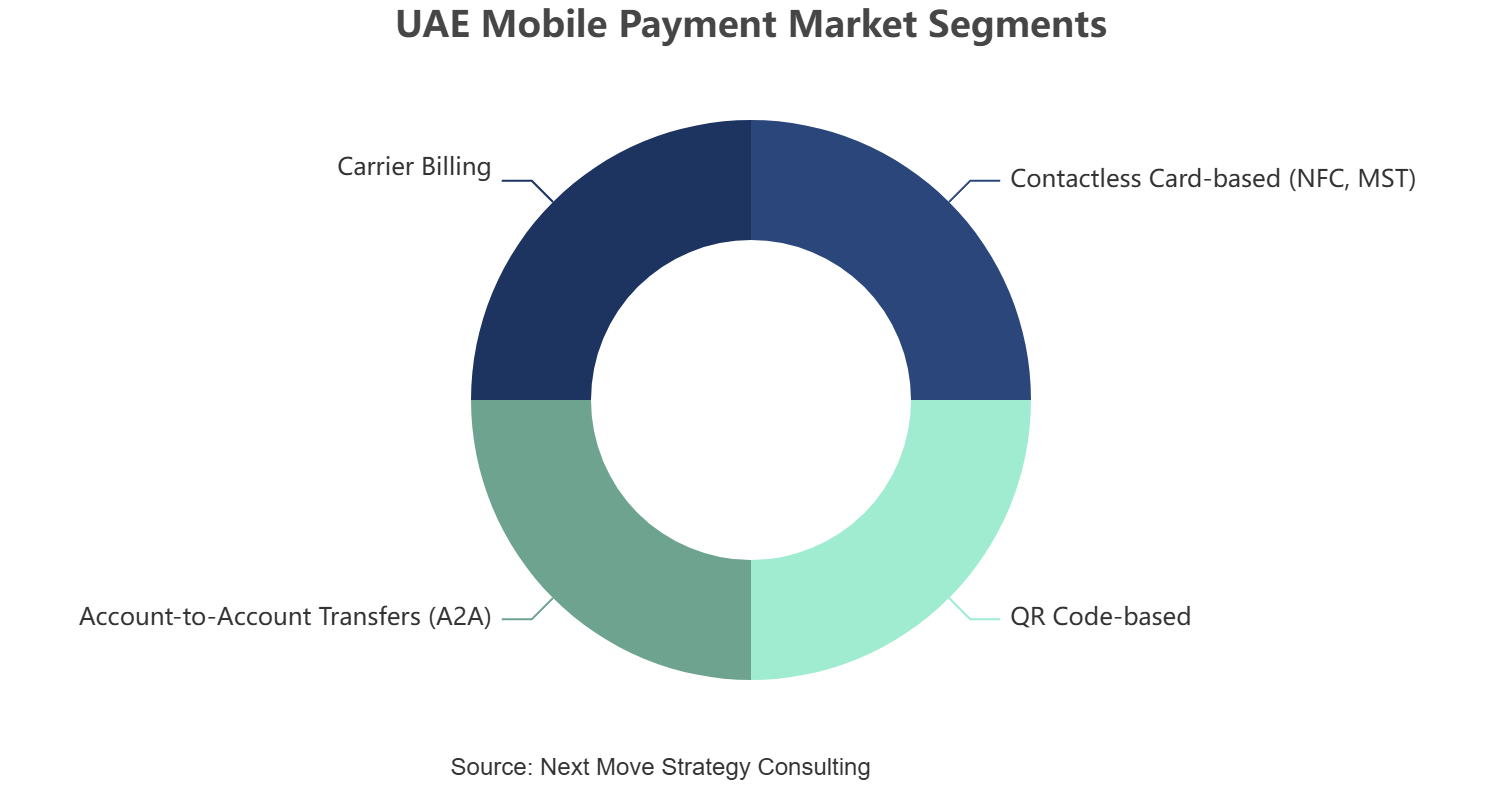
Based on payment channel, the UAE mobile payment market is segmented into contactless card-based (NFC, MST), QR code-based, account-to-account transfers, and carrier billing.
Contactless card-based payments hold the dominant position, supported by extensive NFC-enabled terminal rollouts and strong consumer familiarity with tap-to-pay cards across Emirati retail chains. Our analysis indicates that QR code-based payments represent the fastest-growing channel, driven by low-cost merchant onboarding among small businesses and street vendors previously excluded from card acceptance networks. This dual dynamic reflects a maturing contactless base alongside rapid grassroots expansion at the merchant long tail.
By Transaction Use-Case Insights
How Is the UAE Mobile Payment Market Segmented by Transaction Use-Case?
Based on transaction use-case, the UAE mobile payment market is segmented into peer-to-peer, point-of-sale, bill and recurring payments, business-to-business, and government or tax remittance transactions.
Point-of-sale transactions dominate the market as consumers increasingly use mobile-linked cards and applications for everyday retail purchases across supermarkets, restaurants, and transport services. We observed that peer-to-peer transfers are the fastest-growing use case, propelled by app-based providers enabling instant, fee-light transfers between individuals. This growth is reshaping informal payment behavior, particularly among younger consumers replacing cash for shared expenses and small transactions.
Growth Opportunities
Our findings suggest that three forward-looking opportunities are emerging across infrastructure, financial inclusion, and embedded technology segments of the UAE Mobile Payment Market
Where Can Providers Capture Value from SME Digitalization?
Small and medium enterprises adopting low-cost QR and app-based acceptance tools represent a significant whitespace opportunity for payment providers. Companies offering simplified onboarding and transparent pricing can capture share among micro-merchants currently underserved by traditional card networks across the Northern Emirates.
How Can Instant Account-to-Account Rails Unlock New Revenue Models?
Expanding instant payment infrastructure under CBUAE's Aani platform creates opportunities for providers to build subscription and recurring-billing products directly on bank transfer rails. Fintech companies leveraging these rails can offer merchants lower processing costs than card-based alternatives, benefiting retail and utility billing segments.
What Opportunity Exists in Cross-Border Remittance Integration?
The UAE's large expatriate population creates opportunity for providers integrating low-cost, mobile-first remittance capabilities directly into payment applications. Companies partnering with international money transfer networks can capture recurring transaction volume from the retail consumer and SME customer segments.
SWOT Analysis of the UAE Mobile Payment Market:
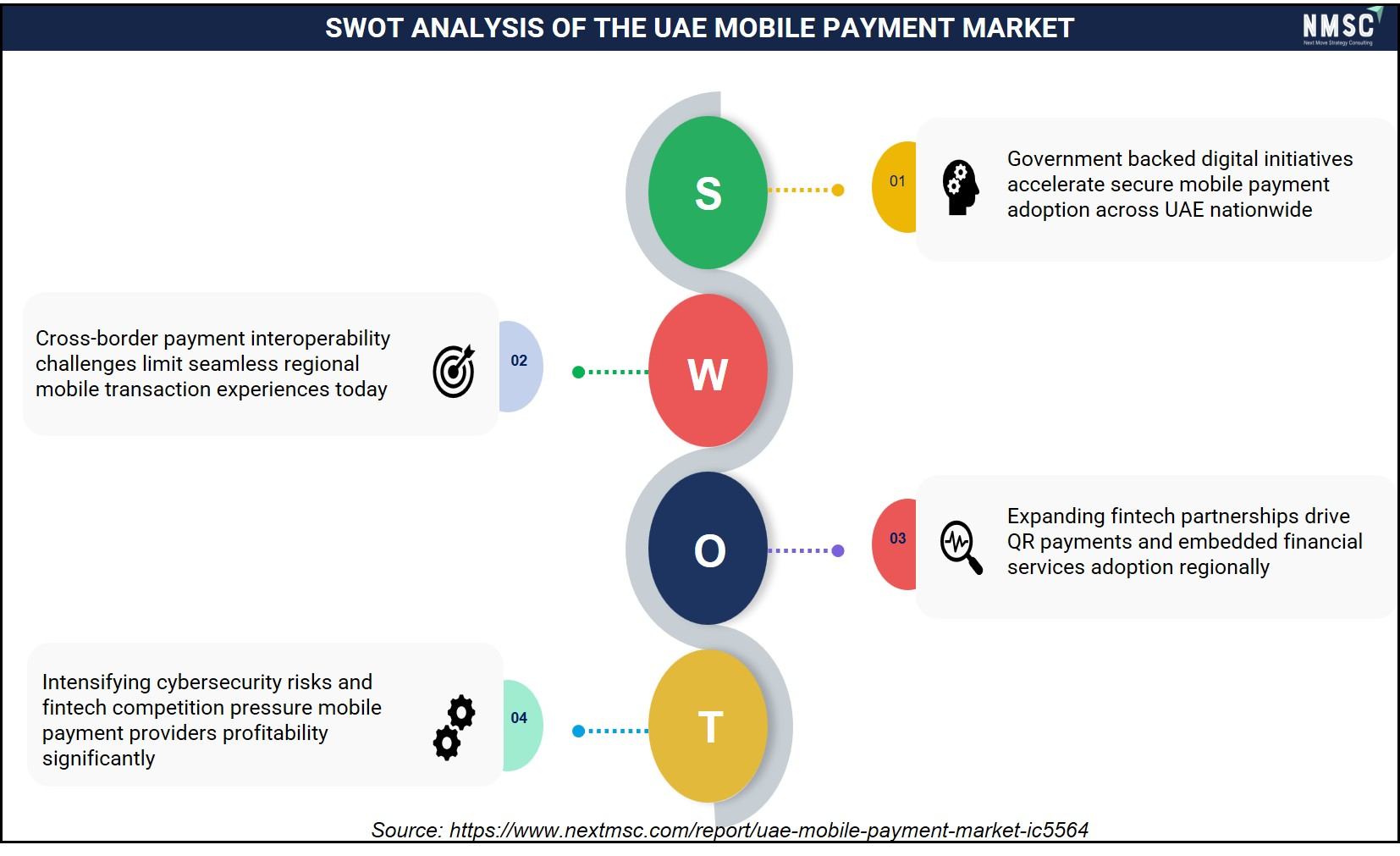
Based on NMSC’s research, we found that the UAE mobile payment market is supported by strong government-backed digital initiatives, which are accelerating secure payment adoption nationwide. However, cross-border interoperability challenges continue to limit seamless regional transactions. Moreover, expanding fintech partnerships is creating significant opportunities for QR payments and embedded financial services. At the same time, rising cybersecurity risks and intense fintech competition remain key threats, highlighting the importance of continuous innovation, security enhancement, and strategic collaboration for sustained market growth.
Competitive Landscape
We observed that the UAE mobile payment market features a highly competitive landscape, with domestic fintech innovators competing alongside global card networks, technology platform wallets, and international payment processors.
|
Dimension |
Description |
|
Market Structure |
Highly competitive with domestic fintech leaders alongside global technology and payment processing companies. Established card-linked wallets compete with app-native providers building direct bank-rail payment models across retail and peer-to-peer use cases. |
|
Innovation Focus |
Account-to-account payment rails, QR code merchant acceptance, embedded checkout application programming interfaces, and biometric authentication dominate current product development strategies among leading providers. |
|
M&A Activity |
Strategic partnerships between fintech providers, banks, and merchant acquirers continue to shape the competitive landscape as companies expand acceptance networks and strengthen cross-border payment capabilities. |
How Do Companies Compete in the UAE Mobile Payment Market?
Companies compete primarily through merchant acceptance breadth, transaction fee structures, and application user experience. Providers such as Al Etihad Payments LLC and Network International LLC leverage strong domestic infrastructure control and extensive merchant networks to maintain market presence. Meanwhile, global platform companies including Apple Distribution International Ltd., Google LLC, and Samsung Electronics Co., Ltd. compete through device-integrated wallet ecosystems that link directly to existing card infrastructure.
Which Competitive Archetypes Dominate the UAE Mobile Payment Market?
Two primary competitive archetypes characterize the UAE Mobile Payment Market. The first comprises domestic Emirati banks and payment infrastructure operators, including First Abu Dhabi Bank PJSC, Wio Bank PJSC, and Network International LLC, differentiating through established banking rails and merchant relationships. The second includes global technology and fintech companies, including Apple Distribution International Ltd., Google LLC, Careem Deliveries FZ-LLC, and Ziina Payment LLC, competing through device integration and app-native user experience.
How Are Companies Differentiating Through Innovation?
Innovation strategies increasingly focus on instant account-to-account settlement, biometric authentication, and embedded checkout integration within third-party merchant applications. Companies are investing in application programming interface partnerships with retailers, transport operators, and government portals. Our analysis indicates that providers combining low transaction fees with instant settlement capabilities are strengthening merchant loyalty across the Emirati small business segment.
What M&A and Expansion Activity Is Shaping the Market?
Strategic partnerships and merchant network expansion continue to shape competition across the UAE Mobile Payment Market. Leading companies are strengthening positions through bank partnerships, acquirer integrations, and expanded QR and NFC acceptance infrastructure. These initiatives enable providers to broaden transaction volume, enter underserved merchant segments, and respond to evolving demand for instant, low-cost digital payment rails.
Key Market Players
Our assessment indicates that the following 15 companies are actively shaping merchant acceptance expansion, product innovation, and competitive dynamics within the UAE mobile payment market.
-
Al Etihad Payments LLC
-
Network International LLC
-
Digital Financial Services LLC
-
Careem Deliveries FZ-LLC
-
Apple Distribution International Ltd.
-
Google LLC
-
First Abu Dhabi Bank PJSC
-
Wio Bank PJSC
-
Ziina Payment LLC
-
Pyypl Ltd.
-
Mamo Limited
-
Hubpay Limited
-
Tap Payment Services L.L.C.
-
Checkout MENA FZ-LLC
Investment Opportunities
What Capital Inflows Are Targeting the UAE Mobile Payment Market?
Capital inflows into the UAE mobile payment market are increasingly directed toward account-to-account payment infrastructure, merchant acquisition technology, and embedded checkout integration. Leading fintech and payment processing companies continue to invest in expanding acceptance networks among small and medium enterprises. We observed that investors favor companies demonstrating scalable merchant onboarding capabilities and strong regulatory compliance under CBUAE licensing requirements.
How Is Infrastructure Investment Supporting the Market?
Infrastructure investment is expanding NFC terminal deployment, QR code acceptance networks, and instant payment settlement rails across Emirati retail and public sector channels. Our findings suggest that companies are investing in application programming interface development and cloud-based processing capacity to support transaction volume growth. Partnerships with banks and acquirers continue to strengthen distribution reach across underserved regional markets.
What ESG Considerations Are Shaping Investment Decisions?
Environmental, social, and governance considerations are becoming integral to investment decisions, with financial inclusion, data privacy compliance, and transparent fee structures emerging as key priorities. We found that investors increasingly favor companies demonstrating measurable progress in extending payment access to underserved small merchants while maintaining robust data protection practices aligned with European Union regulatory standards.
Key Benefits for Stakeholders
How Does This Report Benefit Enterprise and Industry Leaders?
Enterprise and industry leaders gain access to validated market segmentation, competitive benchmarking, and regional demand forecasts that support strategic planning and product development across the UAE mobile payment market. Our analysis shows that detailed assessments of payment channels, transaction use-cases, and customer segments help companies identify high-growth opportunities and strengthen market positioning.
How Does This Report Benefit Investors and Financial Analysts?
Investors and financial analysts benefit from consistent market size estimates, growth forecasts, and competitive assessments that support investment evaluation and capital allocation decisions. We observed that the report's analysis of account-to-account payment adoption and merchant network expansion enables stakeholders to identify companies with the strongest long-term growth potential through 2035.
How Does This Report Benefit Technology Vendors and Product Teams?
Technology vendors and product development teams gain insights into emerging innovation trends, including embedded checkout integration, biometric authentication, and instant payment rails transforming the Emirati payment industry. Our findings suggest that this analysis helps research and development teams prioritize product pipelines aligned with evolving merchant and consumer expectations.
Key Market Segments
By Payment Channel
-
Contactless Card-based (NFC, MST)
-
QR Code-based
-
Account-to-Account Transfers (A2A)
-
Carrier Billing
By Platform Types
-
Web-Embedded
-
Native App
By Transaction Use-Case
-
Peer-to-Peer (P2P)
-
Point-of-Sale (P2M)
-
Bill and Recurring Payments
-
Business-to-Business
-
Government/Tax Remittance
By Payment Location
-
Remote Payment
-
Proximity Payment
By Customer Type
-
Retail Consumers
-
Small and Medium Enterprises (SMEs)
-
Large Enterprises
-
Government and Public Sector
Conclusion and Recommendations
What Is the Long-Term Outlook for the UAE Mobile Payment Market?
The long-term outlook for the UAE mobile payment market remains strongly positive, supported by regulatory momentum toward cashless adoption, expanding NFC and QR merchant infrastructure, and rising consumer comfort with app-based transfers. We observed that continued growth in account-to-account payment rails and embedded checkout integration will drive expansion across point-of-sale, peer-to-peer, and government remittance segments throughout the forecast period.
What Strategic Positioning Should Companies Pursue?
Providers should prioritize investment in low-cost merchant onboarding, instant settlement capabilities, and application programming interface partnerships with retailers and government agencies. Our assessment indicates that companies expanding QR and account-to-account acceptance among small and medium enterprises will be well positioned to capture underserved segments within the UAE mobile payment market.
How Attractive Is the Market for New Investment?
The UAE mobile payment market presents an attractive investment opportunity, supported by a 22.99% projected CAGR between 2026 and 2035 and expanding regulatory support for instant and open banking payment rails. We found that investment potential is particularly strong for companies focused on merchant acquisition technology, embedded finance, and cross-border payment processing.
What Market Shifts and Key Risks Should Stakeholders Monitor?
Stakeholders should closely monitor persistent cash preference among older demographics, fragmented rural merchant infrastructure, and evolving data privacy regulation. Our analysis shows that companies unable to expand affordable acceptance technology into underserved regions may face slower adoption relative to metropolitan markets.
What Are the Key Growth Pathways for the Market?
Key growth pathways include expanding QR and NFC acceptance among small merchants, scaling account-to-account payment rails under the CBUAE Aani platform, and deepening embedded checkout partnerships with e-commerce and mobility platforms. NMSC's analysis indicates that companies successfully combining low-cost acceptance technology with instant settlement capabilities will be best positioned to capture the UAE mobile payment market's projected growth through 2035.
About the Author
 Saista Faiyaz
— Saista Faiyaz is Research Associate at Next Move Strategy Consulting, where she has covered consumer markets and healthcare technologies for 3 years. Her work includes primary interview review, secondary-source validation, market sizing, and structured analysis of company and industry data. She supports research by comparing evidence across sources, organizing findings into market narratives, and documenting assumptions used in analysis. Her scope includes cross-market benchmarking, and reports.
Saista Faiyaz
— Saista Faiyaz is Research Associate at Next Move Strategy Consulting, where she has covered consumer markets and healthcare technologies for 3 years. Her work includes primary interview review, secondary-source validation, market sizing, and structured analysis of company and industry data. She supports research by comparing evidence across sources, organizing findings into market narratives, and documenting assumptions used in analysis. Her scope includes cross-market benchmarking, and reports.
About the Reviewer
 Supradip Baul
— Supradip Baul is an accomplished business consultant and strategist with over a decade of rich experience in market intelligence, strategy, technology, and business transformation. His work has included rigorous qualitative and quantitative analysis across multiple industries, helping clients shape investment decisions and long-term roadmaps. Earlier in his career, he was associated with Gartner, where he contributed to industry-leading reports and market share analyses. He has worked with leading global companies and holds an MBA with a dual specialization in Marketing and Finance.
Supradip Baul
— Supradip Baul is an accomplished business consultant and strategist with over a decade of rich experience in market intelligence, strategy, technology, and business transformation. His work has included rigorous qualitative and quantitative analysis across multiple industries, helping clients shape investment decisions and long-term roadmaps. Earlier in his career, he was associated with Gartner, where he contributed to industry-leading reports and market share analyses. He has worked with leading global companies and holds an MBA with a dual specialization in Marketing and Finance.
At Next Move Strategy Consulting, we understand that insightful market research is the cornerstone of successful business decisions. That's why we employ a robust and multifaceted approach, combining various methodologies to deliver the most accurate and actionable data for our clients.

Research Landscape
We navigate the world of research with two primary approaches:
Qualitative Approach
Our qualitative research methodologies involve immersive techniques such as in-depth interviews, focus groups, and observational studies. By engaging directly with individuals and stakeholders, we uncover valuable insights that quantitative data alone may overlook.

Quantitative Research
In tandem with qualitative methodologies, NMSC leverages the power of Quantitative Research to provide a robust foundation of numerical insights. Through systematic data collection and analysis, we quantify patterns, preferences, and market trends, offering a comprehensive view of the business landscape.
Our quantitative research approach employs diverse tools, including surveys, experiments, and statistical modelling. These methodologies enable us to gather data from a large and representative sample, ensuring the statistical significance of our findings. By employing structured questionnaires and standardized data collection methods, we guarantee the reliability and validity of the information we present to our clients.
Quantitative research is particularly effective in measuring the prevalence of trends, assessing market size, and gauging the impact of various factors on consumer behavior. The numerical precision attained through this approach equips our clients with actionable insights, facilitating data-driven decision-making and strategy formulation.


Our Specialized Toolbox for Industry-Specific Market Research
We deploy a specialized arsenal of techniques tailored to meet your unique requirements. Here's a glimpse into our comprehensive toolbox:

Information Procurement
The stage entails acquiring market data or relevant information through various sources and methodologies.


Market Research Approach
We utilize both top-down and bottom-up approaches in market research analysis to achieve a comprehensive understanding of the market dynamics, leveraging the broad perspective of industry trends and macroeconomic factors alongside detailed insights from specific segments and individual companies.

Porters Five Forces Analysis
We conduct Porter's Five Forces analysis to evaluate the competitive landscape of an industry, providing us with insights into factors that affect profitability and strategic positioning.

SWOT Analysis

Forecasting
We utilize a forecasting model to predict future consumption by considering parameters like population, economics, regulations, market competition, drivers, constraints, technology, and pricing. We also employ statistical techniques such as multilinear regression, exponential smoothing, moving average, ARIMA, and Monte Carlo simulations for accurate predictions. In econometric forecasting, we analyzed short-term and long-term event impacts, attributing values based on regulatory frameworks, economic factors, and market events.





 Speak to Our Analyst