4WD UTV Market: Why Utility Cabs Are Rewriting Who Builds UTVs | NextMSC

Introduction
On August 4, 2026, Yamaha Motor Co., Ltd. announced that it would discontinue in-house production of recreational off-highway vehicles (ROVs) at Yamaha Motor Manufacturing Corporation of America in Georgia and move to a collaborative model built on OEM supply through partner companies. Two months later, on October 7, 2026, Yamaha Motor Co., Ltd. and Deere & Company agreed to pursue joint development and mutual supply of ROVs. A manufacturer that assembled side-by-sides in the United States has shifted its center of gravity from the assembly line to partnerships, and its stated reason is the utility segment, which Yamaha Motor Co., Ltd. describes as the bigger part of the ROV market. The 4WD UTV market is being reorganized around the vehicles that work for a living.
According to Next Move Strategy Consulting's 4WD UTV Market report, the global market is projected to reach USD 12.83 billion by 2030, growing at a CAGR of 6.7% from 2025 to 2030. NextMSC primary research and analysis also sizes shipments at 646 thousand units in 2024, rising to 1,212 thousand units by 2030 at a CAGR of 10.5%. The gap between the volume and value growth rates is the quantitative signature of the shift described in this analysis, and the sections below test it against corporate disclosures, government data and trade developments from the past six months.
For More Information: Download FREE Sample on 4WD UTV Market Report
Yamaha Steps Back From Side-by-Side Assembly as Utility Cabs Anchor the 4WD UTV Market
Yamaha Motor Co., Ltd. Retires In-House ROV Production in Georgia
The August 4, 2026 news release from Yamaha Motor Co., Ltd. describes sweeping structural reforms to its Outdoor Land Vehicle business. In-house ROV production at Yamaha Motor Manufacturing Corporation of America ends, resources move to all-terrain vehicles (ATVs) and golf cars, and approximately 300 positions are adjusted, including approximately 200 full-time roles. Yamaha Motor Co., Ltd. expects approximately ¥12.0 billion of one-time expenses in fiscal 2026 and aims to return the business to profitability in fiscal 2028, while retaining its presence in ROVs and strengthening its offering in the market's bigger utility segment.
The backdrop explains the decision. In its results for the first nine months of fiscal 2026, published on November 6, 2026, Yamaha Motor Co., Ltd. reported Outdoor Land Vehicle revenues of ¥107.2 billion, down 3.7%, and an operating loss of ¥24.1 billion against a loss of ¥26.3 billion a year earlier. The company said recreational vehicle demand was strong and ATV sales performed well, while the end of in-house ROV production reduced revenue. Strong demand with a loss-making product line places the pressure in the economics of building side-by-sides.
Yamaha and Deere & Company Pair Powertrain Design With U.S. Manufacturing
On October 7, 2026, Yamaha Motor Co., Ltd. announced a collaboration agreement with Deere & Company covering joint development and mutual supply in the ROV segment. Yamaha Motor Co., Ltd. contributes powertrain and vehicle design expertise, while Deere & Company contributes vehicle development capabilities, U.S. manufacturing expertise and customer insights. Both keep their own brands, dealer networks and customer relationships. Powersports Business noted on October 7, 2026 that neither company disclosed where future products will be manufactured, so the competitive effect cannot yet be measured.
In its November 6, 2026 investor briefing, Yamaha Motor Co., Ltd. management said that ROV competition has intensified while demand for utility models has expanded. For the 4WD UTV market the signal is structural: two global equipment brands are sharing platforms rather than funding duplicate development in a segment where volume is rising faster than revenue.
Polaris Inc. Shows What a Utility-Heavy Mix Does to Share and Margin
Polaris Inc. supplied the clearest evidence of how a utility-weighted portfolio performs. On October 27, 2026, the company reported third quarter sales of USD 2,043 million, up 11%, or 17% excluding the divested Indian Motorcycle business. North American off-road vehicle retail rose 2%, which Polaris Inc. said outperformed the industry and marked its sixth consecutive quarter of share gains. Utility products represent over 60% of Polaris Powersports sales, RANGER cabbed units with factory heat and air conditioning account for more than 50% of RANGER sales, and sales of utility cabbed units have grown by more than 70% since 2023.
The same call explains the mechanism. Management said utility growth more than offset pressure on recreational demand, which it linked to cost of living. Polaris Inc. raised its full-year 2026 outlook for the third time, and the value-tier RANGER 500 helped its mid-size RANGER portfolio gain more than 10 points of segment share in the quarter.
BRP Inc. Turns Utility Cabs Into Growth, Then Meets the Tariff Bill
BRP Inc. reported on September 3, 2026 that second quarter fiscal 2027 revenues rose 18.5% to CA$2,236.8 million, driven by higher off-road vehicle shipments and a favorable side-by-side mix. Year-Round Products, whose growth BRP Inc. attributed primarily to off-road vehicle volume, increased 33.3% to CA$1,485.1 million and represented 66% of quarterly revenues. Powersports Business reported on September 8, 2026 that Can-Am gained more than three percentage points of current-model-year side-by-side share in North America, capturing nearly one-third of units sold, and that utility-cab units have quadrupled over six years to nearly half of the utility segment.
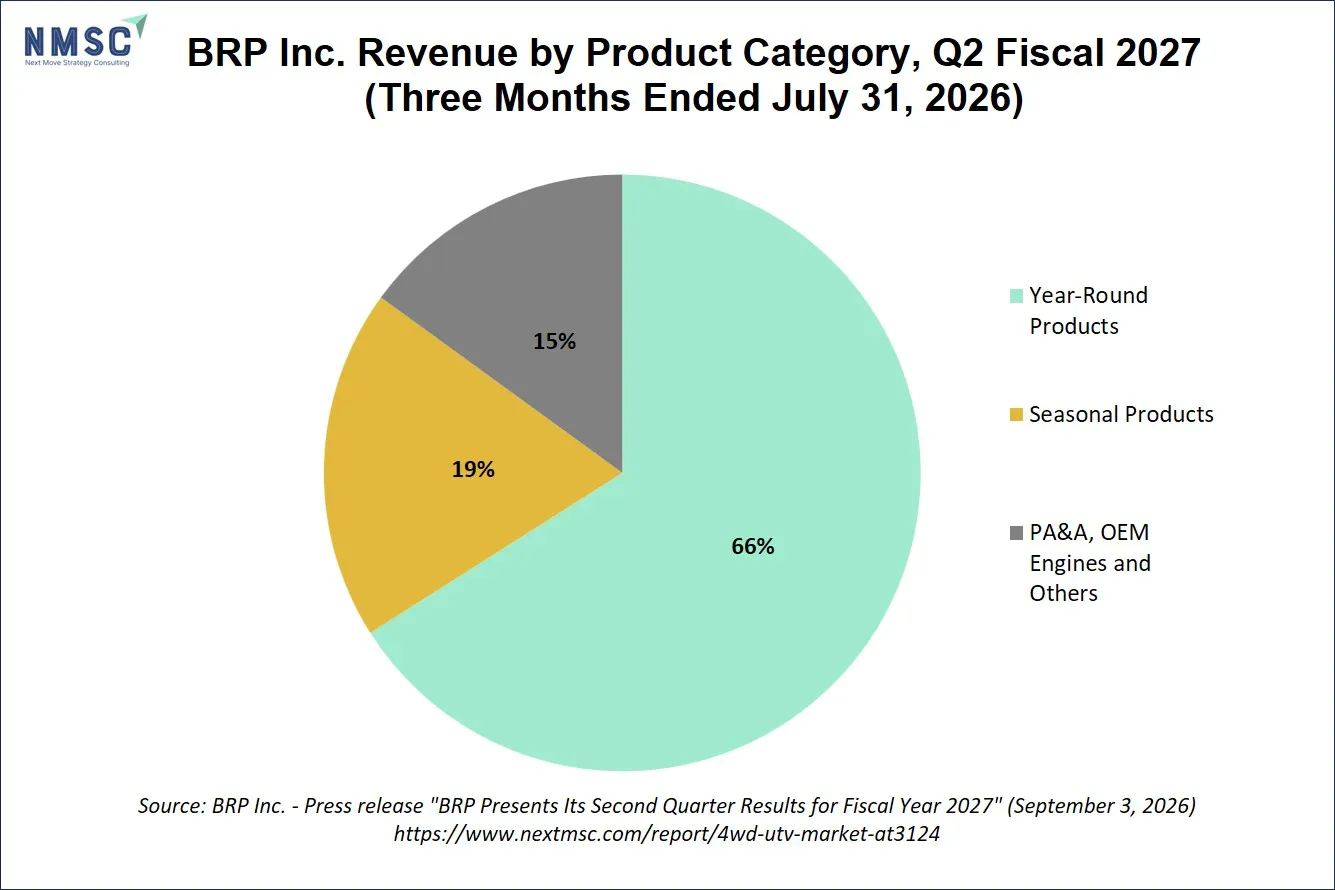
BRP Inc. reported second quarter fiscal 2027 revenues of CA$2,236.8 million for the three months ended July 31, 2026. Year-Round Products accounted for 66% of revenues, Seasonal Products for 19% and PA&A, OEM Engines and Others for 15%. BRP Inc. attributed the growth in Year-Round Products primarily to a higher volume of off-road vehicle units sold and a favorable side-by-side mix.
Profitability moved the other way. BRP Inc. reported a gross profit margin of 11.7%, down from 21.1%, and attributed the decline to Section 232 tariffs on steel, aluminum and copper imports into the United States and to a supplier financial restructuring that cost CA$74.8 million, or 330 basis points. BRP Inc. nonetheless raised its fiscal 2027 normalized diluted earnings per share guidance to between CA$4.00 and CA$4.50 and committed to a major off-road product announcement every six months for the next four years. Demand is not the constraint in this part of the 4WD UTV market; input cost is.
NMSC Strategic Perspective: Why Utility Demand Now Sets the Pace of the 4WD UTV Market
NextMSC primary research and analysis reads these developments as one structural shift: purchasing logic in the 4WD UTV market is moving from discretionary recreation toward budgeted utility use. Polaris Inc. and BRP Inc. both report share gains concentrated in cabbed utility products while recreational demand softens. Yamaha Motor Co., Ltd. is converting to a partner-supplied model in the very segment where it sees demand expanding. And the buyers who supply incremental volume, namely contractors, farms and defense agencies, judge a vehicle on uptime and total cost of ownership rather than styling.
The NextMSC forecast quantifies the consequence. Value is projected to grow at a CAGR of 6.7% while volume grows at 10.5%, so the implied average revenue per unit moves from approximately USD 13,000 in 2024 to approximately USD 10,600 in 2030. That decline is consistent with a mix tilting toward value-tier and mid-size utility platforms, such as the Polaris Inc. RANGER 500, rather than premium recreational models. NextMSC research also identifies the 400-800 cc displacement class as the largest segment, because it balances torque against fuel use and maintenance cost, the equation a fleet buyer solves.
Section Summary:
Four 2026 disclosures show that utility use, not recreation, is carrying 4WD UTV volume, and that cost structure now decides who keeps the margin.
-
Yamaha Motor Co., Ltd. ended in-house ROV production on August 4, 2026 and signed a joint development and mutual supply agreement with Deere & Company on October 7, 2026.
-
BRP Inc. grew Year-Round Products revenue 33.3%, yet gross margin fell to 11.7% from 21.1%.
-
NextMSC projects volume to grow at 10.5% against value at 6.7%, a mix shift toward lower-priced utility platforms.
Industry Impact Analysis
Data Center Construction Turns the 4WD UTV Market Into a Fleet Business
The Associated General Contractors of America reported on November 2, 2026, in its analysis of U.S. Census Bureau data, that spending on data center construction rose 8.6% in September 2026 and 90% from September 2025, while all other private construction categories combined fell 7.8% over 12 months. When one project type expands by 90% while the rest contract, vehicle demand concentrates on a small number of very large job sites.
Polaris Inc. described the operating profile of that demand on its October 27, 2026 call. Sales of commercial, government and defense products grew at a high-double-digit rate, helped by data centers. The vehicles run long hours, are often left idling and cannot be washed frequently, which shows up in parts data as more frequent alternator belt replacement. Contractors and rental companies buy fleets, and the vehicles typically spend two to three years in service, which creates recurring demand for parts. Polaris Inc. reported Powersports parts, garments and accessories sales up 19% in the quarter.
Agriculture: Rising Costs Meet Government Support at the Farm Gate
Farm demand rests on cash flow rather than on profit headlines. The USDA Economic Research Service forecast on September 3, 2026 that U.S. net farm income would fall 2.6% to USD 158.4 billion in 2026, while net cash farm income would edge up 0.4% to USD 176.4 billion. Direct Government farm payments are forecast at USD 47.4 billion, up USD 19.5 billion from 2025, and total production expenses are forecast to rise USD 21.2 billion, or 4.5%, to USD 492.8 billion.
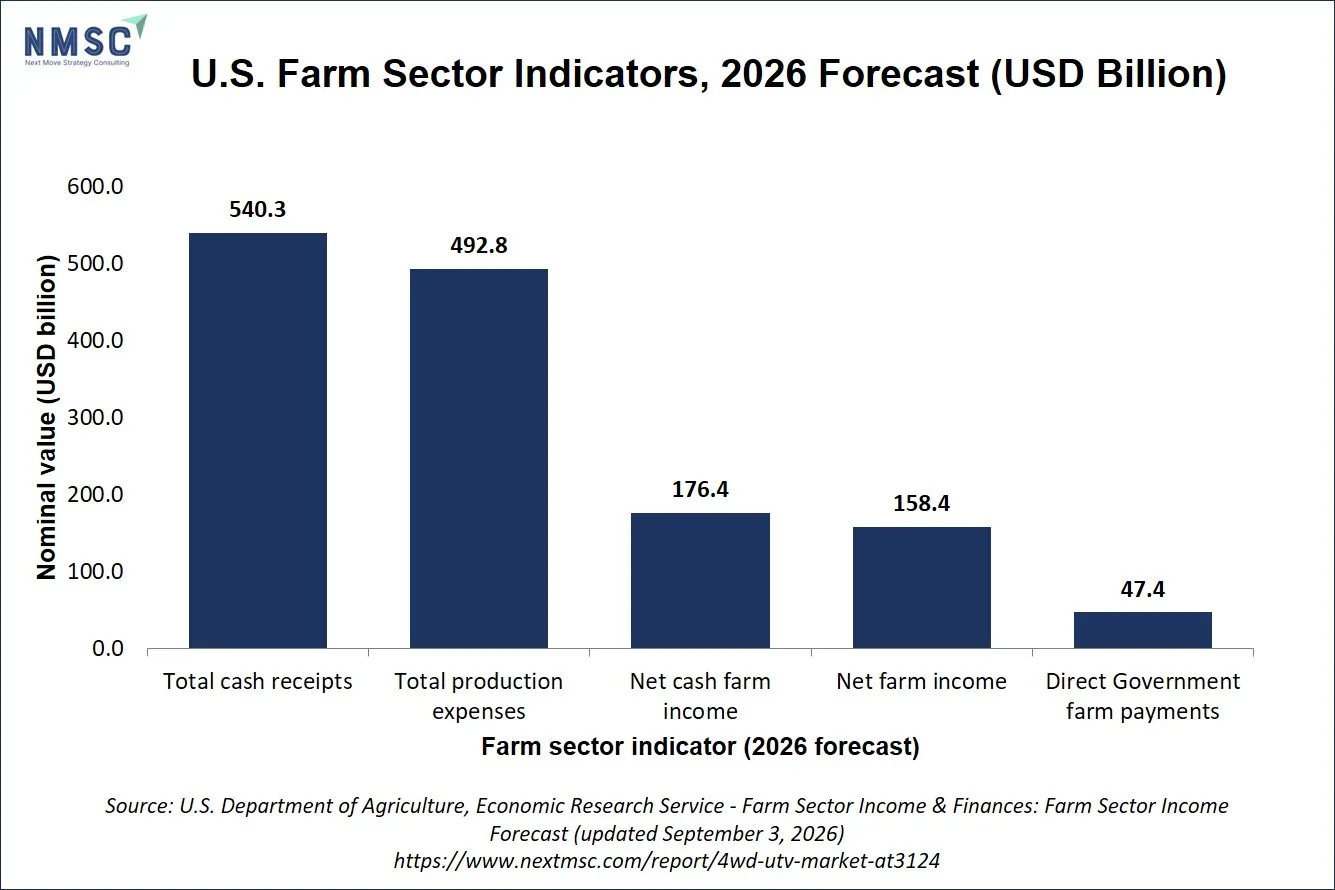
The USDA Economic Research Service forecasts 2026 total cash receipts of USD 540.3 billion and total production expenses of USD 492.8 billion. Net cash farm income is forecast at USD 176.4 billion and net farm income at USD 158.4 billion. Direct Government farm payments are forecast at USD 47.4 billion. All values are nominal 2026 forecasts published on September 3, 2026.
Within expenses, the USDA Economic Research Service expects fuel and oil costs to rise USD 4.8 billion, or 28.8%. Higher fuel costs raise the hourly operating cost of every gasoline or diesel utility vehicle on a farm, which strengthens the total cost case for electric models. Polaris Inc. lists the 2027 RANGER XP Kinetic with a range of up to 80 miles and a starting MSRP of USD 37,499, and Equipment World reported on September 8, 2026 that the model returned to the lineup after a brief hiatus because of high demand and customer requests.
Defense and Government Buyers Add a Budget-Driven Demand Layer
Government demand follows budgets and project schedules. Polaris Inc. said on October 27, 2026 that its government and defense business is growing across a range of customers, supported by increased defense spending across the United States, Canada and NATO. Textron Inc. added a second data point on October 29, 2026: revenues at Textron Specialized Vehicles increased USD 26 million, or 9%, reflecting higher volume and mix and a favorable impact from pricing.
Tariffs, Steel and Aluminum: The Cost Side of the 4WD UTV Market
Cost pressure is the main offset. Polaris Inc. expects to pay approximately USD 215 million in tariffs in 2026 and said commodity and logistics costs, led by steel, diesel, aluminum and trucking, will run approximately USD 70 million higher than in 2025. It expects China-sourced content to fall to 9% of material cost of goods sold by year-end from approximately 14% at the start of the year, with a target below 5% by the end of 2027. BRP Inc. ties its margin decline to Section 232 duties on steel, aluminum and copper. Manufacturers with North American capacity and diversified suppliers hold a cost advantage in the 4WD UTV market that import-dependent rivals cannot replicate quickly.
Section Summary:
Fleet buyers, farm cash flow and defense budgets are lifting utility demand, while tariffs and commodity costs compress what manufacturers keep.
-
Data center construction rose 90% year over year in September 2026 while other private categories combined fell 7.8%, according to the Associated General Contractors of America.
-
The USDA Economic Research Service forecasts 2026 net cash farm income of USD 176.4 billion against production expenses of USD 492.8 billion.
-
Polaris Inc. expects approximately USD 215 million in 2026 tariff costs and is cutting China-sourced material content.
-
Localized supply chains are becoming a competitive asset.
Pros and Cons of Recent Market Developments
|
Pros |
Cons |
|
Utility demand is holding: Polaris Inc. reported North American off-road retail up 2% in the third quarter of 2026. |
Recreational demand is soft, as Polaris Inc. linked buyer hesitation to cost of living and higher monthly payments. |
|
Data center construction rose 90% year over year in September 2026, creating fleet demand. |
All other private construction categories combined fell 7.8% over 12 months. |
|
Platform sharing, as in the Yamaha Motor Co., Ltd. and Deere & Company agreement, spreads development cost. |
Manufacturing location and launch timing are undisclosed, so the effect is not yet measurable. |
|
The 2027 RANGER XP Kinetic offers up to 80 miles of range against farm fuel and oil costs forecast up 28.8%. |
The RANGER XP Kinetic starts at USD 37,499, against USD 11,999 for the RANGER 600. |
Key Data & Statistics
Key 4WD UTV Industry Events and Quantified Impact (2026)
|
Event |
Date |
Quantified Impact |
|
Yamaha Motor Co., Ltd. ends in-house ROV production in Georgia |
August 4, 2026 |
Approximately 300 positions adjusted; approximately ¥12.0 billion one-time expenses |
|
BRP Inc. reports Q2 fiscal 2027 |
September 3, 2026 |
Revenues CA$2,236.8 million (+18.5%); gross margin 11.7% versus 21.1% |
|
Yamaha Motor Co., Ltd. and Deere & Company sign ROV agreement |
October 7, 2026 |
Joint development and mutual supply; brands and dealers retained |
|
Polaris Inc. reports Q3 2026 |
October 27, 2026 |
Sales USD 2,043 million (+11%); North American ORV retail +2% |
|
Textron Inc. reports Q3 2026 |
October 29, 2026 |
Textron Specialized Vehicles revenues +USD 26 million (+9%) |
Utility Demand and Cost Reference Points (2026)
|
Indicator |
Value |
Basis |
|
Utility products as a share of Polaris Powersports sales |
Over 60% |
Polaris Inc., October 27, 2026 |
|
Cabbed units as a share of RANGER sales |
More than 50% |
Polaris Inc., October 27, 2026 |
|
Data center construction growth, September 2026 year over year |
90% |
Associated General Contractors of America, November 2, 2026 |
|
U.S. net cash farm income forecast for 2026 |
USD 176.4 billion |
USDA Economic Research Service, September 3, 2026 |
|
Expected Polaris Inc. tariff payments in 2026 |
Approximately USD 215 million |
Polaris Inc., October 27, 2026 |
Future Outlook & Forecast
From USD 8.40 Billion to USD 12.83 Billion: Three Forces Behind a 6.7% CAGR
According to NextMSC primary research and analysis, the global 4WD UTV market is projected to reach USD 12.83 billion by 2030 from USD 8.40 billion in 2024, a CAGR of 6.7% from 2025 to 2030, with volume rising from 646 thousand units to 1,212 thousand units at a CAGR of 10.5%. Three forces underpin that trajectory.
-
The cabbed utility mix. NextMSC research identifies the 400-800 cc displacement class as the largest segment, and cabbed utility products are where Polaris Inc. and BRP Inc. report their fastest growth.
-
Institutional and fleet buyers. Data center construction, farm cash income and defense budgets finance purchases through channels less sensitive to consumer credit than recreational buying.
-
Electrification. NextMSC research identifies electric propulsion as the fastest-growing propulsion type, supported by rising farm fuel costs and product returns such as the 2027 RANGER XP Kinetic, although purchase price remains the main brake.
North America and Africa: Two Different Growth Engines
NextMSC regional analysis identifies North America as the largest regional market, supported by defense and sports-related spending, and Africa as the fastest-growing region, supported by agriculture in countries such as Nigeria and Morocco. Polaris Inc. quantifies North America's weight: it generated USD 1,815 million, or 89%, of third quarter sales, while international sales of USD 228 million, or 11%, fell 11% year over year.
Section Summary:
NextMSC projects the 4WD UTV market to reach USD 12.83 billion by 2030 at a 6.7% CAGR, with utility mix, institutional buyers and electrification as the main forces.
-
Fleet, farm and defense buyers diversify demand away from consumer credit.
-
Electric propulsion is the fastest-growing propulsion type in NextMSC research, constrained by purchase price.
-
North America leads on size, while Africa leads on growth rate.
Next Steps for Stakeholders
For C-Level Executives and Operations Leaders
-
Rebuild the portfolio around cabbed utility configurations. Polaris Inc. and BRP Inc. both link share gains to cab-equipped utility units. Test whether current platforms can offer factory heat and air conditioning at value-tier price points, where Polaris Inc. gained more than 10 points of mid-size segment share.
-
Treat tariff exposure as a sourcing design problem. Map metal content by supplier and country, and price the cost of moving it into North America against the margin lost to duties such as the Section 232 tariffs that weighed on BRP Inc.
-
Evaluate platform sharing before committing to a new vehicle architecture. The Yamaha Motor Co., Ltd. and Deere & Company agreement shows that established brands can keep separate dealers while sharing development and supply.
For Institutional Investors
-
Separate share gains from margin recovery. BRP Inc. shows revenue growth of 18.5% coexisting with an 11.7% gross margin, while Polaris Inc. improved adjusted EBITDA margin by 118 basis points to 8.8%. Track margin by cost category, not unit share alone.
-
Watch the disclosure calendar. Polaris Inc. has scheduled an investor day for early February 2027, BRP Inc. has promised major off-road announcements every six months, and Yamaha Motor Co., Ltd. targets Outdoor Land Vehicle profitability in fiscal 2028.
Conclusion
The 4WD UTV market is not simply growing; it is being reorganized. Yamaha Motor Co., Ltd. has exited in-house side-by-side production, Deere & Company has become a development and supply partner, Polaris Inc. and BRP Inc. are gaining share through cabbed utility products, and data center construction, farm cash income and defense budgets are supplying a different kind of buyer from the weekend rider. Against that demand, tariffs and commodity costs decide how much revenue becomes profit.
According to NextMSC primary research and analysis, the market is projected to grow from USD 8.40 billion in 2024 to USD 12.83 billion by 2030 at a CAGR of 6.7%, with volume growing faster than value at 10.5%. Stakeholders who build for uptime, localize supply and share platforms where scale is lacking are positioned to capture that growth in the 4WD UTV market.
About the Author
 Priyanshu Das
— Priyanshu Das is SEO Executive at Next Move Strategy Consulting, where he has led on-page and off-page SEO, keyword research, and SEO audits for the firm's B2B market research publications for 2 years. His audit process combines technical crawl analysis, backlink profile review, and competitor keyword gap mapping — using tools including Screaming Frog and Google Search Console — to prioritize fixes by organic search-visibility impact, informed by his own prior in-house and agency SEO experience.
About the Reviewer
 Sanyukta Deb
— Sanyukta Deb is Digital Marketing Team Lead at Next Move Strategy Consulting, where she has led content strategy and technical SEO for the firm's B2B market research publications for over 2 years. Her editorial process translates NextMSC's primary and secondary research — spanning technology, industrial, and consumer sectors — into commercial narratives, backed by search-intent, keyword, and competitive analysis. She brings 5 years of overall experience in digital marketing and content strategy.












Add Comment