5 Best Florida Contractor Coverage Plans for Builders

In January 2026, Greg Abel succeeded Warren Buffett as CEO of Berkshire Hathaway one of the largest insurance and reinsurance groups by premium volume, and among the most closely watched names in the Property and Casualty (P&C) Insurance Market, which NMSC values at USD 3.75 trillion in 2025, projected to reach USD 5.77 trillion by 2030 at a 9.0% CAGR. Abel's first shareholder letter delivered an unusually direct signal: after years of pricing discipline, Berkshire now expects to “write less property and casualty business for a period of time.” That single sentence captures where the wider market stands heading into the back half of 2026 a hard-pricing cycle giving way to softer conditions, even as the underlying demand driving NMSC's long-term forecast keeps growing.
Why Is the P&C Insurance Market's Hard-Pricing Cycle Ending?
The immediate cause is capital, not claims. Reinsurance has attracted a wave of new capacity from traditional and alternative markets alike, and a comparatively mild run of catastrophe losses has let that capacity compete hard on price. Gallagher Re's H1 2026 Natural Catastrophe and Climate Report noted a fifth consecutive quarter without a single insured loss event exceeding $10 billion a stretch of calm that stands in sharp contrast to 2025's opening months, when the California wildfires drove some of the worst first-quarter catastrophe losses insurers had seen in years.
Swiss Re's July 2026 world insurance research now forecasts just 0.6% global real non-life premium growth for 2026 and 1% for 2027, describing competitive pricing and easing reinsurance costs persisting into 2027. The softening is uneven by line: Marsh's renewal-pricing data shows commercial property rates falling roughly 12% even as casualty lines continued rising around 2% a genuine two-speed market rather than a uniform downturn. CNA Financial's own first-quarter 2026 renewal data illustrates the shift directly: commercial-lines rate increases slowed to just 2%, down from 6% a year earlier, even as retention held at 81%.
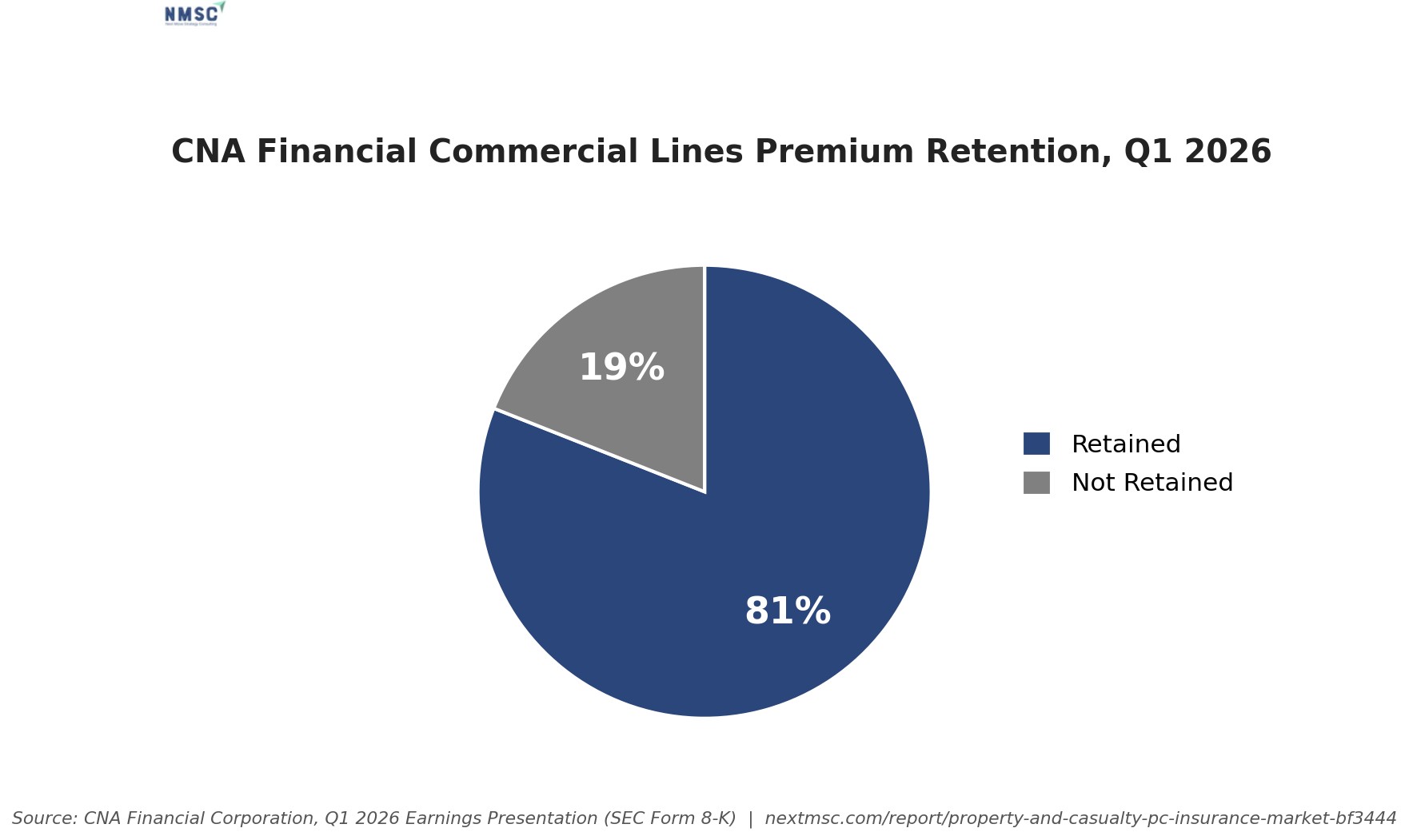
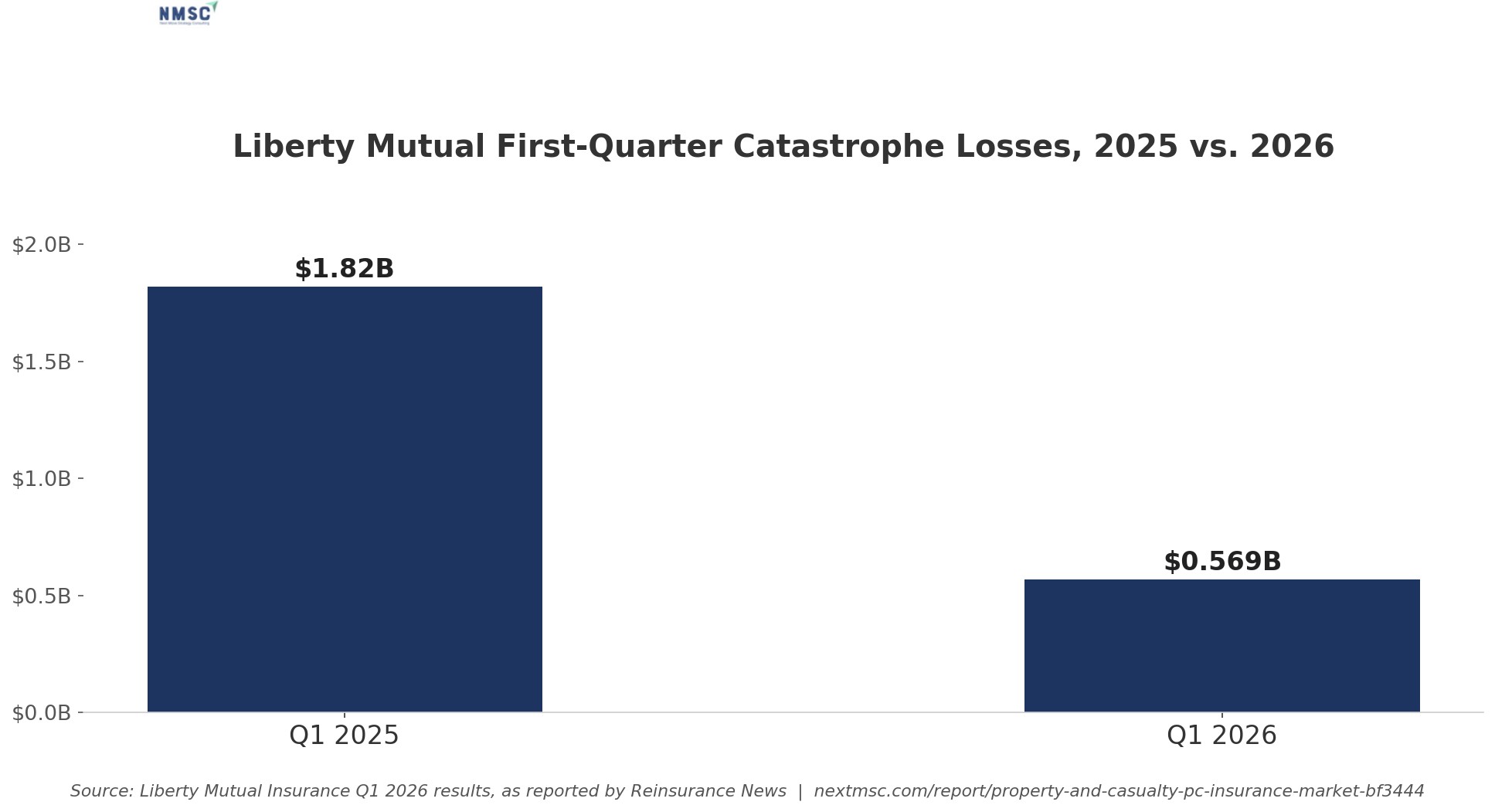
A capital-rich reinsurance market and an unusually calm run of catastrophe losses have combined to soften pricing across much of the P&C Insurance Market, though the effect is far from uniform across lines.
-
Gallagher Re recorded a fifth straight quarter without a single insured loss event topping $10 billion
-
Swiss Re forecasts real non-life premium growth of just 0.6% for 2026, with soft conditions persisting into 2027
-
Commercial property pricing is falling (~-12%) while casualty lines continue rising (~+2%) a two-speed market
-
CNA's own renewal data shows commercial rate increases slowing from 6% to 2% year-over-year
How Are Industry Leaders Responding Across the P&C Insurance Market?
Berkshire Hathaway's transition is the clearest signal of the cycle turning: full-year 2025 pre-tax underwriting earnings fell to $9.5 billion from $11.4 billion in 2024, and Abel has warned of “continued headwinds” into 2026 for both primary insurance and reinsurance. Even so, Berkshire's own results stayed resilient Q2 2026 pre-tax underwriting earnings of $2.18 billion included a P&C reinsurance combined ratio of 77.4%, among the strongest in the group.
State Farm, Allstate, Progressive, and Liberty Mutual the large U.S. personal-lines writers are the clearest beneficiaries of calmer weather. State Farm returned to profitability in 2025 with a $1.5 billion underwriting gain after two years of losses exceeding $8 billion, and announced a $5 billion dividend to auto policyholders; its homeowners line, however, stayed unprofitable. Allstate's Q2 2026 net income jumped 56% to $3.2 billion as catastrophe losses fell 12.8%, though average homeowners premiums kept rising even as underwriting improved. Liberty Mutual's Q1 2026 net income more than doubled on a 68.8% drop in catastrophe losses. Progressive was the outlier: Q2 2026 earnings per share fell 6.1% year-over-year as its combined ratio deteriorated 110 basis points to 87.1, a reminder that even the calmer environment doesn't lift every carrier equally.
Travelers and Chubb posted standout commercial-lines results Travelers' Q2 2026 core income per share rose 54%, and Chubb's Q4 2025 net income climbed 24.7% to $3.21 billion, a result strong enough that Berkshire Hathaway itself increased its equity stake in Chubb. CNA Financial, by contrast, illustrated the softening directly: first-half 2026 core income fell 11% to $674 million as underlying underwriting results weakened alongside the rate slowdown described above.
Allianz posted a record first-half 2026 operating profit of €9.4 billion and a solvency ratio of 225%, its highest since 2018, and used that capital strength to announce a 15-year exclusive distribution agreement alongside its acquisition of HSBC Life Singapore (July 2026); Reuters has separately reported Allianz is examining a possible £5 billion acquisition of UK roadside-assistance provider AA, though no deal has been confirmed. AXA reported resilient first-quarter 2026 revenue despite a cooling industrial insurance segment and elevated fire-damage claims. Among Japan's “big three” non-life insurers, Tokio Marine leaned further on its international book overseas net premiums reached ¥3.37 trillion for the year ended March 2026, supported by a long-standing capital alliance with Berkshire Hathaway while MS&AD has scheduled a merger of its core non-life subsidiaries and a group rename for April 2027, and Sompo reported first-quarter adjusted profit up ¥19.9 billion year-over-year on improved domestic underwriting and overseas investment gains.
For the remaining named leaders PICC, Ping An, USAA, Generali, Talanx, and Aviva no comparably specific, independently sourced development from the past six months was identified beyond routine quarterly reporting; their inclusion in NMSC's competitive set reflects overall scale in the market rather than a distinct recent strategic move.
Leadership in the P&C Insurance Market is bifurcating along the same lines as the pricing cycle itself: personal-lines carriers are enjoying a calmer catastrophe environment, while commercial-lines specialists are starting to feel the softening, and the largest global players are using strong capital positions to keep acquiring.
-
Berkshire Hathaway's leadership transition coincides directly with the turn in the reinsurance pricing cycle
-
U.S. personal-lines carriers (State Farm, Allstate, Liberty Mutual) are benefiting most from lower catastrophe losses
-
CNA's softening results illustrate the commercial-lines pricing pressure building across the market
-
Allianz and Japan's “big three” insurers are pursuing international expansion and consolidation from positions of capital strength
What Does This Mean for Small Commercial Buyers?
None of this consolidation among the largest carriers changes how most small and mid-sized businesses actually buy coverage: through independent agencies that shop across several underwriters at once. A Florida general contractor comparing builder's-risk and general-liability options, for example, is typically working with an agency such as Affordable Contractors Insurance rather than negotiating with a carrier directly and how quickly that agency can issue a certificate of insurance increasingly depends on the same digital infrastructure driving change further up the market.
That infrastructure is itself a distinct, fast-growing market: NMSC values the P&C Insurance Core Platform Market the policy administration, billing, and claims software insurers and their distribution partners run on at USD 7.81 billion in 2023, growing to a projected USD 14.33 billion by 2030 at an 8% CAGR. As more of that spend goes toward cloud-based, API-connected platforms, the instant, 24/7 certificate issuance small commercial buyers now expect becomes less a competitive differentiator and more a baseline requirement.
NMSC Market Size & Growth Comparison
|
Market |
Base-year value |
2030 projected value |
CAGR |
|
Property and Casualty (P&C) Insurance Market |
USD 3.75 trillion (2025) |
USD 5.77 trillion |
9.0% (2025–2030) |
|
P&C Insurance Core Platform Market |
USD 7.81 billion (2023) |
USD 14.33 billion |
8.0% (2024–2030) |
2026 P&C Insurance Market Timeline
|
Date |
Development |
|
Jan. 2026 |
Greg Abel succeeds Warren Buffett as CEO of Berkshire Hathaway |
|
Feb. 2026 |
Berkshire Hathaway discloses an increased equity stake in Chubb |
|
Apr.–May 2026 |
Allstate and Liberty Mutual report sharply lower Q1 catastrophe losses year-over-year |
|
Jul. 2026 |
Allianz announces acquisition of HSBC Life Singapore; Swiss Re issues 2026–2027 soft-market forecast |
|
Aug. 2026 |
Allianz and CNA Financial report H1/Q2 2026 results confirming the pricing slowdown in commercial lines |
A Test for Next Year's Planning
For insurers, brokers, and commercial buyers alike, the softening cycle described here will not move at the same speed in every line or region. Before setting next year's renewal strategy or capital plan, run a simple check: compare your own line-specific rate trend against the property-versus-casualty divergence described above, rather than assuming the whole market is moving in one direction at once. Businesses that price and reserve line by line will be better positioned than those reacting to the market as a single, uniform cycle.
Teams tracking these dynamics in more detail can go deeper into segment- and regional-level forecasts Download Free Sample
Conclusion
A leadership change at the industry's most closely watched insurer, a wave of reinsurance capital, and an unusually calm run of catastrophe losses have combined to turn a years-long hard market soft unevenly, and not without exceptions. The Property and Casualty (P&C) Insurance Market's long-term growth story, reflected in NMSC's projected climb to USD 5.77 trillion by 2030, remains intact. But the leaders best positioned to capture that growth over the next several years look less like the carriers that dominated the hard-market years, and more like the ones now moving fastest to acquire, diversify, and modernize while pricing conditions allow them room to do so.
About the Author
 Sanyukta Deb
— Sanyukta Deb is Digital Marketing Team Lead at Next Move Strategy Consulting, where she has led content strategy and technical SEO for the firm's B2B market research publications for over 2 years. Her editorial process translates NextMSC's primary and secondary research — spanning technology, industrial, and consumer sectors — into commercial narratives, backed by search-intent, keyword, and competitive analysis. She brings 5 years of overall experience in digital marketing and content strategy.
Sanyukta Deb
— Sanyukta Deb is Digital Marketing Team Lead at Next Move Strategy Consulting, where she has led content strategy and technical SEO for the firm's B2B market research publications for over 2 years. Her editorial process translates NextMSC's primary and secondary research — spanning technology, industrial, and consumer sectors — into commercial narratives, backed by search-intent, keyword, and competitive analysis. She brings 5 years of overall experience in digital marketing and content strategy.
About the Reviewer
 Debashree Dey
— Debashree Dey is Assistant Manager at Next Move Strategy Consulting, where she supports cross-vertical market content and communications across diverse industries for 6 years. Her professional background includes senior content writing, communications, and published manuscript authorship, with experience developing audience-focused business narratives and maintaining clear, consistent messaging. Her role supports research-led content development and editorial quality across NextMSC publications.
Debashree Dey
— Debashree Dey is Assistant Manager at Next Move Strategy Consulting, where she supports cross-vertical market content and communications across diverse industries for 6 years. Her professional background includes senior content writing, communications, and published manuscript authorship, with experience developing audience-focused business narratives and maintaining clear, consistent messaging. Her role supports research-led content development and editorial quality across NextMSC publications.


















Add Comment