7 Trends Reshaping the Active Seat Belt System Market in 2026
Introduction
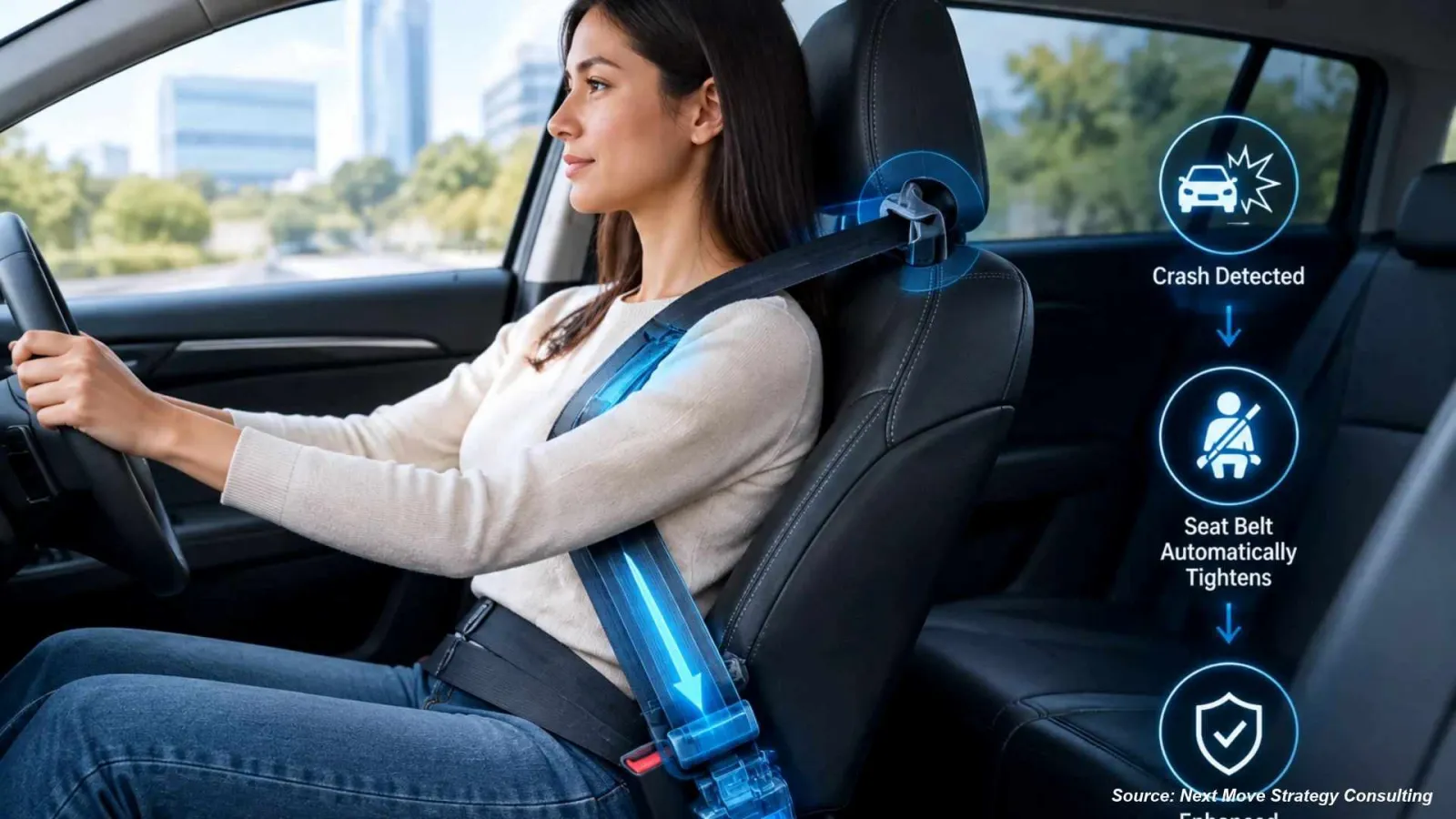
On July 23, 2026, ZF LIFETEC announced an Infrared Belt, a seat belt webbing built from yarns with a distinct infrared signature so that in-cabin cameras can see how a belt actually runs across an occupant's body. Series production was scheduled to begin in August 2026 for all seating positions, including the rear seats. The announcement matters because a conventional buckle sensor confirms only that a tongue plate is inserted, not that the belt crosses the shoulder rather than sitting behind the back. That gap between a latched belt and a correctly worn belt now sits at the centre of competition in the active seat belt system market.
According to Next Move Strategy Consulting's Active Seat Belt System Market report, the global active seat belt system market was valued at USD 13.22 billion in 2024 and is projected to reach USD 20.98 billion by 2030, growing at a CAGR of 8.0% from 2025 to 2030. The report segments the market by component, namely retractors, pretensioners and buckle lifters, and by application, namely passenger cars and commercial vehicles, and it covers 28 countries.
For More Information: Download FREE Sample on Active Seat Belt System Market Report
This analysis covers Euro NCAP's first 2026 ratings, the revised United States seat belt reminder timetable, supplier results from Autoliv and Joyson Electronics, and observed rear-seat belt use. It then sets out the NMSC Strategic Perspective on where value is migrating within the active seat belt system industry.
ZF's Infrared Belt and Euro NCAP's First 2026 Ratings Move Seat Belts From Hardware to Verified Protection
ZF LIFETEC's Infrared Belt: Making Correct Wear Visible to Cameras
ZF LIFETEC's July 23, 2026 press release describes a specific engineering route to belt verification. The Infrared Belt combines yarns with different spectral properties, which produces an infrared signature that camera-based systems can read as a stable, high-contrast signal. Infrared cameras can then track the path of the belt along the body, and vehicle manufacturers can apply detection algorithms to judge whether the belt is routed over the shoulder or runs under the arm or behind the occupant's back. ZF LIFETEC states that this approach is more robust than conventional colour cameras, where optical reflections or identically coloured backgrounds can hide the path of the belt.
The release also explains why the timing is deliberate. ZF LIFETEC points to the European Union requirement that entered into force on July 7, 2026, under which camera-based fatigue and distraction detection is mandatory for all newly approved vehicle types. The camera hardware required for driver monitoring therefore provides a platform on which belt verification can build. ZF LIFETEC adds that Euro NCAP requires detected belt misuse to be communicated through audiovisual warnings, and that further occupant monitoring requirements are expected under Euro NCAP's Vision 2030 roadmap. The company will present the webbing at the AIRBAG 2026 event in Mannheim from December 8 to 10, 2026.
Euro NCAP's First 2026 Ratings: Credit for Detecting Belt Misuse
Euro NCAP published its first results under the 2026 protocols on July 8, 2026, awarding five stars to the BMW iX3 and the ZEEKR 7GT. The two cars show how the new framework treats belt monitoring. Euro NCAP reported that the iX3 offers cabin monitoring that can classify occupants but does not include detection of an out-of-position front passenger or of improper belt use, and the car scored 73% in the Safe Driving stage. The ZEEKR 7GT includes sensors that flag incorrect lap-only belt use and scored 79% in the same stage.
Both cars reached five stars, so belt-misuse detection is not yet decisive for the top rating. Euro NCAP's published scores also do not isolate belt monitoring within the Safe Driving stage, so the 6 percentage-point gap between the two cars cannot be attributed to belt detection alone. In Crash Protection, Euro NCAP described virtual modelling and sled testing of the ZEEKR 7GT across 5th, 50th and 95th percentile occupants, so restraints now have to perform across a range of body sizes.
On September 2, 2026, Euro NCAP released results for four further cars tested under the 2026 protocols, as reported by FIA Region I. The AION UT, GEELY E2 and Leapmotor B05 each earned five stars, and the CUPRA Raval earned four stars as standard and five stars with an optional Safety Pack. Euro NCAP's testers noted the Raval's robust seat belt usage detection.
Autoliv's Second Quarter: Seat Belt Sales Soften While India and Chinese OEMs Grow
Autoliv's Financial Report for April to June 2026, published on July 17, 2026, gives the clearest supplier-side read on demand. Net sales of Seatbelt Products and Other were USD 897 million in the second quarter, against USD 902 million a year earlier, a reported decline of 0.5% and an organic decline of 3.0%. Autoliv reported that seat belt sales fell organically in the Americas, China and EMEA and rose in Asia excluding China. Over the first six months, Seatbelt Products and Other reached USD 1,787 million, up 3.5% as reported and down 1.0% organically.
The regional detail shows where safety content per vehicle is rising. Autoliv reported 36% organic sales growth in India in the quarter, which it attributed mainly to increasing safety content in vehicles rather than to production volumes alone. In China, Autoliv's sales to domestic manufacturers grew organically by about 44% while sales to global manufacturers fell by about 24%, and Chinese manufacturers accounted for 55% of Autoliv's China sales against about 40% a year earlier. On July 6 and July 7, 2026, Autoliv announced strategic cooperation agreements with Great Wall Motor and XPENG.
Autoliv also restructured its European footprint. On May 8, 2026, the company announced the gradual discontinuation of manufacturing in Türkiye, which covers steering wheels, airbags and seat belts and affects about 2,200 employees, with closure expected in the first half of 2028. Its full-year 2026 guidance assumes a 2.5% decline in global light vehicle production and organic sales growth of about 0%.
Joyson Electronics' First Half: Order Growth Follows Chinese Automakers Abroad
Joyson Electronics, which runs an automotive safety division alongside its electronics business, reported first-half 2026 results on August 25, 2026. Revenue was about RMB 28.1 billion, net profit attributable to shareholders was about RMB 0.74 billion, up about 4.4%, and new customer nominations carried an estimated lifecycle order value of about RMB 44.9 billion. Joyson Electronics stated that leading Chinese automakers and emerging electric vehicle manufacturers have become key drivers of new order growth.
Its overseas gross margin rose to about 18.1% in the first half, from about 9% in the first half of 2022. The release does not separate safety revenue from the group total, so these figures indicate customer mix rather than seat belt demand specifically.
NMSC Strategic Perspective: Why Verified Wear Is the Next Value Pool in the Active Seat Belt System Market
NextMSC primary research and analysis reads the 2026 developments as a change in what OEMs buy rather than in how many belts they buy. NextMSC's forecast of 8.0% CAGR from 2025 to 2030 rests on growth in the three hardware segments the report tracks, namely retractors, pretensioners and buckle lifters. The July 2026 events add a layer that cuts across all three: a verification layer in which the belt, the cabin camera and the vehicle software jointly establish that the occupant is protected.
Three conclusions follow from NextMSC's analysis. First, regulation is converging on verification from two directions. Euro NCAP's 2026 protocols reward belt-misuse detection, while the United States reminder rules sit on a delayed timetable, so European programmes will set the technical reference and North American programmes will adopt it as compliance dates arrive. NextMSC's research identifies Europe as the largest regional market and North America as the fastest-growing region over the forecast period.
Second, content per vehicle moves toward software-compatible textiles and sensors, which favours suppliers that already integrate belts with airbags, steering wheels and occupant sensing. Third, the competitive map is widening. Autoliv's growth with Chinese OEMs and Joyson Electronics' order intake from Chinese automakers show that supplier selection is increasingly tied to the global expansion of Chinese vehicle brands, and the five-star Euro NCAP ratings earned by the ZEEKR 7GT, AION UT, GEELY E2 and Leapmotor B05 show that those programmes can meet European restraint standards.
The principal restraint remains cost. NextMSC's report identifies the sensors, actuators and control units that active belts require, and that passive belts do not, as the main barrier to adoption. The verification layer lowers that barrier only where camera hardware is already mandatory, as in the European Union from July 7, 2026, so suppliers should plan for uneven adoption by region and vehicle price tier through 2030.
Section Summary:
Three 2026 signals show where value is moving: belt verification, rear-seat coverage and a wider supplier base.
-
ZF LIFETEC's Infrared Belt, in series production from August 2026, lets cameras check belt routing in every seat.
-
Euro NCAP's first 2026 ratings reward misuse detection, but five stars remain attainable without it.
-
Autoliv and Joyson Electronics both report growth tied to Chinese OEMs, while Autoliv's seat belt sales fell 3.0% organically.
Industry Impact Analysis: What 2026 Rules Mean for the Active Seat Belt System Market
NHTSA Moves Seat Belt Reminder Compliance to September 2028
On April 6, 2026, the National Highway Traffic Safety Administration (NHTSA) published an interim final rule in the Federal Register that amends the seat belt warning requirements of Federal Motor Vehicle Safety Standard No. 208 in response to petitions for reconsideration. The rule sets a compliance date of September 1, 2028, with optional early compliance, in place of the staged dates that NHTSA set in January 2025: September 1, 2026 for front seats and September 1, 2027 for rear seats. NHTSA's rule documents also record its earlier finding that rear-seat occupant detection presents technological and cost challenges, which is why the rear requirement does not mandate occupant detection.
The U.S. Rear-Seat Gap: What Observed Behaviour Shows
The National Highway Traffic Safety Administration (NHTSA) report Occupant Restraint Use in 2025, published in May 2026, records observations of 87,385 occupants in 66,497 vehicles during June 2025. Front-seat belt use was 91.3%, against 91.2% in 2024, while rear-seat belt use was 84.0%, against 80.1% in 2024. The difference between seating positions is the practical case for rear reminders and for belts that can verify wear in every seat.
Rear-seat use also varied by vehicle type and by law. It was 88.2% in vans and sport utility vehicles, 81.2% in pickup trucks and 76.5% in passenger cars. In States requiring belt use in all seating positions it was 86.3%, compared with 78.0% in States requiring belts only in the front seat. NHTSA cautions that its observers count only visible shoulder belts, so the rear-seat figure reflects both occupant behaviour and the availability of shoulder belts, which NHTSA reports are present at the rear outboard positions of 96.8% of passenger vehicles on the road.
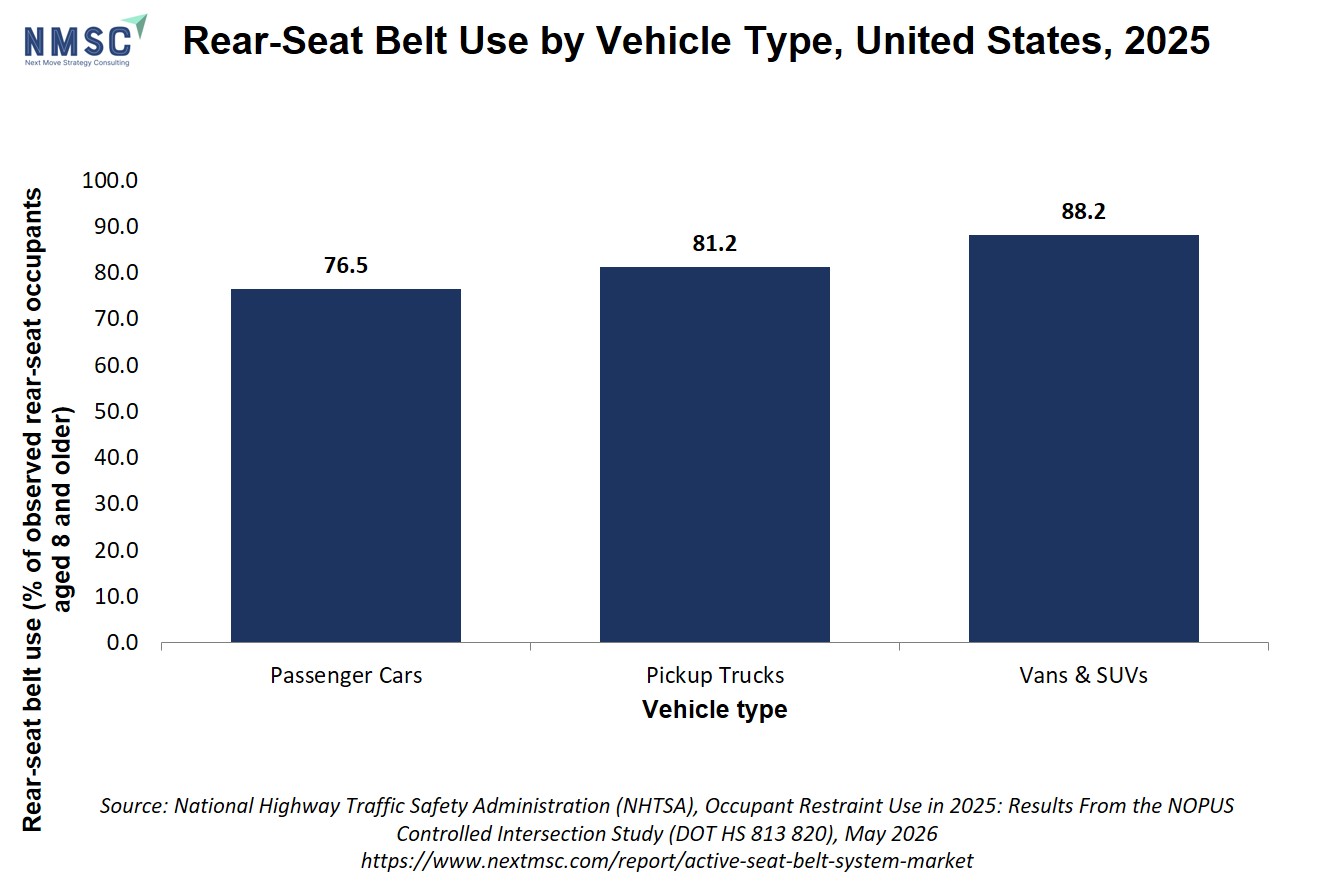
Rear-seat belt use was highest in vans and sport utility vehicles at 88.2% and lowest in passenger cars at 76.5%, with pickup trucks at 81.2%. The 11.7 percentage-point spread between the highest and lowest vehicle types shows that rear-seat belt use is not uniform across the fleet. NHTSA counts an occupant as belted only when a shoulder belt is visible from the roadside.
European Camera Mandates Create the Platform for Belt Verification
The European Union requirement described by ZF LIFETEC, in force since July 7, 2026, makes camera-based driver attention monitoring mandatory for all newly approved vehicle types. ZF LIFETEC adds that Euro NCAP expects vehicles to confirm that occupants wear the belt correctly, and that further requirements are expected under Euro NCAP's Vision 2030 roadmap. NextMSC primary research and analysis indicates that purchase specifications will increasingly have to define how a belt interacts with a camera and with restraint software, in addition to its retraction and load-limiting performance.
Section Summary:
Regulation, observed behaviour and supplier restructuring are pulling the market in the same direction, toward verified protection in every seat.
-
NHTSA's April 6, 2026 interim final rule moves seat belt reminder compliance to September 1, 2028.
-
NHTSA's 2025 survey shows rear-seat belt use at 84.0%, against 91.3% in the front seats.
-
The European camera requirement in force since July 7, 2026 gives belt verification a ready sensor platform.
Pros and Cons of Recent Market Developments
|
Pros |
Cons |
|
ZF LIFETEC's Infrared Belt lets cameras verify belt routing in all seating positions, with series production scheduled from August 2026. |
Verification depends on in-cabin cameras, which the European Union mandates for driver monitoring from July 7, 2026 but which other regions do not yet require. |
|
Euro NCAP's first 2026 ratings recognise belt-misuse detection, as in the ZEEKR 7GT's lap-only belt flag. |
Five-star ratings remain attainable without belt-misuse detection, as the BMW iX3 shows, so OEMs can defer the added cost. |
|
Autoliv's sales in Asia excluding China rose 11.3% organically in the second quarter, led by 36% growth in India. |
Autoliv's Seatbelt Products and Other sales fell 3.0% organically in the same quarter, with declines in the Americas, China and EMEA. |
|
NHTSA's 2025 survey shows rear-seat belt use rising to 84.0% from 80.1%, which widens the base for rear-seat reminders. |
NHTSA's interim final rule moved seat belt reminder compliance to September 1, 2028, which delays United States fitment volume. |
|
Chinese OEMs are expanding supplier programmes, with Autoliv's sales to them up about 44% and Joyson Electronics reporting about RMB 44.9 billion of new lifecycle orders. |
Autoliv's sales to global OEMs in China fell about 24%, and its Türkiye closure carries about USD 142 million of restructuring charges. |
Key Data & Statistics
The tables below consolidate the supplier and behavioural data cited in this analysis, each with its named source.
Autoliv Net Sales by Product and Region, Second Quarter 2026 (USD million)
|
Segment |
Q2 2026 |
Q2 2025 |
Reported change |
Organic change |
|
Seatbelt Products and Other |
897 |
902 |
(0.5)% |
(3.0)% |
|
Airbags, Steering Wheels and Other |
1,906 |
1,812 |
5.2% |
3.0% |
|
Americas |
910 |
891 |
2.1% |
(3.3)% |
|
EMEA |
832 |
828 |
0.4% |
(2.2)% |
|
Asia excluding China |
539 |
519 |
4.0% |
11.3% |
|
China |
522 |
477 |
9.6% |
3.4% |
|
Total net sales |
2,803 |
2,714 |
3.3% |
1.0% |
United States Seat Belt Use, 2024 and 2025 (% of observed occupants aged 8 and older)
|
Seating position or group |
2024 |
2025 |
|
Front seats, all occupants |
91.2% |
91.3% |
|
Rear seats, all passengers |
80.1% |
84.0% |
|
Rear seats, States requiring belts in all seating positions |
80.1% |
86.3% |
|
Rear seats, States requiring belts in front seats only |
80.1% |
78.0% |
|
Rear seats, passenger cars |
78.1% |
76.5% |
|
Rear seats, vans and sport utility vehicles |
83.2% |
88.2% |
|
Rear seats, pickup trucks |
71.5% |
81.2% |
Two readings stand out. Autoliv's regional split shows seat belt demand is weakest where global OEM volumes are under pressure and strongest in Asia excluding China, led by India. NHTSA's data shows the rear seat is where verification and reminders have the most room to change outcomes.
Future Outlook & Forecast: Where the Active Seat Belt System Market Heads by 2030
NextMSC's model projects the active seat belt system market to rise from USD 13.22 billion in 2024 to USD 20.98 billion in 2030, an increase of USD 7.76 billion over six years at a CAGR of 8.0% from 2025 to 2030. NextMSC primary research and analysis combines top-down and bottom-up approaches with statistical techniques including multilinear regression, exponential smoothing, ARIMA and Monte Carlo simulation, and it assigns values to regulatory and market events that affect the forecast window.
Near-term volume is a headwind. Autoliv's 2026 guidance assumes global light vehicle production will decline by 2.5% and organic sales growth of about 0%, and the company expects the effects of customer compensation and mitigation initiatives to weigh more heavily in the fourth quarter. In NextMSC's view, the forecast therefore depends on content per vehicle, meaning the number and sophistication of belt components in each car, rather than on unit production, and the 2026 developments point to that content rising where cameras and rating protocols require it.
Several checkpoints will test the outlook before the end of 2026. They are listed below.
-
October 23, 2026: Autoliv's third-quarter report, the next read on seat belt sales by region.
-
December 8 to 10, 2026: AIRBAG 2026 in Mannheim, where ZF LIFETEC will present its infrared webbing.
-
Further Euro NCAP releases under the 2026 protocols, which will show how many rated vehicles detect belt misuse.
Section Summary:
The outlook rests on content per vehicle and regulatory sequencing rather than on production volume.
-
NextMSC projects growth from USD 13.22 billion in 2024 to USD 20.98 billion in 2030 at 8.0% CAGR.
-
Autoliv's guidance assumes a 2.5% fall in global light vehicle production in 2026.
-
Europe holds the predominant share and North America shows the most rapid growth, per NextMSC research.
Next Steps for Stakeholders
Automaker product and safety leaders. Map the Euro NCAP 2026 occupant monitoring points against the current belt-status sensing on each platform, and decide which programmes will carry belt-misuse detection before the September 1, 2028 United States compliance date. Programmes already fitting in-cabin cameras for the European driver monitoring requirement are the lowest-cost candidates.
Tier-1 and Tier-2 suppliers. Build the case for textile, sensor and software content alongside retractors and pretensioners. Qualify infrared or equivalent webbing with camera suppliers, and review capacity plans against the regional pattern in Autoliv's second-quarter data, where growth sits in India and with Chinese OEMs.
Investors. Track seat belt-specific disclosure rather than group totals, because Joyson Electronics does not separate safety revenue and Autoliv reports Seatbelt Products and Other as a single line. Use the October 23, 2026 Autoliv report as the next data point.
Fleet and mobility operators. Rear-seat belt use of 84.0% in NHTSA's 2025 survey shows a persistent gap. Specify rear-seat reminders and belt-status reporting in procurement requirements now.
Conclusion
The active seat belt system market is moving from selling restraint force to selling verified protection. ZF LIFETEC's Infrared Belt, Euro NCAP's first 2026 ratings and the European camera requirement that took effect on July 7, 2026 all point to belts that report how they are worn. NHTSA's delayed reminder timetable, Autoliv's softer seat belt sales and the restructuring of European capacity show that the transition will be uneven by region and by customer.
NextMSC's projection of USD 20.98 billion by 2030 at an 8.0% CAGR remains the anchor for planning, and the 2026 events indicate where the incremental value will sit: in sensing, software-compatible webbing and rear-seat coverage. Executives and investors who treat correct wear as the new test for the active seat belt system industry will be better placed than those who continue to price belts on mechanical performance alone.
About the Author
 Sanyukta Deb
— Sanyukta Deb is Digital Marketing Team Lead at Next Move Strategy Consulting, where she has led content strategy and technical SEO for the firm's B2B market research publications for over 2 years. Her editorial process translates NextMSC's primary and secondary research — spanning technology, industrial, and consumer sectors — into commercial narratives, backed by search-intent, keyword, and competitive analysis. She brings 5 years of overall experience in digital marketing and content strategy.
About the Reviewer
 Debashree Dey
— Debashree Dey is Assistant Manager at Next Move Strategy Consulting, where she supports cross-vertical market content and communications across diverse industries for 6 years. Her professional background includes senior content writing, communications, and published manuscript authorship, with experience developing audience-focused business narratives and maintaining clear, consistent messaging. Her role supports research-led content development and editorial quality across NextMSC publications.












Add Comment