Air Spring Market: Why Trailers and Indian Trucks Are Going Air | NextMSC
Introduction
On July 1, 2026, Ashok Leyland, the flagship company of the Hinduja Group, launched what it described as India's first range of trucks equipped with air suspension. Business Standard reported that the AVTR 4925 10x2 MAV (49 tonnes), AVTR 4625 10x2 MAV (46 tonnes) and AVTR 4525 8x2 MAV (45 tonnes) carry payload advantages of 1.5 tonnes, 4 tonnes and 4 tonnes respectively. In the United States, Hendrickson reports that more than 70% of fleets already use air suspensions on their trailers, so the Indian launch opens a heavy-truck fitment pathway in one of the world's largest road freight economies.
According to Next Move Strategy Consulting's Air Spring Market report, the global air spring market was valued at USD 8.82 billion in 2026 and is projected to reach USD 13.81 billion by 2035, growing at a CAGR of 5.12% from 2026 to 2035. NextMSC primary research and analysis places the 2025 base-year value at USD 8.26 billion, identifies Asia-Pacific as the leading region and attributes approximately 68% of demand to road vehicles. The forecast adds USD 4.99 billion to annual market value, and the past six months of evidence show where that increment is likely to originate.
For More Information: Download FREE Sample on Air Spring Market Report
This analysis follows that increment through dated, source-attributed developments: a new original-equipment programme in India, an ownership change at a leading air spring producer, standardisation of trailer air suspension in the United States and Europe, and a truck production cycle recovering at different speeds by region. Each is tested for what it means for suppliers, fleet operators and investors sizing the air spring market.
From Leaf Springs to Air: Five Signals Reshaping the Air Spring Market in 2026
Ashok Leyland Puts Air Suspension on Indian Heavy Trucks
According to Business Standard, Shenu Agarwal, managing director and chief executive officer of Ashok Leyland, presented the range as a continuation of the company's record of introducing technology to Indian commercial vehicles, while Sanjeev Kumar, president of the medium and heavy commercial vehicle business, tied it to customer demand for efficiency, reliability and value across the vehicle's operating life. The trucks are offered in cowl and cabin configurations with several loading-span options, and the range includes Intelligent Vehicle Acceleration Control and Automatic Traction Control as standard features.
The July 1, 2026 launch marks a notable original-equipment shift for the air spring market because it changes the default specification of a truck class. Ashok Leyland states that the range pairs higher payload capability with only a marginal increase in initial investment, and that air suspension improves stability under load, reduces vibration, extends tyre life and removes the need to grease the rear suspension. Payload advantage lifts revenue per trip, while the absence of greasing points turns scheduled maintenance labour into occasional component replacement, the cost line that air spring and valve suppliers can address.
India's volume backdrop explains why content per vehicle has become the more reliable growth lever. ICRA, in a forecast reported by Business Standard on September 18, 2026, expects domestic commercial vehicle wholesale volumes to grow 4-6% in fiscal 2027, with medium and heavy commercial vehicles growing only 1-3% against 6-8% for light commercial vehicles. With heavy-truck unit growth in low single digits, a suspension upgrade raises revenue for each vehicle sold, which is a different path from the volume recovery visible in Europe.
Supplier data point the same way. In its November 5, 2026 corporate news, SAF-HOLLAND reported that trailer demand in Asia-Pacific, particularly India, remained solid through the third quarter, and that Asia-Pacific sales rose 14.6% to EUR 170.3 million in the first nine months of 2026.
Continental Sells ContiTech to Lone Star: A EUR 4.0 Billion Reference Price
On July 4, 2026, Continental AG announced that it had agreed to sell its ContiTech group sector to an affiliate of Lone Star Funds for EUR 4.0 billion, with performance-based components of up to EUR 250 million in subsequent years. Continental called the sale the final step in its realignment into a pure-play tyre manufacturer. just-auto reported on July 6, 2026 that ContiTech's industrial portfolio includes air springs, and the transaction remains subject to regulatory clearance.
For the air spring market the relevance is structural. A private-equity owner takes control of an industrial rubber platform at a disclosed price, which gives investors a valuation reference for elastomer-based components. In NextMSC's assessment, purchasing teams at truck and trailer manufacturers should expect supply agreements to be reviewed during the transition, and competitors with integrated axle and suspension systems have a window to approach customers re-evaluating single-source exposure.
BPW and Hendrickson Show That Trailer Air Suspension Is Standard Fitment
On July 22, 2026, BPW reported that more than 200,000 two- and three-axle trailers have been fitted with its ECO Air 9-tonne air suspension unit across Europe since 2020. BPW states that individual components can be replaced during repairs rather than whole assemblies, and the system carries a 5+3-year ECO Plus warranty with no mileage limit. The unit is built from an axle, a cast trailing arm and a cast air bag beam joined by a patented laser clamping process, and it is used on trailers ranging from curtainsiders and refrigerated box bodies to construction-site tippers.
Hendrickson's June 23, 2026 release shows the same maturity in North America. Its ULTRAA-K tandem air slider is quoted at up to nearly 100 pounds lighter than typical tandem air sliders, and its ZMD air springs are designed to remove conventional shock absorbers from the maintenance schedule. When penetration is this high, competition moves from whether a trailer has air suspension to how much weight the system removes, how long it runs between services and how many years the supplier will warrant it.
NextMSC Strategic Perspective: Where the Next Increment of Air Spring Demand Sits
NextMSC primary research and analysis identifies heavy-truck and trailer suspension upgrades, rising aftermarket replacement demand and expanding rail and off-highway adoption as the growth factors behind the 5.12% CAGR. The 2026 evidence maps onto these factors in a way that is specific to this market. The first is specification migration: Ashok Leyland's range converts a truck class into an air-suspended platform, and NextMSC expects other Asia-Pacific manufacturers to evaluate similar offers as fleets compare payload and maintenance economics.
The second is installed-base replacement. Trailer penetration above 70% among U.S. fleets and 200,000 ECO Air trailers in Europe create a population of bellows, valves and bushings that will age together, so the aftermarket scales with the fleet already on the road. The third is ownership realignment, as the ContiTech sale shows capital moving toward industrial rubber platforms. Because original-equipment demand follows production, replacement demand follows the installed base and specification changes lift content per vehicle, a softer quarter in one geography is offset elsewhere, which is why NextMSC models a steady 5.12% CAGR from a USD 8.82 billion base rather than a cyclical spike.
Section Summary:
Air suspension is extending from trailers into heavy trucks, ownership of a leading air spring franchise is changing, and trailer standardisation has shifted competition to weight, maintenance and warranty.
-
Ashok Leyland's July 1, 2026 launch brings air suspension to Indian heavy trucks with quoted payload advantages of 1.5 tonnes and 4 tonnes.
-
Continental AG's EUR 4.0 billion ContiTech sale creates a valuation reference and an ownership transition through the close.
-
Hendrickson and BPW data confirm mature trailer penetration, so differentiation rests on weight, service interval and warranty.
Industry Impact Analysis: Policy, Production Cycles and Supplier Strategy
Three transmission channels connect current events to air spring revenue. Regulation changes when fleets buy new tractors, production data show how many vehicles will leave factories with air suspension, and supplier results reveal whether orders are converting into sales. Each channel is examined below with dated figures from named sources.
Regulation: The U.S. 2027 Emissions Proposal Pulls Purchases Forward, Then Pauses Them
On July 9, 2026, the U.S. Environmental Protection Agency proposed amendments and nonconformance penalties for model year 2027 and later heavy-duty highway engines in fact sheet EPA 420-F-26-012. The agency states that the proposal retains nearly 90% of the nitrogen oxide reductions of the 2023 rule and keeps existing model year 2026 emissions warranty periods, which it says lowers per-engine costs.
FreightWaves reported on November 4, 2026, citing FTR Transportation Intelligence, that preliminary North American Class 8 net orders for October 2026 totalled 15,600 units, down 36% year over year and nearly 50% below the 10-year October average of 31,089 units. Year-to-date orders reached 278,201 units, up 74%, and the earlier pre-buy ahead of the 2027 standards was complete. FTR senior analyst Dan Moyer said fleets may redirect capital toward trailers in the near term. Because trailers carry air suspension at the penetration Hendrickson reports, that shift sustains air spring volumes even when tractor orders slow.
Europe: Heavy-Truck Registrations Rise 11.1% in the First Half of 2026
The European Automobile Manufacturers' Association (ACEA) reported on July 29, 2026 that new EU truck registrations reached 171,933 units in the first half of 2026, up 9.8%, as heavy trucks rose 11.1% and medium trucks 2.8%. Heavy trucks of 16 tonnes and over accounted for 145,756 registrations. Poland posted the strongest gain among large markets at 25.9%, followed by Spain at 13.2% and Germany at 7.1%. ACEA characterised the growth as a recovery from a low base.
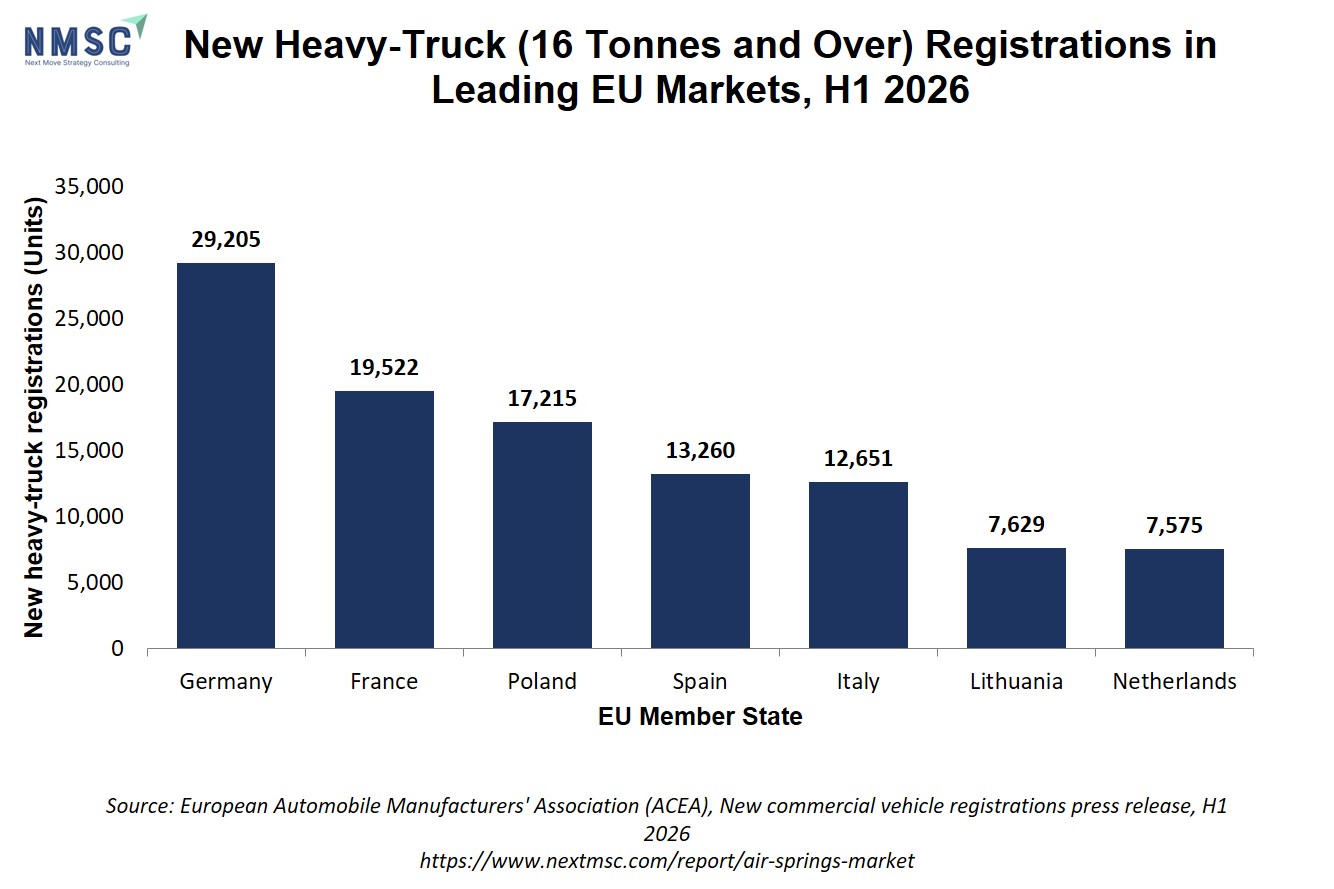
The chart shows the seven EU Member States with the highest new heavy-truck registrations in the first half of 2026, as published by ACEA. Germany recorded 29,205 units, France 19,522, Poland 17,215, Spain 13,260 and Italy 12,651, while Lithuania recorded 7,629 and the Netherlands 7,575. Registrations are actual first-half figures covering vehicles of 16 tonnes and over.
Heavy trucks are where air suspension specifications are most demanding, because axle loads and tyre wear costs scale with gross weight, so a recovery concentrated above 16 tonnes lifts original-equipment air spring demand more than a medium-truck recovery would. The country spread in the ACEA data, with Germany, France, Poland, Spain and Italy each above 12,000 heavy-truck registrations, shows that the recovery is not confined to a single national market, which reduces the exposure of suspension suppliers to one customer base.
Supplier Evidence: SAF-HOLLAND Shows Where Suspension Demand Is Recovering
SAF-HOLLAND's November 5, 2026 corporate news gives the most current supplier view. Group sales rose 4.1% to EUR 1,362.3 million in the first nine months of 2026, and third-quarter sales accelerated 9.4% to EUR 456.6 million. Sales to trailer manufacturers rose 9.2% and made up about half of group sales, while sales to truck manufacturers rose 0.9% because the North American truck recovery began only later in the year. Adjusted EBIT rose to EUR 130.3 million and operating free cash flow more than doubled to EUR 123.6 million.
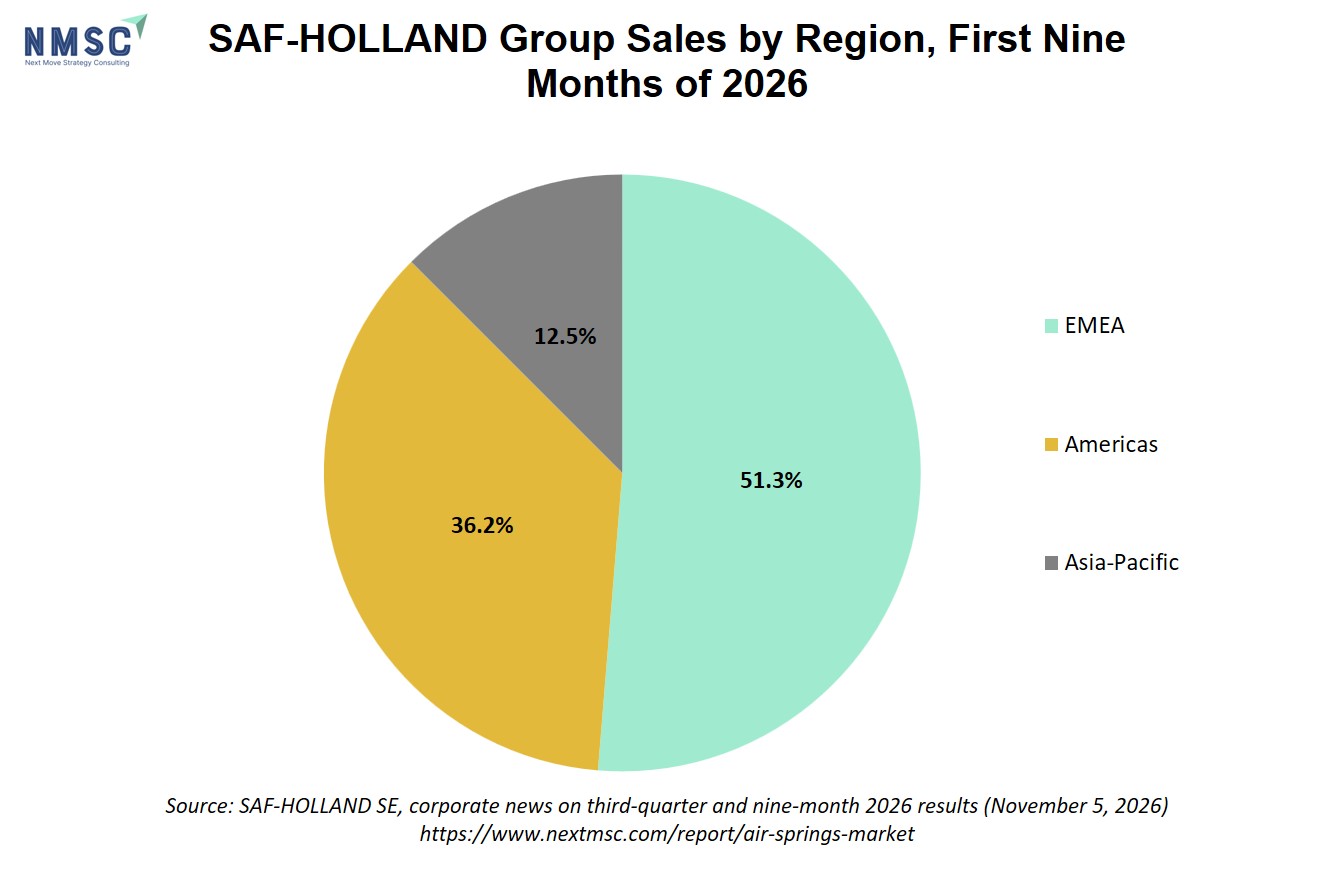
The chart shows each region's share of SAF-HOLLAND's group sales of EUR 1,362.3 million in the first nine months of 2026. Shares are calculated from the regional sales published in the same release, EUR 699.2 million for EMEA, EUR 492.8 million for the Americas and EUR 170.3 million for Asia-Pacific, and are shown to one decimal place. Group sales also include fifth wheels, couplings and brake systems, so the split reflects the full product range rather than air suspension alone.
EMEA sales rose 6.1% to EUR 699.2 million and Asia-Pacific sales rose 14.6%, while Americas sales of EUR 492.8 million were 1.7% below the prior year. SAF-HOLLAND expects 2026 group sales in the upper third of its EUR 1,700 million to EUR 1,850 million range and notes improving North American indicators. The pattern matches the ACEA data: Europe and Asia-Pacific supplied growth through nine months, and North America is the swing region for the fourth quarter.
Air Spring Market Aftermarket: Replacement Cycles and Service Disruption
The aftermarket is the most stable layer of the air spring market because it depends on vehicles in service rather than current production. SAF-HOLLAND reported aftermarket sales of EUR 515.2 million in nine months, against EUR 520.7 million a year earlier, and linked weaker Americas performance partly to the SAP S/4HANA rollout at five production sites, with delayed sales expected largely in the fourth quarter. That is an execution issue rather than a demand issue. BPW's modular repair approach and Hendrickson's shock-absorber-free ZMD air springs lower ownership cost per vehicle, which supports a larger installed base even as revenue per service event falls, consistent with NextMSC's identification of aftermarket replacement as a growth factor.
Section Summary:
Regional cycles diverge, but the installed base keeps expanding, so air spring revenue is supported by several independent demand sources at once.
-
The EPA proposal keeps most emissions benefits, and FTR data show fleets redirecting capital toward trailers after the pre-buy.
-
ACEA data show EU heavy-truck registrations up 11.1% in the first half, led by Poland, Spain and Germany.
-
SAF-HOLLAND shows EMEA and Asia-Pacific growth offsetting a 1.7% Americas decline, with a fourth-quarter aftermarket catch-up expected.
Pros and Cons of Recent Market Developments
The table sets each development against the constraint that accompanies it.
Recent developments in the air spring market: advantages and constraints
|
Pros |
Cons |
|
Ashok Leyland quotes payload advantages of 1.5 tonnes to 4 tonnes and no rear-suspension greasing. |
Marginal increase in initial investment. |
|
Hendrickson reports air suspension on more than 70% of U.S. fleet trailers. |
High penetration shifts growth toward replacement and upgrades. |
|
BPW's ECO Air reached more than 200,000 European trailers with a 5+3-year warranty. |
Modular repair and long warranties reduce service revenue per trailer. |
|
ACEA reports EU heavy-truck registrations up 11.1% in the first half of 2026. |
ACEA describes the rise as a recovery from a low base. |
|
SAF-HOLLAND's third-quarter sales rose 9.4%. |
Americas sales were 1.7% lower over nine months. |
|
Continental's EUR 4.0 billion ContiTech sale sets a valuation reference. |
The deal remains subject to regulatory clearance. |
|
The EPA proposal retains nearly 90% of the 2023 rule's nitrogen oxide reductions. |
October 2026 Class 8 orders fell 36% year over year, per FTR. |
Key Data & Statistics
The tables consolidate the dated developments and NextMSC's forecast values used in this analysis.
Dated developments in the air spring market, July to November 2026
|
Date |
Development |
Key figure |
|
July 1, 2026 |
Ashok Leyland air-suspension truck launch |
1.5 to 4 tonnes payload advantage |
|
July 4, 2026 |
Continental AG sells ContiTech |
EUR 4.0 billion |
|
July 9, 2026 |
U.S. EPA model year 2027 proposal |
Nearly 90% of reductions retained |
|
July 22, 2026 |
BPW ECO Air milestone |
200,000 European trailers |
|
July 29, 2026 |
ACEA first-half registrations |
171,933 EU trucks, up 9.8% |
|
November 4, 2026 |
FreightWaves October Class 8 orders |
15,600 units, down 36% |
|
November 5, 2026 |
SAF-HOLLAND nine-month results |
EUR 1,362.3 million, up 4.1% |
NextMSC forecast snapshot for the air spring market
|
Metric |
Value |
|
Base-year value (2025) |
USD 8.26 billion |
|
Market value (2026) |
USD 8.82 billion |
|
Forecast value (2035) |
USD 13.81 billion |
|
CAGR (2026-2035) |
5.12% |
|
Leading region |
Asia-Pacific |
|
Road vehicles share of demand |
Approximately 68% |
Future Outlook & Forecast: Where the Next USD 4.99 Billion Comes From
NextMSC projects the air spring market to rise from USD 8.82 billion in 2026 to USD 13.81 billion by 2035 at a CAGR of 5.12%, from a 2025 base-year value of USD 8.26 billion. The evidence supports that path through three channels: specification upgrades in emerging truck markets, led by Ashok Leyland's launch and ICRA's low single-digit volume outlook; replacement and weight-saving designs in the mature trailer fleet, as shown by Hendrickson's ULTRAA-K; and the heavy-truck recovery that ACEA documents in Europe and SAF-HOLLAND expects to reach North America more fully in the fourth quarter.
Risks are specific and measurable. FTR's October 2026 data show how quickly North American demand can pause when regulation and equipment costs are uncertain, ACEA attributes part of Europe's gain to a low base, and the ContiTech transition leaves supply relationships under review. NextMSC treats these as timing risks to the annual path rather than threats to the 2035 value, because the installed base of air-suspended vehicles keeps expanding and requires replacement parts.
Section Summary:
The forecast rests on specification upgrades, installed-base replacement and a recovering heavy-truck cycle, with timing risks tied to regulation, a low comparison base and an ownership transition.
-
NextMSC projects growth from USD 8.82 billion in 2026 to USD 13.81 billion by 2035 at a CAGR of 5.12%.
-
India's move to air-suspended heavy trucks raises content per vehicle while unit growth stays in low single digits.
-
North American order volatility and the ContiTech closing are the main timing risks through 2027.
Four indicators will confirm or challenge this path over the next twelve months. The first is the final form of the EPA rule, which determines whether North American tractor orders recover after the October 2026 pause. The second is the ContiTech closing, which Continental expects to complete after regulatory clearance. The third is SAF-HOLLAND's fourth-quarter aftermarket sales, which will show whether the SAP-related delay was a timing effect. The fourth is the uptake of Ashok Leyland's air-suspension range, which will show whether Indian fleets accept the payload and maintenance case.
Next Steps for Stakeholders
-
Truck and trailer manufacturers: review air spring supply agreements with ContiTech before the Lone Star closing, qualify a second source for high-volume part numbers, and test Ashok Leyland's payload and maintenance claims against local duty cycles before specifying air suspension on new heavy-truck platforms.
-
Fleet operators: compare total cost of ownership on weight, service interval and warranty, using Hendrickson's 100-pound slider saving and BPW's 5+3-year warranty as reference points, and time trailer purchases against the pause in North American tractor orders.
-
Component suppliers: prioritise Asia-Pacific and Eastern European capacity, where SAF-HOLLAND and ACEA data show the fastest growth, and build aftermarket programmes around modular components.
-
Investors: use the EUR 4.0 billion ContiTech price as a valuation reference, track SAF-HOLLAND's fourth-quarter aftermarket catch-up, and monitor ACEA and FTR data to confirm the heavy-truck recovery is spreading beyond Europe.
Conclusion
The air spring market entered the second half of 2026 with a clear set of dated signals: Ashok Leyland's air-suspension trucks in India, Continental's EUR 4.0 billion ContiTech sale, trailer air suspension that is standard in the United States and increasingly modular in Europe, and a heavy-truck recovery documented by ACEA and SAF-HOLLAND. NextMSC projects the market to reach USD 13.81 billion by 2035, and the 2026 evidence shows the increment will come from specification upgrades, replacement demand and production recovery working together. Stakeholders who track those three channels with named, dated sources will be better positioned than those who rely on volume forecasts alone, and the air spring market rewards that discipline because its revenue is spread across vehicles, regions and the installed base.
About the Author
 Priyanshu Das
— Priyanshu Das is SEO Executive at Next Move Strategy Consulting, where he has led on-page and off-page SEO, keyword research, and SEO audits for the firm's B2B market research publications for 2 years. His audit process combines technical crawl analysis, backlink profile review, and competitor keyword gap mapping — using tools including Screaming Frog and Google Search Console — to prioritize fixes by organic search-visibility impact, informed by his own prior in-house and agency SEO experience.
About the Reviewer
 Sanyukta Deb
— Sanyukta Deb is Digital Marketing Team Lead at Next Move Strategy Consulting, where she has led content strategy and technical SEO for the firm's B2B market research publications for over 2 years. Her editorial process translates NextMSC's primary and secondary research — spanning technology, industrial, and consumer sectors — into commercial narratives, backed by search-intent, keyword, and competitive analysis. She brings 5 years of overall experience in digital marketing and content strategy.














Add Comment