Advanced Healthcare Technology: How Surgical Robots Face Rivals | NextMSC

Introduction
On November 17, 2026, Medtronic announced that the U.S. Food and Drug Administration had cleared its Hugo robotic-assisted surgery system for general surgery, a category the company estimates covers about 3.5 million U.S. operations each year. The clearance arrived four months after Johnson & Johnson won De Novo authorization for its OTTAVA system, so a hospital buying a soft tissue robot in the United States now has several credible platforms to compare. Competition inside the operating room is only one part of a wider reset in the advanced healthcare technology market, where AI documentation tools, virtual care platforms and diagnostic imaging suppliers are all changing how hospitals allocate capital and software budgets.
According to Next Move Strategy Consulting's Advanced Healthcare Technology Market report, the industry spans artificial intelligence and machine learning, telemedicine and telehealth, robotic surgery, wearable health technology and 3D printing. The analysis covers 28 countries and 15 profiled companies across a 2025 to 2030 forecast period. NextMSC primary research and analysis identifies an ageing population, rising healthcare infrastructure investment and faster network connectivity as the structural demand drivers, with high initial cost as the main restraint. This blog tests those drivers against the latest evidence from company filings, regulators and the World Health Organization.
For More Information: Download FREE Sample on Advanced Healthcare Technology Market Report
Robots, Algorithms and Virtual Care: A Quarter That Reset Hospital Technology Priorities
Medtronic Hugo: General Surgery Clearance on November 17, 2026
Medtronic's announcement covers upper abdominal operations as well as lower abdominal procedures such as inguinal hernia repair and appendectomy. MD+DI reported that the company estimates these procedures represent about 3.5 million U.S. surgeries each year. Hugo first received U.S. clearance for urologic procedures in December 2025, so the new 510(k) lets a hospital run one robotic platform across two high-volume service lines instead of buying a separate system for each.
Medtronic stated that Hugo procedure growth worldwide is running at more than two times the robotic surgery market and is on track to surpass 50,000 procedures by the end of its fiscal year. The company also announced on September 16, 2026 a U.S. clearance for the LigaSure RAS Maryland instrument, which brings vessel-sealing technology already used in more than 45 million open and laparoscopic procedures into the robotic setting. For surgeons trained on that instrument, familiar tools shorten the learning curve that has historically slowed adoption of a new platform. Dr. Francesco Bianco, a surgeon at UI Health and professor of surgery at the University of Illinois College of Medicine, said in Medtronic's November 17, 2026 announcement that expanding robotic capabilities with Hugo gives his health system additional treatment options to offer.
Johnson & Johnson's OTTAVA and Stryker's Versius Agreement Widen the Field
Medtronic is not alone. On July 22, 2026, Johnson & Johnson announced U.S. De Novo authorization for its OTTAVA robotic surgical system, which the company describes as the world's first table-integrated soft tissue robotic system. The authorized indications span general surgery procedures such as cholecystectomy and hiatal hernia repair. Johnson & Johnson will begin with a limited group of U.S. customers while it pursues additional indications. "We are pioneering a new category of surgical robotics with OTTAVA," said Tim Schmid, Executive Vice President and Worldwide Chairman, MedTech at Johnson & Johnson, in the July 22, 2026 announcement.
MD+DI reported in October 2026 that Stryker had agreed the previous month to distribute CMR Surgical's Versius soft tissue robotic system in the U.S. market. Taken together, three of the largest U.S. medical device companies now field or distribute a soft tissue robot, which ends a period of more than two decades in which Intuitive Surgical's da Vinci, introduced in 2000, defined the category. Hospitals gain bargaining leverage because a credible alternative now exists for every robotic procedure line they run.
Intuitive Surgical's Third Quarter Sets the Benchmark for Advanced Healthcare Technology
The incumbent's numbers show the demand that challengers are chasing. On October 20, 2026, Intuitive Surgical reported third quarter revenue of USD 3.05 billion, up 22% from USD 2.51 billion a year earlier. About 906,000 da Vinci procedures were performed in the quarter, 14% more than the 797,000 recorded in the third quarter of 2025, while Ion procedures grew 31% to about 49,700. The company placed 546 da Vinci systems, including 315 da Vinci 5 units, and ended the quarter with an installed base of 12,094 systems, 12% higher than a year before.
Intuitive Surgical also changed its pricing posture. According to its earnings release, pricing actions will reduce da Vinci instruments and accessories revenue per procedure by 3% to 5% at constant mix once fully implemented, with China reductions starting in the fourth quarter of 2026 and other actions beginning in the first half of 2027. Management said on the October 20, 2026 earnings call that the cuts target high-volume benign procedures where cost can limit access.
Geography shows where the next volume sits. U.S. da Vinci procedure growth was 10% in the quarter and growth outside the United States was 20%, Intuitive Surgical's management said on the same call, and India recorded 42% procedure growth while passing 200,000 cumulative da Vinci procedures.
Oracle Health, GE HealthCare and Teladoc Health: Software, Imaging and Virtual Care
Software is absorbing clinical labor as quickly as robots absorb surgical steps. On September 14, 2026, Oracle Health announced U.S. availability of its Clinical AI Agent for nurses inside the Oracle Health Foundation EHR for inpatient care, adding voice-driven chart navigation, AI-generated acute nursing summaries and voice-enabled discrete charting. Oracle Health stated that the agent's clinical note capabilities have saved physicians more than 400,000 hours across U.S. health organizations since launching nearly two years ago. "Nurses are the heart of patient care," said Seema Verma, Executive Vice President and General Manager, Oracle Health and Life Sciences, in the September 14, 2026 announcement, which named BayCare Health System as an early adopter.
GE HealthCare shows how imaging suppliers convert installed equipment into recurring demand. For the quarter ended September 30, 2026, GE HealthCare reported revenue of USD 5.5 billion, up 7.2%, organic orders growth of 4.0%, a backlog of USD 23.7 billion and an adjusted EBIT margin of 16.6%, up 180 basis points, and it raised full-year guidance. Pharmaceutical Diagnostics grew 13% to USD 846 million. In October 2026 the company also announced a USD 945 million cash agreement to acquire SOFIE Biosciences, expected to close in the first half of 2027, to build its PET radiopharmaceutical supply footprint in the United States.
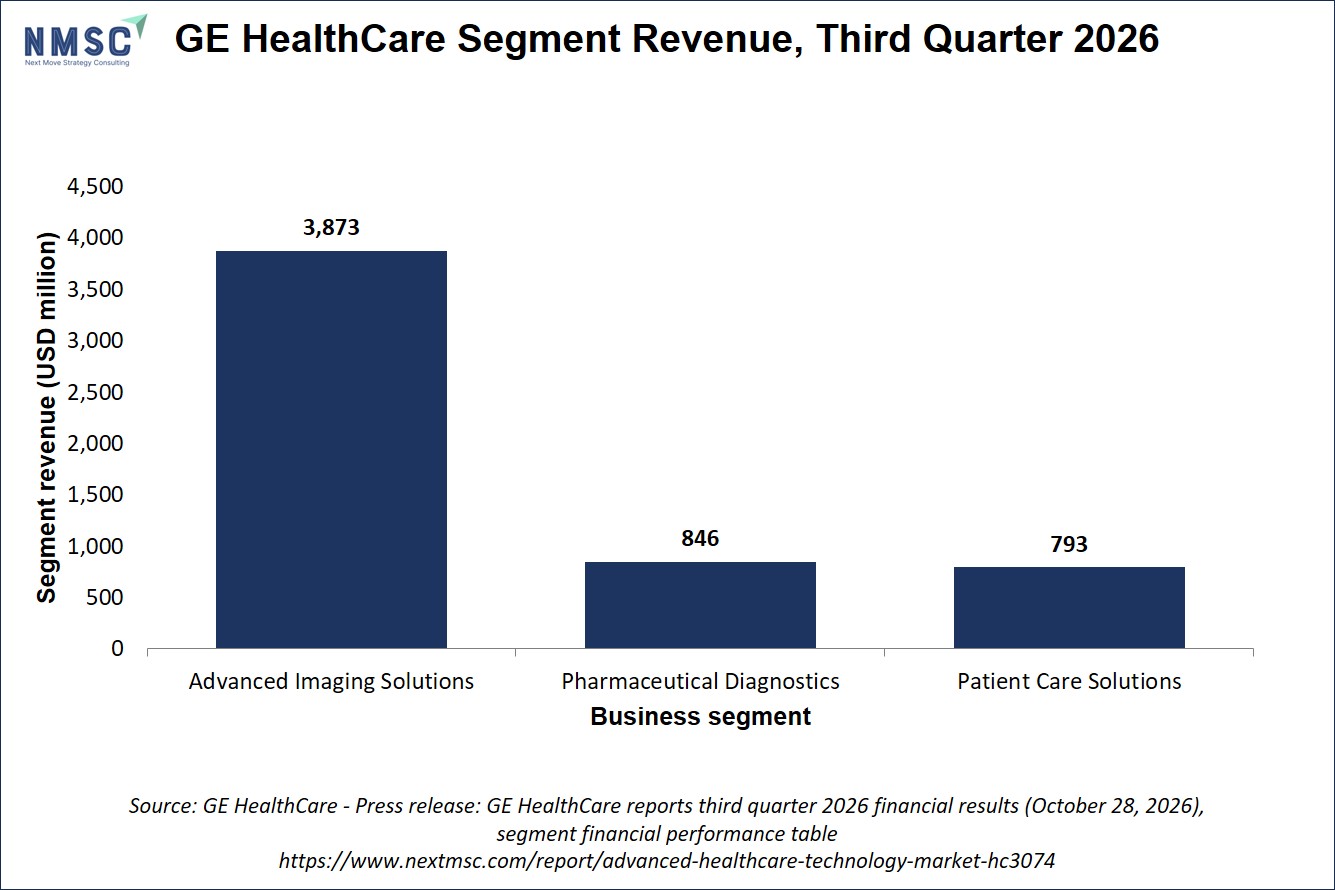
GE HealthCare's October 28, 2026 results release reports third quarter 2026 segment revenues of USD 3,873 million for Advanced Imaging Solutions, USD 846 million for Pharmaceutical Diagnostics and USD 793 million for Patient Care Solutions. The release shows year-on-year revenue growth of 6.1%, 13.0% and 8.5% for the three segments respectively.
Virtual care is consolidating around insurance-backed demand. Teladoc Health reported third quarter 2026 revenue of USD 605.1 million, down 3%, with Integrated Care revenue up 2% to USD 398.5 million and BetterHelp revenue down 13% to USD 206.6 million, while adjusted EBITDA rose 14% to USD 79.4 million. Fierce Healthcare reported that executives said 36% of acquired U.S. users in the quarter came through insurance, about 8 percentage points more than in the second quarter. Revenue is shrinking where consumers pay directly and holding where payers and employers contract, which explains why Teladoc Health is steering clients toward the Teladoc One model that launched in July 2026.
NMSC Strategic Perspective: Why Competition Is Widening the Advanced Healthcare Technology Market
NextMSC primary research and analysis reads these events as a shift from product scarcity to platform choice. The Advanced Healthcare Technology Market report names ageing populations, healthcare infrastructure investment and connectivity as demand drivers and the rising use of robotics in surgery as the leading future opportunity. The 2026 clearances validate that opportunity from the supply side: with Medtronic, Johnson & Johnson and Stryker entering a field that Intuitive Surgical dominated, the buyer's question changes from whether to adopt a surgical robot to which cost-per-procedure model suits a given service line.
The economics point the same way. In its third quarter, Intuitive Surgical earned USD 1.80 billion from instruments and accessories against USD 769 million from systems, so recurring procedure revenue, not capital equipment sales, is where the profit pool sits and where price competition will land first. The announced 3% to 5% cut in revenue per procedure is the incumbent's response to that exposure. NextMSC regional analysis identifies Asia-Pacific as the fastest-growing region, and Intuitive Surgical's 42% procedure growth in India is consistent with that view, while North America retains the largest base because of higher healthcare spending.
For technology suppliers outside surgery, the implication is that workflow ownership matters more than device novelty. Oracle Health's nursing agent, GE HealthCare's operations software and Teladoc Health's bundled model each try to sit inside a daily clinical workflow, because a tool embedded in the workflow is renewed with the contract while a standalone tool is cut in the next budget review. NextMSC therefore expects the competitive map of the advanced healthcare technology market to be drawn by integration depth rather than by single-product launches.
Section Summary:
Three developments define the quarter: a multi-vendor soft tissue robotics field, price action by the incumbent, and AI moving into nursing and operations workflows.
-
Medtronic's Hugo (November 17, 2026) and Johnson & Johnson's OTTAVA (July 22, 2026) gave U.S. hospitals alternatives to da Vinci in general surgery.
-
Intuitive Surgical will cut da Vinci instruments and accessories revenue per procedure by 3% to 5% at constant mix as pricing actions are fully implemented.
-
Oracle Health reports more than 400,000 physician hours saved and now extends its Clinical AI Agent to inpatient nurses.
Industry Impact Analysis
Regulation: FDA Oversight of AI Devices and the World Health Organization Strategy
Regulators are writing the rules under which these products will operate. The U.S. Food and Drug Administration maintains a public list of AI-enabled medical devices, last updated on September 4, 2026, with the most recent authorization decision dated June 29, 2026. The agency states that the list is not a comprehensive resource of AI-enabled devices, but it remains the clearest public record of which products have cleared review.
At the international level, the World Health Organization is drafting the Global Strategy on Digital Health 2028-2033 after the World Health Assembly requested it in May 2025. At a Member States information session on July 24, 2026, the World Health Organization's Data, Digital Health, Analytics and AI department reported that many Member States operate fragmented, parallel digital systems and lack interoperability architecture. The online consultation ran until September 1, 2026, and the draft is scheduled to reach the 160th Executive Board, which meets from January 25 to February 2, 2027, before submission to the 80th World Health Assembly.
Hospital Economics: Pricing, Tariffs and Workforce Capacity
Hospital budgets are being shaped by three forces visible in this quarter's filings. First, price: Intuitive Surgical's per-procedure cut lowers the marginal cost of choosing robotics for benign procedures, which widens the eligible case pool. Second, trade policy: Intuitive Surgical booked a USD 22 million after-tax benefit from refunds of tariffs paid under the International Emergency Economic Powers Act, and GE HealthCare recorded a USD 55 million tariff refund, which lifted cash flow for both suppliers. Third, labor: Oracle Health's documentation agents target clinician hours, which hospitals count as capacity, rather than software licences, which they count as cost.
Section Summary:
Regulation, pricing and labor constraints are steering hospital budgets toward technologies with measurable throughput or time savings.
The U.S. Food and Drug Administration's AI device list records decisions through June 29, 2026, and the agency warns that the list is not exhaustive.
The World Health Organization's 2028-2033 digital health strategy centres on interoperability across fragmented national systems.
Tariff refunds at Intuitive Surgical and GE HealthCare lifted supplier cash flow in the third quarter.
Pros and Cons of Recent Market Developments
|
Pros |
Cons |
|
Medtronic's Hugo clearance (November 17, 2026) gives U.S. hospitals a second major platform across urology and general surgery. |
Hospitals running more than one robotic platform face duplicated training, instruments and service contracts. |
|
Intuitive Surgical's 3% to 5% cut in revenue per procedure lowers the cost of robotic surgery for benign procedures. |
Intuitive Surgical expects instruments and accessories revenue per procedure to fall, so its growth must come from volume. |
|
Oracle Health's Clinical AI Agent has saved physicians more than 400,000 hours, and the nursing release extends that gain to inpatient wards. |
Voice and AI documentation depends on EHR integration, which smaller providers may be unable to afford. |
|
GE HealthCare's USD 23.7 billion backlog gives imaging suppliers multi-quarter revenue visibility. |
The USD 945 million SOFIE Biosciences deal adds regulatory approval and integration risk before its expected first-half 2027 close. |
|
Teladoc Health's insurance-covered services are converting demand into revenue, with 36% of acquired U.S. users coming through insurance. |
BetterHelp revenue fell 13%, which shows that direct-pay virtual care is shrinking. |
|
The World Health Organization's consultation on the 2028-2033 strategy points toward common interoperability expectations. |
Fragmented, parallel national systems persist, and the new strategy will not take effect before 2028. |
Key Data & Statistics
Intuitive Surgical: Third Quarter 2026 Versus Third Quarter 2025
|
Indicator |
Q3 2026 |
Q3 2025 |
Change |
|
da Vinci procedures |
About 906,000 |
About 797,000 |
+14% |
|
Ion procedures |
About 49,700 |
About 37,900 |
+31% |
|
da Vinci systems placed |
546 |
427 |
+28% |
|
da Vinci installed base |
12,094 |
10,763 |
+12% |
|
Revenue |
USD 3.05 billion |
USD 2.51 billion |
+22% |
Milestones in Robotic Surgery and Digital Health, July to November 2026
|
Date |
Organisation |
Milestone |
|
July 22, 2026 |
Johnson & Johnson |
De Novo authorization of the OTTAVA robotic surgical system for general surgery |
|
September 14, 2026 |
Oracle Health |
U.S. availability of the Clinical AI Agent for inpatient nurses |
|
September 16, 2026 |
Medtronic |
U.S. clearance of the LigaSure RAS Maryland instrument for the Hugo system |
|
October 2026 |
GE HealthCare |
USD 945 million cash agreement to acquire SOFIE Biosciences |
|
October 20, 2026 |
Intuitive Surgical |
Third quarter results and 3% to 5% per-procedure pricing action |
|
November 17, 2026 |
Medtronic |
U.S. clearance of the Hugo system for general surgery |
Third Quarter 2026 Results Across Three Care-Technology Providers
|
Company |
Revenue |
Year-on-year change |
Highlight |
|
Intuitive Surgical |
USD 3.05 billion |
+22% |
546 da Vinci systems placed |
|
GE HealthCare |
USD 5.5 billion |
+7.2% |
Backlog of USD 23.7 billion |
|
Teladoc Health |
USD 605.1 million |
-3% |
Adjusted EBITDA up 14% to USD 79.4 million |
Future Outlook & Forecast
Three Structural Forces Behind the Advanced Healthcare Technology Market Through 2030
NextMSC's forecast period for the advanced healthcare technology market runs from 2025 to 2030, and the evidence gathered here points to three structural forces across that window.
1. A multi-vendor robotics field. Intuitive Surgical guides to da Vinci procedure growth of 14% to 15% in 2026, closer to the midpoint, while Medtronic expects Hugo to surpass 50,000 procedures by the end of its fiscal year. Two platforms growing in parallel means the category expands through new hospitals and new procedure types rather than through share transfer alone, and international da Vinci growth of 20% shows how much unserved demand exists outside the United States.
2. AI embedded in clinical workflow. Oracle Health moved from physician notes to automated coding, dictation and chart review, announced on August 19, 2026, and then to inpatient nursing on September 14, 2026. That cadence shows a product roadmap that adds a new clinical workflow every few weeks.
3. Capital moving toward recurring and payer-backed revenue. Intuitive Surgical's USD 1.80 billion of quarterly instruments and accessories revenue, Teladoc Health's insurance pivot and GE HealthCare's Pharmaceutical Diagnostics unit all point the same way. Spending is moving toward revenue that repeats with each procedure, scan or covered visit.
Regional Outlook: North America's Scale, Asia-Pacific's Pace
NextMSC regional analysis identifies North America as the largest region because of higher healthcare spending in the United States and Canada, and Asia-Pacific as the fastest-growing region because ageing populations in countries such as Japan raise the need for continuous health monitoring. Intuitive Surgical's 42% procedure growth in India is an early commercial signal for the Asia-Pacific view, while the U.S. regulatory pipeline for Hugo, OTTAVA and Versius defines the North American contest.
Section Summary:
The evidence supports a forecast period defined by competition in robotics, AI inside daily workflows and spending that follows recurring revenue.
-
Intuitive Surgical guides to 14% to 15% da Vinci procedure growth in 2026, while Medtronic targets more than 50,000 Hugo procedures by the end of its fiscal year.
-
Oracle Health added coding, dictation, chart review and nursing workflows within about a month of each other in August and September 2026.
-
NextMSC regional analysis points to North America for scale and Asia-Pacific for the fastest growth.
Next Steps for Stakeholders
For C-Level Executives and Health System Leaders
-
Re-open robotic surgery procurement. With several U.S. vendors now authorized or distributing soft tissue systems, request per-procedure pricing rather than system pricing, and model instruments and accessories cost against Intuitive Surgical's announced 3% to 5% reduction before signing a multi-year agreement.
-
Measure AI by hours returned. Oracle Health's 400,000 physician hours is a vendor-reported figure, so require a baseline and quarterly hours-saved reporting from any documentation agent, and extend pilots to nursing workflows where the first deployments are now available.
-
Write interoperability into contracts. The World Health Organization's 2028-2033 strategy process centres on interoperability architecture, so contract language should require standards-based data exchange from every new platform.
For Institutional Investors
-
Track recurring revenue, not placements. Intuitive Surgical's 546 placements are a leading indicator, but USD 1.80 billion of quarterly instruments and accessories revenue is what its price actions will test first, so compare procedure growth with the 14% to 15% full-year guidance.
-
Watch conversion in virtual care. Teladoc Health's fourth quarter revenue guidance of USD 569 million to USD 615 million will show whether insurance-covered BetterHelp volume can offset the 13% decline in direct-pay revenue.
Conclusion
The advanced healthcare technology market is being rebuilt around platform choice and workflow ownership. Within four months, Johnson & Johnson, Medtronic and Stryker entered soft tissue robotics, Intuitive Surgical answered with per-procedure price cuts, Oracle Health extended AI documentation from physicians to nurses, and GE HealthCare and Teladoc Health reshaped imaging supply and virtual care around recurring, payer-backed revenue.
NextMSC primary research and analysis frames the 2025 to 2030 forecast period as one in which robotic surgery, AI and telehealth segments compete on integration depth and cost per outcome rather than on novelty. Executives who benchmark vendors on those two measures, and investors who track recurring revenue and regulatory milestones, will be best placed as the World Health Organization's 2028-2033 digital health strategy moves toward adoption.
About the Author
 Priyanshu Das
— Priyanshu Das is SEO Executive at Next Move Strategy Consulting, where he has led on-page and off-page SEO, keyword research, and SEO audits for the firm's B2B market research publications for 2 years. His audit process combines technical crawl analysis, backlink profile review, and competitor keyword gap mapping — using tools including Screaming Frog and Google Search Console — to prioritize fixes by organic search-visibility impact, informed by his own prior in-house and agency SEO experience.
About the Reviewer
 Sanyukta Deb
— Sanyukta Deb is Digital Marketing Team Lead at Next Move Strategy Consulting, where she has led content strategy and technical SEO for the firm's B2B market research publications for over 2 years. Her editorial process translates NextMSC's primary and secondary research — spanning technology, industrial, and consumer sectors — into commercial narratives, backed by search-intent, keyword, and competitive analysis. She brings 5 years of overall experience in digital marketing and content strategy.
















Add Comment