Advanced Swarm Intelligence Market: Why Software Now Leads Swarms | NextMSC
Introduction
On October 6, 2026, Defence Industry Europe reported that the U.S. Department of War had narrowed its Swarm Forge drone program from more than 130 competing companies to approximately 25 key industry partners. The department said continuous field testing keeps only the most resilient, platform-agnostic and capable systems. Field events in June and September tested whether software could orchestrate air and ground systems under electronic warfare interference while human operators stayed on-the-loop. That test shows where value now accrues in the advanced swarm intelligence market: in the coordination layer rather than in any single vehicle.
According to Next Move Strategy Consulting's Advanced Swarm Intelligence Market report, the global advanced swarm intelligence market was valued at USD 39.6 million in 2023 and is projected to reach USD 524.3 million by 2030, growing at a CAGR of 45.8% from 2024 to 2030. Against the 2023 base, that implies a 13.2-fold expansion in seven years, which is arithmetic on NextMSC's own figures and not a separate forecast.
For More Information: Download FREE Sample on Advanced Swarm Intelligence Market Report
Swarm Forge Cuts Its Field to 25 Firms: Why Coordination Software Is the Scarce Asset
Swarm Forge: A 90-Day Path From Field Test to Operational Unit
Swarm Forge began in January 2026 as the Department of War's Pace-Setting Project #1 and runs under the Direct Reporting Portfolio Manager for Unmanned Systems, with the Chief Digital and Artificial Intelligence Office leading the effort alongside U.S. Army Special Operations Command, Defence Industry Europe reported on October 6, 2026. The department says commercial companies compete and integrate alongside Special Operations Forces operators, compressing acquisition into a 90-day zero-to-deployment pipeline.
The quarterly field events, called Crucibles, show the technical bar. The second Crucible, held in June, validated the program's primary objectives when an advanced battle manager orchestrated air and ground systems while human operators remained on-the-loop. The third, held in September at Fort Bragg, North Carolina, added electronic warfare interference, night operations and complex terrain. A fourth Crucible is scheduled for late January 2027 at Camp Lejeune, North Carolina, by which point the department expects to validate finalized swarm packages for operational units.
A selection standard built on platform-agnostic capability favors vendors whose algorithms run across many airframes, the position that routing, clustering, scheduling and optimization capabilities occupy in NextMSC's segmentation. The department also said Crucible data supplies real-world drone behavior for simulations, which turns every field test into training material for coordination software.
Drone Dominance Gauntlet II: 60,000 Orders Reward Production and Resilience
Soldier Systems Daily reported on September 25, 2026 that the Drone Dominance Program ran its Qualifier from June 8 to 19, 2026 at Camp Grayling, Michigan, where 49 drone companies competed across two mission areas: Long Range Strike and Tactical Assault in Confined Environments. Gauntlet II followed in August 2026 at Fort Carson, Colorado, testing find-fix-finish missions at 15 kilometer stand-off ranges or in confined environments, with extra lanes for electronic warfare performance against counter-UAS systems.
To qualify for Gauntlet II, each invited company had to deliver an order of 120 drones with lethality payloads within about five weeks. Scoring combined event performance, military operator evaluations and demonstrated production and supply chain capability. The program selected the top five performers in each mission area and will place orders for 60,000 drones, with quantities set at contract award. Drone Dominance buys airframes, yet its weight on electronic warfare resilience points to the same autonomy stack that Swarm Forge tests.
Shield AI and LUCAS: Swarm Autonomy Reaches Low-Cost One-Way Attack Drones
On May 19, 2026, Shield AI announced that the Office of the Under Secretary of War for Research and Engineering had selected it to integrate its Hivemind autonomy software onto the Low-Cost Uncrewed Combat Attack System, known as LUCAS. Hivemind serves as the AI pilot, letting groups of drones coordinate and adapt in real time based on warfighter input, according to Shield AI's press release. DefenseScoop reported on May 20, 2026 that LUCAS is a one-way attack drone the U.S. military cloned from an Iranian variant, according to the company.
A low-cost airframe is cheap to replace, but the coordination software that lets many airframes act as one is reused on every unit. In NextMSC's assessment, that reuse is the mechanism behind the market's steep growth rate: each platform that adopts a swarm stack extends an existing software base.
Swarmer's SkyKnight Program: Early Revenue Evidence for a Software-Only Model
Swarmer, Inc. (Nasdaq: SWMR), a drone autonomy software company that reports more than 100,000 real-world combat missions in Ukraine since April 2024, published second quarter 2026 results on August 13, 2026. The company expanded its SkyKnight software licensing program, lifting total contracted license value from USD 2.9 million to USD 3.9 million; upgrade options, if fully exercised, would lift the maximum to approximately USD 14.2 million. Quarterly revenue was USD 216,413 against USD 138,206 a year earlier, while the net loss widened to USD 7.3 million.
Swarmer invoiced USD 1.5 million under SkyKnight in the quarter and collected USD 1.4 million, yet recognized only USD 0.2 million as revenue, with the rest recorded as deferred revenue or an advance. It also partnered with Oak Grove Technologies to integrate its software into the Chimera UAV platform and with Lantronix on an NDAA-compliant compute platform. "We believe the expansion of the SkyKnight program validates both our technology and business model," said Alex Fink, President and U.S. Chief Executive Officer of Swarmer, in the company's second quarter 2026 results release on August 13, 2026.
Unanimous AI and Carnegie Mellon: Human Swarming Outforecasts a Prediction Market
On June 10, 2026, Unanimous AI announced at the 2nd International Conference on Human-AI Interaction and Experience Design in Valencia, Spain a study produced with Carnegie Mellon and published by IEEE. Groups of 25 sports fans using the Thinkscape platform forecast 50 NBA games against the spread over 12 weeks. The swarm was 62% accurate, against 55% for the Polymarket prediction market on the same games, and it needed 25 forecasters in a five-minute interaction, where the market drew thousands of forecasters over 48 hours.
The result gives the human swarming application a measured benchmark, although it rests on a sports-forecasting task and on figures reported by Unanimous AI itself, so it is directional evidence.
NMSC Strategic Perspective: Why Orchestration Software Defines the Advanced Swarm Intelligence Market
NextMSC analysis identifies one structural shift: the unit of competition has moved from the individual drone or robot to the orchestration layer that lets mixed machines act as one system. Swarm Forge rewards platform-agnostic software, the Shield AI selection applies swarm autonomy to the cheapest class of airframe, and Swarmer licenses its software to manufacturers.
NextMSC segments the market by model type, capability type (routing, clustering, scheduling and optimization), organization size, application (human swarming, drones and robotics) and end user. The 2026 evidence concentrates in the drones application and the military and defense end user, while the Unanimous AI study and warehouse robotics point to the human swarming and robotics applications.
The EUR 18.9 billion that EU member states are investing in drone technologies over 2024 to 2029 is far larger than the USD 524.3 million NextMSC projects for 2030, although the measures differ. The forecast covers the intelligence layer, not the airframes, and a small software share of a large fleet can still compound at 45.8% a year.
Section Summary:
Four 2026 developments show where swarm spending is shifting: from individual platforms toward vendor-neutral coordination software.
-
Swarm Forge cut its field from more than 130 companies to approximately 25 on platform-agnostic, field-tested performance.
-
Shield AI's LUCAS selection applies swarm autonomy to low-cost one-way attack drones.
-
Swarmer's contracted SkyKnight license value rose from USD 2.9 million to USD 3.9 million, while recognized revenue lagged invoicing.
-
Unanimous AI and Carnegie Mellon reported 62% forecasting accuracy for a human swarm against 55% for a prediction market.
Industry Impact Analysis
Defence Capital: Production Funding Arrives Before Coordination Software
On November 12, 2026, defense technology company UFORCE said it raised USD 700 million at a USD 6 billion valuation to expand production in Ukraine and add manufacturing capacity abroad, Defence Industry Europe reported. More production raises the number of platforms in service, and Swarmer describes its software as letting one operator control hundreds of autonomous platforms, the efficiency gain larger fleets require.
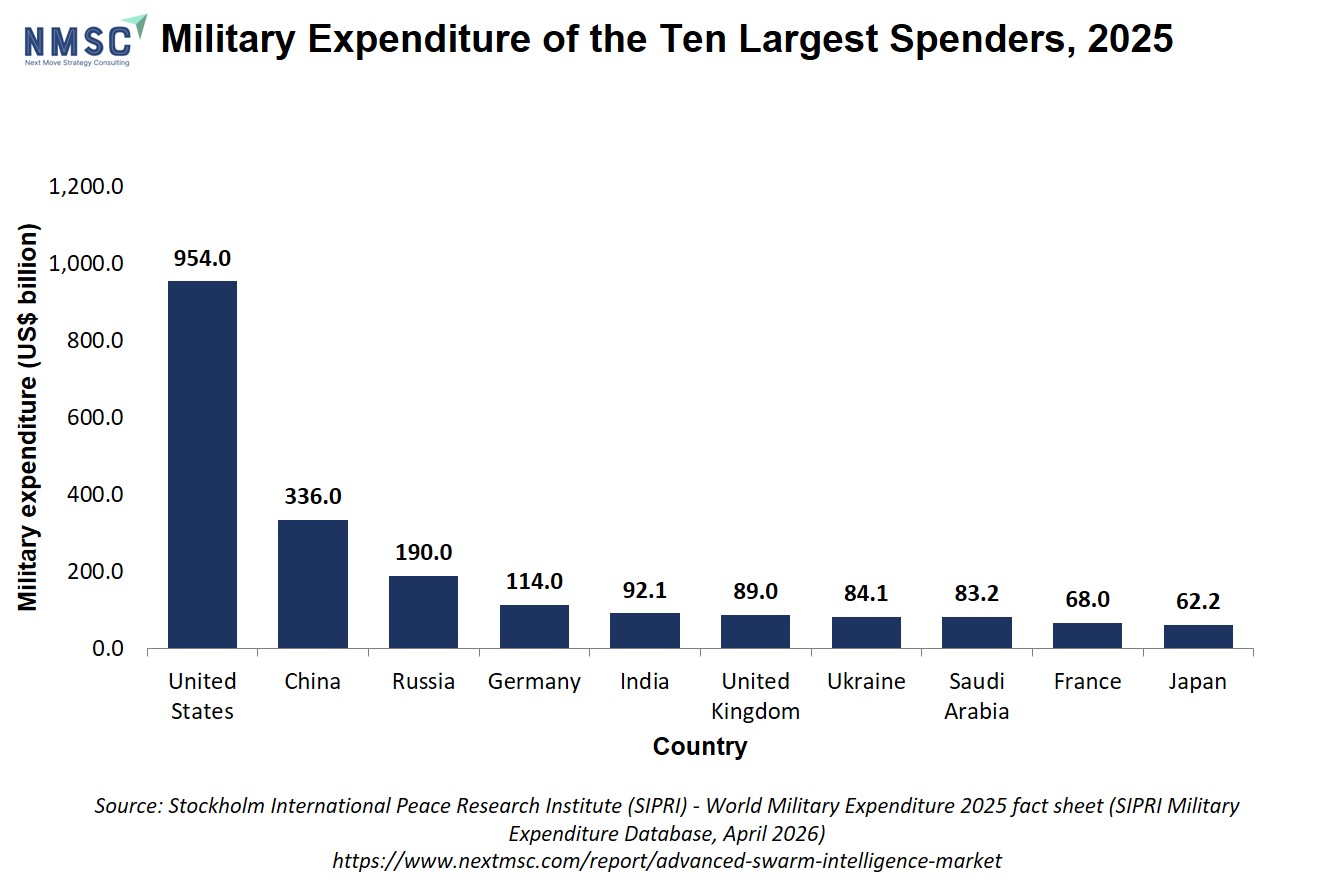
SIPRI's World Military Expenditure 2025 fact sheet, published in April 2026, ranks the United States first at US$954 billion, followed by China at US$336 billion and Russia at US$190 billion. Germany (US$114 billion), India (US$92.1 billion), the United Kingdom (US$89.0 billion), Ukraine (US$84.1 billion), Saudi Arabia (US$83.2 billion), France (US$68.0 billion) and Japan (US$62.2 billion) complete the ten largest spenders. World military expenditure reached US$2887 billion in 2025, the highest level SIPRI has recorded.
NATO and the EU: Procurement Reform Meets a Delivery Gap
The European Defence Agency's 2026 annual defence readiness report, obtained by Euronews and reported on October 8, 2026, found that investment in counter-drone and very short-range air defence capabilities grew sixfold between 2024 and 2025, yet only around one third of programmes are expected to deliver by 2030. EU countries are investing EUR 18.9 billion in drone technologies over 2024 to 2029, the report says, mostly for surveillance, reconnaissance and target acquisition.
The report cites fragmented national procurement, limited interoperability and insufficient industrial surge capacity. For swarm intelligence vendors, interoperability is the commercial opening: a coordination layer that works across national platforms addresses the fragmentation the report describes.
NATO moved on the procurement side. On November 5, 2026, NATO announced that its counter-drone marketplace, launched under the Drone Edge initiative, lets Allies buy counter-drone solutions directly from the NATO catalogue without a further tender process. It lists 16 solutions from five companies, covering static, transportable and on-the-move systems already deployed in Allied countries and in Ukraine. Coordinated attackers must be met by coordinated defenders, so counter-drone demand also raises the bar for swarm software.
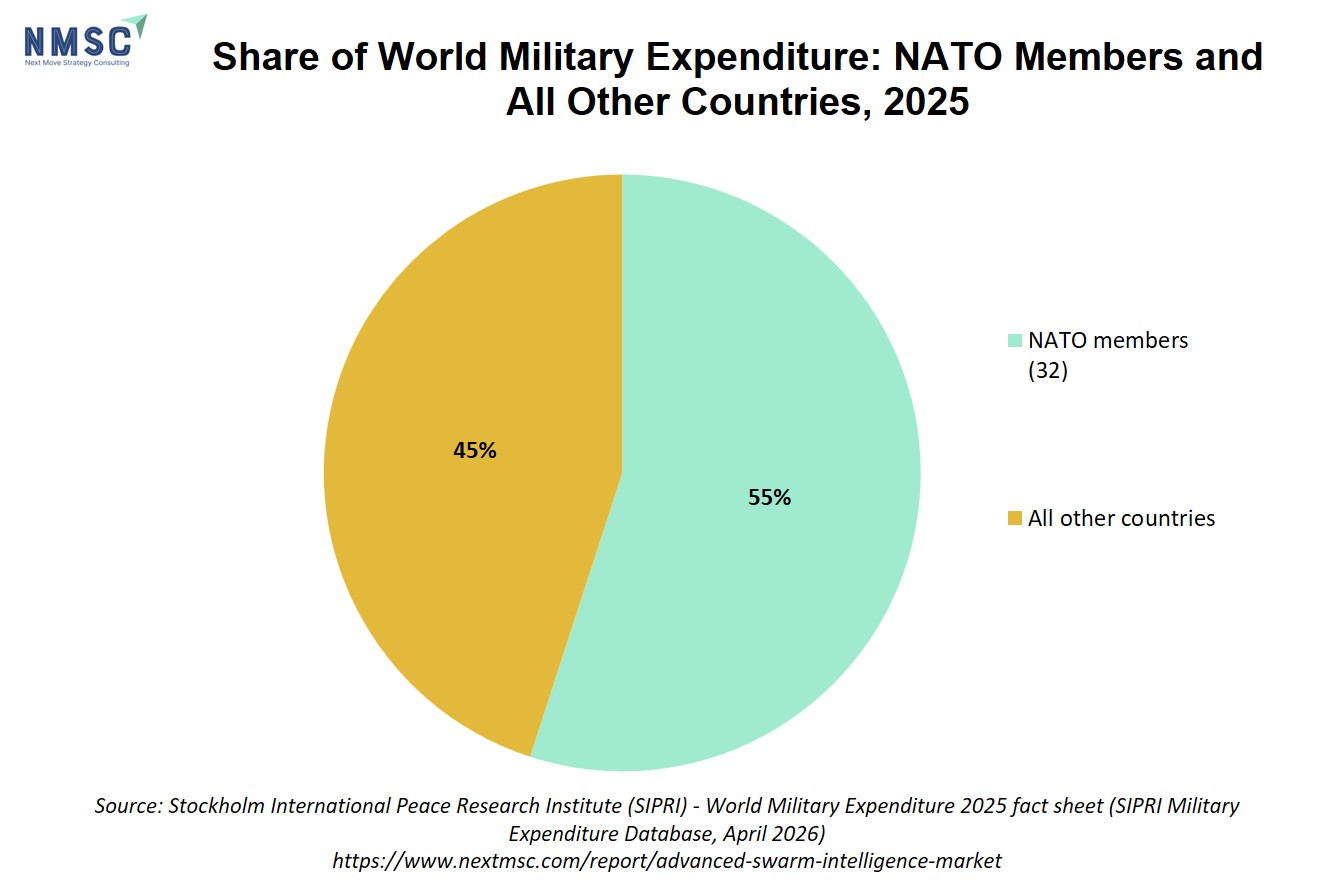
SIPRI reports that the military expenditure of the 32 NATO members amounted to US$1581 billion in 2025, or 55% of spending globally, out of a world total of US$2887 billion. The remaining 45% is spending by all other countries, calculated as 100% minus the published NATO share. SIPRI adds that European NATO members spent US$559 billion in total.
Regulation: A United Nations Text Fixes Human Oversight as the Design Baseline
AFP reported on September 6, 2026 that 128 countries had agreed a text defining lethal autonomous weapons systems, announced by Dutch Foreign Minister Tom Berendsen, as a first step toward talks on a possible international treaty. The International Committee of the Red Cross stated that "the unconstrained development and use of autonomous weapon systems pose serious legal, ethical and humanitarian challenges," in AFP's September 6, 2026 report. UN member states are due to decide at the November talks of the Convention on Certain Conventional Weapons whether to move toward a treaty.
For swarm vendors, the effect is a design requirement. Swarm Forge already specifies human operators on-the-loop, so vendors that document operator authority will meet both doctrine and any later treaty text.
Commercial Robotics: IFR Data Shows Labor Scarcity Pulling Automation Forward
The International Federation of Robotics released World Robotics 2026 on September 24, 2026, reporting that the global operating base of industrial robots has reached five million. China accounted for 59% of global installations in 2025, and the United States installed 38,400 industrial robots, a 12% increase, passing Japan's 36,200 to become the second-largest market. "US robot demand has rebounded very strongly: 2025 ranked as the third strongest year on record behind 2018 and 2022," said Jane Heffner, President of the International Federation of Robotics, in the federation's September 24, 2026 press release, adding that growth came from the food industry and from warehousing, logistics and medical applications.
The federation's presentation lists tight labor markets and AI-enabled adaptive task execution among the forces shaping demand. Its methodology excludes drones and underwater vehicles, so its counts miss the drone segment of swarm demand, yet robot fleets in warehouses and plants create the same routing and scheduling problem that NextMSC's capability segments describe.
Section Summary:
Capital, procurement reform and regulation are shaping swarm adoption, and each favors software that works across platforms and keeps humans in control.
-
UFORCE's USD 700 million round funds production capacity, expanding the base coordination software can serve.
-
Only around one third of EU counter-drone programmes are on track for 2030, with fragmentation as a cause.
-
NATO's Drone Edge marketplace shortens counter-drone purchasing cycles.
-
A United Nations text defining lethal autonomous weapons systems, agreed by 128 countries, makes documented human oversight a baseline design requirement.
Pros and Cons of Recent Market Developments
|
Pros |
Cons |
|
Swarm Forge field tests turn prototypes into validated swarm packages within a 90-day pipeline. |
Only around one third of EU counter-drone programmes are expected to deliver by 2030. |
|
Swarmer's SkyKnight contracted license value rose from USD 2.9 million to USD 3.9 million. |
Swarmer recognized USD 0.2 million of the USD 1.5 million it invoiced in the second quarter. |
|
Drone Dominance orders for 60,000 drones create a large base for coordination software. |
Orders cover airframes, so software revenue depends on separate integration decisions. |
|
A human swarm reached 62% forecasting accuracy against 55% for a prediction market. |
The study used NBA games, and the figures come from the vendor. |
Key Data & Statistics
Key Swarm-Related Events and Quantified Detail, May to November 2026
|
Event |
Date |
Quantified Detail |
|
Shield AI selected for LUCAS Hivemind integration |
May 19, 2026 |
Selected by the Office of the Under Secretary of War for Research and Engineering |
|
Unanimous AI and Carnegie Mellon forecasting study |
June 10, 2026 |
62% accuracy versus 55% for a prediction market across 50 games |
|
Swarmer second quarter 2026 results |
August 13, 2026 |
SkyKnight contracted license value USD 3.9 million; revenue USD 216,413 |
|
Drone Dominance Gauntlet II results |
September 25, 2026 |
Top five performers per mission area; orders for 60,000 drones |
|
United Nations lethal autonomous weapons text |
September 6, 2026 |
128 countries agreed the text |
|
Swarm Forge field narrowed |
October 6, 2026 |
More than 130 companies reduced to approximately 25 |
Procurement, Readiness and Robot Demand Reference Points
|
Indicator |
Value |
Basis |
|
Drones ordered after Gauntlet II |
60,000 |
Soldier Systems Daily, September 25, 2026 |
|
Swarmer combat missions since April 2024 |
More than 100,000 |
Swarmer, August 13, 2026 |
|
EU counter-drone investment growth, 2024 to 2025 |
Sixfold |
Euronews, October 8, 2026 |
|
China share of 2025 industrial robot installations |
59% |
International Federation of Robotics, September 24, 2026 |
|
United States industrial robot installations, 2025 |
38,400 (up 12%) |
International Federation of Robotics, September 24, 2026 |
Future Outlook & Forecast
The Road to USD 524.3 Million: Three Forces Behind the Advanced Swarm Intelligence Market
According to NextMSC primary research and analysis, the global advanced swarm intelligence market is projected to reach USD 524.3 million by 2030, growing at a CAGR of 45.8% from 2024 to 2030. Three forces visible in the 2026 evidence underpin that trajectory.
1. Field-test pipelines convert prototypes into procurement. Swarm Forge's plan to validate finalized swarm packages by late January 2027 and the 60,000-drone Drone Dominance order show defence buyers moving from demonstrations to fielded inventory.
2. Interoperability gaps create demand for vendor-neutral software. The European Defence Agency's findings on fragmentation, together with NATO's Drone Edge marketplace, favor hardware-agnostic coordination software, as Swarmer's integrations with Chimera and Lantronix show.
3. Commercial robotics extends the buyer base beyond defence. Tight labor markets and AI-enabled autonomy shape robot demand, according to the International Federation of Robotics, and fleet coordination is the software requirement that follows as warehouses and plants add robots.
Three risks temper the outlook. A treaty process after the November Convention on Certain Conventional Weapons talks could restrict weapons autonomy. Swarmer's gap between invoiced and recognized revenue shows licensing can convert slowly. The one-third delivery rate in the European Defence Agency report shows budgets alone do not guarantee fielded capability.
Regional View: North America Leads, Asia-Pacific Expands
NextMSC regional analysis identifies North America as the dominant region through the forecast period, supported by military adoption of unmanned vehicles and the presence of swarm technology developers. Asia-Pacific is expected to show steady growth as swarm robots spread through industrial automation in Japan, China and South Korea, and International Federation of Robotics data supports that view on the demand side: China took 59% of 2025 installations.
Section Summary:
NextMSC projects the market to reach USD 524.3 million by 2030 at a 45.8% CAGR, with defence procurement, interoperability and commercial robotics as the main forces.
-
Field-test pipelines such as Swarm Forge shorten the path from algorithm to recurring license.
-
Hardware-agnostic coordination software answers the fragmentation and interoperability gaps the European Defence Agency describes.
-
Warehouse and plant robotics widen the buyer base beyond defence.
-
Treaty talks, slow revenue conversion and delivery gaps are the main risks to the trajectory.
Next Steps for Stakeholders
For C-Level Executives and Technology Leaders
Treat orchestration software as a separate procurement category. Swarm Forge's platform-agnostic standard and Swarmer's manufacturer-facing licenses show that coordination software can be bought, tested and replaced independently of airframes. Require vendors to demonstrate performance under electronic warfare interference with human operators on-the-loop.
Design for human oversight from the start. With 128 countries agreeing a text on lethal autonomous weapons and treaty talks due in November, systems that cannot document operator control will carry regulatory risk in export markets.
Pilot human swarming against an existing forecasting method. The Unanimous AI result is directional, and a pilot with a defined baseline will show whether a five-minute swarm session matches a slower panel process.
For Institutional Investors
Read Swarmer's filings for the conversion of invoices into revenue. In the second quarter, USD 1.5 million was invoiced under SkyKnight while USD 0.2 million was recognized. Cash of USD 25.3 million at June 30, 2026 against a quarterly net loss of USD 7.3 million frames the runway.
Track the fourth Swarm Forge Crucible in late January 2027. The selection of finalized swarm packages is the clearest near-term catalyst for software vendors.
Separate hardware capital from software capital. UFORCE's USD 700 million round funds production, while NextMSC's forecast measures the intelligence layer.
Conclusion
The advanced swarm intelligence market is being defined by a shift in what buyers evaluate. Swarm Forge cut its field to approximately 25 companies on platform-agnostic performance, Shield AI's Hivemind is being integrated onto LUCAS, and Swarmer licenses its software to manufacturers. Each signal moves value from the vehicle to the coordination layer.
According to NextMSC primary research and analysis, the market is projected to reach USD 524.3 million by 2030 at a 45.8% CAGR. Stakeholders who match technology choices to human-oversight rules, vendor-neutral integration and measured revenue conversion are best placed to capture that expansion as field trials become procurement.
About the Author
 Sanyukta Deb
— Sanyukta Deb is Digital Marketing Team Lead at Next Move Strategy Consulting, where she has led content strategy and technical SEO for the firm's B2B market research publications for over 2 years. Her editorial process translates NextMSC's primary and secondary research — spanning technology, industrial, and consumer sectors — into commercial narratives, backed by search-intent, keyword, and competitive analysis. She brings 5 years of overall experience in digital marketing and content strategy.
About the Reviewer
 Debashree Dey
— Debashree Dey is Assistant Manager at Next Move Strategy Consulting, where she supports cross-vertical market content and communications across diverse industries for 6 years. Her professional background includes senior content writing, communications, and published manuscript authorship, with experience developing audience-focused business narratives and maintaining clear, consistent messaging. Her role supports research-led content development and editorial quality across NextMSC publications.

















Add Comment