AI Data Centers and Nuclear Boom Reshape Technical Insulation Market | NextMSC

Introduction
The global technical insulation market stands at a pivotal inflection point, shaped simultaneously by binding regulatory mandates, a historic surge in AI-driven data center construction, and the most aggressive nuclear energy expansion the United States has seen in four decades. According to Next Move Strategy Consulting's Technical Insulation Market report, the global technical insulation market is projected to reach USD 11.82 billion by 2030, growing at a CAGR of 4.0% from 2024 to 2030.
This trajectory is not driven by broad macroeconomic tailwinds alone. It is being shaped by a convergence of highly specific, measurable forces: the European Union's Energy Performance of Buildings Directive (EPBD) requiring member states to reduce average residential primary energy use by 16% by 2030; U.S. data center construction starts reaching USD 25.2 billion in January 2026 alone; and the U.S. Department of Energy's confirmation that four advanced nuclear reactors reached criticality by July 4, 2026 — each of which places direct, quantifiable demand on high-performance insulation systems. For C-level executives and institutional investors, the question is no longer whether the technical insulation market will grow, but which end-use segments and geographies will capture the most durable share of that growth.
For More Information: Download FREE Sample on Technical Insulation Market Report
Electrification, Regulation, and the AI Infrastructure Boom: Three Forces Rewriting Demand for Technical Insulation
Knauf's €120 Million Electric Melting Line Signals a Supply-Side Transformation
On July 28, 2026, Knauf Insulation — part of the Knauf Group, which generated EUR 15.3 billion in sales in 2025 across more than 300 production sites — commissioned a new electric melting line for rock mineral wool at its Novi Marof plant in Croatia, following an investment of more than €120 million. The line uses submerged arc furnace technology powered by electricity from guaranteed renewable sources, reducing CO₂ emissions from the melting process compared with conventional coke-based melting, and enabling the use of up to 50% recycled raw material. The investment adds 60,000 tonnes of annual production capacity and has created 80 additional jobs at the site.
Leon Bustin, Technical Director at Knauf Insulation, stated: "This will add a selection of lower-embodied-carbon rock mineral wool products available to our customers for applications such as flat roofs and sandwich panel boards. These products make a difference for projects where carbon performance is an increasingly important consideration." (Knauf Insulation, July 28, 2026.)
This investment is not an isolated corporate decision. It is a direct response to the EU's EPBD transposition deadline of May 29, 2026, which requires all EU member states to embed minimum energy performance standards into national law. The directive mandates that the 16% worst-performing non-residential buildings be renovated by 2030 and the 26% worst-performing by 2033 — a renovation pipeline that structurally requires mineral wool and other high-performance insulation materials at scale.
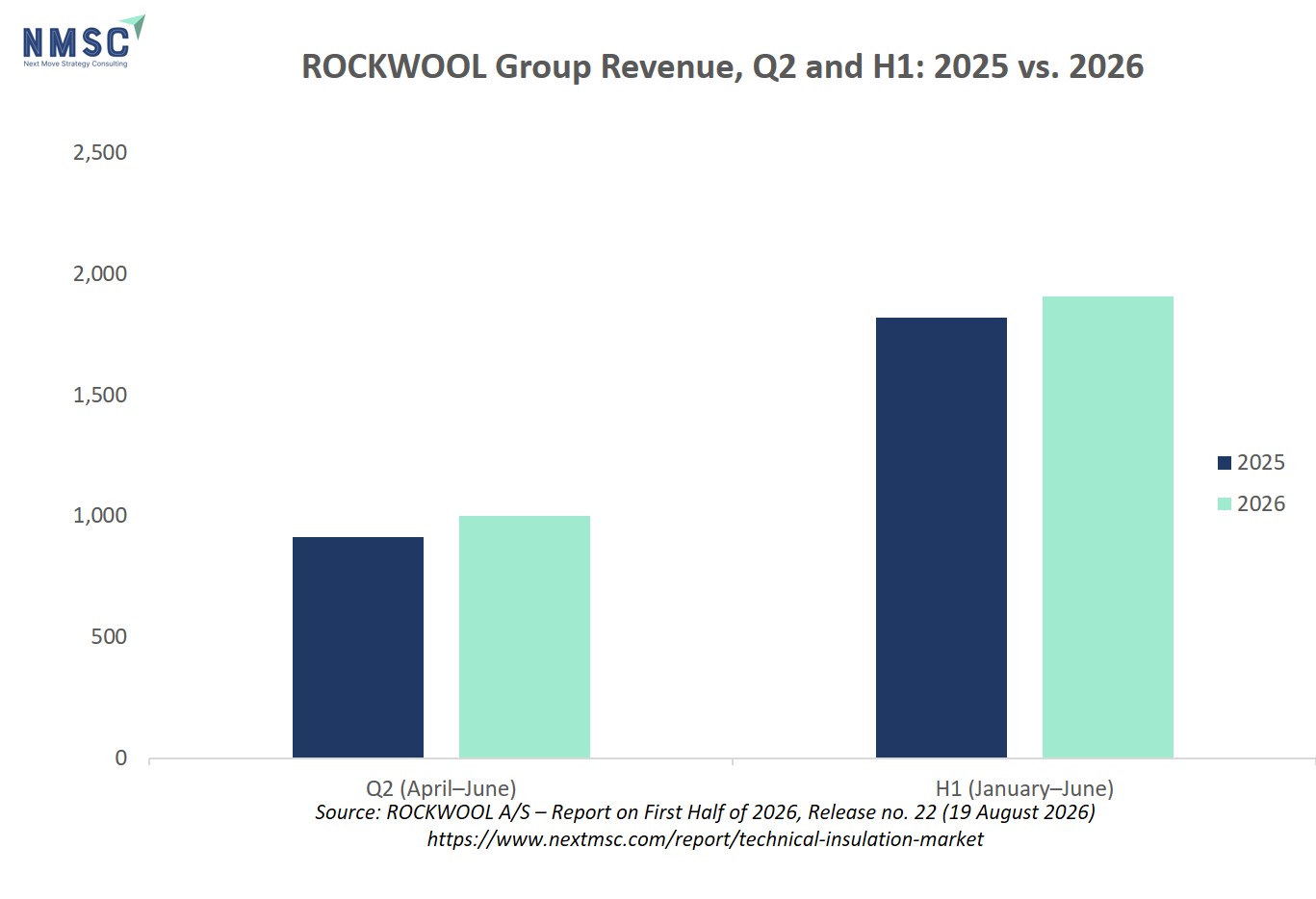
Separately, ROCKWOOL Group — the world's leading stone wool manufacturer — reported H1 2026 revenue of 1,906 MEUR, representing 6% growth in local currencies, with Q2 2026 delivering a record-high revenue of 1,000 MEUR, up 10% year-on-year. ROCKWOOL's CEO Jes Munk Hansen attributed the performance directly to insulation demand dynamics: "Energy price increases are driving greater focus on energy efficiency in the built environment, thus creating greater demand for insulation." (ROCKWOOL Group, August 20, 2026.) In June 2026, ROCKWOOL also acquired the remaining stake in Swedish company ScanArc Plasma Technologies to support its path to fossil-free melting — a strategic move that mirrors Knauf's electrification investment and signals that decarbonized production is becoming a competitive differentiator, not merely a compliance exercise.
AI Data Centers: A New and Rapidly Scaling End-Use Category
The mechanical insulation industry's most structurally new demand driver in 2026 is the AI-driven data center construction boom. U.S. data center construction starts reached USD 25.2 billion in January 2026 alone, and globally, an estimated 100 GW of new data center capacity is expected between 2026 and 2030 — effectively doubling worldwide capacity. The sector may require up to USD 3 trillion in infrastructure investment by 2030, growing at a projected 14% CAGR.
Data centers are not conventional commercial buildings. They operate continuously at strict temperature and humidity thresholds, making mechanical insulation — applied to chilled water systems, refrigeration piping, ductwork, and process equipment — a non-negotiable performance requirement rather than a cost-reduction measure. Oracle, in partnership with OpenAI and SoftBank, is executing a USD 100 billion initial investment in data centers and power generation facilities in Texas as part of a broader USD 500 billion five-year plan. Amazon Web Services has invested more than USD 19.7 billion in Ohio cloud computing infrastructure alone, with forecasted investment surpassing USD 23 billion by 2030. Each of these facilities requires aerogel blankets, foam insulation, and pipe and duct insulation systems to maintain the thermal precision that AI workloads demand.
NMSC Strategic Perspective: Where the Market's Structural Demand Is Concentrating
NextMSC primary research and analysis identifies three end-use segments — data centers and electronics, power generation (nuclear), and oil and gas — as the highest-conviction demand concentrations within the broader technical insulation market through 2030.
The data center segment is transitioning from a niche application to a primary growth engine. Aerogel-based insulation, which provides superior thermal resistance in thinner profiles than conventional mineral wool, is gaining traction in hyperscale facilities where space efficiency and fire safety are both critical. The U.S. Department of Energy's own research into aerogel production for low-cost, high-R insulation underscores the material's strategic importance in next-generation building and industrial applications.
In the nuclear segment, the U.S. Department of Energy's July 25, 2026 fact sheet confirmed that four advanced reactors reached criticality by July 4, 2026, and that the UPRISE initiative targets 2.5 GW of additional nuclear capacity by 2027 and 5 GW by 2029. Nuclear reactor containment structures, reactor coolant systems, and containment buildings require specialized high-temperature insulation systems that are distinct from standard building insulation — creating a premium-priced, technically demanding sub-segment that favors established players with nuclear-grade certification.
In oil and gas, the U.S. Energy Information Administration projects that U.S. natural gas production will increase by 4.5 billion cubic feet per day (Bcf/d) in 2026, supported by pipeline capacity additions — with 12 new or expanded gas pipeline projects set for completion in Texas, Louisiana, and Oklahoma in 2026 alone. Each new pipeline kilometre requires pipe and duct insulation to manage condensation, prevent corrosion, and maintain fluid temperature — translating directly into sustained volume demand for technical insulation manufacturers.
Section Summary:
The technical insulation market's near-term demand is being shaped by three concurrent, independently verifiable forces: regulatory renovation mandates in Europe, AI-driven data center construction in North America, and a U.S. nuclear energy renaissance. Supply-side players are responding with electrified, lower-carbon production lines that simultaneously reduce embodied carbon and expand capacity.
Key Takeaways:
-
Knauf Group's €120 million electric melting line in Croatia adds 60,000 tonnes of annual mineral wool capacity, directly aligned with EU EPBD renovation demand.
-
ROCKWOOL's H1 2026 record revenue of 1,000 MEUR in Q2 confirms that insulation demand is translating into measurable financial outperformance for leading manufacturers.
-
U.S. data center construction starts of USD 25.2 billion in January 2026 represent a structurally new and rapidly scaling end-use category for technical insulation.
-
The U.S. nuclear renaissance — with four advanced reactors reaching criticality by July 4, 2026 — creates a premium-priced, technically demanding sub-segment for nuclear-grade insulation systems.
Industry Impact Analysis
The EU EPBD: A Renovation Mandate That Converts Policy Into Procurement
The revised Energy Performance of Buildings Directive (EU/2024/1275) entered into force on May 28, 2024, with a transposition deadline of May 29, 2026. The directive's core finding is stark: 85% of EU buildings were constructed before 2000, and 75% have poor energy performance. Buildings account for approximately 40% of total energy consumed in the EU and approximately 50% of the EU's gas consumption. The directive requires EU member states to reduce the average primary energy use of residential buildings by 16% by 2030 and by 20–22% by 2035, with at least 55% of that reduction achieved through renovation of the worst-performing buildings.
For the technical insulation industry, this is not a soft policy signal — it is a procurement mandate. Insulation of building envelopes (walls, roofs, foundations) is the primary mechanism through which renovation projects achieve energy performance improvements. The EU's construction industry employs almost 25 million people and is composed predominantly of small and medium-sized enterprises; the EPBD's renovation wave is expected to sustain multi-year demand for insulation boards, mineral wool batts, and HVAC insulation across all 27 member states.
On March 10, 2026, the European Commission published a recommendation with practical guidance on the establishment of one-stop shops for energy renovation of buildings, as part of a comprehensive support package for energy efficiency financing — further operationalizing the renovation pipeline.
IEA Energy Efficiency 2025: Investment Acceleration and the Policy Gap
The International Energy Agency's Energy Efficiency 2025 report — the IEA's primary annual analysis on global energy efficiency developments — found that global energy efficiency-related investment is set to reach almost USD 800 billion in 2025, growing by 6% compared to 2024 and over 70% compared to 2015. Governments implemented over 250 new or updated efficiency-related policies in 2025, in countries representing over 85% of global energy demand.
However, the IEA also identified a critical structural gap: around half of countries globally still do not have efficiency standards for new buildings, and there are no mandatory energy performance standards for industrial motors in two-thirds of all countries globally. This gap represents both a risk and an opportunity for the technical insulation market — markets with weak standards today are the most likely candidates for regulatory tightening over the 2026–2030 forecast period, which would accelerate insulation demand in currently underpenetrated geographies.
The IEA also noted that efficiency actions since 2000 have reduced household energy bills in advanced economies by up to 20%, and that industries today produce 20% more value per unit of energy consumed than in 2000 — a statistic that directly supports the business case for technical insulation investment in commercial and industrial settings.
Boston Hospitals: A Case Study in Insulation's Untapped Industrial Potential
A September 2026 investigation by Commonwealth Beacon found that Boston hospitals consume roughly four times the energy of comparable buildings across the city, and remain among the lowest-performing structures in their push toward net-zero emissions. Jeff Saliba, Business Manager of Heat and Frost Insulators and Allied Workers Local 6, identified mechanical insulation deficiencies as a primary correctable factor. This case illustrates a broader pattern: large institutional facilities — hospitals, universities, government buildings — represent a significant and largely untapped retrofit market for technical insulation, particularly in HVAC and pipe insulation applications.
Section Summary:
The EU EPBD's May 2026 transposition deadline has converted a decade of policy discussion into binding national renovation obligations across 27 member states. Simultaneously, the IEA's USD 800 billion global efficiency investment figure for 2025 confirms that capital is flowing into the sector at scale. The Boston hospital case study illustrates that institutional retrofit demand — beyond new construction — represents a structurally underserved market segment.
Key Takeaways:
-
75% of EU buildings have poor energy performance; the EPBD mandates renovation of the 16% worst-performing non-residential buildings by 2030, creating a multi-year insulation procurement pipeline.
-
Global energy efficiency investment reached nearly USD 800 billion in 2025, growing 6% year-on-year, per the IEA's Energy Efficiency 2025 report.
-
Approximately half of countries globally lack building efficiency standards, representing the next wave of regulatory-driven insulation demand.
-
Institutional retrofit markets (hospitals, universities, government facilities) remain structurally underserved and represent a high-margin opportunity for technical insulation contractors.
Key Industry Benchmarks and Demand Drivers — Selected Credible External Data Points (2025–2026)
|
Indicator |
Value / Finding |
Source |
|
Global energy efficiency investment (2025) |
~USD 800 billion (6% YoY growth) |
IEA, Energy Efficiency 2025 |
|
New/updated efficiency policies enacted (2025) |
250+ policies in countries covering 85% of global energy demand |
IEA, Energy Efficiency 2025 |
|
EU buildings with poor energy performance |
75% (of 85% built before 2000) |
European Commission, EPBD |
|
EU buildings' share of total energy consumption |
~40% |
European Commission, EPBD |
|
ROCKWOOL H1 2026 revenue |
1,906 MEUR (+6% in local currencies) |
ROCKWOOL Group, August 2026 |
|
ROCKWOOL Q2 2026 revenue (record high) |
1,000 MEUR (+10% YoY) |
ROCKWOOL Group, August 2026 |
|
U.S. data center construction starts (Jan 2026) |
USD 25.2 billion |
Mechanical Insulators LMCT, March 2026 |
|
New global data center capacity (2026–2030) |
~100 GW (doubling worldwide capacity) |
Mechanical Insulators LMCT, March 2026 |
|
U.S. natural gas production increase (2026) |
+4.5 Bcf/d |
U.S. EIA, Short-Term Energy Outlook |
|
Advanced nuclear reactors reaching criticality (by July 4, 2026) |
4 reactors |
U.S. Department of Energy, July 25, 2026 |
|
Knauf Croatia electric melting line investment |
€120 million; +60,000 tonnes annual capacity |
Knauf Insulation, July 28, 2026 |
Future Outlook & Forecast
NMSC Forecast: USD 11.82 Billion by 2030 at 4.0% CAGR
NextMSC primary research and analysis projects the global technical insulation market to grow from USD 8.96 billion in 2023 to USD 11.82 billion by 2030, at a CAGR of 4.0%. This trajectory reflects a market that is expanding steadily rather than cyclically — underpinned by regulatory mandates with legally binding timelines, infrastructure investment programs with multi-year capital commitments, and material innovation that is expanding the addressable application base.
Asia Pacific: Sustained Dominance Through Industrial and Chemical Sector Expansion
Asia Pacific holds the dominant share of the technical insulation market and is expected to maintain that position through 2030, per NextMSC proprietary research and analysis. The region's chemical industry — a primary consumer of pipe and duct insulation for temperature regulation of storage tanks and pipelines — continues to expand at scale. India's chemical sector, for instance, is projected to grow from USD 220 billion in 2022 to USD 1 trillion by 2040, according to the India Brand Equity Foundation. China's crude oil production reached 208 million tonnes in 2023, a 1.6% increase over 2022, per World Energy Media — sustaining demand for pipeline insulation across the region's expanding oil and gas infrastructure.
North America: Nuclear and Data Center Demand Create a Premium-Priced Growth Layer
North America's technical insulation market is entering a phase where two structurally new demand categories — nuclear power and AI data centers — are layering premium-priced volume on top of the existing commercial real estate and HVAC base. The U.S. Department of Energy's UPRISE initiative targets 2.5 GW of additional nuclear capacity by 2027 and 5 GW by 2029. Nuclear reactor insulation — applied to containment structures, reactor coolant systems, and containment buildings — requires materials certified to nuclear-grade standards, commanding significantly higher margins than standard building insulation. Simultaneously, the data center construction pipeline (USD 25.2 billion in starts in January 2026 alone) is creating sustained demand for aerogel blankets, foam insulation, and pipe insulation systems in facilities that operate 24/7 and cannot tolerate thermal performance failures.
Material Innovation: Aerogel and Nanoporous Materials as the Next Frontier
NextMSC primary research and analysis identifies aerogel and nanoporous insulation materials as the highest-growth material sub-segment within the technical insulation market through 2030. These materials — characterized by nanoscale pore structures that deliver superior thermal resistance in thinner profiles — are gaining adoption in data centers (where rack density and space constraints make conventional mineral wool impractical), in oil and gas pipelines (where corrosion under insulation is a persistent operational risk), and in nuclear applications (where fire resistance and thermal stability under extreme conditions are non-negotiable). The U.S. Department of Energy is actively supporting aerogel production research to reduce costs and expand the material's addressable market. NASA's 2026 research into next-generation polymer aerogel insulation for cryogenic applications further signals the material's expanding technical frontier.
The Decarbonization Premium: Low-Embodied-Carbon Products as a Competitive Differentiator
The EU's EPBD now requires the disclosure of life-cycle global warming potential for new buildings from January 2028 (for buildings exceeding 1,000 m²) and from January 2030 for all new buildings. This creates a direct commercial incentive for specifiers and contractors to select insulation products with lower embodied carbon — precisely the product category that Knauf's Croatia investment and ROCKWOOL's ScanArc acquisition are designed to supply. Manufacturers that can credibly certify lower-embodied-carbon mineral wool products will command specification preference in EU renovation projects, creating a durable competitive moat that is difficult for new entrants to replicate without equivalent capital investment in electrified production.
Section Summary:
The technical insulation market's 4.0% CAGR through 2030 is supported by a combination of regulatory renovation mandates, infrastructure investment programs, and material innovation — each operating on independent timelines that collectively reduce the market's cyclical exposure. Asia Pacific's industrial and chemical sector expansion sustains volume demand; North America's nuclear and data center buildout creates a premium-priced growth layer; and the EU's embodied carbon disclosure requirements are beginning to reshape product specification decisions.
Key Takeaways:
-
NextMSC projects the market to reach USD 11.82 billion by 2030 at a 4.0% CAGR, driven by regulatory, infrastructure, and material innovation forces operating on independent timelines.
-
Asia Pacific maintains market dominance through chemical and oil and gas sector expansion; North America's nuclear renaissance and AI data center boom add a premium-priced demand layer.
-
Aerogel and nanoporous materials represent the highest-growth material sub-segment, with adoption accelerating in data centers, nuclear, and oil and gas applications.
-
EU life-cycle carbon disclosure requirements from 2028 onward will make low-embodied-carbon insulation products a specification requirement rather than a voluntary preference.
Next Steps for Stakeholders
For C-Level Executives at Insulation Manufacturers:
Prioritize capital allocation toward electrified, lower-carbon production lines. Knauf's €120 million Croatia investment and ROCKWOOL's ScanArc acquisition demonstrate that decarbonized production is transitioning from a sustainability commitment to a commercial prerequisite for EU market access. Manufacturers without credible low-embodied-carbon product lines will face specification exclusion as EPBD life-cycle carbon disclosure requirements take effect from 2028.
Develop nuclear-grade and data center-specific product certifications. The U.S. nuclear renaissance and AI data center boom are creating premium-priced sub-segments that require specialized material certifications. Manufacturers that invest in these certifications now will be positioned to capture disproportionate margin in the 2027–2030 period.
For Institutional Investors:
ROCKWOOL's H1 2026 record revenue and upward-revised full-year outlook (5–7% revenue growth in local currencies) confirm that the leading technical insulation manufacturers are translating structural demand drivers into measurable financial outperformance. The sector's exposure to regulatory mandates with legally binding timelines reduces demand cyclicality relative to broader construction materials.
Monitor the aerogel insulation sub-segment. Aspen Aerogels, Inc. — one of the key players identified in NextMSC's proprietary competitive analysis — is positioned at the intersection of data center, oil and gas, and industrial insulation demand. The U.S. DOE's active support for aerogel cost reduction research signals a potential inflection in the material's price competitiveness over the forecast period.
For Procurement and Project Development Teams:
Engage insulation suppliers early in data center and nuclear project planning cycles. The specialized nature of aerogel blankets, nuclear-grade insulation systems, and high-temperature pipe insulation means that lead times and certification requirements can materially affect project schedules. Early supplier engagement reduces execution risk.
Leverage the EU's one-stop shop framework for renovation projects. The European Commission's March 2026 guidance on one-stop shops for energy renovation provides a structured pathway for accessing financing and technical assistance for EPBD-compliant renovation projects — reducing the administrative burden on project developers and accelerating procurement timelines.
Conclusion
The technical insulation market is not growing because of generic construction activity — it is growing because three structurally distinct demand forces are operating simultaneously and reinforcing each other. The EU's EPBD has converted 75% of Europe's poorly performing building stock into a legally mandated renovation pipeline. The AI infrastructure boom has created a new, high-performance end-use category in data centers that requires insulation systems capable of maintaining thermal precision in continuously operating facilities. And the U.S. nuclear renaissance — confirmed by four advanced reactors reaching criticality by July 4, 2026 — is creating a premium-priced, technically demanding sub-segment that favors established manufacturers with nuclear-grade certification.
According to NextMSC's Technical Insulation Market report, the market is projected to grow from USD 8.96 billion in 2023 to USD 11.82 billion by 2030 at a 4.0% CAGR. The manufacturers and investors who will capture the most durable share of that growth are those who recognize that the market's next competitive frontier is not volume alone — it is the combination of low-embodied-carbon production, nuclear and data center-grade certification, and aerogel material innovation that will define specification preference through the end of the decade.
About the Author
 Sanyukta Deb
— Sanyukta Deb is Digital Marketing Team Lead at Next Move Strategy Consulting, where she has led content strategy and technical SEO for the firm's B2B market research publications for over 2 years. Her editorial process translates NextMSC's primary and secondary research — spanning technology, industrial, and consumer sectors — into commercial narratives, backed by search-intent, keyword, and competitive analysis. She brings 5 years of overall experience in digital marketing and content strategy.
Sanyukta Deb
— Sanyukta Deb is Digital Marketing Team Lead at Next Move Strategy Consulting, where she has led content strategy and technical SEO for the firm's B2B market research publications for over 2 years. Her editorial process translates NextMSC's primary and secondary research — spanning technology, industrial, and consumer sectors — into commercial narratives, backed by search-intent, keyword, and competitive analysis. She brings 5 years of overall experience in digital marketing and content strategy.
About the Reviewer
 Debashree Dey
— Debashree Dey is Assistant Manager at Next Move Strategy Consulting, where she supports cross-vertical market content and communications across diverse industries for 6 years. Her professional background includes senior content writing, communications, and published manuscript authorship, with experience developing audience-focused business narratives and maintaining clear, consistent messaging. Her role supports research-led content development and editorial quality across NextMSC publications.
Debashree Dey
— Debashree Dey is Assistant Manager at Next Move Strategy Consulting, where she supports cross-vertical market content and communications across diverse industries for 6 years. Her professional background includes senior content writing, communications, and published manuscript authorship, with experience developing audience-focused business narratives and maintaining clear, consistent messaging. Her role supports research-led content development and editorial quality across NextMSC publications.

















Add Comment