Foldable Display Market: Apple's Debut Signals a $19B Shift
Introduction
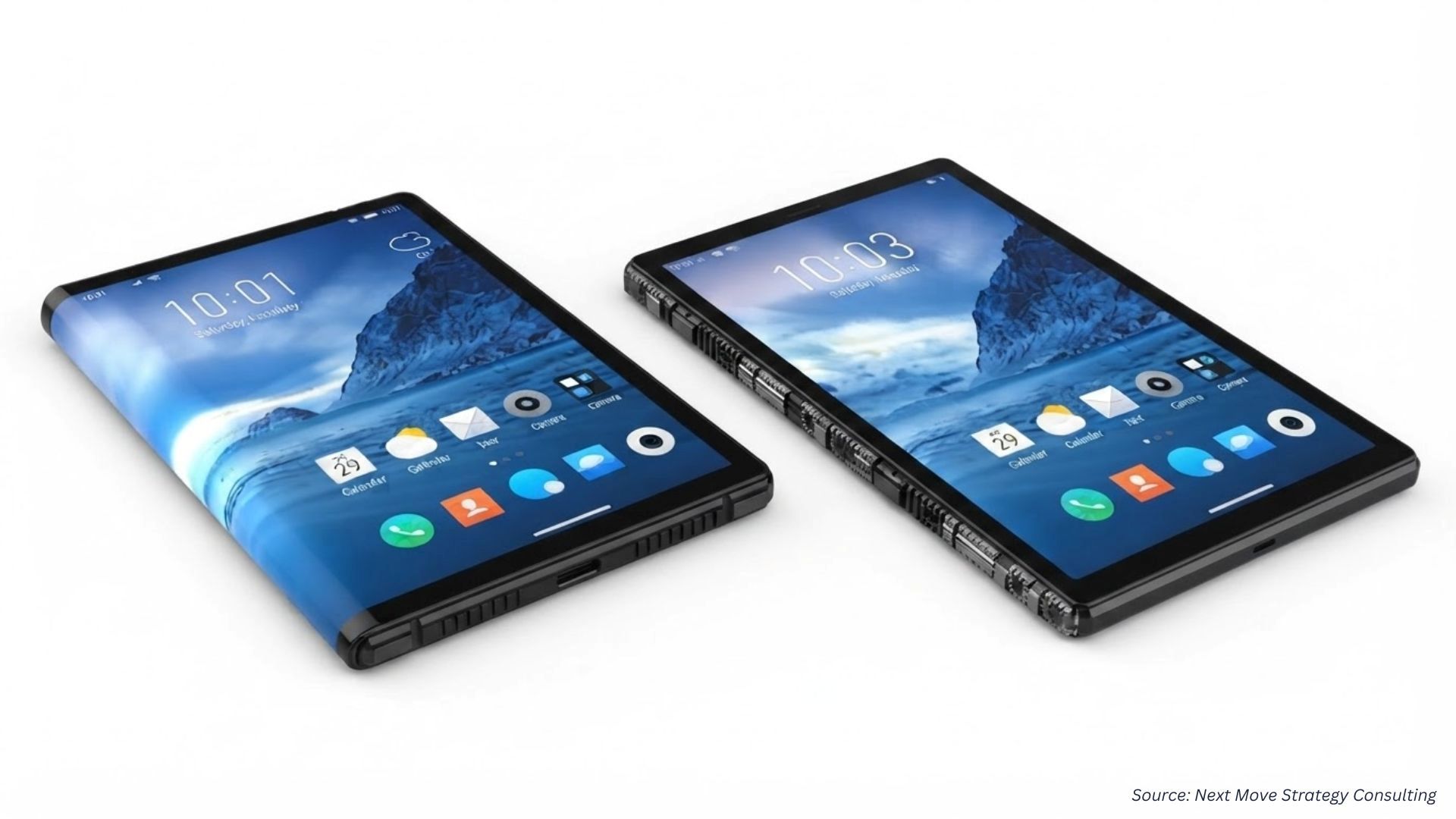
The global Foldable Display Market is entering its most consequential phase of commercial maturation. For years, the category was defined by incremental hardware refinements and a narrow base of early adopters willing to pay a premium for a form factor that still carried visible engineering compromises. That era is drawing to a close. In September 2026, Apple is set to announce its first-ever foldable iPhone — a device that industry analysts and supply chain observers widely regard as the single most significant catalyst for mainstream foldable display adoption since Samsung introduced the original Galaxy Z Fold in 2019.
The convergence of Apple's market entry, Samsung Display's breakthrough crease-free OLED technology unveiled at CES 2026, and Huawei's pioneering wide-format foldable design has created a structural inflection point for the foldable display market. According to Next Move Strategy Consulting, the global foldable display market is projected to reach USD 19,235.78 million by 2030, expanding at a remarkable CAGR of 59.9% from 2024 to 2030. For C-level executives, technology investors, and display supply chain strategists, the question is no longer whether foldable displays will achieve scale — it is which technologies, form factors, and market participants will define the next chapter of this rapidly evolving industry.
For More Information: Download FREE Sample on Foldable Display Market Report
The Crease-Free Breakthrough and Apple's Entry Redefine the Foldable Display Market
Samsung's MONT FLEX Technology: Solving the Industry's Most Persistent Problem
On January 6, 2026, Samsung Display unveiled what the display industry had long considered its most elusive engineering challenge: a crease-free folding OLED panel, demonstrated publicly at CES 2026 in Las Vegas. The company set up a direct comparison area showing the new panel alongside the Galaxy Z Fold 7, where the crease on the new device appeared nearly invisible even under reflective lighting, with text remaining seamless across the fold.
The technology behind this achievement is Samsung's proprietary MONT FLEX system, which uses laser-drilled metal plates manufactured by Fine M-Tec — the same supplier that industry analyst Ming-Chi Kuo had previously connected to Apple's iPhone Duo supply chain. These plates distribute bending stress evenly across the fold area, preventing material fatigue and permanent creasing. Samsung combines MONT FLEX with its LEAD technology, a polarizer-free display architecture that increases brightness while reducing power consumption by 37% compared to traditional OLED panels.
While Samsung described the crease-free panel as a research-and-development concept at the time of the CES demonstration, industry observers have since connected the technology to both the Samsung Galaxy Z Fold 8 — launched in August 2026 — and Apple's iPhone Duo. The significance of this development cannot be overstated: the visible crease has been the single most frequently cited consumer objection to foldable smartphones in every major user research study conducted since 2019. Its elimination removes the most tangible barrier to mainstream adoption.
Apple's Foldable iPhone: The Catalyst the Market Has Been Waiting For
Apple is scheduled to announce its first foldable iPhone the iPhone Duo on September 9, 2026, with the device expected to go on sale on September 18, 2026, alongside the iPhone 18 Pro. The device is expected to feature a approximately 5.4-inch display when closed and an approximately 7.6-inch display when unfolded, and is anticipated to be priced between USD 2,000 and USD 2,500.
Apple's entry into the foldable display market carries implications that extend well beyond its own device sales. Historically, Apple's adoption of a new display technology — whether OLED in 2017 or ProMotion 120Hz in 2021 — has triggered rapid industry-wide standardization, accelerated component cost reduction through scale, and expanded the addressable consumer base by lending mainstream credibility to previously niche form factors. The foldable display market is positioned to follow the same trajectory.
Huawei's Wide-Format Design: A New Form Factor Paradigm
In May 2026, Huawei launched the Pura X Max, pioneering a new wide-format foldable design that features a shorter and wider aspect ratio, delivering a more tablet-like experience when unfolded. Samsung followed with a similar wide-format design in the Galaxy Z Fold 8 in August 2026. According to Omdia's August 2026 Smartphone Feature Forecast, this wide-format book-type design is projected to become a defining trend for the next generation of foldable smartphones, with leading vendors already increasing production targets for wide-format devices in 2026 and more Android brands expected to adopt similar designs in 2027.
NMSC Strategic Perspective: Three Concurrent Catalysts Creating a Structural Demand Surge
From Next Move Strategy Consulting's analytical standpoint, the foldable display market in 2026 is experiencing a rare convergence of three simultaneous demand catalysts that collectively represent a structural — rather than cyclical — acceleration.
The first catalyst is technological credibility: Samsung's crease-free OLED demonstration at CES 2026 signals that the display industry has resolved the form factor's most visible engineering limitation. This shifts the consumer conversation from "why does it have a crease?" to "what can I do with a larger, foldable screen?" — a fundamentally more productive commercial dialogue.
The second catalyst is ecosystem legitimacy: Apple's entry into the foldable smartphone category in September 2026 will expose the foldable form factor to Apple's global installed base of over 1.4 billion active devices, a consumer segment that has historically demonstrated above-average willingness to pay for premium hardware experiences.
The third catalyst is form factor diversification: The emergence of the wide-format book-type design alongside traditional book-type and flip-type foldables expands the addressable use-case spectrum, attracting productivity-oriented users who previously found traditional foldable aspect ratios insufficiently differentiated from standard smartphones.
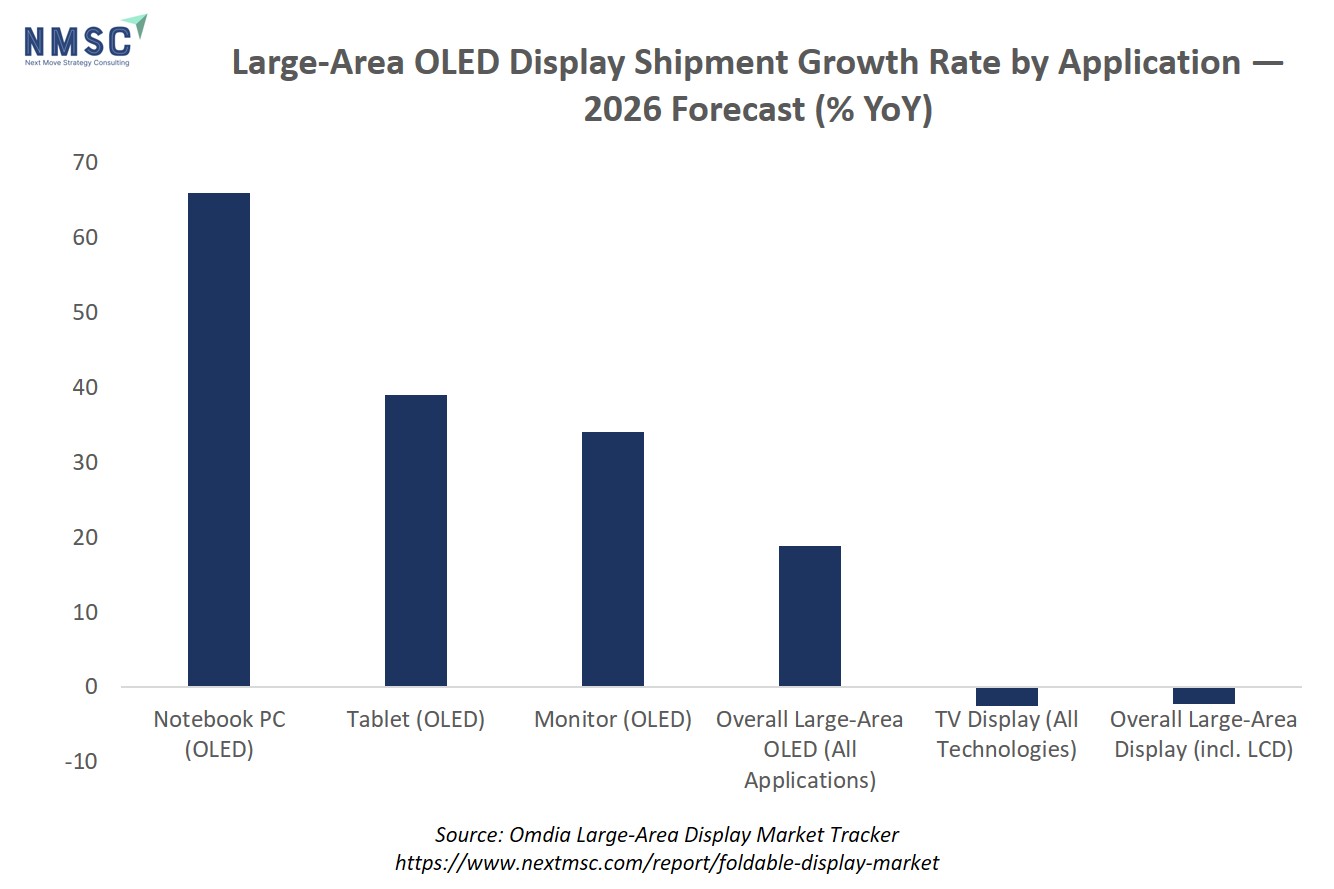
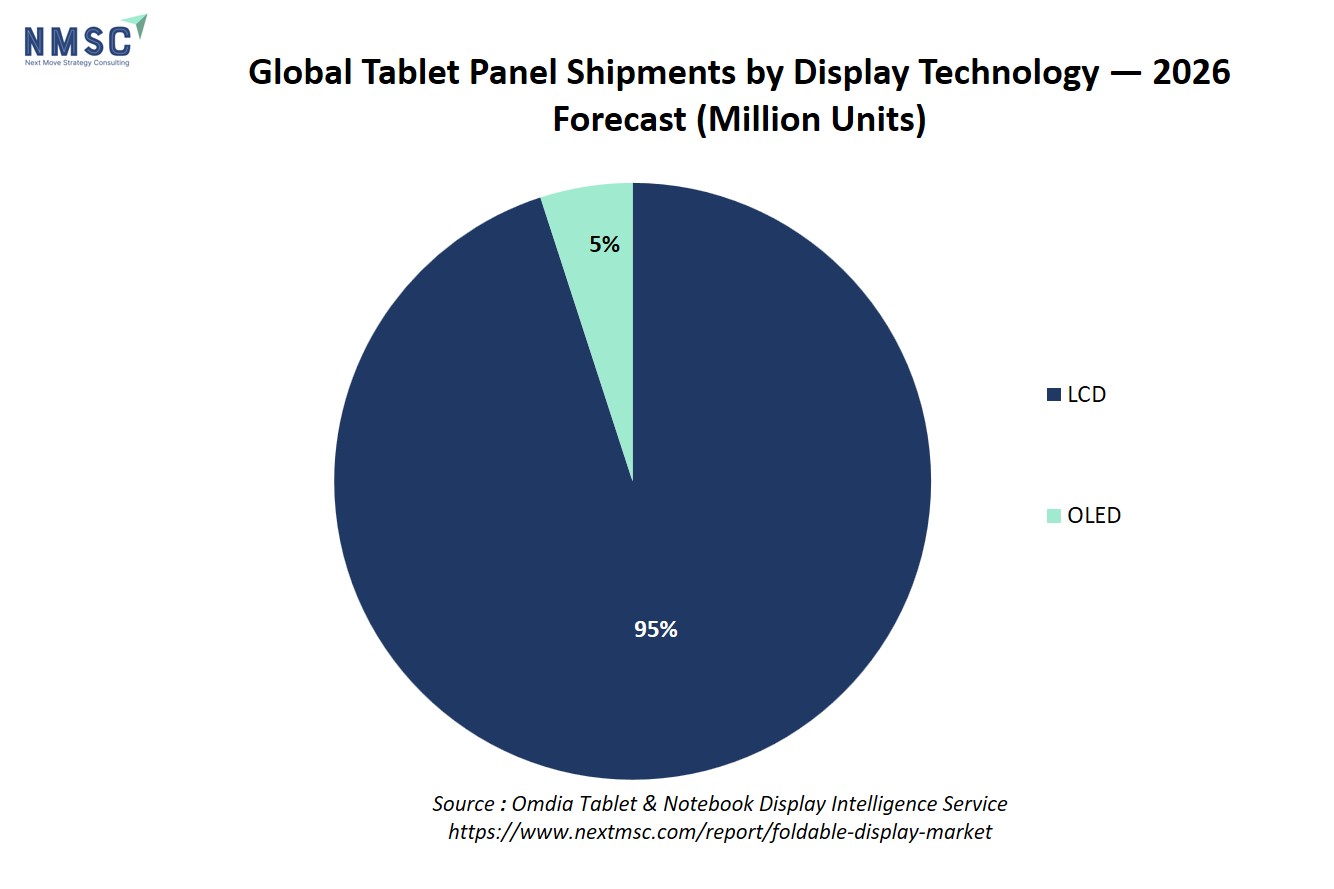
NMSC's analysis indicates that the OLED technology segment will continue to dominate the foldable display market through 2030, driven by its superior color accuracy, contrast ratio, and power efficiency advantages — particularly relevant as the LEAD polarizer-free architecture further widens the performance gap between OLED and competing display technologies. The Smartphone application segment is expected to retain the largest revenue share, while the Automotive and Wearable segments represent the highest-growth adjacent opportunities as foldable display technology matures and component costs decline.
Key Takeaways:
-
Samsung Display's MONT FLEX + LEAD crease-free OLED technology, unveiled at CES 2026, reduces power consumption by 37% vs. traditional OLED and eliminates the form factor's most persistent consumer objection.
-
Apple's foldable iPhone is scheduled for announcement on September 9, 2026, priced between USD 2,000 and USD 2,500 — bringing mainstream credibility to the foldable display category.
-
Huawei's Pura X Max (May 2026) and Samsung's Galaxy Z Fold 8 (August 2026) have established the wide-format book-type design as the next dominant foldable form factor.
-
NMSC identifies OLED technology and the Smartphone application segment as the primary revenue drivers through 2030, with Automotive and Wearable segments as high-growth adjacencies.
Industry Impact Analysis
Foldable Shipments Defy a Declining Smartphone Market
The broader smartphone market is experiencing its most severe contraction in recent memory. According to IDC, worldwide smartphone shipments are forecast to decline 13.9% year-on-year in 2026 to 1.09 billion units, driven by a memory crisis and macroeconomic headwinds. Against this backdrop, foldable smartphones stand as the industry's most compelling counter-narrative. IDC forecasts foldable smartphone shipments to grow 30% year-on-year in 2026, boosted directly by Apple's market entry, even as the overall smartphone market contracts sharply.
Omdia's August 2026 data provides additional granularity. Global foldable smartphone shipments reached 18.2 million units in 2025, with year-on-year growth slowing to 6% — the lowest rate recorded in recent years — as the market awaited the next generation of hardware innovation. During the first half of 2026, shipments reached 5.1 million units, down 21.6% year-on-year, reflecting the pre-launch demand pause ahead of Apple's entry and the Galaxy Z Fold 8 launch. Omdia forecasts full-year 2026 foldable shipments to exceed 22 million units, representing more than 22% year-on-year growth as second-half launches from Apple, Samsung, and other Android vendors drive a sharp recovery.
Book-Type Dominance and the Decline of Flip-Type Foldables
The foldable smartphone market is undergoing a significant internal structural shift. According to Omdia, book-type foldable smartphones accounted for 69% of global foldable shipments in the first half of 2026, with Huawei and Samsung together commanding 75% of the book-type segment. Flip-type foldable smartphones, by contrast, declined 47% in the first half of 2026 compared to the same period in 2025, reflecting weakening consumer appetite for the clamshell form factor as the wide-format book-type design gains traction.
This structural shift has direct implications for display manufacturers. Book-type foldables require larger, more complex display panels with higher material and engineering costs, but also command significantly higher average selling prices (ASPs) and generate greater per-unit revenue for display suppliers. The shift toward book-type and wide-format designs therefore represents a positive revenue mix shift for the foldable display supply chain, even if unit volume growth is more moderate than headline shipment figures suggest.
Supply Chain Concentration and Competitive Dynamics
The foldable display supply chain remains highly concentrated. Samsung Display and BOE Technology Group are the dominant panel suppliers, with LG Display, Visionox, and Japan Display occupying secondary positions. The emergence of Apple as a major foldable display customer — with Samsung Display widely reported as the primary panel supplier for the first-generation foldable iPhone — will further consolidate Samsung Display's position as the technology leader in the segment, at least in the near term.
However, Apple's entry also creates a powerful incentive for BOE and other Chinese display manufacturers to accelerate their own crease-free and high-durability foldable panel development programs, as they seek to qualify as alternative suppliers for future Apple foldable device generations. This competitive dynamic is expected to accelerate technology diffusion and compress the cost premium associated with advanced foldable display technologies over the medium term.
Key Takeaways:
-
IDC forecasts overall smartphone shipments to decline 13.9% in 2026, while foldable smartphone shipments are forecast to grow 30% year-on-year — the starkest divergence in the category's history.
-
Omdia forecasts full-year 2026 foldable shipments to exceed 22 million units, recovering from a 21.6% year-on-year decline in 1H 2026 as Apple and Samsung second-half launches drive demand.
-
Book-type foldables account for 69% of global foldable shipments in 1H 2026; flip-type declined 47% year-on-year in the same period.
-
Huawei and Samsung together hold 75% of the book-type foldable segment, but Apple's entry as a major display customer will intensify competitive pressure on panel suppliers to accelerate technology development.
Pros and Cons of Recent Market Developments
|
Recent Development |
Pros |
Cons |
|
Samsung's Crease-Free OLED (CES 2026) |
Eliminates the form factor's most persistent consumer objection; 37% power reduction improves battery life; positions Samsung Display as the undisputed technology leader |
Classified as an R&D concept at CES with no confirmed mass-production timeline; laser-drilled metal plate process (Fine M-Tec) adds manufacturing complexity and cost |
|
Apple's Foldable iPhone Entry (Sept 2026) |
Brings mainstream credibility and a global installed base of 1.4B+ active devices to the foldable category; accelerates component cost reduction through scale; drives 30% YoY foldable shipment growth |
USD 2,000–USD 2,500 price point limits addressable market to premium consumers; first-generation Apple products historically carry iterative limitations |
|
Huawei's Wide-Format Pura X Max (May 2026) |
Establishes a new, more ergonomic form factor with broader productivity use cases; drives Samsung and other vendors to adopt similar designs |
Huawei's access to advanced semiconductor components remains constrained by U.S. export controls, limiting global distribution |
|
Book-Type Foldable Dominance (69% share, 1H 2026) |
Higher ASPs and per-unit display revenue for panel suppliers; stronger use-case differentiation vs. standard smartphones |
Larger, heavier devices with higher BOM costs; complex hinge and display engineering increases repair costs and durability risk |
|
Flip-Type Foldable Decline (−47% YoY, 1H 2026) |
Rationalizes the product portfolio; concentrates R&D investment in higher-value book-type and wide-format designs |
Reduces addressable market for entry-level foldable consumers; may slow overall foldable category volume growth in the near term |
|
OLED Technology Dominance |
Superior color accuracy, contrast, and power efficiency; LEAD polarizer-free architecture further widens performance gap vs. competing technologies |
High manufacturing cost and yield sensitivity; dependence on a concentrated supplier base creates supply chain risk |
Global Foldable Smartphone Shipment Data & Forecasts — Primary Source Summary
|
Metric |
Value |
Unit |
Period |
|
Global Foldable Smartphone Shipments |
18.2 Million |
Units |
Full Year 2025 |
|
YoY Growth — Foldable Shipments |
6% |
% |
Full Year 2025 |
|
Global Foldable Smartphone Shipments |
5.1 Million |
Units |
1H 2026 |
|
YoY Change — 1H 2026 Foldable Shipments |
−21.6% |
% |
1H 2026 vs. 1H 2025 |
|
Flip-Type Foldable Shipment Change |
−47% |
% |
1H 2026 vs. 1H 2025 |
|
Book-Type Share of Global Foldable Shipments |
69% |
% |
1H 2026 |
|
Huawei + Samsung Combined Book-Type Share |
75% |
% |
1H 2026 |
|
Global Foldable Smartphone Shipments Forecast |
>22 Million |
Units |
Full Year 2026 |
|
YoY Growth Forecast — Foldable Shipments |
>22% |
% |
Full Year 2026 |
|
Global Foldable Smartphone Shipments Forecast |
20.6 Million |
Units |
Full Year 2025 |
|
YoY Growth Forecast — Foldable Shipments |
30% |
% |
Full Year 2026 |
|
Overall Smartphone Market YoY Change |
−13.9% |
% |
Full Year 2026 |
|
Global Foldable Smartphone Shipments Forecast |
36 Million |
Units |
2028 |
|
Global Foldable Smartphone Shipments Forecast |
45 Million |
Units |
2030 |
|
Foldable Share of Total Smartphone Market |
<3% |
% |
2030 (Forecast) |
|
Samsung LEAD Technology Power Reduction vs. Traditional OLED |
37% |
% |
CES 2026 |
|
Apple Foldable iPhone Expected Price Range |
USD 2,000–USD 2,500 |
USD |
September 2026 |
Future Outlook & Forecast
The Foldable Display Market's Path to USD 19.24 Billion by 2030
According to Next Move Strategy Consulting, the global foldable display market is projected to expand from USD 720 million in 2023 to USD 19,235.78 million by 2030, at a CAGR of 59.9% from 2024 to 2030. This exceptional growth rate reflects the compounding effect of rapid technology maturation, expanding application scope, and the entry of the world's most valuable consumer electronics brand into the category.
Asia-Pacific is expected to maintain its dominant regional position throughout the forecast period, underpinned by the concentration of key display manufacturers — including Samsung Display, BOE, LG Display, and Visionox — and a large, technology-forward consumer base in China, South Korea, Japan, and India. North America is expected to register accelerating growth as Apple's foldable iPhone drives premium consumer adoption and the automotive industry's integration of foldable display technology in infotainment systems expands.
Long-Term Shipment Trajectory and Premium Positioning
Omdia's August 2026 forecast provides a clear long-term shipment trajectory: global foldable smartphone shipments are projected to reach 36 million units by 2028 and 45 million units by 2030, representing more than a doubling from 2025 levels. Despite this growth, foldable smartphones are expected to remain a premium niche, accounting for less than 3% of total global smartphone shipments by 2030.
This premium positioning is structurally embedded in the category's economics. Complex components — including large flexible OLED panels, precision hinges, and specialized ultra-thin glass — keep bill of materials costs high, compelling vendors to prioritize margin over volume. As Omdia's Principal Analyst Zaker Li noted in August 2026: "In a year defined by supply chain constraints and market uncertainty, foldable smartphones stand out as the industry's most compelling growth story."
Application Diversification: Beyond Smartphones
While smartphones will remain the dominant application segment through 2030, the foldable display market's long-term growth trajectory is increasingly supported by application diversification. The automotive sector represents a particularly compelling adjacent opportunity, as vehicle manufacturers integrate foldable and curved display technology into next-generation infotainment and instrument cluster systems to reduce weight and enhance interior design flexibility. The wearable segment — encompassing smartwatches and health monitoring devices with flexible display interfaces — represents a further growth vector as display durability and power efficiency improve.
The rollable display sub-segment, while currently nascent, is expected to emerge as a meaningful commercial category within the forecast period as manufacturers extend flexible display technology beyond the fold-and-unfold paradigm to enable continuously variable screen sizes.
Section Summary: The foldable display market is on a trajectory to reach USD 19.24 billion by 2030, driven by OLED technology leadership, Apple's market entry, and expanding application scope across automotive and wearable segments. The category will remain premium-positioned, with foldable smartphones accounting for less than 3% of total smartphone shipments by 2030 even as absolute unit volumes more than double.
Key Takeaways:
-
NMSC projects the global foldable display market to reach USD 19,235.78 million by 2030, at a 59.9% CAGR from 2024 to 2030.
-
Omdia forecasts global foldable smartphone shipments to reach 36 million units by 2028 and 45 million units by 2030 — more than doubling from 2025 levels.
-
Asia-Pacific will maintain regional dominance through 2030, anchored by Samsung Display, BOE, LG Display, and Visionox manufacturing concentration.
-
Application diversification into automotive infotainment and wearables will provide incremental revenue streams beyond the smartphone segment as display technology matures.
Next Steps for Stakeholders
For C-Level Executives and Technology Manufacturers:
-
Invest in crease-free and polarizer-free OLED display R&D now. Samsung's MONT FLEX + LEAD technology has established a new performance benchmark. Manufacturers that do not develop comparable crease-free and power-efficient display solutions risk losing design wins to Samsung Display as Apple and other OEMs standardize on this technology for next-generation foldable devices.
-
Develop differentiated wide-format foldable product strategies. The wide-format book-type design pioneered by Huawei's Pura X Max and adopted by Samsung's Galaxy Z Fold 8 is emerging as the dominant next-generation foldable form factor. OEMs that have not yet defined their wide-format product roadmap should treat this as a near-term strategic priority, as Omdia projects more Android brands will adopt similar designs in 2027.
-
Expand foldable display applications into automotive and wearable segments. The smartphone segment will remain the primary revenue driver, but automotive infotainment and wearable applications offer above-average growth potential as display durability and cost profiles improve. Manufacturers with existing automotive display relationships should actively pursue foldable display integration programs with vehicle OEM partners.
-
Qualify alternative display suppliers ahead of Apple's second-generation foldable. Apple's entry as a major foldable display customer will intensify competition among panel suppliers. BOE and other manufacturers seeking to qualify as Apple alternative suppliers should accelerate crease-free panel development and durability certification programs to be positioned for second-generation device design wins.
For Institutional Investors and Financial Analysts:
-
Prioritize exposure to foldable display supply chain leaders. Samsung Display and BOE Technology Group are the primary beneficiaries of the foldable display market's growth trajectory. Display glass suppliers, hinge manufacturers, and ultra-thin glass producers serving these panel makers represent compelling secondary investment opportunities.
-
Monitor Apple's foldable iPhone sell-through data closely. Apple's first-generation foldable iPhone launch in September 2026 will provide the most significant real-world demand signal the foldable display market has ever generated. Strong sell-through data will validate the 30% YoY foldable shipment growth forecast and support upward revisions to long-term market size estimates.
-
Assess flip-type foldable exposure as a risk factor. Omdia's data showing a 47% year-on-year decline in flip-type foldable shipments in 1H 2026 signals a structural demand shift away from the clamshell form factor. Investors with exposure to manufacturers or suppliers heavily dependent on flip-type foldable volumes should reassess their risk profiles accordingly.
Conclusion
The global foldable display market has reached a structural inflection point in 2026. Samsung Display's crease-free OLED breakthrough at CES 2026, Apple's imminent foldable iPhone launch, and Huawei's pioneering wide-format design have collectively resolved the form factor's most persistent engineering and commercial limitations. The result is a market that is transitioning from early-adopter niche to premium mainstream — a transition that will generate extraordinary value for the manufacturers, suppliers, and investors positioned to capture it.
According to Next Move Strategy Consulting, the global foldable display market is projected to expand from USD 720 million in 2023 to USD 19,235.78 million by 2030 at a 59.9% CAGR — one of the most compelling growth trajectories in the global technology hardware landscape. Omdia's August 2026 forecast of 36 million foldable smartphone shipments by 2028 and 45 million by 2030 confirms that the demand foundation for this market expansion is real, measurable, and accelerating. For executives and investors who have been monitoring the foldable display market from the sidelines, the strategic window for early-mover positioning is narrowing rapidly.
About the Author
 Sanyukta Deb
— Sanyukta Deb is Digital Marketing Team Lead at Next Move Strategy Consulting, where she has led content strategy and technical SEO for the firm's B2B market research publications for over 2 years. Her editorial process translates NextMSC's primary and secondary research — spanning technology, industrial, and consumer sectors — into commercial narratives, backed by search-intent, keyword, and competitive analysis. She brings 5 years of overall experience in digital marketing and content strategy.
Sanyukta Deb
— Sanyukta Deb is Digital Marketing Team Lead at Next Move Strategy Consulting, where she has led content strategy and technical SEO for the firm's B2B market research publications for over 2 years. Her editorial process translates NextMSC's primary and secondary research — spanning technology, industrial, and consumer sectors — into commercial narratives, backed by search-intent, keyword, and competitive analysis. She brings 5 years of overall experience in digital marketing and content strategy.
About the Reviewer
 Debashree Dey
— Debashree Dey is Assistant Manager at Next Move Strategy Consulting, where she supports cross-vertical market content and communications across diverse industries for 6 years. Her professional background includes senior content writing, communications, and published manuscript authorship, with experience developing audience-focused business narratives and maintaining clear, consistent messaging. Her role supports research-led content development and editorial quality across NextMSC publications.
Debashree Dey
— Debashree Dey is Assistant Manager at Next Move Strategy Consulting, where she supports cross-vertical market content and communications across diverse industries for 6 years. Her professional background includes senior content writing, communications, and published manuscript authorship, with experience developing audience-focused business narratives and maintaining clear, consistent messaging. Her role supports research-led content development and editorial quality across NextMSC publications.

















Add Comment