AI in Military Maintenance: Redefining Defense Readiness
Introduction
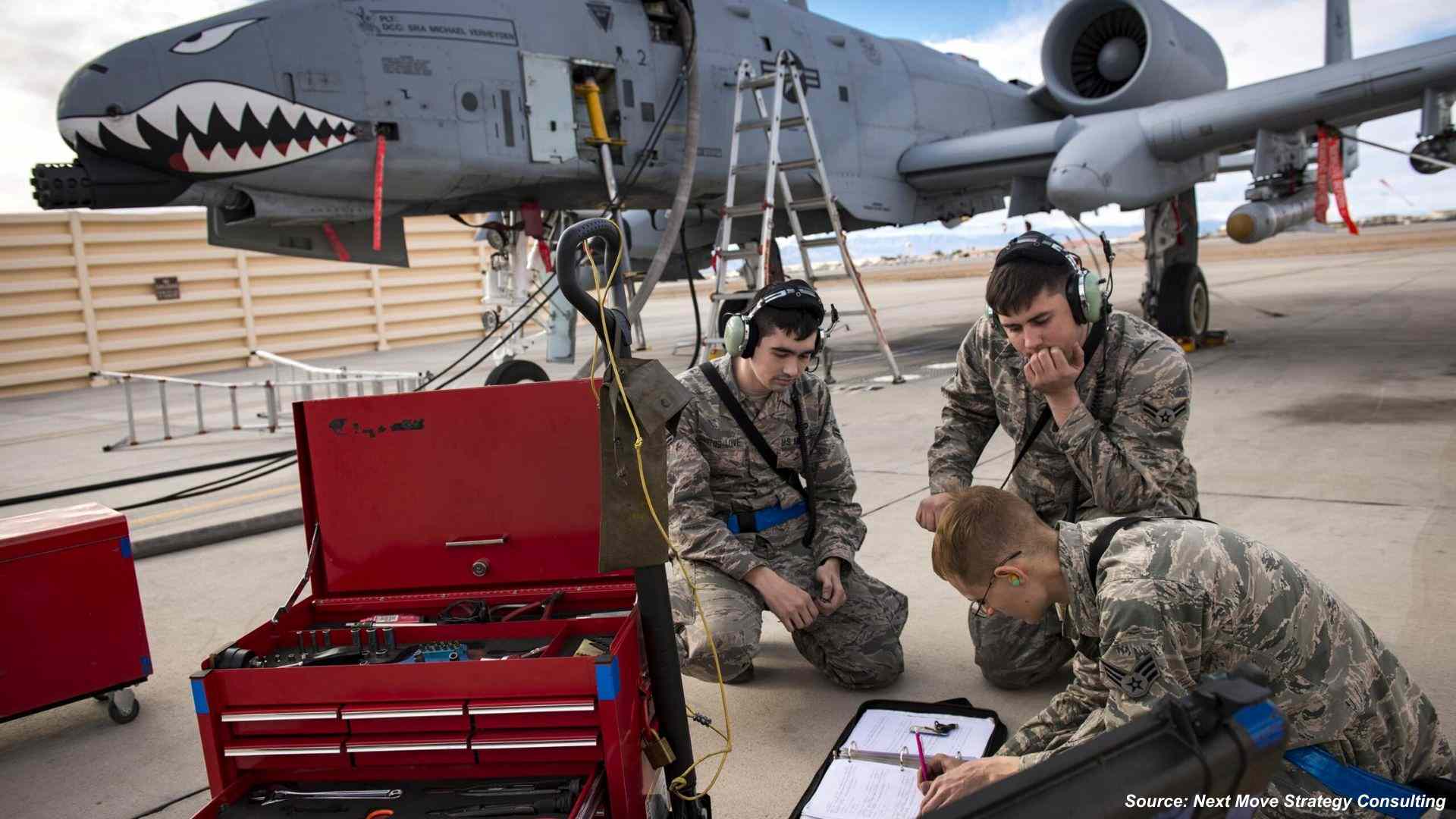
The global defense establishment is undergoing a fundamental transformation in how it sustains and maintains its most critical assets. Across air, land, naval, and space platforms, artificial intelligence is no longer a peripheral experiment — it is rapidly becoming the operational backbone of military readiness. The AI in Military Maintenance Market is at the center of this shift, enabling defense forces to move from reactive, schedule-driven maintenance cycles toward predictive and prescriptive models that anticipate failures before they occur, reduce unplanned downtime, and extend the operational life of high-value platforms.
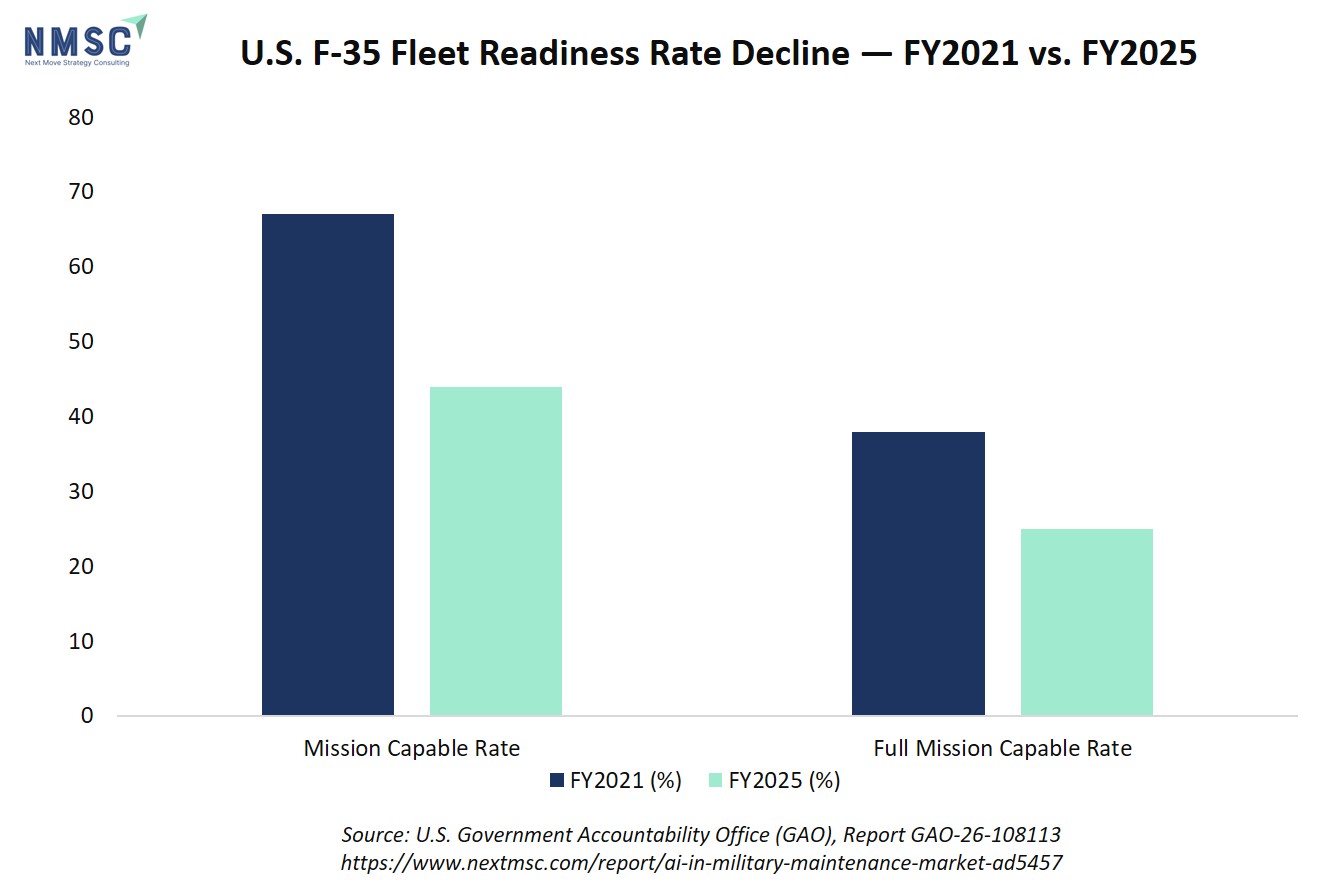
The urgency of this transition is underscored by a stark operational reality. According to Boston Consulting Group, mission-capable rates for defense aviation fleets in the United States, France, and Germany routinely fall below 70%, and in 2024, only one-third of the United Kingdom's F-35 fleet was fully mission capable. These figures represent not merely a maintenance challenge, but a strategic vulnerability — one that AI-driven sustainment solutions are uniquely positioned to address. As governments accelerate defense modernization budgets and formalize AI-first policy mandates, the AI in military maintenance market is entering a period of sustained, structurally reinforced growth that presents significant opportunities for investors, defense primes, and technology vendors alike.
For More Information: Download FREE Sample on AI in Military Maintenance Market Report
From Scheduled Downtime to Predictive Dominance: The Forces Reshaping Military Sustainment
A Policy-Driven Inflection Point
The most consequential development shaping the AI in military maintenance market in 2026 is not a single technology breakthrough — it is the convergence of high-level policy mandates with operational necessity. In January 2026, the U.S. Department of War issued its Artificial Intelligence Strategy, directing the Department to become an "AI-first" warfighting force across all components, from front to back. The strategy explicitly identifies AI-enabled capability development as a force that "will re-define the character of military affairs over the next decade," and establishes seven Pace-Setting Projects to accelerate AI integration across warfighting, intelligence, and enterprise domains.
This was followed in June 2026 by the White House's National Security Presidential Memorandum NSPM-11, which directed the national security enterprise to accelerate AI adoption across intelligence and warfighting domains, guided by four pillars: Adoption, Adaptation, Assurance, and Accountability. The memorandum explicitly states that "AI can help protect our warfighters during peacetime and on the battlefield, enable precise operations that minimize harm to civilians, and ensure the United States continues to maintain technical overmatch against our adversaries."
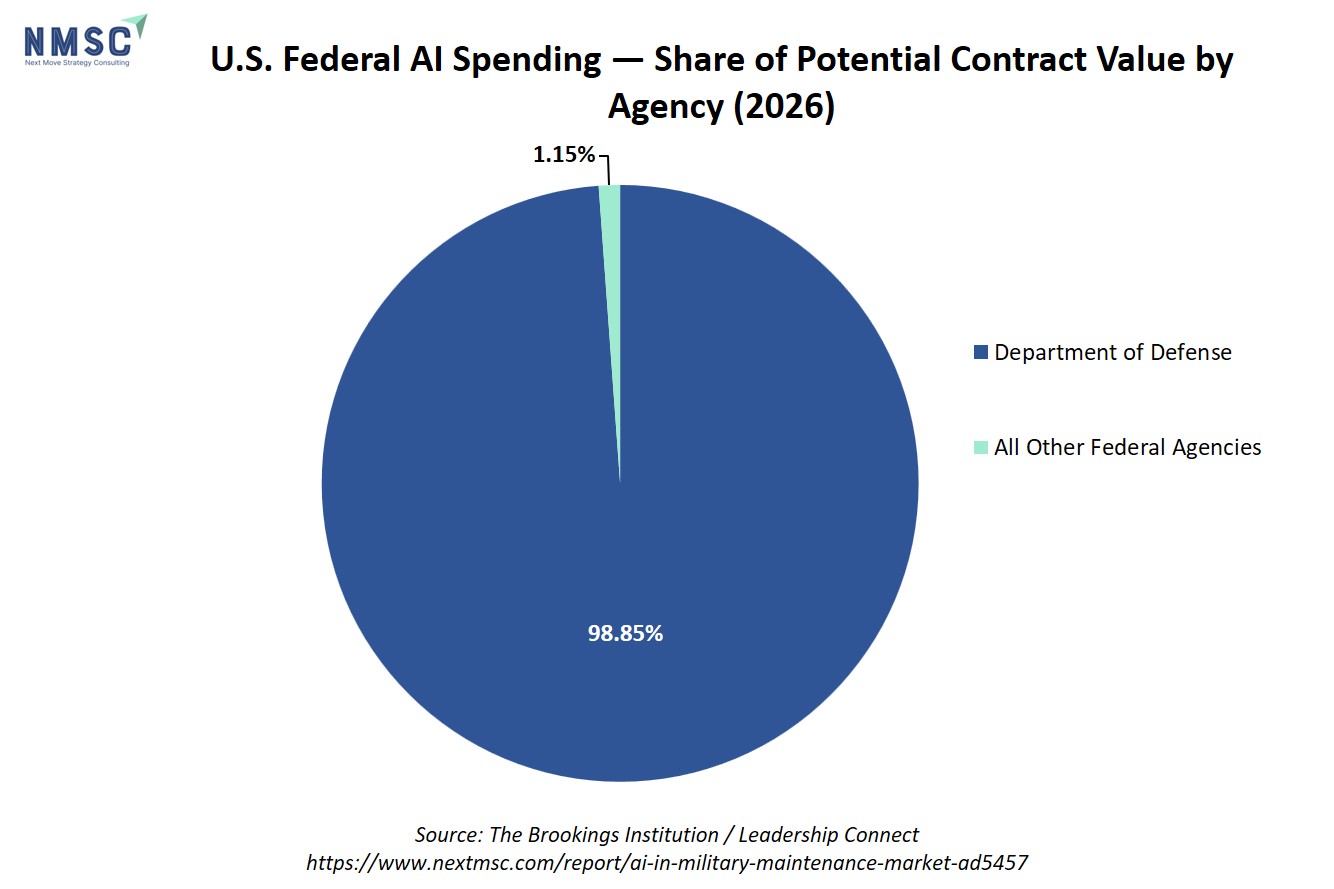
The financial scale of this commitment is equally significant. According to the Brookings Institution, the U.S. Department of Defense's potential value of AI contracts rose an extraordinary 1,605% from 2024 to 2026, reaching USD 90.7 billion — representing 98.9% of all federal AI spending. This concentration of investment signals that defense AI, including maintenance applications, is no longer a discretionary budget line — it is a strategic imperative.
Landmark Contracts Accelerating Market Momentum
The policy environment has translated directly into landmark commercial activity. In June 2026, Palantir Technologies secured a USD 10 billion, 10-year Enterprise Agreement with the U.S. Army to consolidate data infrastructure contracts, providing streamlined access to advanced data integration, predictive analytics, and AI tools to enhance military readiness and operational maintenance workflows. In March 2026, GE Aerospace and Palantir expanded their strategic partnership to scale agentic AI-powered solutions across military and commercial aviation, optimizing predictive maintenance, supply chain constraints, and aircraft readiness for the U.S. Air Force. In December 2025, Lockheed Martin and ManTech announced a strategic teaming agreement to integrate AI-driven sustainment solutions into the U.S. combat aircraft fleet, delivering real-time performance monitoring, predictive maintenance, and optimized logistics support.
NMSC Strategic Perspective
According to Next Move Strategy Consulting's analysis, defense primes and pure-play AI vendors are increasingly co-developing maintenance platforms under long-term sustainment contracts — a structural shift that favors vendors able to demonstrate measurable readiness improvements over those offering standalone analytics tools. The firm's research identifies the shift from scheduled to predictive and prescriptive maintenance postures as the primary growth driver, contributing an estimated +5.8% impact on the market's CAGR. Rising performance-based logistics contracting, which ties vendor payment directly to platform availability and readiness metrics rather than parts and labor hours, contributes an additional +4.9% CAGR impact.
NMSC further observes that defense sustainment budgets are shifting decisively toward predictive and prescriptive maintenance models, with readiness-linked contracting reinforcing structural demand across every platform category through 2035. This is not a cyclical trend — it is a policy-reinforced structural realignment of how defense forces allocate sustainment resources globally.
Section Summary: The AI in military maintenance market is being propelled by an unprecedented alignment of policy mandates, institutional investment, and landmark commercial contracts. The U.S. government's AI-first defense posture, formalized through the DoW AI Strategy and NSPM-11, has catalyzed a surge in defense AI spending that is directly benefiting the maintenance and sustainment segment.
Key Takeaways:
-
The U.S. DoD's potential AI contract value reached USD 90.7 billion in 2026, representing 98.9% of all federal AI spending.
-
NSPM-11 (June 2026) formally directed the national security enterprise to accelerate AI adoption across all warfighting and enterprise domains.
-
Palantir's USD 10 billion, 10-year U.S. Army Enterprise Agreement is the most significant single contract signal of AI's entrenchment in military sustainment.
-
Performance-based logistics contracting is structurally incentivizing vendors to invest in predictive capability, creating durable demand through 2035.
Industry Impact Analysis
Transforming Platform Readiness Across All Domains
The operational impact of AI in military maintenance extends across every platform category, but the effects are most immediately visible in defense aviation. Boston Consulting Group identifies three primary mechanisms through which AI improves defense aviation readiness: generative AI copilots for maintainers, AI-enabled supply chain control towers, and a shift from reactive to proactive sustainment through predictive maintenance solutions. Each of these mechanisms addresses a distinct constraint — workforce knowledge gaps, parts visibility failures, and unplanned downtime — that has historically suppressed mission-capable rates below operationally acceptable thresholds.
The workforce dimension is particularly acute. As BCG notes, older generations of maintainers with long tenure are retiring, and younger personnel struggle to navigate complex maintenance documentation that is often still distributed across disparate, paper-based sources. Generative AI platforms that synthesize technical manuals and maintenance logs into conversational troubleshooting guidance directly address this institutional knowledge gap, enabling less experienced maintainers to complete jobs correctly on the first pass.
The Digital Twin Revolution in Naval and Space Sustainment
Beyond aviation, digital twin technology is emerging as a transformative force in naval and space platform sustainment. Digital twin software simulates platform-specific wear patterns before physical inspection, allowing maintenance crews to prioritize high-risk components without requiring physical access — a capability that is operationally essential for submarines and satellites, where physical inspection is either extremely costly or physically impossible once assets are deployed.
Space platforms represent the most compelling case for AI-driven maintenance: once a satellite is in orbit, no physical intervention is possible. AI-based anomaly detection and remaining useful life estimation are therefore not efficiency tools for space assets — they are the only available maintenance mechanism. This operational reality explains why Space Platforms is the fastest-growing platform category in the AI in military maintenance market, projected at a 30.2% CAGR from 2026 to 2035.
Regulatory and Compliance Dynamics
The regulatory environment is simultaneously an accelerant and a constraint. The U.S. Department of Defense's Condition Based Maintenance Plus (CBM+) policy has formalized the transition to predictive maintenance as the default sustainment posture across services, reinforcing adoption faster than in comparable commercial markets that lack equivalent policy mandates. However, data classification and security clearance requirements for AI vendors processing classified operational data extend implementation timelines significantly, with NMSC estimating a −2.6% CAGR impact from this restraint, concentrated in North America and Europe.
NATO's data interoperability standards add a further layer of complexity for vendors seeking to serve allied forces, requiring maintenance platforms to support cross-border data sharing — a requirement that slows single-nation vendor lock-in while improving long-term multinational program compatibility.
Section Summary: AI in military maintenance is delivering measurable operational impact across aviation, naval, and space domains, addressing workforce knowledge gaps, parts visibility failures, and unplanned downtime. Policy frameworks such as CBM+ and NSPM-11 are accelerating adoption, while security clearance requirements and interoperability gaps introduce implementation friction that favors established defense primes over new entrants.
Key Takeaways:
-
Mission-capable rates for defense aviation fleets in the U.S., France, and Germany routinely fall below 70%, creating a structural demand case for AI-driven predictive maintenance.
-
Digital twin technology is gaining fastest adoption in naval and space platforms, where physical inspection access is limited or impossible.
-
The DoD's CBM+ policy formally mandates the shift to predictive maintenance, reinforcing adoption beyond what commercial market incentives alone would drive.
-
Security clearance compliance requirements impose a −2.6% CAGR drag, disproportionately affecting smaller AI vendors without established defense-sector infrastructure.
Pros and Cons of Recent Market Developments
|
Recent Development |
Pros |
Cons |
|
U.S. DoW AI-First Strategy & NSPM-11 (2026) |
Formalizes AI adoption across all defense domains; removes bureaucratic barriers to deployment; accelerates vendor onboarding timelines |
Classified annexes and security requirements extend compliance timelines; smaller vendors face disproportionate accreditation costs |
|
Palantir's USD 10B U.S. Army Enterprise Agreement |
Validates large-scale, long-term AI sustainment contracting; signals institutional confidence in AI-driven readiness platforms |
Concentration of contract value among a small number of vendors may limit competitive diversity and innovation from smaller players |
|
Performance-Based Logistics (PBL) Contracting Expansion |
Directly incentivizes vendors to invest in predictive capability; aligns vendor margins with platform readiness outcomes |
Requires vendors to absorb greater financial risk tied to readiness metrics; smaller vendors may lack capital to sustain PBL contract structures |
|
NATO Data Interoperability Standards |
Creates addressable demand for multinational maintenance platforms; reduces single-nation vendor lock-in |
Slows deployment timelines for vendors lacking cross-border data infrastructure; raises compliance costs for non-NATO-native vendors |
|
Generative AI for Technical Knowledge Management |
Reduces diagnostic time for complex systems; addresses institutional knowledge loss from retiring maintainers |
Requires extensive validation before deployment on classified systems; model accuracy must meet stringent defense-grade reliability standards |
|
Edge AI Deployment for Forward-Deployed Assets |
Enables real-time inference without continuous connectivity; critical for forward-deployed and space-based assets |
Higher infrastructure investment required; edge hardware must meet military-grade durability and security specifications |
Future Outlook & Forecast
A USD 18.85 Billion Market by 2035
According to Next Move Strategy Consulting, the global AI in military maintenance market was valued at USD 2.15 billion in 2025 and is estimated at USD 2.68 billion in 2026, with a forecast to reach USD 18.85 billion by 2035, expanding at a 24.2% CAGR between 2026 and 2035. The market is expected to create an absolute dollar opportunity of USD 16.17 billion between 2026 and 2035, presenting significant investment potential across predictive analytics, digital twin technology, and performance-based logistics contracting.
This trajectory is underpinned by structural, policy-driven demand rather than cyclical defense spending patterns, suggesting durable growth even under moderate variation in overall defense budget allocation across the forecast period.
Generative AI: The Fastest-Growing Technology Segment
Among AI technology sub-segments, Generative AI is projected to grow at a 34.1% CAGR from 2026 to 2035 — the fastest of any technology category within the market. This reflects the expanding deployment of large language models to convert dense technical manuals and maintenance logs into conversational troubleshooting guidance for field technicians, reducing diagnostic time for complex systems where institutional knowledge has historically been concentrated among a small number of experienced personnel.
Machine Learning currently holds the largest AI technology share at approximately 30% (USD 0.65 billion in 2025), reflecting its established role in condition monitoring, fault detection, and remaining useful life estimation across sensor-rich platform fleets.
Asia-Pacific: The Fastest-Growing Regional Market
Asia-Pacific is the fastest-growing regional market at a 26.9% CAGR from 2026 to 2035, driven by defense modernization programs in China, India, and Australia that are expanding fleet size faster than legacy maintenance infrastructure can scale manually. India is the fastest-growing individual country at a 29.6% CAGR — the highest of any country covered — supported by the Ministry of Defence's indigenous defense modernization initiatives and a rapidly expanding platform inventory.
A critical structural advantage in Asia-Pacific is that new-platform maintenance programs in the region are being designed AI-native from acquisition rather than retrofitted, favoring vendors with modern architecture over legacy defense maintenance software providers.
Deloitte's Broader Defense AI Investment Outlook
Corroborating the structural growth trajectory, Deloitte projects that U.S. aerospace and defense spending on AI and generative AI is expected to reach USD 5.8 billion by 2029 — 3.5 times higher than 2025 levels. This broader investment surge directly supports the AI in military maintenance segment, as sustainment and readiness applications represent a primary use case for defense AI investment across all major allied nations.
Section Summary: The AI in military maintenance market is on a structurally reinforced growth trajectory, with NMSC projecting a 24.2% CAGR from 2026 to 2035 and an absolute dollar opportunity of USD 16.17 billion. Generative AI and edge deployment are the fastest-growing technology and deployment sub-segments, while Asia-Pacific and India represent the highest-growth regional and country-level opportunities respectively.
Key Takeaways:
-
The global AI in military maintenance market is forecast to reach USD 18.85 billion by 2035 at a 24.2% CAGR, per NMSC.
-
Generative AI is the fastest-growing technology sub-segment at 34.1% CAGR, driven by technical knowledge management and field troubleshooting applications.
-
Asia-Pacific leads regional growth at 26.9% CAGR; India is the fastest-growing country at 29.6% CAGR.
-
U.S. A&D AI spending is projected to reach USD 5.8 billion by 2029, 3.5x higher than 2025 levels, per Deloitte.
Next Steps for Stakeholders
For C-Level Defense Executives and Program Leaders:
-
Prioritize CBM+ compliance as a competitive differentiator. The U.S. DoD's Condition Based Maintenance Plus policy is no longer optional — it is the default sustainment posture. Defense program leaders should audit current maintenance frameworks against CBM+ requirements and identify platform categories where AI-driven predictive capability can be deployed to demonstrate measurable readiness improvements within existing budget cycles.
-
Invest in security accreditation infrastructure early. Data classification and security clearance requirements represent the single largest restraint on AI vendor onboarding timelines. Organizations that invest in accredited, classification-compliant cloud and edge infrastructure now will hold a durable competitive advantage as procurement cycles accelerate through 2030.
-
Evaluate performance-based logistics contracting structures. PBL contracting aligns vendor incentives with platform readiness outcomes. Defense leaders should assess which platform categories are best suited for PBL structures and engage vendors with demonstrated predictive maintenance track records to structure contracts that reward measurable availability improvements.
For Investors and Financial Analysts:
-
Focus capital allocation on Space Force and naval digital twin sub-segments. These represent the strongest near-term return profiles within the AI in military maintenance market, supported by measurable readiness gains and expanding modernization budgets that are less exposed to near-term defense procurement delays.
-
Prioritize vendors with existing defense-sector accreditation. Security clearance infrastructure is a meaningful funding prerequisite in this market. Investors should favor vendors with established cleared infrastructure and reference-program proof points over commercial AI entrants lacking defense-sector track records.
-
Monitor Asia-Pacific defense modernization programs. India's 29.6% CAGR and the region's AI-native platform acquisition approach represent a high-growth opportunity for vendors with modern architecture and no legacy system dependencies.
For Technology Vendors and Product Teams:
-
Pursue prime contractor partnerships over standalone go-to-market strategies. The competitive landscape is anchored by large defense primes for contract ownership. Pure-play AI vendors that position as subcontracted software and analytics partners — rather than direct sustainment contract holders — will access the market more efficiently and with lower compliance overhead.
-
Develop edge AI capabilities for forward-deployed and space-based assets. Edge deployment is the fastest-growing deployment sub-segment at 29.3% CAGR. Vendors that can demonstrate inference capability on forward-deployed assets without continuous connectivity to central data centers will command a significant differentiation advantage in procurement evaluations.
Conclusion
The AI in military maintenance market represents one of the most structurally compelling investment and growth opportunities within the broader defense technology landscape. Driven by an unprecedented convergence of policy mandates — including the U.S. DoW's AI-First Strategy, NSPM-11, and the DoD's CBM+ framework — and landmark commercial contracts such as Palantir's USD 10 billion U.S. Army Enterprise Agreement, the market is transitioning from early-stage experimentation to large-scale, long-term deployment. The operational imperative is clear: with mission-capable rates for defense aviation fleets routinely below 70% across major allied nations, AI-driven predictive and prescriptive maintenance is no longer a discretionary capability — it is a strategic necessity.
According to Next Move Strategy Consulting, the global AI in military maintenance market is projected to grow from USD 2.68 billion in 2026 to USD 18.85 billion by 2035 at a 24.2% CAGR, creating an absolute dollar opportunity of USD 16.17 billion over the forecast period. The fastest-growing segments — Generative AI at 34.1% CAGR, Space Platforms at 30.2% CAGR, and Asia-Pacific at 26.9% CAGR — point to where the most significant value creation will occur. Stakeholders who align their investment, product, and partnership strategies with these structural growth vectors, while building the security accreditation infrastructure that defense procurement demands, are best positioned to capture disproportionate share of this expanding market through 2035.
About the Author
 Sanyukta Deb
— Sanyukta Deb is Digital Marketing Team Lead at Next Move Strategy Consulting, where she has led content strategy and technical SEO for the firm's B2B market research publications for over 2 years. Her editorial process translates NextMSC's primary and secondary research — spanning technology, industrial, and consumer sectors — into commercial narratives, backed by search-intent, keyword, and competitive analysis. She brings 5 years of overall experience in digital marketing and content strategy.
Sanyukta Deb
— Sanyukta Deb is Digital Marketing Team Lead at Next Move Strategy Consulting, where she has led content strategy and technical SEO for the firm's B2B market research publications for over 2 years. Her editorial process translates NextMSC's primary and secondary research — spanning technology, industrial, and consumer sectors — into commercial narratives, backed by search-intent, keyword, and competitive analysis. She brings 5 years of overall experience in digital marketing and content strategy.
About the Reviewer
 Debashree Dey
— Debashree Dey is Assistant Manager at Next Move Strategy Consulting, where she supports cross-vertical market content and communications across diverse industries for 6 years. Her professional background includes senior content writing, communications, and published manuscript authorship, with experience developing audience-focused business narratives and maintaining clear, consistent messaging. Her role supports research-led content development and editorial quality across NextMSC publications.
Debashree Dey
— Debashree Dey is Assistant Manager at Next Move Strategy Consulting, where she supports cross-vertical market content and communications across diverse industries for 6 years. Her professional background includes senior content writing, communications, and published manuscript authorship, with experience developing audience-focused business narratives and maintaining clear, consistent messaging. Her role supports research-led content development and editorial quality across NextMSC publications.














Add Comment