AI in Military Maintenance Market Size, Share, Trends and Growth Analysis, By Offering (Software, Platforms, and Services), By AI Technology, By Deployment, By Maintenance Application, By Platform (Air, Land, Naval, Space, Missile Systems, C4ISR Systems, and Ground Support Equipment), By Contract Model (Software License, Software Subscription, Professional Services and others), By End User, and Region — Global Industry Report and Forecast, 2026–2035
What Is the AI in Military Maintenance Market Size?
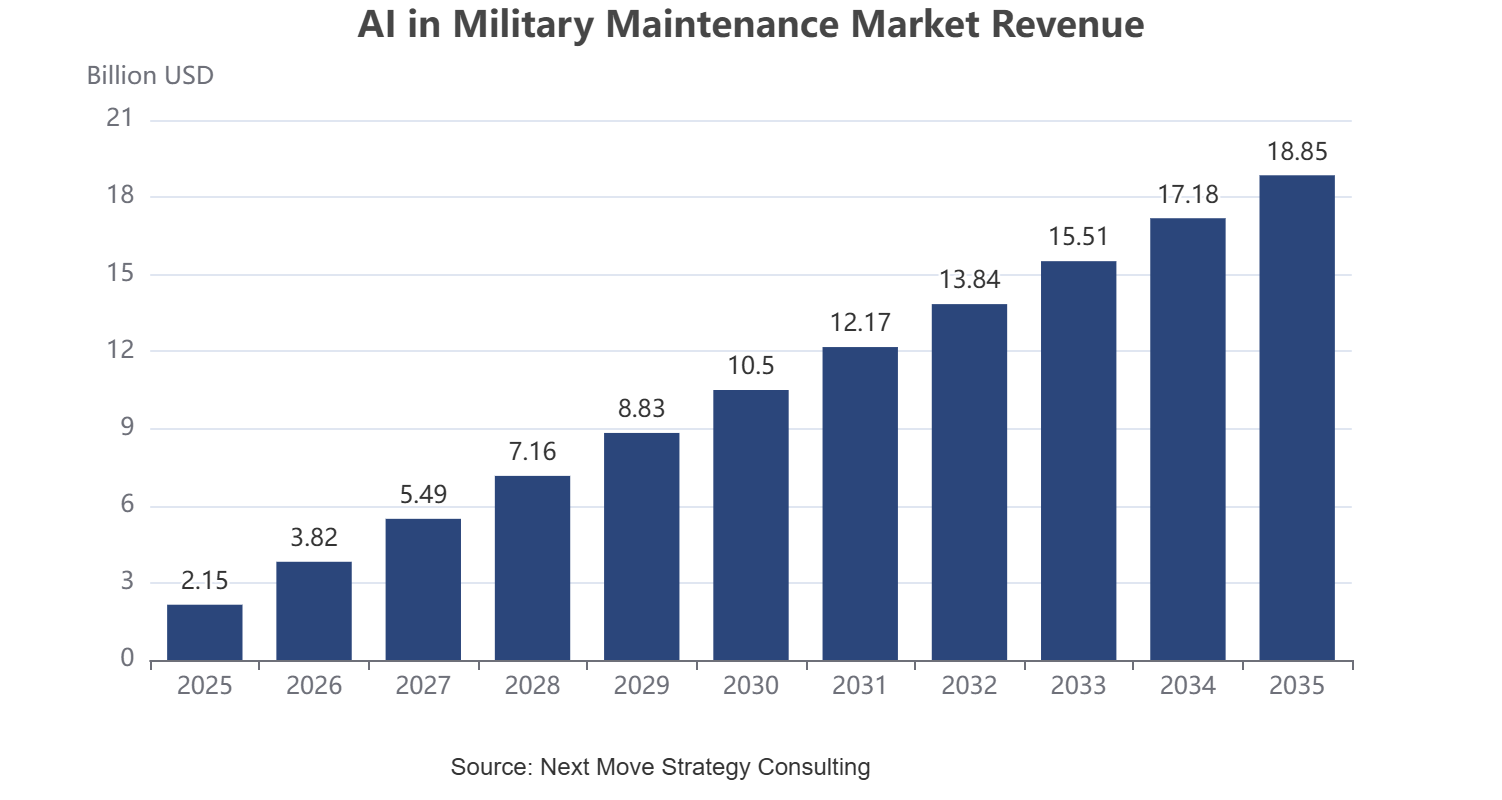
The global AI in Military Maintenance market size was valued at USD 2.15 Billion in 2025 and is estimated at USD 2.68 Billion in 2026, forecast to reach USD 18.85 Billion by 2035, expanding at a 24.2% CAGR between 2026 and 2035. North America leads with approximately 44% share, while Software offerings dominate all other segments with approximately 42% share.
We observed that defense sustainment budgets are shifting decisively toward predictive and prescriptive maintenance models, with readiness-linked contracting reinforcing structural demand across every platform category through 2035.
|
Key Takeaways |
|
By Offering: Software held the largest share of approximately 42% (USD 0.90 Billion) in 2025; Platforms is the fastest-growing sub-segment at 25.9% CAGR from 2026–2035. |
|
By AI Technology: Machine Learning held the largest share of approximately 30% (USD 0.65 Billion) in 2025; Generative AI is the fastest-growing sub-segment at 34.1% CAGR from 2026–2035. |
|
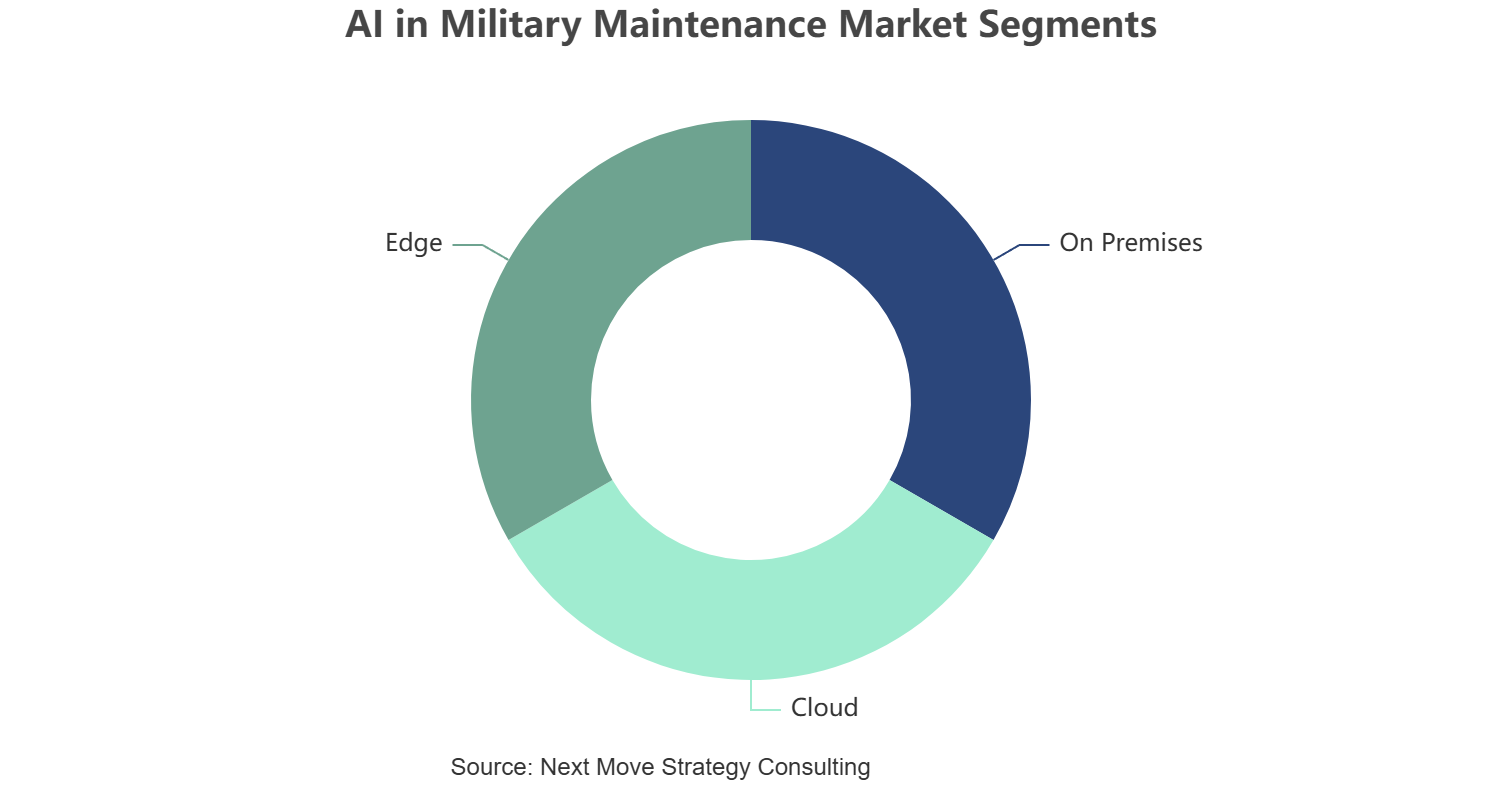
By Deployment: Cloud held the largest share of approximately 48% (USD 1.03 Billion) in 2025; Edge is the fastest-growing sub-segment at 29.3% CAGR from 2026–2035. |
|
By Maintenance Application: Predictive Maintenance held the largest share of approximately 26% (USD 0.56 Billion) in 2025; Prescriptive Maintenance is the fastest-growing sub-segment at 31.4% CAGR from 2026–2035. |
|
By Platform: Air Platforms held the largest share of approximately 34% (USD 0.74 Billion) in 2025; Space Platforms is the fastest-growing sub-segment at 30.2% CAGR from 2026–2035. |
|
By Contract Model: Performance Based Logistics held the largest share of approximately 29% (USD 0.62 Billion) in 2025; Long Term Sustainment Contracts is the fastest-growing sub-segment at 26.8% CAGR from 2026–2035. |
|
By End User: Army held the largest share of approximately 30% (USD 0.65 Billion) in 2025; Space Force is the fastest-growing sub-segment at 30.0% CAGR from 2026–2035. |
|
Dominant Region: North America dominated with approximately 44% revenue share (USD 0.95 Billion) in 2025. |
|
Fastest-Growing Region: Asia-Pacific is expected to register the highest CAGR of 26.9% during 2026–2035. |
|
Dominant Country: U.S. led with approximately USD 0.72 Billion in 2025. |
|
Fastest-Growing Country: India is the fastest-growing country at approximately 29.6% CAGR from 2026–2035. |
Market Opportunity: The AI in Military Maintenance market is expected to create an absolute dollar opportunity of USD 16.17 Billion between 2026 and 2035, presenting significant investment potential across predictive analytics, digital twin, and performance based logistics contracting.
According to Next Move Strategy Consulting analysis, defense primes and pure-play AI vendors are increasingly co-developing maintenance platforms under long term sustainment contracts, a structural shift that favors vendors able to demonstrate measurable readiness improvements over those offering standalone analytics tools.
What Does the AI in Military Maintenance Market Encompass?
The AI in Military Maintenance market encompasses software, platforms, and services that apply machine learning, computer vision, and related AI technologies to predict, plan, and optimize maintenance across air, land, naval, space, and missile defense assets. Our assessment indicates that the scope extends the broader AI in Military and Defense Market into a maintenance-specific discipline covering condition monitoring, fault detection, remaining useful life estimation, and automated inspection for defense platform sustainment.
Regulatory frameworks such as the U.S. Department of Defense's Condition Based Maintenance Plus policy and NATO's data interoperability standards shape how maintenance data is collected, shared, and acted upon across allied forces. We observed that technology adoption is shifting toward edge-deployed inference for forward-deployed assets with limited connectivity. Next Move Strategy Consulting's analysis indicates that this shift, combined with performance based logistics contracting, is redefining how defense sustainment budgets are allocated across the market.
|
Parameters |
Details |
|
Market Size in 2025 |
USD 2.15 Billion |
|
Market Size in 2026 |
USD 2.68 Billion |
|
Revenue Forecast in 2035 |
USD 18.85 Billion |
|
Growth Rate |
CAGR of 24.2% from 2026 to 2035 |
|
Analysis Period |
2025–2035 |
|
Base Year Considered |
2025 |
|
Forecast Period |
2026–2035 |
|
Market Size Estimation |
Revenue (USD Billion) |
|
Companies Profiled |
18 |
|
Countries Covered |
33 |
|
Market Share |
Available for Top 10 Companies |
Key Emerging Trends
Our findings suggest that the AI in Military Maintenance market is being reshaped by four structural trends transforming how defense forces sustain platform readiness.
How Is Digital Twin Technology Transforming Platform Sustainment?
Digital twin software is increasingly used to simulate platform-specific wear patterns before physical inspection, allowing maintenance crews to prioritize high-risk components. We observed that this approach is gaining adoption fastest among naval surface combatants and submarines, where physical inspection access is limited and costly. This trend builds directly on capability advances already visible in the broader Digital Twin Market, now being adapted specifically for defense sustainment use cases.
Why Are Defense Forces Adopting Predictive Maintenance Over Scheduled Maintenance?
Defense forces are moving away from fixed-interval scheduled maintenance toward condition-based and predictive approaches that reduce unnecessary part replacement and unplanned downtime. We observed that this shift is most advanced in fixed wing aircraft fleets, where sensor-rich platforms generate sufficient data for reliable failure prediction. The U.S. Department of Defense's Condition Based Maintenance Plus policy has formalized this transition, reinforcing predictive maintenance as the default sustainment posture across services.
How Is Generative AI Supporting Technical Knowledge Management?
Generative AI is being deployed to convert dense technical manuals and maintenance logs into conversational troubleshooting guidance for field technicians. Our analysis shows that this reduces diagnostic time for complex systems where institutional knowledge has historically been concentrated among a small number of experienced personnel. Palantir Technologies Inc. and IBM Corporation have both expanded natural language processing capabilities within maintenance knowledge platforms supporting this shift.
What Role Do Unmanned Systems Play in Automated Inspection?
Unmanned aerial and maritime systems are increasingly used to conduct automated visual inspection of hard-to-access platform components, such as aircraft fuselage exteriors and ship hulls. Our findings suggest that this reduces inspection time relative to manual methods while improving defect detection consistency. Demand for these capabilities is closely linked to broader growth already observed in the Military Drone Market, which is expanding inspection-capable unmanned platform fleets across allied forces.
Ecosystem Analysis of the AI in Military Maintenance Market
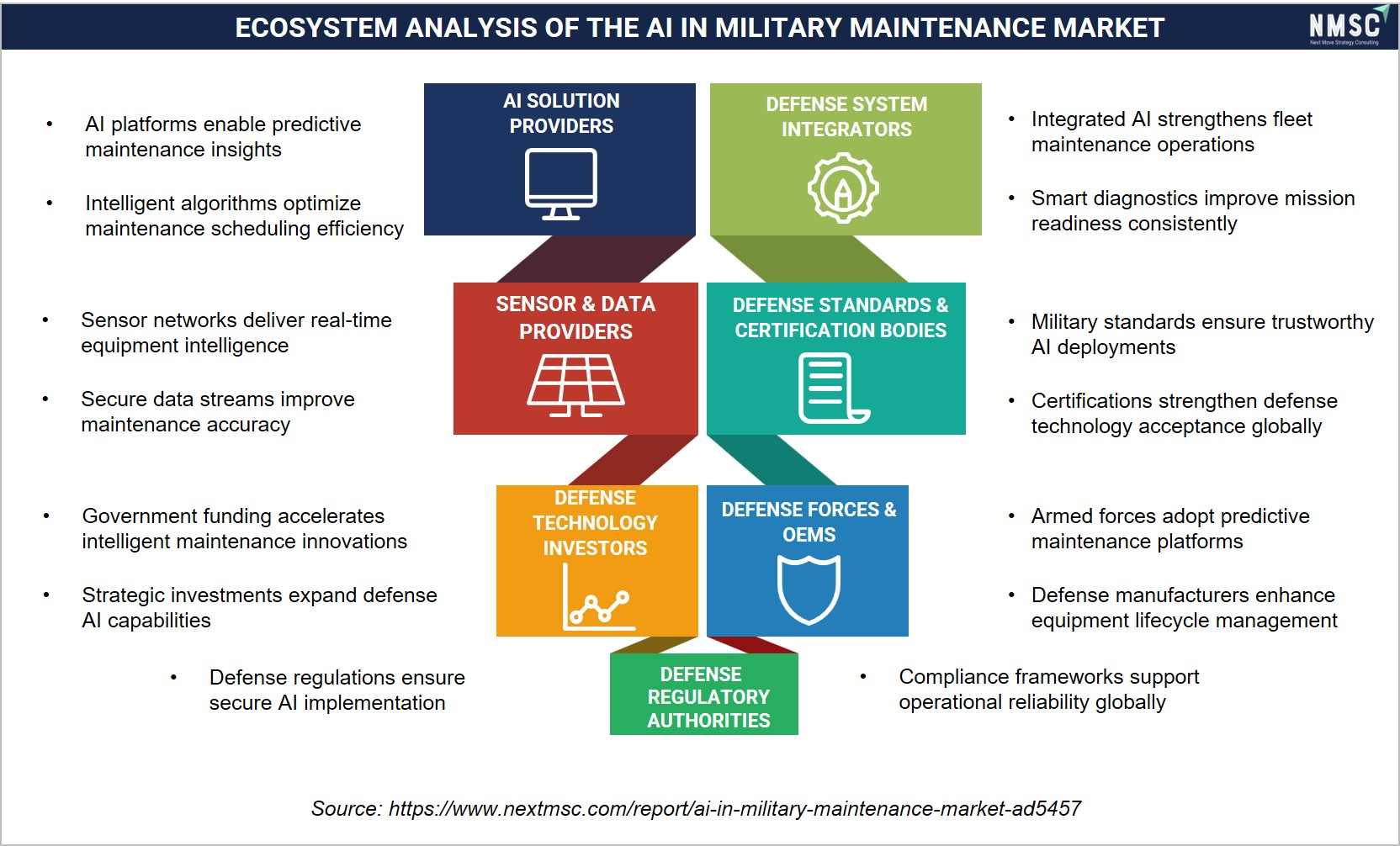
Based on our ecosystem assessment, we observed that AI solution providers, defense system integrators, sensor and data providers, certification bodies, defense technology investors, OEMs, and regulatory authorities collectively strengthen the AI in military maintenance market. Moreover, our industry evaluation indicates that strategic collaboration across technology development, system integration, certification, and defense modernization initiatives accelerates AI deployment, enhances predictive maintenance capabilities, and improves operational readiness across military platforms.
Growth Drivers & Restraints
Growth Catalyst & Risk Assessment Matrix
|
Factors |
Type |
(+/−) % Impact on CAGR |
Geographic Relevance |
Impact Timeline |
|
Shift from scheduled to predictive and prescriptive maintenance postures |
Driver |
+5.8% |
Global |
2026–2035 |
|
Rising performance based logistics and long term sustainment contracting |
Driver |
+4.9% |
North America, Europe |
2026–2033 |
|
Expansion of edge AI for forward-deployed asset monitoring |
Driver |
+4.1% |
Global |
2027–2035 |
|
Growing defense modernization budgets in Asia-Pacific |
Driver |
+3.4% |
Asia-Pacific |
2026–2035 |
|
Adoption of digital twin simulation for naval and space platforms |
Driver |
+2.9% |
North America, Europe |
2027–2034 |
|
Data classification and security clearance requirements for AI vendors |
Restraint |
−2.6% |
North America, Europe |
2026–2032 |
|
Legacy platform sensor retrofitting costs |
Restraint |
−2.2% |
Global |
2026–2031 |
|
Shortage of cleared AI and data science talent |
Restraint |
−1.8% |
North America, Europe |
2026–2029 |
|
Interoperability gaps across allied maintenance data standards |
Restraint |
−1.4% |
Europe, Asia-Pacific |
2027–2035 |
What Is the Primary Growth Driver of the AI in Military Maintenance Market?
The primary growth driver is the structural shift from scheduled to predictive and prescriptive maintenance postures across defense fleets. Our findings suggest that this shift is directly reinforced by policy, as the U.S. Department of Defense's Condition Based Maintenance Plus framework requires services to justify continued reliance on fixed-interval maintenance. This regulatory reinforcement is accelerating adoption faster than in comparable commercial predictive maintenance markets lacking equivalent policy mandates.
How Is Performance Based Logistics Contracting Driving AI in Military Maintenance Market Growth?
Performance based logistics contracting is driving growth by tying vendor payment directly to platform availability and readiness metrics rather than parts and labor hours. We observed that this model incentivizes vendors to invest in predictive capability, since improved failure prediction directly improves contract margins. The U.S. Department of Defense's sustainment guidance has expanded performance based logistics use across multiple platform categories, reinforcing this contracting model as a durable growth driver.
What Is Restraining the AI in Military Maintenance Market?
Data classification and security clearance requirements are restraining faster vendor onboarding, since AI maintenance platforms processing classified operational data require extensive accreditation before deployment. Our assessment indicates that this extends implementation timelines significantly relative to commercial AI deployments. Smaller specialized AI vendors face proportionally higher compliance costs than large defense primes with established security infrastructure, slowing broader market entry despite strong underlying demand.
Segmentation Analysis
Segment Sizing: By Offering
|
Segment |
2025 (USD Billion) |
2035 (USD Billion) |
CAGR% (2026–2035) |
|
Software |
0.90 |
7.54 |
23.5% |
|
Platforms |
0.52 |
5.09 |
25.9% |
|
Services |
0.73 |
6.22 |
23.8% |
|
Total |
2.15 |
18.85 |
24.2% |
Which Offering Dominates the AI in Military Maintenance Market?
Software dominates with approximately 42% share in 2025, valued at USD 0.90 Billion, as defense forces prioritize analytics, monitoring, and planning software that integrates with existing platform sensor infrastructure. Platforms is the fastest-growing sub-segment at 25.9% CAGR through 2035, reflecting rising demand for consolidated asset performance management and enterprise AI maintenance platforms that replace fragmented single-purpose software tools across multiple platform categories.
Segment Sizing: By Platform
|
Segment |
2025 (USD Billion) |
2035 (USD Billion) |
CAGR% (2026–2035) |
|
Air Platforms |
0.74 |
5.65 |
22.5% |
|
Land Platforms |
0.47 |
3.77 |
22.9% |
|
Naval Platforms |
0.39 |
3.39 |
24.3% |
|
Space Platforms |
0.17 |
2.26 |
30.2% |
|
Missile Systems |
0.13 |
1.32 |
26.4% |
|
C4ISR Systems |
0.19 |
1.89 |
25.8% |
|
Ground Support Equipment |
0.06 |
0.57 |
25.3% |
|
Total |
2.15 |
18.85 |
24.2% |
Which Platform Category Leads Adoption?
Air Platforms lead with approximately 34% share in 2025, valued at USD 0.74 Billion, reflecting the sensor density and long-established maintenance data history of fixed wing and rotary wing fleets. Space Platforms is the fastest-growing category at 30.2% CAGR through 2035, as satellite operators adopt AI-based anomaly detection to manage assets that cannot receive physical maintenance once deployed, making predictive capability operationally essential rather than optional.
Segment Sizing: By End User
|
Segment |
2025 (USD Billion) |
2035 (USD Billion) |
CAGR% (2026–2035) |
|
Army |
0.65 |
5.08 |
22.8% |
|
Navy |
0.47 |
3.96 |
23.6% |
|
Air Force |
0.60 |
5.09 |
23.7% |
|
Marine Corps |
0.17 |
1.51 |
24.5% |
|
Space Force |
0.13 |
1.70 |
30.0% |
|
Joint Defense Organizations |
0.13 |
1.51 |
28.3% |
|
Total |
2.15 |
18.85 |
24.2% |
Which End User Segment Is Growing Fastest?
Army holds the largest share at approximately 30% in 2025, valued at USD 0.65 Billion, reflecting its comparatively larger platform inventory across land vehicles and support equipment. Space Force is the fastest-growing end user at 30.0% CAGR through 2035, consistent with expanding satellite constellations and ground control infrastructure that require continuous AI-based monitoring given the impossibility of physical maintenance intervention once assets are in orbit.
Growth Opportunities
Our analysis shows three whitespace opportunities where platform vendors can capture disproportionate share as defense sustainment modernizes.
Can Space Force Present a Disproportionate Growth Channel for Vendors?
Space Force represents a comparatively small but fastest-growing end user segment, with limited legacy maintenance infrastructure creating fewer displacement barriers than Army or Air Force accounts. Palantir Technologies Inc. and C3.ai, Inc. are positioned to benefit from purpose-built satellite and ground control monitoring platforms tailored to this segment's unique operational constraints.
Does Naval Digital Twin Adoption Represent an Underserved Opportunity?
Naval platforms remain comparatively underserved by digital twin adoption relative to air platforms, given limited physical inspection access for submarines and surface combatants. Huntington Ingalls Industries, Inc. and BAE Systems plc are positioned to capture this segment as fleet sustainment programs increasingly require simulation-based inspection prioritization.
Can Allied Nation Interoperability Standards Expand Addressable Demand?
Emerging NATO data interoperability standards create whitespace for vendors offering maintenance platforms compatible across allied forces rather than single-nation deployments. Thales S.A. and L3Harris Technologies, Inc. are positioned to benefit as multinational sustainment programs prioritize cross-border data-sharing compatibility over single-customer solutions.
Regional Outlook
|
Region |
2025 (USD Billion) |
2035 (USD Billion) |
CAGR% (2026–2035) |
Key Driver |
|
North America |
0.95 |
7.16 |
22.2% |
Condition Based Maintenance Plus policy adoption |
|
Europe |
0.56 |
4.90 |
24.1% |
NATO interoperability and sustainment modernization |
|
Asia-Pacific |
0.41 |
4.34 |
26.9% |
Defense modernization and fleet expansion |
|
Middle East & Africa |
0.17 |
1.70 |
26.2% |
Platform readiness and sustainment digitization |
|
Latin America |
0.06 |
0.75 |
29.2% |
Fleet modernization procurement programs |
|
Total |
2.15 |
18.85 |
24.2% |
— |
North America AI in Military Maintenance Market
North America is the most mature market for AI in military maintenance, anchored by U.S. Department of Defense sustainment modernization programs. Our assessment indicates that the region benefits from formalized condition-based maintenance policy and a deep base of cleared AI talent, though security accreditation requirements extend implementation timelines. Strategic outlook favors vendors with existing defense prime relationships over new entrants lacking cleared infrastructure through 2035.
Europe AI in Military Maintenance Market
Europe's market is shaped by NATO data interoperability standards requiring maintenance platforms to support cross-border allied data sharing. We observed that this requirement is slowing single-nation vendor lock-in while improving long-term multinational program compatibility. The UK, Germany, and France lead regional deployment, with joint procurement programs accelerating platform standardization across allied maintenance infrastructure.
Asia-Pacific AI in Military Maintenance Market
Asia-Pacific is the fastest-growing region as defense modernization programs in China, India, and Australia expand fleet size faster than legacy maintenance infrastructure can scale manually. Based on research conducted by Next Move Strategy Consulting, we found that new-platform maintenance programs in the region are being designed AI-native from acquisition rather than retrofitted, favoring vendors with modern architecture over legacy defense maintenance software providers.
Middle East & Africa AI in Military Maintenance Market
Middle East & Africa is undergoing accelerated sustainment digitization as defense modernization programs in Saudi Arabia and the UAE prioritize platform readiness investment. Our findings suggest that South Africa's more established defense industrial base is adopting condition monitoring tools fastest within the region, while Gulf markets prioritize enterprise AI maintenance platform deployment tied to broader defense procurement modernization.
Latin America AI in Military Maintenance Market
Latin America's market is driven by fleet modernization procurement programs in Brazil and Argentina prioritizing readiness improvement for aging platform inventories. We observed that regional defense budgets favor cost-efficient predictive maintenance software over full platform replacement, favoring vendors offering retrofit-compatible monitoring solutions over vendors requiring extensive new sensor infrastructure investment.
U.S. AI in Military Maintenance Market
Based on our estimates… the U.S. AI in Military Maintenance market was valued at approximately USD 0.72 Billion in 2025 and is projected to reach approximately USD 5.24 Billion by 2035 at a CAGR of 22.0%. Demand is concentrated among all six branches under Condition Based Maintenance Plus policy, with high technology penetration and strong regulatory clarity from the Department of Defense supporting sustained, competitively intense vendor selection cycles through 2035.
Canada AI in Military Maintenance Market
The market in… Canada is valued at approximately USD 0.11 Billion in 2025, projected to reach approximately USD 0.83 Billion by 2035 at a CAGR of 22.3%. Adoption is concentrated among Royal Canadian Air Force and Navy fleet sustainment programs, with moderate technology penetration and a regulatory environment shaped by the Department of National Defence supporting steady platform modernization through 2035.
UK AI in Military Maintenance Market
As per our estimate… the UK market was valued at approximately USD 0.18 Billion in 2025, projected to reach approximately USD 1.62 Billion by 2035 at a CAGR of 24.6%. The UK Ministry of Defence's sustainment digitization initiatives and strong domestic defense industrial base support high technology penetration, with competitive intensity concentrated among vendors serving both Royal Navy and Royal Air Force platform categories through 2035.
Germany AI in Military Maintenance Market
According to our analysis… Germany was valued at approximately USD 0.13 Billion in 2025, projected to reach approximately USD 1.14 Billion by 2035 at a CAGR of 24.4%. Demand structure favors land platform maintenance software among Bundeswehr modernization programs, with the Federal Ministry of Defence's digitization strategy shaping steady adoption and strong competitive intensity among European and domestic vendors through 2035.
France AI in Military Maintenance Market
Based on our estimates… France was valued at approximately USD 0.10 Billion in 2025, projected to reach approximately USD 0.89 Billion by 2035 at a CAGR of 24.3%. Regulatory influence from the Ministère des Armées shapes sustainment digitization requirements, while strong domestic defense industrial capacity and steady procurement modernization support a strategic outlook favoring vendors with proven naval and air platform maintenance capability through 2035.
China AI in Military Maintenance Market
The market in… China was valued at approximately USD 0.14 Billion in 2025, projected to reach approximately USD 1.79 Billion by 2035 at a CAGR of 29.0%. Rapid fleet expansion across air and naval platforms and strong state-directed defense modernization investment support high technology penetration, with competitive activity concentrated among domestic defense industrial vendors serving large-scale platform sustainment programs through 2035.
India AI in Military Maintenance Market
As per our estimate… India was valued at approximately USD 0.06 Billion in 2025, projected to reach approximately USD 0.80 Billion by 2035 at a CAGR of 29.6%, the fastest of any country covered. The Ministry of Defence's indigenous defense modernization initiatives and rapidly expanding platform inventory support high adoption velocity among both established defense vendors and emerging domestic AI providers through 2035.
Japan AI in Military Maintenance Market
According to our analysis… Japan was valued at approximately USD 0.05 Billion in 2025, projected to reach approximately USD 0.50 Billion by 2035 at a CAGR of 25.9%. Demand is concentrated among Japan Self-Defense Forces modernizing maritime and air platform sustainment, with moderate technology penetration and a cautious regulatory posture from the Ministry of Defense supporting steady, incremental platform adoption through 2035.
South Korea AI in Military Maintenance Market
Based on our estimates… South Korea was valued at approximately USD 0.04 Billion in 2025, projected to reach approximately USD 0.45 Billion by 2035 at a CAGR of 27.4%. High technology penetration and strong government support for defense AI adoption from the Defense Acquisition Program Administration support competitive intensity among domestic and international vendors targeting land and air platform sustainment through 2035.
Australia AI in Military Maintenance Market
The market in… Australia was valued at approximately USD 0.03 Billion in 2025, projected to reach approximately USD 0.32 Billion by 2035 at a CAGR of 26.7%. The Department of Defence's sustainment modernization programs shape platform governance requirements, while moderate technology penetration among naval and air platform fleets supports steady demand for predictive maintenance software through 2035.
UAE AI in Military Maintenance Market
As per our estimate… the UAE was valued at approximately USD 0.05 Billion in 2025, projected to reach approximately USD 0.53 Billion by 2035 at a CAGR of 26.1%. Strong government-led defense modernization investment and the UAE Ministry of Defence's readiness improvement initiatives support high technology penetration among regional and international defense contractors operating from the country through 2035.
Saudi Arabia AI in Military Maintenance Market
According to our analysis… Saudi Arabia was valued at approximately USD 0.06 Billion in 2025, projected to reach approximately USD 0.62 Billion by 2035 at a CAGR of 26.3%. The Saudi Ministry of Defence's platform readiness mandates under national defense modernization programs support rising technology penetration, with strategic outlook favoring vendors offering localized sustainment infrastructure and training capability through 2035.
South Africa AI in Military Maintenance Market
Based on our estimates… South Africa was valued at approximately USD 0.02 Billion in 2025, projected to reach approximately USD 0.24 Billion by 2035 at a CAGR of 27.0%. The Department of Defence's sustainment digitization guidance and a relatively established domestic defense industrial base support moderate technology penetration, with condition monitoring tools seeing the strongest regional adoption through 2035.
Brazil AI in Military Maintenance Market
The market in… Brazil was valued at approximately USD 0.03 Billion in 2025, projected to reach approximately USD 0.42 Billion by 2035 at a CAGR of 28.7%. The Ministério da Defesa's fleet modernization programs support rising technology penetration, with predictive maintenance for aging air and naval platform inventories driving the strongest regional demand segment through 2035.
Argentina AI in Military Maintenance Market
As per our estimate… Argentina was valued at approximately USD 0.01 Billion in 2025, projected to reach approximately USD 0.16 Billion by 2035 at a CAGR of 28.3%. Moderate technology penetration among land and air platform fleets and a developing regulatory framework from the Ministerio de Defensa support gradual platform adoption, with strategic outlook favoring cost-efficient, retrofit-compatible deployment models through 2035.
Strategic Framework of the AI in Military Maintenance Market
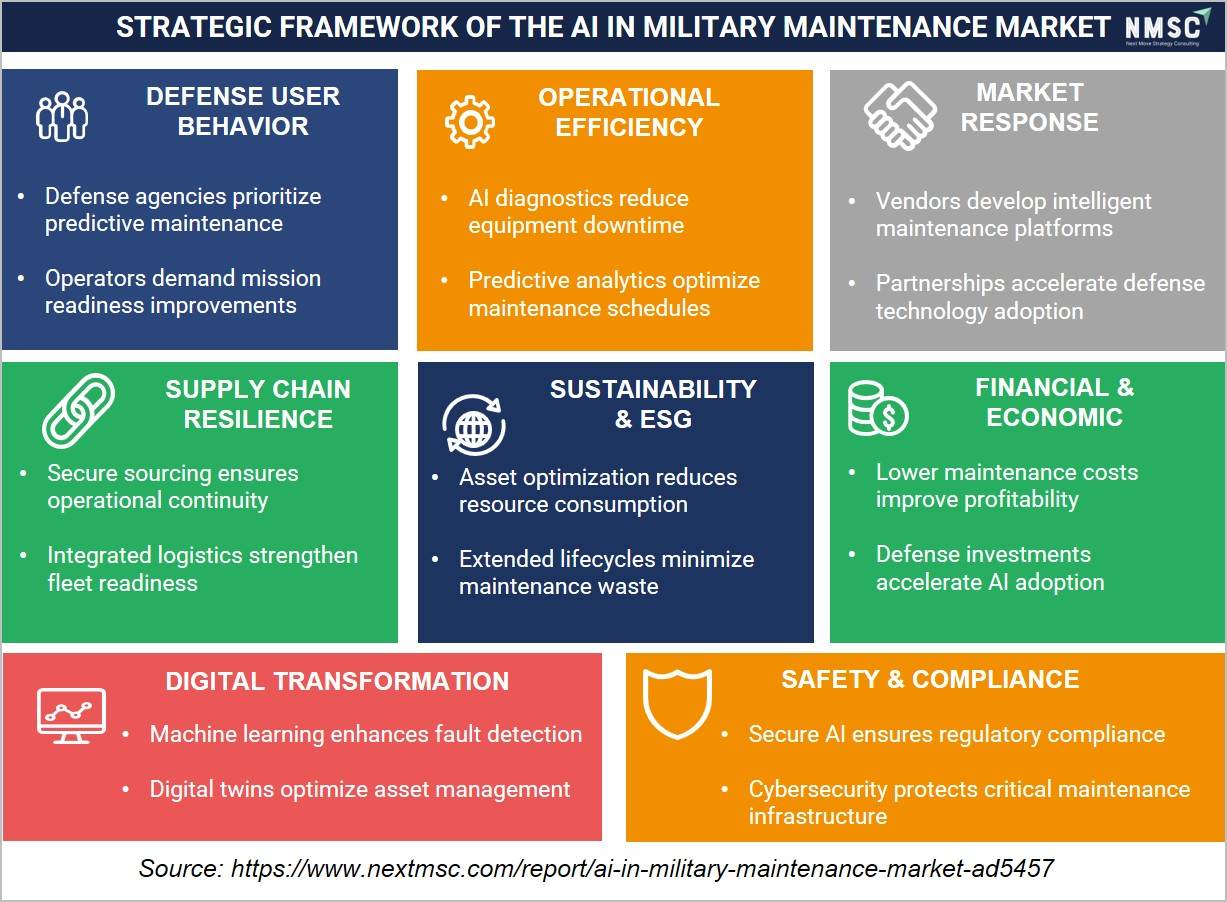
Based on our strategic assessment, we identified that defense agencies increasingly prioritize predictive maintenance, while AI-driven diagnostics, digital twins, secure maintenance platforms, resilient supply chains, and cybersecurity collectively enhance mission readiness and operational efficiency. Furthermore, our industry analysis indicates that sustained defense investments and digital transformation initiatives accelerate AI adoption, optimize lifecycle maintenance, strengthen regulatory compliance, and improve long-term military asset performance.
Competitive Landscape
Our analysis shows that the competitive landscape remains anchored by large defense primes, with pure-play AI vendors competing primarily as subcontracted software and analytics partners rather than direct sustainment contract holders.
|
Dimension |
Description |
|
Market Structure |
Concentrated among defense primes for contract ownership, with pure-play AI vendors competing as software and analytics subcontractors |
|
Innovation Focus |
Predictive analytics, digital twin simulation, and edge AI for forward-deployed and space-based assets |
|
M&A Activity |
Moderate and rising, concentrated among defense primes acquiring AI analytics capability to strengthen sustainment contract bids |
How Do Companies Compete in This Market?
Companies compete primarily on existing defense prime relationships, security clearance infrastructure, and depth of platform-specific maintenance data used to train predictive models. Our findings suggest that vendors with established sustainment contracts, such as Lockheed Martin Corporation and RTX Corporation, hold a durable incumbency advantage that is difficult for pure-play AI entrants to replicate without a prime contractor partnership.
Which Competitive Archetypes Dominate the Market?
Two archetypes dominate: large defense primes offering integrated platform-and-maintenance packages, and cloud and AI technology vendors supplying underlying analytics infrastructure. General Dynamics Corporation and Northrop Grumman Corporation represent the integrated defense prime archetype, while Microsoft Corporation and Amazon Web Services, Inc. represent the cloud infrastructure archetype, each competing on breadth of platform integration versus depth of AI capability.
What Innovation and Differentiation Strategies Are Vendors Pursuing?
Vendors are differentiating through edge AI capabilities that allow inference on forward-deployed assets without continuous connectivity to central data centers. We observed that C3.ai, Inc. and Palantir Technologies Inc. have both expanded edge-deployable analytics, while defense primes pursue proprietary platform-specific data advantages that cloud vendors cannot easily replicate without direct sensor access.
What M&A Activity Is Shaping the Competitive Landscape?
M&A activity is concentrated among defense primes acquiring specialized AI and data analytics capability to strengthen sustainment contract bids against competitors. Our assessment indicates that acquirers are prioritizing targets with existing security accreditation and defense-sector track records over commercial AI vendors lacking cleared infrastructure, reflecting the market's structural preference for proven, compliant capability over unproven commercial technology.
Key Market Players
Our analysis identifies 18 companies shaping the competitive structure of the AI in Military Maintenance market across defense primes, cloud infrastructure providers, and specialized AI analytics vendors.
-
Lockheed Martin Corporation
-
RTX Corporation
-
Northrop Grumman Corporation
-
The Boeing Company
-
BAE Systems plc
-
General Dynamics Corporation
-
L3Harris Technologies, Inc.
-
Thales S.A.
-
Leidos Holdings, Inc.
-
Science Applications International Corporation
-
CACI International Inc.
-
Palantir Technologies Inc.
-
IBM Corporation
-
Microsoft Corporation
-
Oracle Corporation
-
Amazon Web Services, Inc.
-
C3.ai, Inc.
-
Huntington Ingalls Industries, Inc.
Latest Developments
|
Date |
Event |
|
June 2026 |
Palantir Technologies secured a landmark USD 10 billion, 10-year Enterprise Agreement with the U.S. Army to consolidate data infrastructure contracts, providing streamlined access to advanced data integration, predictive analytics, and AI tools to enhance military readiness and operational maintenance workflows. |
|
March 2026 |
GE Aerospace and Palantir Technologies expanded their strategic partnership to scale agentic AI-powered solutions across military and commercial aviation, optimizing predictive maintenance, supply chain constraints, and aircraft readiness for the U.S. Air Force. |
|
December 2025 |
Lockheed Martin and ManTech announced a strategic teaming agreement to integrate advanced artificial intelligence-driven sustainment solutions into the U.S. combat aircraft fleet, delivering real-time performance monitoring, predictive maintenance, and optimized logistics support. |
Investment Opportunities
Where Are Capital Inflows Concentrated?
Capital inflows remain concentrated in predictive analytics and edge AI vendors serving defense primes as subcontracted technology partners, where measurable readiness improvements support clearer return-on-investment cases for sustainment contract bids. Our findings suggest that investors favor vendors with existing defense-sector accreditation over commercial AI entrants lacking cleared infrastructure, reflecting security clearance as a meaningful funding prerequisite in this market.
What Infrastructure Investment Is Required for Scale?
Scaling requires sustained investment in accredited, classification-compliant cloud and edge infrastructure capable of processing operational maintenance data under strict security requirements. We observed that vendors serving multiple allied nations must maintain jurisdiction-specific data infrastructure to satisfy divergent national security requirements, raising infrastructure costs relative to single-nation competitors but strengthening long-term multinational program defensibility.
How Do ESG Considerations Factor Into Investment Decisions?
Environmental, Social, and Governance considerations factor into investment decisions primarily through platform lifespan extension, since predictive maintenance reduces premature part replacement and associated material waste across defense fleets. Our analysis shows that investors are increasingly attentive to vendors demonstrating measurable maintenance efficiency gains, as extended platform service life supports broader sustainability objectives within defense procurement programs.
Key Benefits for Stakeholders
How Does This Report Benefit Defense Program and Sustainment Leaders?
This report equips defense program and sustainment leaders with segmented market sizing, competitive benchmarking, and regional adoption data to prioritize platform investment decisions. Our analysis provides evidence-based guidance on which offering categories and platform types are gaining the fastest adoption, supporting more confident vendor selection and budget allocation across predictive maintenance and readiness modernization initiatives through 2035.
How Does This Report Benefit Investors and Financial Analysts?
Investors and financial analysts gain a structured view of market sizing, growth trajectories, and competitive positioning across 18 profiled companies. Our findings suggest that segment- and region-level CAGR data supports more precise capital allocation decisions, while the competitive landscape analysis clarifies which archetypes and geographic markets present the strongest near-term growth and consolidation opportunities.
How Does This Report Benefit Technology Vendors and Product Teams?
Technology vendors and product teams benefit from detailed segmentation across offering, AI technology, deployment, maintenance application, platform, contract model, and end user, clarifying where whitespace opportunities remain. Our assessment indicates that this analysis supports more informed roadmap and go-to-market prioritization, particularly for vendors evaluating expansion into underserved segments such as Space Force and naval digital twin adoption.
Key Market Segments
By Offering
-
Software
-
Analytics Software
-
Monitoring Software
-
Planning Software
-
Digital Twin Software
-
Knowledge Management Software
-
-
Platforms
-
Asset Performance Management Platforms
-
Enterprise AI Maintenance Platforms
-
-
Services
-
Consulting Services
-
Implementation Services
-
System Integration Services
-
Training Services
-
Support Services
-
Managed Services
-
By AI Technology
-
Machine Learning
-
Deep Learning
-
Computer Vision
-
Natural Language Processing
-
Generative AI
-
Reinforcement Learning
-
Hybrid AI
By Deployment
-
On Premises
-
Cloud
-
Edge
By Maintenance Application
-
Condition Monitoring
-
Fault Detection
-
Remaining Useful Life Estimation
-
Predictive Maintenance
-
Prescriptive Maintenance
-
Automated Inspection
-
Maintenance Planning Optimization
-
Spare Parts Optimization
-
Technical Knowledge Management
By Platform
-
Air Platforms
-
Fixed Wing Aircraft
-
Rotary Wing Aircraft
-
Unmanned Aerial Systems
-
-
Land Platforms
-
Combat Vehicles
-
Tactical Vehicles
-
Artillery Systems
-
Air Defense Systems
-
-
Naval Platforms
-
Surface Combatants
-
Submarines
-
Unmanned Maritime Systems
-
-
Space Platforms
-
Satellites
-
Ground Control Systems
-
-
Missile Systems
-
Strategic Missile Systems
-
Tactical Missile Systems
-
-
C4ISR Systems
-
Command and Control Systems
-
Surveillance Systems
-
Communication Systems
-
-
Ground Support Equipment
-
Airfield Support Equipment
-
Depot Support Equipment
-
By Contract Model
-
Software License
-
Software Subscription
-
Professional Services
-
Performance Based Logistics
-
Long Term Sustainment Contracts
End User
-
Army
-
Navy
-
Air Force
-
Marine Corps
-
Space Force
-
Joint Defense Organizations
By Region
-
North America: U.S., Canada, Mexico
-
Europe: UK, Germany, France, Italy, Spain, Sweden, Denmark, Finland, Netherlands, Rest of Europe
-
Asia-Pacific: China, India, Japan, South Korea, Taiwan, Indonesia, Vietnam, Australia, Philippines, Malaysia, Rest of APAC
-
Middle East & Africa: Saudi Arabia, UAE, Egypt, Israel, Turkey, Nigeria, South Africa, Rest of MEA
-
Latin America: Brazil, Argentina, Chile, Colombia, Rest of LATAM
Conclusion & Recommendations
What Is the Long-Term Outlook?
The long-term outlook remains strongly positive, with the market projected to grow from USD 2.68 Billion in 2026 to USD 18.85 Billion by 2035 at a 24.2% CAGR. Our analysis shows that this trajectory is underpinned by structural policy-driven demand rather than cyclical defense spending, suggesting durable growth even under moderate variation in overall defense budget allocation across the forecast period.
What Strategic Positioning Should Vendors Pursue?
Vendors should prioritize partnership with established defense primes and early investment in security accreditation over standalone commercial go-to-market strategies. Our findings suggest that defense sustainment programs increasingly evaluate vendors on demonstrated readiness improvement within pilot deployments, making reference-program proof points a stronger competitive lever than generalized AI capability claims in defense procurement cycles.
How Attractive Is the Market for Investment?
The market presents high investment attractiveness given its 24.2% forecast CAGR and structural, policy-reinforced modernization demand. We observed that Space Force and naval digital twin sub-segments offer the strongest near-term return profiles, supported by measurable readiness gains and expanding modernization budgets that are less exposed to near-term defense procurement delays.
What Market Shifts and Key Risks Should Stakeholders Monitor?
Stakeholders should monitor evolving data classification and security clearance requirements, which could extend implementation timelines for AI vendors lacking established defense-sector accreditation. Our assessment indicates that vendors unable to demonstrate compliant, secure infrastructure face rising competitive disadvantage as classification scrutiny of AI-processed operational maintenance data intensifies across major defense markets through 2035.
What Are the Primary Growth Pathways?
Primary growth pathways include expansion into underserved Space Force and naval digital twin segments, geographic expansion into Asia-Pacific's fastest-growing defense modernization programs, and deepening performance based logistics contracting beyond current air and land platform concentration. Next Move Strategy Consulting's analysis indicates that vendors pursuing multiple pathways simultaneously are best positioned to sustain growth as individual segment adoption curves mature at different rates through 2035.
About the Author
 Saista Faiyaz is Research Associate at Next Move Strategy Consulting, where she has covered consumer markets and healthcare technologies for 3 years. Her work includes primary interview review, secondary-source validation, market sizing, and structured analysis of company and industry data. She supports research by comparing evidence across sources, organizing findings into market narratives, and documenting assumptions used in analysis. Her scope includes cross-market benchmarking, and reports.
About the Reviewer
 Supradip Baul is an accomplished business consultant and strategist with over a decade of rich experience in market intelligence, strategy, technology, and business transformation. His work has included rigorous qualitative and quantitative analysis across multiple industries, helping clients shape investment decisions and long-term roadmaps. Earlier in his career, he was associated with Gartner, where he contributed to industry-leading reports and market share analyses. He has worked with leading global companies and holds an MBA with a dual specialization in Marketing and Finance.
At Next Move Strategy Consulting, we understand that insightful market research is the cornerstone of successful business decisions. That's why we employ a robust and multifaceted approach, combining various methodologies to deliver the most accurate and actionable data for our clients.

Research Landscape
We navigate the world of research with two primary approaches:
Qualitative Approach
Our qualitative research methodologies involve immersive techniques such as in-depth interviews, focus groups, and observational studies. By engaging directly with individuals and stakeholders, we uncover valuable insights that quantitative data alone may overlook.

Quantitative Research
In tandem with qualitative methodologies, NMSC leverages the power of Quantitative Research to provide a robust foundation of numerical insights. Through systematic data collection and analysis, we quantify patterns, preferences, and market trends, offering a comprehensive view of the business landscape.
Our quantitative research approach employs diverse tools, including surveys, experiments, and statistical modelling. These methodologies enable us to gather data from a large and representative sample, ensuring the statistical significance of our findings. By employing structured questionnaires and standardized data collection methods, we guarantee the reliability and validity of the information we present to our clients.
Quantitative research is particularly effective in measuring the prevalence of trends, assessing market size, and gauging the impact of various factors on consumer behavior. The numerical precision attained through this approach equips our clients with actionable insights, facilitating data-driven decision-making and strategy formulation.


Our Specialized Toolbox for Industry-Specific Market Research
We deploy a specialized arsenal of techniques tailored to meet your unique requirements. Here's a glimpse into our comprehensive toolbox:

Information Procurement
The stage entails acquiring market data or relevant information through various sources and methodologies.


Market Research Approach
We utilize both top-down and bottom-up approaches in market research analysis to achieve a comprehensive understanding of the market dynamics, leveraging the broad perspective of industry trends and macroeconomic factors alongside detailed insights from specific segments and individual companies.

Porters Five Forces Analysis
We conduct Porter's Five Forces analysis to evaluate the competitive landscape of an industry, providing us with insights into factors that affect profitability and strategic positioning.

SWOT Analysis

Forecasting
We utilize a forecasting model to predict future consumption by considering parameters like population, economics, regulations, market competition, drivers, constraints, technology, and pricing. We also employ statistical techniques such as multilinear regression, exponential smoothing, moving average, ARIMA, and Monte Carlo simulations for accurate predictions. In econometric forecasting, we analyzed short-term and long-term event impacts, attributing values based on regulatory frameworks, economic factors, and market events.





 Speak to Our Analyst