Air Separation Plant Market: How Chip Fabs Are Reshaping Demand | NextMSC
Introduction
On July 31, 2026, Linde plc committed USD 1 billion to expand its on-site industrial gases complex in Phoenix, Arizona, where it will build, own and operate two new SPECTRA air separation units beside the three already operating at the site. The units will supply ultra-high-purity nitrogen, oxygen and argon to two new semiconductor fabrication facilities. The same announcement disclosed that Linde LienHwa, the company's joint venture in Taiwan, plans to invest about USD 800 million in further air separation units and hydrogen production units for the same customer's Taiwanese sites. The commitment illustrates a shift in where new capacity is being funded: beside semiconductor fabs, under long-term supply arrangements, in addition to the steel mills and refineries that historically anchored demand.
According to Next Move Strategy Consulting's Air Separation Plant Market report, the global air separation plant market was valued at USD 6.04 billion in 2024 and is projected to reach USD 7.89 billion by 2030, growing at a CAGR of 4.6% from 2025 to 2030. NextMSC primary research and analysis segments the market by process (cryogenic and non-cryogenic), by gas (nitrogen, oxygen, argon and others) and by industry vertical (iron and steel, chemical, oil and gas, healthcare and others), and identifies Asia-Pacific as the largest regional market.
For More Information: Download FREE Sample on Air Separation Plant Market Report
This analysis examines what the shift means for suppliers, equipment makers and investors. It draws on primary disclosures issued between June and October 2026 by Linde plc, Air Liquide and Air Products, on steel statistics from the World Steel Association, and on the OECD Steel Outlook 2026, and it keeps NextMSC's proprietary market sizing separate from externally reported data.
From Steel Mills to Chip Fabs: How Linde's USD 1 Billion Phoenix Commitment Is Redrawing the Air Separation Plant Market
Linde's Phoenix and Taiwan Commitments: Purity and Contract Security Set the Terms
The Phoenix expansion is a build-own-operate arrangement. Linde carries the capital cost of the units and recovers it through long-term supply to the customer, in place of a one-off equipment sale. Linde's press release of July 31, 2026 states that the two new SPECTRA units will complement three existing air separation units on the site and will support two new fabrication facilities. Linde describes the SPECTRA technology as providing the purity, reliability and operating efficiency that advanced semiconductor manufacturing requires. In NextMSC's assessment, the commercial logic is straightforward: a fab cannot tolerate gas interruptions or purity excursions, so the customer contracts for dedicated, redundant on-site capacity and accepts the long commitment that comes with it.
Linde's third-quarter 2026 results, filed with the U.S. Securities and Exchange Commission on October 29, 2026, show how much of the company's growth now rests on contracts of this kind. Sales reached USD 9,404 million, up 9%, and underlying sales rose 5%, made up of 3% from pricing and 2% from volumes, mainly in the electronics, chemicals and energy, and manufacturing end markets. The project backlog stood at USD 11 billion, of which USD 7.9 billion was contractual sale-of-gas business. Chief Executive Officer Sanjiv Lamba stated that customer proposal activity remained robust, particularly in electronics. Full-year capital expenditure is guided at USD 5.5 billion to USD 6.0 billion.
The equipment side of Linde's business moved in the same direction. Linde Engineering, the segment that designs and manufactures air separation equipment and other industrial gas plants for customers, reported sales of USD 582 million, up 12%, with order intake of USD 499 million and a third-party sale-of-equipment backlog of USD 2.9 billion. This segment is the nearest publicly reported proxy for third-party plant demand, although it excludes the units that Linde builds and owns for its own gas business.
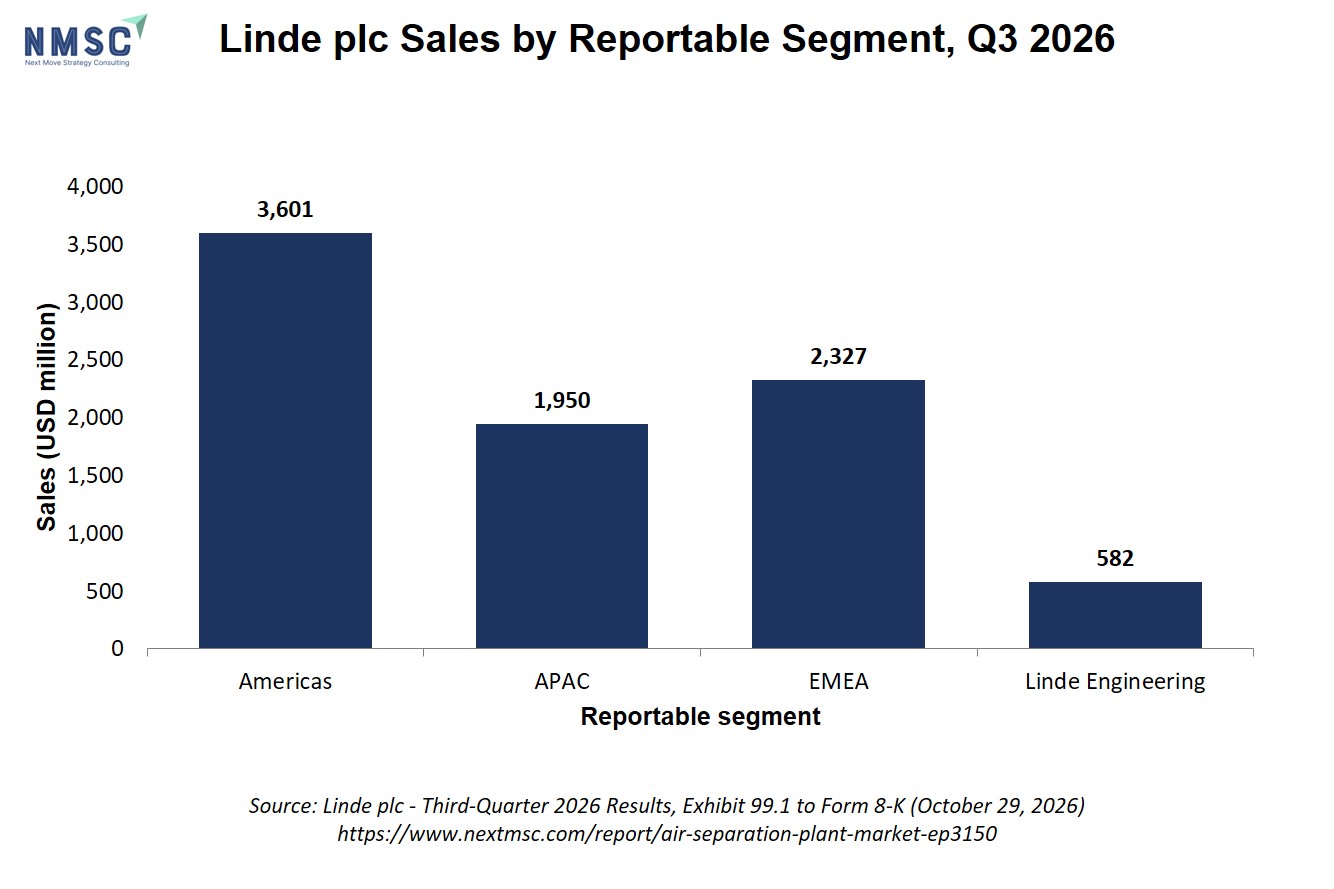
Linde plc's third-quarter 2026 earnings release reports sales of USD 3,601 million in the Americas, USD 1,950 million in APAC, USD 2,327 million in EMEA and USD 582 million at Linde Engineering. Linde Engineering also reported order intake of USD 499 million for the quarter.
Air Liquide and Air Products: Pipelines Extend From Fabs to Terminals and Regional Grids
Air Liquide's third-quarter 2026 release, published on October 29, 2026, points in the same direction. Revenue reached EUR 7,259 million, up 3.0% on a comparable basis. Investment decisions of EUR 1.25 billion in the quarter took the nine-month total above EUR 4.1 billion, and the company stated that its investments in electronics had almost doubled in nine months compared with the whole of 2025. The release also records an investment of more than USD 170 million to build, own and operate two industrial gas production units for SK hynix's first United States site, in Indiana. gasworld reported on the results that electronics sales rose 12%, that Air Liquide's investment backlog had reached a record EUR 6.2 billion, and that its BEYOND plan, unveiled on October 5, 2026, targets around EUR 24 billion of industrial investment decisions through 2030.
Two further commitments announced in October 2026 show the range of end uses behind new capacity. On October 8, 2026, Air Liquide announced a new air separation unit at its existing Fairfield facility in Yennora, New South Wales, to produce nitrogen and oxygen for food and beverage processing, healthcare, mining and advanced manufacturing, with start-up expected in 2028. In the same month, Air Products announced that it had concluded the definitive agreement to design, build and operate Malaysia's first LNG-based air separation unit at the Pengerang regasification terminal in Johor, for a joint venture led by PETRONAS Gas Berhad together with DIALOG Group Berhad. The unit is planned to produce more than 600 tonnes per day of liquid oxygen, nitrogen and argon.
These announcements reflect different project ownership and operating arrangements rather than a single financing model. In Phoenix, Linde will build, own and operate two new air separation units alongside its existing facilities to supply a semiconductor manufacturer's expansion. At Pengerang, Malaysia, Air Products has entered into a definitive agreement with PG Cold Energy 1 Sdn. Bhd., a joint venture led by PETRONAS Gas Berhad and DIALOG Group Berhad, under which Air Products will design, build and operate an LNG-based air separation unit at the Pengerang regasification terminal. In New South Wales, Air Liquide will invest in, build and operate a new unit at its existing Fairfield facility in Yennora to strengthen regional supplies of industrial and medical gases. For plant builders and component suppliers, these projects signal demand linked to industrial gas suppliers' investment programmes, semiconductor expansion and regional infrastructure requirements, although their commercial and ownership structures differ.
Steel Remains the Largest Oxygen Consumer, but Its Volume Is Flat
The traditional anchor of oxygen demand is not growing. The World Steel Association reported on October 23, 2026 that crude steel output across its 70 reporting countries was 142.4 million tonnes in September 2026, 0.2% lower than a year earlier, and that output for January to September fell 0.7% to 1,367.5 million tonnes. The OECD Steel Outlook 2026, published in June 2026, found that global steelmaking capacity had risen for a fifth consecutive year to a record 2,445 million tonnes in 2025 while steel demand contracted for a fourth consecutive year, and it projected that excess capacity would keep growing through 2028.
The route by which steel is made matters as much as the volume. Oxygen steelmaking supplies most of the world's output and is concentrated in the largest producing economies, which limits growth in bulk oxygen offtake from the sector in a flat year. The OECD adds that, of 138.8 million tonnes of capacity underway or planned for completion over the next three years, 46% is basic oxygen furnace capacity and 51% is electric arc furnace capacity, so new steel capacity is arriving in both routes.
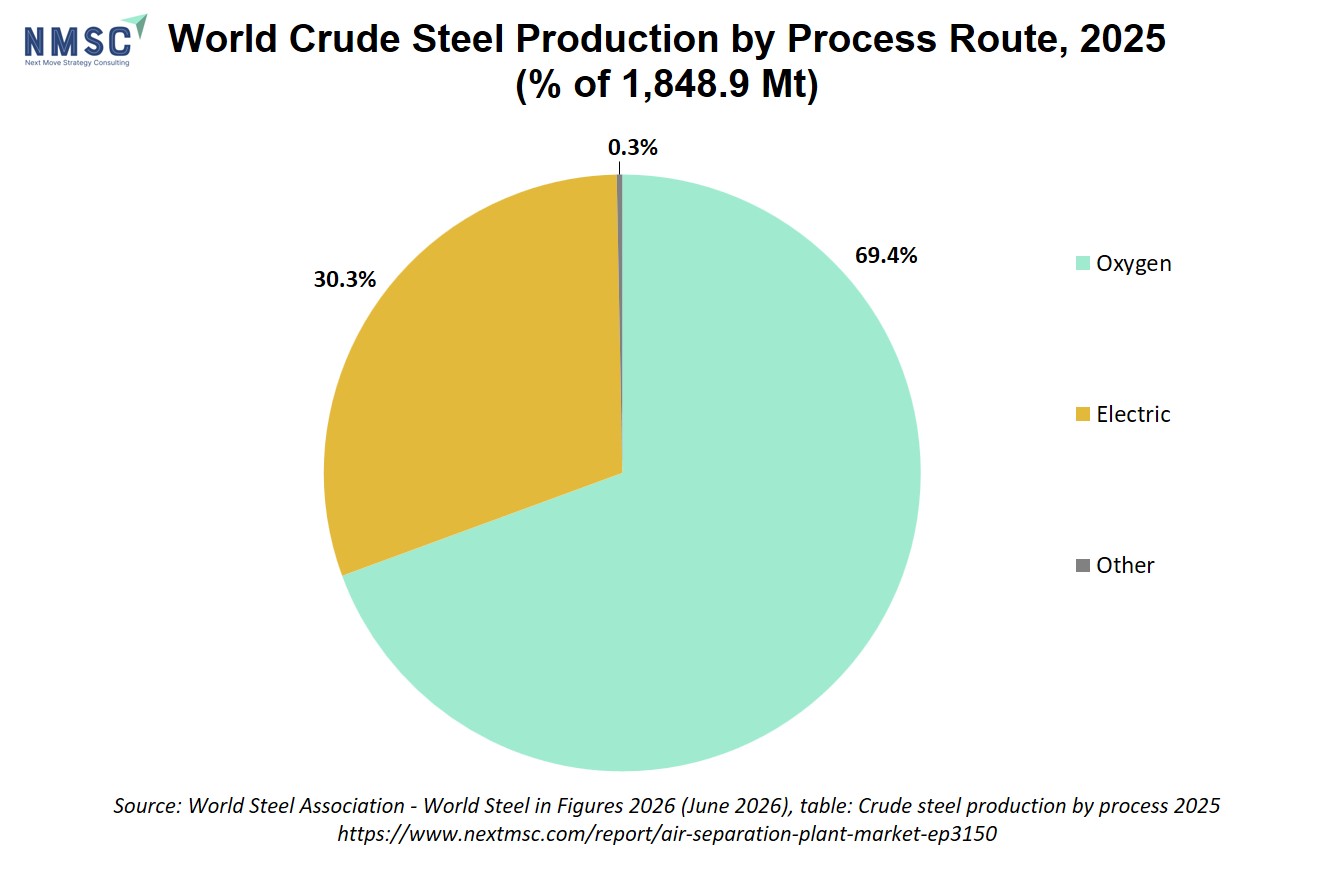
World Steel in Figures 2026 reports that of 1,848.9 million tonnes of crude steel produced worldwide in 2025, 69.4% came from the oxygen route, 30.3% from electric furnaces and 0.3% from other processes. The same publication records that the oxygen route supplied 89.4% of China's output and 42.3% of India's, while electric furnaces supplied 71.3% of United States output.
NMSC Strategic Perspective: Contract-Backed Purity Demand Is Becoming the Marginal Driver
NextMSC primary research and analysis continues to identify iron and steel, oil and gas, and environmental compliance as structural drivers of the air separation plant market, and the 2026 evidence does not overturn that view. It does change the weighting between them. Steel output is flat, whereas semiconductor fabrication, healthcare supply security and regional merchant networks are generating the commitments that are being announced and funded in 2026.
NextMSC's forecast of USD 6.04 billion in 2024 rising to USD 7.89 billion in 2030 implies an addition of USD 1.85 billion in annual market value over the period. A single Linde commitment of USD 1 billion in Phoenix is of the same order of magnitude. The two figures are not like-for-like, because the Linde figure covers units and associated infrastructure across a multi-year build programme, whereas NextMSC's figures are annual market values. The comparison nonetheless shows how a small number of large programmes can move the market's trajectory in any given year.
The regional signal is consistent with NextMSC's research, which identifies Asia-Pacific as the largest regional market and North America as the fastest-growing region. Linde's APAC and Americas segments grew sales by 12% and 11% in the third quarter, against 7% in EMEA. Air Liquide reported revenue growth of 6.2% in its Americas gas and services business and a decline of 0.5% in EMEA.
The principal caution in NextMSC's analysis is concentration. Fab-linked demand depends on semiconductor capital spending, and Air Liquide's Americas figures show how quickly equipment-related revenue can swing: electronics revenue in that region fell 4.8% in the quarter because of a sharp decline in equipment and installations sales. Supplier backlogs therefore smooth gas volumes more reliably than they smooth plant deliveries.
Section Summary:
The core shift is a change in the source of incremental demand. Linde plc, Air Liquide and Air Products committed capital in 2026 mainly against semiconductor, regional merchant and LNG-linked requirements, while World Steel Association and OECD data show steel volumes flat.
-
Linde plc committed USD 1 billion in Phoenix and, through Linde LienHwa, about USD 800 million in Taiwan for fab-linked gas supply.
-
Air Liquide's electronics investments in the first nine months of 2026 almost doubled its 2025 full-year total.
-
Steel output fell 0.7% in January to September 2026, so steel supplies volume rather than incremental growth.
Industry Impact Analysis: Capital, Contracts and Capacity Across the Air Separation Plant Market
The high initial investment that NextMSC identifies as the principal restraint on the air separation plant market has not slowed announcements, but it has shaped who makes them. The commitments of 2026 come from the largest gas suppliers, which can fund programmes of USD 1 billion from operating cash flow: Linde's third-quarter operating cash flow was USD 3,169 million, and after capital expenditure of USD 1,392 million, free cash flow was USD 1,777 million. Smaller operators and new entrants face the capital barrier that NextMSC's research describes. In NextMSC's assessment, this concentrates plant ownership among a few suppliers and moves independent players toward equipment, services and regional merchant niches.
Contract structure is the second effect. Linde's USD 7.9 billion of contractual sale-of-gas backlog, which it cites in support of its capital expenditure guidance, means that a large part of new capacity is committed before it is built. For equipment suppliers and engineering contractors, order timing follows the supplier's capital plan, which Air Liquide has set out through 2030 in its BEYOND programme, and should be less exposed to short-term fluctuations in steel or chemical output than merchant demand would be.
Third, regional supply security is becoming an explicit rationale. Air Liquide presents its Fairfield project as a way to improve the reliability of industrial and medical gas supply across Australia. Its third-quarter release attributes strong demand in Large Industries to customers connected to pipeline networks on the United States Gulf Coast, while it records EMEA revenue down 0.5%. Capacity is therefore being added where utilisation is high and supply chains are tight, not uniformly across regions.
Fourth, energy and emissions performance is entering plant design. Air Products describes the Pengerang unit as supporting lower-emission industrial development in Malaysia, and the unit's siting at an LNG regasification terminal indicates that energy integration is a design consideration. NextMSC's research identifies the integration of carbon capture systems with air separation as a longer-term opportunity, and the Pengerang project is the type of energy-integrated design on which such applications would build.
For investors, the combined evidence supports a view that earnings visibility in this industry increasingly comes from contract backlogs. Linde guided full-year 2026 adjusted earnings per share to USD 17.82 to USD 17.92, up 8% to 9%, while Air Liquide reaffirmed its 2026 outlook and, as gasworld reported, cautioned that conditions remained volatile.
Section Summary:
The industry impact of the 2026 commitments is a concentration of plant ownership, a longer contractual horizon for plant orders and an uneven regional pattern of capacity additions.
-
Capital intensity favours suppliers able to fund USD 1 billion programmes from operating cash flow.
-
Contracted backlog, including Linde's USD 7.9 billion of sale-of-gas business, sets the timing of plant orders.
-
Capacity is added where demand is firm, such as the United States Gulf Coast, Asia-Pacific fabs and Australia, while EMEA revenue softened.
Pros and Cons of Recent Market Developments in the Air Separation Plant Market
The table below weighs the developments described above from the perspective of a supplier or investor in air separation plants.
|
Pros |
Cons |
|
Long-term, contract-backed demand from semiconductor customers |
Dependence on semiconductor capital spending, which can delay equipment deliveries |
|
Linde's USD 7.9 billion sale-of-gas backlog gives multi-year visibility |
High capital cost concentrates ownership and limits new entrants |
|
Regional additions improve supply reliability for medical and industrial gases |
Air Liquide's EMEA revenue fell 0.5% in the third quarter |
|
Energy-integrated designs such as the LNG-based Pengerang unit support lower-emission supply |
Flat steel output limits growth in bulk oxygen demand |
Key Data & Statistics Behind the Air Separation Plant Market in 2026
The two tables below consolidate the primary disclosures used in this analysis. Table figures are reported by the named companies and are not NextMSC estimates; NextMSC's own market size and forecast appear in the introduction and in the outlook section.
Recent air separation unit commitments, August to October 2026
|
Company |
Location |
Commitment |
Date |
|
Linde plc |
Phoenix, Arizona |
USD 1 billion; two new SPECTRA units beside three existing units |
July 31, 2026 |
|
Linde LienHwa |
Taiwan |
About USD 800 million for air separation and hydrogen units |
July 31, 2026 |
|
Air Products |
Pengerang, Johor |
LNG-based unit; more than 600 tonnes per day |
Oct 2026 |
|
Air Liquide |
Yennora, New South Wales |
New unit for nitrogen and oxygen; start-up 2028 |
Oct 8, 2026 |
Third-quarter 2026 indicators from Linde plc and Air Liquide
|
Indicator |
Linde plc |
Air Liquide |
|
Sales or revenue |
USD 9,404 million |
EUR 7,259 million |
|
Reported growth |
9% |
10.0% |
|
Underlying or comparable growth |
5% |
3.0% |
|
Project pipeline (company definition) |
USD 11 billion |
EUR 6.2 billion |
Future Outlook & Forecast: Where the Air Separation Plant Market Goes From Here
NextMSC's research projects the air separation plant market to expand from USD 6.04 billion in 2024 to USD 7.89 billion in 2030, a CAGR of 4.6% over 2025 to 2030. For context, Linde reported underlying sales growth of 5% and Air Liquide reported comparable revenue growth of 3.0% in the third quarter of 2026. These are company-wide gas sales, not plant-market values, so they are not like-for-like, but they sit in the same range as NextMSC's CAGR and indicate that the forecast does not depend on an unusual acceleration.
Three developments will determine whether the market tracks the forecast. The first is the conversion of backlog into operating plants. Linde's project backlog of USD 11 billion and Air Liquide's EUR 6.2 billion investment backlog, as reported by gasworld, represent decided programmes that must now be engineered, built and commissioned, with start-up dates running into 2028 for projects such as Air Liquide's Fairfield unit.
The second is semiconductor capital spending. Linde and Air Liquide both cite electronics as the leading source of new proposals and investments, so a slowdown in fab construction would be expected to affect the plant pipeline. The third is the pace of energy integration. NextMSC's research identifies the integration of carbon capture systems with air separation as the principal future opportunity, and the LNG-linked Pengerang unit provides an early reference for energy-integrated plant design.
Steel is the swing factor in the other direction. The OECD projects that excess steelmaking capacity will keep growing through 2028 amid sluggish demand growth, which argues for caution on new bulk oxygen demand from the sector. A cyclical recovery in steel would be an upside to the outlook that the 2026 evidence does not yet support.
Section Summary:
NextMSC's forecast of USD 7.89 billion by 2030 rests on a market whose incremental demand is increasingly contract-backed and fab-linked, with steel a source of volume rather than growth.
-
NextMSC projects the market to reach USD 7.89 billion by 2030 at a 4.6% CAGR.
-
Backlog conversion, fab capital spending and energy integration are the three variables to monitor.
-
A steel recovery is an upside that 2026 data does not yet show.
Next Steps for Stakeholders
The actions below follow from the evidence above and are framed for executives and investors.
-
Equipment manufacturers and engineering contractors: align capacity planning with the capital programmes of the large gas suppliers, using the backlog disclosures of Linde plc and Air Liquide as lead indicators of order timing.
-
Gas suppliers: prioritise purity, redundancy and energy-integrated design in bids for fab-linked supply, since these attributes define the Phoenix and Pengerang commitments.
-
Investors: track backlog conversion and electronics proposal activity in quarterly filings, alongside steel output, which fell 0.7% in January to September 2026.
-
Steel and chemical producers: evaluate long-term on-site supply and energy integration with gas suppliers as capacity decisions are made, using the oxygen and electric route mix as the starting point.
-
Industrial buyers in Asia-Pacific and North America: secure supply reliability through regional capacity commitments of the type announced at Fairfield, in preference to relying on spot merchant supply.
Conclusion
The air separation plant market, valued by NextMSC at USD 6.04 billion in 2024 and projected to reach USD 7.89 billion by 2030, is being shaped in 2026 less by steel output than by contract-backed commitments for semiconductor fabs, regional supply networks and energy-integrated plants. Linde plc's USD 1 billion Phoenix expansion, Air Liquide's record investment programme and the Air Products unit in Pengerang show where capital is being deployed, while World Steel Association and OECD data show that steel volumes are flat. Stakeholders who track backlog conversion and fab spending, and who treat steel as a source of volume rather than growth, will be best placed to interpret the NextMSC forecast over 2025 to 2030.
About the Author
 Priyanshu Das
— Priyanshu Das is SEO Executive at Next Move Strategy Consulting, where he has led on-page and off-page SEO, keyword research, and SEO audits for the firm's B2B market research publications for 2 years. His audit process combines technical crawl analysis, backlink profile review, and competitor keyword gap mapping — using tools including Screaming Frog and Google Search Console — to prioritize fixes by organic search-visibility impact, informed by his own prior in-house and agency SEO experience.
About the Reviewer
 Sanyukta Deb
— Sanyukta Deb is Digital Marketing Team Lead at Next Move Strategy Consulting, where she has led content strategy and technical SEO for the firm's B2B market research publications for over 2 years. Her editorial process translates NextMSC's primary and secondary research — spanning technology, industrial, and consumer sectors — into commercial narratives, backed by search-intent, keyword, and competitive analysis. She brings 5 years of overall experience in digital marketing and content strategy.












Add Comment