Antimicrobial Furniture Market: Trends & Forecasts for 2026
Introduction
The global antimicrobial furniture market stands at a critical inflection point. As healthcare systems worldwide intensify their response to drug-resistant pathogens, the built environment — including the furniture within hospitals, schools, corporate offices, and public spaces — has emerged as a frontline defense against microbial transmission. The antimicrobial furniture market, valued at USD 4.07 billion in 2023, is no longer a niche segment of the broader furnishings industry; it is a strategic imperative for facility managers, procurement officers, and institutional investors operating in hygiene-sensitive environments.
The convergence of escalating antimicrobial resistance (AMR) threats, tightening infection control regulations, and rapid material science innovation is reshaping procurement decisions across sectors. In May 2026, the World Health Assembly formally adopted the updated Global Action Plan on Antimicrobial Resistance (GAP-AMR) 2026–2036, signaling an unprecedented global commitment to reducing drug-resistant infections — a development with direct and measurable implications for the antimicrobial furniture market. For C-level executives, institutional procurement teams, and investors, understanding the forces driving this market is no longer optional — it is foundational to sound strategic planning.
WHO's 2026 AMR Action Plan and the Surge in Antimicrobial Furniture Demand
A Globally Impactful Regulatory Catalyst
On May 25, 2026, the World Health Assembly adopted the updated Global Action Plan on Antimicrobial Resistance (GAP-AMR) 2026–2036, marking the most comprehensive multilateral commitment to combating drug-resistant pathogens in over a decade. The plan explicitly targets a 10% reduction in bacterial AMR-associated deaths in humans by 2030 and calls for intensified infection prevention across all sectors — including healthcare facilities, long-term care environments, and public institutions.
The urgency behind this action plan is grounded in alarming epidemiological data. According to the WHO, bacterial AMR was associated with more than 4.7 million deaths globally in 2021. Approximately 1 in 6 laboratory-confirmed bacterial infections worldwide were resistant to antibiotics in 2023, and between 2018 and 2023, antibiotic resistance rose in over 40% of the pathogen-antibiotic combinations monitored, with an average annual increase of 5–15%. The total cost of treating resistant bacterial infections alone is projected to reach USD 412 billion annually by 2035, with additional productivity losses of USD 443 billion per year.
These figures are not abstract public health statistics — they translate directly into procurement mandates. Healthcare administrators and facility planners are under mounting institutional pressure to reduce environmental pathogen loads, and antimicrobial furniture represents one of the most scalable, passive, and cost-effective interventions available. Furniture surfaces — including bed rails, seating, tables, and storage units — are recognized vectors for microbial transmission in clinical and institutional settings. The CDC's 2024 National and State Healthcare-Associated Infections (HAI) Progress Report, released on July 15, 2026, confirms that approximately 1 in 38 U.S. patients contracts at least one infection in association with their healthcare on any given day, underscoring the persistent burden of HAIs despite significant progress.
NMSC Strategic Perspective: Translating AMR Policy Into Market Opportunity
From Next Move Strategy Consulting's analytical standpoint, the adoption of the GAP-AMR 2026–2036 represents a structural demand catalyst for the antimicrobial furniture market — not a cyclical uptick. The plan's sixth strategic objective explicitly calls for "strengthening multisectoral governance and sustainable financing" for AMR response, which will channel institutional capital toward infection-resistant built environments across healthcare, education, and hospitality sectors.
For More Information – Download FREE Sample on Antimicrobial Furniture Market Report
NMSC's analysis indicates that the healthcare and medical end-user segment will continue to command the largest share of the antimicrobial furniture market through 2030, driven by regulatory compliance requirements, hospital accreditation standards, and the growing adoption of infection control frameworks in long-term care facilities. The October 2025 release of the Multisociety Guidance for Infection Prevention and Control in Nursing Homes — developed by SHEA, APIC, IDSA, PALTmed, and AGS — further reinforces this trajectory by recommending infection prevention input on environmental systems, including cleaning practices and surface materials, as a standard of care in nursing home operations.
Beyond healthcare, NMSC identifies the corporate and educational segments as high-growth adjacencies. The post-pandemic normalization of hybrid work has prompted facility managers to reassess the hygiene standards of shared workspaces, while educational institutions face increasing scrutiny over student health environments. These converging demand vectors position the antimicrobial furniture market for sustained, broad-based expansion through the forecast period.
Section Summary: The WHO's adoption of the GAP-AMR 2026–2036 and the CDC's ongoing HAI surveillance data collectively establish a compelling, policy-driven demand environment for the antimicrobial furniture market. The market's growth is no longer solely reactive to pandemic-era hygiene awareness — it is being institutionalized through global regulatory frameworks and multisociety clinical guidance.
Key Takeaways:
-
The WHO GAP-AMR 2026–2036, adopted May 25, 2026, mandates intensified infection prevention across all institutional sectors, directly elevating demand for antimicrobial surfaces.
-
Bacterial AMR is associated with over 4.7 million deaths globally (2021), with treatment costs projected to reach USD 412 billion annually by 2035.
-
Approximately 1 in 38 U.S. hospital patients contracts an HAI daily, sustaining procurement pressure for antimicrobial furniture solutions.
-
NMSC identifies healthcare as the dominant end-user segment, with corporate and educational sectors emerging as high-growth adjacencies.
Industry Impact Analysis
Infection Control Mandates Reshape Procurement Standards
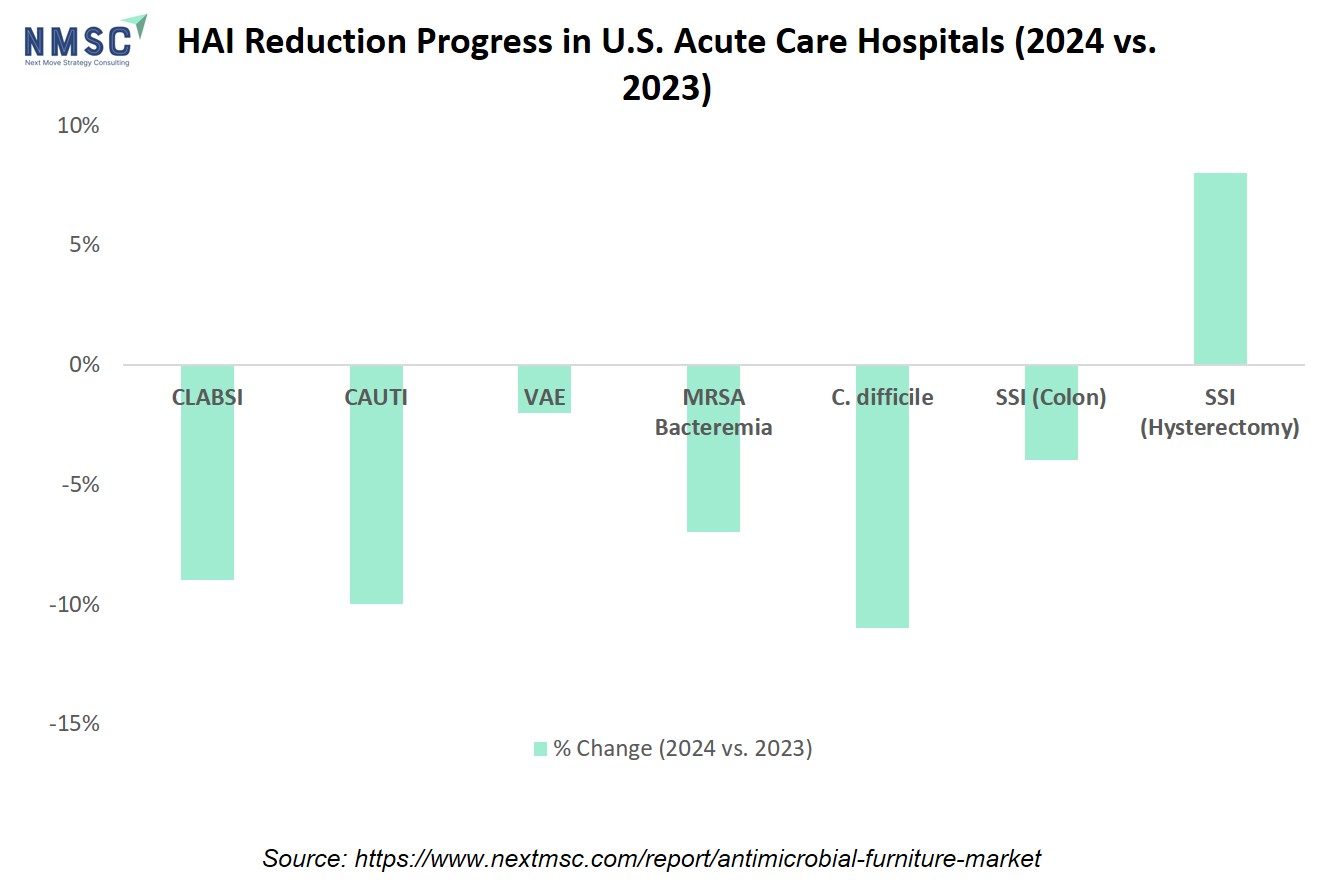
The regulatory and clinical guidance landscape governing infection control has undergone a material shift in 2025–2026, with direct consequences for furniture procurement across institutional sectors. The CDC's 2024 HAI Progress Report documents meaningful reductions in several key infection categories — including an 11% decrease in hospital-onset C. difficile infections and a 7% decrease in MRSA bacteremia — yet the persistence of HAIs at scale confirms that environmental interventions, including antimicrobial furniture, remain essential components of comprehensive infection prevention strategies.
The U.S. Food and Drug Administration's Quality Management System Regulation (QMSR), which became effective on February 2, 2026, incorporates updated standards for medical device environments that indirectly influence the specification of furniture and surface materials in clinical settings. Simultaneously, the American Home Furnishings Alliance (AHFA) 2026 Regulatory Summit has placed the U.S. Environmental Protection Agency's (EPA) risk assessment for formaldehyde at the top of the industry agenda, signaling a broader regulatory tightening of material standards in the furniture sector that will accelerate the transition toward certified antimicrobial and low-emission products.
Material Innovation Drives Competitive Differentiation
The antimicrobial furniture market is segmented by surface material into copper, silver, titanium, and other categories, each offering distinct performance profiles. Silver ion technology has emerged as a leading innovation vector, with manufacturers such as BioCote reporting up to a 96% reduction in bacterial presence on treated surfaces. Copper-infused materials are gaining renewed traction, supported by a growing body of peer-reviewed research published in 2025 documenting the metal's efficacy against drug-resistant Gram-negative bacteria — precisely the pathogen class identified by the WHO as posing the greatest global burden.
Nanotechnology represents the most transformative frontier in antimicrobial furniture manufacturing. By embedding nano-scale antimicrobial agents within substrate materials — rather than applying surface coatings that degrade over time — manufacturers can deliver durable, long-lasting protection that maintains aesthetic integrity. This innovation directly addresses one of the market's primary restraints: the higher upfront cost of antimicrobial furniture relative to conventional alternatives. As nanotechnology-enabled production scales, cost parity with standard furniture is expected to improve, broadening the addressable market beyond premium healthcare and institutional buyers.
Regional Dynamics: North America Leads, Asia-Pacific Accelerates
North America maintains the dominant share of the global antimicrobial furniture market, underpinned by the region's substantial healthcare infrastructure investment, stringent regulatory environment, and high consumer awareness of hygiene standards. The U.S. Department of Agriculture's (USDA) commitment of USD 110 million in grants for improving healthcare facilities in rural areas further stimulates demand for antimicrobial furniture solutions in underserved healthcare settings.
Asia-Pacific is positioned for the most dynamic growth trajectory over the forecast period. According to UN-Habitat, the urban population in Asia is projected to grow by 50%, adding approximately 1.2 billion people by 2050 — a demographic shift that will generate substantial demand for institutional and residential furniture across healthcare, hospitality, and educational sectors. Investment in Asia-Pacific hotel assets reached USD 10.1 billion year-to-date as of August 2022, reflecting the region's expanding hospitality sector and its growing appetite for hygiene-compliant furnishings.
Key Takeaways:
-
The FDA QMSR (effective February 2, 2026) and EPA formaldehyde risk assessments are tightening material standards across clinical and institutional furniture categories.
-
Silver ion technology achieves up to 96% bacterial reduction on treated surfaces, while copper-infused materials are gaining clinical validation against drug-resistant Gram-negative pathogens.
-
North America holds the dominant regional market share, supported by USDA rural healthcare infrastructure grants.
-
Asia-Pacific urbanization — projected to add 1.2 billion urban residents by 2050 — represents the market's most significant long-term growth opportunity.
Key Data & Statistics
CDC 2024 HAI Progress Report — Key Infection Reduction Metrics in U.S. Acute Care Hospitals
|
HAI Type |
2024 Change vs. 2023 |
States Performing Better Than 2015 Baseline |
|
Central Line-Associated Bloodstream Infections (CLABSI) |
−9% |
46 states |
|
Catheter-Associated Urinary Tract Infections (CAUTI) |
−10% |
46 states |
|
Ventilator-Associated Events (VAE) |
−2% |
11 states |
|
Hospital-Onset MRSA Bacteremia |
−7% |
42 states |
|
Hospital-Onset C. difficile Infections |
−11% |
51 states |
|
Colon Surgery Surgical Site Infections (SSI) |
−4% |
21 states |
Future Outlook & Forecast
Market Trajectory: From USD 4.07 Billion to USD 6.94 Billion by 2030
According to Next Move Strategy Consulting's proprietary research, the global antimicrobial furniture market was valued at USD 4.07 billion in 2023 and is projected to reach USD 6.94 billion by 2030, expanding at a CAGR of 7.9% from 2024 to 2030. This growth trajectory reflects the compounding effect of regulatory tailwinds, material innovation, and expanding end-user adoption across healthcare, education, corporate, and hospitality sectors.
The healthcare and medical end-user segment will remain the primary revenue contributor through the forecast period, driven by the institutionalization of infection control standards under frameworks such as the WHO GAP-AMR 2026–2036 and the CMS Quality Reporting Programs that mandate HAI surveillance and prevention across U.S. healthcare facilities.
Nanotechnology and Smart Surfaces: The Next Competitive Frontier
The integration of nanotechnology into antimicrobial furniture manufacturing is expected to be the single most transformative development over the forecast horizon. Manufacturers are investing in nano-scale silver, copper, and zinc oxide particles that can be embedded directly into substrate materials — including polymers, textiles, and laminates — delivering persistent antimicrobial efficacy without compromising surface aesthetics or structural integrity. This technological evolution will progressively reduce the cost premium associated with antimicrobial furniture, expanding the addressable market to price-sensitive segments including household consumers and small-to-medium educational institutions.
Emerging trends also include the integration of smart antimicrobial surfaces with IoT-enabled monitoring capabilities, allowing facility managers to track surface hygiene compliance in real time. While still nascent, this convergence of antimicrobial materials science and digital facility management represents a significant value-creation opportunity for manufacturers and technology partners operating in the space.
Competitive Landscape: Key Players and Strategic Moves
The competitive landscape of the antimicrobial furniture market includes Ashley Furniture Industries, Godrej & Boyce Mfg, Herman Miller Inc., HNI Corporation, Hille Furniture, The Home Depot Inc., Inter IKEA Group, Action TESA, Kohler Co., and La-Z-Boy Inc. These players are pursuing product launches, omnichannel expansion, and material innovation as primary growth strategies. Notably, IKEA's announced investment of approximately USD 2.2 billion in its U.S. omnichannel growth strategy underscores the scale of capital being deployed in the broader furniture market, with antimicrobial product lines representing a growing component of institutional and commercial offerings.
Hille Furniture's launch of SteriTouch — a silver-ion antimicrobial additive integrated into its furniture production — exemplifies the product innovation strategies being deployed across the public sector, education, and healthcare verticals. As regulatory requirements tighten and institutional buyers become more sophisticated in their procurement criteria, differentiation through certified antimicrobial performance will become a baseline competitive requirement rather than a premium feature.
Section Summary: The antimicrobial furniture market is on a well-supported growth trajectory toward USD 6.94 billion by 2030, underpinned by regulatory mandates, nanotechnology innovation, and expanding end-user adoption. The competitive landscape is intensifying, with material science and smart surface integration emerging as the primary axes of differentiation.
Key Takeaways:
-
The global antimicrobial furniture market is projected to grow from USD 4.07 billion (2023) to USD 6.94 billion (2030) at a CAGR of 7.9%, per NMSC.
-
Nanotechnology-enabled antimicrobial treatments will progressively reduce cost premiums, broadening market accessibility.
-
Smart antimicrobial surfaces integrated with IoT monitoring represent an emerging, high-value product category.
-
Certified antimicrobial performance is transitioning from a premium differentiator to a baseline procurement requirement in healthcare and institutional settings.
Next Steps for Stakeholders
For Healthcare Facility Administrators and Procurement Officers:
Align furniture procurement specifications with the infection prevention input requirements outlined in the SHEA/APIC Multisociety Guidance for Nursing Homes (October 2025) and the CDC's HAI prevention frameworks. Prioritize suppliers offering independently certified antimicrobial performance data — particularly for high-touch surfaces in patient care areas, waiting rooms, and rehabilitation facilities. Evaluate the total cost of ownership, including reduced infection-related costs, when comparing antimicrobial furniture against conventional alternatives.
For Institutional Investors and Private Equity:
The antimicrobial furniture market's 7.9% CAGR through 2030, combined with the structural demand catalysts of the WHO GAP-AMR 2026–2036 and tightening regulatory standards, presents a compelling investment thesis. Focus on manufacturers with proprietary material science capabilities — particularly in nanotechnology and silver ion integration — and those with established distribution channels in North America and Asia-Pacific. The healthcare and long-term care segments offer the most defensible revenue streams given their regulatory-driven procurement mandates.
For Furniture Manufacturers and Material Suppliers:
Accelerate R&D investment in nanotechnology-based antimicrobial treatments that deliver durable performance without surface degradation. Pursue third-party certification of antimicrobial efficacy to meet the increasingly rigorous procurement criteria of institutional buyers. Develop Asia-Pacific market entry strategies that account for the region's rapid urbanization, expanding hospitality sector, and growing healthcare infrastructure investment. Explore partnerships with IoT and digital facility management platforms to develop next-generation smart antimicrobial surface solutions.
For Corporate Real Estate and Facilities Management:
The post-pandemic normalization of hybrid work has created a sustained demand for hygiene-compliant shared workspaces. Incorporate antimicrobial furniture specifications into workplace design standards, particularly for high-traffic areas such as conference rooms, reception areas, and collaborative workspaces. Leverage the growing body of clinical evidence supporting antimicrobial surface efficacy to build the business case for capital expenditure approval.
Conclusion
The antimicrobial furniture market is at the convergence of three powerful forces: an escalating global AMR crisis, a tightening regulatory environment, and rapid material science innovation. The WHO's adoption of the GAP-AMR 2026–2036 in May 2026 has elevated infection prevention from a facility-level operational concern to a global policy priority, with direct implications for how institutions specify, procure, and manage their built environments. The CDC's 2024 HAI data confirms that while meaningful progress has been made in reducing healthcare-associated infections, the burden remains substantial — and environmental interventions, including antimicrobial furniture, are an indispensable component of comprehensive infection control strategies.
According to Next Move Strategy Consulting, the global antimicrobial furniture market is projected to grow to USD 6.94 billion by 2030 at a CAGR of 7.9%, driven by healthcare sector demand, regulatory compliance requirements, and expanding adoption across corporate, educational, and hospitality verticals. For C-level executives, institutional investors, and procurement decision-makers, the strategic imperative is clear: antimicrobial furniture is no longer a discretionary upgrade — it is a foundational element of responsible facility management in an era of rising antimicrobial resistance.
About the Author
 Sanyukta Deb
— Sanyukta Deb is Digital Marketing Team Lead at Next Move Strategy Consulting, where she has led content strategy and technical SEO for the firm's B2B market research publications for over 2 years. Her editorial process translates NextMSC's primary and secondary research — spanning technology, industrial, and consumer sectors — into commercial narratives, backed by search-intent, keyword, and competitive analysis. She brings 5 years of overall experience in digital marketing and content strategy.
Sanyukta Deb
— Sanyukta Deb is Digital Marketing Team Lead at Next Move Strategy Consulting, where she has led content strategy and technical SEO for the firm's B2B market research publications for over 2 years. Her editorial process translates NextMSC's primary and secondary research — spanning technology, industrial, and consumer sectors — into commercial narratives, backed by search-intent, keyword, and competitive analysis. She brings 5 years of overall experience in digital marketing and content strategy.
About the Reviewer
 Debashree Dey
— Debashree Dey is Assistant Manager at Next Move Strategy Consulting, where she supports cross-vertical market content and communications across diverse industries for 6 years. Her professional background includes senior content writing, communications, and published manuscript authorship, with experience developing audience-focused business narratives and maintaining clear, consistent messaging. Her role supports research-led content development and editorial quality across NextMSC publications.
Debashree Dey
— Debashree Dey is Assistant Manager at Next Move Strategy Consulting, where she supports cross-vertical market content and communications across diverse industries for 6 years. Her professional background includes senior content writing, communications, and published manuscript authorship, with experience developing audience-focused business narratives and maintaining clear, consistent messaging. Her role supports research-led content development and editorial quality across NextMSC publications.
















Add Comment